Theoretical consistency and phenomenology of supercooled cosmological phase transitions
Pith reviewed 2026-06-26 13:51 UTC · model grok-4.3
The pith
The SU(2)cSM produces a supercooled phase transition whose gravitational waves are detectable by LISA throughout its parameter space.
A machine-rendered reading of the paper's core claim, the machinery that carries it, and where it could break.
Core claim
The supercooled first-order phase transition in the SU(2)cSM, analyzed for the first time with high-temperature dimensional reduction in a classically scale-invariant model, produces a consistent three-dimensional effective field theory; explicit evaluation of fluctuation determinants then yields the NLO nucleation rate, from which phase transition parameters and gravitational wave spectra are derived that remain detectable by LISA throughout the considered parameter space.
What carries the argument
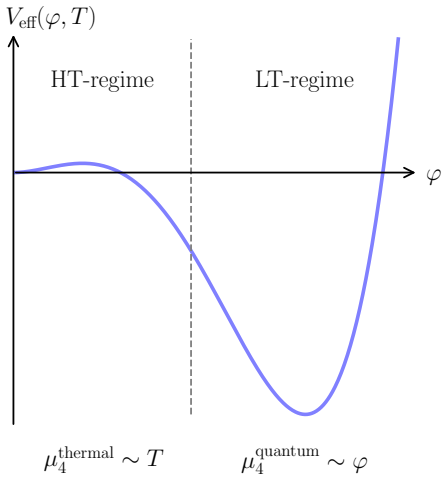
High-temperature dimensional reduction to a three-dimensional effective field theory for the SU(2)cSM, combined with explicit computation of fluctuation determinants to obtain the NLO thermal bubble nucleation rate.
If this is right
- The SU(2)cSM becomes experimentally testable through LISA gravitational wave observations.
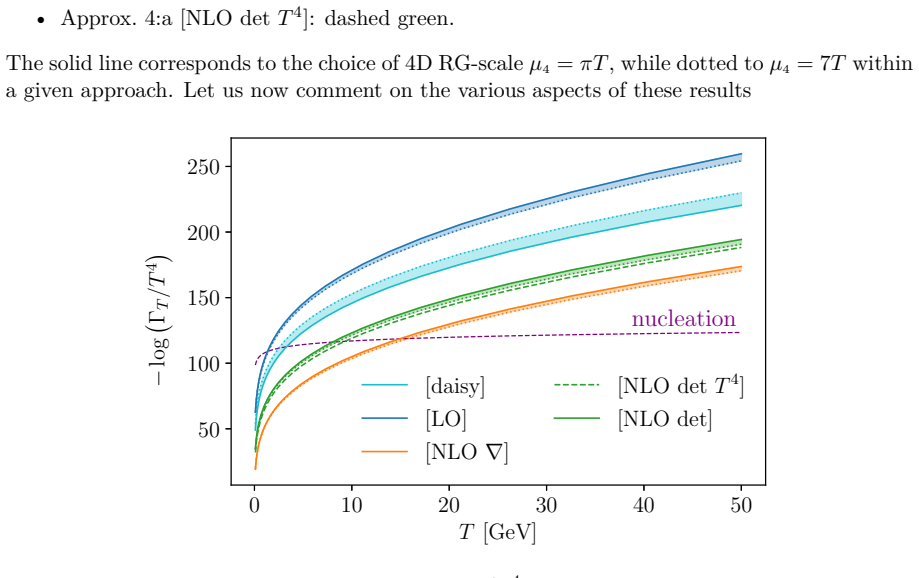
- Higher-order corrections must be included because they change both phase transition parameters and gravitational wave predictions.
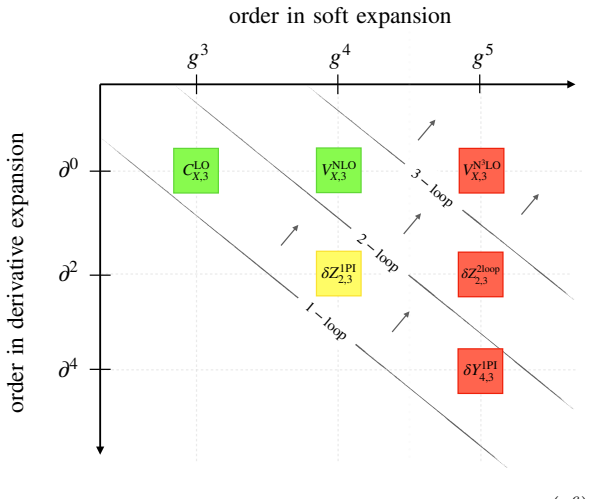
- A consistent power-counting scheme exists for applying dimensional reduction to this scale-invariant model in the supercooled regime.
- The model exhibits radiative symmetry breaking that naturally leads to a supercooled transition.
Where Pith is reading between the lines
- The same dimensional-reduction approach could be applied to other classically scale-invariant extensions to check whether they also produce LISA-detectable signals.
- If the power-counting scheme holds, the method supplies a template for estimating when supercooling occurs in similar models without full four-dimensional calculations.
- The demonstrated sensitivity to higher-order terms implies that future gravitational wave data analysis will require comparable NLO treatments to extract model parameters reliably.
Load-bearing premise
The high-temperature dimensional reduction and associated power-counting scheme remain valid for the classically scale-invariant SU(2)cSM when applied to the supercooled regime.
What would settle it
A lattice simulation or direct four-dimensional calculation that shows the three-dimensional effective theory deviates substantially from the true nucleation rate in the supercooled limit, or LISA observations that place an upper limit on gravitational wave amplitude below the predicted signal in the relevant frequency band.
Figures

read the original abstract
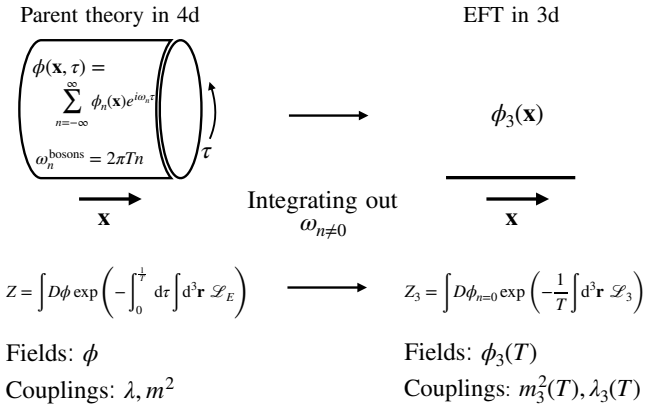
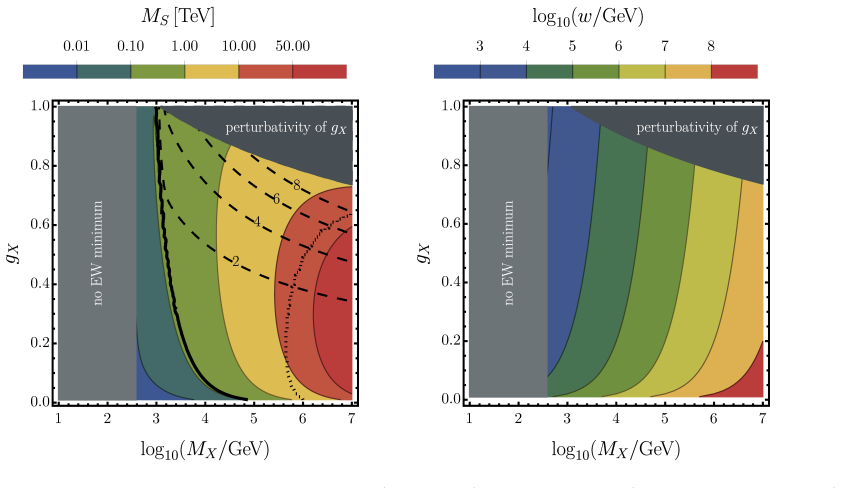
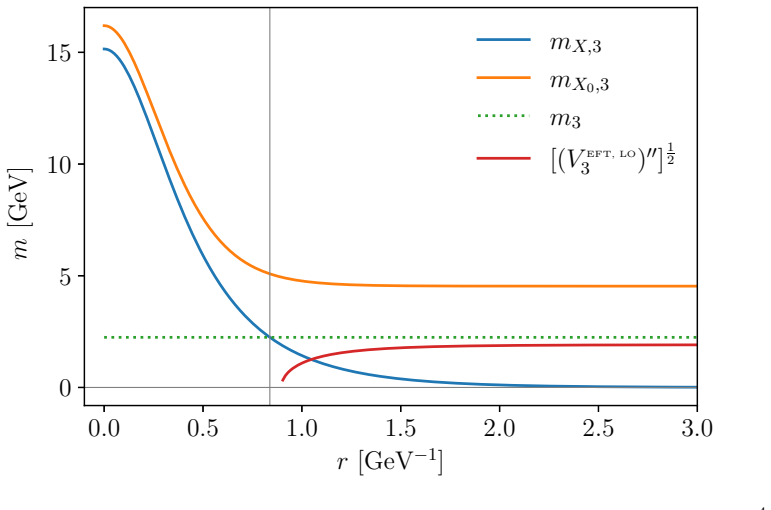
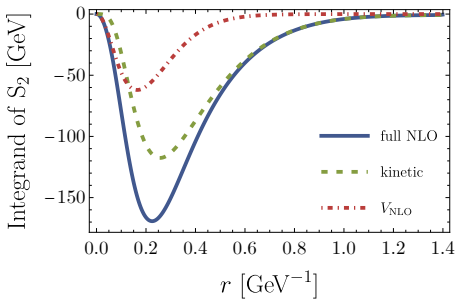
This dissertation investigates a supercooled phase transition (PT) in the early Universe. Using high-temperature dimensional reduction (DR), we compute the NLO thermal bubble nucleation rate. By explicitly evaluating fluctuation determinants, we provide a state-of-the-art description of thermal bubble nucleation. As a case study, we consider the SU(2)cSM, an extension of the conformal Standard Model with an additional SU(2)$_X$ gauge sector and scalar field that acquires a vev through radiative symmetry breaking. This symmetry breaking proceeds via a supercooled first-order phase transition. The first part of the thesis introduces the theoretical framework, including effective actions, RG improvements, finite-temperature quantum field theory, effective field theory techniques, and thermal bubble nucleation. The second part applies these methods to the SU(2)cSM. We establish a consistent power-counting scheme, construct the leading-order effective potential, analyse symmetry breaking and parameter space, derive an RG-improved potential, and incorporate thermal corrections. We then apply high-temperature DR to a classically scale-invariant model for the first time, derive the corresponding three-dimensional EFT, and compute the NLO nucleation rate. A detailed numerical evaluation of fluctuation determinants enables a comparison of different approximation schemes and their limitations. Finally, we present the phenomenological implications. We determine phase transition parameters, perform parameter scans, and predict the resulting gravitational wave signals. We find that the supercooled phase transition in the SU(2)cSM produces a strong signal detectable by LISA throughout the parameter space considered, making the model experimentally testable. We also demonstrate that higher-order corrections can significantly affect both phase transition dynamics and gravitational wave predictions.
Editorial analysis
A structured set of objections, weighed in public.
Referee Report
Summary. The manuscript computes the NLO thermal bubble nucleation rate for a supercooled first-order phase transition in the SU(2)cSM (a classically scale-invariant extension of the SM with an additional SU(2)_X gauge sector) by applying high-temperature dimensional reduction to a 3D EFT for the first time in such a model. It explicitly evaluates fluctuation determinants, compares approximation schemes, derives phase-transition parameters via parameter scans, and predicts strong gravitational-wave signals detectable by LISA throughout the considered parameter space, while showing that higher-order corrections can significantly affect the dynamics and GW predictions.
Significance. If the high-T DR remains controlled, the work supplies a state-of-the-art numerical treatment of nucleation rates via explicit determinant evaluation and demonstrates that the SU(2)cSM yields LISA-accessible GW signals, strengthening the model's phenomenological interest. The explicit comparison of schemes and first application to a classically scale-invariant model are concrete strengths.
major comments (1)
- [DR application and power-counting section] The central claim that the supercooled PT produces a strong LISA-detectable GW signal throughout parameter space rests on the NLO nucleation rate obtained from high-T DR to the 3D EFT. However, in the supercooled regime T_n ≪ v (with v the radiatively generated vev), the power-counting scheme that assumes T sets the dominant scale for integrating out non-zero Matsubara modes loses its standard justification; the classically scale-invariant nature of the model removes tree-level mass parameters and makes the hierarchy even more sensitive. No explicit verification that the 3D EFT remains a controlled description at the computed T_n is supplied (abstract and the DR-application section).
minor comments (2)
- Notation for the 3D EFT parameters and matching conditions could be clarified with an explicit table relating 4D and 3D couplings.
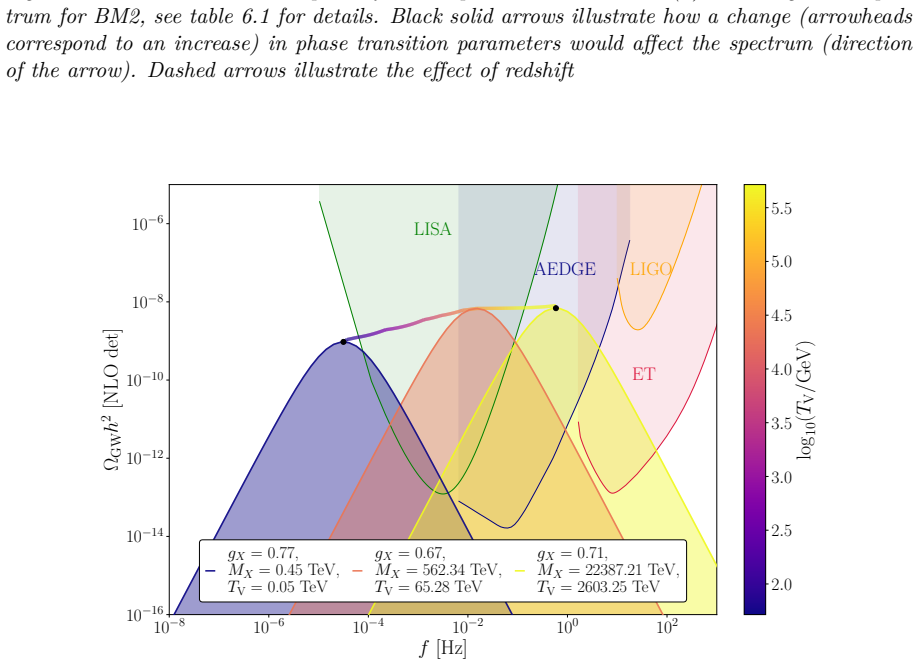
- Figure captions for the GW spectra should state the frequency range and the precise definition of the peak amplitude used.
Simulated Author's Rebuttal
We thank the referee for their careful reading of the manuscript and for the constructive comment on the justification of high-temperature dimensional reduction in the supercooled regime. We address the point below.
read point-by-point responses
-
Referee: [DR application and power-counting section] The central claim that the supercooled PT produces a strong LISA-detectable GW signal throughout parameter space rests on the NLO nucleation rate obtained from high-T DR to the 3D EFT. However, in the supercooled regime T_n ≪ v (with v the radiatively generated vev), the power-counting scheme that assumes T sets the dominant scale for integrating out non-zero Matsubara modes loses its standard justification; the classically scale-invariant nature of the model removes tree-level mass parameters and makes the hierarchy even more sensitive. No explicit verification that the 3D EFT remains a controlled description at the computed T_n is supplied (abstract and the DR-application section).
Authors: We appreciate the referee highlighting this subtlety. The manuscript does establish a consistent power-counting scheme adapted to the classically scale-invariant SU(2)cSM in the DR-application section, where the absence of tree-level mass parameters is accounted for by identifying the radiatively generated vev and the thermal scale as the relevant hierarchies for integrating out non-zero Matsubara modes. This scheme is used to derive the 3D EFT and the NLO nucleation rate. We nevertheless agree that an explicit numerical check of the EFT validity (for instance, by evaluating the size of the expansion parameters or estimating higher-dimensional operator contributions at the computed T_n values) is not supplied. We will add such a verification, including a table or discussion of the expansion parameters for representative points in the scanned parameter space, in the revised manuscript. revision: yes
Circularity Check
No significant circularity; derivation chain is self-contained computation
full rationale
The paper's chain proceeds by constructing the 3D EFT from high-T DR, explicitly evaluating fluctuation determinants for the NLO nucleation rate, deriving phase transition parameters, and then scanning to obtain GW predictions. None of these steps reduces a claimed prediction to an input by construction, a fitted parameter renamed as output, or a load-bearing self-citation whose justification collapses to the present work. The LISA-detectability result follows from the downstream numerical evaluation rather than being presupposed in the rate computation or EFT matching.
Axiom & Free-Parameter Ledger
free parameters (1)
- SU(2)cSM model parameters
axioms (2)
- standard math Standard finite-temperature QFT and effective potential formalism
- domain assumption Validity of high-temperature dimensional reduction for the classically scale-invariant model
invented entities (1)
-
SU(2)_X gauge sector plus additional scalar
no independent evidence
Reference graph
Works this paper leans on
-
[1]
Conformal model for gravitational waves and dark matter: a status update,
M. Kierkla, A. Karam, and B. Świeżewska, “Conformal model for gravitational waves and dark matter: a status update,” JHEP 03, 007 (2023) , arXiv:2210.07075 [astro-ph.CO]
arXiv 2023
-
[2]
M. Kierkla, B. Świeżewska, T. V. I. Tenkanen, and J. van de Vis, “Gravitational waves from supercooled phase transitions: dimensional transmutation meets dimensional reduc- tion,” JHEP 02, 234 (2024) , arXiv:2312.12413 [hep-ph]
arXiv 2024
-
[3]
Finite- temperature bubble nucleation with shifting scale hierarchies,
M. Kierkla, P. Schicho, B. Świeżewska, T. V. I. Tenkanen, and J. van de Vis, “Finite- temperature bubble nucleation with shifting scale hierarchies,” JHEP 07, 153 (2025) , arXiv:2503.13597 [hep-ph]
arXiv 2025
-
[4]
Theoretical uncertainties for primordial black holes from cosmological phase transitions,
M. Kierkla, N. Ramberg, P. Schicho, and D. Schmitt, “Theoretical uncertainties for primordial black holes from cosmological phase transitions,” (2025), arXiv:2506.15496 [hep-ph]
Pith/arXiv arXiv 2025
-
[5]
Scale-Invariant Model for Gravitational Waves and Dark Matter,
A. Karam, M. Kierkla, and B. Świeżewska, “Scale-Invariant Model for Gravitational Waves and Dark Matter,” PoS CORFU2022, 106 (2023), arXiv:2303.18122 [astro-ph.CO]
arXiv 2023
-
[6]
M. Kierkla et al., “From Hubble to Bubble,” JHEP 11, 077 (2023) , arXiv:2309.08530 [astro-ph.CO]
arXiv 2023
-
[7]
Visions in quantum gravity,
L. Buoninfante et al., “Visions in quantum gravity,” SciPost Phys. Comm. Rep., 11 (2025)
2025
-
[8]
Bubble Trouble: a Review on Electroweak Baryogenesis,
J. van de Vis, J. de Vries, and M. Postma, “Bubble Trouble: a Review on Electroweak Baryogenesis,” (2025), arXiv:2508.09989 [hep-ph]
arXiv 2025
-
[9]
Baumann, Cosmology (Cambridge University Press, July 2022)
D. Baumann, Cosmology (Cambridge University Press, July 2022)
2022
-
[10]
Y. Gouttenoire, Beyond the Standard Model Cocktail , Springer Theses (Springer, Cham, 2022), arXiv:2207.01633 [hep-ph]
arXiv 2022
-
[11]
What is the Hierarchy Problem?
M. E. Peskin, “What is the Hierarchy Problem?” Nucl. Phys. B 1018, 116971 (2025) , arXiv:2505.00694 [hep-ph]
arXiv 2025
-
[12]
The quantum criticality of the Standard Model and the hierarchy problem,
J. P. Garcés, F. Goertz, M. Lindner, and Á. Pastor-Gutiérrez, “The quantum criticality of the Standard Model and the hierarchy problem,” JHEP 10, 134 (2025), arXiv:2506.15919 [hep-ph]
arXiv 2025
-
[13]
Radiative corrections as the origin of spontaneous sym- metry breaking,
S. Coleman and E. Weinberg, “Radiative corrections as the origin of spontaneous sym- metry breaking,” Phys. Rev. D 7, 1888–1910 (1973)
1910
-
[14]
Higgs vacuum stability from the dark matter portal,
V. V. Khoze, C. McCabe, and G. Ro, “Higgs vacuum stability from the dark matter portal,” JHEP 08, 026 (2014) , arXiv:1403.4953 [hep-ph]
Pith/arXiv arXiv 2014
-
[15]
The next-to-minimal coleman-weinberg model,
R. Hempfling, “The next-to-minimal coleman-weinberg model,” Physics Letters B 379, 153–158 (1996)
1996
-
[16]
Gravitational waves from warped spacetime,
L. Randall and G. Servant, “Gravitational waves from warped spacetime,” JHEP 05, 054 (2007), arXiv:hep-ph/0607158 [hep-ph]
Pith/arXiv arXiv 2007
-
[17]
Gravitational Backreaction Effects on the Holographic Phase Transition,
T. Konstandin, G. Nardini, and M. Quiros, “Gravitational Backreaction Effects on the Holographic Phase Transition,” Phys. Rev. D82, 083513 (2010), arXiv:1007.1468 [hep-ph]. –122–
Pith/arXiv arXiv 2010
-
[18]
Cosmological Consequences of Nearly Conformal Dy- namics at the TeV scale,
T. Konstandin and G. Servant, “Cosmological Consequences of Nearly Conformal Dy- namics at the TeV scale,” JCAP 1112, 009 (2011) , arXiv:1104.4791 [hep-ph]
Pith/arXiv arXiv 2011
-
[19]
QCD-induced Electroweak Phase Transition,
B. von Harling and G. Servant, “QCD-induced Electroweak Phase Transition,” JHEP 01, 159 (2018) , arXiv:1711.11554 [hep-ph]
Pith/arXiv arXiv 2018
-
[20]
Electroweak Phase Transition and Baryogenesis in Composite Higgs Models,
S. Bruggisser, B. Von Harling, O. Matsedonskyi, and G. Servant, “Electroweak Phase Transition and Baryogenesis in Composite Higgs Models,” JHEP 12, 099 (2018) , arXiv:1 804.07314 [hep-ph]
2018
-
[21]
J. Kubo and M. Yamada, “Scale genesis and gravitational wave in a classically scale invariant extension of the standard model,” JCAP 1612, 001 (2016) , arXiv:1610.02241 [hep-ph]
Pith/arXiv arXiv 2016
-
[22]
Supercool composite Dark Matter beyond 100 TeV,
I. Baldes, Y. Gouttenoire, F. Sala, and G. Servant, “Supercool composite Dark Matter beyond 100 TeV,” JHEP 07, 084 (2022) , arXiv:2110.13926 [hep-ph]
arXiv 2022
-
[23]
Dynamical generation of the weak and Dark Matter scale,
T. Hambye and A. Strumia, “Dynamical generation of the weak and Dark Matter scale,” Phys. Rev. D88, 055022 (2013) , arXiv:1306.2329 [hep-ph]
Pith/arXiv arXiv 2013
-
[24]
Hearing the signal of dark sectors with gravitational wave detectors,
J. Jaeckel, V. V. Khoze, and M. Spannowsky, “Hearing the signal of dark sectors with gravitational wave detectors,” Phys. Rev. D94, 103519 (2016), arXiv:1602.03901 [hep-ph]
Pith/arXiv arXiv 2016
-
[25]
Probing a classically conformal B-L model with gravitational waves,
R. Jinno and M. Takimoto, “Probing a classically conformal B-L model with gravitational waves,” Phys. Rev. D95, 015020 (2017) , arXiv:1604.05035 [hep-ph]
Pith/arXiv arXiv 2017
-
[26]
L. Marzola, A. Racioppi, and V. Vaskonen, “Phase transition and gravitational wave phenomenology of scalar conformal extensions of the Standard Model,” Eur. Phys. J. C77, 484 (2017) , arXiv:1704.01034 [hep-ph]
Pith/arXiv arXiv 2017
-
[27]
Strong gravitational radiation from a simple dark matter model,
I. Baldes and C. Garcia-Cely, “Strong gravitational radiation from a simple dark matter model,” JHEP 05, 190 (2019) , arXiv:1809.01198 [hep-ph]
Pith/arXiv arXiv 2019
-
[28]
Gravitational waves from conformal sym- metry breaking,
T. Prokopec, J. Rezacek, and B. Świeżewska, “Gravitational waves from conformal sym- metry breaking,” JCAP 02, 009 (2019) , arXiv:1809.11129 [hep-ph]
Pith/arXiv arXiv 2019
-
[30]
Scale-genesis by Dark Matter and Its Gravitational Wave Signal,
Z. Kang and J. Zhu, “Scale-genesis by Dark Matter and Its Gravitational Wave Signal,” Phys. Rev. D 102, 053011 (2020) , arXiv:2003.02465 [hep-ph]
arXiv 2020
-
[31]
Updated predictions for gravitational waves pro- duced in a strongly supercooled phase transition,
J. Ellis, M. Lewicki, and V. Vaskonen, “Updated predictions for gravitational waves pro- duced in a strongly supercooled phase transition,” JCAP 11, 020 (2020) , arXiv:2007. 15586 [astro-ph.CO]
2020
-
[32]
Mukhanov, Physical Foundations of Cosmology (Cambridge University Press, Oxford, 2005)
V. Mukhanov, Physical Foundations of Cosmology (Cambridge University Press, Oxford, 2005)
2005
-
[33]
E. W. Kolb and M. S. Turner, The Early Universe , Vol. 69 (Taylor and Francis, May 2019)
2019
-
[34]
Is there a hot electroweak phase transition at mH ≥ mW ?
K. Kajantie, M. Laine, K. Rummukainen, and M. E. Shaposhnikov, “Is there a hot electroweak phase transition at mH ≥ mW ?” Phys. Rev. Lett. 77, 2887–2890 (1996) , arXiv:hep-ph/9605288
Pith/arXiv arXiv 1996
-
[35]
Laine and A
M. Laine and A. Vuorinen, Basics of thermal field theory: a tutorial on perturbative computations (Springer International Publishing, 2016)
2016
-
[36]
Gravitational Waves from Phase Transitions,
D. Croon and D. J. Weir, “Gravitational Waves from Phase Transitions,” Contemp. Phys. 65, 75 (2024) , arXiv:2410.21509 [hep-ph] . –123–
arXiv 2024
-
[37]
C. Caprini et al., “Science with the space-based interferometer eLISA. II: Gravitational waves from cosmological phase transitions,” JCAP 1604, 001 (2016) , arXiv:1512.06239 [astro-ph.CO]
Pith/arXiv arXiv 2016
-
[38]
Reconstructing the spectral shape of a stochastic gravitational wave background with LISA,
C. Caprini et al., “Reconstructing the spectral shape of a stochastic gravitational wave background with LISA,” JCAP 11, 017 (2019) , arXiv:1906.09244 [astro-ph.CO]
arXiv 2019
-
[40]
Observational prospects for phase transitions at LISA: Fisher matrix analysis,
C. Gowling and M. Hindmarsh, “Observational prospects for phase transitions at LISA: Fisher matrix analysis,” JCAP 10, 039 (2021) , arXiv:2106.05984 [astro-ph.CO]
arXiv 2021
-
[41]
Prospects for LISA to detect a gravitational-wave background from first order phase transitions,
G. Boileau, N. Christensen, C. Gowling, M. Hindmarsh, and R. Meyer, “Prospects for LISA to detect a gravitational-wave background from first order phase transitions,” JCAP 02, 056 (2023) , arXiv:2209.13277 [gr-qc]
arXiv 2023
-
[42]
C. Gowling, M. Hindmarsh, D. C. Hooper, and J. Torrado, “Reconstructing physical pa- rameters from template gravitational wave spectra at LISA: first order phase transitions,” JCAP 04, 061 (2023) , arXiv:2209.13551 [astro-ph.CO]
arXiv 2023
-
[43]
Observation of Gravitational Waves from a Binary Black Hole Merger,
B. P. Abbott et al. (Virgo, LIGO Scientific), “Observation of Gravitational Waves from a Binary Black Hole Merger,” Phys. Rev. Lett. 116, 061102 (2016) , arXiv:1602.03837 [gr-qc]
Pith/arXiv arXiv 2016
-
[44]
GW151226: Observation of Gravitational Waves from a 22-Solar-Mass Binary Black Hole Coalescence,
B. P. Abbott et al. (Virgo, LIGO Scientific), “GW151226: Observation of Gravitational Waves from a 22-Solar-Mass Binary Black Hole Coalescence,” Phys. Rev. Lett. 116, 241103 (2016) , arXiv:1606.04855 [gr-qc]
Pith/arXiv arXiv 2016
-
[45]
GW170104: Observation of a 50-Solar- Mass Binary Black Hole Coalescence at Redshift 0.2,
B. P. Abbott et al. (VIRGO, LIGO Scientific), “GW170104: Observation of a 50-Solar- Mass Binary Black Hole Coalescence at Redshift 0.2,” Phys. Rev. Lett. 118, [Erratum: Phys. Rev. Lett.121,no.12,129901(2018)], 221101 (2017) , arXiv:1706.01812 [gr-qc]
Pith/arXiv arXiv 2018
-
[46]
GW170817: Observation of Gravitational Waves from a Binary Neutron Star Inspiral,
B. P. Abbott et al. (Virgo, LIGO Scientific), “GW170817: Observation of Gravitational Waves from a Binary Neutron Star Inspiral,” Phys. Rev. Lett. 119, 161101 (2017), arXiv:1 710.05832 [gr-qc]
2017
-
[47]
GW170814: A Three-Detector Observation of Gravitational Waves from a Binary Black Hole Coalescence,
B. P. Abbott et al. (LIGO Scientific, Virgo), “GW170814: A Three-Detector Observation of Gravitational Waves from a Binary Black Hole Coalescence,” Phys. Rev. Lett. 119, 141101 (2017) , arXiv:1709.09660 [gr-qc]
Pith/arXiv arXiv 2017
-
[48]
GW170608: Observation of a 19-solar- mass Binary Black Hole Coalescence,
B. . P. . Abbott et al. (LIGO Scientific, Virgo), “GW170608: Observation of a 19-solar- mass Binary Black Hole Coalescence,” Astrophys. J. Lett. 851, L35 (2017) , arXiv:1711. 05578 [astro-ph.HE]
2017
-
[49]
AEDGE: Atomic Experiment for Dark Matter and Gravity Exploration in Space,
Y. A. El-Neaj et al. (AEDGE), “AEDGE: Atomic Experiment for Dark Matter and Gravity Exploration in Space,” EPJ Quant. Technol. 7, 6 (2020) , arXiv:1908 . 00802 [gr-qc]
2020
-
[50]
The Einstein Telescope: A third-generation gravitational wave obser- vatory,
M. Punturo et al., “The Einstein Telescope: A third-generation gravitational wave obser- vatory,” Class. Quant. Grav. 27, edited by F. Ricci, 194002 (2010)
2010
-
[51]
Sensitivity Studies for Third-Generation Gravitational Wave Observato- ries,
S. Hild et al., “Sensitivity Studies for Third-Generation Gravitational Wave Observato- ries,” Class. Quant. Grav. 28, 094013 (2011) , arXiv:1012.0908 [gr-qc]
Pith/arXiv arXiv 2011
-
[52]
AION: An Atom Interferometer Observatory and Network,
L. Badurina et al., “AION: An Atom Interferometer Observatory and Network,” JCAP 05, 011 (2020) , arXiv:1911.11755 [astro-ph.CO]
arXiv 2020
-
[53]
G., Belgacem, E., Benkel, R., et al
K. G. Arun et al., “New horizons for fundamental physics with lisa,” Living Reviews in Relativity 25, 10.1007/s41114-022-00036-9 (2022)
-
[54]
Cosmology with the Laser Interfer- ometer Space Antenna,
P. Auclair et al. (LISA Cosmology Working Group), “Cosmology with the Laser Interfer- ometer Space Antenna,” Living Rev. Rel. 26, 5 (2023), arXiv:2204.05434 [astro-ph.CO]. –124–
arXiv 2023
-
[55]
M. D. Schwartz, Quantum Field Theory and the Standard Model (Cambridge University Press, Mar. 2014)
2014
-
[56]
C. P. Burgess, Introduction to effective field theory: thinking effectively about hierarchies of scale (Cambridge University Press, 2020)
2020
-
[57]
A New approach to quantum statistical mechanics,
T. Matsubara, “A New approach to quantum statistical mechanics,” Prog. Theor. Phys. 14, 351–378 (1955)
1955
-
[58]
Effective field theory approach to thermal bubble nucleation,
O. Gould and J. Hirvonen, “Effective field theory approach to thermal bubble nucleation,” Phys. Rev. D 104, 096015 (2021) , arXiv:2108.04377 [hep-ph]
arXiv 2021
-
[59]
Higher-order corrections to the bubble-nucleation rate at finite tempera- ture,
A. Ekstedt, “Higher-order corrections to the bubble-nucleation rate at finite tempera- ture,” Eur. Phys. J. C 82, 173 (2022) , arXiv:2104.11804 [hep-ph]
arXiv 2022
-
[60]
Bubble nucleation to all orders,
A. Ekstedt, “Bubble nucleation to all orders,” JHEP 08, 115 (2022) , arXiv:2201.07331 [hep-ph]
arXiv 2022
-
[61]
T. Hambye, A. Strumia, and D. Teresi, “Super-cool Dark Matter,” JHEP 08, 188 (2018) , arXiv:1805.01473 [hep-ph]
Pith/arXiv arXiv 2018
-
[62]
Introduction to the Background Field Method,
L. F. Abbott, “Introduction to the Background Field Method,” Acta Phys. Polon. B 13, 33 (1982)
1982
-
[63]
M. E. Peskin and D. V. Schroeder, An Introduction to quantum field theory (Addison- Wesley, Reading, USA, 1995)
1995
-
[64]
Renormalizable models with simple symmetry breaking. 1. Symmetry breaking by a source term,
K. Symanzik, “Renormalizable models with simple symmetry breaking. 1. Symmetry breaking by a source term,” Commun. Math. Phys. 16, 48–80 (1970)
1970
-
[65]
Coleman, Aspects of Symmetry: Selected Erice Lectures (Cambridge University Press, Cambridge, U.K., 1985)
S. Coleman, Aspects of Symmetry: Selected Erice Lectures (Cambridge University Press, Cambridge, U.K., 1985)
1985
-
[66]
Broken scale invariance in scalar field theory,
C. G. Callan, “Broken scale invariance in scalar field theory,” Phys. Rev. D 2, 1541–1547 (1970)
1970
-
[67]
Small distance behavior in field theory and power counting,
K. Symanzik, “Small distance behavior in field theory and power counting,” Commun. Math. Phys. 18, 227–246 (1970)
1970
-
[68]
Small distance behavior analysis and Wilson expansion,
K. Symanzik, “Small distance behavior analysis and Wilson expansion,” Commun. Math. Phys. 23, 49–86 (1971)
1971
-
[69]
The Fate of the False Vacuum. 1. Semiclassical Theory,
S. R. Coleman, “The Fate of the False Vacuum. 1. Semiclassical Theory,” Phys. Rev. D 15, [Erratum: Phys.Rev.D 16, 1248 (1977)], 2929–2936 (1977)
1977
-
[70]
Higgs boson and vacuum stability in models with extended scalar sector,
B. N. Swiezewska, “Higgs boson and vacuum stability in models with extended scalar sector,” PhD thesis (Warsaw U., 2016)
2016
-
[71]
Consistent use of effective potentials,
A. Andreassen, W. Frost, and M. D. Schwartz, “Consistent use of effective potentials,” Physical Review D 91, 10.1103/physrevd.91.016009 (2015)
-
[72]
Consistent conformal extensions of the standard model,
F. Loebbert, J. Miczajka, and J. Plefka, “Consistent conformal extensions of the standard model,” Phys. Rev. D 99, 015026 (2019)
2019
-
[73]
Precision decay rate calculations in quantum field theory,
A. Andreassen, D. Farhi, W. Frost, and M. D. Schwartz, “Precision decay rate calculations in quantum field theory,” Phys. Rev. D 95, 085011 (2017) , arXiv:1604.06090 [hep-th]
Pith/arXiv arXiv 2017
-
[74]
Fate of the false vacuum. ii. first quantum corrections,
C. G. Callan and S. Coleman, “Fate of the false vacuum. ii. first quantum corrections,” Phys. Rev. D 16, 1762–1768 (1977)
1977
-
[75]
First and second order phase transitions in gauge theories at finite temper- ature,
P. Ginsparg, “First and second order phase transitions in gauge theories at finite temper- ature,” Nuclear Physics B 170, 388–408 (1980)
1980
-
[76]
High-temperature yang-mills theories and three- dimensional quantum chromodynamics,
T. Appelquist and R. D. Pisarski, “High-temperature yang-mills theories and three- dimensional quantum chromodynamics,” Phys. Rev. D 23, 2305–2317 (1981) . –125–
1981
-
[77]
Dimensional reduction in finite-temperature quantum chromodynamics,
S. Nadkarni, “Dimensional reduction in finite-temperature quantum chromodynamics,” Phys. Rev. D 27, 917–931 (1983)
1983
-
[78]
Limitations to dimensional reduction at high temperature,
N. Landsman, “Limitations to dimensional reduction at high temperature,” Nuclear Physics B 322, 498–530 (1989)
1989
-
[79]
K. Kajantie, M. Laine, K. Rummukainen, and M. E. Shaposhnikov, “Generic rules for high temperature dimensional reduction and their application to the standard model,” Nucl. Phys. B 458, 90–136 (1996) , arXiv:hep-ph/9508379
Pith/arXiv arXiv 1996
-
[80]
3d physics and the electroweak phase transition: perturbation theory,
K. Farakos, K. Kajantie, K. Rummukainen, and M. Shaposhnikov, “3d physics and the electroweak phase transition: perturbation theory,” Nuclear Physics B 425, 67–109 (1994)
1994
-
[81]
Effective field theory approach to high temperature thermo- dynamics,
E. Braaten and A. Nieto, “Effective field theory approach to high temperature thermo- dynamics,” Phys. Rev. D 51, 6990–7006 (1995) , arXiv:hep-ph/9501375
Pith/arXiv arXiv 1995
-
[82]
Free energy of qcd at high temperature,
E. Braaten and A. Nieto, “Free energy of qcd at high temperature,” Phys. Rev. D 53, 3421–3437 (1996)
1996
discussion (0)
Sign in with ORCID, Apple, or X to comment. Anyone can read and Pith papers without signing in.