Ultra-Precise Astrometric Search for Exoplanets with SKA-VLBI
Pith reviewed 2026-06-25 21:56 UTC · model grok-4.3
The pith
SKA-VLBI will enable indirect detection of thousands of exoplanets around radio-bright ultra-cool dwarfs, M dwarfs and young stars.
A machine-rendered reading of the paper's core claim, the machinery that carries it, and where it could break.
Core claim
SKA-VLBI astrometric observations in L and C bands will open the possibility of indirect detection of thousands of planetary companions to radio-bright ultra cool dwarfs, M dwarfs and young stars. The anticipated sensitivity of SKA-VLBI together with multi-beam Tied Array Beams and MultiView analysis will deliver an order-of-magnitude improvement in astrometric precision, providing much finer details for a wider range of exoplanets and hosts.
What carries the argument
SKA-VLBI multi-beam Tied Array Beams combined with MultiView analysis, which together with higher sensitivity produce the order-of-magnitude gain in micro-arcsecond astrometric precision.
If this is right
- When a companion is detected the astrometric fit will yield dynamical masses of the star and planet.
- In binary systems containing planets the fit will give individual component masses and the mutual inclination angle, revealing prograde or retrograde orbits.
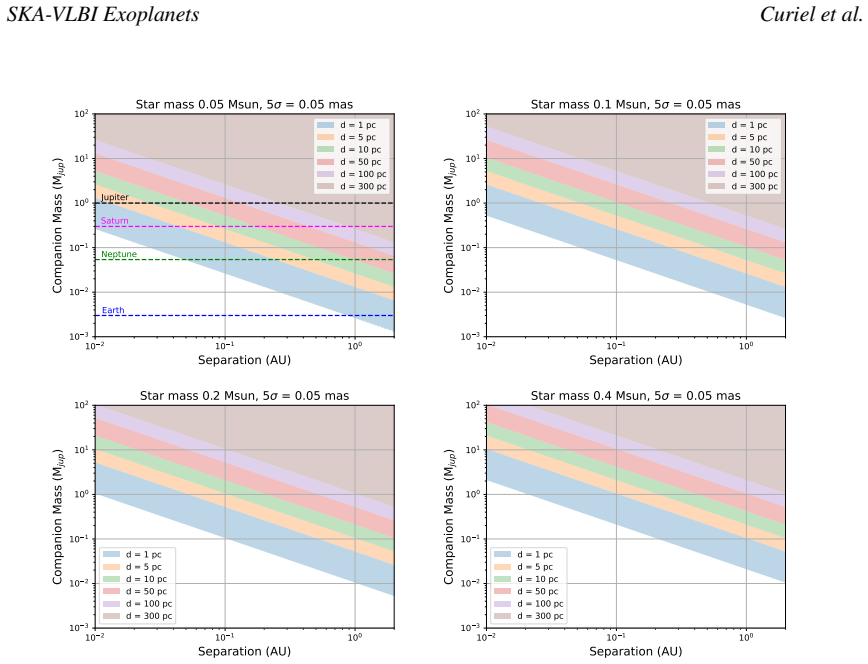
- Micro-arcsecond precision will allow detection of lower-mass planets in addition to Jupiter-like bodies.
- Radio astrometry will detect a population of exoplanets complementary to those found by optical, infrared and transit methods.
Where Pith is reading between the lines
- A large survey of radio-bright low-mass stars could be prioritized once SKA-VLBI begins operations to maximize early detections.
- Joint radio-optical campaigns on the same targets would test consistency between independent mass and orbit determinations.
- Non-detections in the first SKA-VLBI samples would still constrain the occurrence rate of planets around ultra-cool dwarfs at radio wavelengths.
Load-bearing premise
The SKA-VLBI system will actually deliver the expected sensitivity and order-of-magnitude astrometric precision improvement with the multi-beam and MultiView techniques.
What would settle it
Early SKA-VLBI observations of calibration sources or known exoplanet-host stars that show no improvement beyond current VLBI precision levels would falsify the precision claim.
Figures
read the original abstract
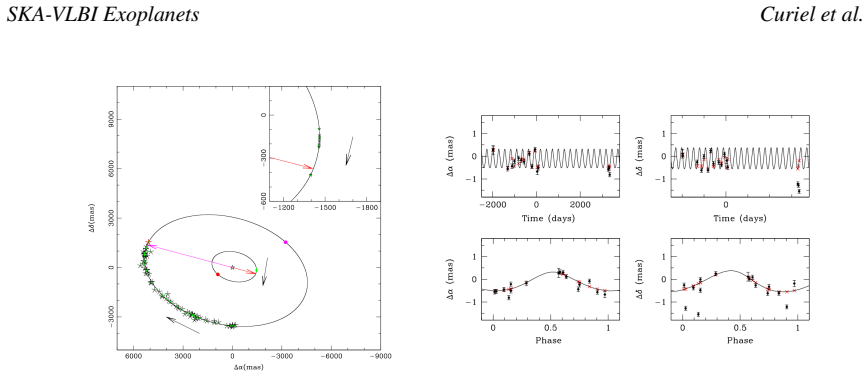
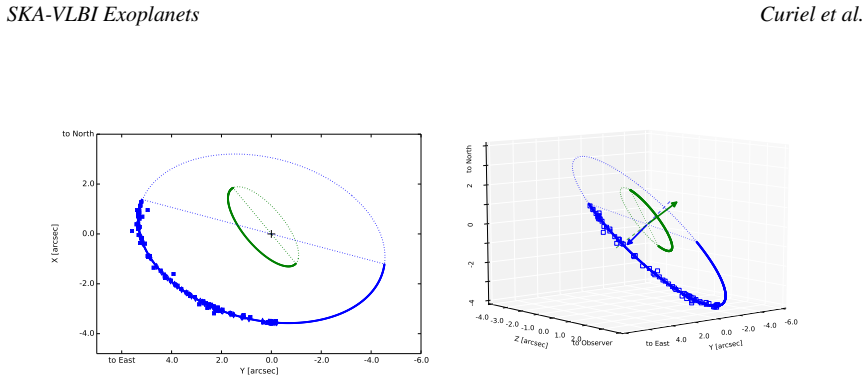
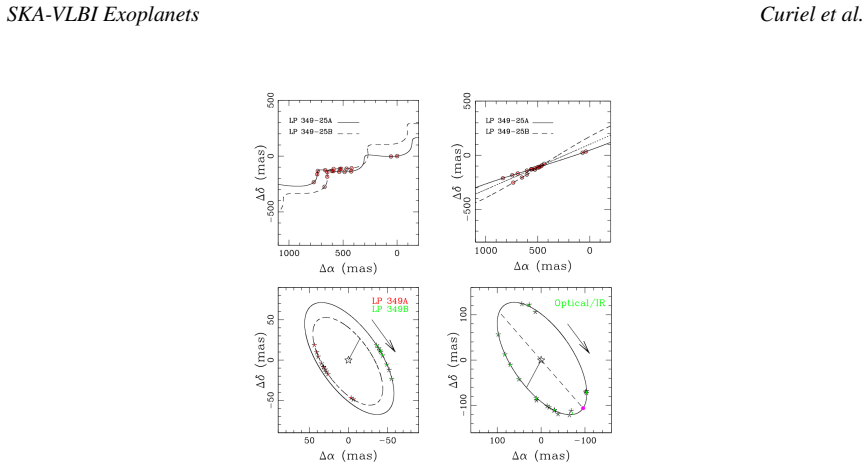
The study of exoplanets is a rapidly developing field, driven by the discoveries of Kepler and TESS, among others. The recent detection of Jovian planetary companions of low-mass stars demonstrates that VLBI observations will be an excellent tool for indirect detection of planetary companions through precise radio astrometry of the host star. The anticipated sensitivity of SKA-VLBI and its capability to form multi-beam Tied Array Beams and MultiView analysis will allow us to achieve an order of magnitude increase in astrometric precision, providing much finer details for a wider range of exoplanets and hosts, which will revolutionize the field of exoplanets. Precise micro-arcsecond astrometric observations are crucial for detecting not only Jupiter-like planets, but also lower-mass planets. SKA-VLBI astrometric observations in L and C bands will open the possibility of indirect detection of thousands of planetary companions to radio-bright ultra cool dwarfs, M dwarfs and young stars. When a companion is also detected, the astrometric fit of the data will provide the dynamical masses of the components. In the case of binary systems with planets, fitting the astrometric data will provide the individual masses of stars and planets, as well as the mutual inclination angle of the system, which will show whether the planet is moving in prograde or retrograde orbit around its host star. The search for exoplanets at radio wavelengths will be complementary to other techniques and will allow for the detection of a population of exoplanets that is difficult to reach using other techniques.
Editorial analysis
A structured set of objections, weighed in public.
Referee Report
Summary. The manuscript proposes SKA-VLBI astrometry in L and C bands as a tool for indirect exoplanet detection via precise radio positions of radio-bright ultra-cool dwarfs, M dwarfs, and young stars. It claims that multi-beam Tied Array Beams and MultiView analysis will deliver an order-of-magnitude gain in astrometric precision over existing VLBI, enabling detection of thousands of planetary companions, dynamical mass measurements, and orbital inclination constraints in binary systems, thereby complementing optical surveys.
Significance. If the projected instrumental performance is realized, the approach could access a radio-selected population of hosts and planets that is difficult to reach with transit or radial-velocity methods, providing dynamical masses and mutual inclinations. The manuscript functions as a concept outline rather than a data-driven analysis, so its significance rests on the credibility of the forward projections rather than new empirical results.
major comments (3)
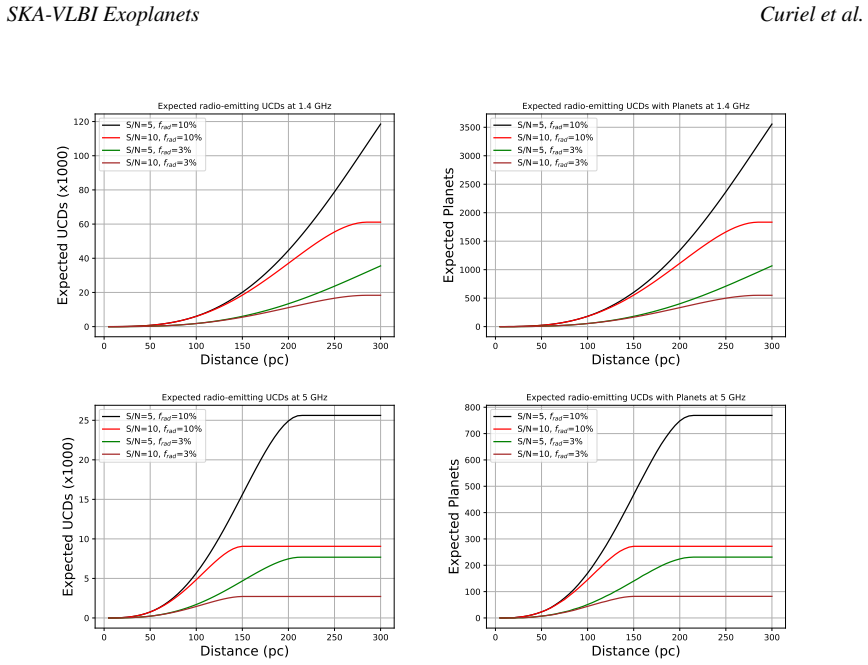
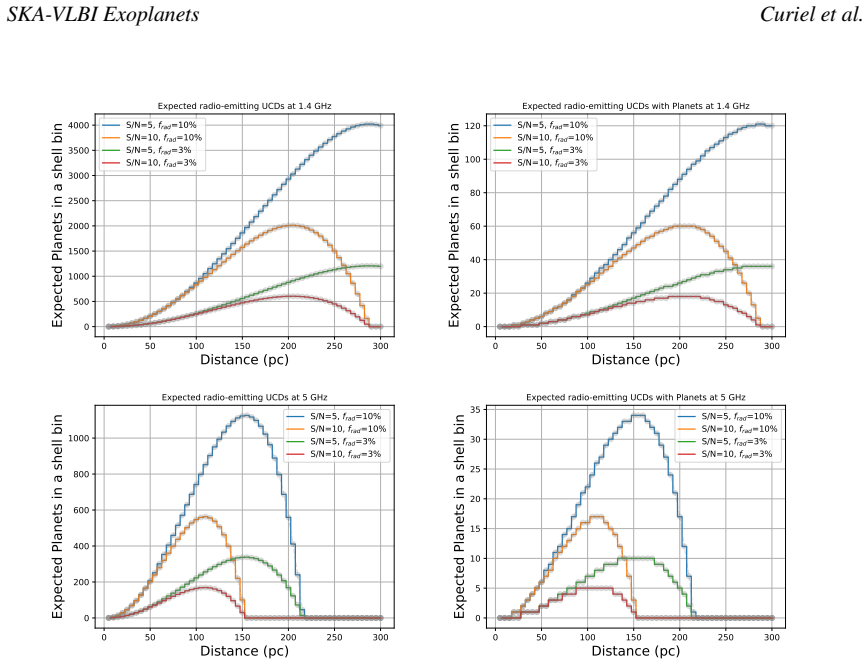
- [Abstract] Abstract: the quantitative claim that SKA-VLBI 'will open the possibility of indirect detection of thousands of planetary companions' is presented without any target catalog, expected detection rate calculation, or Monte-Carlo simulation that converts the stated sensitivity gain into a planet yield; this number is load-bearing for the central assertion yet unsupported.
- [Abstract] Abstract: the assertion of 'an order of magnitude increase in astrometric precision' via multi-beam and MultiView is stated without reference to current VLBI benchmarks (e.g., typical micro-arcsecond errors for the cited targets), projected SKA thermal-noise floors, or an error budget that includes ionospheric, tropospheric, or source-structure terms; the improvement is therefore not demonstrated.
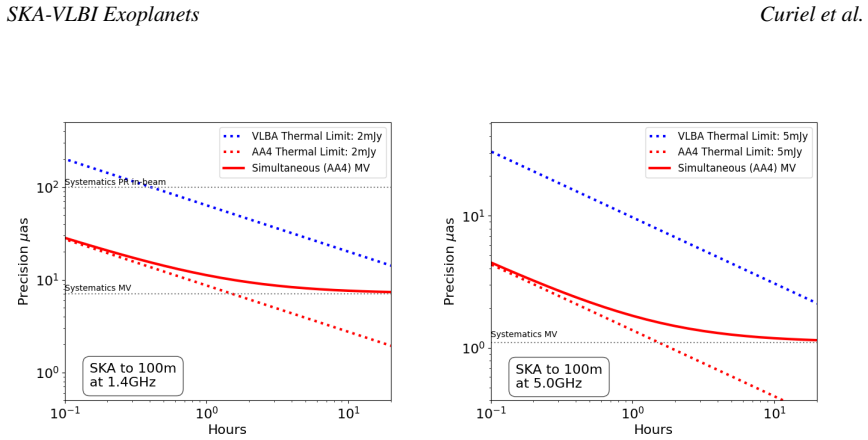
- The manuscript contains no section deriving or tabulating the expected astrometric precision, number of accessible targets, or completeness as a function of planet mass and period; all numerical projections therefore remain qualitative.
minor comments (1)
- [Abstract] The abstract refers to 'Jovian planetary companions of low-mass stars' detected by VLBI but does not cite the specific prior works that established this capability.
Simulated Author's Rebuttal
We thank the referee for their constructive comments on our concept paper. We address each major comment below and note the revisions planned.
read point-by-point responses
-
Referee: [Abstract] Abstract: the quantitative claim that SKA-VLBI 'will open the possibility of indirect detection of thousands of planetary companions' is presented without any target catalog, expected detection rate calculation, or Monte-Carlo simulation that converts the stated sensitivity gain into a planet yield; this number is load-bearing for the central assertion yet unsupported.
Authors: We acknowledge that the 'thousands' figure is presented qualitatively without a detailed calculation or catalog in the manuscript. The estimate is based on the expected number of radio-bright ultra-cool dwarfs, M dwarfs, and young stars accessible with SKA sensitivity combined with literature occurrence rates. We will qualify the claim in the abstract and add a paragraph with a rough target count drawn from existing radio surveys, plus references to occurrence rate studies. A full Monte-Carlo simulation lies beyond the scope of this short concept outline. revision: yes
-
Referee: [Abstract] Abstract: the assertion of 'an order of magnitude increase in astrometric precision' via multi-beam and MultiView is stated without reference to current VLBI benchmarks (e.g., typical micro-arcsecond errors for the cited targets), projected SKA thermal-noise floors, or an error budget that includes ionospheric, tropospheric, or source-structure terms; the improvement is therefore not demonstrated.
Authors: The order-of-magnitude claim rests on SKA sensitivity gains lowering thermal noise and multi-beam/MultiView techniques improving calibration over standard VLBI. Current VLBI achieves ~10-100 μas for these targets. We will add references to existing VLBI astrometric results for the cited source classes and a concise error budget discussion covering the main terms to substantiate the projected improvement. revision: yes
-
Referee: [—] The manuscript contains no section deriving or tabulating the expected astrometric precision, number of accessible targets, or completeness as a function of planet mass and period; all numerical projections therefore remain qualitative.
Authors: As a concise concept paper the focus is on scientific potential rather than exhaustive modeling. We agree that adding quantitative derivations would improve the manuscript. We will introduce a new section outlining expected L- and C-band precisions, target numbers from known catalogs, and completeness considerations for planet mass and period, supported by references to VLBI performance and occurrence rate literature. revision: yes
Circularity Check
No significant circularity; purely prospective instrument claims
full rationale
The manuscript contains no derivations, equations, fitted parameters, or quantitative predictions that could reduce to inputs by construction. All claims are forward-looking statements about anticipated SKA-VLBI sensitivity, multi-beam, and MultiView performance enabling future detections; these rest on external instrumental expectations rather than any self-referential loop, self-citation chain, or renaming of known results. No load-bearing step meets the criteria for circularity.
Axiom & Free-Parameter Ledger
axioms (1)
- domain assumption SKA-VLBI will achieve an order-of-magnitude increase in astrometric precision via multi-beam and MultiView techniques
Reference graph
Works this paper leans on
-
[1]
2019 , eprint=
Anticipated Performance of the Square Kilometre Array -- Phase 1 (SKA1) , author=. 2019 , eprint=
2019
-
[2]
2015 , publisher=
Advancing Astrophysics with the Square Kilometre Array (AASKA14) , author=. 2015 , publisher=
2015
-
[3]
Bourke and Mar\'ia J
Tyler L. Bourke and Mar\'ia J. Rioja and Richard Dodson and Huib Jan van Langevelde and Tao An , title =. 2026 , publisher =
2026
-
[4]
2026 , publisher =
Salvador Curiel and author2 and author3 and author4 and author5 , title =. 2026 , publisher =
2026
-
[5]
Kavanagh and author2 and author3 and author4 and author5 ,title =
Robert D. Kavanagh and author2 and author3 and author4 and author5 ,title =. 2026 ,publisher =
2026
-
[6]
2026 ,publisher =
Maria Rioja and author2 and author3 and author4 and author5 ,title =. 2026 ,publisher =
2026
-
[7]
2026 ,publisher =
Harish Vedantham and author2 and author3 and author4 and author5 ,title =. 2026 ,publisher =
2026
-
[8]
Beyond the Local Volume. II. Population Scaleheights and Ages of Ultracool Dwarfs in Deep HST/WFC3 Parallel Fields. , keywords =. doi:10.3847/1538-4357/ac7053 , archivePrefix =. 2204.07621 , primaryClass =
-
[9]
Parallaxes of Southern Extremely Cool Objects. I. Targets, Proper Motions, and First Results. , keywords =. doi:10.1088/0004-6256/141/2/54 , archivePrefix =. 1011.1378 , primaryClass =
work page internal anchor Pith review Pith/arXiv arXiv doi:10.1088/0004-6256/141/2/54
-
[10]
The AB Doradus system revisited: The dynamical mass of AB Dor A/C. , keywords =. doi:10.1051/0004-6361/201730641 , adsurl =
-
[11]
J., Longmore, S., & Bonnell, I
Chaotic star formation and the alignment of stellar rotation with disc and planetary orbital axes. , keywords =. doi:10.1111/j.1365-2966.2009.15773.x , archivePrefix =. 0909.4255 , primaryClass =
-
[12]
A long-period planet around GJ 1151 measured with CARMENES and HARPS-N data
The CARMENES search for exoplanets around M dwarfs. A long-period planet around GJ 1151 measured with CARMENES and HARPS-N data. , keywords =. doi:10.1051/0004-6361/202245053 , archivePrefix =. 2301.04442 , primaryClass =
-
[13]
Magnetic and Gravitational Disk-Star Interactions: An Interdependence of PMS Stellar Rotation Rates and Spin-Orbit Misalignments. , keywords =. doi:10.1088/0004-637X/778/2/169 , archivePrefix =. 1310.2179 , primaryClass =
work page internal anchor Pith review Pith/arXiv arXiv doi:10.1088/0004-637x/778/2/169
-
[14]
Radio Observations of a Large Sample of Late M, L, and T Dwarfs: The Distribution of Magnetic Field Strengths. , keywords =. doi:10.1086/505787 , archivePrefix =. astro-ph/0603176 , primaryClass =
work page internal anchor Pith review Pith/arXiv arXiv doi:10.1086/505787
-
[15]
Discovery of Radio Emission from the Brown Dwarf LP944-20
Discovery of radio emission from the brown dwarf LP944-20. , keywords =. doi:10.1038/35066514 , archivePrefix =. astro-ph/0102301 , primaryClass =
work page internal anchor Pith review Pith/arXiv arXiv doi:10.1038/35066514
-
[16]
Radio Interferometric Planet Search. I. First Constraints On Planetary Companions For Nearby, Low-Mass Stars From Radio Astrometry. , keywords =. doi:10.1088/0004-637X/701/2/1922 , archivePrefix =. 0907.1680 , primaryClass =
work page internal anchor Pith review Pith/arXiv arXiv doi:10.1088/0004-637x/701/2/1922 1922
-
[17]
Anticipated Performance of the Square Kilometre Array -- Phase 1 (SKA1). arXiv e-prints , keywords =. doi:10.48550/arXiv.1912.12699 , archivePrefix =. 1912.12699 , primaryClass =
-
[18]
The population of M dwarfs observed at low radio frequencies. Nature Astronomy , keywords =. doi:10.1038/s41550-021-01483-0 , archivePrefix =. 2110.03713 , primaryClass =
-
[19]
Double-blind test program for astrometric planet detection with Gaia
Double-blind test program for astrometric planet detection with Gaia. , keywords =. doi:10.1051/0004-6361:20078997 , archivePrefix =. 0802.0515 , primaryClass =
work page internal anchor Pith review Pith/arXiv arXiv doi:10.1051/0004-6361:20078997
-
[20]
Evidence for a radiation belt around a brown dwarf. Science , keywords =. doi:10.1126/science.adg6635 , archivePrefix =. 2303.06453 , primaryClass =
-
[21]
Substellar Companions of the Young Weak-line TTauri Star DoAr21. , keywords =. doi:10.3847/1538-4357/ab40ac , archivePrefix =. 1909.02870 , primaryClass =
-
[22]
An Astrometric Planetary Companion Candidate to the M9 Dwarf TVLM 513-46546. , keywords =. doi:10.3847/1538-3881/ab9e6e , archivePrefix =. 2008.01595 , primaryClass =
-
[23]
3D Orbital Architecture of a Dwarf Binary System and Its Planetary Companion. , keywords =. doi:10.3847/1538-3881/ac7c66 , archivePrefix =. 2208.14553 , primaryClass =
-
[24]
Precise Mass, Orbital Motion, and Stellar Properties of the M-dwarf Binary LP 349 - 25AB. , keywords =. doi:10.3847/1538-4357/ad3df6 , archivePrefix =. 2404.16964 , primaryClass =
-
[25]
Orbital motion and dynamical mass of the complex periodic variable binary system 2MASS J05082729-2101444. arXiv e-prints , keywords =. doi:10.48550/arXiv.2605.04173 , archivePrefix =. 2605.04173 , primaryClass =
work page internal anchor Pith review Pith/arXiv arXiv doi:10.48550/arxiv.2605.04173
-
[26]
Astrometry and Photometry for Cool Dwarfs and Brown Dwarfs
Astrometry and Photometry for Cool Dwarfs and Brown Dwarfs. , keywords =. doi:10.1086/341646 , archivePrefix =. astro-ph/0205050 , primaryClass =
work page internal anchor Pith review Pith/arXiv arXiv doi:10.1086/341646
-
[27]
The Hawaii Infrared Parallax Program. I. Ultracool Binaries and the L/T Transition. , keywords =. doi:10.1088/0067-0049/201/2/19 , archivePrefix =. 1201.2465 , primaryClass =
work page internal anchor Pith review Pith/arXiv arXiv doi:10.1088/0067-0049/201/2/19
-
[28]
Distances, Luminosities, and Temperatures of the Coldest Known Substellar Objects
Distances, Luminosities, and Temperatures of the Coldest Known Substellar Objects. Science , keywords =. doi:10.1126/science.1241917 , archivePrefix =. 1309.1422 , primaryClass =
work page internal anchor Pith review Pith/arXiv arXiv doi:10.1126/science.1241917
-
[29]
High-precision Radio and Infrared Astrometry of LSPM J1314+1320AB. II. Testing Pre-main-sequence Models at the Lithium Depletion Boundary with Dynamical Masses. , keywords =. doi:10.3847/0004-637X/827/1/23 , archivePrefix =. 1605.07182 , primaryClass =
work page internal anchor Pith review Pith/arXiv arXiv doi:10.3847/0004-637x/827/1/23
-
[30]
Individual Dynamical Masses of Ultracool Dwarfs
Individual Dynamical Masses of Ultracool Dwarfs. , keywords =. doi:10.3847/1538-4365/aa5e4c , archivePrefix =. 1703.05775 , primaryClass =
work page internal anchor Pith review Pith/arXiv arXiv doi:10.3847/1538-4365/aa5e4c
-
[31]
The First VLBI Detection of an Ultracool Dwarf: Implications for the Detectability of Sub-Stellar Companions. , keywords =. doi:10.1088/0004-637X/706/2/L205 , archivePrefix =. 0910.1349 , primaryClass =
work page internal anchor Pith review Pith/arXiv arXiv doi:10.1088/0004-637x/706/2/l205
-
[32]
Frontiers in Astronomy and Space Sciences , keywords =
The Census of Exoplanets in Visual Binaries: population trends from a volume-limited Gaia DR2 and literature search. Frontiers in Astronomy and Space Sciences , keywords =. doi:10.3389/fspas.2021.625250 , archivePrefix =. 2101.12667 , primaryClass =
-
[33]
An Astrometric Search for a Sub-stellar Companion of the M8.5 Dwarf TVLM 513-46546 Using Very Long Baseline Interferometry. , keywords =. doi:10.1088/0004-637X/777/1/70 , archivePrefix =. 1307.4117 , primaryClass =
work page internal anchor Pith review Pith/arXiv arXiv doi:10.1088/0004-637x/777/1/70
-
[34]
Astronomy and Astrophysics , publisher =
Gaia Data Release 3. Stellar multiplicity, a teaser for the hidden treasure. , keywords =. doi:10.1051/0004-6361/202243782 , archivePrefix =. 2206.05595 , primaryClass =
-
[35]
Physical properties and astrometry of radio-emitting brown dwarf TVLM513-46546 revisited
Physical properties and astrometry of radio-emitting brown dwarf TVLM 513-46546 revisited. , keywords =. doi:10.1093/mnras/stw3329 , archivePrefix =. 1612.05656 , primaryClass =
work page internal anchor Pith review Pith/arXiv arXiv doi:10.1093/mnras/stw3329
-
[36]
Astrometric detection of a Neptune-mass candidate planet in the nearest M-dwarf binary system GJ65 with VLTI/GRAVITY. , keywords =. doi:10.1051/0004-6361/202449547 , archivePrefix =. 2404.08746 , primaryClass =
-
[37]
Looking for a Pulse: A Search for Rotationally Modulated Radio Emission from the Hot Jupiter, Bo \"o tis b. , keywords =. doi:10.1088/0004-637X/762/1/34 , archivePrefix =. 1210.8259 , primaryClass =
work page internal anchor Pith review Pith/arXiv arXiv doi:10.1088/0004-637x/762/1/34
-
[38]
Astronomy and Astrophysics , author =
Gaia Data Release 3. Astrometric orbit determination with Markov chain Monte Carlo and genetic algorithms: Systems with stellar, sub-stellar, and planetary mass companions. , keywords =. doi:10.1051/0004-6361/202244161 , archivePrefix =. 2206.05439 , primaryClass =
-
[39]
Resolved imaging confirms a radiation belt around an ultracool dwarf. , keywords =. doi:10.1038/s41586-023-06138-w , archivePrefix =. 2302.12841 , primaryClass =
-
[40]
The Strongest Magnetic Fields on the Coolest Brown Dwarfs
The Strongest Magnetic Fields on the Coolest Brown Dwarfs. , keywords =. doi:10.3847/1538-4365/aac2d5 , archivePrefix =. 1808.02485 , primaryClass =
work page internal anchor Pith review Pith/arXiv arXiv doi:10.3847/1538-4365/aac2d5
-
[41]
Search for exoplanets and brown dwarfs with VLBI
Search for exoplanets and brown dwarfs with VLBI. , keywords =. doi:10.1093/mnras/stw1354 , archivePrefix =. 1608.06719 , primaryClass =
work page internal anchor Pith review Pith/arXiv arXiv doi:10.1093/mnras/stw1354
-
[42]
Planet-induced radio emission from the coronae of M dwarfs: the case of Prox Cen and AU Mic. , keywords =. doi:10.1093/mnras/stab929 , archivePrefix =. 2103.16318 , primaryClass =
-
[43]
The Initial Mass Function Based on the Full-sky 20 pc Census of 3600 Stars and Brown Dwarfs. , keywords =. doi:10.3847/1538-4365/ad24e2 , archivePrefix =. 2312.03639 , primaryClass =
-
[44]
Star-Disc-Binary Interactions in Protoplanetary Disc Systems and Primordial Spin-Orbit Misalignments
Star-disc-binary interactions in protoplanetary disc systems and primordial spin-orbit misalignments. , keywords =. doi:10.1093/mnras/stu485 , archivePrefix =. 1402.1907 , primaryClass =
work page internal anchor Pith review Pith/arXiv arXiv doi:10.1093/mnras/stu485 1907
-
[45]
154 MHz detection of faint, polarized flares from UV Ceti
154 MHz Detection of Faint, Polarized Flares from UV Ceti. , keywords =. doi:10.3847/2041-8213/aa5ffd , archivePrefix =. 1702.03030 , primaryClass =
work page internal anchor Pith review Pith/arXiv arXiv doi:10.3847/2041-8213/aa5ffd 2041
-
[46]
Abundance and colour gradients in discs
A population of very young brown dwarfs and free-floating planets in Orion. , keywords =. doi:10.1046/j.1365-8711.2000.03515.x , archivePrefix =. astro-ph/0003061 , primaryClass =
-
[47]
Planets in Binaries: Formation and Dynamical Evolution. Galaxies , keywords =. doi:10.3390/galaxies7040084 , archivePrefix =. 2002.12006 , primaryClass =
-
[48]
Formation of Hot Planets by a Combination of Planet Scattering, Tidal Circularization, and the Kozai Mechanism. , keywords =. doi:10.1086/529369 , archivePrefix =. 0801.1368 , primaryClass =
work page internal anchor Pith review Pith/arXiv arXiv doi:10.1086/529369
-
[49]
A Volume-limited Radio Search for Magnetic Activity in 140 Exoplanets with the Very Large Array. , keywords =. doi:10.3847/1538-3881/ad58be , archivePrefix =. 2404.16940 , primaryClass =
-
[50]
Coherent radio bursts from known M-dwarf planet-host YZ Ceti. Nature Astronomy , keywords =. doi:10.1038/s41550-023-01914-0 , archivePrefix =. 2304.00031 , primaryClass =
-
[51]
Searching for star-planet interactions in GJ 486 at radio wavelengths with the uGMRT. , keywords =. doi:10.1051/0004-6361/202451835 , archivePrefix =. 2411.17689 , primaryClass =
-
[52]
Monitoring the radio emission of Proxima Centauri. , keywords =. doi:10.1051/0004-6361/202039052 , archivePrefix =. 2012.02116 , primaryClass =
-
[53]
A JWST survey of the Trapezium Cluster & inner Orion Nebula. I. Observations & overview. arXiv e-prints , keywords =. doi:10.48550/arXiv.2310.03552 , archivePrefix =. 2310.03552 , primaryClass =
-
[54]
Astrometric exoplanet detection with Gaia
Astrometric Exoplanet Detection with Gaia. , keywords =. doi:10.1088/0004-637X/797/1/14 , archivePrefix =. 1411.1173 , primaryClass =
work page internal anchor Pith review Pith/arXiv arXiv doi:10.1088/0004-637x/797/1/14
-
[55]
Precise radio astrometry and new developments for the next-generation of instruments. , keywords =. doi:10.1007/s00159-020-00126-z , archivePrefix =. 2010.02156 , primaryClass =
-
[56]
A Radio Counterpart to a Jupiter-mass Binary Object in Orion. , keywords =. doi:10.3847/2041-8213/ad18ac , archivePrefix =. 2401.04905 , primaryClass =
-
[57]
Upper Limits to the Proper Motions of JuMBO 24, a Jupiter-mass Binary Object Candidate in Orion. , keywords =. doi:10.3847/1538-4357/adceaa , archivePrefix =. 2504.15519 , primaryClass =
-
[58]
Astrometric planet search around southern ultracool dwarfs. I. First results, including parallaxes of 20 M8-L2 dwarfs. , keywords =. doi:10.1051/0004-6361/201323208 , archivePrefix =. 1403.1275 , primaryClass =
work page internal anchor Pith review Pith/arXiv arXiv doi:10.1051/0004-6361/201323208
-
[59]
NPARSEC: NTT Parallaxes of Southern Extremely Cool objects. Goals, targets, procedures and first results. , keywords =. doi:10.1093/mnras/stt876 , archivePrefix =. 1306.4527 , primaryClass =
work page internal anchor Pith review Pith/arXiv arXiv doi:10.1093/mnras/stt876
-
[60]
New prospects for observing and cataloguing exoplanets in well detached binaries
New prospects for observing and cataloguing exoplanets in well-detached binaries. , keywords =. doi:10.1093/mnras/stw1218 , archivePrefix =. 1608.00764 , primaryClass =
work page internal anchor Pith review Pith/arXiv arXiv doi:10.1093/mnras/stw1218
-
[61]
Astrometric Detection of Giant Planets Around Nearby M Dwarfs: The Gaia Potential
Astrometric detection of giant planets around nearby M dwarfs: the Gaia potential. , keywords =. doi:10.1093/mnras/stt1899 , archivePrefix =. 1310.1405 , primaryClass =
work page internal anchor Pith review Pith/arXiv arXiv doi:10.1093/mnras/stt1899
-
[62]
Gaia-4b and 5b: Radial Velocity Confirmation of Gaia Astrometric Orbital Solutions Reveal a Massive Planet and a Brown Dwarf Orbiting Low-mass Stars. , keywords =. doi:10.3847/1538-3881/ada9e1 , archivePrefix =. 2410.05654 , primaryClass =
-
[63]
Introduction to magnetic star-planet interactions. arXiv e-prints , keywords =. doi:10.48550/arXiv.2502.13262 , archivePrefix =. 2502.13262 , primaryClass =
-
[64]
Research in Astronomy and Astrophysics , keywords =
The Potential of Detecting Radio-flaring Ultracool Dwarfs at L band in the FAST Drift-scan Survey. Research in Astronomy and Astrophysics , keywords =. doi:10.1088/1674-4527/ac66bd , archivePrefix =. 2205.01011 , primaryClass =
-
[65]
A natural formation scenario for misaligned and short-period eccentric extrasolar planets. , keywords =. doi:10.1111/j.1365-2966.2011.19390.x , archivePrefix =. 1107.2113 , primaryClass =
-
[66]
Coherent radio emission from a quiescent red dwarf indicative of star-planet interaction. Nature Astronomy , keywords =. doi:10.1038/s41550-020-1011-9 , archivePrefix =. 2002.08727 , primaryClass =
-
[67]
Ultra-Wideband Detection of 22 Coherent Radio Bursts on M Dwarfs
Ultra-wideband Detection of 22 Coherent Radio Bursts on M Dwarfs. , keywords =. doi:10.3847/1538-4357/aaf88e , archivePrefix =. 1810.00855 , primaryClass =
work page internal anchor Pith review Pith/arXiv arXiv doi:10.3847/1538-4357/aaf88e
-
[68]
Discovery of Young, Isolated Planetary Mass Objects in the Orionis Star Cluster. Science , keywords =. doi:10.1126/science.290.5489.103 , adsurl =
-
[69]
, year = 2007, month = apr, volume =
Plasma interactions of exoplanets with their parent star and associated radio emissions. , year = 2007, month = apr, volume =. doi:10.1016/j.pss.2006.05.045 , adsurl =
-
[70]
A circularly polarized low-frequency radio burst from the exoplanetary system HD 189733. , keywords =. doi:10.1051/0004-6361/202555209 , archivePrefix =. 2506.07912 , primaryClass =
-
[71]
A Flare-type IV Burst Event from Proxima Centauri and Implications for Space Weather. , keywords =. doi:10.3847/1538-4357/abca90 , archivePrefix =. 2012.04642 , primaryClass =
discussion (0)
Sign in with ORCID, Apple, or X to comment. Anyone can read and Pith papers without signing in.