REVIEW 2 major objections 1 minor 41 references
AugSplat uses a radiance field trained on sparse inputs to synthesize auxiliary views that improve Gaussian Splatting optimization.
Reviewed by Pith at T0; open to challenge. T0 means a machine referee read the full paper against a public rubric. the ladder, T0–T4 →
AugSplat augments Gaussian Splatting with synthetic views from a pre-trained radiance field to improve sparse-view reconstruction quality on mip-NeRF 360 scenes while keeping real-time rendering.
T0 review reviewed 2026-07-01 challenge →
load-bearing objection AugSplat adds synthetic views from a sparse-trained radiance field to supervise Gaussian Splatting, with staged and dual variants, but the abstract gives no numbers so the gains are unverified. the 2 major comments →
AugSplat: Radiance Field-Informed Gaussian Splatting for Sparse-View Settings
The pith
A machine-rendered reading of the paper's core claim, the machinery that carries it, and where it could break.
The reading
Core claim
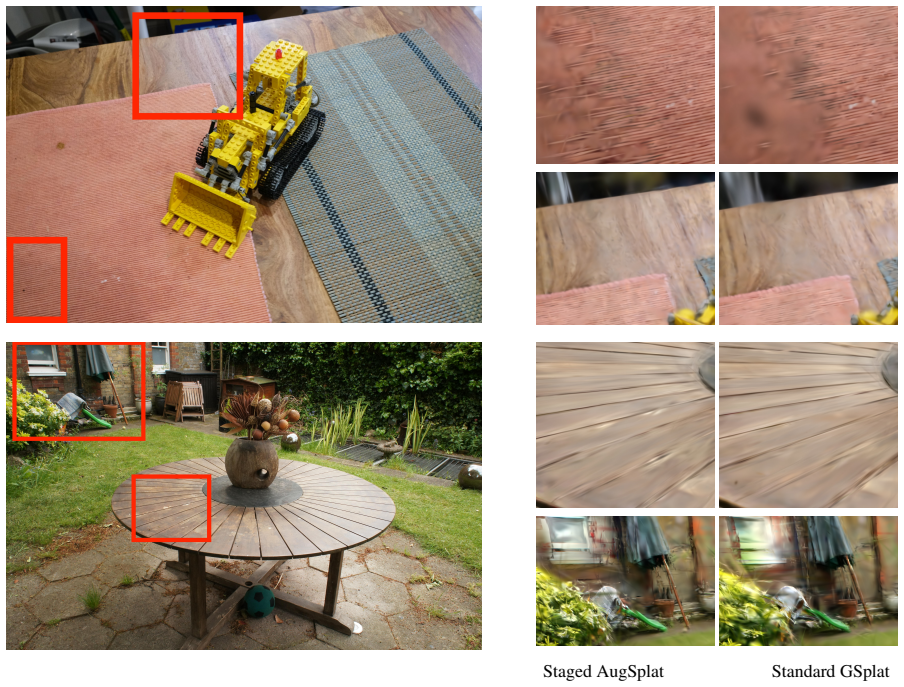
A radiance field is first trained on the given sparse real views. It then synthesizes additional images from nearby novel viewpoints that increase view-space coverage. These synthetic images supply auxiliary supervision to Gaussian Splatting: Staged AugSplat optimizes first on the synthetic set before switching to real images, while Dual AugSplat trains jointly on both sets with a decaying weight on the synthetic loss. Both variants raise reconstruction quality on sparse-view mip-NeRF 360 scenes relative to standard Gaussian Splatting while preserving real-time rasterization at test time.
What carries the argument
Radiance field-informed view augmentation: a radiance field trained on sparse real views generates synthetic images used as auxiliary supervision for Gaussian Splatting optimization.
Load-bearing premise
The radiance field trained on the sparse real views produces synthetic images of high enough quality to supply beneficial auxiliary supervision without introducing artifacts that degrade the final Gaussian Splatting model.
What would settle it
A direct comparison showing that Gaussian Splatting models trained with the added synthetic views achieve lower PSNR, SSIM, or LPIPS scores than models trained only on the original sparse real views would falsify the benefit of the augmentation.
If this is right
- Staged AugSplat reaches the highest average performance across the tested sparse-view scenes.
- Dual AugSplat delivers nearly matching quality while keeping real-image supervision active throughout training.
- Both variants outperform standard Gaussian Splatting without sacrificing real-time rendering speed.
- The approach increases effective view coverage available for supervision in sparse regimes.
Where Pith is reading between the lines
- The same augmentation pattern could be tested on other fast-rendering methods that also depend on good initial geometry.
- Applying the staged schedule to progressively sparser input sets would reveal how much view density the radiance field can compensate for.
- The method implicitly suggests that any slow but robust sparse-view reconstructor could bootstrap a faster one through synthetic data.
- Real-world captures with uneven camera distributions would be a direct test of whether the synthesized views remain helpful outside controlled benchmarks.
Editorial analysis
A structured set of objections, weighed in public.
Referee Report
Summary. The paper introduces AugSplat, a framework that trains a radiance field on sparse input views to synthesize additional images from novel viewpoints, which are then used as auxiliary supervision for Gaussian Splatting optimization. Two variants are studied: Staged AugSplat (initial optimization on synthetic views followed by real-image supervision) and Dual AugSplat (joint optimization with a decaying weight on the synthetic loss). The central claim, based on experiments with sparse-view mip-NeRF 360 scenes, is that both variants improve reconstruction quality over standard Gaussian Splatting, with the staged variant achieving the strongest average performance, while preserving real-time rasterization at inference.
Significance. If the empirical results hold and the synthetic views prove beneficial without introducing harmful artifacts, the work provides a simple, practical bridge between radiance fields and Gaussian Splatting for sparse-view regimes. The explicit comparison of staged versus dual supervision schedules is a useful design contribution, and the emphasis on maintaining real-time inference is aligned with application needs.
major comments (2)
- [Abstract] Abstract: The statement that 'Experiments on sparse-view mip-NeRF 360 scenes show that AugSplat improves reconstruction quality over standard Gaussian Splatting' and that 'Staged AugSplat achieves the strongest average performance' is presented without any quantitative metrics (PSNR, SSIM, LPIPS), baseline tables, or error analysis. This absence makes the central empirical claim impossible to evaluate from the provided information.
- [Method / Experiments] Method description (and Experiments section): No quantitative validation is supplied that the radiance field, trained only on the sparse real views, produces synthetic images whose geometry and appearance are sufficiently accurate to serve as auxiliary supervision. In particular, there is no reported correlation between radiance-field quality on held-out real views and the observed GS improvement, leaving the key assumption that synthetic views are net beneficial (rather than artifact-inducing) untested.
minor comments (1)
- [Abstract] The abstract would be clearer if it briefly named the evaluation metrics and the number of scenes or views used in the mip-NeRF 360 experiments.
Simulated Author's Rebuttal
We thank the referee for the constructive comments on our manuscript. Below we provide point-by-point responses to the major comments and indicate the revisions we will make.
read point-by-point responses
-
Referee: [Abstract] Abstract: The statement that 'Experiments on sparse-view mip-NeRF 360 scenes show that AugSplat improves reconstruction quality over standard Gaussian Splatting' and that 'Staged AugSplat achieves the strongest average performance' is presented without any quantitative metrics (PSNR, SSIM, LPIPS), baseline tables, or error analysis. This absence makes the central empirical claim impossible to evaluate from the provided information.
Authors: We agree that the abstract would be strengthened by including concrete quantitative results. In the revised version we will update the abstract to report the key average improvements (e.g., PSNR, SSIM, LPIPS) achieved by Staged and Dual AugSplat relative to standard Gaussian Splatting on the sparse-view mip-NeRF 360 scenes, with explicit references to the corresponding tables. revision: yes
-
Referee: [Method / Experiments] Method description (and Experiments section): No quantitative validation is supplied that the radiance field, trained only on the sparse real views, produces synthetic images whose geometry and appearance are sufficiently accurate to serve as auxiliary supervision. In particular, there is no reported correlation between radiance-field quality on held-out real views and the observed GS improvement, leaving the key assumption that synthetic views are net beneficial (rather than artifact-inducing) untested.
Authors: The observation is correct: the current manuscript does not provide a direct quantitative assessment of radiance-field accuracy on held-out views or a correlation analysis with the observed Gaussian Splatting gains. While the end-to-end improvements serve as indirect support, we acknowledge that an explicit validation would be valuable. We will add a short analysis in the Experiments section that reports radiance-field metrics on held-out real views and examines their relationship to the final reconstruction quality. revision: yes
Circularity Check
No circularity: empirical augmentation method with independent supervision sources
full rationale
The paper presents AugSplat as a practical pipeline: train a radiance field on the given sparse real views, synthesize additional images from novel viewpoints, and use those as auxiliary supervision (either staged or dual-weighted) while optimizing Gaussian Splatting. No derivation chain, first-principles prediction, or fitted parameter is claimed to produce a result that is definitionally equivalent to the inputs. The reported gains are empirical measurements on mip-NeRF 360 scenes; the quality of the radiance-field synthetics is an external, falsifiable assumption rather than a self-referential fit. No self-citation is invoked as a uniqueness theorem or load-bearing premise, and the method does not rename a known result or smuggle an ansatz. The approach is therefore self-contained against external benchmarks.
Axiom & Free-Parameter Ledger
axioms (1)
- domain assumption A radiance field trained on sparse input views can synthesize additional novel viewpoints that are useful for supervising Gaussian Splatting.
Cite this review
Pith. "Pith review of AugSplat: Radiance Field-Informed Gaussian Splatting for Sparse-View Settings." pith.science (2026). https://pith.science/paper/XFAEIHBJ
@misc{pith2026260631556,
  author       = {Pith},
  title        = {Pith review of: AugSplat: Radiance Field-Informed Gaussian Splatting for Sparse-View Settings},
  year         = {2026},
  howpublished = {\url{https://pith.science/paper/XFAEIHBJ}},
  note         = {Machine review of arXiv:2606.31556}
}
read the original abstract
Generating high-quality novel views at real-time frame rates remains a central challenge in 3D vision, particularly in sparse-view scenarios. Neural radiance fields have demonstrated robust reconstruction from limited observations, but their reliance on volumetric rendering leads to high computational cost and slow inference. In contrast, Gaussian Splatting methods achieve real-time rendering through rasterization, but their optimization is highly sensitive to the quality of the initial geometry. This sensitivity becomes especially problematic in sparse-view settings, where limited observations often lead to incomplete or noisy point-cloud reconstructions. In this work, we present AugSplat, a simple framework for improving Gaussian Splatting in sparse-view regimes using radiance-field-based view augmentation. We first train a radiance field on the sparse input views and use it to synthesize additional images from nearby novel viewpoints, increasing the effective view-space coverage available for supervision. These synthetic views are then used as auxiliary supervision during Gaussian Splatting optimization. We study two variants: Staged AugSplat, which uses synthetic views for an initial optimization phase before switching to real images, and Dual AugSplat, which jointly trains on real and synthetic views with a decaying synthetic loss weight. Experiments on sparse-view mip-NeRF 360 scenes show that AugSplat improves reconstruction quality over standard Gaussian Splatting. Staged AugSplat achieves the strongest average performance, while Dual AugSplat provides a closely performing formulation that keeps real-image supervision active throughout training, and both variants preserve real-time rendering at inference.
Figures




Reference graph
Works this paper leans on
-
[1]
Barron, Ben Mildenhall, Matthew Tancik, Peter Hedman, Ricardo Martin-Brualla, and Pratul P
Jonathan T. Barron, Ben Mildenhall, Matthew Tancik, Peter Hedman, Ricardo Martin-Brualla, and Pratul P. Srinivasan. Mip-nerf: A multiscale representation for anti-aliasing neu- ral radiance fields. InProceedings of the IEEE/CVF Interna- tional Conference on Computer Vision, 2021. 5
work page 2021
-
[2]
Mip-nerf 360: Unbounded anti-aliased neural radiance fields
Jonathan T Barron, Ben Mildenhall, Dor Verbin, Pratul P Srinivasan, and Peter Hedman. Mip-nerf 360: Unbounded anti-aliased neural radiance fields. InCVPR, 2022. 2, 5
work page 2022
-
[3]
Barron, Ben Mildenhall, Dor Verbin, Pratul P
Jonathan T. Barron, Ben Mildenhall, Dor Verbin, Pratul P. Srinivasan, and Peter Hedman. Zip-nerf: Anti-aliased grid- based neural radiance fields. InICCV, 2023. 2
work page 2023
-
[4]
Learning implicit fields for generative shape modeling
Zhiqin Chen and Hao Zhang. Learning implicit fields for generative shape modeling. InCVPR, 2019. 1
work page 2019
-
[5]
Jaeyoung Chung, Suyoung Lee, Hyeongjin Nam, Lee Jaerin, and Kyoung Mu Lee. Luciddreamer: Domain-free genera- tion of 3d gaussian splatting scenes.IEEE transactions on visualization and computer graphics, PP, 2025. 2
work page 2025
-
[6]
Headgas: Real-time animatable head avatars via 3d gaussian splatting
Helisa Dhamo, Yinyu Nie, Arthur Moreau, Jifei Song, Richard Shaw, Yiren Zhou, and Eduardo P ´erez-Pellitero. Headgas: Real-time animatable head avatars via 3d gaussian splatting. InComputer Vision – ECCV 2024, pages 459–476. Springer Nature Switzerland, 2024. 2
work page 2024
-
[7]
Putting nerf on a diet: Semantically consistent few-shot view synthesis
Ajay Jain, Matthew Tancik, and Pieter Abbeel. Putting nerf on a diet: Semantically consistent few-shot view synthesis. InProceedings of the IEEE/CVF International Conference on Computer Vision (ICCV), pages 5885–5894, 2021. 1
work page 2021
-
[8]
3d gaussian splatting for real-time radiance field rendering.SIGGRAPH, 2023
Bernhard Kerbl, Georgios Kopanas, Thomas Leimk ¨uhler, and George Drettakis. 3d gaussian splatting for real-time radiance field rendering.SIGGRAPH, 2023. 1, 2
work page 2023
-
[9]
Jiahe Li, Jiawei Zhang, Xiao Bai, Jin Zheng, Xin Ning, Jun Zhou, and Lin Gu. Dngaussian: Optimizing sparse-view 3d gaussian radiance fields with global-local depth normaliza- tion. InProceedings of the IEEE/CVF Conference on Com- puter Vision and Pattern Recognition (CVPR), pages 20775– 20785, 2024. 2
work page 2024
-
[10]
Sgs-slam: Se- mantic gaussian splatting for neural dense slam
Mingrui Li, Shuhong Liu, Heng Zhou, Guohao Zhu, Na Cheng, Tianchen Deng, and Hongyu Wang. Sgs-slam: Se- mantic gaussian splatting for neural dense slam. InEuropean Conference on Computer Vision, pages 163–179. Springer,
-
[11]
Scaffold-gs: Structured 3d gaussians for view-adaptive rendering
Tao Lu, Mulin Yu, Linning Xu, Yuanbo Xiangli, Limin Wang, Dahua Lin, and Bo Dai. Scaffold-gs: Structured 3d gaussians for view-adaptive rendering. InProceedings of the IEEE/CVF Conference on Computer Vision and Pattern Recognition, pages 20654–20664, 2024. 2
work page 2024
-
[12]
Dawid Malarz, Weronika Smolak-Dy ˙zewska, Jacek Tabor, Sławomir Tadeja, and Przemysław Spurek. Gaussian splat- ting with nerf-based color and opacity.Computer Vision and Image Understanding, 251, 2025. 2
work page 2025
-
[13]
Ricardo Martin-Brualla, Noha Radwan, Mehdi S. M. Sajjadi, Jonathan T. Barron, Alexey Dosovitskiy, and Daniel Duck- worth. Nerf in the wild: Neural radiance fields for uncon- strained photo collections. InCVPR, 2021. 1
work page 2021
-
[14]
Hidenobu Matsuki, Riku Murai, Paul HJ Kelly, and Andrew J Davison. Gaussian splatting slam. InCVPR, 2024. 2
work page 2024
-
[15]
Occupancy networks: Learning 3d reconstruction in function space
Lars Mescheder, Michael Oechsle, Michael Niemeyer, Se- bastian Nowozin, and Andreas Geiger. Occupancy networks: Learning 3d reconstruction in function space. InCVPR,
-
[16]
Splatfields: Neural gaussian splats for sparse 3d and 4d re- construction
Marko Mihajlovic, Sergey Prokudin, Siyu Tang, Robert Maier, Federica Bogo, Tony Tung, and Edmond Boyer. Splatfields: Neural gaussian splats for sparse 3d and 4d re- construction. InEuropean Conference on Computer Vision (ECCV). Springer, 2024. 2
work page 2024
-
[17]
Srinivasan, Matthew Tancik, Jonathan T
Ben Mildenhall, Pratul P. Srinivasan, Matthew Tancik, Jonathan T. Barron, Ravi Ramamoorthi, and Ren Ng. Nerf: Representing scenes as neural radiance fields for view syn- thesis. InECCV, 2020. 1, 2
work page 2020
-
[18]
Human gaussian splatting: Real-time rendering of animatable avatars
Arthur Moreau, Jifei Song, Helisa Dhamo, Richard Shaw, Yiren Zhou, and Eduardo P ´erez-Pellitero. Human gaussian splatting: Real-time rendering of animatable avatars. In CVPR, 2024. 2
work page 2024
-
[19]
Instant neural graphics primitives with a multires- olution hash encoding.ACM Trans
Thomas M ¨uller, Alex Evans, Christoph Schied, and Alexan- der Keller. Instant neural graphics primitives with a multires- olution hash encoding.ACM Trans. Graph., 41(4):102:1– 102:15, 2022. 2
work page 2022
-
[20]
Barron, Ben Mildenhall, Mehdi S
Michael Niemeyer, Jonathan T. Barron, Ben Mildenhall, Mehdi S. M. Sajjadi, Andreas Geiger, and Noha Radwan. Regnerf: Regularizing neural radiance fields for view syn- thesis from sparse inputs. InProceedings of the IEEE/CVF Conference on Computer Vision and Pattern Recognition (CVPR), pages 5480–5490, 2022. 1, 2
work page 2022
-
[21]
Radsplat: Radiance field-informed gaussian splat- ting for robust real-time rendering with 900+ fps
Michael Niemeyer, Fabian Manhardt, Marie-Julie Rakoto- saona, Michael Oechsle, Daniel Duckworth, Rama Gosula, Keisuke Tateno, John Bates, Dominik Kaeser, and Federico Tombari. Radsplat: Radiance field-informed gaussian splat- ting for robust real-time rendering with 900+ fps. In2025 International Conference on 3D Vision (3DV), pages 134– 144, 2025. 2
work page 2025
-
[22]
Deepsdf: Learning con- tinuous signed distance functions for shape representation
Jeong Joon Park, Peter Florence, Julian Straub, Richard Newcombe, and Steven Lovegrove. Deepsdf: Learning con- tinuous signed distance functions for shape representation. InCVPR, 2019. 1
work page 2019
-
[23]
Gaus- sianavatars: Photorealistic head avatars with rigged 3d gaus- sians
Shenhan Qian, Tobias Kirschstein, Liam Schoneveld, Davide Davoli, Simon Giebenhain, and Matthias Nießner. Gaus- sianavatars: Photorealistic head avatars with rigged 3d gaus- sians. InCVPR, 2024. 2
work page 2024
-
[24]
Langsplat: 3d language gaussian splatting
Minghan Qin, Wanhua Li, Jiawei Zhou, Haoqian Wang, and Hanspeter Pfister. Langsplat: 3d language gaussian splatting. InCVPR, 2024. 2
work page 2024
-
[25]
Splat- slam: Globally optimized rgb-only slam with 3d gaussians
Erik Sandstr ¨om, Ganlin Zhang, Keisuke Tateno, Michael Oechsle, Michael Niemeyer, Youmin Zhang, Manthan Patel, Luc Van Gool, Martin Oswald, and Federico Tombari. Splat- slam: Globally optimized rgb-only slam with 3d gaussians. InProceedings of the IEEE/CVF Conference on Computer Vision and Pattern Recognition (CVPR) Workshops, pages 1686–1697, 2025. 2
work page 2025
-
[26]
Schonberger and Jan-Michael Frahm
Johannes L. Schonberger and Jan-Michael Frahm. Structure- from-motion revisited. InProceedings of the IEEE Confer- ence on Computer Vision and Pattern Recognition (CVPR),
-
[27]
Language embedded 3d gaussians for open- vocabulary scene understanding
Jin-Chuan Shi, Miao Wang, Hao-Bin Duan, and Shao- Hua Guan. Language embedded 3d gaussians for open- vocabulary scene understanding. InCVPR, 2024. 2
work page 2024
-
[28]
Nerfstudio: A modular framework for neural radiance field development
Matthew Tancik, Ethan Weber, Evonne Ng, Ruilong Li, Brent Yi, Justin Kerr, Terrance Wang, Alexander Kristof- fersen, Jake Austin, Kamyar Salahi, Abhik Ahuja, David McAllister, and Angjoo Kanazawa. Nerfstudio: A modular framework for neural radiance field development. InACM SIGGRAPH 2023 Conference Proceedings, 2023. 5
work page 2023
-
[29]
Dreamgaussian: Generative gaussian splatting for ef- ficient 3d content creation
Jiaxiang Tang, Jiawei Ren, Hang Zhou, Ziwei Liu, and Gang Zeng. Dreamgaussian: Generative gaussian splatting for ef- ficient 3d content creation. InICLR, 2024. 2
work page 2024
-
[30]
Guangcong Wang, Zhaoxi Chen, Chen Change Loy, and Zi- wei Liu. Sparsenerf: Distilling depth ranking for few-shot novel view synthesis.IEEE/CVF International Conference on Computer Vision (ICCV), 2023. 2
work page 2023
-
[31]
Vggsfm: Visual geometry grounded deep structure from motion
Jianyuan Wang, Nikita Karaev, Christian Rupprecht, and David Novotny. Vggsfm: Visual geometry grounded deep structure from motion. InProceedings of the IEEE/CVF Conference on Computer Vision and Pattern Recognition (CVPR), pages 21686–21697, 2024. 1
work page 2024
-
[32]
Vggt: Visual geometry grounded transformer
Jianyuan Wang, Minghao Chen, Nikita Karaev, Andrea Vedaldi, Christian Rupprecht, and David Novotny. Vggt: Visual geometry grounded transformer. InProceedings of the IEEE/CVF Conference on Computer Vision and Pattern Recognition, 2025. 5
work page 2025
-
[33]
4d gaussian splatting for real-time dynamic scene rendering
Guanjun Wu, Taoran Yi, Jiemin Fang, Lingxi Xie, Xiaopeng Zhang, Wei Wei, Wenyu Liu, Qi Tian, and Xinggang Wang. 4d gaussian splatting for real-time dynamic scene rendering. InCVPR, 2024. 2
work page 2024
-
[34]
Neural fields in visual computing and beyond.Computer Graphics Forum, 41(2):641–676, 2022
Yiheng Xie, Towaki Takikawa, Shunsuke Saito, Or Litany, Shiqin Yan, Numair Khan, Federico Tombari, James Tomp- kin, Vincent Sitzmann, and Srinath Sridhar. Neural fields in visual computing and beyond.Computer Graphics Forum, 41(2):641–676, 2022. 1
work page 2022
-
[35]
Sparsegs: Sparse view synthesis using 3d gaussian splatting
Haolin Xiong, Sairisheek Muttukuru, Hanyuan Xiao, Rishi Upadhyay, Pradyumna Chari, Yajie Zhao, and Achuta Kadambi. Sparsegs: Sparse view synthesis using 3d gaussian splatting. InProceedings of the International Conference on 3D Vision (3DV), 2025. 2
work page 2025
-
[36]
4k4d: Real-time 4d view synthesis at 4k resolution
Zhen Xu, Sida Peng, Haotong Lin, Guangzhao He, Jiaming Sun, Yujun Shen, Hujun Bao, and Xiaowei Zhou. 4k4d: Real-time 4d view synthesis at 4k resolution. InCVPR, 2024. 2
work page 2024
-
[37]
Gs-slam: Dense visual slam with 3d gaussian splatting
Chi Yan, Delin Qu, Dan Xu, Bin Zhao, Zhigang Wang, Dong Wang, and Xuelong Li. Gs-slam: Dense visual slam with 3d gaussian splatting. InCVPR, 2024. 2
work page 2024
-
[38]
Vickie Ye, Ruilong Li, Justin Kerr, Matias Turkulainen, Brent Yi, Zhuoyang Pan, Otto Seiskari, Jianbo Ye, Jeffrey Hu, Matthew Tancik, and Angjoo Kanazawa. gsplat: An open-source library for gaussian splatting.Journal of Ma- chine Learning Research, 26(34):1–17, 2025. 5
work page 2025
-
[39]
Gaussiandreamer: Fast generation from text to 3d gaussians by bridging 2d and 3d diffusion models
Taoran Yi, Jiemin Fang, Junjie Wang, Guanjun Wu, Lingxi Xie, Xiaopeng Zhang, Wenyu Liu, Qi Tian, and Xinggang Wang. Gaussiandreamer: Fast generation from text to 3d gaussians by bridging 2d and 3d diffusion models. InCVPR,
-
[40]
pixelnerf: Neural radiance fields from one or few images
Alex Yu, Vickie Ye, Matthew Tancik, and Angjoo Kanazawa. pixelnerf: Neural radiance fields from one or few images. InProceedings of the IEEE/CVF Conference on Computer Vision and Pattern Recognition (CVPR), pages 4578–4587,
-
[41]
Shunyuan Zheng, Boyao Zhou, Ruizhi Shao, Boning Liu, Shengping Zhang, Liqiang Nie, and Yebin Liu. Gps- gaussian: Generalizable pixel-wise 3d gaussian splatting for real-time human novel view synthesis. InCVPR, 2024. 2
work page 2024
This paper was first reviewed by grok-4.3 on July 1, 2026.
discussion (0)
Sign in with ORCID, Apple, or X to comment. Anyone can read and Pith papers without signing in.