Gravitational collapse of matter fields in de Sitter spacetimes
Pith reviewed 2026-05-22 13:51 UTC · model grok-4.3
The pith
In de Sitter spacetimes, black hole and cosmological horizons develop as the time evolution of marginally trapped surfaces during gravitational collapse of matter fields.
A machine-rendered reading of the paper's core claim, the machinery that carries it, and where it could break.
Core claim
The quasilocal formalism of trapped surfaces provides an ideal framework to study the evolution of horizons. More precisely, black hole and cosmological horizons may be viewed as the time development of marginally trapped surfaces. This holds for a wide class of energy-momentum tensors including dust, perfect fluids with equations of state, fluids with radial and tangential pressure, and fluids with bulk and shear viscosity, under different initial conditions on velocity and density profiles.
What carries the argument
Spherical marginally trapped surfaces whose time development corresponds to the formation and growth of black-hole and cosmological horizons.
If this is right
- Horizon formation can be followed uniformly for dust, perfect fluids, and viscous fluids using the same trapped-surface evolution.
- Both black-hole and cosmological horizons arise from the same class of marginally trapped surfaces under the examined initial data.
- Analytical and numerical methods together suffice to track the surfaces throughout the collapse.
- The quasilocal description applies across the listed matter models without requiring global event-horizon definitions.
Where Pith is reading between the lines
- The same trapped-surface tracking might be examined in numerical relativity codes for cosmological collapse scenarios.
- The framework could be tested by relaxing spherical symmetry or by including additional matter couplings not covered in the present cases.
- It suggests that local trapped-surface conditions, rather than global causal boundaries, govern horizon dynamics in de Sitter-like expansion.
Load-bearing premise
The chosen initial conditions on velocity and density profiles, together with the broad range of energy-momentum tensors considered, capture the generic behavior of collapse and horizon formation in de Sitter spacetime.
What would settle it
A concrete counter-example in which a black-hole or cosmological horizon appears during collapse but does not arise as the time development of a marginally trapped surface would refute the claim.
Figures




read the original abstract
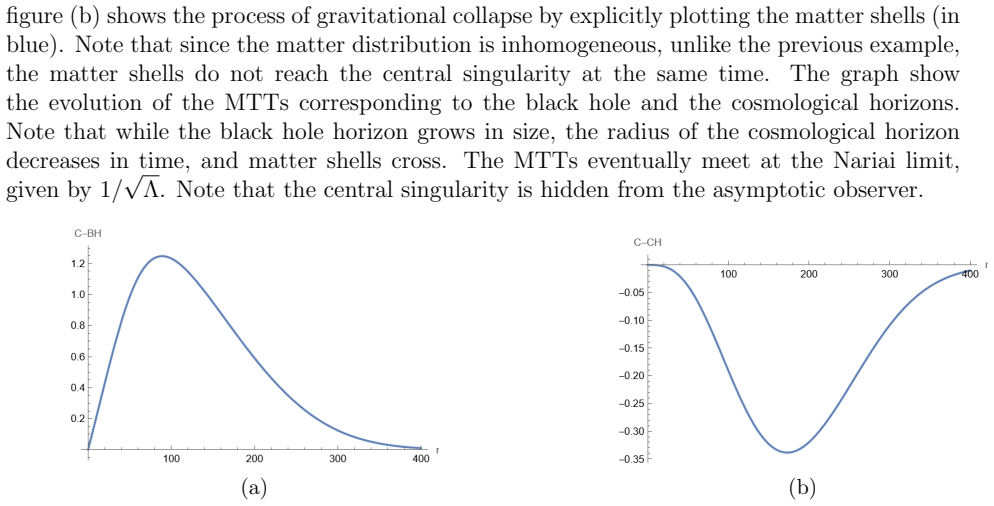
In this paper, we discuss the spherically symmetric gravitational collapse of matter fields in the de Sitter universe. The energy-momentum tensor of the matter field is assumed to admit a wide variety including dust, perfect fluids with equations of state, fluids with tangential and radial pressure, and with bulk and shear viscosity. Under different initial conditions imposed on the velocity and the density profiles, and by combining the results from exact analytical methods with those obtained from numerical techniques, we track the formation and evolution of spherical marginally trapped spheres as the matter suffers continual gravitational collapse. We show that the quasilocal formalism of trapped surfaces provides an ideal framework to study the evolution of horizons. More precisely, black hole and cosmological horizons may be viewed as the time development of marginally trapped surfaces.
Editorial analysis
A structured set of objections, weighed in public.
Referee Report
Summary. The manuscript studies spherically symmetric gravitational collapse of matter fields (dust, perfect fluids with various equations of state, fluids with radial/tangential pressure, and viscous fluids) in de Sitter spacetime. Under a range of initial velocity and density profiles, analytic and numerical methods are combined to follow the formation and evolution of spherical marginally trapped surfaces. The central claim is that the quasilocal trapped-surface formalism supplies an ideal framework for horizon dynamics, with black-hole and cosmological horizons appearing as the time development of marginally trapped surfaces.
Significance. If the results are robust, the work would supply a concrete quasilocal description linking marginally trapped surfaces to both black-hole and cosmological horizons in an expanding de Sitter background. This could clarify the dynamical relationship between trapped surfaces and apparent horizons for a family of matter models. The combination of exact solutions and numerical evolution is a positive feature, but the significance is limited by the absence of demonstrated insensitivity to the specific initial data and viscosity parameters chosen.
major comments (2)
- [Abstract / initial-conditions paragraph] Abstract and the section discussing initial conditions: the assertion that the quasilocal formalism provides an 'ideal framework' for the generic evolution of horizons is supported only by results for a finite collection of velocity/density profiles and the enumerated energy-momentum tensors (dust, perfect fluids, viscous fluids). No explicit test is reported showing that the observed MTS-to-horizon correspondence persists under changes in the initial profiles or in the viscosity coefficients; without such a check the stronger claim of generality remains conditional on the modeling choices.
- [Numerical methods section] The manuscript states that analytic and numerical techniques are combined to track trapped surfaces, yet the provided description contains no explicit convergence tests, error estimates, or resolution studies for the numerical component. Because the central claim concerns the time development of marginally trapped surfaces, the absence of these diagnostics leaves the reliability of the numerical horizon-tracking results unquantified.
minor comments (2)
- [Section 2] Notation for the energy-momentum tensor components and the definition of the marginally trapped surface condition should be stated explicitly at the first appearance rather than assumed from standard references.
- [Figures] Figure captions for the evolution plots should include the specific initial velocity and density parameters used in each run to allow direct comparison with the text.
Simulated Author's Rebuttal
We thank the referee for the careful reading of our manuscript and for the constructive comments. We address each major comment below and indicate the revisions we will make to strengthen the presentation.
read point-by-point responses
-
Referee: [Abstract / initial-conditions paragraph] Abstract and the section discussing initial conditions: the assertion that the quasilocal formalism provides an 'ideal framework' for the generic evolution of horizons is supported only by results for a finite collection of velocity/density profiles and the enumerated energy-momentum tensors (dust, perfect fluids, viscous fluids). No explicit test is reported showing that the observed MTS-to-horizon correspondence persists under changes in the initial profiles or in the viscosity coefficients; without such a check the stronger claim of generality remains conditional on the modeling choices.
Authors: We acknowledge that the study examines a representative but finite set of matter models (dust, perfect fluids with various equations of state, fluids with radial/tangential pressure, and viscous fluids) and a selection of initial velocity and density profiles. The consistent formation and evolution of marginally trapped surfaces into black-hole and cosmological horizons across these cases supports the utility of the quasilocal approach in de Sitter spacetime. However, we did not perform systematic sensitivity tests to arbitrary variations in viscosity coefficients or additional profile families. In the revised manuscript we will adjust the abstract and the initial-conditions discussion to state that the results hold for the considered class of models and initial data, thereby qualifying the claim of generality without overstating the scope of the present work. revision: partial
-
Referee: [Numerical methods section] The manuscript states that analytic and numerical techniques are combined to track trapped surfaces, yet the provided description contains no explicit convergence tests, error estimates, or resolution studies for the numerical component. Because the central claim concerns the time development of marginally trapped surfaces, the absence of these diagnostics leaves the reliability of the numerical horizon-tracking results unquantified.
Authors: We agree that explicit numerical validation is necessary to quantify the reliability of the horizon-tracking results. Although the original manuscript combines analytic and numerical methods, it does not report convergence tests, grid resolutions, or error estimates. In the revised version we will add a subsection describing the numerical scheme, the resolutions employed, results of convergence studies under successive grid refinements, and estimates of numerical errors in the locations and time evolution of the marginally trapped surfaces. revision: yes
Circularity Check
No circularity: direct tracking of marginally trapped surfaces via analytics and numerics
full rationale
The derivation proceeds by imposing standard GR definitions of marginally trapped surfaces on spherically symmetric metrics in de Sitter, then solving the Einstein equations analytically for selected matter models (dust, perfect fluids, viscous fluids) and numerically for chosen velocity/density profiles. The observation that black-hole and cosmological horizons arise as the time development of these surfaces is extracted from the resulting trajectories of the apparent horizons; it is not presupposed by redefining the surfaces or by fitting parameters whose output is then relabeled a prediction. No load-bearing self-citations, uniqueness theorems imported from prior work by the same authors, or ansatzes smuggled via citation appear in the abstract or the described methodology. The representativeness of the chosen initial data is a question of scope, not a circular reduction of the central claim to its inputs.
Axiom & Free-Parameter Ledger
axioms (2)
- domain assumption Spherically symmetric spacetime and matter distribution
- domain assumption Energy-momentum tensor admits dust, perfect fluids, tangential/radial pressure, and viscous terms
Reference graph
Works this paper leans on
-
[1]
The Large Scale Structure of Spacetime
S.W. Hawking and G.F.R. Ellis, “The Large Scale Structure of Spacetime”, Cambridge University Press, Cambridge 1975
work page 1975
-
[2]
Wald, General Relativity, University of Chicago Press, 1984
Robert M. Wald, General Relativity, University of Chicago Press, 1984
work page 1984
-
[3]
L.D. Landau and E.M. Lifshitz, The Classical Theory of Fields, Pergamon Press, 1975
work page 1975
-
[4]
P.S. Joshi, Gravitational Collapse and Spacetime Singularities, Cambridge University Press, Cambridge, 2007
work page 2007
-
[5]
A. M. Abrahams and C. R. Evans, Phys. Rev. D49, 3998-4003 (1994) doi:10.1103/PhysRevD.49.3998
-
[6]
Rostworowski, [arXiv:2503.17549 [gr-qc]]
A. Rostworowski, [arXiv:2503.17549 [gr-qc]]
- [7]
-
[8]
R. Penrose, Riv. Nuovo Cim.1, 252 (1969) [Gen. Rel. Grav.34, 1141 (2002)]
work page 1969
-
[9]
Singularities and time asymmetry,
R. Penrose, “Singularities and time asymmetry,” S. W. Hawking and E. Israel, “General Relativity: An Einstein Centenary Survey, Pt.2,” Univ. Pr., 2010
work page 2010
- [10]
- [11]
- [12]
-
[13]
P. S. Joshi and D. Malafarina, Int. J. Mod. Phys. D20, 2641-2729 (2011)
work page 2011
- [14]
-
[15]
J. R. Oppenheimer and H. Snyder, Phys. Rev. 56, 455 (1939)
work page 1939
- [16]
-
[17]
R. C. Tolman, Proc. Nat. Acad. Sci.20, 169 (1934) [Gen. Rel. Grav.29, 935 (1997)]
work page 1934
- [18]
-
[19]
C. W. Misner and D. H. Sharp, Phys. Rev. 136, B571 (1964)
work page 1964
-
[20]
W. C. Hernandez and C. W. Misner, Astrophys. J.143, 452 (1966). 28
work page 1966
-
[21]
Exact solutions of Einstein’s field equations,
H. Stephani, D. Kramer, M. A. H. MacCallum, C. Hoenselaers and E. Herlt, “Exact solutions of Einstein’s field equations,” Cambridge Univ. Press, 2003
work page 2003
-
[22]
G. C. Omer, Proc. Nat. Acad. Sci. USA53, 1 (1965)
work page 1965
-
[23]
A. Krasinski, Cambridge Univ. Press, 2011, ISBN 978-0-511-88754-3
work page 2011
-
[24]
An introduction to general relativity and cosmology,
J. Plebanski and A. Krasinski, “An introduction to general relativity and cosmology,” Cambridge Univ. Press, (2006)
work page 2006
- [25]
-
[26]
S. S. Deshingkar, A. Chamorro, S. Jhingan and P. S. Joshi, Phys. Rev. D63, 124005 (2001)
work page 2001
- [27]
-
[28]
Gravitational dust collapse with cosmological constant
M. Cissoko, J. C. Fabris, J. Gariel, G. Le Denmat and N. O. Santos, [arXiv:gr-qc/9809057 [gr-qc]]
work page internal anchor Pith review Pith/arXiv arXiv
-
[29]
U. Debnath, S. Nath and S. Chakraborty, Mon. Not. Roy. Astron. Soc.369, 1961-1964 (2006)
work page 1961
-
[30]
D. M. Eardley and L. Smarr, Phys. Rev. D19, 2239 (1979)
work page 1979
- [31]
-
[32]
Papapetrou, ‘Formation of a singularity and causality’
A. Papapetrou, ‘Formation of a singularity and causality’. In A Random Walk in Relativ- ity and Cosmology, eds N. Dadhich, J. Krishna Rao, J. V. Narlikar, C. V. Vishveshwara. New Delhi: Wiley Eastern (1985)
work page 1985
-
[33]
R. P. A. C. Newman, Class. Quant. Grav.3, 527 (1986)
work page 1986
- [34]
-
[35]
R. P. A. C. Newman and P. S. Joshi, Ann. Phys.182, 112 (1988)
work page 1988
-
[36]
I. H. Dwivedi and P. S. Joshi, Class. Quant. Grav.6, 1599 (1989)
work page 1989
- [37]
- [38]
- [39]
-
[40]
P. S. Joshi and I. H. Dwivedi, Phys. Rev. D47, 5357 (1993)
work page 1993
- [41]
-
[42]
I. H. Dwivedi and P. S. Joshi, Commun. Math. Phys.166, 117 (1994)
work page 1994
-
[43]
T. P. Singh and P. S. Joshi, Class. Quant. Grav.13, 559 (1996)
work page 1996
-
[44]
S. Jhingan, P. S. Joshi and T. P. Singh, Class. Quant. Grav.13, 3057 (1996)
work page 1996
- [45]
- [46]
- [47]
-
[48]
P. S. Joshi and I. H. Dwivedi, Class. Quant. Grav.16, 41 (1999)
work page 1999
- [49]
- [50]
-
[51]
R. Hassannejad, A. Sadeghi and F. Shojai, Class. Quant. Grav.40, no.7, 075002 (2023)
work page 2023
- [52]
- [53]
-
[54]
Nariai, reprinted, with historical comments in Gen
H. Nariai, reprinted, with historical comments in Gen. Rel. Grav.31, 951 (1999)
work page 1999
- [55]
- [56]
- [57]
- [58]
- [59]
- [60]
-
[61]
S. L. Shapiro and S. A. Teukolsky, New York, USA: Wiley (1983)
work page 1983
-
[62]
Numerical Relativity: Solving Einstein’s Equations on the Computer,
T. W. Baumgarte and S. L. Shapiro, “Numerical Relativity: Solving Einstein’s Equations on the Computer,” Cambridge University Press (2010)
work page 2010
-
[63]
S. A. Hayward, Phys. Rev. D49, 6467 (1994)
work page 1994
-
[64]
A. Chatterjee, B. Chatterjee and A. Ghosh, Phys. Rev. D87, no. 8, 084051 (2013)
work page 2013
-
[65]
A. Ashtekar, C. Beetle, O. Dreyer, S. Fairhurst, B. Krishnan, J. Lewandowski and J. Wis- niewski, Phys. Rev. Lett.85, 3564 (2000)
work page 2000
- [66]
- [67]
- [68]
-
[69]
A. Ashtekar, J. Baez, A. Corichi and K. Krasnov, Phys. Rev. Lett.80, 904 (1998)
work page 1998
- [70]
- [71]
- [72]
-
[73]
A. Ashtekar and G. J. Galloway, Adv. Theor. Math. Phys.9, no. 1, 1 (2005)
work page 2005
-
[74]
L. Andersson, M. Mars and W. Simon, Phys. Rev. Lett.95, 111102 (2005). 30
work page 2005
-
[75]
L. Andersson, M. Mars and W. Simon, Adv. Theor. Math. Phys.12, no. 4, 853 (2008)
work page 2008
- [76]
- [77]
- [78]
-
[79]
I. Bengtsson, E. Jakobsson and J. M. M. Senovilla, Phys. Rev. D88, 064012 (2013)
work page 2013
- [80]
discussion (0)
Sign in with ORCID, Apple, or X to comment. Anyone can read and Pith papers without signing in.