REVIEW 3 major objections 5 minor 227 references
Reinforcement Fine-Tuning Powers Reasoning Capability of Multimodal Large Language Models
T0 review · 3 major / 5 minor · reviewed 2026-08-07 · deepseek-v4-flash
Pith's one-line read The paper argues that reinforcement fine-tuning (RFT), not supervised fine-tuning alone, is what gives multimodal large language models their reasoning power across vision, audio, video, GUI, and agent settings.
desk verdict A useful map of RFT-for-MLLM work whose central causal claim outruns the evidence it surveys. read the letter →
The pith
A machine-rendered reading of the paper's core claim, the machinery that carries it, and where it could break.
The reading
What carries the argument
The key machinery is the RFT training loop itself: a policy model initialized from an SFT model, a reward signal that is either an outcome reward (rule-based correctness) or a process reward model, and an on-policy RL optimizer, chiefly PPO (proximal policy optimization with a critic value model) or GRPO (group relative policy optimization, which replaces the critic with group-normalized rewards). The paper renames the common taxonomy as critic-model-driven versus critic-model-free algorithms, arguing this fits classical RL better than the earlier value-based/value-free distinction. This loop is what transforms a model that can describe images or audio into one that can reason step by step. The paper treats this loop as the portable ingredient that carries reasoning gains across modalities.
What would settle it
A controlled study that trains the same base model on the same curated multimodal reasoning data with the same compute budget under two conditions, one with the RL objective and one with continued supervised fine-tuning, would settle the matter: if the SFT-only model matches the RL model's benchmark gains, the position is falsified.
Extended reading notes
Core claim
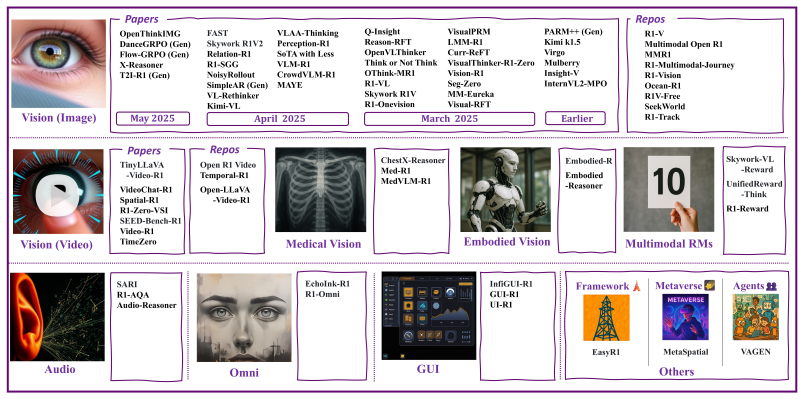
The paper's central claim is stated explicitly as its position: Reinforcement Fine-Tuning (RFT) powers reasoning capability of Multimodal Large Language Models (MLLMs). By RFT it means the post-training phase in which a model, typically initialized from a supervised fine-tuned base, is optimized by an RL objective such as PPO or GRPO with rule-based outcome rewards or learned process rewards. The paper reads the surge of results after DeepSeek-R1 as evidence that this paradigm transfers from text to multimodal domains: RFT reportedly improves visual math and multi-discipline reasoning, audio question answering, GUI action prediction, 3D metaverse spatial reasoning, video reasoning, medical and embodied vision, and even text-to-image generation. It classifies the community's progress into five successes and proposes five future directions: generalization across modalities, tasks, and domains; combining outcome and process rewards; safety of reasoning MLLMs; data augmentation; and better algorithms and reward paradigms.
Load-bearing premise
The claim rests on the assumption that the reasoning gains reported in the surveyed works are caused by RFT itself, and not by earlier supervised fine-tuning, the choice of reward, curated data, extra compute, or test-time filtering.
Editorial extensions
If this is right
- If RFT is the powering ingredient, training pipelines for multimodal reasoners should allocate marginal compute to RL post-training rather than only to further supervised data collection.
- Rule-based outcome rewards should keep working across tasks where correctness is verifiable, lowering the cost of multimodal reasoning training.
- The critic-model-free line (GRPO and variants) is likely to dominate in multimodal settings because it avoids the memory and stability cost of a critic.
- Benchmarks should be designed to test reasoning under RL training, not just static accuracy, since the paper reports trends toward harder, interactive, and process-oriented benchmarks.
- A generalizable reasoning model spanning modalities is a plausible near-term goal if RFT transfers as the cited works suggest.
Reading between the lines
- The paper's position would be stronger with controlled ablations: the surveyed works mostly compare RFT against an SFT baseline, so gains could partly come from more training compute, better data curation, or reward design rather than from the RL algorithm per se.
- One untested extension suggested by the position is unified reward models shared across modalities; the paper mentions multimodal reward training as a direction but does not propose a single cross-modal reward standard.
- If RFT is modality-agnostic, abrupt reasoning gains akin to vision's 'aha moments' should appear in audio and GUI agents too; the paper documents such cases anecdotally but does not measure them systematically.
- Safety may become the binding constraint: the paper flags reward hacking, jailbreaks, and overthinking as future work, which follows directly from giving verifiable rewards more weight.
Editorial analysis
A structured set of objections, weighed in public.
Referee Report
Summary. This position paper argues that reinforcement fine-tuning (RFT) powers the reasoning capability of multimodal large language models (MLLMs). After an introductory background on reinforcement learning and multimodal reasoning, the paper organizes recent work into five claimed successes: diverse modalities, diverse tasks and domains, better training algorithms, abundant benchmarks, and thriving engineering frameworks. It then proposes five future research directions. A companion GitHub repository collects the surveyed work. The paper contains no new experiments or quantitative meta-analysis; its central claim rests on a qualitative synthesis of recent preprints and open-source projects.
Significance. If the central claim were established, the paper would make a useful case for RFT as a general post-training mechanism for multimodal reasoning, organizing a fast-moving literature and giving newcomers a structured map of methods, benchmarks, and frameworks. The paper's strengths are its breadth of coverage (vision, video, audio, omni, GUI, medical, embodied, metaverse, agents, and generation), its taxonomy of critic-model-driven versus critic-model-free RFT algorithms, and the accompanying curated repository with links to code and models. However, the paper makes no original measurements, and the central causal claim is substantially stronger than the evidence it marshals: the cited works typically couple RFT with SFT cold starts, curated data selection, reward shaping, or additional compute, and the survey neither isolates the RFT component nor engages with null or mixed results. The paper is therefore more an annotated bibliography than a supported position statement in its current form.
major comments (3)
- [Section 3, opening paragraph and Successes 1-3] The central claim that 'RFT has significantly enhanced the reasoning abilities of MLLMs' is not supported by the cited evidence because no cited work isolates the RFT component from confounds. For example, Virgo [69] and LMM-R1 [72] use SFT cold starts, ThinkLite-VL [97] uses MCTS-filtered data, R1-VL [76] adds step-wise rewards, and OpenVLThinker [77] iterates SFT and GRPO with evolving data. The survey never reports an ablation in which only the RL component is toggled while base model, data, and inference budget are held fixed, nor does it discuss null or negative results. In particular, VLAA-Thinking [98] is cited as a success, yet its title and content directly investigate 'SFT or RL?' and report nuanced trade-offs; ignoring that result makes the causal attribution to RFT underdetermined. As a position paper, the argument must at least acknowledge these confounds and justify why RFT, rather than SFT data quality, reward design, or extra compute, is the operative factor.
- [Section 3, Successes 4-5] The sections on 'Abundant Benchmarks' and 'Thriving Engineering Frameworks' do not provide evidence for the causal claim that RFT powers reasoning. The proliferation of evaluation benchmarks and open-source RL frameworks shows community activity and lowered engineering barriers, but it says nothing about whether RFT is responsible for observed capability gains. Including these as 'successes' of RFT conflates the existence of tools with the efficacy of the method, weakening the argument's focus.
- [Appendix A and Section 3 text] The survey gives the same evidential weight to unreviewed code repositories as to full papers. Works such as VAGEN [56], MMR1 [73], R1-Track [91], and Open-R1-Video [102] are listed under 'Open-Source Projects (Repository without Paper)' and yet are cited in the text as demonstrating RFT effectiveness (e.g., 'VAGEN has advanced the training of VLM-based visual agents'). Without published results, benchmarks, or ablations, these items cannot support the strong causal claim. The authors should either reclassify such entries as community resources only or find peer-reviewed evidence for the specific claims made.
minor comments (5)
- [Section 2.1] The text says 'A donates the action space' and 's0 is the inital state'; both should be corrected to 'denotes' and 'initial state', respectively.
- [Section 2.3, Eq. (7)] The definition of the group relative advantage contains a typo: the paper writes 'ˆAi,t = eri = (r(oi,a) − mean(...))/std(...)', which mixes an exponential with the normalization formula. The GRPO advantage is the normalized reward, not an exponentiated one; please correct the equation or the surrounding explanation.
- [Section 3, bulleted questions in the introduction to Section 3] The sentence 'the community has made significant process' should read 'significant progress'.
- [Section 4, TO DO 3] The phrase 'According to [28], this point can generally be divided into three components' is unclear, since the three listed components (reward hacking, jailbreak attacks, overthinking) do not appear to be the organization of reference [28]; please clarify the attribution or rephrase.
- [Appendix A] Inconsistent naming appears for 'MAYE [144]' versus 'MAYA [144]' in the main text, and the appendix contains spacing artifacts such as 'OpenLLaV A-Video-R1' and 'GUI-R1 [52]' versus 'GUI-R1 [53]' in Section 3; these should be harmonized.
Circularity Check
No construction-circularity: the survey's position is an external synthesis of cited empirical results, not a derivation from its own assumptions.
full rationale
The paper is a position paper/survey. Its POSITION is stated in Section 1 and repeated in Section 3, but the supporting evidence is a list of externally reported RFT-for-MLLM papers and benchmarks (Sections 3 and Appendix A), each with its own independent training recipes and evaluations. There is no fitted parameter later renamed as a prediction, no target quantity defined in terms of itself, no unique-solution theorem imported from the authors' own prior work, and no equation in which the output is identical to the input by construction. The closest concern is evidentiary rather than circular: each cited work includes SFT cold starts, data filtering, reward shaping, or extra compute (e.g., Virgo [69], LMM-R1 [72], ThinkLite-VL [97], OpenVLThinker [77]), so the survey does not isolate the RFT component; and VLAA-Thinking [98], titled 'SFT or RL?', is cited as evidence of RFT success without its trade-off conclusion being discussed. That is a threat to the strength of the causal generalization, but it is a confound/rigor critique, not a case where the paper's derivation reduces to its inputs. The paper's background sections restate standard RL definitions from external textbooks and papers. No self-citation is load-bearing. Accordingly the circularity score is 0.
Assumptions & free parameters
assumptions (3)
- domain assumption Reported improvements in the cited works are attributable to RFT rather than to auxiliary factors such as SFT stages, data curation, reward design, or added compute.
- domain assumption The surveyed works, including unreviewed preprints and open-source repositories, are treated as valid demonstrations of the claim.
- standard math Standard reinforcement learning background, including MDPs, PPO, and GRPO, as presented in Section 2, is correct.
Cite this review
Pith. "Pith review of Reinforcement Fine-Tuning Powers Reasoning Capability of Multimodal Large Language Models." pith.science (2026). https://pith.science/paper/XJZ2HTY4
@misc{pith2026250518536,
  author       = {Pith},
  title        = {Pith review of: Reinforcement Fine-Tuning Powers Reasoning Capability of Multimodal Large Language Models},
  year         = {2026},
  howpublished = {\url{https://pith.science/paper/XJZ2HTY4}},
  note         = {Machine review of arXiv:2505.18536}
}
read the original abstract
Standing in 2025, at a critical juncture in the pursuit of Artificial General Intelligence (AGI), reinforcement fine-tuning (RFT) has demonstrated significant potential in enhancing the reasoning capability of large language models (LLMs) and has led to the development of cutting-edge AI models such as OpenAI-o1 and DeepSeek-R1. Moreover, the efficient application of RFT to enhance the reasoning capability of multimodal large language models (MLLMs) has attracted widespread attention from the community. In this position paper, we argue that reinforcement fine-tuning powers the reasoning capability of multimodal large language models. To begin with, we provide a detailed introduction to the fundamental background knowledge that researchers interested in this field should be familiar with. Furthermore, we meticulously summarize the improvements of RFT in powering reasoning capability of MLLMs into five key points: diverse modalities, diverse tasks and domains, better training algorithms, abundant benchmarks and thriving engineering frameworks. Finally, we propose five promising directions for future research that the community might consider. We hope that this position paper will provide valuable insights to the community at this pivotal stage in the advancement toward AGI. Summary of works done on RFT for MLLMs is available at https://github.com/Sun-Haoyuan23/Awesome-RL-based-Reasoning-MLLMs.
Figures
Reference graph
Works this paper leans on
-
[98]
Sft or rl? an early investigation into training r1-like reasoning large vision- language models
Hardy Chen, Haoqin Tu, Fali Wang, Hui Liu, Xianfeng Tang, Xinya Du, Yuyin Zhou, and Cihang Xie. Sft or rl? an early investigation into training r1-like reasoning large vision- language models. arXiv preprint arXiv:2504.11468, 2025
arXiv 2025
-
[69]
Virgo: A preliminary exploration on reproducing o1-like mllm
Yifan Du, Zikang Liu, Yifan Li, Wayne Xin Zhao, Yuqi Huo, Bingning Wang, Weipeng Chen, Zheng Liu, Zhongyuan Wang, and Ji-Rong Wen. Virgo: A preliminary exploration on reproducing o1-like mllm. arXiv preprint arXiv:2501.01904, 2025
arXiv 2025
-
[72]
Lmm-r1: Empowering 3b lmms with strong reasoning abilities through two-stage rule-based rl
Yingzhe Peng, Gongrui Zhang, Miaosen Zhang, Zhiyuan You, Jie Liu, Qipeng Zhu, Kai Yang, Xingzhong Xu, Xin Geng, and Xu Yang. Lmm-r1: Empowering 3b lmms with strong reasoning abilities through two-stage rule-based rl. arXiv preprint arXiv:2503.07536, 2025
arXiv 2025
-
[97]
Sota with less: Mcts-guided sample selection for data-efficient visual reasoning self-improvement
Xiyao Wang, Zhengyuan Yang, Chao Feng, Hongjin Lu, Linjie Li, Chung-Ching Lin, Kevin Lin, Furong Huang, and Lijuan Wang. Sota with less: Mcts-guided sample selection for data-efficient visual reasoning self-improvement. arXiv preprint arXiv:2504.07934, 2025
arXiv 2025
-
[76]
Jingyi Zhang, Jiaxing Huang, Huanjin Yao, Shunyu Liu, Xikun Zhang, Shijian Lu, and Dacheng Tao. R1-vl: Learning to reason with multimodal large language models via step-wise group relative policy optimization. arXiv preprint arXiv:2503.12937, 2025
arXiv 2025
-
[77]
Yihe Deng, Hritik Bansal, Fan Yin, Nanyun Peng, Wei Wang, and Kai-Wei Chang. Open- vlthinker: An early exploration to complex vision-language reasoning via iterative self- improvement. arXiv preprint arXiv:2503.17352, 2025
arXiv 2025
-
[56]
Vagen: Training vlm agents with multi-turn reinforcement learning, 2025
Kangrui Wang, Pingyue Zhang, Zihan Wang, Qineng Wang, Yaning Gao, Linjie Li, Zhengyuan Yang, Chi Wan, Hanyang Chen, Yiping Lu, and Manling Li. Vagen: Training vlm agents with multi-turn reinforcement learning, 2025. URL https://github.com/RAGEN-AI/ VAGEN
2025
-
[73]
Mmr1: Ad- vancing the frontiers of multimodal reasoning
Sicong Leng, Jing Wang, Jiaxi Li, Hao Zhang, Zhiqiang Hu, Boqiang Zhang, Hang Zhang, Yuming Jiang, Xin Li, Deli Zhao, Fan Wang, Yu Rong, Aixin Sun, and Shijian Lu. Mmr1: Ad- vancing the frontiers of multimodal reasoning. https://github.com/LengSicong/ MMR1, 2025
2025
-
[91]
R1-track: Direct application of mllms to visual object tracking via reinforcement learning
Biao Wang. R1-track: Direct application of mllms to visual object tracking via reinforcement learning. https://github.com/Wangbiao2/R1-Track, 2025
2025
-
[102]
Open-r1-video
Xiaodong Wang and Peixi Peng. Open-r1-video. https://github.com/ Wang-Xiaodong1899/Open-R1-Video , 2025
2025
Show all 227 references
-
[1]
Reinforcement learning: An introduction, volume 1
Richard S Sutton, Andrew G Barto, et al. Reinforcement learning: An introduction, volume 1. MIT press Cambridge, 1998
1998
-
[2]
Proximal policy optimization algorithms
John Schulman, Filip Wolski, Prafulla Dhariwal, Alec Radford, and Oleg Klimov. Proximal policy optimization algorithms. arXiv preprint arXiv:1707.06347, 2017
2017 arXiv
-
[3]
Training language models to follow instructions with human feedback
Long Ouyang, Jeffrey Wu, Xu Jiang, Diogo Almeida, Carroll Wainwright, Pamela Mishkin, Chong Zhang, Sandhini Agarwal, Katarina Slama, Alex Ray, et al. Training language models to follow instructions with human feedback. Advances in neural information processing systems, 35:2773...
2022
-
[4]
Gpt-4 technical report
Josh Achiam, Steven Adler, Sandhini Agarwal, Lama Ahmad, Ilge Akkaya, Florencia Leoni Aleman, Diogo Almeida, Janko Altenschmidt, Sam Altman, Shyamal Anadkat, et al. Gpt-4 technical report. arXiv preprint arXiv:2303.08774, 2023
2023 arXiv
-
[5]
Llama: Open and efficient foundation language models
Hugo Touvron, Thibaut Lavril, Gautier Izacard, Xavier Martinet, Marie-Anne Lachaux, Timo- thée Lacroix, Baptiste Rozière, Naman Goyal, Eric Hambro, Faisal Azhar, et al. Llama: Open and efficient foundation language models. arXiv preprint arXiv:2302.13971, 2023
2023 arXiv
-
[6]
Llama 2: Open foundation and fine-tuned chat models
Hugo Touvron, Louis Martin, Kevin Stone, Peter Albert, Amjad Almahairi, Yasmine Babaei, Nikolay Bashlykov, Soumya Batra, Prajjwal Bhargava, Shruti Bhosale, et al. Llama 2: Open foundation and fine-tuned chat models. arXiv preprint arXiv:2307.09288, 2023
2023 arXiv
-
[7]
Introducing openai o1
OpenAI. Introducing openai o1. https://openai.com/o1/, 2024
2024
-
[8]
Deepseek-r1: Incentivizing reasoning capability in llms via reinforcement learning
Daya Guo, Dejian Yang, Haowei Zhang, Junxiao Song, Ruoyu Zhang, Runxin Xu, Qihao Zhu, Shirong Ma, Peiyi Wang, Xiao Bi, et al. Deepseek-r1: Incentivizing reasoning capability in llms via reinforcement learning. arXiv preprint arXiv:2501.12948, 2025
2025 arXiv
-
[9]
Mind with eyes: from language reasoning to multimodal reasoning
Zhiyu Lin, Yifei Gao, Xian Zhao, Yunfan Yang, and Jitao Sang. Mind with eyes: from language reasoning to multimodal reasoning. arXiv preprint arXiv:2503.18071, 2025
2025 arXiv
-
[10]
Reinforced mllm: A survey on rl-based reasoning in multimodal large language models
Guanghao Zhou, Panjia Qiu, Cen Chen, Jie Wang, Zheming Yang, Jian Xu, and Minghui Qiu. Reinforced mllm: A survey on rl-based reasoning in multimodal large language models. arXiv preprint arXiv:2504.21277, 2025
2025 arXiv
-
[11]
A markovian decision process
Richard Bellman. A markovian decision process. Journal of mathematics and mechanics, pages 679–684, 1957
1957
-
[12]
Convergence of q-learning: A simple proof
Francisco S Melo. Convergence of q-learning: A simple proof. Institute Of Systems and Robotics, Tech. Rep, pages 1–4, 2001
2001
-
[13]
Playing atari with deep reinforcement learning.arXiv preprint arXiv:1312.5602, 2013
V olodymyr Mnih, Koray Kavukcuoglu, David Silver, Alex Graves, Ioannis Antonoglou, Daan Wierstra, and Martin Riedmiller. Playing atari with deep reinforcement learning.arXiv preprint arXiv:1312.5602, 2013
2013 arXiv
-
[14]
Human-level control through deep reinforcement learning
V olodymyr Mnih, Koray Kavukcuoglu, David Silver, Andrei A Rusu, Joel Veness, Marc G Bellemare, Alex Graves, Martin Riedmiller, Andreas K Fidjeland, Georg Ostrovski, et al. Human-level control through deep reinforcement learning. nature, 518(7540):529–533, 2015
2015
-
[15]
Deep reinforcement learning with double q-learning
Hado Van Hasselt, Arthur Guez, and David Silver. Deep reinforcement learning with double q-learning. In Proceedings of the AAAI conference on artificial intelligence, volume 30, 2016. 10
2016
-
[16]
Dueling network architectures for deep reinforcement learning
Ziyu Wang, Tom Schaul, Matteo Hessel, Hado Hasselt, Marc Lanctot, and Nando Freitas. Dueling network architectures for deep reinforcement learning. In International conference on machine learning, pages 1995–2003. PMLR, 2016
1995
-
[17]
Rainbow: Combining improvements in deep reinforcement learning
Matteo Hessel, Joseph Modayil, Hado Van Hasselt, Tom Schaul, Georg Ostrovski, Will Dabney, Dan Horgan, Bilal Piot, Mohammad Azar, and David Silver. Rainbow: Combining improvements in deep reinforcement learning. In Proceedings of the AAAI conference on artificial intelligence,...
2018
-
[18]
Policy gradi- ent methods for reinforcement learning with function approximation
Richard S Sutton, David McAllester, Satinder Singh, and Yishay Mansour. Policy gradi- ent methods for reinforcement learning with function approximation. Advances in neural information processing systems, 12, 1999
1999
-
[19]
Actor-critic algorithms
Vijay Konda and John Tsitsiklis. Actor-critic algorithms. Advances in neural information processing systems, 12, 1999
1999
-
[20]
Asynchronous methods for deep reinforce- ment learning
V olodymyr Mnih, Adria Puigdomenech Badia, Mehdi Mirza, Alex Graves, Timothy Lillicrap, Tim Harley, David Silver, and Koray Kavukcuoglu. Asynchronous methods for deep reinforce- ment learning. In International conference on machine learning, pages 1928–1937. PmLR, 2016
1928
-
[21]
Trust region policy optimization
John Schulman, Sergey Levine, Pieter Abbeel, Michael Jordan, and Philipp Moritz. Trust region policy optimization. In International conference on machine learning, pages 1889–1897. PMLR, 2015
2015
-
[22]
Llm as a mastermind: A survey of strategic reasoning with large language models
Yadong Zhang, Shaoguang Mao, Tao Ge, Xun Wang, Adrian de Wynter, Yan Xia, Wenshan Wu, Ting Song, Man Lan, and Furu Wei. Llm as a mastermind: A survey of strategic reasoning with large language models. arXiv preprint arXiv:2404.01230, 2024
2024 arXiv
-
[23]
Reasoning with large language models, a survey
Aske Plaat, Annie Wong, Suzan Verberne, Joost Broekens, Niki van Stein, and Thomas Back. Reasoning with large language models, a survey. arXiv preprint arXiv:2407.11511, 2024
2024
-
[24]
Towards large reasoning models: A survey of reinforced reasoning with large language models
Fengli Xu, Qianyue Hao, Zefang Zong, Jingwei Wang, Yunke Zhang, Jingyi Wang, Xiaochong Lan, Jiahui Gong, Tianjian Ouyang, Fanjin Meng, et al. Towards large reasoning models: A survey of reinforced reasoning with large language models. arXiv preprint arXiv:2501.09686, 2025
2025 arXiv
-
[25]
A tutorial on llm reasoning: Relevant methods behind chatgpt o1
Jun Wang. A tutorial on llm reasoning: Relevant methods behind chatgpt o1. arXiv preprint arXiv:2502.10867, 2025
2025 arXiv
-
[26]
Thinking machines: A survey of llm based reasoning strategies
Dibyanayan Bandyopadhyay, Soham Bhattacharjee, and Asif Ekbal. Thinking machines: A survey of llm based reasoning strategies. arXiv preprint arXiv:2503.10814, 2025
2025 arXiv
-
[27]
Towards reasoning era: A survey of long chain-of-thought for reasoning large language models
Qiguang Chen, Libo Qin, Jinhao Liu, Dengyun Peng, Jiannan Guan, Peng Wang, Mengkang Hu, Yuhang Zhou, Te Gao, and Wanxiang Che. Towards reasoning era: A survey of long chain-of-thought for reasoning large language models. arXiv preprint arXiv:2503.09567, 2025
2025 arXiv
-
[28]
100 days after deepseek-r1: A survey on replication studies and more directions for reasoning language models
Chong Zhang, Yue Deng, Xiang Lin, Bin Wang, Dianwen Ng, Hai Ye, Xingxuan Li, Yao Xiao, Zhanfeng Mo, Qi Zhang, et al. 100 days after deepseek-r1: A survey on replication studies and more directions for reasoning language models. arXiv preprint arXiv:2505.00551, 2025
2025 arXiv
-
[29]
Investigating inference-time scaling for chain of multi-modal thought: A preliminary study
Yujie Lin, Ante Wang, Moye Chen, Jingyao Liu, Hao Liu, Jinsong Su, and Xinyan Xiao. Investigating inference-time scaling for chain of multi-modal thought: A preliminary study. arXiv preprint arXiv:2502.11514, 2025
2025 arXiv
-
[30]
Multimodal chain-of-thought reasoning: A comprehensive survey
Yaoting Wang, Shengqiong Wu, Yuecheng Zhang, Shuicheng Yan, Ziwei Liu, Jiebo Luo, and Hao Fei. Multimodal chain-of-thought reasoning: A comprehensive survey. arXiv preprint arXiv:2503.12605, 2025
2025 arXiv
-
[31]
Perception, reason, think, and plan: A survey on large multimodal reasoning models, 2025
Yunxin Li, Zhenyu Liu, Zitao Li, Xuanyu Zhang, Zhenran Xu, Xinyu Chen, Haoyuan Shi, Shenyuan Jiang, Xintong Wang, Jifang Wang, Shouzheng Huang, Xinping Zhao, Borui Jiang, Lanqing Hong, Longyue Wang, Zhuotao Tian, Baoxing Huai, Wenhan Luo, Weihua Luo, Zheng Zhang, Baotian Hu, a...
2025
-
[32]
Kimi Team, Angang Du, Bofei Gao, Bowei Xing, Changjiu Jiang, Cheng Chen, Cheng Li, Chenjun Xiao, Chenzhuang Du, Chonghua Liao, et al. Kimi k1. 5: Scaling reinforcement learning with llms. arXiv preprint arXiv:2501.12599, 2025
2025 arXiv
-
[33]
Introducing openai o3 and o4-mini
OpenAI. Introducing openai o3 and o4-mini. https://openai.com/index/ introducing-o3-and-o4-mini/ , 2025
2025
-
[34]
Grok 3 beta — the age of reasoning agents
xAI. Grok 3 beta — the age of reasoning agents. https://x.ai/grok, 2025
2025
-
[35]
Open-reasoner-zero: An open source approach to scaling up reinforcement learning on the base model
Jingcheng Hu, Yinmin Zhang, Qi Han, Daxin Jiang, Xiangyu Zhang, and Heung-Yeung Shum. Open-reasoner-zero: An open source approach to scaling up reinforcement learning on the base model. arXiv preprint arXiv:2503.24290, 2025
2025 arXiv
-
[36]
High- dimensional continuous control using generalized advantage estimation
John Schulman, Philipp Moritz, Sergey Levine, Michael Jordan, and Pieter Abbeel. High- dimensional continuous control using generalized advantage estimation. arXiv preprint arXiv:1506.02438, 2015
2015 arXiv
-
[37]
What’s behind ppo’s collapse in long-cot? value optimization holds the secret
Yufeng Yuan, Yu Yue, Ruofei Zhu, Tiantian Fan, and Lin Yan. What’s behind ppo’s collapse in long-cot? value optimization holds the secret. arXiv preprint arXiv:2503.01491, 2025
2025 arXiv
-
[38]
Deepseekmath: Pushing the limits of mathematical reasoning in open language models
Zhihong Shao, Peiyi Wang, Qihao Zhu, Runxin Xu, Junxiao Song, Xiao Bi, Haowei Zhang, Mingchuan Zhang, YK Li, Y Wu, et al. Deepseekmath: Pushing the limits of mathematical reasoning in open language models. arXiv preprint arXiv:2402.03300, 2024
2024 arXiv
-
[39]
Approximating kl divergence
John Schulman. Approximating kl divergence. http://joschu.net/blog/ kl-approx.html, 2020
2020
-
[40]
Dapo: An open-source llm reinforcement learning system at scale
Qiying Yu, Zheng Zhang, Ruofei Zhu, Yufeng Yuan, Xiaochen Zuo, Yu Yue, Tiantian Fan, Gaohong Liu, Lingjun Liu, Xin Liu, et al. Dapo: An open-source llm reinforcement learning system at scale. arXiv preprint arXiv:2503.14476, 2025
2025 arXiv
-
[41]
Understanding r1-zero-like training: A critical perspective
Zichen Liu, Changyu Chen, Wenjun Li, Penghui Qi, Tianyu Pang, Chao Du, Wee Sun Lee, and Min Lin. Understanding r1-zero-like training: A critical perspective. arXiv preprint arXiv:2503.20783, 2025
2025 arXiv
-
[42]
Light-r1: Curriculum sft, dpo and rl for long cot from scratch and beyond
Liang Wen, Yunke Cai, Fenrui Xiao, Xin He, Qi An, Zhenyu Duan, Yimin Du, Junchen Liu, Lifu Tang, Xiaowei Lv, et al. Light-r1: Curriculum sft, dpo and rl for long cot from scratch and beyond. arXiv preprint arXiv:2503.10460, 2025
2025 arXiv
-
[43]
Tinyzero
Jiayi Pan, Junjie Zhang, Xingyao Wang, Lifan Yuan, Hao Peng, and Alane Suhr. Tinyzero. https://github.com/Jiayi-Pan/TinyZero, 2025. Accessed: 2025-01-24
2025
-
[44]
Can 1b llm surpass 405b llm? rethinking compute-optimal test-time scaling
Runze Liu, Junqi Gao, Jian Zhao, Kaiyan Zhang, Xiu Li, Biqing Qi, Wanli Ouyang, and Bowen Zhou. Can 1b llm surpass 405b llm? rethinking compute-optimal test-time scaling. arXiv preprint arXiv:2502.06703, 2025
2025 arXiv
-
[45]
Visualprm: An effective process reward model for multimodal reasoning
Weiyun Wang, Zhangwei Gao, Lianjie Chen, Zhe Chen, Jinguo Zhu, Xiangyu Zhao, Yangzhou Liu, Yue Cao, Shenglong Ye, Xizhou Zhu, et al. Visualprm: An effective process reward model for multimodal reasoning. arXiv preprint arXiv:2503.10291, 2025
2025 arXiv
-
[46]
Can we generate images with cot? let’s verify and reinforce image generation step by step
Ziyu Guo, Renrui Zhang, Chengzhuo Tong, Zhizheng Zhao, Peng Gao, Hongsheng Li, and Pheng-Ann Heng. Can we generate images with cot? let’s verify and reinforce image generation step by step. arXiv preprint arXiv:2501.13926, 2025
2025 arXiv
-
[47]
Audio-reasoner: Improving reasoning capability in large audio language models
Zhifei Xie, Mingbao Lin, Zihang Liu, Pengcheng Wu, Shuicheng Yan, and Chunyan Miao. Audio-reasoner: Improving reasoning capability in large audio language models. arXiv preprint arXiv:2503.02318, 2025
2025
-
[48]
Reinforce- ment learning outperforms supervised fine-tuning: A case study on audio question answering
Gang Li, Jizhong Liu, Heinrich Dinkel, Yadong Niu, Junbo Zhang, and Jian Luan. Reinforce- ment learning outperforms supervised fine-tuning: A case study on audio question answering. arXiv preprint arXiv:2503.11197, 2025
2025 arXiv
-
[49]
Sari: Structured audio reasoning via curriculum-guided reinforcement learning
Cheng Wen, Tingwei Guo, Shuaijiang Zhao, Wei Zou, and Xiangang Li. Sari: Structured audio reasoning via curriculum-guided reinforcement learning. arXiv preprint arXiv:2504.15900, 2025. 12
2025 arXiv
-
[50]
R1-omni: Explainable omni-multimodal emotion recognition with reinforcement learning
Jiaxing Zhao, Xihan Wei, and Liefeng Bo. R1-omni: Explainable omni-multimodal emotion recognition with reinforcement learning. arXiv preprint arXiv:2503.05379, 2025
2025 arXiv
-
[51]
Echoink-r1: Exploring audio-visual reasoning in multimodal llms via reinforcement learning
Zhenghao Xing, Xiaowei Hu, Chi-Wing Fu, Wenhai Wang, Jifeng Dai, and Pheng-Ann Heng. Echoink-r1: Exploring audio-visual reasoning in multimodal llms via reinforcement learning. arXiv preprint arXiv:2505.04623, 2025
2025 arXiv
-
[52]
Ui-r1: Enhancing action prediction of gui agents by reinforcement learning
Zhengxi Lu, Yuxiang Chai, Yaxuan Guo, Xi Yin, Liang Liu, Hao Wang, Guanjing Xiong, and Hongsheng Li. Ui-r1: Enhancing action prediction of gui agents by reinforcement learning. arXiv preprint arXiv:2503.21620, 2025
2025 arXiv
-
[53]
Gui-r1: A generalist r1-style vision-language action model for gui agents
Run Luo, Lu Wang, Wanwei He, and Xiaobo Xia. Gui-r1: A generalist r1-style vision-language action model for gui agents. arXiv preprint arXiv:2504.10458, 2025
2025 arXiv
-
[54]
Infigui-r1: Advancing multimodal gui agents from reactive actors to deliberative reasoners
Yuhang Liu, Pengxiang Li, Congkai Xie, Xavier Hu, Xiaotian Han, Shengyu Zhang, Hongxia Yang, and Fei Wu. Infigui-r1: Advancing multimodal gui agents from reactive actors to deliberative reasoners. arXiv preprint arXiv:2504.14239, 2025
2025 arXiv
-
[55]
Metaspatial: Reinforcing 3d spatial reasoning in vlms for the metaverse
Zhenyu Pan and Han Liu. Metaspatial: Reinforcing 3d spatial reasoning in vlms for the metaverse. arXiv preprint arXiv:2503.18470, 2025
2025
-
[57]
Inter-gps: Interpretable geometry problem solving with formal language and symbolic reasoning
Pan Lu, Ran Gong, Shibiao Jiang, Liang Qiu, Siyuan Huang, Xiaodan Liang, and Song-Chun Zhu. Inter-gps: Interpretable geometry problem solving with formal language and symbolic reasoning. arXiv preprint arXiv:2105.04165, 2021
2021 arXiv
-
[58]
Measuring multimodal mathematical reasoning with math-vision dataset
Ke Wang, Junting Pan, Weikang Shi, Zimu Lu, Houxing Ren, Aojun Zhou, Mingjie Zhan, and Hongsheng Li. Measuring multimodal mathematical reasoning with math-vision dataset. Advances in Neural Information Processing Systems, 37:95095–95169, 2024
2024
-
[59]
Mathverse: Does your multi-modal llm truly see the diagrams in visual math problems? In European Conference on Computer Vision, pages 169–186
Renrui Zhang, Dongzhi Jiang, Yichi Zhang, Haokun Lin, Ziyu Guo, Pengshuo Qiu, Aojun Zhou, Pan Lu, Kai-Wei Chang, Yu Qiao, et al. Mathverse: Does your multi-modal llm truly see the diagrams in visual math problems? In European Conference on Computer Vision, pages 169–186. Sprin...
2024
-
[60]
Mathvista: Evaluating mathematical reasoning of foundation models in visual contexts
Pan Lu, Hritik Bansal, Tony Xia, Jiacheng Liu, Chunyuan Li, Hannaneh Hajishirzi, Hao Cheng, Kai-Wei Chang, Michel Galley, and Jianfeng Gao. Mathvista: Evaluating mathematical reasoning of foundation models in visual contexts. arXiv preprint arXiv:2310.02255, 2023
-
[61]
Mm-math: Advancing multimodal math evaluation with process evaluation and fine-grained classification
Kai Sun, Yushi Bai, Ji Qi, Lei Hou, and Juanzi Li. Mm-math: Advancing multimodal math evaluation with process evaluation and fine-grained classification. In Findings of the Association for Computational Linguistics: EMNLP 2024, pages 1358–1375, 2024
2024
-
[62]
We-math: Does your large multi- modal model achieve human-like mathematical reasoning? arXiv preprint arXiv:2407.01284, 2024
Runqi Qiao, Qiuna Tan, Guanting Dong, Minhui Wu, Chong Sun, Xiaoshuai Song, Zhuoma GongQue, Shanglin Lei, Zhe Wei, Miaoxuan Zhang, et al. We-math: Does your large multi- modal model achieve human-like mathematical reasoning? arXiv preprint arXiv:2407.01284, 2024
2024 arXiv
-
[63]
Dynamath: A dynamic visual benchmark for evaluating mathematical reasoning robustness of vision language models
Chengke Zou, Xingang Guo, Rui Yang, Junyu Zhang, Bin Hu, and Huan Zhang. Dynamath: A dynamic visual benchmark for evaluating mathematical reasoning robustness of vision language models. In The Thirteenth International Conference on Learning Representations,
-
[64]
Olympiadbench: A challenging benchmark for promoting agi with olympiad-level bilingual multimodal scientific problems
Chaoqun He, Renjie Luo, Yuzhuo Bai, Shengding Hu, Zhen Leng Thai, Junhao Shen, Jinyi Hu, Xu Han, Yujie Huang, Yuxiang Zhang, et al. Olympiadbench: A challenging benchmark for promoting agi with olympiad-level bilingual multimodal scientific problems. arXiv preprint arXiv:2402....
2024 arXiv
-
[65]
Mmmu-pro: A more robust multi-discipline multimodal understanding benchmark
Xiang Yue, Tianyu Zheng, Yuansheng Ni, Yubo Wang, Kai Zhang, Shengbang Tong, Yuxuan Sun, Botao Yu, Ge Zhang, Huan Sun, et al. Mmmu-pro: A more robust multi-discipline multimodal understanding benchmark. arXiv preprint arXiv:2409.02813, 2024
2024 arXiv
-
[66]
Can mllms reason in multimodality? emma: An enhanced multimodal reasoning benchmark
Yunzhuo Hao, Jiawei Gu, Huichen Will Wang, Linjie Li, Zhengyuan Yang, Lijuan Wang, and Yu Cheng. Can mllms reason in multimodality? emma: An enhanced multimodal reasoning benchmark. arXiv preprint arXiv:2501.05444, 2025
2025 arXiv
-
[67]
Enhancing the reasoning ability of multimodal large language models via mixed preference optimization
Weiyun Wang, Zhe Chen, Wenhai Wang, Yue Cao, Yangzhou Liu, Zhangwei Gao, Jinguo Zhu, Xizhou Zhu, Lewei Lu, Yu Qiao, et al. Enhancing the reasoning ability of multimodal large language models via mixed preference optimization. arXiv preprint arXiv:2411.10442, 2024
2024 arXiv
-
[68]
Mulberry: Empowering mllm with o1-like reasoning and reflection via collective monte carlo tree search
Huanjin Yao, Jiaxing Huang, Wenhao Wu, Jingyi Zhang, Yibo Wang, Shunyu Liu, Yingjie Wang, Yuxin Song, Haocheng Feng, Li Shen, et al. Mulberry: Empowering mllm with o1-like reasoning and reflection via collective monte carlo tree search. arXiv preprint arXiv:2412.18319, 2024
2024 arXiv
-
[70]
Mm- eureka: Exploring visual aha moment with rule-based large-scale reinforcement learning
F Meng, L Du, Z Liu, Z Zhou, Q Lu, D Fu, B Shi, W Wang, J He, K Zhang, et al. Mm- eureka: Exploring visual aha moment with rule-based large-scale reinforcement learning. arXiv preprint arXiv:2503.07365, 2025
2025 arXiv
-
[71]
Vision-r1: Incentivizing reasoning capability in multimodal large language models
Wenxuan Huang, Bohan Jia, Zijie Zhai, Shaosheng Cao, Zheyu Ye, Fei Zhao, Zhe Xu, Yao Hu, and Shaohui Lin. Vision-r1: Incentivizing reasoning capability in multimodal large language models. arXiv preprint arXiv:2503.06749, 2025
2025 arXiv
-
[74]
R1-onevision: Advancing generalized multimodal reasoning through cross-modal formalization
Yi Yang, Xiaoxuan He, Hongkun Pan, Xiyan Jiang, Yan Deng, Xingtao Yang, Haoyu Lu, Dacheng Yin, Fengyun Rao, Minfeng Zhu, et al. R1-onevision: Advancing generalized multimodal reasoning through cross-modal formalization. arXiv preprint arXiv:2503.10615, 2025
2025 arXiv
-
[75]
Skywork r1v: Pioneering multimodal reasoning with chain-of-thought
Yi Peng, Xiaokun Wang, Yichen Wei, Jiangbo Pei, Weijie Qiu, Ai Jian, Yunzhuo Hao, Jiachun Pan, Tianyidan Xie, Li Ge, et al. Skywork r1v: Pioneering multimodal reasoning with chain-of-thought. arXiv preprint arXiv:2504.05599, 2025
2025 arXiv
-
[78]
Vl- rethinker: Incentivizing self-reflection of vision-language models with reinforcement learning
Haozhe Wang, Chao Qu, Zuming Huang, Wei Chu, Fangzhen Lin, and Wenhu Chen. Vl- rethinker: Incentivizing self-reflection of vision-language models with reinforcement learning. arXiv preprint arXiv:2504.08837, 2025
2025 arXiv
-
[79]
Noisyrollout: Reinforcing visual reasoning with data augmentation
Xiangyan Liu, Jinjie Ni, Zijian Wu, Chao Du, Longxu Dou, Haonan Wang, Tianyu Pang, and Michael Qizhe Shieh. Noisyrollout: Reinforcing visual reasoning with data augmentation. arXiv preprint arXiv:2504.13055, 2025. 14
2025
-
[80]
Skywork r1v2: Multimodal hybrid reinforcement learning for reasoning
Yichen Wei, Yi Peng, Xiaokun Wang, Weijie Qiu, Wei Shen, Tianyidan Xie, Jiangbo Pei, Jianhao Zhang, Yunzhuo Hao, Xuchen Song, et al. Skywork r1v2: Multimodal hybrid reinforcement learning for reasoning. arXiv preprint arXiv:2504.16656, 2025
2025 arXiv
-
[81]
Fast-slow thinking for large vision-language model reasoning
Wenyi Xiao, Leilei Gan, Weilong Dai, Wanggui He, Ziwei Huang, Haoyuan Li, Fangxun Shu, Zhelun Yu, Peng Zhang, Hao Jiang, et al. Fast-slow thinking for large vision-language model reasoning. arXiv preprint arXiv:2504.18458, 2025
2025
-
[82]
Vlm-r1: A stable and generalizable r1-style large vision-language model
Haozhan Shen, Peng Liu, Jingcheng Li, Chunxin Fang, Yibo Ma, Jiajia Liao, Qiaoli Shen, Zilun Zhang, Kangjia Zhao, Qianqian Zhang, et al. Vlm-r1: A stable and generalizable r1-style large vision-language model. arXiv preprint arXiv:2504.07615, 2025
2025 arXiv
-
[83]
Crowdvlm-r1: Expanding r1 ability to vision language model for crowd counting using fuzzy group relative policy reward
Zhiqiang Wang, Pengbin Feng, Yanbin Lin, Shuzhang Cai, Zongao Bian, Jinghua Yan, and Xingquan Zhu. Crowdvlm-r1: Expanding r1 ability to vision language model for crowd counting using fuzzy group relative policy reward. arXiv preprint arXiv:2504.03724, 2025
2025
-
[84]
aha moment
Hengguang Zhou, Xirui Li, Ruochen Wang, Minhao Cheng, Tianyi Zhou, and Cho-Jui Hsieh. R1-zero’s" aha moment" in visual reasoning on a 2b non-sft model. arXiv preprint arXiv:2503.05132, 2025
2025 arXiv
-
[85]
Think or not think: A study of explicit thinking in rule-based visual reinforcement fine-tuning
Ming Li, Jike Zhong, Shitian Zhao, Yuxiang Lai, and Kaipeng Zhang. Think or not think: A study of explicit thinking in rule-based visual reinforcement fine-tuning. arXiv preprint arXiv:2503.16188, 2025
2025
-
[86]
Seg- zero: Reasoning-chain guided segmentation via cognitive reinforcement
Yuqi Liu, Bohao Peng, Zhisheng Zhong, Zihao Yue, Fanbin Lu, Bei Yu, and Jiaya Jia. Seg- zero: Reasoning-chain guided segmentation via cognitive reinforcement. arXiv preprint arXiv:2503.06520, 2025
2025 arXiv
-
[87]
Q-insight: Understanding image quality via visual reinforcement learning
Weiqi Li, Xuanyu Zhang, Shijie Zhao, Yabin Zhang, Junlin Li, Li Zhang, and Jian Zhang. Q-insight: Understanding image quality via visual reinforcement learning. arXiv preprint arXiv:2503.22679, 2025
2025 arXiv
-
[88]
Perception-r1: Pioneering perception policy with reinforcement learning
En Yu, Kangheng Lin, Liang Zhao, Jisheng Yin, Yana Wei, Yuang Peng, Haoran Wei, Jian- jian Sun, Chunrui Han, Zheng Ge, et al. Perception-r1: Pioneering perception policy with reinforcement learning. arXiv preprint arXiv:2504.07954, 2025
2025 arXiv
-
[89]
Compile scene graphs with reinforcement learning
Zuyao Chen, Jinlin Wu, Zhen Lei, Marc Pollefeys, and Chang Wen Chen. Compile scene graphs with reinforcement learning. arXiv preprint arXiv:2504.13617, 2025
2025 arXiv
-
[90]
Relation-r1: Cognitive chain-of-thought guided reinforcement learning for unified relational comprehension
Lin Li, Wei Chen, Jiahui Li, and Long Chen. Relation-r1: Cognitive chain-of-thought guided reinforcement learning for unified relational comprehension. arXiv preprint arXiv:2504.14642, 2025
2025
-
[92]
SeekWorld: Geolocation is a natural RL task for o3-like visual clue-tracking
Kaibin Tian, Zijie Xin, and Jiazhen Liu. SeekWorld: Geolocation is a natural RL task for o3-like visual clue-tracking. https://github.com/TheEighthDay/SeekWorld,
-
[93]
Openthinkimg: Learning to think with images via visual tool reinforcement learning
Zhaochen Su, Linjie Li, Mingyang Song, Yunzhuo Hao, Zhengyuan Yang, Jun Zhang, Guanjie Chen, Jiawei Gu, Juntao Li, Xiaoye Qu, et al. Openthinkimg: Learning to think with images via visual tool reinforcement learning. arXiv preprint arXiv:2505.08617, 2025
2025 arXiv
-
[94]
Insight-v: Exploring long-chain visual reasoning with multimodal large language models
Yuhao Dong, Zuyan Liu, Hai-Long Sun, Jingkang Yang, Winston Hu, Yongming Rao, and Ziwei Liu. Insight-v: Exploring long-chain visual reasoning with multimodal large language models. arXiv preprint arXiv:2411.14432, 2024
2024 arXiv
-
[95]
Visual-rft: Visual reinforcement fine-tuning
Ziyu Liu, Zeyi Sun, Yuhang Zang, Xiaoyi Dong, Yuhang Cao, Haodong Duan, Dahua Lin, and Jiaqi Wang. Visual-rft: Visual reinforcement fine-tuning. arXiv preprint arXiv:2503.01785, 2025
2025 arXiv
-
[96]
Reason-rft: Reinforcement fine-tuning for visual reasoning
Huajie Tan, Yuheng Ji, Xiaoshuai Hao, Minglan Lin, Pengwei Wang, Zhongyuan Wang, and Shanghang Zhang. Reason-rft: Reinforcement fine-tuning for visual reasoning. arXiv preprint arXiv:2503.20752, 2025. 15
2025
-
[99]
Kimi-vl technical report
Kimi Team, Angang Du, Bohong Yin, Bowei Xing, Bowen Qu, Bowen Wang, Cheng Chen, Chenlin Zhang, Chenzhuang Du, Chu Wei, et al. Kimi-vl technical report. arXiv preprint arXiv:2504.07491, 2025
2025 arXiv
-
[100]
R1-vision: Let’s first take a look at the image
Ya-Qi Yu, Minghui Liao, , Feilong Chen, Jihao Wu, and Chao Weng. R1-vision: Let’s first take a look at the image. https://github.com/yuyq96/R1-Vision, 2025. Accessed: 2025-02-08
2025
-
[101]
Ocean- r1: An open and generalizable large vision-language model enhanced by reinforcement learning
Lingfeng Ming, Yadong Li, Song Chen, Jianhua Xu, Zenan Zhou, and Weipeng Chen. Ocean- r1: An open and generalizable large vision-language model enhanced by reinforcement learning. https://github.com/VLM-RL/Ocean-R1, 2025. Accessed: 2025-04-03
2025
-
[103]
Timezero: Temporal video grounding with reasoning-guided lvlm
Ye Wang, Boshen Xu, Zihao Yue, Zihan Xiao, Ziheng Wang, Liang Zhang, Dingyi Yang, Wenxuan Wang, and Qin Jin. Timezero: Temporal video grounding with reasoning-guided lvlm. arXiv preprint arXiv:2503.13377, 2025
2025 arXiv
-
[104]
Envolving temporal rea- soning capability into lmms via temporal consistent reward
Hongyu Li, Songhao Han, Yue Liao, Jialin Gao, and Si Liu. Envolving temporal rea- soning capability into lmms via temporal consistent reward. https://github.com/ appletea233/Temporal-R1, 2025
2025
-
[105]
Open llava-video-r1
Canhui Tang. Open llava-video-r1. https://github.com/Hui-design/ Open-LLaVA-Video-R1 , 2025. Accessed: 2025-03-18
2025
-
[106]
Video-r1: Reinforcing video reasoning in mllms
Kaituo Feng, Kaixiong Gong, Bohao Li, Zonghao Guo, Yibing Wang, Tianshuo Peng, Benyou Wang, and Xiangyu Yue. Video-r1: Reinforcing video reasoning in mllms. arXiv preprint arXiv:2503.21776, 2025
2025 arXiv
-
[107]
Exploring the effect of reinforcement learning on video understanding: Insights from seed-bench-r1
Yi Chen, Yuying Ge, Rui Wang, Yixiao Ge, Lu Qiu, Ying Shan, and Xihui Liu. Exploring the effect of reinforcement learning on video understanding: Insights from seed-bench-r1. arXiv preprint arXiv:2503.24376, 2025
2025 arXiv
-
[108]
Improved visual-spatial reasoning via r1-zero-like training
Zhenyi Liao, Qingsong Xie, Yanhao Zhang, Zijian Kong, Haonan Lu, Zhenyu Yang, and Zhijie Deng. Improved visual-spatial reasoning via r1-zero-like training. arXiv preprint arXiv:2504.00883, 2025
2025 arXiv
-
[109]
Spatial-r1: Enhancing mllms in video spatial reasoning
Kun Ouyang. Spatial-r1: Enhancing mllms in video spatial reasoning. arXiv preprint arXiv:2504.01805, 2025
2025 arXiv
-
[110]
Videochat-r1: Enhancing spatio-temporal perception via reinforce- ment fine-tuning
Xinhao Li, Ziang Yan, Desen Meng, Lu Dong, Xiangyu Zeng, Yinan He, Yali Wang, Yu Qiao, Yi Wang, and Limin Wang. Videochat-r1: Enhancing spatio-temporal perception via reinforce- ment fine-tuning. arXiv preprint arXiv:2504.06958, 2025
2025 arXiv
-
[111]
Tinyllava-video-r1: Towards smaller lmms for video reasoning
Xingjian Zhang, Siwei Wen, Wenjun Wu, and Lei Huang. Tinyllava-video-r1: Towards smaller lmms for video reasoning. arXiv preprint arXiv:2504.09641, 2025
2025 arXiv
-
[112]
Medvlm-r1: Incentivizing medical reasoning capability of vision-language models (vlms) via reinforcement learning.arXiv preprint arXiv:2502.19634, 2025
Jiazhen Pan, Che Liu, Junde Wu, Fenglin Liu, Jiayuan Zhu, Hongwei Bran Li, Chen Chen, Cheng Ouyang, and Daniel Rueckert. Medvlm-r1: Incentivizing medical reasoning capability of vision-language models (vlms) via reinforcement learning.arXiv preprint arXiv:2502.19634, 2025
2025 arXiv
-
[113]
Med-r1: Reinforcement learning for generalizable medical reasoning in vision-language models
Yuxiang Lai, Jike Zhong, Ming Li, Shitian Zhao, and Xiaofeng Yang. Med-r1: Reinforcement learning for generalizable medical reasoning in vision-language models. arXiv preprint arXiv:2503.13939, 2025. 16
2025
-
[114]
Chestx- reasoner: Advancing radiology foundation models with reasoning through step-by-step verifi- cation
Ziqing Fan, Cheng Liang, Chaoyi Wu, Ya Zhang, Yanfeng Wang, and Weidi Xie. Chestx- reasoner: Advancing radiology foundation models with reasoning through step-by-step verifi- cation. arXiv preprint arXiv:2504.20930, 2025
2025 arXiv
-
[115]
Embodied-reasoner: Synergizing visual search, reasoning, and action for embodied interactive tasks
Wenqi Zhang, Mengna Wang, Gangao Liu, Xu Huixin, Yiwei Jiang, Yongliang Shen, Guiyang Hou, Zhe Zheng, Hang Zhang, Xin Li, et al. Embodied-reasoner: Synergizing visual search, reasoning, and action for embodied interactive tasks. arXiv preprint arXiv:2503.21696, 2025
2025 arXiv
-
[116]
Embodied-r: Collaborative framework for activating embodied spatial reasoning in foundation models via reinforcement learning
Baining Zhao, Ziyou Wang, Jianjie Fang, Chen Gao, Fanhang Man, Jinqiang Cui, Xin Wang, Xinlei Chen, Yong Li, and Wenwu Zhu. Embodied-r: Collaborative framework for activating embodied spatial reasoning in foundation models via reinforcement learning. arXiv preprint arXiv:2504....
2025 arXiv
-
[117]
Simplear: Pushing the frontier of autoregressive visual generation through pretraining, sft, and rl
Junke Wang, Zhi Tian, Xun Wang, Xinyu Zhang, Weilin Huang, Zuxuan Wu, and Yu-Gang Jiang. Simplear: Pushing the frontier of autoregressive visual generation through pretraining, sft, and rl. arXiv preprint arXiv:2504.11455, 2025
2025 arXiv
-
[118]
T2i-r1: Reinforcing image generation with collaborative semantic-level and token-level cot
Dongzhi Jiang, Ziyu Guo, Renrui Zhang, Zhuofan Zong, Hao Li, Le Zhuo, Shilin Yan, Pheng- Ann Heng, and Hongsheng Li. T2i-r1: Reinforcing image generation with collaborative semantic-level and token-level cot. arXiv preprint arXiv:2505.00703, 2025
2025 arXiv
-
[119]
Flow-grpo: Training flow matching models via online rl
Jie Liu, Gongye Liu, Jiajun Liang, Yangguang Li, Jiaheng Liu, Xintao Wang, Pengfei Wan, Di Zhang, and Wanli Ouyang. Flow-grpo: Training flow matching models via online rl. arXiv preprint arXiv:2505.05470, 2025
2025 arXiv
-
[120]
Dancegrpo: Unleashing grpo on visual generation
Zeyue Xue, Jie Wu, Yu Gao, Fangyuan Kong, Lingting Zhu, Mengzhao Chen, Zhiheng Liu, Wei Liu, Qiushan Guo, Weilin Huang, and Ping Luo. Dancegrpo: Unleashing grpo on visual generation. arXiv preprint arXiv:2505.07818, 2025
2025 arXiv
-
[121]
Boosting the generalization and reasoning of vision language models with curriculum reinforcement learning
Huilin Deng, Ding Zou, Rui Ma, Hongchen Luo, Yang Cao, and Yu Kang. Boosting the generalization and reasoning of vision language models with curriculum reinforcement learning. arXiv preprint arXiv:2503.07065, 2025
2025 arXiv
-
[122]
Othink- mr1: Stimulating multimodal generalized reasoning capabilities via dynamic reinforcement learning
Zhiyuan Liu, Yuting Zhang, Feng Liu, Changwang Zhang, Ying Sun, and Jun Wang. Othink- mr1: Stimulating multimodal generalized reasoning capabilities via dynamic reinforcement learning. arXiv preprint arXiv:2503.16081, 2025
2025 arXiv
-
[123]
Training reasoning model with dynamic advantage estimation on reinforcement learning
Lujun Gui and Qingnan Ren. Training reasoning model with dynamic advantage estimation on reinforcement learning. https://github.com/ShadeCloak/ADORA, 2025
2025
-
[124]
The second half
Shunyu Yao. The second half. https://ysymyth.github.io/ The-Second-Half/, 2025
2025
-
[125]
Zerobench: An impossible visual benchmark for contemporary large multimodal models
Jonathan Roberts, Mohammad Reza Taesiri, Ansh Sharma, Akash Gupta, Samuel Roberts, Ioana Croitoru, Simion-Vlad Bogolin, Jialu Tang, Florian Langer, Vyas Raina, et al. Zerobench: An impossible visual benchmark for contemporary large multimodal models. arXiv preprint arXiv:2502....
2025 arXiv
-
[126]
V1: Toward multimodal reasoning by designing auxiliary tasks, 2025
Tianyu Pang Haonan Wang, Chao Du. V1: Toward multimodal reasoning by designing auxiliary tasks, 2025. URL https://v1-videoreasoning.notion.site
2025
-
[127]
Geosense: Evaluating identification and application of geometric principles in multimodal reasoning
Liangyu Xu, Yingxiu Zhao, Jingyun Wang, Yingyao Wang, Bu Pi, Chen Wang, Mingliang Zhang, Jihao Gu, Xiang Li, Xiaoyong Zhu, et al. Geosense: Evaluating identification and application of geometric principles in multimodal reasoning. arXiv preprint arXiv:2504.12597, 2025
2025 arXiv
-
[128]
Mm-iq: Benchmarking human-like abstraction and reasoning in multimodal models
Huanqia Cai, Yijun Yang, and Winston Hu. Mm-iq: Benchmarking human-like abstraction and reasoning in multimodal models. arXiv preprint arXiv:2502.00698, 2025
2025 arXiv
-
[129]
Mdk12-bench: A multi-discipline benchmark for evaluating reasoning in multimodal large language models
Pengfei Zhou, Fanrui Zhang, Xiaopeng Peng, Zhaopan Xu, Jiaxin Ai, Yansheng Qiu, Chuanhao Li, Zhen Li, Ming Li, Yukang Feng, et al. Mdk12-bench: A multi-discipline benchmark for evaluating reasoning in multimodal large language models. arXiv preprint arXiv:2504.05782, 2025. 17
2025 arXiv
-
[130]
Mv- math: Evaluating multimodal math reasoning in multi-visual contexts
Peijie Wang, Zhong-Zhi Li, Fei Yin, Xin Yang, Dekang Ran, and Cheng-Lin Liu. Mv- math: Evaluating multimodal math reasoning in multi-visual contexts. arXiv preprint arXiv:2502.20808, 2025
2025 arXiv
-
[131]
Pulsecheck457: A diagnostic benchmark for 6d spatial reasoning of large multimodal models
Xingrui Wang, Wufei Ma, Tiezheng Zhang, Celso M de Melo, Jieneng Chen, and Alan Yuille. Pulsecheck457: A diagnostic benchmark for 6d spatial reasoning of large multimodal models. arXiv e-prints, pages arXiv–2502, 2025
2025
-
[132]
Vcr-bench: A comprehensive evaluation framework for video chain-of-thought reasoning
Yukun Qi, Yiming Zhao, Yu Zeng, Xikun Bao, Wenxuan Huang, Lin Chen, Zehui Chen, Jie Zhao, Zhongang Qi, and Feng Zhao. Vcr-bench: A comprehensive evaluation framework for video chain-of-thought reasoning. arXiv preprint arXiv:2504.07956, 2025
2025 arXiv
-
[133]
Mme-cot: Benchmarking chain-of-thought in large multimodal models for reasoning quality, robustness, and efficiency
Dongzhi Jiang, Renrui Zhang, Ziyu Guo, Yanwei Li, Yu Qi, Xinyan Chen, Liuhui Wang, Jianhan Jin, Claire Guo, Shen Yan, et al. Mme-cot: Benchmarking chain-of-thought in large multimodal models for reasoning quality, robustness, and efficiency. arXiv preprint arXiv:2502.09621, 2025
2025 arXiv
-
[134]
Video-mmlu: A massive multi-discipline lecture understanding benchmark
Enxin Song, Wenhao Chai, Weili Xu, Jianwen Xie, Yuxuan Liu, and Gaoang Wang. Video-mmlu: A massive multi-discipline lecture understanding benchmark. arXiv preprint arXiv:2504.14693, 2025
2025 arXiv
-
[135]
Gdi-bench: A benchmark for general document intelligence with vision and reasoning decoupling
Siqi Li, Yufan Shen, Xiangnan Chen, Jiayi Chen, Hengwei Ju, Haodong Duan, Song Mao, Hongbin Zhou, Bo Zhang, Pinlong Cai, et al. Gdi-bench: A benchmark for general document intelligence with vision and reasoning decoupling. arXiv preprint arXiv:2505.00063, 2025
2025 arXiv
-
[136]
Visulogic: A benchmark for evaluating visual reasoning in multi-modal large language models
Weiye Xu, Jiahao Wang, Weiyun Wang, Zhe Chen, Wengang Zhou, Aijun Yang, Lewei Lu, Houqiang Li, Xiaohua Wang, Xizhou Zhu, et al. Visulogic: A benchmark for evaluating visual reasoning in multi-modal large language models. arXiv preprint arXiv:2504.15279, 2025
2025 arXiv
-
[137]
ivispar–an interactive visual-spatial reasoning benchmark for vlms
Julius Mayer, Mohamad Ballout, Serwan Jassim, Farbod Nosrat Nezami, and Elia Bruni. ivispar–an interactive visual-spatial reasoning benchmark for vlms. arXiv preprint arXiv:2502.03214, 2025
2025
-
[138]
Open r1: A fully open reproduction of deepseek-r1, January 2025
Hugging Face. Open r1: A fully open reproduction of deepseek-r1, January 2025. URL https://github.com/huggingface/open-r1
2025
-
[139]
Trl: Transformer reinforcement learning
Leandro von Werra, Younes Belkada, Lewis Tunstall, Edward Beeching, Tristan Thrush, Nathan Lambert, Shengyi Huang, Kashif Rasul, and Quentin Gallouédec. Trl: Transformer reinforcement learning. https://github.com/huggingface/trl, 2020
2020
-
[140]
R1-v: Reinforcing super gener- alization ability in vision-language models with less than $3
Liang Chen, Lei Li, Haozhe Zhao, Yifan Song, and Vinci. R1-v: Reinforcing super gener- alization ability in vision-language models with less than $3. https://github.com/ Deep-Agent/R1-V, 2025. Accessed: 2025-02-02
2025
-
[141]
Gonzalez, Hao Zhang, and Ion Stoica
Woosuk Kwon, Zhuohan Li, Siyuan Zhuang, Ying Sheng, Lianmin Zheng, Cody Hao Yu, Joseph E. Gonzalez, Hao Zhang, and Ion Stoica. Efficient memory management for large language model serving with pagedattention. In Proceedings of the ACM SIGOPS 29th Symposium on Operating Systems...
2023
-
[142]
Easyr1: An efficient, scalable, multi-modality rl training framework
Yaowei Zheng, Junting Lu, Shenzhi Wang, Zhangchi Feng, Dongdong Kuang, and Yuwen Xiong. Easyr1: An efficient, scalable, multi-modality rl training framework. https:// github.com/hiyouga/EasyR1, 2025
2025
-
[143]
Hybridflow: A flexible and efficient rlhf framework
Guangming Sheng, Chi Zhang, Zilingfeng Ye, Xibin Wu, Wang Zhang, Ru Zhang, Yanghua Peng, Haibin Lin, and Chuan Wu. Hybridflow: A flexible and efficient rlhf framework. arXiv preprint arXiv: 2409.19256, 2024
2024 arXiv
-
[144]
Rethinking rl scaling for vision language models: A transparent, from-scratch framework and comprehensive evaluation scheme
Yan Ma, Steffi Chern, Xuyang Shen, Yiran Zhong, and Pengfei Liu. Rethinking rl scaling for vision language models: A transparent, from-scratch framework and comprehensive evaluation scheme. arXiv preprint arXiv:2504.02587, 2025
2025 arXiv
-
[145]
X-reasoner: Towards generalizable reasoning across modalities and domains
Qianchu Liu, Sheng Zhang, Guanghui Qin, Timothy Ossowski, Yu Gu, Ying Jin, Sid Kiblawi, Sam Preston, Mu Wei, Paul V ozila, et al. X-reasoner: Towards generalizable reasoning across modalities and domains. arXiv preprint arXiv:2505.03981, 2025. 18
2025 arXiv
-
[146]
R1-reward: Training multimodal reward model through stable reinforcement learning
Yi-Fan Zhang, Xingyu Lu, Xiao Hu, Chaoyou Fu, Bin Wen, Tianke Zhang, Changyi Liu, Kaiyu Jiang, Kaibing Chen, Kaiyu Tang, et al. R1-reward: Training multimodal reward model through stable reinforcement learning. arXiv preprint arXiv:2505.02835, 2025
2025 arXiv
-
[147]
Unified multimodal chain-of-thought reward model through reinforcement fine-tuning
Yibin Wang, Zhimin Li, Yuhang Zang, Chunyu Wang, Qinglin Lu, Cheng Jin, and Jiaqi Wang. Unified multimodal chain-of-thought reward model through reinforcement fine-tuning. arXiv preprint arXiv:2505.03318, 2025
2025
-
[148]
Skywork-vl reward: An effective reward model for multimodal understanding and reasoning
Xiaokun Wang, Jiangbo Pei, Wei Shen, Yi Peng, Yunzhuo Hao, Weijie Qiu, Ai Jian, Tianyidan Xie, Xuchen Song, Yang Liu, et al. Skywork-vl reward: An effective reward model for multimodal understanding and reasoning. arXiv preprint arXiv:2505.07263, 2025
2025 arXiv
-
[149]
Mllm-protector: Ensuring mllm’s safety without hurting performance
Renjie Pi, Tianyang Han, Jianshu Zhang, Yueqi Xie, Rui Pan, Qing Lian, Hanze Dong, Jipeng Zhang, and Tong Zhang. Mllm-protector: Ensuring mllm’s safety without hurting performance. In Proceedings of the 2024 Conference on Empirical Methods in Natural Language Processing, pages...
2024
-
[150]
Eyes closed, safety on: Protecting multimodal llms via image- to-text transformation
Yunhao Gou, Kai Chen, Zhili Liu, Lanqing Hong, Hang Xu, Zhenguo Li, Dit-Yan Yeung, James T Kwok, and Yu Zhang. Eyes closed, safety on: Protecting multimodal llms via image- to-text transformation. In European Conference on Computer Vision, pages 388–404. Springer, 2024
2024
-
[151]
Mllmguard: A multi-dimensional safety evaluation suite for multimodal large language models
Tianle Gu, Zeyang Zhou, Kexin Huang, Liang Dandan, Yixu Wang, Haiquan Zhao, Yuanqi Yao, Yujiu Yang, Yan Teng, Yu Qiao, et al. Mllmguard: A multi-dimensional safety evaluation suite for multimodal large language models. Advances in Neural Information Processing Systems, 37:7256...
2024
-
[152]
Safety of multimodal large language models on images and text
Xin Liu, Yichen Zhu, Yunshi Lan, Chao Yang, and Yu Qiao. Safety of multimodal large language models on images and text. In IJCAI, 2024
2024
-
[153]
The hidden risks of large reasoning models: A safety assessment of r1
Kaiwen Zhou, Chengzhi Liu, Xuandong Zhao, Shreedhar Jangam, Jayanth Srinivasa, Gaowen Liu, Dawn Song, and Xin Eric Wang. The hidden risks of large reasoning models: A safety assessment of r1. arXiv preprint arXiv:2502.12659, 2025
2025
-
[154]
Safechain: Safety of language models with long chain-of-thought reasoning capabilities
Fengqing Jiang, Zhangchen Xu, Yuetai Li, Luyao Niu, Zhen Xiang, Bo Li, Bill Yuchen Lin, and Radha Poovendran. Safechain: Safety of language models with long chain-of-thought reasoning capabilities. arXiv preprint arXiv:2502.12025, 2025
2025 arXiv
-
[155]
A mousetrap: Fooling large reasoning models for jailbreak with chain of iterative chaos
Yang Yao, Xuan Tong, Ruofan Wang, Yixu Wang, Lujundong Li, Liang Liu, Yan Teng, and Yingchun Wang. A mousetrap: Fooling large reasoning models for jailbreak with chain of iterative chaos. arXiv preprint arXiv:2502.15806, 2025
2025 arXiv
-
[156]
Concrete problems in ai safety
Dario Amodei, Chris Olah, Jacob Steinhardt, Paul Christiano, John Schulman, and Dan Mané. Concrete problems in ai safety. arXiv preprint arXiv:1606.06565, 2016
2016 arXiv
-
[157]
Reward hacking in reinforcement learning
Lilian Weng. Reward hacking in reinforcement learning. lilianweng.github.io, Nov 2024. URL https://lilianweng.github.io/posts/2024-11-28-reward-hacking/
2024
-
[158]
Aligning large multimodal models with factually augmented rlhf
Zhiqing Sun, Sheng Shen, Shengcao Cao, Haotian Liu, Chunyuan Li, Yikang Shen, Chuang Gan, Liang-Yan Gui, Yu-Xiong Wang, Yiming Yang, et al. Aligning large multimodal models with factually augmented rlhf. arXiv preprint arXiv:2309.14525, 2023
2023 arXiv
-
[159]
Self-supervised visual preference alignment
Ke Zhu, Liang Zhao, Zheng Ge, and Xiangyu Zhang. Self-supervised visual preference alignment. In Proceedings of the 32nd ACM International Conference on Multimedia, pages 291–300, 2024
2024
-
[160]
R1V-Free: Advancing Open-World Visual Reasoning with Label-Free AI Feedback,
Xize Cheng, Zhengzhou Cai, Zehan Wang, Shengpeng Ji, Ziyue Jiang, Tao Jin, and Zhou Zhao. R1V-Free: Advancing Open-World Visual Reasoning with Label-Free AI Feedback,
-
[162]
19 A Summary of works done on RFT for MLLMs A.1 Vision (Image) Papers
URL https://github.com/Exgc/R1V-Free. 19 A Summary of works done on RFT for MLLMs A.1 Vision (Image) Papers
-
[164]
[DanceGRPO (Gen) [120] ] DanceGRPO: Unleashing GRPO on Visual Generation [ Project] [ Code]
-
[165]
[Flow-GRPO (Gen) [119] ] Flow-GRPO: Training Flow Matching Models via Online RL [ Models] [ Code]
-
[166]
[X-Reasoner [145] ] X-Reasoner: Towards Generalizable Reasoning Across Modalities and Domains [ Code]
-
[167]
[T2I-R1 (Gen) [118] ] T2I-R1: Reinforcing Image Generation with Collaborative Semantic- level and Token-level CoT [ Code]
-
[169]
[Skywork R1V2 [ 80] ] Skywork R1V2: Multimodal Hybrid Reinforcement Learning for Reasoning [ Models] [ Code]
-
[170]
[Relation-R1 [90] ] Relation-R1: Cognitive Chain-of-Thought Guided Reinforcement Learn- ing for Unified Relational Comprehension [ Code]
-
[171]
[R1-SGG [89] ] Compile Scene Graphs with Reinforcement Learning [ Code]
-
[172]
[NoisyRollout [79] ] Reinforcing Visual Reasoning with Data Augmentation [ Models] [ Datasets] [ Code]
-
[173]
[SimpleAR (Gen) [117] ] SimpleAR: Pushing the Frontier of Autoregressive Visual Generation through Pretraining, SFT, and RL [ Models] [ Code]
-
[174]
[VL-Rethinker [78] ] VL-Rethinker: Incentivizing Self-Reflection of Vision-Language Models with Reinforcement Learning [ Project] [ Models] [ Dataset] [ Code]
-
[175]
[Kimi-VL [99] ] Kimi-VL Technical Report [ Project] [ Models] [ Demo] [ Code]
-
[176]
[VLAA-Thinking [98] ] SFT or RL? An Early Investigation into Training R1-Like Reasoning Large Vision-Language Models [ Models] [ Dataset] [ Code]
-
[177]
[Perception-R1 [ 88] ] Perception-R1: Pioneering Perception Policy with Reinforcement Learning [ Models] [ Datasets] [ Code]
-
[178]
[SoTA with Less [97] ] SoTA with Less: MCTS-Guided Sample Selection for Data-Efficient Visual Reasoning Self-Improvement [ Model] [ Datasets] [ Code]
-
[179]
[VLM-R1 [82] ] VLM-R1: A Stable and Generalizable R1-style Large Vision-Language Model [ Model] [ Dataset] [ Demo] [ Code]
-
[180]
[CrowdVLM-R1 [83] ] CrowdVLM-R1: Expanding R1 Ability to Vision Language Model for Crowd Counting using Fuzzy Group Relative Policy Reward [ Dataset] [ Code]
-
[181]
[MAYE [144] ] Rethinking RL Scaling for Vision Language Models: A Transparent, From- Scratch Framework and Comprehensive Evaluation Scheme [ Dataset] [ Code]
-
[183]
[Reason-RFT [ 96] ] Reason-RFT: Reinforcement Fine-Tuning for Visual Reasoning [ Project] [ Dataset] [ Code]
-
[184]
[OpenVLThinker [77] ] OpenVLThinker: An Early Exploration to Vision-Language Reasoning via Iterative Self-Improvement [ Model] [ Code]
-
[185]
[Think or Not Think [85] ] Think or Not Think: A Study of Explicit Thinking in Rule-Based Visual Reinforcement Fine-Tuning [ Models] [ Datasets] [ Code] 20
-
[186]
[OThink-MR1 [122] ] OThink-MR1: Stimulating multimodal generalized reasoning capabili- ties via dynamic reinforcement learning
-
[187]
[R1-VL [76] ] R1-VL: Learning to Reason with Multimodal Large Language Models via Step-wise Group Relative Policy Optimization [ Model] [ Code]
-
[188]
[Skywork R1V [ 80] ] Skywork R1V: Pioneering Multimodal Reasoning with Chain-of- Thought [ Model] [ Code]
-
[189]
[R1-Onevision [74] ] R1-Onevision: Advancing Generalized Multimodal Reasoning through Cross-Modal Formalization [ Model] [ Dataset] [ Demo] [ Code]
-
[190]
[VisualPRM [45] ] VisualPRM: An Effective Process Reward Model for Multimodal Reason- ing [ Project] [ Model] [ Dataset] [ Benchmark]
-
[191]
[LMM-R1 [72] ] LMM-R1: Empowering 3B LMMs with Strong Reasoning Abilities Through Two-Stage Rule-Based RL [ Code]
-
[192]
[Curr-ReFT [121] ] Boosting the Generalization and Reasoning of Vision Language Models with Curriculum Reinforcement Learning [ Models] [ Dataset] [ Code]
-
[193]
Aha Moment
[VisualThinker-R1-Zero [ 84] ] R1-Zero’s "Aha Moment" in Visual Reasoning on a 2B Non-SFT Model [ Code]
-
[194]
[Vision-R1 [ 71] ] Vision-R1: Incentivizing Reasoning Capability in Multimodal Large Language Models [ Code]
-
[195]
[Seg-Zero [86] ] Seg-Zero: Reasoning-Chain Guided Segmentation via Cognitive Reinforce- ment [ Model] [ Dataset] [ Code]
-
[196]
[MM-Eureka [70] ] MM-Eureka: Exploring Visual Aha Moment with Rule-based Large-scale Reinforcement Learning [ Models] [ Dataset] [ Code]
-
[197]
[Visual-RFT [ 95] ] Visual-RFT: Visual Reinforcement Fine-Tuning [ Project] [ Data sets][ Code]
-
[199]
[Kimi k1.5 [32] ] Kimi k1.5: Scaling Reinforcement Learning with LLMs [ Project]
-
[200]
[Virgo [69] ] Virgo: A Preliminary Exploration on Reproducing o1-like MLLM [ Model] [ Code]
-
[203]
[InternVL2-MPO [67] ] Enhancing the Reasoning Ability of Multimodal Large Language Models via Mixed Preference Optimization [ Project] [ Model] [ Code] Open-Source Projects (Repository without Paper) [R1-V [140] ] [ Code] [ Datasets] [ Blog] [Multimodal Open R1 [138] ] [ Code]...
-
[204]
[TinyLLaV A-Video-R1 [111] ] TinyLLaV A-Video-R1: Towards Smaller LMMs for Video Reasoning [ Model] [ Code]
-
[205]
[VideoChat-R1 [110] ] VideoChat-R1: Enhancing Spatio-Temporal Perception via Reinforce- ment Fine-Tuning [ Model] [ Code]
-
[206]
[Spatial-R1 [109] ] Spatial-R1: Enhancing MLLMs in Video Spatial Reasoning [ Model] [ Datasets] [ Code]
-
[207]
[R1-Zero-VSI [108] ] Improved Visual-Spatial Reasoning via R1-Zero-Like Training [ Code]
-
[208]
[SEED-Bench-R1 [107] ] Exploring the Effect of Reinforcement Learning on Video Under- standing: Insights from SEED-Bench-R1 [ Dataset] [ Code]
-
[209]
[Video-R1 [106] ] Video-R1: Reinforcing Video Reasoning in MLLMs [ Model] [ Data set][ Code]
-
[210]
[TimeZero [103] ] TimeZero: Temporal Video Grounding with Reasoning-Guided LVLM [ Model] [ Code] Open-Source Projects (Repository without Paper) [Open R1 Video [102] ] [ Code] [ Model] [ Dataset] [Temporal-R1 [104] ] [ Code] [ Models] [Open-LLaV A-Video-R1 [105] ] [ Code] A.3 ...
-
[211]
[ChestX-Reasoner [114] ] ChestX-Reasoner: Advancing Radiology Foundation Models with Reasoning through Step-by-Step Verification
-
[212]
[Med-R1 [113] ] Med-R1: Reinforcement Learning for Generalizable Medical Reasoning in Vision-Language Models [ Model] [ Code]
-
[214]
[Embodied-R [116] ] Embodied-R: Collaborative Framework for Activating Embodied Spatial Reasoning in Foundation Models via Reinforcement Learning [ Code]
-
[215]
[Embodied-Reasoner [95] ] Embodied-Reasoner: Synergizing Visual Search, Reasoning, and Action for Embodied Interactive Tasks [ Project] [ Dataset][ Code] A.5 Multimodal Reward Model Papers
-
[216]
[Skywork-VL Reward [148] ] Skywork-VL Reward: An Effective Reward Model for Multi- modal Understanding and Reasoning [ Model] [ Code]
-
[217]
[UnifiedReward-Think [147] ] Unified Multimodal Chain-of-Thought Reward Model through Reinforcement Fine-Tuning [ Project] [ Models] [ Datasets] [ Code]
-
[218]
[R1-Reward [146] ] R1-Reward: Training Multimodal Reward Model Through Stable Rein- forcement Learning [ Model] [ Dataset] [ Code] 22 A.6 Audio Papers
-
[219]
[SARI [ 49] ] SARI: Structured Audio Reasoning via Curriculum-Guided Reinforcement Learning
-
[220]
[R1-AQA [48] ] Reinforcement Learning Outperforms Supervised Fine-Tuning: A Case Study on Audio Question Answering [ Model] [ Code]
-
[221]
[Audio-Reasoner [47] ] Audio-Reasoner: Improving Reasoning Capability in Large Audio Language Models [ Project] [ Model] [ Code] A.7 Omni Papers
-
[222]
[EchoInk-R1 [51] ] EchoInk-R1: Exploring Audio-Visual Reasoning in Multimodal LLMs via Reinforcement Learning [ Model] [ Dataset] [ Code]
-
[223]
[R1-Omni [50] ] R1-Omni: Explainable Omni-Multimodal Emotion Recognition with Rein- forcement Learning [ Model] [ Code] A.8 GUI Papers
-
[224]
[InfiGUI-R1 [54] ] InfiGUI-R1: Advancing Multimodal GUI Agents from Reactive Actors to Deliberative Reasoners [ Model] [ Code]
-
[225]
[GUI-R1 [52] ] GUI-R1: A Generalist R1-Style Vision-Language Action Model For GUI Agents [ Model] [ Dataset] [ Code]
-
[226]
[UI-R1 [53] ] UI-R1: Enhancing Action Prediction of GUI Agents by Reinforcement Learning A.9 Framework Open-Source Project (Repository without Paper) [EasyR1 [142] ] [ Code] A.10 Metaverse Paper
-
[227]
[MetaSpatial [55] ] MetaSpatial: Reinforcing 3D Spatial Reasoning in VLMs for the Metaverse [ Dataset] [ Code] A.11 Agents Open-Source Project (Repository without Paper) [V AGEN [56] ] [ Code] 23
-
[2025]
URL https://openreview.net/forum?id=VOAMTA8jKu
-
[2411]
[Insight-V [94] ] Insight-V: Exploring Long-Chain Visual Reasoning with Multimodal Large Language Models [ Model] [ Code]
-
[2412]
[Mulberry [68] ] Mulberry: Empowering MLLM with o1-like Reasoning and Reflection via Collective Monte Carlo Tree Search [ Model] [ Code]
-
[2501]
[PARM++ (Gen) [46] ] Can We Generate Images with CoT? Let’s Verify and Reinforce Image Generation Step by Step [ Project] [ Model] [ Code]
-
[2502]
[MedVLM-R1 [112] ] MedVLM-R1: Incentivizing Medical Reasoning Capability of Vision- Language Models (VLMs) via Reinforcement Learning [ Model] A.4 Embodied Vision Papers
-
[2503]
[Q-Insight [87] ] Q-Insight: Understanding Image Quality via Visual Reinforcement Learning [ Code]
-
[2504]
[FAST [81] ] Fast-Slow Thinking for Large Vision-Language Model Reasoning [ Code]
-
[2505]
[OpenThinkIMG [93] ] OpenThinkIMG: Learning to Think with Images via Visual Tool Reinforcement Learning [ Model] [ Datasets] [ Code]
Reviewed August 7, 2026 · model on record in the stance chip above.
Discussion (0). Sign in to comment.