REVIEW 3 major objections 6 minor 2 cited by
Masked Generative Nested Transformers with Decode Time Scaling
T0 review · 3 major / 6 minor · reviewed 2026-08-09 · deepseek-v4-flash
Pith's one-line read The paper claims that masked parallel decoding should run a model-size curriculum — small submodels first, the full model only at the end — and that key-value caching makes this schedule nearly free, yielding about 3x less inference…
desk verdict Solid empirical efficiency paper: the 2.5-3.7x compute claim likely understates the real gains, but only one wall-clock measurement and no code make the exact figures provisional. read the letter →
The pith
A machine-rendered reading of the paper's core claim, the machinery that carries it, and where it could break.
The reading
What carries the argument
The load-bearing object is a nested transformer family derived from one full model: submodel m_p is obtained by slicing every MLP and attention Q/K/V matrix to a downscaling factor p, so p=8 gives close to 1/8 the parameters and FLOPs while p=1 is the full model. The schedule M = {(m_8)^{k1}, (m_4)^{k2}, (m_2)^{k3}, (m_1)^{k4}} chooses how many decoding iterations each size runs; the paper's default ramps up with equal steps per size. Alongside the schedule, a KV cache stores the last computed key and value tensors of unmasked tokens so the next iteration only runs attention over tokens not yet cached, and an intermittent refresh clears the cache at model-size switches so stale cached features do not leak across capacities. Training the nested family uses progressive distillation: each submodel learns from ground truth plus the next-larger submodel as teacher, with the weight interpolated from ground truth to distillation over training.
What would settle it
On ImageNet-256, vary the cache-refresh schedule at a fixed total FLOPs budget: compare the default refresh every 3 iterations against refresh every iteration and against no caching. If refreshing every iteration does not monotonically approach the no-cache FID of 2.5 for the same model schedule, then stale cached K/V are not the main cause of the residual gap; alternatively, if a no-cache schedule with the same FLOPs, such as more steps of the full model, clearly beats FID 2.9, then the schedule itself, not the cache, would be carrying the win.
Extended reading notes
Core claim
On the paper's own terms, MaGNeTS establishes that decode time should be modeled as a schedule over nested model sizes rather than a fixed-capacity forward pass. At each masked-decoding iteration the model is chosen from nested submodels with downscaling factors p = 8, 4, 2, 1, ramping upward so that, for example, the 12-iteration ImageNet run uses 3, 3, 3, 3 iterations at each size. These submodels share all parameters, so no extra parameter count is introduced. The paper also establishes that key-value caching can be ported from autoregressive decoding to parallel decoding: cache the K/V of tokens that are already unmasked and reuse them, clearing and recomputing the cache only at model-size boundaries to avoid the small but real FID penalty that caching alone incurs (FID 3.4 vs 2.5 without cache, recovered to 2.6 with refresh). The headline evidence is a 2.65-3x FLOP reduction on ImageNet with FID 2.9 compared to 2.3 for its MaskGIT++ baseline, a roughly 2.5x reduction on UCF101 video generation, and a roughly 3.7x reduction on Kinetics600 frame prediction.
Load-bearing premise
The cached key/value vectors of unmasked tokens are computed when those tokens still carry mask embeddings and sometimes by a smaller sub-model, yet they are reused for several later iterations without being recomputed; the method's compute savings depend on how much this approximation costs in sample quality.
Editorial extensions
If this is right
- On ImageNet 256x256, MaGNeTS's 12-iteration schedule uses 490-608 GFLOPs and reaches FID 3.1-2.9, versus MaskGIT++ at 1.3-1.8k GFLOPs for FID 2.5-2.3, so generation becomes roughly 2.65-3x cheaper at similar quality.
- The same schedule carries over to video: UCF101 generation is about 2.5x cheaper than a same-size MAGVIT-L run, with FVD 96.4 at about 1.7k GFLOPs versus 74.4 at about 4.3k.
- Frame prediction on Kinetics600 gets the largest win: about 3.7x less compute, with guided MaGNeTS reaching FVD 9.6 versus 6.6 for the guided MAGVIT-L baseline.
- Scaling analysis shows the compute-FID curve of the scheduled model is more favorable than uniform model scaling, and the gap widens with larger model sizes and higher resolutions.
- Classifier-free guidance can be restricted to the final few decoding iterations without losing quality, which further cuts FLOPs.
Reading between the lines
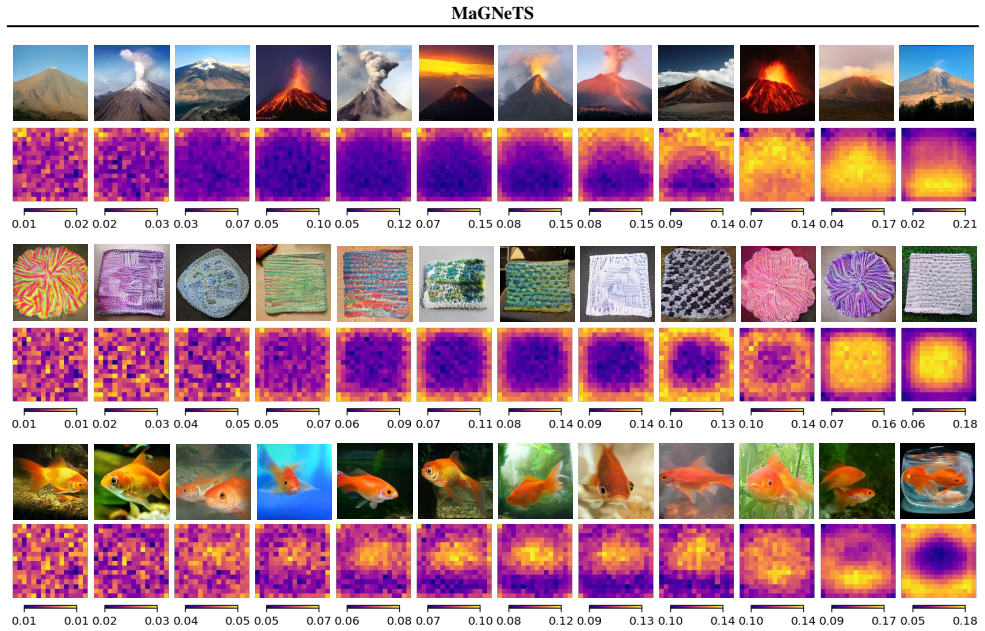
- A natural extension the authors only gesture at is token-dependent scheduling: route individual tokens to larger submodels only when their confidence is low, instead of switching the whole model on a fixed iteration grid; the paper's own unmasking-density analysis suggests such routing could concentrate compute on object boundaries.
- The same coarse-to-fine curriculum may apply to diffusion sampling, where early steps set global layout and later steps add texture; if nested transformers can be adapted to continuous latents, the compute savings could transfer outside discrete-token architectures.
- Because the method inherits its tokenizer, the reported FID gaps are partly a tokenizer property: using a stronger quantizer, as the paper notes MaskBit provides, could push MaGNeTS past the MaskGIT++ baseline at the same compute.
- KV caching in parallel decoding is the assumption that makes the schedule work, so a deployment model could tune refresh frequency per sequence length, since refresh spikes are the visible overhead in the per-iteration GFLOP plot.
Editorial analysis
A structured set of objections, weighed in public.
Referee Report
Summary. MaGNeTS proposes to reduce the inference cost of masked parallel decoding (MaskGIT/MAGVIT) by assigning variable-sized nested transformer submodels to different decode iterations, using smaller models early and larger models late, and by caching key-value pairs of unmasked tokens with an intermittent refresh at model-size switches. The method is evaluated on ImageNet 256x256 class-conditional image generation, UCF101 class-conditional video generation, and Kinetics600 frame prediction. Against the MaskGIT++/MAGVIT baselines, the paper reports 2.5-3.7x lower inference GFLOPs at FID/FVD penalties of roughly 0.6 FID point on ImageNet, ~22 FVD on UCF101, and ~3.6 FVD on Kinetics600, with a single TPUv5 wall-clock measurement showing a 2.5x images/s speedup on ImageNet XL.
Significance. The decode-time scaling idea is timely, and the empirical package is substantial: three tasks, a model-size scaling analysis, and an honest ablation (Table 4) showing that caching alone degrades FID from 2.5 to 3.4 and that refresh recovers most of the gap. The use of shared-parameter nested models means the compute reduction does not come at the cost of additional parameters, and the method is orthogonal to tokenizer improvements. However, the quantitative claim rests on a simplified GFLOPs model in Appendix D rather than on profiling for most configurations, and no code or weights are provided. If the GFLOPs accounting is corrected and independently verified, the contribution is publishable and likely to be useful to the masked-generation community.
major comments (3)
- [Appendix D, Table 9 (get_total_flops)] The cache update `num_cached = total_tokens - num_processed` is one iteration behind. For loop iteration i, `num_processed` is the number of masked tokens at the start of that iteration, i.e., after i completed iterations, but after the iteration executes the mask count corresponds to i+1 completed iterations. The cache should therefore be set from the mask count for the next iteration. As written, the tokens unmasked during iteration i are not added to `num_cached` until one iteration later, so the non-refresh iterations of MaGNeTS are counted as processing the previously unmasked tokens a second time. This inflates MaGNeTS's reported GFLOPs; because the error is conservative it does not reverse the qualitative conclusion, but it makes the exact 2.5-3.7x figures and the per-configuration GFLOPs in Tables 1-3 unreliable as stated. Please correct the update and recompute all GFLOPs.
- [Appendix D, Table 9 (get_flops)] The attention term is inconsistent with the nested-model description in Section 3. The `qkv` and `mlp` terms divide the feature dimension by `model_id`, reflecting the p-times downscaled head and MLP dimensions, but the attention term uses the full `hidden_size`. Since Section 3 states that Q, K, V features have dimension n_h * d_h / p, the attention FLOPs (QK^T and AV) should also scale by `hidden_size // model_id`. This overestimates MaGNeTS's cost for p=8,4,2 and is again conservative, but the pseudocode and the architecture description are in direct conflict. The corrected attention term will make the reported compute reductions larger and should be reported accurately.
- [Section 5 and Table 8] The only wall-clock measurement is Table 8 (ImageNet XL on a single TPUv5 chip, 22.5 vs 56.3 images/s, a 2.5x speedup). The upper end of the claimed 2.5-3.7x range, which covers UCF101 and Kinetics600, is supported only by the Appendix D FLOPs model. Given the two accounting issues above, the paper should provide at least one wall-clock timing for a video or frame-prediction configuration, or state clearly that the 3.7x figure is a theoretical FLOPs estimate rather than an end-to-end speedup.
minor comments (6)
- [Table 1] The table reports only point estimates of FID. Given that the main image result is a comparison of FID 2.9 (MaGNeTS) vs 2.3 (MaskGIT++), confidence intervals or multiple-seed results would help the reader judge whether the quality drop is significant.
- [Section 3, Eq. (3)] The symbol N is used for both the number of visual tokens (in Section 3, X in Z^N) and the number of nested models in Eq. (3); please use different symbols to avoid confusion.
- [Table 4] The column header 'Algorithm Baseline + Cache + Refresh Scheduled + Cache + Refresh' is ambiguous. Please expand it so the six result columns are unambiguously labeled.
- [Section 4, Eq. (2)] The notation (m_{p_i})^{k_i} for 'model m executed for k_i iterations' is easily misread as an exponent; define it explicitly in words.
- [Appendix B, Eq. (5)] The hyperparameter default is given as bias=0.5 and scale=0.8, but Table 6 does not list STemp; please include these values in the table for completeness.
- [Appendix D, Table 9] The pseudo-code mutates `total_tokens` inside `get_total_flops` and leaves `num_heads` unused; add clarifying comments or restructure the code to make the FLOPs model easier to audit.
Circularity Check
No significant circularity: the compute and quality claims are empirical and are validated against independent baselines and an explicit FLOPs model.
full rationale
The paper does not present a derivation chain in which an output is defined in terms of an input or in which a fitted parameter is renamed as a prediction. The central claims are empirical: MaGNeTS trains nested models and measures FID/FVD and inference GFLOPs against MaskGIT++ and MAGVIT baselines. The decode-time schedule and guidance hyperparameters are selected by ablations and held-out metrics, and the reported compute numbers come from the explicit pseudo-code in Appendix D rather than from the quality metric being predicted. The only notable self-citation is MatFormer (Kudugunta et al., 2023), used as the nesting mechanism, but this is prior art and not invoked to establish the paper's own empirical results; even if the nesting mechanism were taken as given, the contribution of scheduling and KV caching is still evaluated independently. The skeptic's concern about the cache-size update in the GFLOPs model is a correctness/accuracy issue, not circularity, because the compute count is not being defined in terms of the claimed outcome. The Limitations section acknowledges tokenizer dependence and inherited artifacts, which further indicates the results are treated as empirical rather than as consequences of the method by construction. Accordingly, no circular step meets the evidentiary bar of equating the prediction with its inputs.
Assumptions & free parameters
free parameters (4)
- Decode-time model schedule (k1,k2,k3,k4) =
(3,3,3,3) for K=12; downscaling factors p in {8,4,2,1}
- Guidance scale (gs) =
65 for ImageNet, 5 for Kinetics600, 0 for UCF101
- Sampling temperatures (bias, scale, mask temperature) =
MaskTemp 6/5, bias=0.5, scale=0.8
- Distillation weight alpha_i =
Linearly decayed from 1 to 0 over training
assumptions (4)
- domain assumption Generation proceeds coarse-to-fine, so early decode iterations need less model capacity than later iterations.
- domain assumption Key/value features computed for a masked token (mask embedding) remain usable as cached features after the token is assigned a real token id.
- domain assumption Nested MatFormer sub-models with shared parameters can be trained jointly with progressive distillation to match or beat standalone models of the same size.
- standard math Standard transformer attention and MLP FLOP arithmetic as used in Table 9.
Cite this review
Pith. "Pith review of Masked Generative Nested Transformers with Decode Time Scaling." pith.science (2026). https://pith.science/paper/XKJAOVPR
@misc{pith2026250200382,
  author       = {Pith},
  title        = {Pith review of: Masked Generative Nested Transformers with Decode Time Scaling},
  year         = {2026},
  howpublished = {\url{https://pith.science/paper/XKJAOVPR}},
  note         = {Machine review of arXiv:2502.00382}
}
abstract
Recent advances in visual generation have made significant strides in producing content of exceptional quality. However, most methods suffer from a fundamental problem - a bottleneck of inference computational efficiency. Most of these algorithms involve multiple passes over a transformer model to generate tokens or denoise inputs. However, the model size is kept consistent throughout all iterations, which makes it computationally expensive. In this work, we aim to address this issue primarily through two key ideas - (a) not all parts of the generation process need equal compute, and we design a decode time model scaling schedule to utilize compute effectively, and (b) we can cache and reuse some of the computation. Combining these two ideas leads to using smaller models to process more tokens while large models process fewer tokens. These different-sized models do not increase the parameter size, as they share parameters. We rigorously experiment with ImageNet256$\times$256 , UCF101, and Kinetics600 to showcase the efficacy of the proposed method for image/video generation and frame prediction. Our experiments show that with almost $3\times$ less compute than baseline, our model obtains competitive performance.
Figures


Figures from the paper (9 more)




Forward citations
Cited by 2 Pith papers
-
ELT: Elastic Looped Transformers for Visual Generation
Weight-shared looped transformers trained with intra-loop self-distillation match MaskGIT-class FID/FVD at roughly 4x fewer parameters and support any-time inference across loop counts.
-
MARch\'e: Fast Masked Autoregressive Image Generation with Cache-Aware Attention
MARche accelerates masked autoregressive image generation by caching stable token projections and refreshing only attention-selected tokens, reaching up to 1.72x speedup with some loss in FID.
Reference graph
Works this paper leans on
-
[4]
Chang, H., Zhang, H., Jiang, L., Liu, C., and Freeman, W
URL https://arxiv.org/abs/1808.01340. Chang, H., Zhang, H., Jiang, L., Liu, C., and Freeman, W. T. Maskgit: Masked generative image transformer. In Proceedings of the IEEE/CVF Conference on Computer Vision and Pattern Recognition, pp. 11315–11325,
-
[5]
Chang, H., Zhang, H., Barber, J., Maschinot, A., Lezama, J., Jiang, L., Yang, M.-H., Murphy, K., Freeman, W. T., Rubinstein, M., et al. Muse: Text-to-image genera- tion via masked generative transformers. arXiv preprint arXiv:2301.00704,
-
[6]
Clark, A., Donahue, J., and Simonyan, K
URL https://arxiv.org/abs/2204.00227. Clark, A., Donahue, J., and Simonyan, K. Adversarial video generation on complex datasets. arXiv preprint arXiv:1907.06571,
arXiv 1907
-
[8]
URL https://arxiv. org/abs/1810.04805. Dhariwal, P. and Nichol, A. Diffusion models beat gans on image synthesis. Advances in neural information processing systems, 34:8780–8794,
-
[10]
Gu, S., Chen, D., Bao, J., Wen, F., Zhang, B., Chen, D., Yuan, L., and Guo, B
URL https://arxiv.org/abs/2204.03638. Gu, S., Chen, D., Bao, J., Wen, F., Zhang, B., Chen, D., Yuan, L., and Guo, B. Vector quantized diffu- sion model for text-to-image synthesis,
-
[11]
Heusel, M., Ramsauer, H., Unterthiner, T., Nessler, B., and Hochreiter, S
URL https://arxiv.org/abs/2111.14822. Heusel, M., Ramsauer, H., Unterthiner, T., Nessler, B., and Hochreiter, S. Gans trained by a two time-scale update rule converge to a local nash equilibrium. Advances in neural information processing systems, 30,
-
[12]
Ho, J., Jain, A., and Abbeel, P
URL https://arxiv.org/abs/ 2207.12598. Ho, J., Jain, A., and Abbeel, P. Denoising diffusion proba- bilistic models. Advances in neural information process- ing systems, 33:6840–6851,
-
[14]
Diffusion models for video prediction and infilling
H¨oppe, T., Mehrjou, A., Bauer, S., Nielsen, D., and Dittadi, A. Diffusion models for video prediction and infilling. arXiv preprint arXiv:2206.07696,
Show all 45 references
-
[15]
H., Kamath, A., Peng, N., and Chang, K.-W
Hu, W., Dou, Z.-Y ., Li, L. H., Kamath, A., Peng, N., and Chang, K.-W. Matryoshka query transformer for large vision-language models. arXiv preprint arXiv:2405.19315,
-
[16]
Scalable adaptive computation for iterative generation
Jabri, A., Fleet, D., and Chen, T. Scalable adaptive computation for iterative generation. arXiv preprint arXiv:2212.11972,
-
[17]
Kingma, D
URL https://arxiv.org/abs/2407.19985. Kingma, D. P. and Gao, R. Understanding the diffusion objective as a weighted integral of elbos. arXiv preprint arXiv:2303.00848, 2,
-
[19]
Lee, Y ., Kim, J.-Y ., Go, H., Jeong, M., Oh, S., and Choi, S
URL https://arxiv.org/abs/2407.12173. Lee, Y ., Kim, J.-Y ., Go, H., Jeong, M., Oh, S., and Choi, S. Multi-architecture multi-expert diffusion models,
-
[20]
Li, L., Li, H., Zheng, X., Wu, J., Xiao, X., Wang, R., Zheng, M., Pan, X., Chao, F., and Ji, R
URL https://arxiv.org/abs/2306.04990. Li, L., Li, H., Zheng, X., Wu, J., Xiao, X., Wang, R., Zheng, M., Pan, X., Chao, F., and Ji, R. Autodiffusion: Training-free optimization of time steps and architectures for automated diffusion model acceleration,
-
[21]
Li, T., Tian, Y ., Li, H., Deng, M., and He, K
URL https://arxiv.org/abs/2309.10438. Li, T., Tian, Y ., Li, H., Deng, M., and He, K. Autoregres- sive image generation without vector quantization. arXiv preprint arXiv:2406.11838, 2024a. Li, T., Tian, Y ., Li, H., Deng, M., and He, K. Autoregres- sive image generation withou...
-
[22]
Lou, A., Meng, C., and Ermon, S
URL https://arxiv.org/abs/2202.09778. Lou, A., Meng, C., and Ermon, S. Discrete diffusion mod- eling by estimating the ratios of the data distribution. In Forty-first International Conference on Machine Learn- ing. Lu, C., Zhou, Y ., Bao, F., Chen, J., Li, C., and Zhu, J. Dpm-...
-
[23]
Luc, P., Clark, A., Dieleman, S., Casas, D
URL https: //arxiv.org/abs/2206.00927. Luc, P., Clark, A., Dieleman, S., Casas, D. d. L., Doron, Y ., Cassirer, A., and Simonyan, K. Transformation-based adversarial video prediction on large-scale data. arXiv preprint arXiv:2003.04035,
2003 arXiv
-
[24]
Mirzadeh, S.-I., Farajtabar, M., Li, A., Levine, N., Mat- sukawa, A., and Ghasemzadeh, H
URL https://arxiv.org/ abs/2210.03142. Mirzadeh, S.-I., Farajtabar, M., Li, A., Levine, N., Mat- sukawa, A., and Ghasemzadeh, H. Improved knowledge distillation via teacher assistant,
-
[25]
Nash, C., Menick, J., Dieleman, S., and Battaglia, P
URL https: //arxiv.org/abs/1902.03393. Nash, C., Menick, J., Dieleman, S., and Battaglia, P. W. Generating images with sparse representations. arXiv preprint arXiv:2103.03841,
1902 arXiv
-
[26]
Transframer: Arbitrary frame prediction with generative models
Nash, C., Carreira, J., Walker, J., Barr, I., Jaegle, A., Ma- linowski, M., and Battaglia, P. Transframer: Arbitrary frame prediction with generative models. arXiv preprint arXiv:2203.09494,
-
[27]
and Dhariwal, P
Nichol, A. and Dhariwal, P. Improved denoising diffusion probabilistic models, 2021a. URL https://arxiv. org/abs/2102.09672. 10 MaGNeTS Nichol, A. Q. and Dhariwal, P. Improved denoising diffu- sion probabilistic models. In International conference on machine learning, pp. 8162...
-
[28]
Peebles, W
URL https: //arxiv.org/abs/2307.12868. Peebles, W. and Xie, S. Scalable diffusion models with trans- formers,
-
[29]
Razavi, A., Van den Oord, A., and Vinyals, O
URL https://arxiv.org/abs/ 2212.09748. Razavi, A., Van den Oord, A., and Vinyals, O. Generating diverse high-fidelity images with vq-vae-2. Advances in neural information processing systems, 32,
-
[30]
Saharia, C., Chan, W., Saxena, S., Li, L., Whang, J., Denton, E
URL https://arxiv.org/ abs/2112.10752. Saharia, C., Chan, W., Saxena, S., Li, L., Whang, J., Denton, E. L., Ghasemipour, K., Gontijo Lopes, R., Karagol Ayan, B., Salimans, T., et al. Photorealistic text-to-image dif- fusion models with deep language understanding. Ad- vances i...
-
[31]
Salimans, T., Goodfellow, I., Zaremba, W., Cheung, V ., Radford, A., and Chen, X
URL https:// arxiv.org/abs/2202.00512. Salimans, T., Goodfellow, I., Zaremba, W., Cheung, V ., Radford, A., and Chen, X. Improved techniques for train- ing gans,
-
[33]
Singer, U., Polyak, A., Hayes, T., Yin, X., An, J., Zhang, S., Hu, Q., Yang, H., Ashual, O., Gafni, O., et al
URL https: //arxiv.org/abs/2202.00273. Singer, U., Polyak, A., Hayes, T., Yin, X., An, J., Zhang, S., Hu, Q., Yang, H., Ashual, O., Gafni, O., et al. Make-a- video: Text-to-video generation without text-video data. arXiv preprint arXiv:2209.14792,
-
[34]
Song, Y ., Dhariwal, P., Chen, M., and Sutskever, I
URL https://arxiv.org/ abs/2010.02502. Song, Y ., Dhariwal, P., Chen, M., and Sutskever, I. Con- sistency models,
2010 arXiv
-
[35]
Soomro, K., Zamir, A
URL https://arxiv.org/ abs/2303.01469. Soomro, K., Zamir, A. R., and Shah, M. Ucf101: A dataset of 101 human actions classes from videos in the wild,
-
[37]
Tian, K., Jiang, Y ., Yuan, Z., Peng, B., and Wang, L
URL https://arxiv.org/abs/ 2106.05945. Tian, K., Jiang, Y ., Yuan, Z., Peng, B., and Wang, L. Visual autoregressive modeling: Scalable image generation via next-scale prediction,
-
[38]
org/abs/2404.02905
URL https://arxiv. org/abs/2404.02905. Unterthiner, T., van Steenkiste, S., Kurach, K., Marinier, R., Michalski, M., and Gelly, S. Fvd: A new metric for video generation
-
[39]
Wang, Z., Wang, J., Liu, Z., and Qiu, Q
URL https://arxiv.org/ abs/2412.15119. Wang, Z., Wang, J., Liu, Z., and Qiu, Q. Binary latent diffusion. In Proceedings of the IEEE/CVF conference on computer vision and pattern recognition, pp. 22576– 22585,
-
[40]
Weber, M., Yu, L., Yu, Q., Deng, X., Shen, X., Cre- mers, D., and Chen, L.-C
URL https://arxiv.org/ abs/2202.05830. Weber, M., Yu, L., Yu, Q., Deng, X., Shen, X., Cre- mers, D., and Chen, L.-C. Maskbit: Embedding-free image generation via bit tokens,
-
[41]
11 MaGNeTS Yan, J
URL https: //arxiv.org/abs/2409.16211. 11 MaGNeTS Yan, J. N., Gu, J., and Rush, A. M. Diffusion models without attention. In Proceedings of the IEEE/CVF Conference on Computer Vision and Pattern Recognition, pp. 8239– 8249,
-
[42]
Yu, J., Li, X., Koh, J
URL https://arxiv.org/abs/2310.03337. Yu, J., Li, X., Koh, J. Y ., Zhang, H., Pang, R., Qin, J., Ku, A., Xu, Y ., Baldridge, J., and Wu, Y . Vector-quantized image modeling with improved vqgan. arXiv preprint arXiv:2110.04627,
-
[43]
G., Yang, M.-H., Hao, Y ., Essa, I., et al
Yu, L., Cheng, Y ., Sohn, K., Lezama, J., Zhang, H., Chang, H., Hauptmann, A. G., Yang, M.-H., Hao, Y ., Essa, I., et al. Magvit: Masked generative video transformer. In Proceedings of the IEEE/CVF Conference on Computer Vision and Pattern Recognition, pp. 10459–10469, 2023a. ...
-
[44]
Representation alignment for generation: Training diffusion transformers is easier than you think, 2024c
Yu, S., Kwak, S., Jang, H., Jeong, J., Huang, J., Shin, J., and Xie, S. Representation alignment for generation: Training diffusion transformers is easier than you think, 2024c. URL https://arxiv.org/abs/2410.06940. Yuan, Z., Zhang, H., Lu, P., Ning, X., Zhang, L., Zhao, T., Y...
-
[45]
URL https://arxiv.org/abs/2209. 09002. Zheng, H., Nie, W., Vahdat, A., and Anandkumar, A. Fast training of diffusion models with masked transformers. arXiv preprint arXiv:2306.09305,
-
[2012]
Stanton, S., Izmailov, P., Kirichenko, P., Alemi, A
URL https://arxiv.org/abs/ 1212.0402. Stanton, S., Izmailov, P., Kirichenko, P., Alemi, A. A., and Wilson, A. G. Does knowledge distillation re- ally work?,
-
[2016]
Sauer, A., Schwarz, K., and Geiger, A
URL https://arxiv.org/abs/ 1606.03498. Sauer, A., Schwarz, K., and Geiger, A. Stylegan-xl: Scaling stylegan to large diverse datasets,
-
[2018]
Cai, M., Yang, J., Gao, J., and Lee, Y . J. Matryoshka multimodal models. arXiv preprint arXiv:2405.17430, 2024a. Cai, R., Muralidharan, S., Heinrich, G., Yin, H., Wang, Z., Kautz, J., and Molchanov, P. Flextron: Many- in-one flexible large language model. arXiv preprint arXiv...
-
[2019]
Imagenet: A large-scale hierarchical image database
Deng, J., Dong, W., Socher, R., Li, L.-J., Li, K., and Fei-Fei, L. Imagenet: A large-scale hierarchical image database. In 2009 IEEE conference on computer vision and pattern recognition, pp. 248–255. Ieee,
2009
-
[2020]
J., Norouzi, M., and Salimans, T
Ho, J., Saharia, C., Chan, W., Fleet, D. J., Norouzi, M., and Salimans, T. Cascaded diffusion models for high fidelity image generation. Journal of Machine Learning Research, 23(47):1–33, 2022a. Ho, J., Salimans, T., Gritsenko, A., Chan, W., Norouzi, M., and Fleet, D. J. Video...
-
[2021]
Kudugunta, S., Kusupati, A., Dettmers, T., Chen, K., Dhillon, I., Tsvetkov, Y ., Hajishirzi, H., Kakade, S., Farhadi, A., Jain, P., et al
URL https://arxiv.org/ abs/2106.00132. Kudugunta, S., Kusupati, A., Dettmers, T., Chen, K., Dhillon, I., Tsvetkov, Y ., Hajishirzi, H., Kakade, S., Farhadi, A., Jain, P., et al. Matformer: Nested transformer for elastic inference. arXiv preprint arXiv:2310.07707,
-
[2022]
Brock, A
URL https: //arxiv.org/abs/2106.05237. Brock, A. Large scale gan training for high fidelity natural image synthesis. arXiv preprint arXiv:1809.11096,
-
[2023]
Beyer, L., Zhai, X., Royer, A., Markeeva, L., Anil, R., and Kolesnikov, A
URL https://arxiv.org/abs/2303.04248. Beyer, L., Zhai, X., Royer, A., Markeeva, L., Anil, R., and Kolesnikov, A. Knowledge distillation: A good teacher is patient and consistent,
-
[2024]
Gao, S., Zhou, P., Cheng, M.-M., and Yan, S
URL https://arxiv.org/ abs/2410.07679. Gao, S., Zhou, P., Cheng, M.-M., and Yan, S. Masked diffusion transformer is a strong image synthesizer. In Proceedings of the IEEE/CVF International Conference on Computer Vision, pp. 23164–23173,
Reviewed August 9, 2026 · model on record in the stance chip above.
Discussion (0). Continue with ORCID to comment.