REVIEW 4 major objections 5 minor 49 references
This paper claims that encoding the continuous-variable wavefunction and Hamiltonian of degenerate SPDC as matrix product states lets the Schrödinger equation be integrated directly in compressed form, achieving compression ratios above 3×1
Reviewed by Pith at T0; open to challenge. T0 means a machine referee read the full paper against a public rubric. the ladder, T0–T4 →
A tensor-network (MPS/MPO) solver simulates SPDC quantum dynamics directly in the continuous quadrature representation, compressing the state >3,000× at α=100.
T0 review reviewed 2026-08-03 challenge →
load-bearing objection A genuinely new CV-MPS simulation of SPDC at alpha=100, but the 'preserving physical fidelity' claim at that amplitude is not yet backed by a convergence check. the 4 major comments →
Tensor-network approach to quantum optical state evolution beyond the Fock basis
The pith
A machine-rendered reading of the paper's core claim, the machinery that carries it, and where it could break.
The reading
Core claim
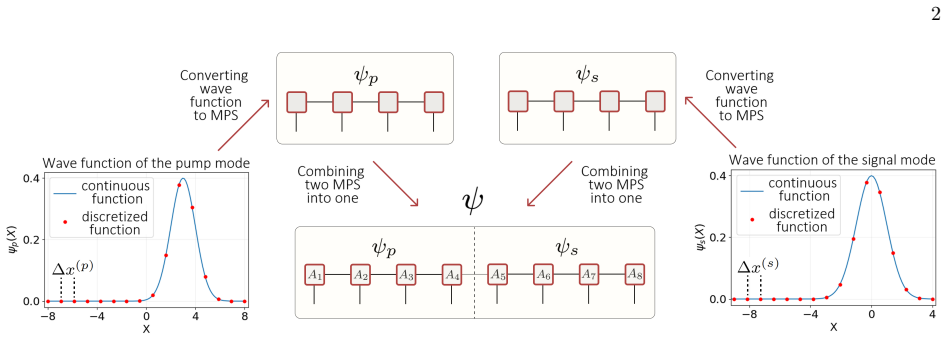
The central claim is that the wavefunction of the SPDC process, discretized on a binary grid in position quadrature, admits a low-rank MPS factorization whose bond dimension stays near 30 throughout evolution, even when the pump is a coherent state with amplitude α=100 (mean photon number 10⁴). Both the states and the Hamiltonian (written through creation/annihilation operators as matrix product operators) are kept in MPS form; each time step reduces to solving a linear system with a variational sweep algorithm. The authors validate the approach at α=10 against an exact Fock-basis simulation, then use energy conservation, the known depletion limit, quadrature squeezing, and the l2 residual t
What carries the argument
The MPS (tensor-train) representation of the two-mode wavefunction on a quantized grid, where each grid point is indexed by binary digits and each tensor corresponds to one bit (one length scale). Creation/annihilation operators become MPOs built from discretized position and derivative operators. Time evolution uses implicit Euler with the operator (I − iΔt H) as an MPO; the linear system is solved by sequential two-tensor updates with singular-value truncation. The compression works because smooth continuous functions have rapidly decaying MPS ranks, a property of quantized tensor trains.
Load-bearing premise
The MPS truncation at bond dimension 30 is assumed to discard negligible weight throughout the α=100 evolution; since fidelity is checked only at α=10, if the true state needs a larger bond dimension the compressed state would be unfaithful and the claimed fidelity would collapse.
What would settle it
Run the α=100 evolution with bond dimensions 30 and 60 (or with an independent sparse-matrix Fock simulation using a cutoff near 3000 photons) and compare the signal-mode photon-number distribution or the state fidelity at the time of maximum pump depletion. If the results differ appreciably or the fidelity falls well below 0.99, the compression claim fails. Equivalently, record the largest discarded singular value at each sweep for α=100; if it is not orders of magnitude below the retained ones, the truncation is unjustified.
If this is right
- Simulations of quantum optical processes with thousands of photons per mode become feasible on a desktop computer, a regime previously out of reach for Fock-basis methods.
- The same MPS machinery should extend to multimode χ(2)/χ(3) processes such as microring resonators, where the Hilbert space grows far faster than in the two-mode case.
- The benchmark metrics (energy conservation, depletion limit, squeezing variance, residual norm) give a template for validating tensor-network simulations when no exact reference exists.
- The compression ratio above 3000 means the memory footprint is dominated by bond dimension, not mesh size, so increasing phase-space resolution costs little additional memory as long as the state stays smooth.
- The fidelity check at α=10 (≥0.994) plus matching benchmarks suggests the method tracks the true quantum dynamics rather than a classical or parametric approximation.
Where Pith is reading between the lines
- The method's viability rests on smoothness of the state's continuous-variable representation; states developing sharp non-Gaussian features may require bond dimensions far above 30, and the α=100 claim should be tested with a higher bond dimension or an independent method.
- The implicit Euler time stepping is first-order; moving to higher-order integrators or a time-dependent variational principle would likely improve accuracy and enable longer evolutions and more modes with the same MPS infrastructure.
- A direct test at α=100 could come from comparing photon-number statistics with a truncated Wigner or positive-P simulation, or by running the same code with bond dimension 60 and checking that observables do not change.
- The connection to quantized tensor trains for PDEs suggests this approach could be applied to other nonlinear quantum dynamics (e.g., second-harmonic generation, four-wave mixing) with minimal modification.
Editorial analysis
A structured set of objections, weighed in public.
Referee Report
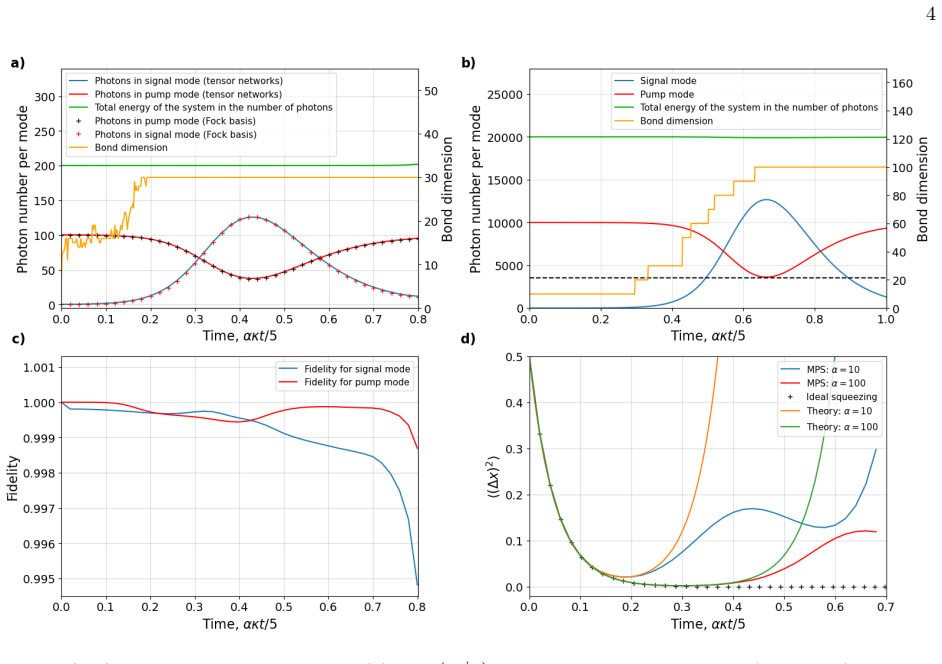
Summary. The paper introduces a tensor-network (MPS/MPO) method for simulating degenerate SPDC in a discretized continuous-variable (quadrature) representation. The initial pump coherent state and signal vacuum are encoded as an MPS on binary-discretized grids; the implicit-Euler propagator (I - i Δt H) is represented as an MPO, and each time step is solved with a DMRG-style sweep. The method is benchmarked against a Fock-basis state-vector calculation for α = 10 (photon-population dynamics and reduced-density-matrix fidelity), then applied to α = 100, where direct Fock simulation is infeasible. At α = 100 the paper reports energy conservation, roughly 66% pump depletion, quadrature squeezing consistent with perturbative predictions, and compression ratios above 3 × 10^3, concluding that the MPS representation captures the dynamics with bond dimension about 30.
Significance. Should the α = 100 result be fully certified, this would be a practically valuable numerical advance: bright SPDC states, whose Fock-space dimension is effectively astronomical, could be stored and evolved with a two-mode MPS of bond dimension about 30, and the framework could plausibly extend to multimode and microresonator settings. The paper has real strengths: a direct comparison with an exact Fock-basis simulation at α = 10, checks against independent published predictions for pump depletion and squeezing, and an explicit residual diagnostic. The conceptual ingredients—quantized tensor trains, MPO representations of a and a†, and DMRG-style linear solvers—are established, but their combination for two-mode quantum-optical evolution is a useful application. The main weakness is certification of the high-intensity operating point, not the method itself.
major comments (4)
- [Sec. III; Figs. 2(b), 2(c); Sec. IV] The central claim that the α=100 evolution preserves physical fidelity is not yet established. The only direct fidelity test is at α=10, and it is computed for the pump and signal density matrices separately, not for the joint two-mode state; reduced-state fidelity can remain high while joint correlations are wrong. At α=100 the bond dimension reaches the imposed cutoff D=30 (Fig. 2b, orange), and no discarded-weight or singular-value-tail data are supplied. The residual in Fig. 3(a) is a per-step linear-solve residual and, without Δt and step count, cannot bound accumulated truncation error. Please add a bond-dimension convergence study at α=100 (e.g., D=30, 40, 60), report discarded weights, and include a joint-state or correlation fidelity at α=10 and a convergence indicator at α=100.
- [Sec. III, Fig. 3(b)] The compression statement is internally inconsistent. The inverse compression ratio is defined as the number of MPS elements divided by the mesh size, but the text states it exceeds 3×10^3 for α=100. With D=30 and n_mps=30, the MPS has roughly 5×10^4 elements while the mesh has 2^30≈10^9 elements, so the compression ratio (mesh/MPS) is about 2×10^4 and the inverse ratio about 5×10^-5. The definition and the reported values/figure axis cannot both be correct. Since compression is a headline claim, this must be fixed.
- [Sec. II/III; Appendix B] The paper does not state several parameters needed to reproduce or interpret the simulation: coupling constant κ, time step Δt, total evolution time, number of DMRG sweeps, truncation tolerance, and convergence criterion. The residual plot in Fig. 3(a) depends on Δt and the number of steps; without these, the significance of the residual is unclear. Report these parameters and include a time-step and grid-resolution convergence study.
- [Sec. III, Fig. 2(c)] The sentence 'the fidelity ... is more than 0.994%' appears to be a text error. If taken literally, the fidelity is about 0.01, inconsistent with the matching photon dynamics in Fig. 2(a). If the intended value is 0.994 (i.e., 99.4%), state it as such and specify whether the fidelity is for the joint state or the reduced density matrices, and with what Fock cutoff.
minor comments (5)
- [Appendix B] U = I - i Δt H is not Hermitian; as written, the functional in Eq. (20) does not have the solution of U x = b as its stationary point. Clarify whether you minimize the normal-equation residual or use a complex-symmetric formulation.
- [Fig. 3(a)] The caption notation 'α = 10 (N = 1) and α = 100 (N = 2 5)' is unclear, as is the normalization factor N = 2^{30-25} in the text. Define the normalization precisely.
- [Fig. 2(a)] 'Both approaches yield identical results' is stronger than the numerical evidence shows; suggest 'agree to within the plotted accuracy'.
- [Sec. III] Please define 'energy' carefully: in the interaction picture the conserved quantity is the total photon number N_p + 2 N_s, not the Hamiltonian; the green line should be labeled accordingly.
- [Full text] No data/code availability statement is included. Given the numerical nature of the work, code or at least full parameter tables should be made available for reproducibility.
Circularity Check
No significant circularity: the central derivation is validated against external exact and perturbative benchmarks, not against fitted or self-derived inputs.
full rationale
The paper's derivation chain is methodologically self-contained. The MPS/TT methodology (ansatz, operator encoding, DMRG-style linear solver) is grounded in external references (Oseledets 2011 [18]; Oseledets & Dolgov 2012 [20]; Schollwöck 2011 [30]; Lindsey 2023 [22]; Khoromskij 2011 [21]), none of which are authored by the present authors. The physical benchmarks used for validation are external: the fidelity check at α=10 compares MPS results against an exact Fock-basis state-vector simulation (Fig. 2a,c); the squeezing variance benchmark is the perturbation theory of Kinsler, Fernée & Drummond 1993 [31]; the pump-depletion limit (~65–66%) comes from Bandilla et al. [34] and Fleischhauer & Veits [35]. None of these quantities is fitted from the simulation or defined in terms of the simulation output, so the agreement reported is genuine external support, not a tautology. Bond dimension and grid parameters are numerical convergence parameters, not physically fitted inputs, so the compression-ratio claim is not a renamed fit. The self-citations present ([7], [24]–[26], [42]–[43]) are contextual references to related tensor-network applications and microresonator work; they carry no load-bearing weight in the derivation or validation, and no 'uniqueness theorem' or ansatz justification is imported from the authors' prior work. The manuscript itself flags the principal limitation: 'In the absence of direct benchmarks for α=100, the MPS ansatz demonstrated good agreement with the several sanity checks' (Sec. IV), and 'Since direct benchmarking with the full Fock basis is computationally infeasible, these metrics serve as reliable indicators of simulation accuracy' (Sec. I). Per the reviewing rule I flag these passages explicitly: they acknowledge that no fidelity-to-exact benchmark exists at the α=100 operating point, and that the l2 residual measures only how well the linear system is solved inside the MPS manifold, not whether the manifold contains the true solution. This is a genuine validation gap and a correctness risk for the headline compression-with-fidelity claim, but it is not circularity: nothing in the α=100 validation is equivalent by construction to the inputs of the solver, and the indirect checks are externally derived rather than fitted from the simulation. Under the operative definition (a 'prediction' or 'first-principles result' being equivalent to its input by construction, or a load-bearing argument reducing to unverified self-citation)
Axiom & Free-Parameter Ledger
free parameters (5)
- grid support (R_s, R_p) =
[-10,10] and [-24,24] (α=10); [-10,10] and [-151,151] (α=100)
- grid resolutions (n_p, n_s bits) =
12/13 (α=10); 15/15 (α=100)
- time step Δt =
not stated
- coupling constant κ =
not stated (likely absorbed into units)
- MPS bond dimension cutoff =
30 (max)
axioms (4)
- standard math MPS/TT decomposition and DMRG linear-solver (Oseledets–Dolgov) provide accurate low-rank solutions to the linear systems.
- domain assumption The SPDC Hamiltonian (1) with the given quadrature operators (2) is the correct closed-system description.
- domain assumption The wavefunction remains sufficiently smooth and compressible throughout the evolution so that MPS with bond dimension ≤30 is accurate.
- domain assumption The finite grid with second-order central differences (15) accurately approximates the unbounded-derivative operators with negligible boundary effects.
Cite this review
Pith. "Pith review of Tensor-network approach to quantum optical state evolution beyond the Fock basis." pith.science (2026). https://pith.science/paper/XKS3P3XF
@misc{pith2026251115295,
  author       = {Pith},
  title        = {Pith review of: Tensor-network approach to quantum optical state evolution beyond the Fock basis},
  year         = {2026},
  howpublished = {\url{https://pith.science/paper/XKS3P3XF}},
  note         = {Machine review of arXiv:2511.15295}
}
read the original abstract
Understanding the quantum evolution of light in nonlinear media is central to the development of next-generation quantum technologies. Yet modeling these processes remains computationally demanding, as the required resources grow rapidly with photon number and phase-space resolution. Here we introduce a tensor-network approach that efficiently captures the dynamics of nonlinear optical systems in a continuous-variable representation. Using the matrix product state (MPS) formalism, both quantum states and operators are encoded in a highly compressed form, enabling direct numerical integration of the Schr\"odinger equation. We demonstrate the method by simulating degenerate spontaneous parametric down-conversion (SPDC) and show that it accurately reproduces established theoretical benchmarks - energy conservation, pump depletion, and quadrature squeezing - even in regimes where conventional Fock-basis simulations become infeasible. For high-intensity pump fields ($\alpha = 100$), the MPS representation achieves compression ratios above $3\cdot 10^3$ while preserving physical fidelity. This framework opens a scalable route to modeling multimode quantum light and nonlinear optical phenomena beyond the reach of traditional methods.
Figures


Reference graph
Works this paper leans on
-
[1]
Integrated photonics in quantum technologies.La Rivista del Nuovo Cimento, 46(2):71–103, 2023
Taira Giordani, Francesco Hoch, Gonzalo Carvacho, Nicol` o Spagnolo, and Fabio Sciarrino. Integrated photonics in quantum technologies.La Rivista del Nuovo Cimento, 46(2):71–103, 2023
2023
-
[2]
Integrated photonic quan- tum technologies.Nature Photonics, 14(5):273–284, 2020
Jianwei Wang, Fabio Sciarrino, Anthony Laing, and Mark G Thompson. Integrated photonic quan- tum technologies.Nature Photonics, 14(5):273–284, 2020
2020
-
[3]
Simulating physics with com- puters
Richard P Feynman. Simulating physics with com- puters. InFeynman and computation, pages 133–
-
[4]
Beyond the parametric approximation: Pump depletion, en- tanglement, and squeezing in macroscopic down- conversion.Physical Review A, 110(1):013712, 2024
Karthik Chinni and Nicol´ as Quesada. Beyond the parametric approximation: Pump depletion, en- tanglement, and squeezing in macroscopic down- conversion.Physical Review A, 110(1):013712, 2024
2024
-
[5]
Quantum state evo- lution of the fundamental mode in the process of second-harmonic generation.Quantum Optics: Journal of the European Optical Society Part B, 3(2):105, 1991
SP Nikitin and A V Masalov. Quantum state evo- lution of the fundamental mode in the process of second-harmonic generation.Quantum Optics: Journal of the European Optical Society Part B, 3(2):105, 1991
1991
-
[6]
Continuous-variable optical quantum-state tomog- raphy.Reviews of modern physics, 81(1):299–332, 2009
Alexander I Lvovsky and Michael G Raymer. Continuous-variable optical quantum-state tomog- raphy.Reviews of modern physics, 81(1):299–332, 2009
2009
-
[7]
Continuous- variable quantum tomography of high-amplitude states.Physical Review A, 108(4):042430, 2023
Ekaterina Fedotova, Nikolai Kuznetsov, Egor Tiunov, AE Ulanov, and AI Lvovsky. Continuous- variable quantum tomography of high-amplitude states.Physical Review A, 108(4):042430, 2023
2023
-
[8]
Density matrix formulation for quantum renormalization groups.Physical review letters, 69(19):2863, 1992
Steven R White. Density matrix formulation for quantum renormalization groups.Physical review letters, 69(19):2863, 1992
1992
-
[9]
Density-matrix algorithms for quantum renormalization groups.Physical review b, 48(14):10345, 1993
Steven R White. Density-matrix algorithms for quantum renormalization groups.Physical review b, 48(14):10345, 1993
1993
-
[10]
Thermo- dynamic limit of density matrix renormalization
Stellan ¨Ostlund and Stefan Rommer. Thermo- dynamic limit of density matrix renormalization. Physical review letters, 75(19):3537, 1995
1995
-
[11]
Class of ansatz wave functions for one-dimensional spin systems and their relation to the density matrix renormalization group.Physical review b, 55(4):2164, 1997
Stefan Rommer and Stellan ¨Ostlund. Class of ansatz wave functions for one-dimensional spin systems and their relation to the density matrix renormalization group.Physical review b, 55(4):2164, 1997
1997
-
[12]
Matrix product state representations.arXiv preprint quant-ph/0608197, 2006
David Perez-Garcia, Frank Verstraete, Michael M Wolf, and J Ignacio Cirac. Matrix product state representations.arXiv preprint quant-ph/0608197, 2006
Pith/arXiv arXiv 2006
-
[13]
Equivalence of the variational matrix product method and the density matrix renormalization group applied to spin chains
Jorge Dukelsky, Miguel A Mart ´ ın-Delgado, Tomoto- shi Nishino, and Germ´ an Sierra. Equivalence of the variational matrix product method and the density matrix renormalization group applied to spin chains. Europhysics letters, 43(4):457, 1998
1998
-
[14]
Matrix prod- uct states represent ground states faithfully.Phys- ical Review B—Condensed Matter and Materials Physics, 73(9):094423, 2006
Frank Verstraete and J Ignacio Cirac. Matrix prod- uct states represent ground states faithfully.Phys- ical Review B—Condensed Matter and Materials Physics, 73(9):094423, 2006
2006
-
[15]
One-dimensional many-body entangled open 7 quantum systems with tensor network methods
Daniel Jaschke, Simone Montangero, and Lincoln D Carr. One-dimensional many-body entangled open 7 quantum systems with tensor network methods. Quantum science and technology, 4(1):013001, 2018
2018
-
[16]
Solving gapped hamiltonians locally.Physical Review B—Condensed Matter and Materials Physics, 73(8):085115, 2006
Matthew B Hastings. Solving gapped hamiltonians locally.Physical Review B—Condensed Matter and Materials Physics, 73(8):085115, 2006
2006
-
[17]
Matrix product states for critical spin chains: Finite-size versus finite-entanglement scaling.Physical Review B—Condensed Matter and Materials Physics, 86(7):075117, 2012
Bogdan Pirvu, Guifre Vidal, Frank Verstraete, and Luca Tagliacozzo. Matrix product states for critical spin chains: Finite-size versus finite-entanglement scaling.Physical Review B—Condensed Matter and Materials Physics, 86(7):075117, 2012
2012
-
[18]
Tensor-train decomposition
Ivan V Oseledets. Tensor-train decomposition. SIAM Journal on Scientific Computing, 33(5):2295– 2317, 2011
2011
-
[19]
Compact matrix form of the d- dimensional tensor decomposition.IEICE Proceed- ings Series, 43(B2L-C2), 2009
Ivan Oseledets. Compact matrix form of the d- dimensional tensor decomposition.IEICE Proceed- ings Series, 43(B2L-C2), 2009
2009
-
[20]
Solution of linear systems and matrix inversion in the tt- format.SIAM Journal on Scientific Computing, 34(5):A2718–A2739, 2012
Ivan V Oseledets and Sergey V Dolgov. Solution of linear systems and matrix inversion in the tt- format.SIAM Journal on Scientific Computing, 34(5):A2718–A2739, 2012
2012
-
[21]
O (d log n)-quantics approxi- mation of n-d tensors in high-dimensional numerical modeling.Constructive Approximation, 34:257–280, 2011
Boris N Khoromskij. O (d log n)-quantics approxi- mation of n-d tensors in high-dimensional numerical modeling.Constructive Approximation, 34:257–280, 2011
2011
-
[22]
Michael Lindsey. Multiscale interpolative construc- tion of quantized tensor trains.arXiv preprint arXiv:2311.12554, 2023
Pith/arXiv arXiv 2023
-
[23]
A quantum-inspired approach to exploit turbulence structures.Nature Computational Science, 2(1):30– 37, 2022
Nikita Gourianov, Michael Lubasch, Sergey Dol- gov, Quincy Y van den Berg, Hessam Babaee, Pey- man Givi, Martin Kiffner, and Dieter Jaksch. A quantum-inspired approach to exploit turbulence structures.Nature Computational Science, 2(1):30– 37, 2022
2022
-
[24]
Quantum- inspired framework for computational fluid dynam- ics.Communications Physics, 7(1):135, 2024
Raghavendra Dheeraj Peddinti, Stefano Pisoni, Alessandro Marini, Philippe Lott, Henrique Argen- tieri, Egor Tiunov, and Leandro Aolita. Quantum- inspired framework for computational fluid dynam- ics.Communications Physics, 7(1):135, 2024
2024
-
[25]
Stefano Pisoni, Raghavendra Dheeraj Peddinti, Egor Tiunov, Siddhartha E Guzman, and Leandro Aolita. Compression, simulation, and synthesis of turbulent flows with tensor trains.arXiv preprint arXiv:2506.05477, 2025
arXiv 2025
-
[26]
Raghavendra Dheeraj Peddinti, Stefano Pisoni, Narsimha Rapaka, Mohamed K Riahi, Egor Tiunov, and Leandro Aolita. Quantum-inspired space-time pde solver and dynamic mode decomposition.arXiv preprint arXiv:2510.21767, 2025
arXiv 2025
-
[27]
Tensor network reduced order models for wall-bounded flows.Phys- ical Review Fluids, 8(12):124101, 2023
Martin Kiffner and Dieter Jaksch. Tensor network reduced order models for wall-bounded flows.Phys- ical Review Fluids, 8(12):124101, 2023
2023
-
[28]
Egor Kornev, Sergey Dolgov, Karan Pinto, Markus Pflitsch, Michael Perelshtein, and Artem Melnikov. Numerical solution of the incompressible navier- stokes equations for chemical mixers via quantum- inspired tensor train finite element method.arXiv preprint arXiv:2305.10784, 2023
Pith/arXiv arXiv 2023
-
[29]
Fast and flexible quantum-inspired differential equation solvers with data integration
Lucas Arenstein, Martin Mikkelsen, and Michael Kastoryano. Fast and flexible quantum-inspired differential equation solvers with data integration. arXiv preprint arXiv:2505.17046, 2025
Pith/arXiv arXiv 2025
-
[30]
The density-matrix renormal- ization group in the age of matrix product states
Ulrich Schollw¨ ock. The density-matrix renormal- ization group in the age of matrix product states. Annals of physics, 326(1):96–192, 2011
2011
-
[31]
Limits to squeezing and phase information in the parametric amplifier.Physical Review A, 48(4):3310, 1993
P Kinsler, M Fern´ ee, and PD Drummond. Limits to squeezing and phase information in the parametric amplifier.Physical Review A, 48(4):3310, 1993
1993
-
[32]
Relating smoothness to expres- sions involving fourier coefficients or to a fourier transform.Journal of Approximation Theory, 164(10):1369–1389, 2012
Zeev Ditzian. Relating smoothness to expres- sions involving fourier coefficients or to a fourier transform.Journal of Approximation Theory, 164(10):1369–1389, 2012
2012
-
[33]
Juan Jos´ e Rodr ´ ıguez-Aldavero, Paula Garc ´ ıa- Molina, Luca Tagliacozzo, and Juan Jos´ e Garc ´ ıa- Ripoll. Chebyshev approximation and com- position of functions in matrix product states for quantum-inspired numerical analysis.arXiv preprint arXiv:2407.09609, 2024
Pith/arXiv arXiv 2024
-
[34]
Parametric down- conversion and maximal pumpdepletion.Journal of Optics B: Quantum and Semiclassical Optics, 2(3):265, 2000
A Bandilla, G Drobn` y, and I Jex. Parametric down- conversion and maximal pumpdepletion.Journal of Optics B: Quantum and Semiclassical Optics, 2(3):265, 2000
2000
-
[35]
Long- time dynamics of spontaneous parametric down- conversion and quantum limitations of conver- sion efficiency.Zeitschrift f¨ ur Naturforschung A, 54(1):57–62, 1999
Michael Fleischhauer and Oliver Veits. Long- time dynamics of spontaneous parametric down- conversion and quantum limitations of conver- sion efficiency.Zeitschrift f¨ ur Naturforschung A, 54(1):57–62, 1999
1999
-
[36]
Path-integral approach to the quantum theory of the degen- erate parametric amplifier.Physical Review A, 29(3):1275, 1984
Mark Hillery and M Suhail Zubairy. Path-integral approach to the quantum theory of the degen- erate parametric amplifier.Physical Review A, 29(3):1275, 1984
1984
-
[37]
Limi- tations to squeezing in a parametric amplifier due to pump quantum fluctuations.Physical Review A, 38(9):4696, 1988
David D Crouch and Samuel L Braunstein. Limi- tations to squeezing in a parametric amplifier due to pump quantum fluctuations.Physical Review A, 38(9):4696, 1988
1988
-
[38]
Strongly driven nonlinear quantum optics in microring resonators.Physical Review A, 92(3):033840, 2015
Z Vernon and JE Sipe. Strongly driven nonlinear quantum optics in microring resonators.Physical Review A, 92(3):033840, 2015
2015
-
[39]
Nonlinear and quantum optics with whis- pering gallery resonators.Journal of Optics, 18(12):123002, 2016
Dmitry V Strekalov, Christoph Marquardt, An- drey B Matsko, Harald GL Schwefel, and Gerd Leuchs. Nonlinear and quantum optics with whis- pering gallery resonators.Journal of Optics, 18(12):123002, 2016
2016
-
[40]
Electrically pumped photonic integrated soliton microcomb.Nature com- munications, 10(1):680, 2019
Arslan S Raja, Andrey S Voloshin, Hairun Guo, So- fya E Agafonova, Junqiu Liu, Alexander S Gorod- nitskiy, Maxim Karpov, Nikolay G Pavlov, Erwan Lucas, Ramzil R Galiev, et al. Electrically pumped photonic integrated soliton microcomb.Nature com- munications, 10(1):680, 2019
2019
-
[41]
Universal formation dynam- ics and noise of kerr-frequency combs in microres- onators.Nature photonics, 6(7):480–487, 2012
Tobias Herr, Klaus Hartinger, Johann Riemens- berger, Christine Y Wang, Emanuel Gavartin, Ronald Holzwarth, Michael L Gorodetsky, and To- bias J Kippenberg. Universal formation dynam- ics and noise of kerr-frequency combs in microres- onators.Nature photonics, 6(7):480–487, 2012
2012
-
[42]
Vorobyev, Nikolay A
Alexander K. Vorobyev, Nikolay A. Kapridov, Timur R. Yunusov, Danila V. Morozov, Andrei N. Danilin, Alexey D. Ivanov, Artem E. Shitikov, Valery E. Lobanov, Igor A. Bilenko, and Dmitry A. Chermoshentsev. Optimization of the dual-pumped normal-dispersion integrated parametric oscillator in the presence of thermal effects.Physical Review Applied, 2025. 8
2025
-
[43]
Optimization of the threshold for degenerate optical parametric oscillations in a bichromatically pumped microres- onator.Physical Review Applied, 24(2):024010, 2025
Nadezhda S Tatarinova, Artem E Shitikov, Georgy V Grechko, Alexander K Vorobyev, Ana- toly V Masalov, Igor A Bilenko, Dmitry A Cher- moshentsev, and Valery E Lobanov. Optimization of the threshold for degenerate optical parametric oscillations in a bichromatically pumped microres- onator.Physical Review Applied, 24(2):024010, 2025
2025
-
[44]
Time-dependent variational princi- ple for quantum lattices.Physical review letters, 107(7):070601, 2011
Jutho Haegeman, J Ignacio Cirac, Tobias J Os- borne, Iztok Piˇ zorn, Henri Verschelde, and Frank Verstraete. Time-dependent variational princi- ple for quantum lattices.Physical review letters, 107(7):070601, 2011
2011
-
[45]
Time integration of tensor trains
Christian Lubich, Ivan V Oseledets, and Bart Vandereycken. Time integration of tensor trains. SIAM Journal on Numerical Analysis, 53(2):917– 941, 2015
2015
-
[46]
Unifying time evolution and optimization with matrix prod- uct states.Physical Review B, 94(16):165116, 2016
Jutho Haegeman, Christian Lubich, Ivan Oseledets, Bart Vandereycken, and Frank Verstraete. Unifying time evolution and optimization with matrix prod- uct states.Physical Review B, 94(16):165116, 2016
2016
-
[47]
A multilinear singular value decomposition
Lieven De Lathauwer, Bart De Moor, and Joos Van- dewalle. A multilinear singular value decomposition. SIAM journal on Matrix Analysis and Applications, 21(4):1253–1278, 2000
2000
-
[48]
Some mathematical notes on three-mode factor analysis.Psychometrika, 31(3):279–311, 1966
Ledyard R Tucker. Some mathematical notes on three-mode factor analysis.Psychometrika, 31(3):279–311, 1966
1966
-
[49]
Classical simulation of quantum many-body systems with a tree tensor network.Physical Review A—Atomic, Molecular, and Optical Physics, 74(2):022320, 2006
Y-Y Shi, L-M Duan, and Guifre Vidal. Classical simulation of quantum many-body systems with a tree tensor network.Physical Review A—Atomic, Molecular, and Optical Physics, 74(2):022320, 2006. 9 V. APPENDIX A. MPO forˆaandˆa † operators In the continuous representation, creation and an- nihilation operators are written as ˆa† = ˆX−d/dX√ 2 , ˆa=...
2006
This paper was first reviewed by deepseek-v4-flash on August 3, 2026.
discussion (0)
Sign in with ORCID, Apple, or X to comment. Anyone can read and Pith papers without signing in.