Space-time duality approach to (inhomogeneous) integrable quenches
Pith reviewed 2026-06-26 15:30 UTC · model grok-4.3
The pith
The space-time duality approach resolves its ambiguity and now applies to inhomogeneous quenches and non-symmetric initial states.
A machine-rendered reading of the paper's core claim, the machinery that carries it, and where it could break.
Core claim
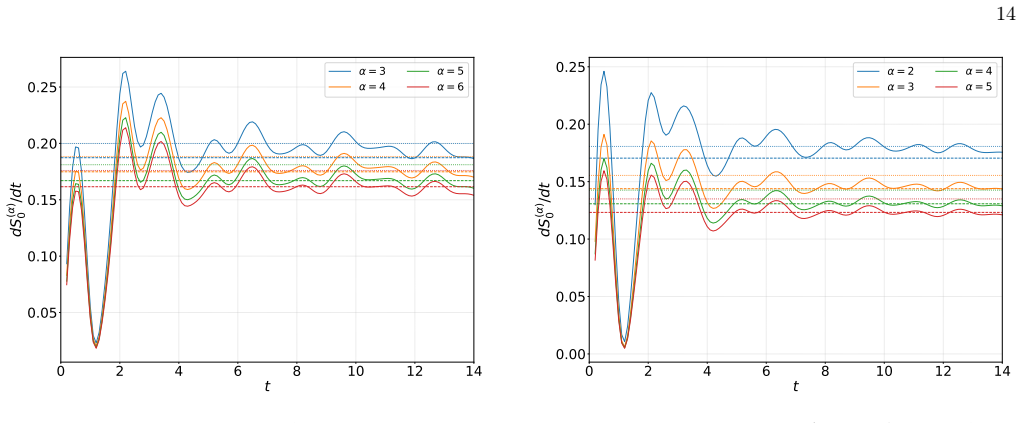
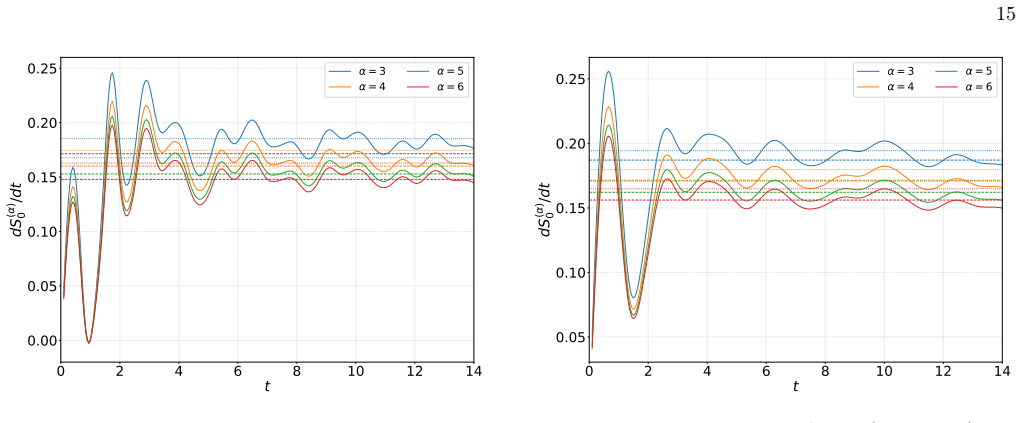
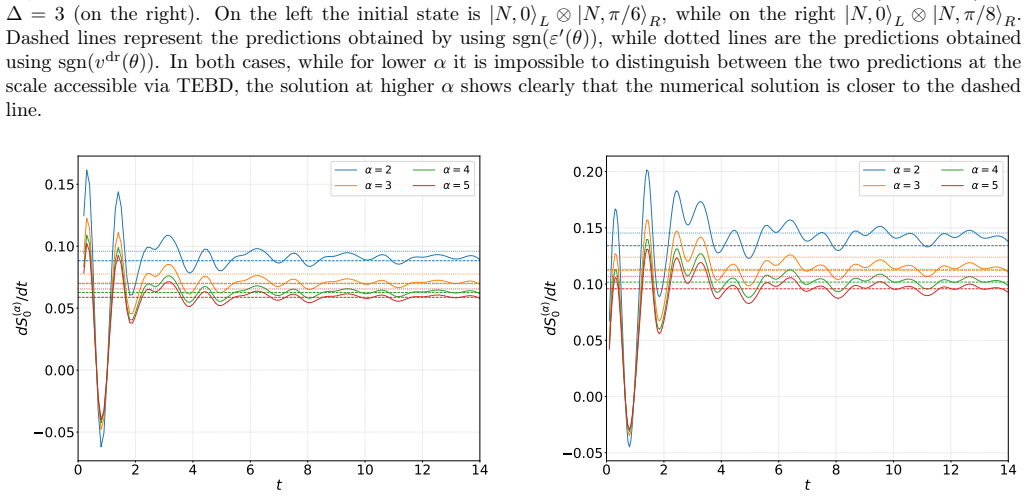
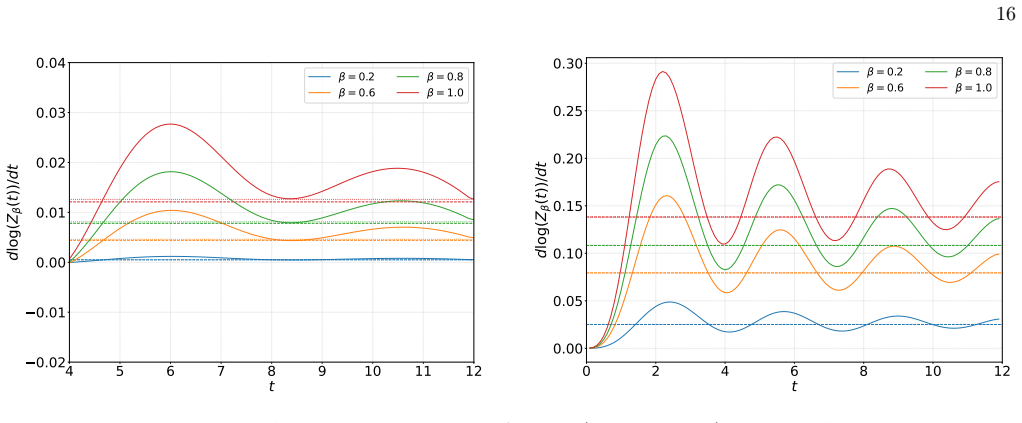
By extending the space-time duality approach unambiguously from first principles, the authors derive closed-form predictions for entanglement growth and charge fluctuations after general quantum quenches, including inhomogeneous cases and non-symmetric initial states, with benchmarks against the Rule 54 cellular automaton and the XXZ chain.
What carries the argument
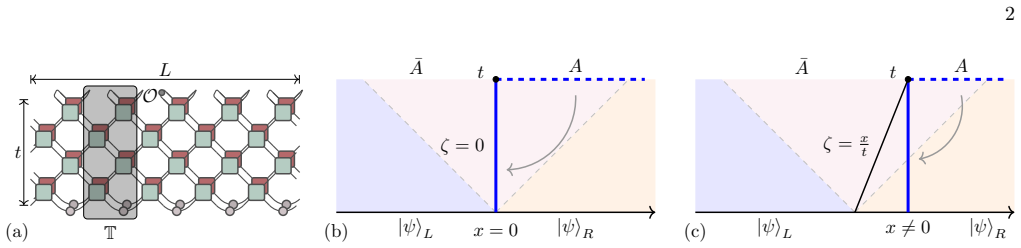
Space-time duality approach (SDA), which relates non-equilibrium quantities such as entanglement growth rates and charge fluctuations to equilibrium properties by exchanging the roles of space and time.
If this is right
- Closed-form expressions become available for entanglement growth after general integrable quenches.
- Charge fluctuations can now be predicted for initial states lacking spatial symmetry.
- The framework covers inhomogeneous quenches without additional restrictions.
- Specialization to entanglement entropy reproduces the quasiparticle picture results.
Where Pith is reading between the lines
- The approach may enable direct comparison with experiments that inherently include spatial inhomogeneities.
- If the first-principles resolution generalizes, similar dualities could apply to a wider class of non-integrable models.
- This could connect non-equilibrium dynamics more tightly to thermodynamic fluctuation theorems.
Load-bearing premise
The space-time duality extends unambiguously to inhomogeneous quenches and non-symmetric initial states from first principles without new inconsistencies or adjustments.
What would settle it
A mismatch between the derived closed-form predictions and either the exact analytical solution of the Rule 54 quantum cellular automaton or TEBD simulations of the XXZ chain for an inhomogeneous quench starting from a non-symmetric state.
Figures
read the original abstract
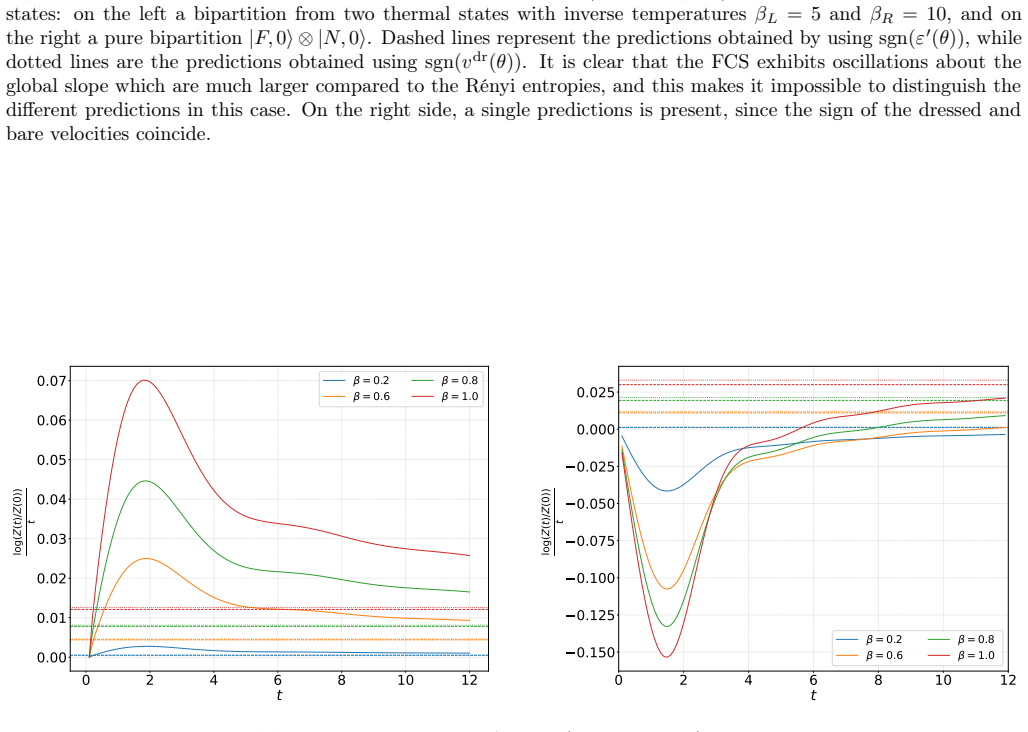
Characterising the universal aspects of non-equilibrium quantum many-body dynamics is one of the key goals of this century's physics research. Progress, however, is hindered by the lack of general theoretical frameworks for studying interacting quantum matter far from equilibrium. A recent breakthrough has been the realization that several key non-equilibrium quantities, such as the rate of growth of entanglement or the fluctuations of conserved charges within finite subsystems, can be related to equilibrium properties through a space-time duality that effectively exchanges the roles of space and time. This observation effectively enables the study of non-equilibrium phenomena using tools and concepts borrowed from equilibrium statistical mechanics and thermodynamics. A first proof of principle of this framework, dubbed space-time duality approach (SDA), was provided by interacting integrable systems, where thermodynamic properties can often be characterized exactly, while dynamical quantities typically remain beyond analytical reach. Subsequent developments, however, revealed that the SDA suffered from an intrinsic ambiguity, restricting its applicability to homogeneous quenches and to charge fluctuations arising from symmetric initial states. Here we resolve this ambiguity from first principles and derive closed-form predictions for entanglement growth and charge fluctuations after general quantum quenches. We benchmark our results against the exact analytical solution of the Rule 54 quantum cellular automaton and extensive TEBD simulations of the XXZ chain. Moreover we show that, when specialised to the entanglement entropy, our framework naturally reproduces the predictions of the quasiparticle picture.
Editorial analysis
A structured set of objections, weighed in public.
Referee Report
Summary. The manuscript extends the space-time duality approach (SDA) to inhomogeneous integrable quenches and general initial states. It claims to resolve an intrinsic ambiguity in the prior SDA framework from first principles, yielding closed-form predictions for entanglement growth and charge fluctuations after arbitrary quantum quenches. The results are benchmarked against the exact analytical solution of the Rule 54 quantum cellular automaton and TEBD simulations of the XXZ chain; when specialized to entanglement entropy, the framework reproduces the quasiparticle picture.
Significance. If the first-principles resolution holds, the work substantially broadens the SDA's applicability beyond homogeneous quenches and symmetric states, allowing equilibrium thermodynamic tools to address a wider range of non-equilibrium observables in integrable systems. The explicit benchmarks against an exact solution and numerical data, together with recovery of the quasiparticle picture, constitute concrete validation. The absence of free parameters or ad-hoc adjustments in the central construction is a notable strength.
minor comments (3)
- The abstract and introduction refer to 'closed-form predictions' and 'first-principles derivation'; the main text should include an explicit statement of the steps that remove the prior ambiguity (e.g., the choice of contour or regularization) so that readers can verify the resolution without external references.
- Figure captions and the benchmark sections should report quantitative error measures (e.g., relative deviation from Rule 54 or TEBD data) rather than qualitative agreement statements.
- Notation for the space-time duality map and the resulting effective partition functions should be introduced once with a clear table or equation list to avoid repeated redefinitions across sections.
Simulated Author's Rebuttal
We thank the referee for the positive evaluation of our manuscript, the detailed summary, and the recommendation for minor revision. No specific major comments were provided in the report.
Circularity Check
No significant circularity; derivation self-contained against external benchmarks
full rationale
The paper presents an extension of the space-time duality approach resolved from first principles, with explicit benchmarks to independent exact solutions (Rule 54 cellular automaton) and numerical TEBD simulations of the XXZ chain. The reproduction of the quasiparticle picture for entanglement entropy is shown as a consistency check rather than a definitional input. No quoted equation reduces a prediction to a fitted parameter or prior self-citation by construction; the central claims remain externally falsifiable.
Axiom & Free-Parameter Ledger
axioms (1)
- domain assumption Space-time duality exchanges roles of space and time to relate non-equilibrium quantities to equilibrium properties in integrable systems
Reference graph
Works this paper leans on
-
[1]
Eisert, M
J. Eisert, M. Friesdorf, and C. Gogolin, Quantum many- body systems out of equilibrium, Nat. Phys.11, 124 (2015)
2015
-
[2]
Calabrese, F
P. Calabrese, F. H. Essler, and G. Mussardo, Introduc- tion to ‘Quantum integrability in out of equilibrium sys- tems’, J. Stat. Mech.: Theory Exp.2016, 064001
2016
-
[3]
Serbyn, D
M. Serbyn, D. A. Abanin, and Z. Papić, Quantum many- body scars and weak breaking of ergodicity, Nat. Phys. 17, 675 (2021)
2021
-
[4]
Bastianello, B
A. Bastianello, B. Bertini, B. Doyon, and R. Vasseur, Introduction to the special issue on emergent hydrody- namics in integrable many-body systems, J. Stat. Mech.: Theory Exp.2022, 014001
2022
-
[5]
D. A. Abanin, E. Altman, I. Bloch, and M. Serbyn, Col- loquium: Many-body localization, thermalization, and entanglement, Rev. Mod. Phys.91, 021001 (2019)
2019
-
[6]
Calabrese and J
P. Calabrese and J. Cardy, Evolution of entanglement en- tropy in one-dimensional systems, J. Stat. Mech.: Theory Exp.2005, P04010
2005
-
[7]
Nahum, J
A. Nahum, J. Ruhman, S. Vijay, and J. Haah, Quantum entanglement growth under random unitary dynamics, Phys. Rev. X7, 031016 (2017)
2017
-
[8]
S. H. Shenker and D. Stanford, Multiple shocks, J. High Energy Phys.12, 046
-
[9]
Kitaev, A simple model of quantum holography, in KITP Program: Entanglement in Strongly-Correlated Quantum Matter(2015)
A. Kitaev, A simple model of quantum holography, in KITP Program: Entanglement in Strongly-Correlated Quantum Matter(2015)
2015
-
[10]
Hosur, X.-L
P. Hosur, X.-L. Qi, D. A. Roberts, and B. Yoshida, Chaos in quantum channels, J. High Energy Phys.2016(2), 004
2016
-
[11]
Calabrese, Entanglement spreading in non-equilibrium integrable systems, SciPost Phys
P. Calabrese, Entanglement spreading in non-equilibrium integrable systems, SciPost Phys. Lect. Notes, 20 (2020)
2020
-
[12]
Zhou and A
T. Zhou and A. Nahum, Entanglement membrane in chaotic many-body systems, Phys. Rev. X10, 031066 (2020)
2020
-
[13]
Skinner, J
B. Skinner, J. Ruhman, and A. Nahum, Measurement- induced phase transitions in the dynamics of entangle- ment, Phys. Rev. X9, 031009 (2019)
2019
-
[14]
Y. Li, X. Chen, and M. P. A. Fisher, Measurement- driven entanglement transition in hybrid quantum cir- cuits, Phys. Rev. B100, 134306 (2019)
2019
-
[15]
Sacha and J
K. Sacha and J. Zakrzewski, Time crystals: a review, Rep. Prog. Phys.81, 016401 (2017)
2017
-
[16]
V. Khemani, R. Moessner, and S. L. Sondhi, A brief his- tory of time crystals, arXiv:1910.10745 (2019)
arXiv 1910
-
[17]
Preskill, Quantum Computing in the NISQ era and beyond, Quantum2, 79 (2018)
J. Preskill, Quantum Computing in the NISQ era and beyond, Quantum2, 79 (2018)
2018
-
[18]
Altman, K
E. Altman, K. R. Brown, G. Carleo, L. D. Carr, E. Dem- ler, C. Chin, B. DeMarco, S. E. Economou, M. A. Eriks- son, K.-M. C. Fu, M. Greiner, K. R. Hazzard, R. G. Hulet, A. J. Kollár, B. L. Lev, M. D. Lukin, R. Ma, X. Mi, S. Misra, C. Monroe, K. Murch, Z. Nazario, K.-K. Ni, A. C. Potter, P. Roushan, M. Saffman, M. Schleier- Smith, I. Siddiqi, R. Simmonds, M...
2021
-
[19]
Rigol, V
M. Rigol, V. Dunjko, and M. Olshanii, Thermalization and its mechanism for generic isolated quantum systems, Nature452, 854 (2008)
2008
-
[20]
Carleo, F
G. Carleo, F. Becca, M. Schiró, and M. Fabrizio, Lo- calization and glassy dynamics of many-body quantum systems, Sci. Rep.2, 243 (2012)
2012
-
[21]
A. J. A. James and R. M. Konik, Quantum quenches in two spatial dimensions using chain array matrix product states, Phys. Rev. B92, 161111 (2015)
2015
-
[22]
R. P. Feynman, Simulating physics with computers (cRc Press, 2018) pp. 133–153
2018
-
[23]
Murciano, P
S. Murciano, P. Calabrese, and R. M. Konik, Postquantum-quench growth of Rényi entropies in low- dimensionalcontinuumbosonicsystems,Phys.Rev.Lett. 129, 106802 (2022)
2022
-
[24]
S.-H. Lin, M. P. Zaletel, and F. Pollmann, Efficient simu- lation of dynamics in two-dimensional quantum spin sys- tems with isometric tensor networks, Phys. Rev. B106, 245102 (2022)
2022
-
[25]
Krinitsin, N
W. Krinitsin, N. Tausendpfund, M. Heyl, M. Rizzi, and M. Schmitt, Time evolution of the quantum Ising model in two dimensions using tree tensor networks, Phys. Rev. B112, 134310 (2025)
2025
-
[26]
Tindall, A
J. Tindall, A. F. Mello, M. Fishman, E. M. Stoudenmire, and D. Sels, Dynamics of disordered quantum systems with two- and three-dimensional tensor networks, Science 392, 868 (2026)
2026
-
[27]
Berges, S
J. Berges, S. Borsányi, and C. Wetterich, Prethermaliza- tion, Phys. Rev. Lett.93, 142002 (2004)
2004
-
[28]
Sotiriadis and J
S. Sotiriadis and J. Cardy, Quantum quench in interact- ing field theory: A self-consistent approximation, Phys. Rev. B81, 134305 (2010)
2010
-
[29]
Schiró and M
M. Schiró and M. Fabrizio, Time-dependent mean field theory for quench dynamics in correlated electron sys- tems, Phys. Rev. Lett.105, 076401 (2010)
2010
-
[30]
Gambassi and P
A. Gambassi and P. Calabrese, Quantum quenches as classical critical films, Europhys. Lett.95, 66007 (2011). 8
2011
-
[31]
Chiocchetta, M
A. Chiocchetta, M. Tavora, A. Gambassi, and A. Mitra, Short-time universal scaling in an isolated quantum sys- tem after a quench, Phys. Rev. B91, 220302(R) (2015)
2015
-
[32]
H. Aoki, N. Tsuji, M. Eckstein, M. Kollar, T. Oka, and P. Werner, Nonequilibrium dynamical mean-field theory and its applications, Rev. Mod. Phys.86, 779 (2014)
2014
-
[33]
Dalfovo, S
F. Dalfovo, S. Giorgini, L. P. Pitaevskii, and S. Stringari, Theory of Bose-Einstein condensation in trapped gases, Rev. Mod. Phys.71, 463 (1999)
1999
-
[34]
Vidal, Efficient classical simulation of slightly entan- gled quantum computations, Phys
G. Vidal, Efficient classical simulation of slightly entan- gled quantum computations, Phys. Rev. Lett.91, 147902 (2003)
2003
-
[35]
A. J. Daley, C. Kollath, U. Schollwöck, and G. Vidal, Time-dependent density-matrix renormalization-group using adaptive effective Hilbert spaces, J. Stat. Mech.: Theory Exp.2004, P04005
2004
-
[36]
Phys.326, 96 (2011)
U.Schollwöck,Thedensity-matrixrenormalizationgroup in the age of matrix product states, Ann. Phys.326, 96 (2011)
2011
-
[37]
S. R. White and A. E. Feiguin, Real-time evolution us- ing the density matrix renormalization group, Phys. Rev. Lett.93, 076401 (2004)
2004
-
[38]
Hauschild and F
J. Hauschild and F. Pollmann, Efficient numerical sim- ulations with tensor networks: Tensor network Python (TeNPy), SciPost Phys. Lect. Notes, 5 (2018)
2018
-
[39]
Fishman, S
M. Fishman, S. R. White, and E. M. Stoudenmire, The iTensor software library for tensor network calculations, SciPost Phys. Codebases, 4 (2022)
2022
-
[40]
Dubail, Entanglement scaling of operators: a confor- mal field theory approach, with a glimpse of simulability of long-time dynamics in1 + 1d, J
J. Dubail, Entanglement scaling of operators: a confor- mal field theory approach, with a glimpse of simulability of long-time dynamics in1 + 1d, J. Phys. A50, 234001 (2017)
2017
-
[41]
A. Rath, V. Vitale, S. Murciano, M. Votto, J. Dubail, R. Kueng, C. Branciard, P. Calabrese, and B. Vermer- sch, Entanglement barrier and its symmetry resolution: Theory and experimental observation, PRX Quantum4, 010318 (2023)
2023
-
[42]
Bertini, K
B. Bertini, K. Klobas, V. Alba, G. Lagnese, and P. Cal- abrese, Growth of Rényi entropies in interacting inte- grable models and the breakdown of the quasiparticle picture, Phys. Rev. X12, 031016 (2022)
2022
-
[43]
Bertini, P
B. Bertini, P. W. Claeys, and T. Prosen, Exactly solvable quantum many-body dynamics from space-time duality, Rev. Mod. Phys.98, 025001 (2026)
2026
-
[44]
M. C. Bañuls, M. B. Hastings, F. Verstraete, and J. I. Cirac, Matrix product states for dynamical simulation of infinite chains, Phys. Rev. Lett.102, 240603 (2009)
2009
-
[45]
Müller-Hermes, J
A. Müller-Hermes, J. Ignacio Cirac, and M. C. Bañuls, Tensor network techniques for the computation of dy- namical observables in one-dimensional quantum spin systems, New J. Phys.14, 075003 (2012)
2012
-
[46]
Ippoliti, T
M. Ippoliti, T. Rakovszky, and V. Khemani, Fractal, log- arithmic, and volume-law entangled nonthermal steady states via spacetime duality, Phys. Rev. X12, 011045 (2022)
2022
-
[47]
A.Lerose, M.Sonner,andD.A.Abanin,Influencematrix approach to many-body Floquet dynamics, Phys. Rev. X 11, 021040 (2021)
2021
-
[48]
Bertini, K
B. Bertini, K. Klobas, and T.-C. Lu, Entanglement neg- ativity and mutual information after a quantum quench: Exact link from space-time duality, Phys. Rev. Lett.129, 140503 (2022)
2022
-
[49]
Bertini, P
B. Bertini, P. Kos, and T. Prosen, Exact spectral form factor in a minimal model of many-body quantum chaos, Phys. Rev. Lett.121, 264101 (2018)
2018
-
[50]
Bertini, P
B. Bertini, P. Kos, and T. Prosen, Exact correlation func- tions for dual-unitary lattice models in1 + 1dimensions, Phys. Rev. Lett.123, 210601 (2019)
2019
-
[51]
C. N. Yang and C. P. Yang, Thermodynamics of a one-dimensional system of bosons with repulsive delta- function interaction, J. Mat. Phys.10, 1115 (1969)
1969
-
[52]
Takahashi,Thermodynamics of One-Dimensional Solvable Models(Cambridge University Press, 1999)
M. Takahashi,Thermodynamics of One-Dimensional Solvable Models(Cambridge University Press, 1999)
1999
-
[53]
Caux and F
J.-S. Caux and F. H. L. Essler, Time evolution of local observables after quenching to an integrable model, Phys. Rev. Lett.110, 257203 (2013)
2013
-
[54]
Ilievski, J
E. Ilievski, J. De Nardis, B. Wouters, J.-S. Caux, F. H. L. Essler, and T. Prosen, Complete generalized Gibbs en- sembles in an interacting theory, Phys. Rev. Lett.115, 157201 (2015)
2015
-
[55]
Caux, The quench action, J
J.-S. Caux, The quench action, J. Stat. Mech.: Theory Exp.2016, 064006
2016
-
[56]
Alba and P
V. Alba and P. Calabrese, Quench action and rényi en- tropies in integrable systems, Phys. Rev. B96, 115421 (2017)
2017
-
[57]
O. A. Castro-Alvaredo, B. Doyon, and T. Yoshimura, Emergent hydrodynamics in integrable quantum systems out of equilibrium, Phys. Rev. X6, 041065 (2016)
2016
-
[58]
Bertini, M
B. Bertini, M. Collura, J. De Nardis, and M. Fagotti, Transport in out-of-equilibriumXXZchains: Exact profiles of charges and currents, Phys. Rev. Lett.117, 207201 (2016)
2016
-
[59]
Doyon, Lecture notes on generalised hydrodynamics, SciPost Phys
B. Doyon, Lecture notes on generalised hydrodynamics, SciPost Phys. Lect. Notes, 18 (2020)
2020
-
[60]
V. Alba, B. Bertini, M. Fagotti, L. Piroli, and P. Rug- giero, Generalized-hydrodynamic approach to inhomoge- neousquenches: correlations, entanglementandquantum effects, J. Stat. Mech.: Theory Exp.2021, 114004
2021
-
[61]
F. H. Essler, A short introduction to generalized hydro- dynamics, Physica A631, 127572 (2023)
2023
-
[62]
Alba and P
V. Alba and P. Calabrese, Entanglement and thermody- namics after a quantum quench in integrable systems, Proc. Natl. Acad. Sci. U.S.A.114, 7947 (2017)
2017
-
[63]
Alba and P
V. Alba and P. Calabrese, Entanglement dynamics after quantum quenches in generic integrable systems, SciPost Phys.4, 017 (2018)
2018
-
[64]
Bertini, P
B. Bertini, P. Calabrese, M. Collura, K. Klobas, and C. Rylands, Nonequilibrium full counting statistics and symmetry-resolved entanglement from space-time dual- ity, Phys. Rev. Lett.131, 140401 (2023)
2023
-
[65]
Piroli, B
L. Piroli, B. Pozsgay, and E. Vernier, What is an inte- grable quench?, Nucl. Phys. B925, 362 (2017)
2017
-
[66]
Bertini, K
B. Bertini, K. Klobas, M. Collura, P. Calabrese, and C. Rylands, Dynamics of charge fluctuations from asym- metric initial states, Phys. Rev. B109, 184312 (2024)
2024
-
[67]
D. X. Horváth and C. Rylands, Full counting statistics of charge in quenched quantum gases, Phys. Rev. A109, 043302 (2024)
2024
-
[68]
D. X. Horvath, B. Doyon, and P. Ruggiero, Full count- ing statistics after quantum quenches as hydrodynamic fluctuations, arXiv:2411.14406 (2025)
arXiv 2025
-
[69]
D. X. Horvath, B. Doyon, and P. Ruggiero, A hydrody- namic theory for non-equilibrium full counting statistics in one-dimensional quantum systems, arXiv:2507.05954 (2025)
arXiv 2025
-
[70]
B.Bertini, M.Fagotti, L.Piroli,andP.Calabrese,Entan- glement evolution and generalised hydrodynamics: non- interacting systems, J. Phys. A51, 39LT01 (2018). 9
2018
-
[71]
K.Klobas, B.Bertini,andL.Piroli,Exactthermalization dynamics in the “Rule 54” quantum cellular automaton, Phys. Rev. Lett.126, 160602 (2021)
2021
-
[72]
Klobas and B
K. Klobas and B. Bertini, Entanglement dynamics in Rule 54: Exact results and quasiparticle picture, SciPost Phys.11, 107 (2021)
2021
-
[73]
Klobas, Non-equilibrium dynamics of symmetry- resolved entanglement and entanglement asymmetry: Exact asymptotics in Rule 54, J
K. Klobas, Non-equilibrium dynamics of symmetry- resolved entanglement and entanglement asymmetry: Exact asymptotics in Rule 54, J. Phys. A57, 505001 (2024)
2024
-
[74]
V. Alba, B. Bertini, and M. Fagotti, Entanglement evo- lution and generalised hydrodynamics: Interacting inte- grable systems, SciPost Phys.7, 005 (2019)
2019
-
[75]
V. E. Korepin, N. M. Bogoliubov, and A. G. Izer- gin,Quantum Inverse Scattering Method and Correla- tion Functions,CambridgeMonographsonMathematical Physics (Cambridge University Press, 1993)
1993
-
[76]
A. B. Zamolodchikov, Thermodynamic Bethe ansatz in relativistic models: Scaling three state Potts and Lee- Yang models, Nucl. Phys. B342, 695 (1990)
1990
-
[77]
See the Supplemental Material for: (i) More details on the treatment of inhomogeneous quenches; (ii) Further numerical results
-
[78]
Orbach, Linear antiferromagnetic chain with anisotropic coupling, Phys
R. Orbach, Linear antiferromagnetic chain with anisotropic coupling, Phys. Rev.112, 309 (1958)
1958
-
[79]
Light- cone
L. Bonnes, F. H. L. Essler, and A. M. Läuchli, “Light- cone” dynamics after quantum quenches in spin chains, Phys. Rev. Lett.113, 187203 (2014)
2014
-
[80]
Klobas and B
K. Klobas and B. Bertini, Exact relaxation to Gibbs and non-equilibrium steady states in the quantum cellular au- tomaton Rule 54, SciPost Phys.11, 106 (2021)
2021
discussion (0)
Sign in with ORCID, Apple, or X to comment. Anyone can read and Pith papers without signing in.