REVIEW 3 major objections 5 minor 2 cited by
PolyTouch: A Robust Multi-Modal Tactile Sensor for Contact-rich Manipulation Using Tactile-Diffusion Policies
T0 review · 3 major / 5 minor · reviewed 2026-08-16 · deepseek-v4-flash
Pith's one-line read PolyTouch shows that combining tactile, acoustic, and peripheral visual sensing in a durable, easy-to-build finger lets diffusion policies consistently outperform vision-only policies on contact-rich bimanual manipulation.
desk verdict A clever, affordable tactile finger with a real durability win, but the policy comparison is confounded by peripheral vision and the durability ratio is overstated. read the letter →
The pith
A machine-rendered reading of the paper's core claim, the machinery that carries it, and where it could break.
The reading
What carries the argument
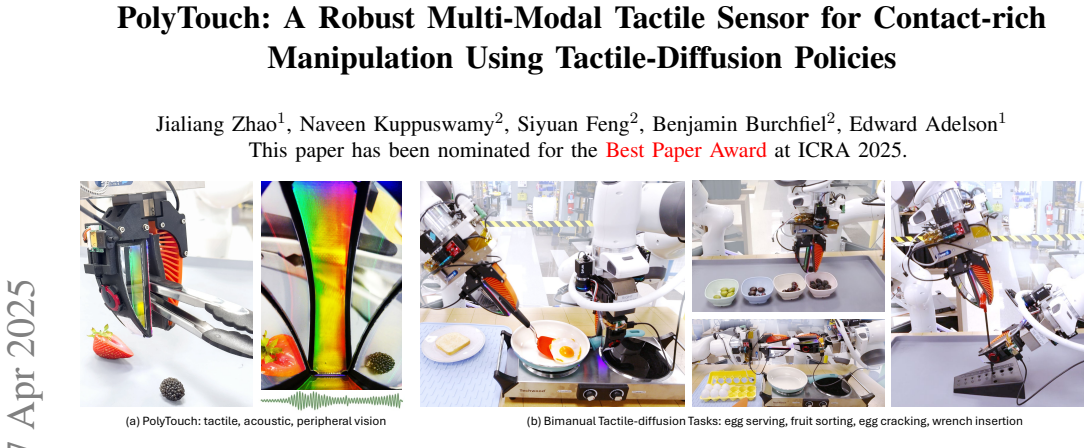
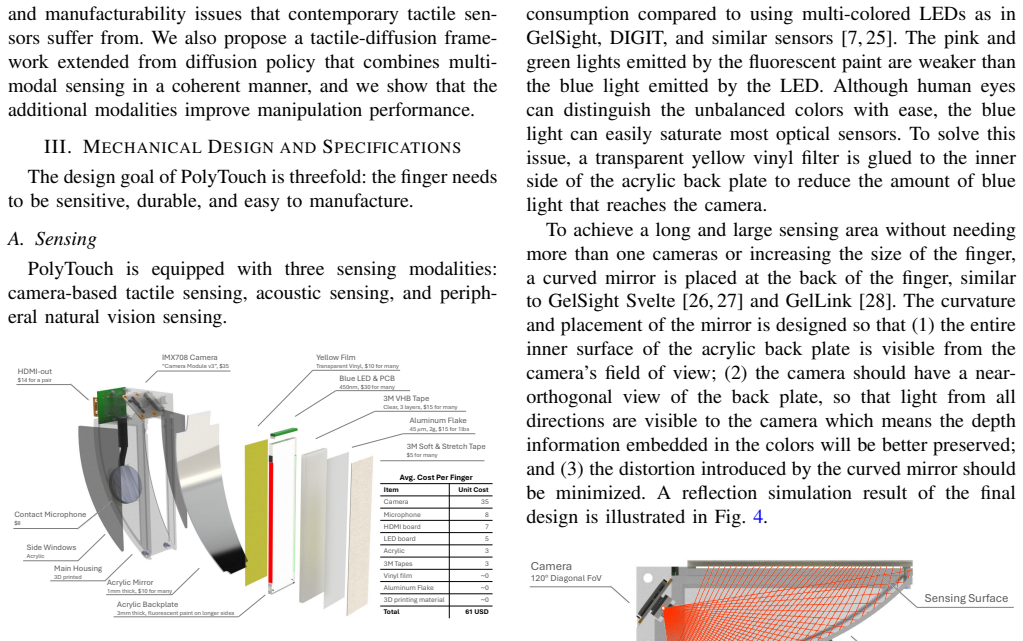
The load-bearing object is the PolyTouch finger plus the tactile-diffusion policy. The finger's optical tactile channel uses a curved mirror and fluorescent-paint illumination so one camera sees a 100 mm by 25 mm contact surface, while the same camera's peripheral view through side windows senses surroundings and the underside of the finger; a piezoelectric contact microphone samples acoustic vibration at 48 kHz, and the elastomer is a 3M VHB tape coated with reflective aluminum powder that can be swapped in less than five minutes. The policy is a diffusion policy, a conditional denoising diffusion model over action sequences, whose observations are encoded by pre-trained feature extractors (T3 for tactile footage, CLIP for wrist and scene cameras, an audio spectrogram transformer for the microphone, and an MLP for proprioception), then fused by a 6-block, 12-head cross-attention combiner before action prediction. This combination is what lets the network use high-resolution contact texture, high-frequency acoustic events, and near-contact visual context at the same time.
What would settle it
Repeat the spatula-rubbing durability protocol with several PolyTouch-VHB and commercial gel units and use the median time-to-failure; and re-run the four tasks' policy evaluations with a fixed number of episodes, say 50 per variant, reporting per-seed success. If median VHB life is not at least 20 times the median gel life, or if the multi-modal variants do not beat the visuo-proprio baseline within confidence intervals, the central claim is not supported.
Extended reading notes
Core claim
The central claim is that multi-modal tactile feedback, meaning tactile texture images, acoustic vibration, and peripheral vision from the same finger, gives learned contact-rich manipulation policies a consistent advantage over vision-and-proprioception-only policies, and that this advantage is practically accessible because the sensor is durable and easy to reproduce. In the authors' experiments, PolyTouch-VHB lasted 35 hours of continuous abrasion and torsion in an emulated tool-use setting before any failure or image-quality loss, while a GelSight Mini with standard gels failed at 1.0 and 3.3 hours and an updated silicone formula lasted 25.0 hours. Policy learning used a tactile-diffusion architecture: pre-trained encoders for each modality are combined with cross-attention, then fed into a diffusion policy head. Across wrench insertion, fruit sorting, egg cracking, and egg serving, the multi-modal policies outperformed the visuo-proprio baseline in average progress and success, and failure modes such as excessive insertion force, insufficient spatula pressure, and mis-sorting visually similar fruit appeared only or mostly in the vision-only policy. The paper frames this as evidence that haptic feedback, not just more or better vision, is needed for robust contact-rich manipulation.
Load-bearing premise
The headline claims, at least 20-fold longer life and consistently better manipulation, rest on single durability trials with no replicates and on evaluation numbers reported without episode counts or variance; if those runs were unrepresentative, the quantitative comparisons could shrink or disappear.
Editorial extensions
If this is right
- Tactile-inclusive policies avoid force failures that vision-only policies exhibit, such as pressing too hard during wrench insertion and too softly during scooping.
- Peripheral vision from the finger reduces grasp-precision errors: the authors report 11 grasp failures for the vision-only policy versus 3 on average for tactile-inclusive variants.
- Surface texture lets the policy distinguish visually similar objects; blackberry-versus-blueberry sorting succeeded 80% of the time with touch and only 20% without.
- The benefit of extra modalities grows with data: improving training data from one-third to full increased the egg-serving success advantage from 0 to 34 percentage points, indicating tactile policies need enough demonstrations to pay off.
- The VHB elastomer's durability and five-minute replacement make long-horizon on-robot data collection with tactile sensing practical.
Reading between the lines
- The paper does not ablate the three finger modalities separately, so an obvious next experiment is to measure the marginal contribution of audio versus peripheral vision versus tactile texture; the current design leaves open whether one channel carries most of the benefit.
- Because PolyTouch outputs a single Ethernet video-and-audio stream, the same finger could be used across many embodiments and sites, making it a plausible platform for a large shared tactile dataset; the authors hint at foundational-policy pretraining but do not demonstrate it.
- The VHB elastomer's viscoelastic hysteresis may limit fast contact estimation; temporal-difference images and the 48 kHz microphone stream are natural complementary cues that the paper mentions as a mitigation but does not evaluate quantitatively.
- A testable extension is to attach PolyTouch to a single-arm mobile manipulator and run the same fruit-sorting protocol with random lighting; the peripheral vision channel should be sensitive to illumination, and its failure would separate the optical contribution from the acoustic and tactile ones.
Signed reviews
Editorial analysis
A structured set of objections, weighed in public.
Referee Report
Summary. The paper introduces PolyTouch, a low-cost robot finger that integrates camera-based tactile sensing, contact-microphone acoustic sensing, and peripheral vision through side windows into a single compact unit. Two elastomer options are presented, with a VHB tape-based formula that is claimed to be easy to fabricate and very durable. The authors report a durability experiment in which PolyTouch-VHB endured 35 hours of continuous rubbing without failure, compared with 1.0 and 3.3 hours for two GelSight Mini standard gels, and they claim 'at least 20-fold' longer lifespan. The paper then proposes a tactile-diffusion policy that encodes tactile-peripheral images with a pre-trained T3 encoder, wrist and scene cameras with CLIP, audio spectrograms with AST, and proprioception with an MLP, combining them via cross-modal attention before a diffusion action head. This policy is evaluated on four bimanual tasks (wrench insertion, fruit sorting, egg cracking, egg serving) against a visuo-proprio baseline that masks the tactile-peripheral and audio inputs. The paper reports consistent improvements in task progress and success for tactile-inclusive policies over the baseline.
Significance. The sensor hardware is a genuine engineering contribution: the VHB-tape elastomer, quick-swap mechanism, fluorescent-paint illumination, and curved-mirror optics are described in enough detail to be reproduced, and the reported cost of about 61 USD per finger is attractive for large-scale data collection. If the policy results are valid, the paper would provide strong evidence that multi-modal contact sensing improves learned contact-rich manipulation over vision-only policies. The use of pre-trained encoders (T3, CLIP, AST) is a sensible design choice that avoids training vision encoders from scratch. However, the policy evaluation has a serious confound and the durability headline is overstated; these issues need to be resolved before the central claims are established.
major comments (3)
- [Section IV-A and Section V-B] The visuo-proprio baseline masks out O_tp and O_aud, but O_tp is defined in Section IV-A as 'Tactile and peripheral vision ... obtained as RGB images from the PolyTouch mounted on each arm.' Therefore the baseline lacks not only the tactile gel images but also the finger's side-window peripheral views of the workspace around the contact surface. The reported improvements of multi-crossatn over visuo-proprio (Table II) thus conflate tactile and acoustic information with an additional close-range visual stream. This is not a minor naming issue: the paper's own failure-mode analysis in Section V-B attributes reduced grasp-precision errors to the peripheral vision modality. The central claim that 'policies trained with multi-modal tactile sensing consistently outperformed state-of-the-art visuomotor policies' is not established unless a control condition provides the baseline with an equivalent peripheral view or masks only the gel-contact region of O_tp while retaining the side-window views.
- [Section V-A and Abstract] The 'at least 20-fold increase in lifespan' claim compares the 35-hour PolyTouch-VHB run to the 1.0-hour GelSight Standard Gel. The other standard gel lasted 3.3 hours, giving a ratio of about 10.6x, so 'at least 20-fold' is not supported against the better-performing commercial gel. In addition, each material was tested with a single sample, so the quantitative headline is not robust. Please report multiple runs per material and compare against the most durable commercial option, or reword the claim to match the data (e.g., 'at least 10-fold').
- [Table II and Section V-B] The evaluation table reports only point estimates of average task progress and average task success, with no episode counts, variances, or statistical tests. For several cells (Crack Egg +1%/+3%, Serve Egg 2/3 data +3%/+20%) the differences are small, and without error bars or episode counts one cannot assess whether the improvements are meaningful. Please report the number of evaluation episodes per task and variant, the standard deviation or confidence interval, and ideally results across multiple training seeds.
minor comments (5)
- [Section III-C] There is a typo: 'silimar' should be 'similar' in the sentence about the silicone gel fabrication process.
- [Section V-B] The training set sizes are given as 'datapoints' (e.g., 'Around 200 datapoints'), but the units are ambiguous; specify whether these are demonstration episodes, trajectory steps, or something else.
- [Section V-B] The metric 'average task progress' depends on a division of each task into 3-7 stages, but the stages are not described per task; specify them for reproducibility.
- [Section IV-A and Figure 5] Figure 5 indicates 'Weights sharing' but the text does not state which parameters are shared across the left and right arms; clarify this in the caption or text.
- [Abstract] The phrase 'in multiple contact-aware manipulation policies' should likely be 'in multiple contact-aware manipulation tasks' (typo).
Circularity Check
No circularity: the paper reports direct measurements and held-out policy evaluations; the main confound (peripheral vision included in the masked tactile stream) is a validity issue, not a definitional reduction.
full rationale
PolyTouch is an empirical systems paper: the durability comparison is a direct abrasion experiment (Section V-A), and the policy comparisons are held-out task evaluations (Section V-B). No prediction is obtained by fitting a parameter and then renaming it, and no result is true by construction. The only load-bearing design decision that could be challenged is that the visuo-proprio baseline masks out Ot_tp, while Ot_tp is defined as 'Tactile and peripheral vision ... obtained as RGB images from the PolyTouch mounted on each arm' (Section IV-A). This conflates tactile/acoustic inputs with an additional close-range camera view, and the paper's own failure-mode analysis attributes grasp-precision gains to peripheral vision. That is a controlled-comparison confound, not circularity: the compared quantities are not equivalent by definition, and a baseline with an equivalent peripheral camera would resolve it. The pretrained T3, CLIP, and AST encoders come from prior work (including the authors' T3) but are not fitted to the four evaluation tasks; citing them is normal methodology, not load-bearing self-citation. Missing episode counts and variances in Table II, and single-sample durability runs, are statistical-evidence concerns, not circular steps. The limitations section (Section VI) discusses VHB hysteresis openly and proposes mitigations, again without circular reasoning. No reduction of any claim to its inputs was found.
Assumptions & free parameters
free parameters (5)
- Durability test force range =
10-30 N
- Durability test movement ranges =
±10 mm translation, ±5 deg rotation per axis
- Policy training dataset sizes =
200 (wrench), 150 (fruit), 70 (egg crack), 150 (egg serve) demonstrations
- Policy training hyperparameters =
observation history 2, action horizon 16, execute 8, 500 epochs, batch size 10
- Evaluation episode count =
not reported
assumptions (5)
- domain assumption The pre-trained T3 encoder provides transferable tactile features for PolyTouch images
- domain assumption CLIP features encode sufficient visual information for wrist and scene views
- domain assumption Diffusion policy is an appropriate action generation model for these tasks
- domain assumption Contact microphone audio at 48 kHz captures contact events relevant to task success
- domain assumption VHB elastomer viscoelastic hysteresis does not prevent effective tactile sensing in policy training
Cite this review
Pith. "Pith review of PolyTouch: A Robust Multi-Modal Tactile Sensor for Contact-rich Manipulation Using Tactile-Diffusion Policies." pith.science (2026). https://pith.science/paper/XMEDQBOD
@misc{pith2026250419341,
  author       = {Pith},
  title        = {Pith review of: PolyTouch: A Robust Multi-Modal Tactile Sensor for Contact-rich Manipulation Using Tactile-Diffusion Policies},
  year         = {2026},
  howpublished = {\url{https://pith.science/paper/XMEDQBOD}},
  note         = {Machine review of arXiv:2504.19341}
}
read the original abstract
Achieving robust dexterous manipulation in unstructured domestic environments remains a significant challenge in robotics. Even with state-of-the-art robot learning methods, haptic-oblivious control strategies (i.e. those relying only on external vision and/or proprioception) often fall short due to occlusions, visual complexities, and the need for precise contact interaction control. To address these limitations, we introduce PolyTouch, a novel robot finger that integrates camera-based tactile sensing, acoustic sensing, and peripheral visual sensing into a single design that is compact and durable. PolyTouch provides high-resolution tactile feedback across multiple temporal scales, which is essential for efficiently learning complex manipulation tasks. Experiments demonstrate an at least 20-fold increase in lifespan over commercial tactile sensors, with a design that is both easy to manufacture and scalable. We then use this multi-modal tactile feedback along with visuo-proprioceptive observations to synthesize a tactile-diffusion policy from human demonstrations; the resulting contact-aware control policy significantly outperforms haptic-oblivious policies in multiple contact-aware manipulation policies. This paper highlights how effectively integrating multi-modal contact sensing can hasten the development of effective contact-aware manipulation policies, paving the way for more reliable and versatile domestic robots. More information can be found at https://polytouch.alanz.info/
Figures

Figures from the paper (3 more)


Forward citations
Cited by 2 Pith papers
-
Classification of Vision-Based Tactile Sensors: A Review
A review that proposes a four-type classification of vision-based tactile sensors, dividing them into marker-based versus intensity-based transduction with subtypes and combinations.
-
VLA-Touch: Enhancing Vision-Language-Action Models with Dual-Level Tactile Feedback
Tactile feedback, provided both as language descriptions for planning and as force signals for action refinement, improves vision-language-action robot policies on contact-rich manipulation tasks.
Reference graph
Works this paper leans on
-
[1]
Octo: An open-source generalist robot policy,
O. M. Team, D. Ghosh, H. Walke, K. Pertsch, K. Black, O. Mees, S. Dasari, J. Hejna, T. Kreiman, C. Xu, et al., “Octo: An open-source generalist robot policy,” arXiv preprint arXiv:2405.12213 , 2024
arXiv 2024
-
[2]
Scaling proprioceptive-visual learning with heterogeneous pre-trained transformers,
L. Wang, X. Chen, J. Zhao, and K. He, “Scaling proprioceptive-visual learning with heterogeneous pre-trained transformers,” in Arxiv, 2024
work page 2024
-
[3]
Diffusion policy: Visuomotor policy learning via action diffusion,
C. Chi, S. Feng, Y . Du, Z. Xu, E. Cousineau, B. Burchfiel, and S. Song, “Diffusion policy: Visuomotor policy learning via action diffusion,” arXiv preprint arXiv:2303.04137 , 2023
arXiv 2023
-
[4]
Texterity: Tactile ex- trinsic dexterity,
A. Bronars, S. Kim, P. Patre, and A. Rodriguez, “Texterity: Tactile ex- trinsic dexterity,” in 2024 IEEE International Conference on Robotics and Automation (ICRA) . IEEE, 2024, pp. 7976–7983
work page 2024
-
[5]
Fingerslam: Closed-loop unknown object localization and reconstruction from visuo-tactile feedback,
J. Zhao, M. Bauza, and E. H. Adelson, “Fingerslam: Closed-loop unknown object localization and reconstruction from visuo-tactile feedback,” in 2023 IEEE International Conference on Robotics and Automation (ICRA). IEEE, 2023, pp. 8033–8039
work page 2023
-
[6]
Neural feels with neural fields: Visuo-tactile perception for in-hand manipulation,
S. Suresh, H. Qi, T. Wu, T. Fan, L. Pineda, M. Lambeta, J. Malik, M. Kalakrishnan, R. Calandra, M. Kaess, et al. , “Neural feels with neural fields: Visuo-tactile perception for in-hand manipulation,” arXiv preprint arXiv:2312.13469, 2023
arXiv 2023
-
[7]
Gelsight: High-resolution robot tactile sensors for estimating geometry and force,
W. Yuan, S. Dong, and E. H. Adelson, “Gelsight: High-resolution robot tactile sensors for estimating geometry and force,” Sensors, vol. 17, no. 12, p. 2762, 2017
2017
-
[8]
Learning object compliance via young’s modulus from single grasps with camera-based tactile sensors,
M. Burgess, “Learning object compliance via young’s modulus from single grasps with camera-based tactile sensors,” arXiv preprint arXiv:2406.15304, 2024
arXiv 2024
Show all 35 references
-
[9]
Measurement of shear and slip with a gelsight tactile sensor,
W. Yuan, R. Li, M. A. Srinivasan, and E. H. Adelson, “Measurement of shear and slip with a gelsight tactile sensor,” in 2015 IEEE International Conference on Robotics and Automation (ICRA). IEEE, 2015, pp. 304–311
2015
-
[10]
Improved gelsight tactile sen- sor for measuring geometry and slip,
S. Dong, W. Yuan, and E. H. Adelson, “Improved gelsight tactile sen- sor for measuring geometry and slip,” in 2017 IEEE/RSJ International Conference on Intelligent Robots and Systems (IROS) . IEEE, 2017, pp. 137–144
2017
-
[11]
Maniwav: Learning robot manipulation from in-the-wild audio-visual data,
Z. Liu, C. Chi, E. Cousineau, N. Kuppuswamy, B. Burchfiel, and S. Song, “Maniwav: Learning robot manipulation from in-the-wild audio-visual data,” arXiv preprint arXiv:2406.19464 , 2024
2024 arXiv
-
[12]
Open-environment robotic acoustic perception for object recognition,
S. Jin, H. Liu, B. Wang, and F. Sun, “Open-environment robotic acoustic perception for object recognition,” Frontiers in neurorobotics, vol. 13, p. 96, 2019
2019
-
[13]
Combining finger vision and optical tactile sensing: Reducing and handling errors while cutting vegetables,
A. Yamaguchi and C. G. Atkeson, “Combining finger vision and optical tactile sensing: Reducing and handling errors while cutting vegetables,” in 2016 IEEE-RAS 16th International Conference on Humanoid Robots (Humanoids) . IEEE, 2016, pp. 1045–1051
2016
-
[14]
Densetact: Optical tactile sensor for dense shape reconstruction,
W. K. Do and M. Kennedy, “Densetact: Optical tactile sensor for dense shape reconstruction,” in 2022 International Conference on Robotics and Automation (ICRA) . IEEE, 2022, pp. 6188–6194
2022
-
[15]
Soft-bubble grippers for robust and perceptive manipulation,
N. Kuppuswamy, A. Alspach, A. Uttamchandani, S. Creasy, T. Ikeda, and R. Tedrake, “Soft-bubble grippers for robust and perceptive manipulation,” International Conference on Intelligent Robots and Systems (IROS), 2020
2020
-
[16]
Soft- bubble: A highly compliant dense geometry tactile sensor for robot manipulation,
A. Alspach, K. Hashimoto, N. Kuppuswarny, and R. Tedrake, “Soft- bubble: A highly compliant dense geometry tactile sensor for robot manipulation,” in RoboSoft, 04 2019, pp. 597–604
2019
-
[17]
Gelslim: A high-resolution, compact, robust, and calibrated tactile- sensing finger,
E. Donlon, S. Dong, M. Liu, J. Li, E. Adelson, and A. Rodriguez, “Gelslim: A high-resolution, compact, robust, and calibrated tactile- sensing finger,” in 2018 IEEE/RSJ International Conference on Intel- ligent Robots and Systems (IROS) . IEEE, 2018, pp. 1927–1934
2018
-
[18]
Leveraging multimodal haptic sensory data for robust cutting,
K. Zhang, M. Sharma, M. Veloso, and O. Kroemer, “Leveraging multimodal haptic sensory data for robust cutting,” in 2019 IEEE-RAS 19th International Conference on Humanoid Robots (Humanoids) . IEEE, 2019, pp. 409–416
2019
-
[19]
Acoustic collision detection and localization for robot manipulators,
X. Fan, D. Lee, Y . Chen, C. Prepscius, V . Isler, L. Jackel, H. S. Seung, and D. Lee, “Acoustic collision detection and localization for robot manipulators,” in 2020 IEEE/RSJ International Conference on Intelligent Robots and Systems (IROS) . IEEE, 2020, pp. 9529–9536
2020
-
[20]
Aurasense: Robot collision avoidance by full surface proximity de- tection,
X. Fan, R. Simmons-Edler, D. Lee, L. Jackel, R. Howard, and D. Lee, “Aurasense: Robot collision avoidance by full surface proximity de- tection,” in 2021 IEEE/RSJ International Conference on Intelligent Robots and Systems (IROS) . IEEE, 2021, pp. 1763–1770
2021
-
[21]
Detecting, locating and recognising human touches in social robots with contact microphones,
J. J. Gamboa-Montero, F. Alonso-Martin, J. C. Castillo, M. Malfaz, and M. A. Salichs, “Detecting, locating and recognising human touches in social robots with contact microphones,” Engineering Applications of Artificial Intelligence , vol. 92, p. 103670, 2020
2020
-
[22]
Sensing touch force using active acoustic sensing,
M. Ono, B. Shizuki, and J. Tanaka, “Sensing touch force using active acoustic sensing,” in Proceedings of the Ninth International Conference on Tangible, Embedded, and Embodied Interaction , 2015, pp. 355–358
2015
-
[23]
Poco: Policy composition from and for heterogeneous robot learning,
L. Wang, J. Zhao, Y . Du, E. H. Adelson, and R. Tedrake, “Poco: Policy composition from and for heterogeneous robot learning,” arXiv preprint arXiv:2402.02511, 2024
2024 arXiv
-
[24]
Retrographic sensors with fluorescent illumination,
E. Adelson, “Retrographic sensors with fluorescent illumination,” Feb. 22 2024, uS Patent App. 18/267,032
2024
-
[25]
Digit: A novel design for a low-cost compact high-resolution tactile sensor with application to in-hand manipulation,
M. Lambeta, P.-W. Chou, S. Tian, B. Yang, B. Maloon, V . R. Most, D. Stroud, R. Santos, A. Byagowi, G. Kammerer, et al. , “Digit: A novel design for a low-cost compact high-resolution tactile sensor with application to in-hand manipulation,” IEEE Robotics and Automation Letter...
2020
-
[26]
Gelsight svelte: A human finger-shaped single-camera tactile robot finger with large sensing coverage and proprioceptive sensing,
J. Zhao and E. H. Adelson, “Gelsight svelte: A human finger-shaped single-camera tactile robot finger with large sensing coverage and proprioceptive sensing,” in 2023 IEEE/RSJ International Conference on Intelligent Robots and Systems (IROS) . IEEE, 2023, pp. 8979– 8984
2023
-
[27]
Gelsight svelte hand: A three-finger, two-dof, tactile-rich, low-cost robot hand for dexterous manipulation,
J. Zhao and E. Adelson, “Gelsight svelte hand: A three-finger, two-dof, tactile-rich, low-cost robot hand for dexterous manipulation,” arXiv preprint arXiv:2309.10886, 2023
2023 arXiv
-
[28]
Gellink: A compact multi-phalanx finger with vision-based tactile sensing and proprioception,
Y . Ma, J. Zhao, and E. Adelson, “Gellink: A compact multi-phalanx finger with vision-based tactile sensing and proprioception,” in 2024 IEEE International Conference on Robotics and Automation (ICRA) . IEEE, 2024, pp. 1107–1113
2024
-
[29]
Reskin: versatile, replaceable, lasting tactile skins,
R. Bhirangi, T. Hellebrekers, C. Majidi, and A. Gupta, “Reskin: versatile, replaceable, lasting tactile skins,” in 5th Annual Conference on Robot Learning , 2021
2021
-
[30]
Fin ray® effect inspired soft robotic gripper: From the robosoft grand challenge toward optimization,
W. Crooks, G. Vukasin, M. O’Sullivan, W. Messner, and C. Rogers, “Fin ray® effect inspired soft robotic gripper: From the robosoft grand challenge toward optimization,” Frontiers in Robotics and AI , vol. 3, p. 70, 2016
2016
-
[31]
Transferable tactile transformers for representation learning across diverse sensors and tasks,
J. Zhao, Y . Ma, L. Wang, and E. H. Adelson, “Transferable tactile transformers for representation learning across diverse sensors and tasks,” arXiv preprint arXiv:2406.13640 , 2024
2024 arXiv
-
[32]
Learning transferable visual models from natural language supervision,
A. Radford, J. W. Kim, C. Hallacy, A. Ramesh, G. Goh, S. Agarwal, G. Sastry, A. Askell, P. Mishkin, J. Clark,et al., “Learning transferable visual models from natural language supervision,” in International conference on machine learning . PMLR, 2021, pp. 8748–8763
2021
-
[33]
Ast: Audio spectrogram trans- former,
Y . Gong, Y .-A. Chung, and J. Glass, “Ast: Audio spectrogram trans- former,” arXiv preprint arXiv:2104.01778 , 2021
2021 arXiv
-
[34]
An image is worth 16x16 words: Transformers for image recognition at scale,
A. Dosovitskiy, “An image is worth 16x16 words: Transformers for image recognition at scale,” arXiv preprint arXiv:2010.11929 , 2020
2010 arXiv
-
[35]
GelSight Mini,
G. Inc., “GelSight Mini,” https://www.gelsight.com/gelsightmini/, 2022, [Online]
2022
Reviewed August 16, 2026 · model on record in the stance chip above.
Discussion (0). Continue with ORCID to comment.