Constituency Optimisation Through Hamiltonian Representation Of Mandates (COTHROM): Algorithmic Redistricting of Irish Election Boundaries
Pith reviewed 2026-06-28 10:21 UTC · model grok-4.3
The pith
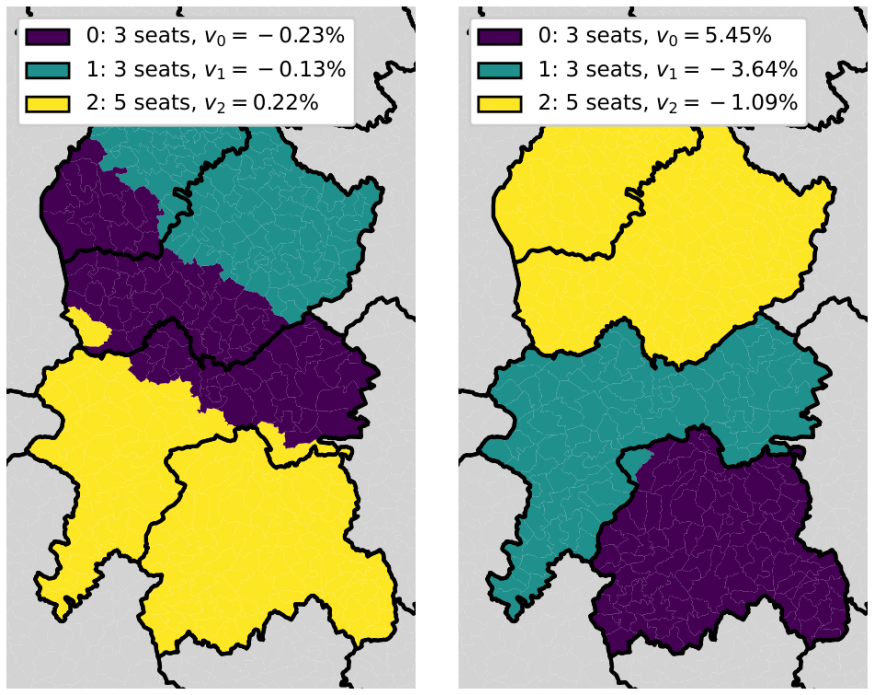
A Potts Hamiltonian model of Irish constitutional rules, minimized by MCMC and selected by Pareto analysis, produces constituency boundaries that score higher than existing legal maps on proportionality and compactness in County Cork.
A machine-rendered reading of the paper's core claim, the machinery that carries it, and where it could break.
Core claim
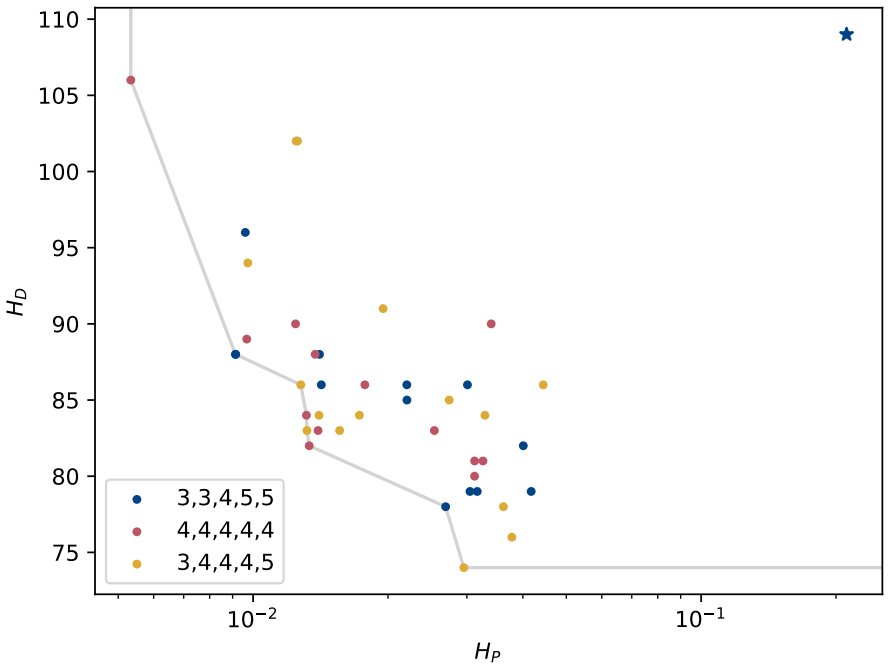
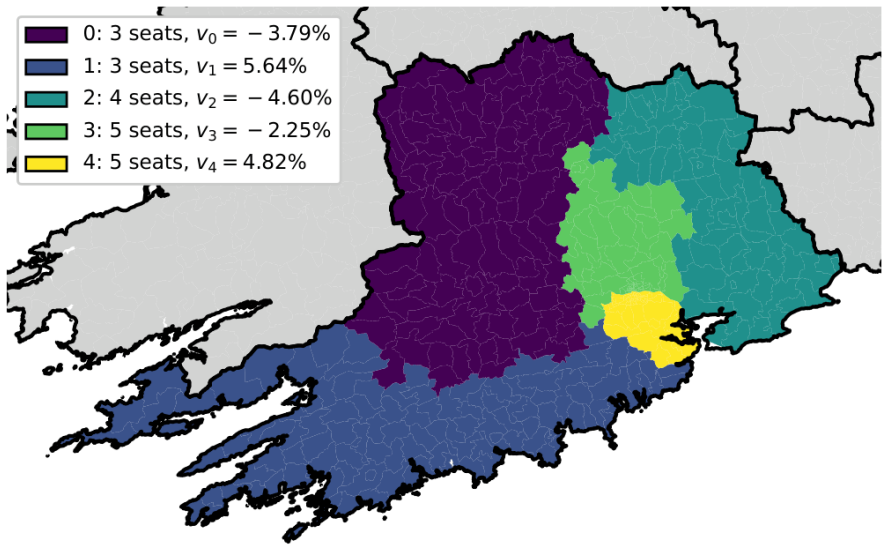
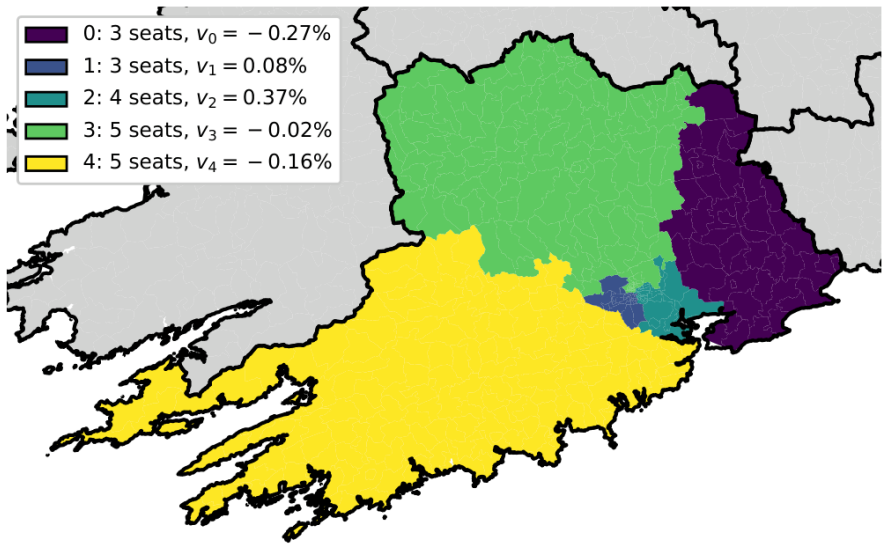
COTHROM parses the redistricting problem using statistical physics, where constitutional objectives are considered as terms in a Potts Hamiltonian. Markov Chain Monte Carlo methods and simulated annealing are employed to minimise this objective function, systematically exploring this configuration space, with coupling constants as proxies for objective weightings. Multi Criterion Decision Analysis (MCDA) and Pareto Optimality is then utilised to remedy the ambiguity in choosing a certain objective weighting combination over others. With respect to proportional representation and compactness objectives evaluated in County Cork, COTHROM consistently improves on the existing legal constituency
What carries the argument
The Potts Hamiltonian whose additive terms represent distinct constitutional objectives and whose coupling constants serve as tunable proxies for their relative weightings; the Hamiltonian is minimized by MCMC and simulated annealing, after which MCDA and Pareto selection extracts the final boundaries.
If this is right
- Trade-offs between objectives become explicit and quantifiable through the choice of coupling constants.
- The configuration space of possible boundaries can be searched systematically rather than by manual adjustment.
- MCDA and Pareto optimality provide a way to compare solutions without committing to a single weighting in advance.
- The method yields boundaries that improve measured scores on proportional representation and compactness relative to the existing legal map in County Cork.
Where Pith is reading between the lines
- The same Hamiltonian construction could be adapted to other countries that use single-transferable-vote systems by redefining the energy terms to match their specific legal rules.
- If the unmodeled constraints turn out to be binding, the Pareto front produced by the current method would require an additional post-processing filter before any boundary could be adopted.
- Scaling the MCMC search to the full national level would depend on whether the computational cost grows acceptably with the number of constituencies.
Load-bearing premise
Constitutional objectives can be faithfully represented as additive energy terms in a Potts Hamiltonian whose coupling constants act as independent, meaningful proxies for legal weightings, and that MCDA/Pareto selection will produce boundaries that remain valid under the complete set of constitutional constraints even when some of those constraints are left out of the model.
What would settle it
Apply COTHROM to County Cork at the same objective weightings used for the reported results, then check whether any generated boundary set violates a constitutional rule not included in the Hamiltonian or scores worse than the legal map when evaluated on the full unmodeled legal criteria.
Figures
read the original abstract
Electoral redistricting in Ireland's Proportional Representation Single Transferable Vote (PR-STV) system faces the challenge of selecting an optimally representative set of electoral boundaries from an enormous set of possible configurations, and where ``representative'' is a delicate balance of constitutional objectives that are often in tension with one another. We present the first computational framework for Irish electoral redistricting that systematically optimises across multiple constitutional requirements while making trade-offs explicit and quantifiable. The electoral redistricting problem is parsed using statistical physics, where constitutional objectives are considered as terms in a Potts Hamiltonian. Markov Chain Monte Carlo (MCMC) methods and simulated annealing are employed to minimise this objective function, systematically exploring this configuration space, with coupling constants as proxies for objective weightings. Multi Criterion Decision Analysis (MCDA) and Pareto Optimality is then utilised to remedy the ambiguity in choosing a certain objective weighting combination over others. With respect to proportional representation and compactness objectives evaluated in County Cork, COTHROM consistently improves on the existing legal constituency boundaries for a range of objective weightings.
Editorial analysis
A structured set of objections, weighed in public.
Referee Report
Summary. The paper presents COTHROM, the first computational framework for Irish PR-STV redistricting. Constitutional objectives are encoded as additive terms in a Potts Hamiltonian; MCMC with simulated annealing minimizes the energy using tunable coupling constants as objective weightings; MCDA and Pareto optimality then select among the resulting maps. The central claim is that, evaluated on proportional representation and compactness in County Cork, the method consistently improves on existing legal boundaries across a range of weightings.
Significance. If the Hamiltonian faithfully encodes the legal criteria and the sampled maps satisfy all unmodeled constraints, the work would supply a novel, transparent, physics-based method for quantifying trade-offs in a domain that has lacked systematic algorithmic treatment. The explicit use of MCDA to handle weighting ambiguity and the attempt to produce falsifiable, multi-objective improvements are strengths. At present the absence of any reported quantitative metrics, validation protocol, or explicit term construction limits the assessed significance.
major comments (3)
- [Abstract] Abstract: the claim that COTHROM 'consistently improves' on legal boundaries rests on an evaluation performed in only one county; no quantitative metrics, baselines, error bars, number of weightings tested, or validation against held-out constitutional criteria are supplied, which is load-bearing for the central empirical claim.
- [Abstract] Abstract (Hamiltonian construction): coupling constants are introduced as free proxies for objective weightings and then tuned; the subsequent MCDA step is invoked precisely to resolve the ambiguity created by those free choices, creating moderate dependence of the final maps on modeling assumptions rather than on external benchmarks.
- [Abstract] Abstract (Potts terms): it is not shown whether the proportionality term computes exact PR-STV quota and transfer effects or only approximates them via additive penalties; if the latter, minima may violate the full set of constitutional constraints (population equality, contiguity, county integrity), undermining the validity of any reported improvement.
Simulated Author's Rebuttal
We thank the referee for the detailed and constructive report. We address each major comment below and indicate planned revisions to the manuscript.
read point-by-point responses
-
Referee: [Abstract] Abstract: the claim that COTHROM 'consistently improves' on legal boundaries rests on an evaluation performed in only one county; no quantitative metrics, baselines, error bars, number of weightings tested, or validation against held-out constitutional criteria are supplied, which is load-bearing for the central empirical claim.
Authors: We agree the abstract claim requires supporting detail. County Cork serves as the initial case study due to data availability and computational scale. The full manuscript contains figures comparing optimized maps to legal boundaries on proportionality and compactness, but these lack the explicit numerical values, baselines, error bars, and weighting counts requested. In revision we will expand the abstract, add a results section reporting specific metrics (e.g., proportionality deviation and Polsby-Popper scores), baselines, standard deviations from repeated MCMC runs, the exact number of weightings evaluated, and a limitations paragraph noting the single-county scope and absence of held-out validation. The central claim will be qualified accordingly. revision: yes
-
Referee: [Abstract] Abstract (Hamiltonian construction): coupling constants are introduced as free proxies for objective weightings and then tuned; the subsequent MCDA step is invoked precisely to resolve the ambiguity created by those free choices, creating moderate dependence of the final maps on modeling assumptions rather than on external benchmarks.
Authors: The tunable coupling constants are intentionally introduced as proxies to sample the multi-objective space; MCDA and Pareto analysis are then applied to identify maps that remain competitive across weightings. This design choice makes trade-offs transparent rather than fixing a single weighting a priori. We will revise the abstract and methods to state explicitly that MCDA selection mitigates single-assumption dependence and that the legal boundaries serve as the external benchmark for improvement. No change to the underlying approach is required. revision: partial
-
Referee: [Abstract] Abstract (Potts terms): it is not shown whether the proportionality term computes exact PR-STV quota and transfer effects or only approximates them via additive penalties; if the latter, minima may violate the full set of constitutional constraints (population equality, contiguity, county integrity), undermining the validity of any reported improvement.
Authors: The proportionality term employs additive penalties on quota deviation to approximate PR-STV effects, as exact transfer simulation at every MCMC step is computationally intractable. Hard constraints on population equality, contiguity, and county integrity are enforced separately via the configuration space definition and post-optimization checks. In revision we will add an explicit subsection describing term construction, state the approximation, report that all presented maps satisfy the hard constraints, and discuss the approximation's limitations. revision: yes
Circularity Check
No circularity: optimization result is independent of inputs
full rationale
The provided abstract and context describe a standard multi-objective optimization pipeline: constitutional goals are encoded as additive Potts terms, couplings act as explicit tunable weights, MCMC/annealing minimizes the resulting Hamiltonian, and MCDA/Pareto filtering selects among the resulting trade-off surfaces. The reported improvement is obtained by direct comparison of the minimized objective values against the fixed legal boundaries on the same metrics; this is a computational search outcome, not a quantity that equals its own modeling choices by construction. No equations, self-citations, uniqueness theorems, or fitted-parameter-as-prediction steps are present in the given text that would collapse the final maps back to the input ansatz or couplings. The derivation therefore remains self-contained against external benchmarks (the existing legal map).
Axiom & Free-Parameter Ledger
free parameters (1)
- coupling constants
axioms (1)
- domain assumption Constitutional objectives can be represented as additive terms in a Potts Hamiltonian
Reference graph
Works this paper leans on
-
[1]
1937 , note =
Constitution of. 1937 , note =
1937
-
[2]
Constituency Review Report 2023: Dáil and European Parliament Constituencies , year =
2023
-
[3]
Electoral Redistricting in Ireland
Coakley, John. Electoral Redistricting in Ireland. Redistricting in Comparative Perspective. 2008
2008
-
[4]
Electoral Reform Act 2022 , year =
2022
-
[5]
Electoral Reform Act 2022, Section 57: Constituency Review Reports , year =
2022
-
[6]
Census of Population 2022 Profile 1 -- Population Distribution and Movements: Background Notes , year =
2022
-
[7]
1964 , note =
Constitution of. 1964 , note =
1964
-
[8]
Catt, Helena , year=. Book Review: David M. Farrell and lan McAllister, The Australian Electoral System: Origins, Variations and Consequences , volume=. Political Science , publisher=. doi:10.1177/003231870605800209 , number=
-
[9]
The Gregory Fractional Transfer , howpublished =
-
[10]
The Politics of Electoral Systems , publisher =
, editor =. The Politics of Electoral Systems , publisher =. 2005 , month =. doi:10.1093/0199257566.001.0001 , url =
-
[11]
Droop, H. R. , year=. On Methods of Electing Representatives , volume=. Journal of the Statistical Society of London , publisher=. doi:10.2307/2339223 , number=
-
[12]
McBride, James P. , year=. Positive aspects of PR‐STV for the Irish political system , volume=. Representation , publisher=. doi:10.1080/00344899608522980 , number=
-
[13]
Nagel , journal =
Stuart S. Nagel , journal =. Simplified Bipartisan Computer Redistricting , urldate =
-
[14]
Weaver, James B. and Hess, Sidney W. , year=. A Procedure for Nonpartisan Districting: Development of Computer Techniques , volume=. The Yale Law Journal , publisher=. doi:10.2307/794769 , number=
-
[15]
Spin systems and Political Districting Problem , volume=
Chou, Chung-I and Li, Sai-Ping , year=. Spin systems and Political Districting Problem , volume=. Journal of Magnetism and Magnetic Materials , publisher=. doi:10.1016/j.jmmm.2006.11.086 , number=
-
[16]
Chou, Chung-I and Li, S.P. , year=. Taming the Gerrymander—Statistical physics approach to Political Districting Problem , volume=. Physica A: Statistical Mechanics and its Applications , publisher=. doi:10.1016/j.physa.2006.01.082 , number=
-
[17]
Garfinkel, R. S. and Nemhauser, G. L. , year=. Optimal Political Districting by Implicit Enumeration Techniques , volume=. Management Science , publisher=. doi:10.1287/mnsc.16.8.b495 , number=
-
[18]
Evolutionary Strategy for Political Districting Problem Using Genetic Algorithm , ISBN =
Chou, Chung-I and Chu, You-ling and Li, Sai-Ping , year =. Evolutionary Strategy for Political Districting Problem Using Genetic Algorithm , ISBN =. doi:10.1007/978-3-540-72590-9\_174 , booktitle =
-
[19]
The Potts model , author =. Rev. Mod. Phys. , volume =. 1982 , month =. doi:10.1103/RevModPhys.54.235 , url =
-
[20]
Fifield, Benjamin and Higgins, , Michael and Imai, Kosuke and Tarr, Alexander , year=. Automated Redistricting Simulation Using Markov Chain Monte Carlo , volume=. Journal of Computational and Graphical Statistics , publisher=. doi:10.1080/10618600.2020.1739532 , number=
-
[21]
Swamy, Rahul and King, Douglas M. and Jacobson, Sheldon H. , year=. Multiobjective Optimization for Politically Fair Districting: A Scalable Multilevel Approach , volume=. Operations Research , publisher=. doi:10.1287/opre.2022.2311 , number=
-
[22]
Deb, K. and Pratap, A. and Agarwal, S. and Meyarivan, T. , year=. A fast and elitist multiobjective genetic algorithm: NSGA-II , volume=. IEEE Transactions on Evolutionary Computation , publisher=. doi:10.1109/4235.996017 , number=
-
[23]
Griffel, David , year=. Multi-objective optimization using evolutionary algorithms: Multi-objective optimization using evolutionary algorithms, by Kalyanmoy Deb, Pp. 487. £60. 2001. ISBN 0 471 87339 X (Wiley). , volume=. The Mathematical Gazette , publisher=. doi:10.1017/s0025557200173498 , number=
-
[24]
2018 , howpublished =
2018
-
[25]
Recombination: A Family of Markov Chains for Redistricting , url=
DeFord, Daryl and Duchin, Moon and Solomon, Justin , year=. Recombination: A Family of Markov Chains for Redistricting , url=. doi:10.1162/99608f92.eb30390f , journal=
-
[26]
Duchin, Moon and Walch, Olivia , year=. Correction to: Political Geometry – Rethinking Redistricting in the US with Math, Law, and Everything In Between , ISBN=. doi:10.1007/978-3-319-69161-9_25 , booktitle=
-
[27]
Sequential Monte Carlo for sampling balanced and compact redistricting plans , volume=
McCartan, Cory and Imai, Kosuke , year=. Sequential Monte Carlo for sampling balanced and compact redistricting plans , volume=. The Annals of Applied Statistics , publisher=. doi:10.1214/23-aoas1763 , number=
-
[28]
2023 , howpublished =
Eliza Somerville , title =. 2023 , howpublished =
2023
-
[29]
Election Law Journal: Rules, Politics, and Policy , volume =
Amariah Becker and Moon Duchin and Dara Gold and Sam Hirsch , title =. Election Law Journal: Rules, Politics, and Policy , volume =. 2021 , doi =
2021
-
[30]
Discrete geometry for electoral geography , volume=
Duchin, Moon and Tenner, Bridget Eileen , year=. Discrete geometry for electoral geography , volume=. doi:10.1016/j.polgeo.2023.103040 , journal=
-
[31]
Gurnee, Wes and Shmoys, David B. , year=. Fairmandering: A column generation heuristic for fairness-optimized political districting , ISBN=. doi:10.1137/1.9781611976830.9 , booktitle=
-
[32]
Political districting: from classical models to recent approaches , volume=
Ricca, Federica and Scozzari, Andrea and Simeone, Bruno , year=. Political districting: from classical models to recent approaches , volume=. 4OR , publisher=. doi:10.1007/s10288-011-0177-5 , number=
-
[33]
1990 , howpublished =
1990
-
[34]
1995 , howpublished =
1995
-
[35]
2004 , howpublished =
2004
-
[36]
2007 , howpublished =
2007
-
[37]
2012 , howpublished =
2012
-
[38]
2017 , howpublished =
2017
-
[39]
2023 , howpublished =
2023
-
[40]
Daniel and Vecchi, Mario P
Kirkpatrick, Scott and Gelatt, C. Daniel and Vecchi, Mario P. , title=. Science , year=
-
[41]
Equation of State Calcula- tions by Fast Computing Machines,
Metropolis, Nicholas and Rosenbluth, Arianna W. and Rosenbluth, Marshall N. and Teller, Augusta H. and Teller, Edward , title =. Journal of Chemical Physics , volume =. 1953 , type =. doi:10.1063/1.1699114 , url =
-
[42]
W. K. Hastings , journal =. Monte Carlo Sampling Methods Using Markov Chains and Their Applications , urldate =
-
[43]
Stochastic Relaxation, Gibbs Distributions, and the Bayesian Restoration of Images , ISBN=
GEMAN, STUART and GEMAN, DONALD , year=. Stochastic Relaxation, Gibbs Distributions, and the Bayesian Restoration of Images , ISBN=. doi:10.1016/b978-0-08-051581-6.50057-x , booktitle=
-
[44]
, title =
Ross, Sheldon M. , title =. Simulation , publisher =. 2005 , type =
2005
-
[45]
2023 , url =
Constituency Review 2023 Working Papers , author =. 2023 , url =
2023
-
[46]
Electoral Act 2017 , year =
2017
-
[47]
Electoral (Amendment) Act 2023 , year =
2023
discussion (0)
Sign in with ORCID, Apple, or X to comment. Anyone can read and Pith papers without signing in.