Fast targeted gravitational-wave followup search for compact binary mergers using GSTLAL pipeline
Pith reviewed 2026-06-26 11:22 UTC · model grok-4.3
The pith
Adding sky localization from electromagnetic triggers to gravitational-wave searches boosts sensitivity to sub-threshold compact binary merger signals.
A machine-rendered reading of the paper's core claim, the machinery that carries it, and where it could break.
Core claim
The central claim is that modifying the likelihood ratio ranking statistic to include a sky localization prior allows the targeted search to achieve a significant improvement in detection efficiency for signals consistent with the provided sky location and timing, while maintaining control over false alarm rates, as shown by comparing performance against the standard all-sky search configuration in injection studies.
What carries the argument
The modified likelihood ratio ranking statistic incorporating a sky localization prior from external electromagnetic triggers.
If this is right
- The targeted search enables rapid follow-up of electromagnetic transients for gravitational-wave signals.
- Detection efficiency increases for sub-threshold signals aligned with the external trigger information.
- False alarm rates are kept under control in the focused analysis.
- The framework aids multi-messenger astronomy efforts with advanced gravitational-wave detectors.
Where Pith is reading between the lines
- Narrowing the search using external priors could reduce the computational load for follow-up analyses.
- The method might be combined with other external data such as host galaxy information to further refine the prior.
- Similar targeted approaches could be applied to searches for other types of gravitational-wave sources beyond compact binaries.
Load-bearing premise
The sky localization and timing information provided by the external electromagnetic triggers is sufficiently accurate that restricting the search to that region does not exclude real signals or require adjustments that affect false-alarm control.
What would settle it
An injection study showing that signals placed at the reported sky location are recovered at lower significance when the sky prior is omitted, or that the targeted version reports a false alarm absent from the all-sky version.
Figures
read the original abstract
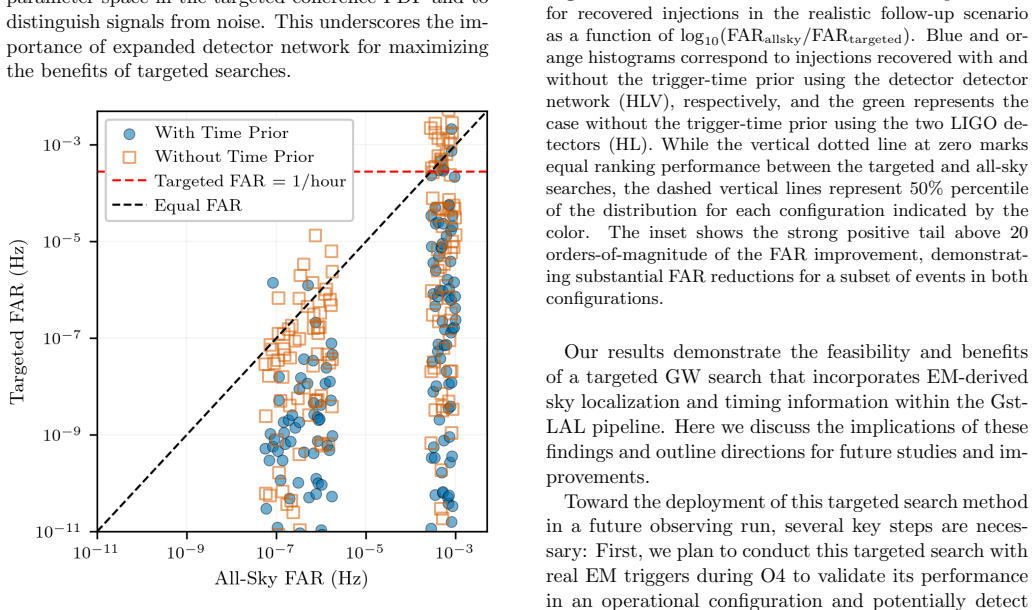
We present a novel method to conduct targeted gravitational-wave searches for compact binary mergers using the GstLAL inspiral pipeline. By incorporating sky localization and timing information from external electromagnetic triggers, we enhance the sensitivity of the search for sub-threshold gravitational-wave signals associated with events such as short gamma-ray bursts. Our approach modifies the standard likelihood ratio ranking statistic to include a sky localization prior, allowing for a more focused analysis on specific regions of the sky. We demonstrate the effectiveness of this method through injection studies, comparing the performance of the targeted search against the standard all-sky search configuration. The results show a significant improvement in detection efficiency for signals consistent with the provided sky location and timing, while maintaining control over false alarm rates. This targeted search framework enables rapid follow-up of electromagnetic transients, facilitating multi-messenger astronomy efforts in the era of advanced gravitational-wave detectors.
Editorial analysis
A structured set of objections, weighed in public.
Referee Report
Summary. The paper describes a modification to the GstLAL inspiral pipeline that incorporates sky localization and timing information from external electromagnetic triggers into the likelihood-ratio ranking statistic. This targeted approach is intended to improve sensitivity to sub-threshold gravitational-wave signals from compact binary mergers associated with events such as short gamma-ray bursts. Effectiveness is claimed to be shown via injection studies that compare the targeted configuration against the standard all-sky search, with the results asserted to demonstrate improved detection efficiency while preserving false-alarm-rate control.
Significance. If the false-alarm-rate calibration is shown to remain valid under the modified prior, the method would offer a practical tool for rapid, focused follow-up of electromagnetic transients in multi-messenger astronomy. The use of injection studies to benchmark performance against the all-sky baseline is a positive element of the experimental design.
major comments (1)
- [Section 3] Section 3: The likelihood ratio is modified to replace the all-sky prior with a localized sky prior derived from the electromagnetic trigger, yet the background estimation procedure (time-shifts or template-bank ranking) is stated to remain unchanged from the standard all-sky configuration. Because background events are now ranked under the new prior while their occurrence rate continues to be measured over the full sky, the resulting p-values are not guaranteed to be uniform under the null; this directly affects the claimed maintenance of false-alarm-rate control in the injection studies.
minor comments (2)
- [Abstract] The abstract states that injection studies demonstrate 'significant improvement' but supplies no numerical values, efficiency curves, or error bars; the results section should include these quantitative metrics with explicit comparison to the all-sky baseline.
- Notation for the modified ranking statistic should be defined explicitly (e.g., the functional form of the sky-prior term) rather than described only in prose.
Simulated Author's Rebuttal
We thank the referee for their careful review and for identifying an important point regarding the statistical calibration of our targeted search. We address the major comment below.
read point-by-point responses
-
Referee: [Section 3] Section 3: The likelihood ratio is modified to replace the all-sky prior with a localized sky prior derived from the electromagnetic trigger, yet the background estimation procedure (time-shifts or template-bank ranking) is stated to remain unchanged from the standard all-sky configuration. Because background events are now ranked under the new prior while their occurrence rate continues to be measured over the full sky, the resulting p-values are not guaranteed to be uniform under the null; this directly affects the claimed maintenance of false-alarm-rate control in the injection studies.
Authors: We thank the referee for highlighting this subtlety. In the implementation, the background estimation applies the modified likelihood ratio (now including the EM-derived sky prior) to the time-shifted data, so that the ranking statistic is identical for both the signal and background hypotheses. The manuscript statement that the background estimation procedure remains unchanged refers to the continued use of the time-shift technique and the same template bank, not to an unmodified ranking statistic. We will revise Section 3 to make this explicit and to confirm that the null distribution is evaluated with the targeted likelihood ratio, thereby preserving uniform p-values and the claimed false-alarm-rate control. revision: yes
Circularity Check
No significant circularity in targeted GW search method
full rationale
The paper modifies the GstLAL likelihood ratio ranking statistic by incorporating an external EM sky localization and timing prior, then validates the targeted search via injection studies against the standard all-sky configuration. No self-definitional steps appear where a claimed output is defined in terms of itself, no fitted inputs are relabeled as predictions, and no load-bearing self-citations reduce the central result to unverified prior work by the same authors. The derivation chain relies on external triggers and empirical performance comparison rather than reducing by construction to its own inputs, so the method is self-contained.
Axiom & Free-Parameter Ledger
Reference graph
Works this paper leans on
-
[1]
The Astrophysical Journal , volume =
What is the Most Promising Electromagnetic Counterpart of a Neutron Star Binary Merger? , author =. The Astrophysical Journal , volume =. 2012 , month = Jan, doi =
2012
-
[2]
Living Reviews in Relativity , volume =
Kilonovae , author =. Living Reviews in Relativity , volume =. 2019 , month = Dec, doi =
2019
-
[3]
Physics Reports , volume =
The electromagnetic counterparts of compact binary mergers , author =. Physics Reports , volume =. 2020 , month = Nov, doi =
2020
-
[9]
2022 , eprint=
Search for Gravitational Waves Associated with Fast Radio Bursts Detected by CHIME/FRB During the LIGO--Virgo Observing Run O3a , author=. 2022 , eprint=
2022
-
[15]
, Month =
Urban, Alexander L. , Month =. Monsters in the Dark: High Energy Signatures of Black Hole Formation with Multimessenger Astronomy , Year =
-
[16]
Searching for Gravitational Wave Associations with High-Energy Astrophysical Transients , Year =
Piotrzkowski, Brandon Joseph , Month =. Searching for Gravitational Wave Associations with High-Energy Astrophysical Transients , Year =
-
[18]
arXiv , Author =:2305.05625 , Primaryclass =
Performance of the low-latency GstLAL inspiral search towards LIGO, Virgo, and KAGRA's fourth observing run , Year =. arXiv , Author =:2305.05625 , Primaryclass =
-
[19]
Abbott, B. P. and others , Da =. Prospects for observing and localizing gravitational-wave transients with Advanced LIGO, Advanced Virgo and KAGRA , Ty =. Living Reviews in Relativity , Number =. 2020 , Bdsk-Url-1 =. doi:10.1007/s41114-020-00026-9 , Id =
-
[20]
Allen, Bruce and Anderson, Warren G. and Brady, Patrick R. and Brown, Duncan A. and Creighton, Jolien D. E. , Date-Added =. FINDCHIRP: An algorithm for detection of gravitational waves from inspiraling compact binaries , Url =. Phys. Rev. D , Month =. 2012 , Bdsk-Url-1 =. doi:10.1103/PhysRevD.85.122006 , Issue =
-
[21]
Progress of Theoretical and Experimental Physics , Month =
Akutsu, T and others , Date-Added =. Progress of Theoretical and Experimental Physics , Month =. 2020 , Bdsk-Url-1 =. doi:10.1093/ptep/ptaa125 , Eprint =
-
[25]
Progress of Theoretical and Experimental Physics , Month =
The LIGO Scientific Collaboration and The Virgo Collaboration and The KAGRA Collaboration and Abbott, R and others , Date-Added =. Progress of Theoretical and Experimental Physics , Month =. 2022 , Bdsk-Url-1 =. doi:10.1093/ptep/ptac073 , Eprint =
-
[26]
Soichiro Morisaki , Date-Added =. Rapid parameter estimation of gravitational waves from binary neutron star coalescence using focused reduced order quadrature , Volume =. 2020 , Bdsk-Url-1 =. doi:10.1103/PhysRevD.102.104020 , Journal =
-
[27]
From simulations to signals: Analyzing gravitational waves from compact binary coalescences , Year =
Heather Fong , Date-Added =. From simulations to signals: Analyzing gravitational waves from compact binary coalescences , Year =
-
[29]
SEARCHING FOR GRAVITATIONAL WAVES FROM BINARY SYSTEMS IN NON-STATIONARY DATA , Year =
Chad Hanna , Date-Added =. SEARCHING FOR GRAVITATIONAL WAVES FROM BINARY SYSTEMS IN NON-STATIONARY DATA , Year =
-
[30]
and Provost, S.B
Mathai, A.M. and Provost, S.B. , Isbn =. Quadratic Forms in Random Variables , Year =
-
[31]
Background Filter: A method for removing signal contamination during significance estimation of a GstLAL anaysis , Year =
Prathamesh Joshi and others , Date-Added =. Background Filter: A method for removing signal contamination during significance estimation of a GstLAL anaysis , Year =
-
[32]
arXiv , Author =:2209.11298 , Keywords =
A binary tree approach to template placement for searches for gravitational waves from compact binary mergers , Year =. arXiv , Author =:2209.11298 , Keywords =
-
[33]
Open data from the third observing run of LIGO, Virgo, KAGRA and GEO
Open data from the third observing run of LIGO, Virgo, KAGRA and GEO , Url =. 2023 , Bdsk-Url-1 =. doi:10.48550/ARXIV.2302.03676 , Keywords =
work page internal anchor Pith review Pith/arXiv arXiv doi:10.48550/arxiv.2302.03676 2023
-
[34]
doi:10.1088/0264-9381/33/7/075009 , Journal =
K L Dooley and J R Leong and T Adams and C Affeldt and A Bisht and C Bogan and J Degallaix and C Gr. doi:10.1088/0264-9381/33/7/075009 , Journal =
-
[35]
Gstreamer , Bdsk-Url-1 =
-
[36]
doi:10.7935/GT1W-FZ16 , Howpublished =
2018 , Bdsk-Url-1 =. doi:10.7935/GT1W-FZ16 , Howpublished =
-
[37]
Flanagan, \'Eanna \'E. and Hughes, Scott A. , Date-Added =. Measuring gravitational waves from binary black hole coalescences. I. Signal to noise for inspiral, merger, and ringdown , Url =. Phys. Rev. D , Month =. 1998 , Bdsk-Url-1 =. doi:10.1103/PhysRevD.57.4535 , Issue =
-
[38]
Balasubramanian , Date-Added =
R. Balasubramanian , Date-Added =. Gravitational waves from coalescing binaries: Detection strategies and Monte Carlo estimation of parameters , Volume =. 1996 , Bdsk-Url-1 =. doi:10.1103/PhysRevD.53.3033 , Journal =
-
[39]
Dhurandhar, S. V. and Sathyaprakash, B. S. , Date-Added =. Choice of filters for the detection of gravitational waves from coalescing binaries. II. Detection in colored noise , Url =. Phys. Rev. D , Month =. 1994 , Bdsk-Url-1 =. doi:10.1103/PhysRevD.49.1707 , Issue =
-
[40]
Observing binary inspiral in gravitational radiation: One interferometer , Volume =
Lee Samuel Finn , Date-Added =. Observing binary inspiral in gravitational radiation: One interferometer , Volume =. 1993 , Bdsk-Url-1 =. doi:10.1103/PhysRevD.47.2198 , Journal =
-
[41]
Lee S. Finn , Date-Added =. Detection, measurement, and gravitational radiation , Volume =. 1992 , Bdsk-Url-1 =. doi:10.1103/PhysRevD.46.5236 , Journal =
-
[42]
and Bildsten, Lars and Finn, Lee Smauel and Flanagan, Eanna E
Cutler, Curt and Apostolatos, Theocharis A. and Bildsten, Lars and Finn, Lee Smauel and Flanagan, Eanna E. and Kennefick, Daniel and Markovic, Dragoljub M. and Ori, Amos and Poisson, Eric and Sussman, Gerald Jay and Thorne, Kip S. , Date-Added =. The last three minutes: Issues in gravitational-wave measurements of coalescing compact binaries , Url =. Phys...
-
[43]
B. S. Sathyaprakash , Date-Added =. Choice of filters for the detection of gravitational waves from coalescing binaries , Volume =. 1991 , Bdsk-Url-1 =. doi:10.1103/PhysRevD.44.3819 , Journal =
-
[44]
Leonard Wainstein and V. D. Zubakov and Albert A. Mullin , Date-Added =. Extraction of signals from noise , Year =
-
[45]
Class. Quant. Grav. , Number =. 2015 , Bdsk-Url-1 =. doi:10.1088/0264-9381/32/2/024001 , Eprint =
-
[46]
Class. Quant. Grav. , Pages =. 2015 , Bdsk-Url-1 =. doi:10.1088/0264-9381/32/7/074001 , Eprint =
-
[47]
Qi Chu , Date-Added =. SPIIR online coherent pipeline to search for gravitational waves from compact binary coalescences , Volume =. 2022 , Bdsk-Url-1 =. doi:10.1103/PhysRevD.105.024023 , Journal =
-
[48]
F Aubin and F Brighenti and R Chierici and D Estevez and G Greco and G M Guidi and V Juste and F Marion and B Mours and E Nitoglia and O Sauter and V Sordini , Date-Added =. The. doi:10.1088/1361-6382/abe913 , Journal =
-
[49]
Alexander H. Nitz , Date-Added =. Rapid detection of gravitational waves from compact binary mergers with PyCBC Live , Volume =. 2018 , Bdsk-Url-1 =. doi:10.1103/PhysRevD.98.024050 , Journal =
-
[50]
and Chatterjee, Deep and Creighton, Jolien D
Mukherjee, Debnandini and Caudill, Sarah and Magee, Ryan and Messick, Cody and Privitera, Stephen and Sachdev, Surabhi and Blackburn, Kent and Brady, Patrick and Brockill, Patrick and Cannon, Kipp and Chamberlin, Sydney J. and Chatterjee, Deep and Creighton, Jolien D. E. and Fong, Heather and Godwin, Patrick and Hanna, Chad and Kapadia, Shasvath and Lang,...
-
[52]
http://www.w3.org/1998/Math/MathML
Constraining the <math xmlns="http://www.w3.org/1998/Math/MathML" display="inline"><mi>p</mi></math>-Mode--<math xmlns="http://www.w3.org/1998/Math/MathML" display="inline"><mi>g</mi></math>-Mode Tidal Instability with GW170817 , Volume =. 2019 , Bdsk-Url-1 =. doi:10.1103/PhysRevLett.122.061104 , Journal =
-
[53]
Properties of the Binary Neutron Star Merger GW170817 , Volume =. 2019 , Bdsk-Url-1 =. doi:10.1103/PhysRevX.9.011001 , Journal =
-
[54]
B. P. Abbott and others , Date-Added =. On the Progenitor of Binary Neutron Star Merger. doi:10.3847/2041-8213/aa93fc , Journal =
-
[55]
GW170817: Measurements of Neutron Star Radii and Equation of State , Volume =. 2018 , Bdsk-Url-1 =. doi:10.1103/PhysRevLett.121.161101 , Journal =
-
[56]
B. P. Abbott and others , Date-Added =. Estimating the Contribution of Dynamical Ejecta in the Kilonova Associated with. doi:10.3847/2041-8213/aa9478 , Journal =
-
[57]
Tn, Nasa and At, N and Feiveson, A H and Delaney, F C , Date-Added =
-
[58]
Neyman, Jerzy and Pearson, Egon Sharpe and Pearson, Karl , Date-Added =. IX. On the problem of the most efficient tests of statistical hypotheses , Url =. Philosophical Transactions of the Royal Society of London. Series A, Containing Papers of a Mathematical or Physical Character , Number =. 1933 , Bdsk-Url-1 =. doi:10.1098/rsta.1933.0009 , Eprint =
-
[59]
Sakon, Shio and Tsukada, Leo and Fong, Heather and Hanna, Chad and Kennington, James and Adhicary, Shomik and Cannon, Kipp and Caudill, Sarah and Cousins, Bryce and Creighton, Jolien D. E. and Ewing, Becca and Godwin, Patrick and Huang, Yun-Jing and Huxford, Rachael and Joshi, Prathamesh and Magee, Ryan and Messick, Cody and Morisaki, Soichiro and Mukherj...
-
[61]
Kipp Cannon , Date-Added =. Method to estimate the significance of coincident gravitational-wave observations from compact binary coalescence , Volume =. 2013 , Bdsk-Url-1 =. doi:10.1103/PhysRevD.88.024025 , Journal =
-
[64]
Andrew L. Miller and S. Probing planetary-mass primordial black holes with continuous gravitational waves , Url =. Physics of the Dark Universe , Pages =. 2021 , Bdsk-Url-1 =. doi:https://doi.org/10.1016/j.dark.2021.100836 , Issn =
-
[65]
Monthly Notices of the Royal Astronomical Society , Month =
Stiskalek, Richard and Veitch, John and Messenger, Chris , Date-Added =. Monthly Notices of the Royal Astronomical Society , Month =. 2020 , Bdsk-Url-1 =. doi:10.1093/mnras/staa3613 , Eprint =
-
[66]
GWTC-2: Compact Binary Coalescences Observed by LIGO and Virgo during the First Half of the Third Observing Run , Volume =. 2021 , Bdsk-Url-1 =. doi:10.1103/PhysRevX.11.021053 , Journal =
-
[67]
Science case for the Einstein telescope , Url =
Michele Maggiore and Chris Van Den Broeck and Nicola Bartolo and Enis Belgacem and Daniele Bertacca and Marie Anne Bizouard and Marica Branchesi and Sebastien Clesse and Stefano Foffa and Juan Garc. Science case for the Einstein telescope , Url =. doi:10.1088/1475-7516/2020/03/050 , Journal =
-
[68]
Folded data for first three observing runs of Advanced LIGO and Advanced Virgo , Url =
LIGO Scientific Collaboration, Virgo Collaboration , Copyright =. Folded data for first three observing runs of Advanced LIGO and Advanced Virgo , Url =. 2022 , Bdsk-Url-1 =. doi:10.5281/ZENODO.6326656 , Publisher =
-
[69]
Deepali Agarwal , Date-Added =. Upper limits on persistent gravitational waves using folded data and the full covariance matrix from Advanced LIGO's first two observing runs , Volume =. 2021 , Bdsk-Url-1 =. doi:10.1103/PhysRevD.104.123018 , Journal =
-
[70]
M Saleem and Javed Rana and V Gayathri and Aditya Vijaykumar and Srashti Goyal and Surabhi Sachdev and Jishnu Suresh and S Sudhagar and Arunava Mukherjee and Gurudatt Gaur and Bangalore Sathyaprakash and Archana Pai and Rana X Adhikari and P Ajith and Sukanta Bose , Date-Added =. The science case for. doi:10.1088/1361-6382/ac3b99 , Journal =
-
[71]
D. R. Lorimer and others , Date-Added =. The Parkes multibeam pulsar survey. doi:10.1093/mnras/stv804 , Journal =
-
[72]
doi:10.1111/j.1745-3933.2010.00965.x , Journal =
-
[73]
Soviet Journal of Experimental and Theoretical Physics Letters , Month = dec, Pages =
-
[74]
Monthly Notices of the Royal Astronomical Society , Keywords =. 2020 , Bdsk-Url-1 =. doi:10.1093/mnras/staa278 , Eprint =
-
[75]
Noise curves used for Simulations in the update of the Observing Scenarios Paper , Urldate =
https://dcc.ligo.org/LIGO\-T2000012/public , Date-Added =. Noise curves used for Simulations in the update of the Observing Scenarios Paper , Urldate =
-
[76]
Parameter estimation for compact binaries with ground-based gravitational-wave observations using the LALInference software library , Url =. , Month =. 2015 , Bdsk-Url-1 =. doi:10.1103/PhysRevD.91.042003 , Eprint =
-
[77]
Mon. Not. Roy. Astron. Soc. , Keywords =. doi:10.1093/mnras/staa2850 , Eprint =
-
[78]
Bilby: A user-friendly Bayesian inference library for gravitational-wave astronomy
2019 , Bdsk-Url-1 =. doi:10.3847/1538-4365/ab06fc , Eid =. arXiv , Author =:1811.02042 , Journal =
work page internal anchor Pith review Pith/arXiv arXiv doi:10.3847/1538-4365/ab06fc 2019
-
[79]
M Punturo and others , Date-Added =. The Einstein Telescope: a third-generation gravitational wave observatory , Url =. doi:10.1088/0264-9381/27/19/194002 , Journal =
-
[80]
Sensitivity studies for third-generation gravitational wave observatories , Url =
S Hild others , Date-Added =. Sensitivity studies for third-generation gravitational wave observatories , Url =. doi:10.1088/0264-9381/28/9/094013 , Journal =
-
[81]
Exploring the sensitivity of next generation gravitational wave detectors , Url =
B P Abbott and others , Date-Added =. Exploring the sensitivity of next generation gravitational wave detectors , Url =. doi:10.1088/1361-6382/aa51f4 , Journal =
-
[82]
GWTC-4.0: Updating the Gravitational-Wave Transient Catalog with Observations from the First Part of the Fourth LIGO-Virgo-KAGRA Observing Run , url =. 2025 , bdsk-url-1 =. arXiv , author =:2508.18082 , keywords =
Pith/arXiv arXiv 2025
-
[83]
GWTC-3: Compact Binary Coalescences Observed by LIGO and Virgo During the Second Part of the Third Observing Run , Url =. 2021 , Bdsk-Url-1 =. doi:10.48550/ARXIV.2111.03606 , Keywords =
work page internal anchor Pith review Pith/arXiv arXiv doi:10.48550/arxiv.2111.03606 2021
-
[84]
GWTC-2.1: Deep Extended Catalog of Compact Binary Coalescences Observed by LIGO and Virgo During the First Half of the Third Observing Run , Url =. 2021 , Bdsk-Url-1 =. doi:10.48550/ARXIV.2108.01045 , Keywords =
work page internal anchor Pith review Pith/arXiv arXiv doi:10.48550/arxiv.2108.01045 2021
-
[85]
Peebles, P. J. E. and Wilkinson, David T. , Doi =. Phys. Rev. , Pages =. 1968 , Bdsk-Url-1 =
1968
-
[86]
Astrophys. J. , Pages =. 1993 , Bdsk-Url-1 =. doi:10.1086/173453 , Eprint =
-
[87]
Astron. Astrophys. , Pages =. 2020 , Bdsk-Url-1 =. doi:10.1051/0004-6361/201833880 , Eprint =
-
[88]
Kass and Adrian E
Robert E. Kass and Adrian E. Raftery , Doi =. Bayes Factors , Volume =. Journal of the American Statistical Association , Number =. 1995 , Bdsk-Url-1 =
1995
-
[89]
Two-Dimensional Correlation Function of Binary Black Hole Coalescences , Url =
Cavagli. Two-Dimensional Correlation Function of Binary Black Hole Coalescences , Url =. 2020 , Bdsk-Url-1 =. doi:10.3390/universe6070093 , Journal =
-
[90]
arXiv , Author =:2101.12248 , Month =
-
[91]
arXiv , Author =:2101.11673 , Month =
-
[92]
J. Phys. Conf. Ser. , Pages =. 2014 , Bdsk-Url-1 =. doi:10.1088/1742-6596/484/1/012027 , Eprint =
-
[93]
Characterization of systematic error in Advanced LIGO calibration , Year =
-
[94]
arXiv , Author =:1701.07709 , Journal =
doi:10.3847/1538-4357/aa677f , Eid =. arXiv , Author =:1701.07709 , Journal =
-
[95]
doi:10.3847/1538-4357/ab20cb , Eid =
2019 , Bdsk-Url-1 =. doi:10.3847/1538-4357/ab20cb , Eid =. arXiv , Author =:1902.08507 , Journal =
-
[96]
doi:10.1088/1742-6596/610/1/012021 , Eid =. arXiv , Author =:1410.4839 , Journal =
work page internal anchor Pith review Pith/arXiv arXiv doi:10.1088/1742-6596/610/1/012021
-
[97]
healpy: equal area pixelization and spherical harmonics transforms for data on the sphere in Python , Url =
Andrea Zonca and Leo Singer and Daniel Lenz and Martin Reinecke and Cyrille Rosset and Eric Hivon and Krzysztof Gorski , Doi =. healpy: equal area pixelization and spherical harmonics transforms for data on the sphere in Python , Url =. Journal of Open Source Software , Month = mar, Number =. 2019 , Bdsk-Url-1 =
2019
-
[98]
GWTC-1: a gravitational-wave transient catalog of compact binary mergers observed by LIGO and Virgo during the first and second observing runs , Volume =
Abbott, BP and Abbott, Richard and Abbott, TD and Abraham, S and Acernese, F and Ackley, K and Adams, C and Adhikari, RX and Adya, VB and Affeldt, C and others , Journal =. GWTC-1: a gravitational-wave transient catalog of compact binary mergers observed by LIGO and Virgo during the first and second observing runs , Volume =
-
[99]
doi:10.1088/0305-4470/9/8/029 , Journal =
discussion (0)
Sign in with ORCID, Apple, or X to comment. Anyone can read and Pith papers without signing in.