REVIEW 3 minor 46 references
The interplay between a perpendicular magnetic field and silicene's spin-orbit coupling breaks spin symmetry to enable spin-selective confinement in quantum dots.
Reviewed by Pith at T0; open to challenge. T0 means a machine referee read the full paper against a public rubric. the ladder, T0–T4 →
T0 review · grok-4.3
2026-06-28 13:18 UTC pith:XSAGIDYQ
load-bearing objection The paper derives exact diffusion coefficients for a silicene QD in perpendicular B plus SOC and shows the combination breaks spin symmetry to give spin-selective quasi-bound states.
Magnetic control of electron scattering in silicene quantum dots
The pith
A machine-rendered reading of the paper's core claim, the machinery that carries it, and where it could break.
Core claim
Applying a constant magnetic field allows electrons to be temporarily localized in silicene quantum dots, forming quasi-bound states. The spin-orbit coupling generates a natural energy gap acting as an effective mass to enhance spatial localization. Exact diffusion coefficients from Dirac equation solutions and continuity conditions demonstrate that this gap significantly enhances electron trapping. The interplay between the external field and SOC breaks spin symmetry, enabling robust and spin-selective confinement.
What carries the argument
Exact diffusion coefficients obtained from low-energy Dirac equation solutions with continuity conditions imposed at the silicene quantum dot interfaces, under perpendicular magnetic field and intrinsic spin-orbit coupling.
Load-bearing premise
The low-energy Dirac equation plus continuity conditions at the SQD interfaces are sufficient to produce exact diffusion coefficients that correctly describe the scattering and the claimed enhancement of trapping.
What would settle it
A calculation or measurement of equal transmission probabilities for opposite spin orientations when both the magnetic field and SOC are active would falsify the spin-symmetry breaking claim.
If this is right
- The intrinsic gap from spin-orbit coupling enhances spatial localization of electrons inside the quantum dot.
- Quasi-bound states form that permit temporary confinement despite Klein tunneling.
- Spin symmetry is broken, producing distinct scattering behavior for each spin orientation.
Where Pith is reading between the lines
- Transport experiments could detect the spin selectivity by measuring different conductances in spin-polarized leads.
- The same field-plus-gap mechanism may produce analogous spin filtering in other gapped Dirac materials.
Editorial analysis
A structured set of objections, weighed in public.
Referee Report
Summary. The manuscript analyzes electron scattering through a circular silicene quantum dot (SQD) in a uniform perpendicular magnetic field. Starting from the low-energy Dirac Hamiltonian that includes minimal coupling for the vector potential and the intrinsic SOC mass term, the authors obtain analytic spinor solutions inside and outside the dot, impose four-component continuity at the interface, and extract exact scattering (diffusion) coefficients. These coefficients are used to compute scattering efficiency, probability densities, and current densities, demonstrating that the SOC gap enhances central trapping and that the combined B+SOC interaction breaks spin symmetry to produce spin-selective quasi-bound states.
Significance. If the derivations and numerics hold, the work supplies exact, parameter-controlled expressions for spin-dependent scattering in a gapped Dirac system under magnetic confinement. This supplies a concrete, falsifiable route to spin-selective quasi-bound states that circumvents Klein tunneling, with direct relevance to silicene-based spin filters or traps. The explicit construction of the matching conditions and the resulting closed-form coefficients constitute a technical strength.
minor comments (3)
- [Abstract] Abstract and §3: the phrase 'exact expressions for the diffusion coefficients' should be accompanied by a brief statement of what physical quantity (transmission probability, differential cross-section, or lifetime) is being reported, to avoid ambiguity with transport diffusion constants.
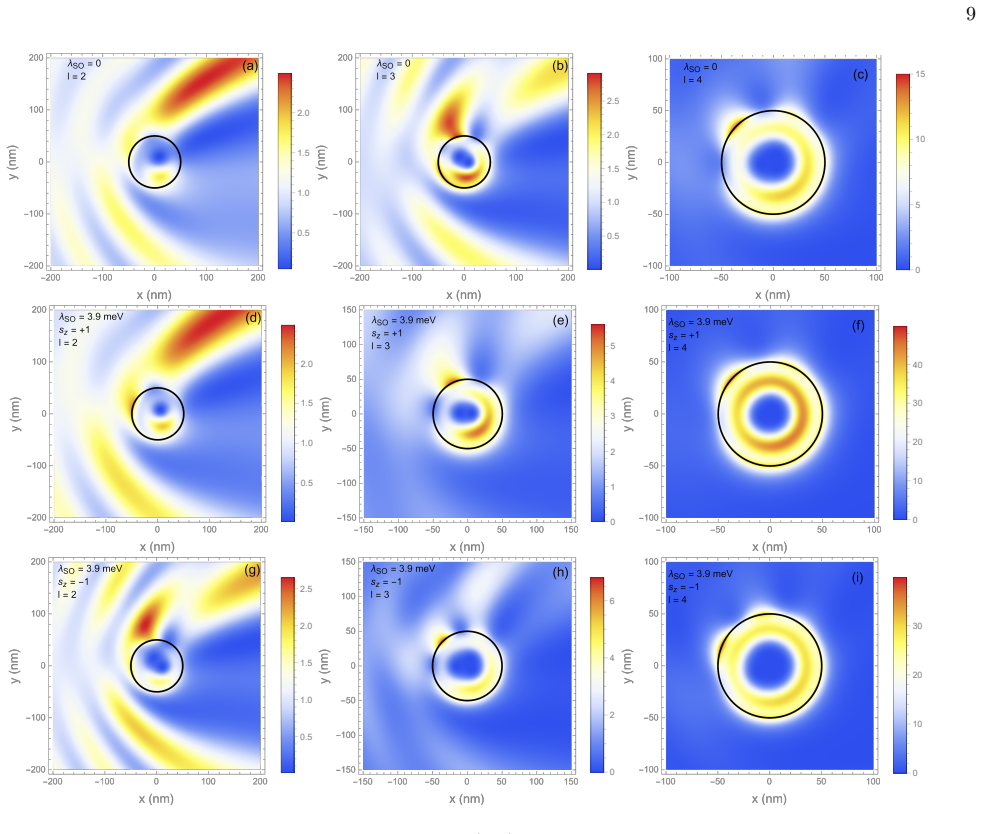
- Figure captions (throughout): probability and current density plots should explicitly label the spin sector (↑/↓) and the value of the SOC gap Δ used, so that the claimed symmetry breaking is immediately visible to the reader.
- [§4] §4: when mapping scattering efficiency versus magnetic length or dot radius, include a short table or inset showing the corresponding values of the dimensionless parameter kR or l_B/R to facilitate direct comparison with other Dirac-scattering studies.
Simulated Author's Rebuttal
We thank the referee for the detailed and positive summary of our manuscript on magnetic control of electron scattering in silicene quantum dots, as well as the recommendation for minor revision. No specific major comments were listed in the report.
Circularity Check
No significant circularity identified
full rationale
The derivation begins from the low-energy Dirac Hamiltonian (with minimal coupling for the perpendicular B field and the SOC mass term), solves the resulting eigenvalue problem inside and outside the circular SQD using angular-momentum channels or Landau-level-like bases, and enforces continuity of the four-component spinor at the interface to obtain scattering coefficients. These steps are the standard, self-contained procedure for massive Dirac scattering; the SOC term explicitly splits the spin sectors, so the claimed spin-symmetry breaking and spin-selective quasi-bound states follow directly from the matching without any fitted parameter, self-citation load-bearing premise, or redefinition of the target quantity as an input. No step reduces to its own output by construction.
Axiom & Free-Parameter Ledger
axioms (1)
- domain assumption Low-energy Dirac equation approximation remains valid inside and outside the silicene quantum dot under the applied magnetic field
read the original abstract
The Klein tunnel effect phenomenon makes it impossible to permanently confine charge carriers in massless nanostructures. However, applying a constant magnetic field allows these electrons to be temporarily localized, thus forming quasi-bound states. In this study, we analyze the mechanism of electron diffusion through a silicene quantum dot (SQD) subjected to a perpendicular magnetic field. To enhance spatial localization, we exploit the spin-orbit coupling (SOC) specific to silicene, which generates a natural energy gap by acting as an effective mass. We first derive the solutions to the Dirac equation at low energy. Subsequently, by imposing the continuity conditions at the SQD interfaces, we obtain exact expressions for the diffusion coefficients. These results are then used to map the scattering efficiency together with the spatial distributions of probability and current densities. Our simulations demonstrate that the presence of this intrinsic gap significantly enhances electron trapping at the center of the SQD. Finally, we prove that the interplay between the external field and SOC breaks spin symmetry, thereby enabling robust and spin-selective confinement.
Figures



Reference graph
Works this paper leans on
-
[1]
Loss and D
D. Loss and D. P. DiVincenzo, Phys. Rev. A 57, 120 (1998)
1998
-
[2]
Hanson, L
R. Hanson, L. P. Kouwenhoven, J. R. Petta, S. Tarucha, and L. M. K. Vandersypen, Rev. Mod. Phys. 79, 1217 12 (2007)
2007
-
[3]
F. A. Zwanenburg, A. S. Dzurak, A. Morello, M. Y. Sim- mons, L. C. L. Hollenberg, G. Klimeck, S. Rogge, S. N. Coppersmith, and M. A. Eriksson, Rev. Mod. Phys. 85, 961 (2013)
2013
-
[4]
Kloeffel and D
C. Kloeffel and D. Loss, Annu. Rev. Condens. Matter Phys. 4, 51 (2013)
2013
-
[5]
Qammar, M
M. Qammar, M. J. H. Tan, P. Ding, J. Ge, Y. Chan, and J. E. Halpert, Nano Research 17, 10426 (2024)
2024
-
[6]
A. H. Castro Neto, F. Guinea, N. M. R. Peres, K. S. Novoselov, and A. K. Geim, Rev. Mod. Phys. 81, 109 (2009)
2009
-
[7]
M. I. Katsnelson, K. S. Novoselov, and A. K. Geim, Nat. Phys. 2, 620 (2006)
2006
-
[8]
Stander, B
N. Stander, B. Huard, and D. Goldhaber-Gordon, Phys. Rev. Lett. 102, 026807 (2009)
2009
-
[9]
Banszerus, A
L. Banszerus, A. Rothstein, T. Fabian, S. M¨ oller, E. Ick- ing, S. Trellenkamp, F. Lentz, D. Neumaier, K. Watan- abe, T. Taniguchi, F. Libisch, C. Volk, and C. Stampfer, Nano Lett. 20, 7709 (2020)
2020
-
[10]
M. M. Elahi, H. Vakili, Y. Zeng, C. R. Dean, and A. W. Ghosh, Phys. Rev. Lett. 132, 146302 (2024)
2024
-
[11]
C. A. Downing, D. A. Stone, and M. E. Portnoi, Phys. Rev. B 84, 155437 (2011)
2011
-
[12]
Romanovsky, C
I. Romanovsky, C. Yannouleas, and U. Landman, Phys. Rev. B 85, 165434 (2012)
2012
-
[13]
Matulis and F
A. Matulis and F. M. Peeters, Phys. Rev. B 77, 115423 (2008)
2008
-
[14]
J. H. Bardarson, M. Titov, and P. W. Brouwer, Phys. Rev. Lett. 102, 226803 (2009)
2009
-
[15]
V. V. Cheianov and V. I. Fal’ko, Phys. Rev. B 74, 041403(R) (2006)
2006
-
[16]
Guti´ errez, L
C. Guti´ errez, L. Brown, C. -J. Kim, J. Park, and A. N. Pasupathy, Nat. Phys. 12, 1069 (2016)
2016
-
[17]
K. S. Novoselov, A. K. Geim, S. V. Morozov, D. Jiang, M. I. Katsnelson, I. V. Grigorieva, S. V. Dubonos, and A. A. Firsov, Nature 438, 197 (2005)
2005
-
[18]
Zhang, Y
Y. Zhang, Y. -W. Tan, H. L. Stormer, and P. Kim, Nature 438, 201 (2005)
2005
-
[19]
C. R. Dean, L. Wang, P. Maher, C. Forsythe, F. Ghahari, Y. Gao, J. Katoch, M. Ishigami, P. Moon, M. Koshino, T. Taniguchi, K. Watanabe, K. L. Shepard, J. Hone, and P. Kim, Nature 497, 598 (2013)
2013
-
[20]
Schelter, P
J. Schelter, P. Recher, and B. Trauzettel, Solid State Commun. 152, 1411 (2012)
2012
-
[22]
C.-C. Liu, W. Feng, and Y. Yao, Phys. Rev. Lett. 107, 076802 (2011)
2011
-
[23]
N. D. Drummond, V. Z´ olyomi, and V. I. Fal’ko, Phys. Rev. B 85, 075423 (2012)
2012
-
[24]
Szafran and D
B. Szafran and D. ˙Zebrowski, Phys. Rev. B 98, 155305 (2018)
2018
-
[25]
F. Chen, F. Qi, and G. Jin, Europhys. Lett. 148, 16001 (2024)
2024
-
[26]
X. Gao, Z. Deng, C. Ma, L. Li, X. Zhang, X. Li, and Z. Zhou, Appl. Phys. Lett. 124, 082406 (2024)
2024
-
[27]
Pena, Physica E 141, 115245 (2022)
A. Pena, Physica E 141, 115245 (2022)
2022
-
[28]
El Azar, A
M. El Azar, A. Bouhlal, and A. Jellal, Comput. Mater. Sci. 231, 112573 (2024)
2024
-
[29]
N. A. Garg, Eur. Phys. J. B 95, 165 (2022)
2022
-
[30]
C. C. Liu, W. Feng, and Y. Yao, Phys. Rev. Lett. 107, 076802 (2011)
2011
-
[31]
C. C. Liu, H. Jiang, and Y. Yao, Phys. Rev. B 84, 195430 (2011)
2011
-
[32]
Cahangirov, M
S. Cahangirov, M. Topsakal, E. Akt¨ urk, H. S ¸ahin, and S. Ciraci, Phys. Rev. Lett. 102, 236804 (2009)
2009
-
[33]
A. Kara, H. Enriquez, A. P. Seitsonen, L. C. Lew Yan Voon, S. Vizzini, B. Aufray, and H. Oughaddou, Surf. Sci. Rep. 67, 1 (2012)
2012
-
[34]
Recher, J
P. Recher, J. Nilsson, G. Burkard, and B. Trauzettel, Phys. Rev. B 76, 235404 (2007)
2007
-
[35]
Hewageegana and V
P. Hewageegana and V. Apalkov, Phys. Rev. B 77, 245426 (2008)
2008
-
[36]
Heinisch, F
R. Heinisch, F. Bronold, and H. Fehske, Phys. Rev. B 87, 155409 (2013)
2013
-
[37]
Schulz, R
C. Schulz, R. Heinisch, and H. Fehske, Quantum Matter 4, 346 (2015)
2015
-
[38]
El Azar, A
M. El Azar, A. Bouhlal, A. D. Alhaidari, and A. Jellal, Physica B 675, 415610 (2024)
2024
-
[39]
Bouhlal, M
A. Bouhlal, M. El Azar, A. Naciri, E. Feddi, and A. Jellal, Physica E 172, 116273 (2025)
2025
-
[40]
P. Vogt, P. De Padova, C. Quaresima, J. Avila, E. Frantzeskakis, M. C. Asensio, A. Resta, B. Ealet, and G. Le Lay, Phys. Rev. Lett. 108, 155501 (2012)
2012
-
[41]
Fleurence, R
A. Fleurence, R. Friedlein, T. Ozaki, H. Kawai, Y. Wang, and Y. Yamada-Takamura, Phys. Rev. Lett. 108, 245501 (2012)
2012
-
[42]
L. Meng, Y. Wang, L. Zhang, S. Du, R. Wu, L. Li, Y. Zhang, G. Li, H. Zhou, W. A. Hofer, and H.-J. Gao, Nano Lett. 13, 685 (2013)
2013
-
[43]
Dell’Anna and A
L. Dell’Anna and A. De Martino, Phys. Rev. B 83, 155449 (2011)
2011
-
[44]
Ramezani Masir, P
M. Ramezani Masir, P. Vasilopoulos, and F. M. Peeters, New J. Phys. 11, 095009 (2011)
2011
-
[45]
M. F. Crommie, C. P. Lutz, and D. M. Eigler, Science 262, 218 (1993)
1993
-
[46]
Y. Zhao, J. Wyrick, F. D. Natterer, J. F. Rodriguez- Nieva, C. Lewandowski, K. Watanabe, T. Taniguchi, L. S. Levitov, N. B. Zhitenev, and J. A. Stroscio, Science 348, 672–675 (2015)
2015
-
[47]
Wiesendanger, Rev
R. Wiesendanger, Rev. Mod. Phys. 81, 1495–1550 (2009)
2009
discussion (0)
Sign in with ORCID, Apple, or X to comment. Anyone can read and Pith papers without signing in.