REVIEW 5 major objections 6 minor 30 references
A humanoid robot can carry heavy objects with a human partner by prioritizing stability over exact tracking, even when precise velocity control becomes impossible.
Reviewed by Pith at T0; open to challenge. T0 means a machine referee read the full paper against a public rubric. the ladder, T0–T4 →
A hierarchical whole-body controller with a kinematic-prior reference generator and a distilled RL residual policy keeps a Unitree G1 balanced while transporting 7-18 kg carried and up to 60 kg pushed loads, where a load-agnostic WBC baseline fails.
T0 review reviewed 2026-08-02 challenge →
load-bearing objection Real idea, thin evidence, and a load-bearing contradiction about the student's observation being 'proprioceptive-only' when Eq. 5 feeds it the object state. the 5 major comments →
Interaction-Aware Whole-Body Control for Compliant Object Transport
The pith
A machine-rendered reading of the paper's core claim, the machinery that carries it, and where it could break.
The reading
Core claim
The central claim is that interaction-oriented whole-body control (IO-WBC)—combining a trajectory-optimized reference generator with an interaction-aware RL residual policy—maintains stable whole-body behavior under strong, time-varying interaction forces even when precise velocity tracking is physically infeasible. The paper reports an 80% success rate (4 of 5 trials) carrying an 18 kg tire where a load-agnostic whole-body controller baseline achieved 0%, and operational stability under pushing loads up to 60 kg, with the policy explicitly prioritizing postural invariance over velocity tracking in extreme conditions. The learned residual policy is trained via asymmetric teacher–student dist
What carries the argument
The load-bearing mechanism is a cascaded architecture with two cooperating components. First, a reference generator (RG) is pretrained via trajectory optimization to map high-level HRC commands into a kinematically feasible lower-body posture prior, keeping the CoM projection within the stability boundary. Second, an RL policy generates joint-position residual corrections (12 leg joints plus 3 waist motors) that are superposed onto the RG prior and converted to torques by PD controllers. The policy is trained in simulation with randomized payload mass/inertia, friction, and impulsive perturbations, then distilled from a privileged teacher (with exact object mass and disturbance knowledge) to
Load-bearing premise
The real-world results rest on the assumption that the randomized physics simulation reproduces the same non-conservative interaction forces and proprioceptive signatures as a real human partner and real payload, yet the paper provides no quantitative sim-to-real gap analysis, no real force measurements, and no sensitivity study of the randomization ranges.
What would settle it
Run the same 18 kg tire-carrying task on the same humanoid with a human partner who deliberately varies push/pull rhythm and grip; if the student policy's success rate drops significantly when the human's interaction pattern moves outside the simulated distribution, the claim that proprioceptive history suffices would be falsified. Alternatively, compare the student's residual actions against force-sensor measurements during the task—if the actions do not correlate with actual contact forces, the implicit inference claim fails.
If this is right
- If the central claim holds, humanoid robots can collaborate on transporting payloads that would destabilize tracking-centric whole-body controllers, without adding force-torque sensors.
- The architecture's explicit tradeoff between velocity tracking and postural stability redefines 'success' for heavy-load assistance: staying upright and compliant can matter more than matching commanded speed.
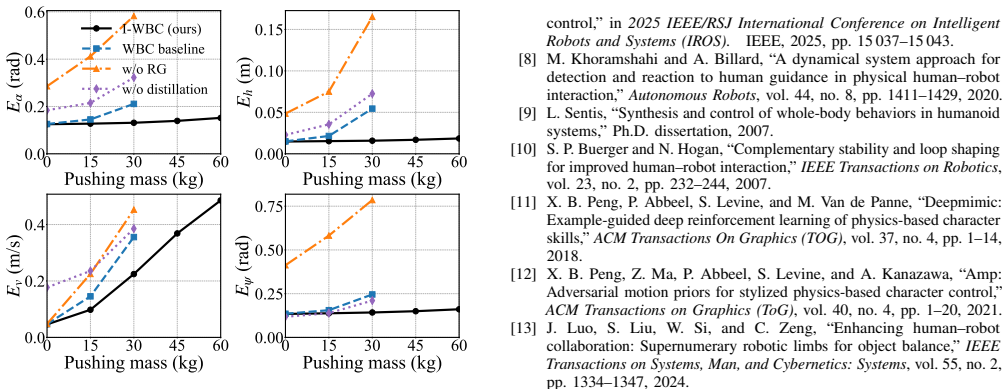
- The reference generator is essential: ablation shows that removing it raises errors 2–4 times even under nominal loads, suggesting kinematic priors are a cheap and effective way to constrain RL exploration.
- The teacher–student distillation is essential: without it, the policy collapses during heavy-load trials, indicating that the history buffer is how the policy 'feels' payload inertia and contact forces.
- The results at 8 kg lifting and 60 kg pushing suggest the same framework could be retrained for other heavy collaborative tasks (e.g., supporting a person, moving furniture) with similar domain randomization.
Where Pith is reading between the lines
- The paper does not report how the 25-step history buffer length was chosen; a shorter buffer would reduce latency and possibly improve sim-to-real transfer, while a longer one might capture slower interaction dynamics. A sensitivity study on buffer length would test this directly.
- If the student policy truly decodes interaction forces from proprioceptive history, it could serve as a virtual force sensor—one could compare its internal representations or residual actions against real force measurements to quantify how much interaction information is retained.
- The 'compliant stagnation' behavior under 60 kg loads suggests a broader design principle for assistive robots: explicitly encoding 'stability over progress' as a reward prior may be preferable to hard tracking constraints, which could be extended to other contact-rich tasks such as door opening or supporting a leaning human.
- Because the RG prior is frozen during policy training, one could investigate whether an adaptive RG that updates from online interaction data would further improve generalization to objects whose properties fall outside the randomized training distribution.
Editorial analysis
A structured set of objections, weighed in public.
Referee Report
Summary. The paper proposes IO-WBC, a hierarchical whole-body controller for humanoid collaborative object transport. A trajectory-optimized reference generator (RG) supplies kinematic priors for the support branch, and an RL residual policy, trained with asymmetric teacher–student distillation, adds interaction-aware joint corrections. The central claim is that this architecture maintains whole-body stability and compliance under heavy, time-varying interaction forces, even when precise velocity tracking is infeasible. Experimental support is reported in Isaac Lab simulation and on a Unitree G1 with a human partner: an 80% success rate (4/5) for carrying an 18 kg tire, robustness up to 8 kg in lifting, and operational pushing up to 60 kg, versus failure of a WBC baseline in all trials. The paper also reports ablations removing the RG prior and the distillation step.
Significance. If the central claim holds, IO-WBC would be a meaningful step toward force-sensor-free humanoid collaborative transport under heavy loads. The hierarchical separation of upper-body interaction and lower-body support, the trajectory-optimized kinematic prior, and the teacher–student distillation are plausible and well-motivated. The paper makes falsifiable predictions (e.g., 4/5 success at 18 kg, 0/5 for the WBC baseline; survival at 60 kg pushing) and includes real-hardware trials, which is a strength. However, the evidence as presented is not yet sufficient: the real trials are only 5 per condition with no variance reporting, the WBC baseline is explicitly load-agnostic, several evaluation metrics overlap the training reward, and there is an unresolved inconsistency between the student observation definition and the 'proprioceptive-only' claim. These issues are load-bearing for the paper's main contribution, not merely presentation.
major comments (5)
- [§III.C.1, Eq. (5); §III.C.2; §IV.A] The student observation in Eq. (5) explicitly includes x_obj and ẋ_obj, the object's egocentric pose and velocity. Section III.C.2 states the student 'relies solely on a proprioceptive history buffer H_t = {s_{t−k},...,s_t}', and the abstract claims the student 'relies only on proprioceptive histories at runtime.' These statements are contradictory: x_obj is external state, not proprioception. Since real experiments use a MoCap system (Section IV.A), x_obj is likely provided by external tracking. An ablation with x_obj removed/zeroed and trials without MoCap is needed to establish that the reported successes come from the learned history-based interaction model rather than direct external object-state input.
- [§III.D.2, Eq. (8); §IV.A, Eq. (9)] The reward rsync in Eq. (8) directly penalizes θ_S − θ_ref_S and vsys − vcoll. The main evaluation metrics in Eq. (9) measure exactly the same kinds of tracking errors (E_α, E_h, E_v, E_ψ). Thus part of the reported tracking improvement in Tables II–III and Figs. 6–7 is a consequence of reward design, not an emergent property of the controller. The paper's narrative says IO-WBC prioritizes stability over tracking when tracking is infeasible, but the primary metrics are tracking errors. Please report interaction-relevant quantities that are not in the reward, such as contact forces, torque saturation, CoM margin, or foot-slip rates.
- [§IV.A, baseline description; §IV.B, Fig. 3(c)] The WBC baseline is described as 'inherently load-agnostic, assuming nominal robot dynamics without explicit coupling terms for heavy payloads.' This makes the comparison 80% vs 0% largely a comparison against a deliberately handicapped controller, not a state-of-the-art interaction-aware whole-body controller. To substantiate the 'SOTA' claim, compare against a load-adaptive or learning-based baseline that does not assume nominal dynamics, or explicitly frame the WBC baseline as an ablative lower bound rather than a strong competitor.
- [§IV.B; §IV.D; Table III] All real-world and simulation results are based on 5 independent runs, but only means and aggregate success rates are reported, with no error bars, confidence intervals, or per-trial data. The headline '80% success (4 out of 5)' and 'remained operational up to 60 kg' rest on very few trials. Additionally, Section IV.A describes a 65 kg crate for cooperative pushing, while Section IV.D, Table III, and the abstract state 60 kg. Please clarify the actual mass and report trial-level data and variance.
- [§IV.A, domain randomization; §IV.D, pushing results] The sim-to-real transfer claim is not quantitatively supported. Table I lists randomization ranges, but there is no sim-to-real gap analysis, no sensitivity study of these ranges, and no real force or velocity measurements during the 60 kg pushing task. The reported E_v = 0.486 m/s at 60 kg shows the robot is not tracking velocity, but the paper does not provide physical evidence (e.g., contact forces, torque limits, foot slip) that the behavior is genuinely compliant rather than a simulation artifact. Please add real-world measurements or a systematic sim-to-real comparison.
minor comments (6)
- [Abstract; §I] Typo: 'we investigates' should be 'we investigate.' Also 'Correspondance' in the footnote should be 'Correspondence.'
- [Fig. 3] The figure labels in the compiled PDF appear garbled (e.g., rows of '/uni...' text), making panels (a)–(c) hard to read. Please regenerate the figure with readable axis labels.
- [Eq. (5)] The notation x_obj and 'egocentric geometry' is not precisely defined. Is this the object pose in the robot's frame, and how is it obtained in simulation versus hardware? Define the coordinates and units.
- [§III.C.1] The action space is 15-dimensional (12 leg joints + 3 waist motors), but the observation includes a gait phase φ_t. The role of the gait phase and how it is set during real deployment is not explained.
- [§IV.B] 'Norm error' is used in Fig. 3 but not defined. State whether it is the Euclidean norm of the four error components and over which time window.
- [References] Reference [30] cites 'Orbit' rather than 'Isaac Lab'; please ensure the cited simulation framework matches the actual framework used.
Circularity Check
Student observation includes external object state, making the 'proprioceptive-only' distillation claim definitionally circular.
specific steps
-
self definitional
[Section III.C.1, Eq. (5); Section III.C.2, Eq. (7); Section IV.A (MoCap)]
"st = [ct, Φb, ωb, q, q̇, ϕt, a_{t−1}, θ_ref_S, x_obj, ẋ_obj] ... the student policy relies solely on a proprioceptive history buffer Ht = {st−k, . . . , st}"
H_t is defined as a history of s_t, and Eq. (5) defines s_t to include x_obj and ẋ_obj, which are external object states, not proprioceptive measurements. Therefore the claim that the student 'relies solely on a proprioceptive history buffer' is true only if 'proprioceptive' is redefined to include the object state. The distillation in Eq. (7) from privileged s_priv to H_t therefore does not demonstrate inference from proprioception alone: the student is handed the object's state at runtime, so the claimed proprioceptive-only deployment result is achieved by construction of the observation rather than by the learned history-based interaction model.
full rationale
The paper's main control derivation is otherwise self-contained: the RG is trained from trajectory optimization (Eq. 4), the RL residual policy is applied through PD torques (Eq. 6), and the real-world success rates (80% at 18 kg, survival at 60 kg) are external outcomes, not restatements of the reward. The reward in Eq. (8) does penalize the same types of errors reported in Eq. (9), but because the paper also reports task success separate from tracking-error metrics, the tracking tables are not by themselves a circular prediction. No load-bearing self-citation or imported uniqueness theorem appears; the cited AMO framework is an external baseline, not author self-citation. The one genuine definitional circularity is in the asymmetric-distillation claim: the student's 'proprioceptive history' H_t is defined as a history of s_t, and Eq. (5) includes x_obj and ẋ_obj in s_t. Thus the claim that the student relies only on proprioceptive history is true only by redefining 'proprioceptive' to include external object state, and the distillation purported to eliminate privileged sensing does not actually remove object-state input. This is load-bearing for the claimed contribution of force-sensor-free interaction inference from proprioception, so the score reflects partial circularity rather than full equivalence.
Axiom & Free-Parameter Ledger
free parameters (5)
- RL policy weights (teacher and student)
- Reward coefficients α1, α2 =
not stated
- Domain randomization ranges =
payload 50-150%, friction 0.5-1.2, etc.
- PD gains Kp, Kd
- Curriculum schedule
axioms (4)
- domain assumption The Isaac Lab physics simulator accurately models the Unitree G1 dynamics and contact with human-partner loads.
- domain assumption External interaction forces are recoverable from joint tracking errors, base acceleration, and proprioceptive history.
- domain assumption A learned human-proxy partner in the MARL simulator approximates real human cooperative behavior.
- domain assumption The trajectory-optimized reference generator provides a kinematically feasible and statically stable lower-body prior.
Cite this review
Pith. "Pith review of Interaction-Aware Whole-Body Control for Compliant Object Transport." pith.science (2026). https://pith.science/paper/XTBZ2FJS
@misc{pith2026260303751,
  author       = {Pith},
  title        = {Pith review of: Interaction-Aware Whole-Body Control for Compliant Object Transport},
  year         = {2026},
  howpublished = {\url{https://pith.science/paper/XTBZ2FJS}},
  note         = {Machine review of arXiv:2603.03751}
}
read the original abstract
Cooperative object transport in unstructured environments remains challenging for assistive humanoids because strong, time-varying interaction forces can make tracking-centric whole-body control unreliable, especially in close-contact support tasks. This paper proposes a bio-inspired, interaction-oriented whole-body control (IO-WBC) that functions as an artificial cerebellum - an adaptive motor agent that translates upstream (skill-level) commands into stable, physically consistent whole-body behavior under contact. This work structurally separates upper-body interaction execution from lower-body support control, enabling the robot to maintain balance while shaping force exchange in a tightly coupled robot-object system. A trajectory-optimized reference generator (RG) provides a kinematic prior, while a reinforcement learning (RL) policy governs body responses under heavy-load interactions and disturbances. The policy is trained in simulation with randomized payload mass/inertia and external perturbations, and deployed via asymmetric teacher-student distillation so that the student relies only on proprioceptive histories at runtime. Extensive experiments demonstrate that IO-WBC maintains stable whole-body behavior and physical interaction even when precise velocity tracking becomes infeasible, enabling compliant object transport across a wide range of scenarios.
Figures


Reference graph
Works this paper leans on
-
[1]
Robots in human environments: Basic autonomous capabilities,
O. Khatib, K. Yokoi, O. Brock, K. Chang, and A. Casal, “Robots in human environments: Basic autonomous capabilities,”The International Journal of Robotics Research, vol. 18, no. 7, pp. 684–696, 1999
1999
-
[2]
Human modeling in physical human-robot interaction: A brief survey,
C. Fang, L. Peternel, A. Seth, M. Sartori, K. Mombaur, and E. Yoshida, “Human modeling in physical human-robot interaction: A brief survey,” IEEE Robotics and Automation Letters, vol. 8, no. 9, pp. 5799–5806, 2023
2023
-
[3]
Navigating embodied intelligence: Enabling technologies, security and privacy, and emerging trends,
Y . Wang, X. Niu, J. Ba, Z. Su, and L. Du, “Navigating embodied intelligence: Enabling technologies, security and privacy, and emerging trends,”IEEE Internet of Things Journal, 2025
2025
-
[4]
Design and control of supernumerary robotic limbs,
F. Parietti, “Design and control of supernumerary robotic limbs,” Ph.D. dissertation, Massachusetts Institute of Technology, 2016
2016
-
[5]
Human–robot collaboration for safe object transportation using force feedback,
J. E. Solanes, L. Gracia, P. Munoz-Benavent, J. V . Miro, M. G. Carmichael, and J. Tornero, “Human–robot collaboration for safe object transportation using force feedback,”Robotics and Autonomous Systems, vol. 107, pp. 196–208, 2018
2018
-
[6]
Multi-robot systems and cooperative object transport: Communications, platforms, and challenges,
X. An, C. Wu, Y . Lin, M. Lin, T. Yoshinaga, and Y . Ji, “Multi-robot systems and cooperative object transport: Communications, platforms, and challenges,”IEEE Open Journal of the Computer Society, vol. 4, pp. 23–36, 2023
2023
-
[7]
Human-robot cooperative heavy payload manipulation based on whole-body model predictive control,
N. Wang, S. Liu, T. L. Lam, and T. Zhang, “Human-robot cooperative heavy payload manipulation based on whole-body model predictive control,” in2025 IEEE/RSJ International Conference on Intelligent Robots and Systems (IROS). IEEE, 2025, pp. 15 037–15 043
2025
-
[8]
A dynamical system approach for detection and reaction to human guidance in physical human–robot interaction,
M. Khoramshahi and A. Billard, “A dynamical system approach for detection and reaction to human guidance in physical human–robot interaction,”Autonomous Robots, vol. 44, no. 8, pp. 1411–1429, 2020
2020
-
[9]
Synthesis and control of whole-body behaviors in humanoid systems,
L. Sentis, “Synthesis and control of whole-body behaviors in humanoid systems,” Ph.D. dissertation, 2007
2007
-
[10]
Complementary stability and loop shaping for improved human–robot interaction,
S. P. Buerger and N. Hogan, “Complementary stability and loop shaping for improved human–robot interaction,”IEEE Transactions on Robotics, vol. 23, no. 2, pp. 232–244, 2007
2007
-
[11]
Deepmimic: Example-guided deep reinforcement learning of physics-based character skills,
X. B. Peng, P. Abbeel, S. Levine, and M. Van de Panne, “Deepmimic: Example-guided deep reinforcement learning of physics-based character skills,”ACM Transactions On Graphics (TOG), vol. 37, no. 4, pp. 1–14, 2018
2018
-
[12]
Amp: Adversarial motion priors for stylized physics-based character control,
X. B. Peng, Z. Ma, P. Abbeel, S. Levine, and A. Kanazawa, “Amp: Adversarial motion priors for stylized physics-based character control,” ACM Transactions on Graphics (ToG), vol. 40, no. 4, pp. 1–20, 2021
2021
-
[13]
Enhancing human–robot collaboration: Supernumerary robotic limbs for object balance,
J. Luo, S. Liu, W. Si, and C. Zeng, “Enhancing human–robot collaboration: Supernumerary robotic limbs for object balance,”IEEE Transactions on Systems, Man, and Cybernetics: Systems, vol. 55, no. 2, pp. 1334–1347, 2024
2024
-
[14]
Human-robot collab- oration in healthcare: a comprehensive review of key components, applications, and future research,
M. A. Ait Ameur, E. Yang, and Y .-P. Zhang, “Human-robot collab- oration in healthcare: a comprehensive review of key components, applications, and future research,”IEEE Transactions on Medical Robotics and Bionics, 2026
2026
-
[15]
Roloma: Robust loco-manipulation for quadruped robots with arms,
H. Ferrolho, V . Ivan, W. Merkt, I. Havoutis, and S. Vijayakumar, “Roloma: Robust loco-manipulation for quadruped robots with arms,” Autonomous Robots, vol. 47, no. 8, pp. 1463–1481, 2023
2023
-
[16]
Amo: Adaptive motion optimization for hyper-dexterous humanoid whole- body control,
J. Li, X. Cheng, T. Huang, S. Yang, R. Qiu, and X. Wang, “Amo: Adaptive motion optimization for hyper-dexterous humanoid whole- body control,” inRobotics: Science and Systems, 2025
2025
-
[17]
Control barrier functions: Theory and applications,
A. D. Ames, S. Coogan, M. Egerstedt, G. Notomista, K. Sreenath, and P. Tabuada, “Control barrier functions: Theory and applications,” in2019 18th European control conference (ECC). Ieee, 2019, pp. 3420–3431
2019
-
[18]
Learning stability certificates from data,
N. Boffi, S. Tu, N. Matni, J.-J. Slotine, and V . Sindhwani, “Learning stability certificates from data,” inProceedings of the 2020 Conference on Robot Learning, ser. Proceedings of Machine Learning Research, vol. 155, 2021, pp. 1341–1350
2020
-
[19]
Heterogeneous multi-agent learning in isaac lab: Scalable simulation for robotic col- laboration,
J. Haight, I. Peterson, C. Allred, and M. Harper, “Heterogeneous multi-agent learning in isaac lab: Scalable simulation for robotic col- laboration,” in2025 IEEE/RSJ International Conference on Intelligent Robots and Systems (IROS), 2025, pp. 13 446–13 451
2025
-
[20]
Learning stable deep dynamics models,
J. Z. Kolter and G. Manek, “Learning stable deep dynamics models,” Advances in neural information processing systems, vol. 32, 2019
2019
-
[21]
Whole-body impedance control of wheeled humanoid robots,
A. Dietrich, “Whole-body impedance control of wheeled humanoid robots,” Ph.D. dissertation, 2015
2015
-
[22]
Anticipating human activities using object affordances for reactive robotic response,
H. S. Koppula and A. Saxena, “Anticipating human activities using object affordances for reactive robotic response,”IEEE transactions on pattern analysis and machine intelligence, vol. 38, no. 1, pp. 14–29, 2015
2015
-
[23]
Learning agile and dynamic motor skills for legged robots,
J. Hwangbo, J. Lee, A. Dosovitskiy, D. Bellicoso, V . Tsounis, V . Koltun, and M. Hutter, “Learning agile and dynamic motor skills for legged robots,”Science robotics, vol. 4, no. 26, p. eaau5872, 2019
2019
-
[24]
Physical human– robot collaboration: Robotic systems, learning methods, collaborative strategies, sensors, and actuators,
U. E. Ogenyi, J. Liu, C. Yang, Z. Ju, and H. Liu, “Physical human– robot collaboration: Robotic systems, learning methods, collaborative strategies, sensors, and actuators,”IEEE transactions on cybernetics, vol. 51, no. 4, pp. 1888–1901, 2019
1901
-
[25]
A lyapunov-based approach to safe reinforcement learning,
Y . Chow, O. Nachum, E. Duenez-Guzman, and M. Ghavamzadeh, “A lyapunov-based approach to safe reinforcement learning,”Advances in neural information processing systems, vol. 31, 2018
2018
-
[26]
H. K. Khalil and J. W. Grizzle,Nonlinear systems. Prentice hall Upper Saddle River, NJ, 2002, vol. 3
2002
-
[27]
Whole body control of mobile manipulators with series elastic actuators for cart pushing tasks,
X. Ren, Z. Li, and M. Zhou, “Whole body control of mobile manipulators with series elastic actuators for cart pushing tasks,”IEEE Transactions on Cybernetics, vol. 54, no. 12, pp. 7891–7904, 2024
2024
-
[28]
Lyapunov barrier policy optimiza- tion,
H. Sikchi, W. Zhou, and D. Held, “Lyapunov barrier policy optimiza- tion,”arXiv preprint arXiv:2103.09230, 2021
Pith/arXiv arXiv 2021
-
[29]
Representation matters: Offline pretraining for sequential decision making,
M. Yang and O. Nachum, “Representation matters: Offline pretraining for sequential decision making,” inInternational Conference on Machine Learning, 2021, pp. 11 784–11 794
2021
-
[30]
Orbit: A unified simulation framework for interactive robot learning environments,
M. Mittal, C. Yu, Q. Yu, J. Liu, N. Rudin, D. Hoeller, J. L. Yuan, R. Singh, Y . Guo, H. Mazharet al., “Orbit: A unified simulation framework for interactive robot learning environments,”IEEE Robotics and Automation Letters, vol. 8, no. 6, pp. 3740–3747, 2023
2023
This paper was first reviewed by deepseek-v4-flash on August 2, 2026.
discussion (0)
Sign in with ORCID, Apple, or X to comment. Anyone can read and Pith papers without signing in.