Are We There Yet? Exploring the Capabilities of MLLMs in Assistive AI Applications
Pith reviewed 2026-06-26 00:05 UTC · model grok-4.3
The pith
MLLMs show both strengths and limitations when tested on real assistive tasks like currency recognition and multilingual scene text.
A machine-rendered reading of the paper's core claim, the machinery that carries it, and where it could break.
Core claim
The paper claims that MLLMs, with their unified vision-language architecture, offer promising capabilities for assistive AI applications but require evaluation on real-world egocentric data to reveal their actual strengths in general visual understanding and language interaction alongside limitations in handling variability, fine-grained recognition, and multilingual comprehension in tasks such as currency identification, scene text QA, and cross-language reading.
What carries the argument
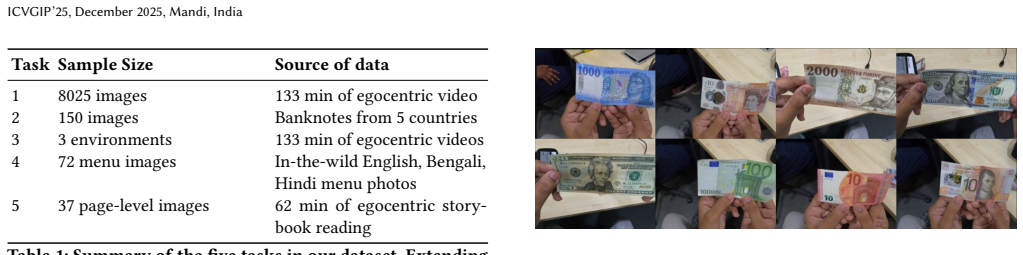
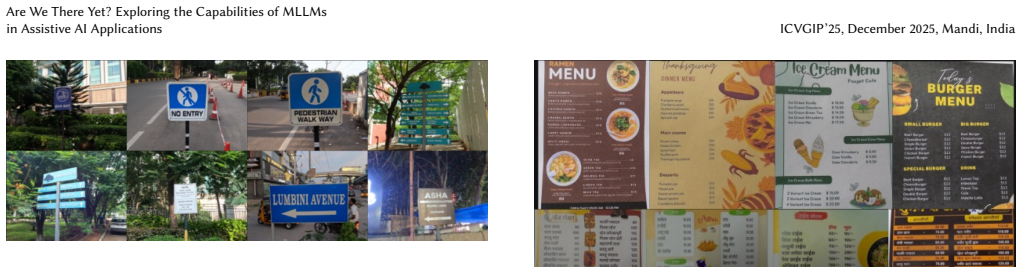
The NetraLink egocentric benchmark and data collection system using a head-mounted GoPro, applied to evaluate MLLMs on three specific assistive tasks: currency recognition, scene text question answering, and multilingual reading.
If this is right
- MLLMs can serve as a flexible foundation for assistive tools due to strong zero- and few-shot performance on some vision-language tasks.
- Real egocentric data from wearable cameras introduces challenges in contextual reasoning and fine-grained visual details that standard benchmarks miss.
- Multilingual reading performance varies by language, affecting the reach of assistive applications in diverse settings.
- The diagnostic points to the need for refinements in MLLM architectures to better support robust assistive technologies grounded in visual perception.
Where Pith is reading between the lines
- Assistive app developers could combine MLLMs with dedicated recognition modules for high-stakes tasks like currency handling to improve reliability.
- The NetraLink approach suggests that future benchmarks for accessibility should prioritize egocentric views over static internet images.
- If limitations persist across models, hybrid systems that allow user feedback or additional sensors may be needed for practical deployment in daily environments.
Load-bearing premise
The selected tasks of currency recognition, scene text QA, and multilingual reading plus the NetraLink egocentric benchmark are representative of the demands and variability in real-world assistive AI applications.
What would settle it
A new collection of egocentric images from comparable real-world assistive scenarios where multiple MLLMs achieve consistently high accuracy across all three task types without task-specific fine-tuning would indicate the reported limitations do not hold generally.
Figures




read the original abstract
Multimodal Large Language Models (MLLMs) have redefined visual understanding by combining vision encoders with large-scale language models. This unified architecture enables strong performance on tasks like image captioning, visual question answering, and multimodal dialogue, often in zero- and few-shot settings. Their general-purpose capabilities and flexible interfaces make MLLMs a promising foundation for real-world vision-language applications. Assistive AI aims to help users interact with their environments through natural language. These scenarios demand robust visual recognition, contextual reasoning, and multilingual comprehension-capabilities that MLLMs are believed to offer. However, their effectiveness in assistive settings remains to be fully understood. In this work, we explore whether MLLMs can support Assistive AI by evaluating state-of-the-art models on real-world tasks: recognizing everyday objects like currency, answering questions based on scene text, and reading visually presented content across multiple languages. To this end, we developed a system, NetraLink, using a head-mounted GoPro to capture real-world egocentric data, and collected a benchmark covering these assistive scenarios. Our findings provide a comprehensive diagnostic of current MLLMs, highlighting their strengths and limitations in enabling assistive technologies grounded in visual perception and language interaction.
Editorial analysis
A structured set of objections, weighed in public.
Referee Report
Summary. The manuscript evaluates state-of-the-art multimodal large language models (MLLMs) on three real-world assistive tasks—recognizing currency, scene text question answering, and multilingual reading—using a new egocentric benchmark (NetraLink) collected via head-mounted GoPro cameras. It claims that the resulting evaluation supplies a comprehensive diagnostic of MLLMs' strengths and limitations for assistive AI applications grounded in visual perception and language interaction.
Significance. If the chosen tasks and benchmark are shown to be representative, the work would supply a useful empirical baseline on MLLM behavior in selected assistive scenarios, potentially guiding targeted improvements in zero- and few-shot visual-language capabilities for accessibility tools.
major comments (2)
- [Abstract] Abstract: the central claim of a 'comprehensive diagnostic' of MLLMs for assistive AI rests on the unargued assumption that currency recognition, scene text QA, multilingual reading, and the NetraLink GoPro egocentric collection are representative of the demands and variability of real-world assistive applications. No coverage analysis, user study, or comparison against existing assistive benchmarks is supplied to justify why these tasks capture core requirements such as dynamic navigation, manipulation guidance, or safety-critical object interaction.
- [Abstract] Abstract: the absence of any quantitative results, error analysis, model versions, prompting strategies, or data-collection protocols prevents verification of whether the observed model behaviors actually support the stated diagnostic conclusions.
Simulated Author's Rebuttal
We thank the referee for the constructive feedback on our manuscript. We address each major comment below and outline planned revisions to strengthen the presentation of scope and results.
read point-by-point responses
-
Referee: [Abstract] Abstract: the central claim of a 'comprehensive diagnostic' of MLLMs for assistive AI rests on the unargued assumption that currency recognition, scene text QA, multilingual reading, and the NetraLink GoPro egocentric collection are representative of the demands and variability of real-world assistive applications. No coverage analysis, user study, or comparison against existing assistive benchmarks is supplied to justify why these tasks capture core requirements such as dynamic navigation, manipulation guidance, or safety-critical object interaction.
Authors: We agree that the selected tasks do not cover the full range of assistive AI demands, including dynamic navigation, manipulation guidance, or safety-critical interactions. The tasks were chosen to address frequent, high-impact needs for visually impaired users (e.g., currency handling and text reading), consistent with prior assistive technology studies. However, the manuscript does not include a formal coverage analysis, user study, or benchmark comparison. We will revise the abstract to replace 'comprehensive diagnostic' with more measured language such as 'targeted diagnostic' and add an explicit limitations subsection discussing task scope and future extensions. revision: yes
-
Referee: [Abstract] Abstract: the absence of any quantitative results, error analysis, model versions, prompting strategies, or data-collection protocols prevents verification of whether the observed model behaviors actually support the stated diagnostic conclusions.
Authors: The abstract is intentionally concise and omits detailed numbers and protocols, which are standard practice. The full manuscript presents quantitative results, error analyses, evaluated model versions, prompting strategies, and the NetraLink data-collection protocol (head-mounted GoPro egocentric capture) in the methods and experiments sections. To improve verifiability from the abstract alone, we will add a short summary sentence highlighting key performance trends and ensure explicit references to the relevant sections. revision: partial
Circularity Check
No circularity: empirical diagnostic study with no derivations or self-referential reductions
full rationale
This is a purely empirical paper that evaluates existing MLLMs on three chosen assistive tasks (currency recognition, scene text QA, multilingual reading) using a new GoPro-collected benchmark called NetraLink. The abstract and provided text contain no equations, no fitted parameters, no predictions derived from inputs, and no load-bearing self-citations or uniqueness theorems. The central claim is simply that the observed model behaviors constitute a diagnostic; representativeness is an external validity question, not a circular reduction of any derivation to its own inputs. No steps match the enumerated circularity patterns.
Axiom & Free-Parameter Ledger
Reference graph
Works this paper leans on
-
[1]
Marah Abdin, Jyoti Aneja, Harkirat Behl, Sébastien Bubeck, Ronen Eldan, Suriya Gunasekar, Michael Harrison, Russell J Hewett, Mojan Javaheripi, Piero Kauff- mann, et al. 2024. Phi-4 technical report.arXiv preprint arXiv:2412.08905(2024)
work page internal anchor Pith review Pith/arXiv arXiv 2024
-
[2]
Srikar Appalaraju, Bhavan Jasani, Bhargava Urala Kota, Yusheng Xie, and R Man- matha. 2021. Docformer: End-to-end transformer for document understanding. InICCV
2021
-
[3]
Youngmin Baek, Bado Lee, Dongyoon Han, Sangdoo Yun, and Hwalsuk Lee. 2019. Character Region Awareness for Text Detection. InCVPR
2019
-
[4]
Shuai Bai, Keqin Chen, Xuejing Liu, Jialin Wang, Wenbin Ge, Sibo Song, Kai Dang, Peng Wang, Shijie Wang, Jun Tang, et al . 2025. Qwen2. 5-vl technical report.arXiv preprint arXiv:2502.13923(2025)
work page internal anchor Pith review Pith/arXiv arXiv 2025
-
[5]
Ali Furkan Biten, Ruben Tito, Andres Mafla, Lluis Gomez, Marçal Rusinol, Ernest Valveny, CV Jawahar, and Dimosthenis Karatzas. 2019. Scene text visual question answering. InICCV
2019
-
[6]
Matthew J Burton, Jacqueline Ramke, Ana Patricia Marques, Rupert RA Bourne, Nathan Congdon, Iain Jones, Brandon AM Ah Tong, Simon Arunga, Damodar Bachani, Covadonga Bascaran, et al. 2021. The lancet global health commission on global eye health: vision beyond 2020.The Lancet Global Health(2021)
2021
-
[7]
Zoya Bylinskii, Adrià Recasens, Ali Borji, Aude Oliva, Antonio Torralba, and Frédo Durand. 2016. Where should saliency models look next?. InECCV
2016
-
[8]
Moran Cerf, E Paxon Frady, and Christof Koch. 2009. Faces and text attract gaze independent of the task: Experimental data and computer model.Journal of vision(2009)
2009
-
[9]
Gongwei Chen, Leyang Shen, Rui Shao, Xiang Deng, and Liqiang Nie. 2024. Lion: Empowering multimodal large language model with dual-level visual knowledge. InCVPR
2024
-
[10]
Dima Damen, Hazel Doughty, Giovanni Maria Farinella, Sanja Fidler, Antonino Furnari, Evangelos Kazakos, Davide Moltisanti, Jonathan Munro, Toby Perrett, Will Price, et al. 2018. Scaling egocentric vision: The epic-kitchens dataset. In ECCV
2018
-
[11]
Abhimanyu Dubey, Abhinav Jauhri, Abhinav Pandey, Abhishek Kadian, Ahmad Al-Dahle, Aiesha Letman, Akhil Mathur, Alan Schelten, Amy Yang, Angela Fan, et al. 2024. The llama 3 herd of models.arXiv e-prints(2024), arXiv–2407
2024
-
[12]
Timothy R Fricke, Nina Tahhan, Serge Resnikoff, Eric Papas, Anthea Burnett, Suit May Ho, Thomas Naduvilath, and Kovin S Naidoo. 2018. Global prevalence of presbyopia and vision impairment from uncorrected presbyopia: systematic review, meta-analysis, and modelling.Ophthalmology(2018)
2018
-
[13]
Kristen Grauman, Andrew Westbury, Eugene Byrne, Zachary Chavis, Antonino Furnari, Rohit Girdhar, Jackson Hamburger, Hao Jiang, Miao Liu, Xingyu Liu, et al. 2022. Ego4d: Around the world in 3,000 hours of egocentric video. InCVPR
2022
-
[14]
Kristen Grauman, Andrew Westbury, Lorenzo Torresani, Kris Kitani, Jitendra Malik, Triantafyllos Afouras, Kumar Ashutosh, Vijay Baiyya, Siddhant Bansal, Bikram Boote, et al. 2024. Ego-exo4d: Understanding skilled human activity from first-and third-person perspectives. InCVPR
2024
-
[15]
Daya Guo, Dejian Yang, Haowei Zhang, Junxiao Song, Ruoyu Zhang, Runxin Xu, Qihao Zhu, Shirong Ma, Peiyi Wang, Xiao Bi, et al . 2025. Deepseek-r1: Incentivizing reasoning capability in llms via reinforcement learning.arXiv preprint arXiv:2501.12948(2025)
work page internal anchor Pith review Pith/arXiv arXiv 2025
-
[16]
Yupan Huang, Tengchao Lv, Lei Cui, Yutong Lu, and Furu Wei. 2022. Layoutlmv3: Pre-training for document ai with unified text and image masking. InACM-MM
2022
-
[17]
Antonia Karamolegkou, Malvina Nikandrou, Georgios Pantazopoulos, Danae Sanchez Villegas, Phillip Rust, Ruchira Dhar, Daniel Hershcovich, and Anders Søgaard. 2025. Evaluating Multimodal Language Models as Visual Assistants for Visually Impaired Users.arXiv preprint arXiv:2503.22610(2025)
-
[18]
Geewook Kim, Teakgyu Hong, Moonbin Yim, JeongYeon Nam, Jinyoung Park, Jinyeong Yim, Wonseok Hwang, Sangdoo Yun, Dongyoon Han, and Seunghyun Park. 2022. OCR-Free Document Understanding Transformer. InECCV
2022
-
[19]
Xin Lai, Zhuotao Tian, Yukang Chen, Yanwei Li, Yuhui Yuan, Shu Liu, and Jiaya Jia. 2024. Lisa: Reasoning segmentation via large language model. InCVPR
2024
-
[20]
Haitao Li, Qian Dong, Junjie Chen, Huixue Su, Yujia Zhou, Qingyao Ai, Ziyi Ye, and Yiqun Liu. 2024. Llms-as-judges: a comprehensive survey on llm-based evaluation methods.arXiv preprint arXiv:2412.05579(2024)
work page internal anchor Pith review Pith/arXiv arXiv 2024
-
[21]
Junnan Li, Dongxu Li, Silvio Savarese, and Steven Hoi. 2023. Blip-2: Bootstrapping language-image pre-training with frozen image encoders and large language models. InICML
2023
-
[22]
Minghui Liao, Zhaoyi Wan, Cong Yao, Kai Chen, and Xiang Bai. 2020. Real-time Scene Text Detection with Differentiable Binarization. InAAAI
2020
-
[23]
Haotian Liu, Chunyuan Li, Yuheng Li, and Yong Jae Lee. 2024. Improved baselines with visual instruction tuning. InCVPR
2024
-
[24]
Haotian Liu, Chunyuan Li, Yuheng Li, Bo Li, Yuanhan Zhang, Sheng Shen, and Yong Jae Lee. 2024. LLaVA-NeXT: Improved reasoning, OCR, and world knowl- edge. https://llava-vl.github.io/blog/2024-01-30-llava-next/
2024
-
[25]
Haotian Liu, Chunyuan Li, Qingyang Wu, and Yong Jae Lee. 2023. Visual Instruc- tion Tuning
2023
-
[26]
Haotian Liu, Chunyuan Li, Qingyang Wu, and Yong Jae Lee. 2023. Visual instruc- tion tuning.NeurIPS(2023)
2023
-
[27]
Sunny Mannava, Rishi Raj Borah, and BR Shamanna. 2022. Current estimates of the economic burden of blindness and visual impairment in India: A cost of illness study.Indian Journal of Ophthalmology(2022)
2022
-
[28]
Minesh Mathew, Dimosthenis Karatzas, and CV Jawahar. 2021. Docvqa: A dataset for vqa on document images. InW ACV
2021
-
[29]
Vision Loss Expert Group of the Global Burden of Disease Study et al . 2024. Global estimates on the number of people blind or visually impaired by cataract: a meta-analysis from 2000 to 2020.Eye(2024)
2024
-
[30]
Ruotian Peng, Haiying He, Yake Wei, Yandong Wen, and Di Hu. 2025. Patch Matters: Training-free Fine-grained Image Caption Enhancement via Local Per- ception. InCVPR
2025
-
[31]
Zhiliang Peng, Wenhui Wang, Li Dong, Yaru Hao, Shaohan Huang, Shuming Ma, and Furu Wei. 2023. Kosmos-2: Grounding multimodal large language models to the world.arXiv preprint arXiv:2306.14824(2023)
work page internal anchor Pith review Pith/arXiv arXiv 2023
-
[32]
Alec Radford, Jong Wook Kim, Chris Hallacy, Aditya Ramesh, Gabriel Goh, Sandhini Agarwal, Girish Sastry, Amanda Askell, Pamela Mishkin, Jack Clark, et al. 2021. Learning transferable visual models from natural language supervision. InICML
2021
-
[33]
Hanoona Rasheed, Muhammad Maaz, Salman Khan, and Fahad S. Khan. 2024. LLaVA++: Extending Visual Capabilities with LLaMA-3 and Phi-3. https://github. com/mbzuai-oryx/LLaVA-pp
2024
-
[34]
Baoguang Shi, Xiang Bai, and Cong Yao. 2016. An end-to-end trainable neural network for image-based sequence recognition and its application to scene text recognition.PAMI(2016)
2016
-
[35]
Baoguang Shi, Xinggang Wang, Pengyuan Lyu, Cong Yao, and Xiang Bai. 2016. Robust Scene Text Recognition with Automatic Rectification. InCVPR
2016
-
[36]
Amanpreet Singh, Vivek Natarjan, Meet Shah, Yu Jiang, Xinlei Chen, Devi Parikh, and Marcus Rohrbach. 2019. Towards VQA Models That Can Read. InCVPR
2019
-
[37]
Ray Smith. 2007. An overview of the Tesseract OCR engine. InICDAR
2007
-
[38]
Gemma Team, Aishwarya Kamath, Johan Ferret, Shreya Pathak, Nino Vieillard, Ramona Merhej, Sarah Perrin, Tatiana Matejovicova, Alexandre Ramé, Morgane Rivière, et al. 2025. Gemma 3 technical report.arXiv preprint arXiv:2503.19786 (2025)
work page internal anchor Pith review Pith/arXiv arXiv 2025
-
[39]
Pavan Kumar Anasosalu Vasu, Fartash Faghri, Chun-Liang Li, Cem Koc, Nate True, Albert Antony, Gokula Santhanam, James Gabriel, Peter Grasch, Oncel Tuzel, et al. 2025. Fastvlm: Efficient vision encoding for vision language models. InProceedings of the Computer Vision and Pattern Recognition Conference. 19769– 19780
2025
-
[40]
Pavan Kumar Anasosalu Vasu, Fartash Faghri, Chun-Liang Li, Cem Koc, Nate True, Albert Antony, Gokula Santhanam, James Gabriel, Peter Grasch, Oncel Tuzel, and Hadi Pouransari. 2025. FastVLM: Efficient Vision Encoding for Vision Language Models. InCVPR
2025
-
[41]
Andreas Veit, Tomas Matera, Lukas Neumann, Jiri Matas, and Serge Belongie
-
[42]
Coco-text: Dataset and benchmark for text detection and recognition in natural images.arXiv preprint arXiv:1601.07140(2016)
work page internal anchor Pith review Pith/arXiv arXiv 2016
-
[43]
Hsueh-Cheng Wang and Marc Pomplun. 2012. The attraction of visual attention to texts in real-world scenes.Journal of vision(2012)
2012
-
[44]
An Yang, Anfeng Li, Baosong Yang, Beichen Zhang, Binyuan Hui, Bo Zheng, Bowen Yu, Chang Gao, Chengen Huang, Chenxu Lv, et al. 2025. Qwen3 technical report.arXiv preprint arXiv:2505.09388(2025)
work page internal anchor Pith review Pith/arXiv arXiv 2025
-
[45]
Heng Yin, Yuqiang Ren, Ke Yan, Shouhong Ding, and Yongtao Hao. 2025. ROD- MLLM: Towards More Reliable Object Detection in Multimodal Large Language Models. InCVPR
2025
- [46]
-
[47]
Xinyu Zhou, Cong Yao, He Wen, Yuzhi Wang, Shuchang Zhou, Weiran He, and Jiajun Liang. 2017. East: an efficient and accurate scene text detector. InCVPR
2017
discussion (0)
Sign in with ORCID, Apple, or X to comment. Anyone can read and Pith papers without signing in.