REVIEW 5 major objections 5 minor 2 cited by
Charged black hole solutions in $f(R,T)$ gravity coupled to nonlinear electrodynamics
T0 review · 5 major / 5 minor · reviewed 2026-08-12 · deepseek-v4-flash
Pith's one-line read This paper claims that Eq. (22) is an exact static spherically symmetric charged black hole solution of f(R,T)=R+βT gravity coupled to the NLED Lagrangian L=f0+F+αF^p.
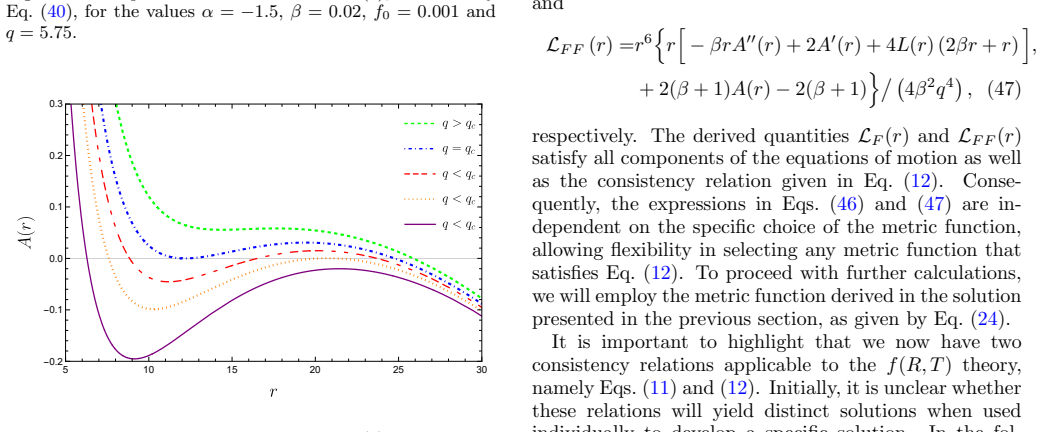
desk verdict Central exact-solution claim is unverified and fails a direct substitution as printed; otherwise a routine f(R,T)+NLED exercise with weak shadow constraints. read the letter →
The pith
A machine-rendered reading of the paper's core claim, the machinery that carries it, and where it could break.
The reading
What carries the argument
The engine of the argument is the power-law NLED Lagrangian \(L=f_0+F+\$\alpha$ F^p\) combined with the linear f(R,T) choice \(f(R,T)=R+\$\beta$ T\) and the magnetic ansatz \(F_{23}=q\sin\$\theta$\); substituting these into the field equations (13)-(15) under the assumption \(B(r)=A(r)\) yields the metric function (22). The consistency relations \(L_F=(\partial L/\partial r)(\partial F/\partial r)^{-1}\) and \(L_{FF}=(\partial L_F/\partial r)(\partial F/\partial r)^{-1}\) are then used to reconstruct the Lagrangian, and the effective metric \(g_{\mu\nu}^{\rm eff}=L_F g_{\mu\nu}-L_{FF}F_{\mu\$\sigma$}F^\$\sigma${}_\nu\) carries the shadow calculation.
What would settle it
Solve the full field equations (13)-(15) without imposing \(B(r)=A(r)\), for example by integrating the difference of the \(tt\) and \(rr\) components for a general \(B(r)\); if the claimed metric survives only under the imposed equality, or if a distinct branch with \(B(r)\neq A(r)\) changes the horizon counts or shadow radius, the central claim is settled.
Extended reading notes
Core claim
On the paper's own terms, the discovery is that the system consisting of \(f(R,T)=R+\$\beta$ T\) gravity and magnetic nonlinear electrodynamics has an exact spherically symmetric black hole solution with metric function (22), obtained under the symmetry \(B(r)=A(r)\). The solution reduces to a Reissner-Nordström type solution with an effective cosmological constant when \(\$\alpha$=0\), and to Schwarzschild when \(q=0\), \(\Lambda_{\rm eff}=0\), and \(\$\alpha$=0\). For \(p=2,4,6\), the Kretschmann scalar diverges as \(r\to 0\) and tends to \(8\Lambda_{\rm eff}^2/3\) at infinity, and the horizon equations produce critical masses and charges separating configurations with one, two, three, or four horizons. A second, independent route fixes the first and second derivatives \(L_F(r)\) and \(L_{FF}(r)\) from the field equations and integrates them, yielding the same Lagrangian \(L_{\rm NLED}(F)=f_0+F+\$\alpha$ F^p+$2^{{1/(2\beta+1)}}$f_1 $F^{{1/(2\beta+1)}}$$q^{{-1/\beta-2}}$\), so the f(R,T) coupling can sustain nonlinear electrodynamics even with \(\$\alpha$=0\). Finally, the shadow radius computed from the effective metric (55) is compared with the observed Sagittarius A* shadow, constraining the model parameters.
Load-bearing premise
The load-bearing assumption is that the metric functions are equal, \(B(r)=A(r)\), before solving; the exact solution, horizon analysis, and shadow constraints all rely on it, and no theorem is given that forces this equality in f(R,T) gravity with these matter sources.
Editorial extensions
If this is right
- For \(\beta=0\), the metric function reduces to the GR plus NLED charged black hole, so the family contains the standard limit and any deviations from GR are controlled by \(\beta\).
- With \(p=2,4,6\), the Kretschmann scalar diverges at \(r=0\) and approaches \(8\Lambda_{\rm eff}^2/3\) as \(r\to\infty\), so the solutions are singular cores embedded in a de Sitter-like asymptotic geometry.
- The horizon analysis predicts up to four horizons depending on \(M\) and \(q\), with critical values such as \(M_c=5.682\) for \(\alpha=0.5\), \(\beta=0.002\), \(f_0=0.001\), \(q=5.75\).
- The shadow-radius comparison with Sagittarius A* permits \(0\le\beta\lesssim1.6\times10^4\) for \(p=2\), \(0\le\beta\lesssim3\times10^{10}\) for \(p=4\), and \(0\le\beta\lesssim7.8\times10^{16}\) for \(p=6\), with corresponding bounds on \(\alpha\) and \(p\).
- The reconstructed Lagrangian (50) stays nonlinear when \(\alpha=0\) because the \(\beta\) term contributes \(F^{1/(2\beta+1)}\), so f(R,T) itself acts as a source of nonlinear electrodynamics.
Reading between the lines
- Because the paper integrates the equations only under \(B(r)=A(r)\), solving the full system without this ansatz is a natural next step; a distinct two-function branch would change the horizon structure and the quoted shadow bounds.
- The allowed ranges for \(\beta\) grow from \(10^4\) to \(10^{16}\) as \(p\) increases, so the shadow measurement mostly pins down combinations of \(p\), \(\beta\), and the effective cosmological constant rather than \(\beta\) alone; tighter future shadow measurements could break this degeneracy.
- The equality of the two reconstruction strategies hints at an integrability condition in this theory; if it holds, any metric function satisfying it could be paired with an explicit NLED Lagrangian, generating further exact solutions without new assumptions.
- Applying quasinormal-mode, thermodynamic, and accretion-disk tests to the shadow-compatible parameter ranges would clarify whether the multi-horizon configurations are dynamically stable and observationally distinguishable from general-relativistic black holes.
Signed reviews
Editorial analysis
A structured set of objections, weighed in public.
Referee Report
Summary. The paper studies static, spherically symmetric black hole solutions in f(R,T)=R+βT gravity coupled to nonlinear electrodynamics with a power-law Lagrangian L=f0+F+αF^p and a purely magnetic charge. It claims to derive a one-parameter family of exact solutions, Eq. (22), specializes to p=2,4,6, computes Kretschmann scalars, discusses horizon structure, reconstructs the NLED Lagrangian from the field equations, and uses EHT Sgr A* shadow observations to constrain β, α, and p. The abstract and introduction state that the solutions are derived and that regularity is verified, although the printed Kretschmann scalars diverge at small r.
Significance. If Eq. (22) were a genuine exact solution, the paper would provide a new family of charged black holes in f(R,T) gravity with an effective cosmological constant and p-dependent corrections, and the shadow constraints could be a useful observational test of the model. Those are potentially valuable contributions. However, the manuscript does not show the derivation of Eq. (22), the direct substitution check against the independent field equation appears to fail, the reconstruction in Sec. III.B has dimensional and circularity problems, and the shadow constraints constrain a combination of f0 and β rather than β alone. These issues affect the central claims of the paper. I also note the absence of any machine-checkable derivation or reproducibility artifact to support the exactness statements.
major comments (5)
- [Sec. III.A, Eq. (22)] The central exact solution is not verified. With B(r)=A(r) and f(R,T)=R+βT, f_R=1, so Eqs. (13) and (14) are identical and Eq. (15) is an independent constraint. The paper states that Eq. (22) follows from the field equations but does not show the substitution. I performed a direct substitution for p=2 using F=q^2/(2r^4), L_F=1+αpF^(p-1), and L_FF=α(p-1)pF^(p-2) into Eq. (15) as printed: after clearing denominators the residual contains powers r^0, r^-4, and r^-8, whose coefficients vanish only for incompatible values β=-4/7, β=0, and β=4/13 unless α=f0=0. This indicates that Eq. (22) is not a solution of the field equations as written, or that the printed equations carry an unstated normalization/sign convention. Because every subsequent result uses Eq. (22), the authors must provide a full derivation or a computer-algebra verification, and must reconcile the normalization of the field equations with the action (1).
- [Sec. II.A and Eqs. (13)-(15)] The normalization of the field equations is ambiguous. The action (1) contains 2κ^2 L_NLED with κ^2=8π, but the field equation (3) and its components (13)-(15) have no κ^2 on the matter right-hand side. If κ^2=8π is intended, the right-hand sides of Eqs. (13)-(15) should be proportional to κ^2 L_NLED; if instead a different convention is used, it must be stated explicitly. This ambiguity propagates into Eq. (22) and into the reconstruction formulas (46)-(47), and it may be the source of the residual terms found in the substitution check.
- [Sec. III.B, Eqs. (46)-(47)] The reconstructed derivatives L_F(r) and L_FF(r) appear to be dimensionally inconsistent. In Eq. (46), for example, the numerator contains r[A'(r)+2 L_NLED(r)(2βr+r)] + A(r) - 1. The term r A'(r) is dimensionless, while r multiplied by 2 L_NLED(r)(2βr+r) has dimension of inverse length squared, so the two terms cannot be added unless a highly nonstandard unit convention is in force. The same issue appears in Eq. (47). A derivation of these formulas and a statement of the units used (including the role of κ^2) are needed before they can be used.
- [Sec. III.B, Eqs. (48)-(50)] The Lagrangian reconstruction is circular in an important sense. Eq. (48) is evaluated on the metric function (22), which was derived by assuming L=f0+F+αF^p. The recovered Lagrangian (50) therefore necessarily contains the input terms, and the claim that 'even if α=0, the Lagrangian remains nonlinear due to β' is not an independent result. To establish that β alone can generate a nonlinear electromagnetic Lagrangian, one would need a metric that is not constructed from a nonlinear Lagrangian input, or an explicit statement that the reconstruction is only a self-consistency check rather than a new derivation.
- [Sec. IV.B, Figs. 5-7 and Subsec. IV.B.1] The reported constraints on β are effectively constraints on the combination f0(1+2β), not on β itself. In the metric (22), the f0 term enters as Λ_eff r^2/3 with Λ_eff=2(2β+1)f0, and for p=4 and p=6 the α-dependent terms decay as r^-14 and r^-22, making them negligible at the photon-sphere and shadow scales. With f0 fixed to Λ/2=5×10^-42, the values β_max≈1.6×10^4, 3×10^10, and 7.8×10^16 correspond simply to different effective cosmological constants. The paper states that β is constrained and that Λ_eff 'increases with β,' but no independent constraint on β is obtained. A joint constraint in terms of physical dimensionless parameters (e.g., f0 M^2 and β) is required to support the observational conclusions.
minor comments (5)
- [Sec. IV.B and figures] The text states that the observer is at rO ∼ 8 Mpc, but Sagittarius A* is at ∼8 kpc and the figure captions say kpc. This should be corrected.
- [Sec. III.A.2, Eq. (38)] The large-F asymptotic expression for the p=4 Lagrangian is written as F+αF^2, but Eq. (36) has αF^4; Eq. (38) should be F+αF^4.
- [Abstract and Sec. V] The manuscript says the regularity of the solutions is verified, but the Kretschmann scalars in Eqs. (33), (39), and (45) diverge at small r. I recommend rephrasing to 'analyze the regularity' or 'check for curvature singularities' to avoid the impression that regular black holes are obtained.
- [Sec. III.A, p=6 text] There is a typo: 'the linear case is recieveed' should read 'the linear case is recovered.'
- [Sec. IV.B.3 and Fig. 9] The text says the shadow radius is analyzed 'within the range p∈[2,6],' but the manuscript presents only p=2,4,6. Please clarify whether p is treated as continuous or as three discrete values.
Circularity Check
The Lagrangian reconstructed in Sec. III.B is the input Lagrangian (19) recovered by inverting the same metric that was built from it; the exact-solution and shadow parts are otherwise self-contained.
-
self definitional
[Section III.B.1 (Strategy one), Eqs. (46)-(50); input Lagrangian Eq. (19) and metric Eq. (22)]
"By considering the form of the function (18), along with the expressions (19)–(21) in the equations of motion, and assuming the symmetry B(r) = A(r), we derive the following metric function from the components of the field equations (13-15) ... By imposing f1 = 0, we recover the form of the Lagrangian given by (19)."
Eq. (22) is obtained by solving the field equations with L = f0 + F + αF^p fixed as input. In Sec. III.B the same metric (22) is then substituted into the field equations to 'derive' L_F(r) and L_FF(r) and integrate them into L_NLED(F), Eq. (50). With f1 = 0, Eq. (50) returns exactly the input Lagrangian (19), term by term; the only new piece is the homogeneous integration term proportional to f1. Thus the reconstructed Lagrangian is a self-consistency check on the original ansatz, not an independent derivation. The claim that the nonlinearity is controlled by both α and β follows from the f1-term, but the f0 + F + αF^p part is recycled from the input.
full rationale
The paper's central exact-solution claim, Eq. (22), is not itself circular: it is proposed as a solution of the stated field equations for a fixed matter Lagrangian, and the shadow analysis in Sec. IV is an honest parameter constraint against external EHT observations rather than a prediction. The citation of the foundational f(R,T) paper [11], which includes two co-authors, is a normal reference to an independent external result and is not load-bearing circularity. The circular element is confined to Sec. III.B: the metric (22) was constructed from the assumed Lagrangian (19)-(21), and the reconstruction procedure then feeds this same metric back into the field equations to recover L_NLED(F). The recovered expression (50) reduces to the input Lagrangian (19) when the integration constant f1 is set to zero, so the 'derivation' of the general Lagrangian is a self-consistency check, not an independent result. This does not invalidate the solution (22), but it does mean the Lagrangian-reconstruction claim and the associated 'nonlinearity governed by β' conclusion are partially circular. Score 6 reflects one central 'prediction' reducing by construction, while the rest of the derivation chain is self-contained.
Assumptions & free parameters
free parameters (7)
- β =
0 ≤ β ≲ 1.6e4 (p=2), ≲3e10 (p=4), ≲7.8e16 (p=6)
- α =
0 ≤ α ≲ 7 (p=2), ≲1.4 (p=4), ≲3.8 (p=6)
- p =
2, 4, 6 (chosen)
- f0 =
Λ/2 with Λ=1e-41
- f1 =
1e-60
- q (magnetic charge) =
0.5M (shadow analysis), 5.75 (horizon analysis)
- M (mass) =
1 (shadow analysis)
assumptions (5)
- domain assumption The f(R,T) field equations (3) with the coupling f_T(T_μν+Θ_μν) are assumed correct.
- ad hoc to paper The metric ansatz B(r)=A(r) is imposed.
- standard math The magnetic field ansatz F_{23}=q sinθ satisfies the modified Maxwell equation (2).
- domain assumption The effective metric (55) governs photon trajectories in nonlinear electrodynamics.
- ad hoc to paper The power-law Lagrangian L=f0+F+αF^p is assumed as the matter source.
Cite this review
Pith. "Pith review of Charged black hole solutions in $f(R,T)$ gravity coupled to nonlinear electrodynamics." pith.science (2026). https://pith.science/paper/XWBUJDDY
@misc{pith2026241200582,
  author       = {Pith},
  title        = {Pith review of: Charged black hole solutions in $f(R,T)$ gravity coupled to nonlinear electrodynamics},
  year         = {2026},
  howpublished = {\url{https://pith.science/paper/XWBUJDDY}},
  note         = {Machine review of arXiv:2412.00582}
}
abstract
In this work, we investigate static and spherically symmetric black hole solutions in $f(R,T)$ gravity, where $R$ is the curvature scalar and $T$ is the trace of the energy-momentum tensor, coupled to nonlinear electrodynamics (NLED). To construct our solutions, we adopt a linear functional form, $f(R,T) = R + \beta T$. In the limit $\beta = 0$, the theory reduces to General Relativity (GR), recovering $f(R,T) \approx R$. We propose a power-law Lagrangian of the form $\mathcal{L} = f_0 + F + \alpha F^p$, where $\alpha =f_0= 0$ corresponds to the linear electrodynamics case. Using this setup, we derive the metric functions and determine an effective cosmological constant. Our analysis focuses on specific cases with $p = 2$, $p = 4$, and $p = 6$, where we formulate analytic expressions for the matter fields supporting these solutions in terms of the Lagrangian as a function of $F$. Additionally, we verify the regularity of the solutions and study the structure of the event horizons. Furthermore, we examine a more specific scenario by determining the free forms of the first and second derivatives $\mathcal{L}_F(r)$ and $\mathcal{L}_{FF}(r)$ of the Lagrangean of the nonlinear electromagnetic field. From these relations, we derive the general form of $\mathcal{L}_{\text{NLED}}(r)$ using consistency relations. This Lagrangian exhibits an intrinsic nonlinearity due to the influence of two constants, $\alpha$ and $\beta$. Specifically, $\alpha$ originates from the power-law term in the proposed Lagrangian, while $\beta$ arises from the assumed linear function $f(R,T)$. The interplay of these constants ensures that the nonlinearity of the Lagrangian is governed by both $\alpha$ and $\beta$, rather than $\alpha$ alone.
Figures


Figures from the paper (4 more)


Forward citations
Cited by 2 Pith papers
-
Causality Constraints on Black Hole Thermodynamics in Nonlinear Electrodynamics
Causality in nonlinear electrodynamics forces the entropy-to-mass-squared ratio of black holes to decrease with mass and the extremal mass-to-charge ratio to increase with charge.
-
Joule-Thomson Effect and Geodesic Structure of Charged AdS Black Holes in f(R,T) Coupled with Nonlinear Electrodynamics
Charge most strongly controls JT inversion and cooling domains of the f(R,T)-NLED AdS black hole; NLED and modified-gravity parameters supply only sub-leading corrections that leave exterior geodesics close to RN-AdS.
Reference graph
Works this paper leans on
-
[1]
(28) The Lagrangian in terms of the radial coordinate, Eq
Solution with p = 2 For this solution, we consider p = 2 in the metric func- tion given by (24), resulting in the following form: A (r) = 1 − 2M r + q2 r2 − Λeff r2 3 − α (2β − 1) q4 10r6 . (28) The Lagrangian in terms of the radial coordinate, Eq. (25), for this case becomes LNLED (r) = f0 + q2 2r4 + αq4 4r8 . (29) 6 In principle, we can rewrite r(F ) fr...
-
[2]
With this imposition, the metric function (24) takes the following form: A(r) = 1 − 2M r + q2 r2 − Λef f 3 r2 − α [6β − 1] q8 104r14
Solution with p = 4 We now consider the solution for p = 4. With this imposition, the metric function (24) takes the following form: A(r) = 1 − 2M r + q2 r2 − Λef f 3 r2 − α [6β − 1] q8 104r14 . (34) Thus, the Lagrangian in terms of the radial coordinate is LNLED (r) = f0 + q2 2r4 + αq8 16r16 . (35) By writing r(F ), we find that the Lagrangian is now des...
-
[3]
In this case, the metric function (24) takes the following form: A(r) = 1 − 2M r + q2 r2 − Λeff 3 r2 − α(10β − 1)q12 672r22
Solution with p = 6 Finally, we consider p = 6. In this case, the metric function (24) takes the following form: A(r) = 1 − 2M r + q2 r2 − Λeff 3 r2 − α(10β − 1)q12 672r22 . (40) which provides the following Lagrangian LNLED (r) = f0 + q2 2r4 + αq12 16r24 . (41) If we write r(F ), we find that the Lagrangian is now described by: LNLED (F ) = Λeff 4β + 2 +...
-
[4]
Below, we illustrate the event horizon representations obtained by solving Eqs
Horizons Next, we present the horizon graphs, focusing exclu- sively on the metric function with the power p = 6, as the graphical behavior for the other powers is analogous. Below, we illustrate the event horizon representations obtained by solving Eqs. (16) and (17) simultaneously, applied to the metric function given in Eq. (40). This approach allows u...
-
[5]
(46), into the consis- tency relation given by Eq
Strategy one Subsequently, by substituting the derivative of the La- grangian density, as described in Eq. (46), into the consis- tency relation given by Eq. (11), we derived an expression that enabled us to determine the Lagrangian density in the following form: LNLED(r) = − r− 2 β −4 Z r β+2 β (rA′(r) + A(r) − 1) β dr + f1r− 2 β −4. (48) Substituting th...
-
[6]
M ” that appears in our metric to the mass. For this rea- son, we specify the shadow radius in units of the local mass “ M
Strategy two In this second approach, we determine the Lagrangian in terms of the electromagnetic scalar, LNLED(F ), by em- ploying the second consistency relation, Eq. (12). The process is analogous to that described in the previous section, with the key difference being the initial use of Eq. (12) instead of Eq. (11). Specifically, by substitut- ing the...
-
[7]
5 we analyze the behavior of the shadow radius rsh of our model for the metric function (22) with power p = 2, i.e
Constraining the β parameter In Fig. 5 we analyze the behavior of the shadow radius rsh of our model for the metric function (22) with power p = 2, i.e. Eq. (28). We consider the shadow size of the black hole Sgr A* as a function of the parameter β and follow the uncertainties given in Eqs. (53) and (54). The assumed values of the constants are: M = 1, q ...
-
[8]
Constraining the α parameter Similar to the procedure developed in the previous sec- tion, we now constrain the parameter α based on the data obtained by the Event Horizon Telescope (EHT) for Sgr A*, as illustrated in Fig. 8. We analyze the be- havior of the shadow radius rsh for the metric function of our model described by Eq. (22), considering the same...
Show all 127 references
-
[9]
To achieve this, we use the same values for the constants and set α = 0.5 and β = 103
Constraining the p parameter Finally, as in the two previous cases, we constrain the parameter p. To achieve this, we use the same values for the constants and set α = 0.5 and β = 103. The obtained results provide strong justification for the values ofp that were assumed in th...
2018
-
[10]
The foundation of the general theory of relativity,
A. Einstein, “The foundation of the general theory of relativity,” Annalen Phys. 49 (1916) no.7, 769-822
1916
-
[11]
Ob- servation of Gravitational Waves from a Binary Black Hole Merger,
B. P. Abbott et al. [LIGO Scientific and Virgo], “Ob- servation of Gravitational Waves from a Binary Black Hole Merger,” Phys. Rev. Lett. 116 (2016) no.6, 061102 [arXiv:1602.03837 [gr-qc]]
2016 arXiv
-
[12]
Multi-messenger Observations of a Binary Neutron Star Merger,
B. P. Abbott et al., “Multi-messenger Observations of a Binary Neutron Star Merger,” Astrophys. J. Lett. 848 (2017) no.2, L12 [arXiv:1710.05833 [astro-ph.HE]]
2017 arXiv
-
[13]
First M87 Event Horizon Telescope Results. I. The Shadow of the Supermassive Black Hole,
K. Akiyama et al. [Event Horizon Telescope], “First M87 Event Horizon Telescope Results. I. The Shadow of the Supermassive Black Hole,” Astrophys. J. Lett. 875 (2019), L1 [arXiv:1906.11238 [astro-ph.GA]]
2019 arXiv
-
[14]
First Sagittarius A* Event Horizon Telescope Results. I. The Shadow of the Supermassive Black Hole in the Center of the Milky Way,
K. Akiyama et al. [Event Horizon Telescope], “First Sagittarius A* Event Horizon Telescope Results. I. The Shadow of the Supermassive Black Hole in the Center of the Milky Way,” Astrophys. J. Lett.930 (2022) no.2, L12 [arXiv:2311.08680 [astro-ph.HE]]
2022 arXiv
-
[15]
Introduction to modified gravity and gravitational alternative for dark energy,
S. Nojiri and S. D. Odintsov, “Introduction to modified gravity and gravitational alternative for dark energy,” eConf C0602061, 06 (2006) [arXiv:hep-th/0601213 [hep-th]]
2006 arXiv
-
[16]
f(R) Theories Of Gravity,
T. P. Sotiriou and V. Faraoni, “f(R) Theories Of Gravity,” Rev. Mod. Phys. 82, 451-497 (2010) [arXiv:0805.1726 [gr-qc]]
2010 arXiv
-
[17]
f(R) theories,
A. De Felice and S. Tsujikawa, “f(R) theories,” Living Rev. Rel. 13, 3 (2010) [arXiv:1002.4928 [gr-qc]]
2010 arXiv
-
[18]
Modified Gravity and Cosmology,
T. Clifton, P. G. Ferreira, A. Padilla and C. Skordis, “Modified Gravity and Cosmology,” Phys. Rept. 513, 1-189 (2012) [arXiv:1106.2476 [astro-ph.CO]]
2012 arXiv
-
[19]
A New Type of Isotropic Cosmo- logical Models Without Singularity,
A. A. Starobinsky, “A New Type of Isotropic Cosmo- logical Models Without Singularity,” Phys. Lett. B 91, 99-102 (1980)
1980
-
[20]
f (R, T) gravity,
T. Harko, F. S. N. Lobo, S. Nojiri and S. D. Odintsov, “f (R, T) gravity,” Phys. Rev. D 84 (2011), 024020 [arXiv:1104.2669 [gr-qc]]
2011 arXiv
-
[21]
Metric-affine f(R,T) theories of gravity and their applications,
E. Barrientos, F. S. N. Lobo, S. Mendoza, G. J. Olmo and D. Rubiera-Garcia, “Metric-affine f(R,T) theories of gravity and their applications,” Phys. Rev. D 97 (2018) no.10, 104041 [arXiv:1803.05525 [gr-qc]]
2018 arXiv
-
[22]
Theories of gravitation with non- minial coupling of matter and the gravitational field,
H. F. M. Gonner, “Theories of gravitation with non- minial coupling of matter and the gravitational field,” Found. Phys. 14 (1984), 865-881
1984
-
[23]
Extra force in f(R) modified the- ories of gravity,
O. Bertolami, C. G. Boehmer, T. Harko and F. S. N. Lobo, “Extra force in f(R) modified the- ories of gravity,” Phys. Rev. D 75 (2007), 104016 [arXiv:0704.1733 [gr-qc]]
2007 arXiv
-
[24]
Non-minimal curvature-matter couplings in modified gravity,
O. Bertolami, J. Paramos, T. Harko and F. S. N. Lobo, “Non-minimal curvature-matter couplings in modified gravity,” [arXiv:0811.2876 [gr-qc]]
-
[25]
Non- minimum coupling of perfect fluids to curvature,
O. Bertolami, F. S. N. Lobo and J. Paramos, “Non- minimum coupling of perfect fluids to curvature,” Phys. Rev. D 78 (2008), 064036 [arXiv:0806.4434 [gr-qc]]
2008 arXiv
-
[26]
f(R, Lm) gravity,
T. Harko and F. S. N. Lobo, “f(R, Lm) gravity,” Eur. Phys. J. C 70 (2010), 373-379 [arXiv:1008.4193 [gr-qc]]
2010 arXiv
-
[27]
Geodesic deviation, Ray- chaudhuri equation, and tidal forces in modified grav- ity with an arbitrary curvature-matter coupling,
T. Harko and F. S. N. Lobo, “Geodesic deviation, Ray- chaudhuri equation, and tidal forces in modified grav- ity with an arbitrary curvature-matter coupling,” Phys. Rev. D 86 (2012), 124034 [arXiv:1210.8044 [gr-qc]]
2012 arXiv
-
[28]
Extended f (R, Lm) gravity with generalized scalar field and ki- netic term dependences,
T. Harko, F. S. N. Lobo and O. Minazzoli, “Extended f (R, Lm) gravity with generalized scalar field and ki- netic term dependences,” Phys. Rev. D 87 (2013) no.4, 047501 [arXiv:1210.4218 [gr-qc]]
2013 arXiv
-
[29]
Further matters in space-time geometry: f (R, T, Rµν T µν ) gravity,
Z. Haghani, T. Harko, F. S. N. Lobo, H. R. Sepangi and S. Shahidi, “Further matters in space-time geometry: f (R, T, Rµν T µν ) gravity,” Phys. Rev. D 88 (2013) no.4, 044023 [arXiv:1304.5957 [gr-qc]]
2013 arXiv
-
[30]
Generalized curvature- matter couplings in modified gravity,
T. Harko and F. S. N. Lobo, “Generalized curvature- matter couplings in modified gravity,” Galaxies2 (2014) no.3, 410-465 [arXiv:1407.2013 [gr-qc]]
2014 arXiv
-
[31]
Beyond Einstein’s Gen- eral Relativity: Hybrid metric-Palatini gravity and curvature-matter couplings,
T. Harko and F. S. N. Lobo, “Beyond Einstein’s Gen- eral Relativity: Hybrid metric-Palatini gravity and curvature-matter couplings,” Int. J. Mod. Phys. D 29 (2020) no.13, 2030008 [arXiv:2007.15345 [gr-qc]]
2020 arXiv
-
[32]
Thermodynamics in f(R,T) Theory of Gravity,
M. Sharif and M. Zubair, “Thermodynamics in f(R,T) Theory of Gravity,” JCAP 03, 028 (2012) [erratum: JCAP 05, E01 (2012)] [arXiv:1204.0848 [gr-qc]]
2012 arXiv
-
[33]
Energy Conditions Con- straints and Stability of Power Law Solutions in f(R,T) Gravity,
M. Sharif and M. Zubair, “Energy Conditions Con- straints and Stability of Power Law Solutions in f(R,T) Gravity,” J. Phys. Soc. Jap. 82, 014002 (2013) [arXiv:1210.3878 [gr-qc]]
2013 arXiv
-
[34]
Testing some f(R,T) gravity mod- els from energy conditions,
F. G. Alvarenga, M. J. S. Houndjo, A. V. Monwanou and J. B. C. Orou, “Testing some f(R,T) gravity mod- els from energy conditions,” J. Mod. Phys. 4, 130-139 (2013) [arXiv:1205.4678 [gr-qc]]
2013 arXiv
-
[35]
Stellar equilibrium configurations of compact stars in f (R, T) gravity,
P. H. R. S. Moraes, J. D. V. Arba˜ nil and M. Mal- heiro, “Stellar equilibrium configurations of compact stars in f (R, T) gravity,” JCAP 06, 005 (2016) [arXiv:1511.06282 [gr-qc]]
2016 arXiv
-
[36]
Compact stars in f (R, T ) gravity,
A. Das, F. Rahaman, B. K. Guha and S. Ray, “Compact stars in f (R, T ) gravity,” Eur. Phys. J. C76, no.12, 654 (2016) [arXiv:1608.00566 [gr-qc]]
2016 arXiv
-
[37]
Charged anisotropic compact star in f (R, T) gravity: A minimal geometric deformation gravitational decoupling approach,
S. K. Maurya and F. Tello-Ortiz, “Charged anisotropic compact star in f (R, T) gravity: A minimal geometric deformation gravitational decoupling approach,” Phys. Dark Univ. 27, 100442 (2020) [arXiv:1905.13519 [gr- qc]]
2020 arXiv
-
[38]
Study of anisotropic strange stars in f (R, T) gravity: An embedding approach under the simplest linear functional of the matter-geometry coupling,
S. K. Maurya, A. Errehymy, D. Deb, F. Tello-Ortiz and M. Daoud, “Study of anisotropic strange stars in f (R, T) gravity: An embedding approach under the simplest linear functional of the matter-geometry coupling,” Phys. Rev. D 100, no.4, 044014 (2019) [arXiv:1907.10149 [gr-qc]]
2019 arXiv
-
[39]
Gravastars in f(R,T) gravity,
A. Das, S. Ghosh, B. K. Guha, S. Das, F. Rahaman and S. Ray, “Gravastars in f(R,T) gravity,” Phys. Rev. D 95, no.12, 124011 (2017) [arXiv:1702.08873 [gr-qc]]
2017 arXiv
-
[40]
Charged Gravastars in Modified Gravity,
Z. Yousaf, K. Bamba, M. Z. Bhatti and U. Ghafoor, “Charged Gravastars in Modified Gravity,” Phys. Rev. D 100, no.2, 024062 (2019) [arXiv:1907.05233 [gr-qc]]
2019 arXiv
-
[41]
Reconstruction of some cosmological models in f(R,T) gravity,
M. Jamil, D. Momeni, M. Raza and R. Myrza- 16 kulov, “Reconstruction of some cosmological models in f(R,T) gravity,” Eur. Phys. J. C 72, 1999 (2012) [arXiv:1107.5807 [physics.gen-ph]]
2012 arXiv
-
[42]
f(R,T) Cosmological Models in Phase Space,
H. Shabani and M. Farhoudi, “f(R,T) Cosmological Models in Phase Space,” Phys. Rev. D 88, 044048 (2013) [arXiv:1306.3164 [gr-qc]]
2013 arXiv
-
[43]
Cosmological and Solar System Consequences of f(R,T) Gravity Models,
H. Shabani and M. Farhoudi, “Cosmological and Solar System Consequences of f(R,T) Gravity Models,” Phys. Rev. D 90, no.4, 044031 (2014) [arXiv:1407.6187 [gr- qc]]
2014 arXiv
-
[44]
Growth of cosmic per- turbations in the modified f(R,T) gravity,
M. Asghari and A. Sheykhi, “Growth of cosmic per- turbations in the modified f(R,T) gravity,” Phys. Dark Univ. 46 (2024), 101695 [arXiv:2405.11840 [gr-qc]]
2024 arXiv
-
[45]
Wormhole Geometries In f (R, T) Grav- ity,
T. Azizi, “Wormhole Geometries In f (R, T) Grav- ity,” Int. J. Theor. Phys. 52, 3486-3493 (2013) [arXiv:1205.6957 [gr-qc]]
2013 arXiv
-
[46]
Static spher- ically symmetric wormholes in f(R, T) gravity,
M. Zubair, S. Waheed and Y. Ahmad, “Static spher- ically symmetric wormholes in f(R, T) gravity,” Eur. Phys. J. C 76, no.8, 444 (2016) [arXiv:1607.05998 [gr- qc]]
2016 arXiv
-
[47]
Analytical general solutions for static worm- holes in f (R, T) gravity,
P. H. R. S. Moraes, R. A. C. Correa and R. V. Lo- bato, “Analytical general solutions for static worm- holes in f (R, T) gravity,” JCAP 07, 029 (2017) [arXiv:1701.01028 [gr-qc]]
2017 arXiv
-
[48]
Modelling worm- holes in f (R, T) gravity,
P. H. R. S. Moraes and P. K. Sahoo, “Modelling worm- holes in f (R, T) gravity,” Phys. Rev. D96, no.4, 044038 (2017) [arXiv:1707.06968 [gr-qc]]
2017 arXiv
-
[49]
Wormhole forma- tion in f (R, T) gravity: Varying Chaplygin gas and barotropic fluid,
E. Elizalde and M. Khurshudyan, “Wormhole forma- tion in f (R, T) gravity: Varying Chaplygin gas and barotropic fluid,” Phys. Rev. D98, no.12, 123525 (2018) [arXiv:1811.11499 [gr-qc]]
2018 arXiv
-
[50]
Modified Gauss-Bonnet theory as gravitational alternative for dark energy,
S. Nojiri and S. D. Odintsov, “Modified Gauss-Bonnet theory as gravitational alternative for dark energy,” Phys. Lett. B 631, 1-6 (2005) [arXiv:hep-th/0508049 [hep-th]]
2005 arXiv
-
[51]
Equivalence of modified gravity equation to the Clausius relation,
K. Bamba, C. Q. Geng, S. Nojiri and S. D. Odintsov, “Equivalence of modified gravity equation to the Clausius relation,” EPL 89, no.5, 50003 (2010) [arXiv:0909.4397 [hep-th]]
2010 arXiv
-
[52]
Reconstruction and deceleration- acceleration transitions in modified gravity,
S. Nojiri, S. D. Odintsov, A. Toporensky and P. Tretyakov, “Reconstruction and deceleration- acceleration transitions in modified gravity,” Gen. Rel. Grav. 42, 1997-2008 (2010) [arXiv:0912.2488 [hep-th]]
2010 arXiv
-
[53]
A type of Levi-Civita solution in mod- ified Gauss-Bonnet gravity,
M. E. Rodrigues, M. J. S. Houndjo, D. Momeni and R. Myrzakulov, “A type of Levi-Civita solution in mod- ified Gauss-Bonnet gravity,” Can. J. Phys. 92, 173-176 (2014) [arXiv:1212.4488 [gr-qc]]
2014 arXiv
-
[54]
Exploring Cylindrical Solutions in Modified f (G) Gravity,
M. J. S. Houndjo, M. E. Rodrigues, D. Momeni and R. Myrzakulov, “Exploring Cylindrical Solutions in Modified f (G) Gravity,” Can. J. Phys. 92, no.12, 1528- 1540 (2014) [arXiv:1301.4642 [gr-qc]]
2014 arXiv
-
[55]
Dark energy in modified Gauss-Bonnet gravity: Late-time acceleration and the hierarchy prob- lem,
G. Cognola, E. Elizalde, S. Nojiri, S. D. Odintsov and S. Zerbini, “Dark energy in modified Gauss-Bonnet gravity: Late-time acceleration and the hierarchy prob- lem,” Phys. Rev. D 73, 084007 (2006) [arXiv:hep- th/0601008 [hep-th]]
2006
-
[56]
Energy conditions in f (G, T) gravity,
M. Sharif and A. Ikram, “Energy conditions in f (G, T) gravity,” Eur. Phys. J. C 76, no.11, 640 (2016) [arXiv:1608.01182 [gr-qc]]
2016 arXiv
-
[57]
Some exact so- lutions in {(G, T) gravity via Noether symmetries,
M. Farasat Shamir and M. Ahmad, “Some exact so- lutions in {(G, T) gravity via Noether symmetries,” Mod. Phys. Lett. A 32, no.16, 1750086 (2017) [arXiv:1707.03189 [gr-qc]]
2017 arXiv
-
[58]
Role of f(G,T) gravity on the evolution of relativistic stars,
M. Z. u. H. Bhatti, M. Sharif, Z. Yousaf and M. Ilyas, “Role of f(G,T) gravity on the evolution of relativistic stars,” Int. J. Mod. Phys. D 27, no.04, 1850044 (2017)
2017
-
[59]
Gravastars in f (G, T) Gravity,
M. F. Shamir and M. Ahmad, “Gravastars in f (G, T) Gravity,” Phys. Rev. D 97, no.10, 104031 (2018) [arXiv:1801.03428 [gr-qc]]
2018 arXiv
-
[60]
Dark torsion as the cosmic speed-up,
G. R. Bengochea and R. Ferraro, “Dark torsion as the cosmic speed-up,” Phys. Rev. D 79, 124019 (2009) [arXiv:0812.1205 [astro-ph]]
2009 arXiv
-
[61]
f(T) teleparallel gravity and cos- mology,
Y. F. Cai, S. Capozziello, M. De Laurentis and E. N. Saridakis, “f(T) teleparallel gravity and cos- mology,” Rept. Prog. Phys. 79, no.10, 106901 (2016) [arXiv:1511.07586 [gr-qc]]
2016 arXiv
-
[62]
Energy conditions in F (T, Θ) gravity and compatibility with a stable de Sitter solution,
F. Kiani and K. Nozari, “Energy conditions in F (T, Θ) gravity and compatibility with a stable de Sitter solution,” Phys. Lett. B 728, 554-561 (2014) [arXiv:1309.1948 [gr-qc]]
2014 arXiv
-
[63]
f (T, T ) gravity and cosmology,
T. Harko, F. S. N. Lobo, G. Otalora and E. N. Saridakis, “f (T, T ) gravity and cosmology,” JCAP 12, 021 (2014) [arXiv:1405.0519 [gr-qc]]
2014 arXiv
-
[64]
Teleparallel equivalent of Gauss-Bonnet gravity and its modifications,
G. Kofinas and E. N. Saridakis, “Teleparallel equivalent of Gauss-Bonnet gravity and its modifications,” Phys. Rev. D 90, 084044 (2014) [arXiv:1404.2249 [gr-qc]]
2014 arXiv
-
[65]
Modified teleparallel theories of gravity,
S. Bahamonde, C. G. B¨ ohmer and M. Wright, “Modified teleparallel theories of gravity,” Phys. Rev. D92, no.10, 104042 (2015) [arXiv:1508.05120 [gr-qc]]
2015 arXiv
-
[66]
New ob- servational constraints on f(T) gravity from cosmic chronometers,
R. C. Nunes, S. Pan and E. N. Saridakis, “New ob- servational constraints on f(T) gravity from cosmic chronometers,” JCAP 08, 011 (2016) [arXiv:1606.04359 [gr-qc]]
2016 arXiv
-
[67]
Cos- mological Solutions of f (T ) Gravity,
A. Paliathanasis, J. D. Barrow and P. G. L. Leach, “Cos- mological Solutions of f (T ) Gravity,” Phys. Rev. D 94, no.2, 023525 (2016) [arXiv:1606.00659 [gr-qc]]
2016 arXiv
-
[68]
Bounce inflation in f (T ) Cosmology: A unified inflaton-quintessence field,
K. Bamba, G. G. L. Nashed, W. El Hanafy and S. K. Ibraheem, “Bounce inflation in f (T ) Cosmology: A unified inflaton-quintessence field,” Phys. Rev. D 94, no.8, 083513 (2016) [arXiv:1604.07604 [gr-qc]]
2016 arXiv
-
[69]
Astrophysical flows near f (T ) gravity black holes,
A. K. Ahmed, M. Azreg-A ¨ ınou, S. Bahamonde, S. Capozziello and M. Jamil, “Astrophysical flows near f (T ) gravity black holes,” Eur. Phys. J. C 76, no.5, 269 (2016) [arXiv:1602.03523 [gr-qc]]
2016 arXiv
-
[70]
Structure formation in f (T ) gravity and a solution for H0 tension,
R. C. Nunes, “Structure formation in f (T ) gravity and a solution for H0 tension,” JCAP 05, 052 (2018) [arXiv:1802.02281 [gr-qc]]
2018 arXiv
-
[71]
f (T ) gravity after GW170817 and GRB170817A,
Y. F. Cai, C. Li, E. N. Saridakis and L. Xue, “ f (T ) gravity after GW170817 and GRB170817A,” Phys. Rev. D 97, no.10, 103513 (2018) [arXiv:1801.05827 [gr-qc]]
2018 arXiv
-
[72]
Hamiltonian formalism for f(T) gravity,
R. Ferraro and M. J. Guzm´ an, “Hamiltonian formalism for f(T) gravity,” Phys. Rev. D97, no.10, 104028 (2018) [arXiv:1802.02130 [gr-qc]]
2018 arXiv
-
[73]
Rotating AdS black holes in Maxwell- f (T ) gravity,
G. G. L. Nashed and E. N. Saridakis, “Rotating AdS black holes in Maxwell- f (T ) gravity,” Class. Quant. Grav. 36, no.13, 135005 (2019) [arXiv:1811.03658 [gr- qc]]
2019 arXiv
-
[74]
From the early to the late time universe within f (T, T ) gravity,
S. B. Nassur, M. J. S. Houndjo, A. V. Kpadonou, M. E. Rodrigues and J. Tossa, “From the early to the late time universe within f (T, T ) gravity,” Astrophys. Space Sci. 360, no.2, 60 (2015) [arXiv:1506.09161 [gr- qc]]
2015 arXiv
-
[75]
Reconstruction, Thermodynam- ics and Stability of ΛCDM Model in f (T, T ) Grav- ity,
E. L. B. Junior, M. E. Rodrigues, I. G. Salako and M. J. S. Houndjo, “Reconstruction, Thermodynam- ics and Stability of ΛCDM Model in f (T, T ) Grav- ity,” Class. Quant. Grav. 33, no.12, 125006 (2016) [arXiv:1501.00621 [gr-qc]]
2016 arXiv
-
[76]
Constraining f (T, T ) gravity models using type Ia supernovae,
D. Saez-Gomez, C. S. Carvalho, F. S. N. Lobo and 17 I. Tereno, “Constraining f (T, T ) gravity models using type Ia supernovae,” Phys. Rev. D 94, no.2, 024034 (2016) [arXiv:1603.09670 [gr-qc]]
2016 arXiv
-
[77]
Quark stars in f (T, T ) -gravity,
M. Pace and J. L. Said, “Quark stars in f (T, T ) -gravity,” Eur. Phys. J. C 77, no.2, 62 (2017) [arXiv:1701.04761 [gr-qc]]
2017 arXiv
-
[78]
Gravastars in f (T, T ) grav- ity,
S. Ghosh, A. D. Kanfon, A. Das, M. J. S. Houndjo, I. G. Salako and S. Ray, “Gravastars in f (T, T ) grav- ity,” Int. J. Mod. Phys. A 35, no.04, 2050017 (2020) [arXiv:2003.03194 [gr-qc]]
2020 arXiv
-
[79]
Dynamical behavior in f (T, TG) cosmology,
G. Kofinas, G. Leon and E. N. Saridakis, “Dynamical behavior in f (T, TG) cosmology,” Class. Quant. Grav. 31, 175011 (2014) [arXiv:1404.7100 [gr-qc]]
2014 arXiv
-
[80]
Cosmological appli- cations of F (T, TG) gravity,
G. Kofinas and E. N. Saridakis, “Cosmological appli- cations of F (T, TG) gravity,” Phys. Rev. D 90, 084045 (2014) [arXiv:1408.0107 [gr-qc]]
2014 arXiv
-
[81]
Black holes in f(T,B) gravity: exact and perturbed solutions,
S. Bahamonde, A. Golovnev, M. J. Guzm´ an, J. L. Said and C. Pfeifer, “Black holes in f(T,B) gravity: exact and perturbed solutions,” JCAP 01, no.01, 037 (2022) [arXiv:2110.04087 [gr-qc]]
2022 arXiv
-
[82]
Ther- modynamics and cosmological reconstruction in f (T, B) gravity,
S. Bahamonde, M. Zubair and G. Abbas, “Ther- modynamics and cosmological reconstruction in f (T, B) gravity,” Phys. Dark Univ. 19, 78-90 (2018) [arXiv:1609.08373 [gr-qc]]
2018 arXiv
-
[83]
Cosmolog- ical bouncing solutions in f (T, B) gravity,
M. Caruana, G. Farrugia and J. Levi Said, “Cosmolog- ical bouncing solutions in f (T, B) gravity,” Eur. Phys. J. C 80, no.7, 640 (2020) [arXiv:2007.09925 [gr-qc]]
2020 arXiv
-
[84]
Cosmological vi- able models in f (T, B) theory as solutions to the H0 tension,
C. Escamilla-Rivera and J. Levi Said, “Cosmological vi- able models in f (T, B) theory as solutions to the H0 tension,” Class. Quant. Grav. 37, no.16, 165002 (2020) [arXiv:1909.10328 [gr-qc]]
2020 arXiv
-
[85]
Nonminimal torsion-matter coupling extension of f(T) gravity,
T. Harko, F. S. N. Lobo, G. Otalora and E. N. Sari- dakis, “Nonminimal torsion-matter coupling extension of f(T) gravity,” Phys. Rev. D 89 (2014), 124036 [arXiv:1404.6212 [gr-qc]]
2014 arXiv
-
[86]
Co- incident General Relativity,
J. Beltr´ an Jim´ enez, L. Heisenberg and T. Koivisto, “Co- incident General Relativity,” Phys. Rev. D 98, no.4, 044048 (2018) [arXiv:1710.03116 [gr-qc]]
2018 arXiv
-
[87]
Cosmology in f (Q) geometry,
J. Beltr´ an Jim´ enez, L. Heisenberg, T. S. Koivisto and S. Pekar, “Cosmology in f (Q) geometry,” Phys. Rev. D 101, no.10, 103507 (2020) [arXiv:1906.10027 [gr-qc]]
2020 arXiv
-
[88]
f (Q, T) gravity,
Y. Xu, G. Li, T. Harko and S. D. Liang, “ f (Q, T) gravity,” Eur. Phys. J. C 79, no.8, 708 (2019) [arXiv:1908.04760 [gr-qc]]
2019 arXiv
-
[89]
The role of the boundary term in f(Q, B) symmetric telepar- allel gravity,
S. Capozziello, V. De Falco and C. Ferrara, “The role of the boundary term in f(Q, B) symmetric telepar- allel gravity,” Eur. Phys. J. C 83, no.10, 915 (2023) [arXiv:2307.13280 [gr-qc]]
2023 arXiv
-
[90]
Non-metricity with boundary terms: f(Q,C) gravity and cosmology,
A. De, T. H. Loo and E. N. Saridakis, “Non-metricity with boundary terms: f(Q,C) gravity and cosmology,” JCAP 03, 050 (2024) [arXiv:2308.00652 [gr-qc]]
2024 arXiv
-
[91]
First evidence that non-metricity f(Q) gravity could challenge ΛCDM,
F. K. Anagnostopoulos, S. Basilakos and E. N. Sari- dakis, “First evidence that non-metricity f(Q) gravity could challenge ΛCDM,” Phys. Lett. B 822, 136634 (2021) [arXiv:2104.15123 [gr-qc]]
2021 arXiv
-
[92]
Cosmo- logical solutions and growth index of matter perturba- tions in f (Q) gravity,
W. Khyllep, A. Paliathanasis and J. Dutta, “Cosmo- logical solutions and growth index of matter perturba- tions in f (Q) gravity,” Phys. Rev. D 103, no.10, 103521 (2021) [arXiv:2103.08372 [gr-qc]]
2021 arXiv
-
[93]
Signatures of f (Q)-gravity in cos- mology,
N. Frusciante, “Signatures of f (Q)-gravity in cos- mology,” Phys. Rev. D 103, no.4, 044021 (2021) [arXiv:2101.09242 [astro-ph.CO]]
2021 arXiv
-
[94]
R. H. Lin and X. H. Zhai, Phys. Rev. D 103, no.12, 124001 (2021) [erratum: Phys. Rev. D 106, no.6, 069902 (2022)] [arXiv:2105.01484 [gr-qc]]
2021 arXiv
-
[95]
Testing F (Q) gravity with redshift space distortions,
B. J. Barros, T. Barreiro, T. Koivisto and N. J. Nunes, “Testing F (Q) gravity with redshift space distortions,” Phys. Dark Univ. 30, 100616 (2020) [arXiv:2004.07867 [gr-qc]]
2020 arXiv
-
[96]
Black holes in f(Q) gravity,
F. D’Ambrosio, S. D. B. Fell, L. Heisenberg and S. Kuhn, “Black holes in f(Q) gravity,” Phys. Rev. D 105, no.2, 024042 (2022) [arXiv:2109.03174 [gr-qc]]
2022 arXiv
-
[97]
Weyl type f (Q, T) gravity, and its cosmological implications,
Y. Xu, T. Harko, S. Shahidi and S. D. Liang, “Weyl type f (Q, T) gravity, and its cosmological implications,” Eur. Phys. J. C 80, no.5, 449 (2020) [arXiv:2005.04025 [gr-qc]]
2020 arXiv
-
[98]
f (Q, T) gravity models with observa- tional constraints,
S. Arora, S. K. J. Pacif, S. Bhattacharjee and P. K. Sahoo, “ f (Q, T) gravity models with observa- tional constraints,” Phys. Dark Univ. 30, 100664 (2020) [arXiv:2007.01703 [gr-qc]]
2020 arXiv
-
[99]
Energy conditions in f (Q, T) gravity,
S. Arora and P. K. Sahoo, “Energy conditions in f (Q, T) gravity,” Phys. Scripta 95, no.9, 095003 (2020) [arXiv:2010.00281 [gr-qc]]
2020 arXiv
-
[100]
Constraining f (Q, T) gravity from energy conditions,
S. Arora, J. R. L. Santos and P. K. Sahoo, “Constraining f (Q, T) gravity from energy conditions,” Phys. Dark Univ. 31, 100790 (2021) [arXiv:2009.00240 [gr-qc]]
2021 arXiv
-
[101]
Matter bounce scenario and the dynamical aspects in f(Q,T) gravity,
A. S. Agrawal, L. Pati, S. K. Tripathy and B. Mishra, “Matter bounce scenario and the dynamical aspects in f(Q,T) gravity,” Phys. Dark Univ. 33, 100863 (2021) [arXiv:2108.02575 [gr-qc]]
2021 arXiv
-
[102]
FR W cosmology in f(Q,T) gravity,
N. Godani and G. C. Samanta, “FR W cosmology in f(Q,T) gravity,” Int. J. Geom. Meth. Mod. Phys. 18, no.09, 2150134 (2021) [arXiv:2105.01546 [gr-qc]]
2021 arXiv
-
[103]
Constraining effective equation of state in f(Q, T) gravity,
S. Arora, A. Parida and P. K. Sahoo, “Constraining effective equation of state in f(Q, T) gravity,” Eur. Phys. J. C 81, no.6, 555 (2021) [arXiv:2104.00001 [gr-qc]]
2021 arXiv
-
[104]
Geodesic deviation, Raychaudhuri equation, New- tonian limit, and tidal forces in Weyl-type f (Q, T) gravity,
J. Z. Yang, S. Shahidi, T. Harko and S. D. Liang, “Geodesic deviation, Raychaudhuri equation, New- tonian limit, and tidal forces in Weyl-type f (Q, T) gravity,” Eur. Phys. J. C 81, no.2, 111 (2021) [arXiv:2101.09956 [gr-qc]]
2021 arXiv
-
[105]
Cosmological perturbation theory in f(Q,T) gravity,
A. N´ ajera and A. Fajardo, “Cosmological perturbation theory in f(Q,T) gravity,” JCAP 03, no.03, 020 (2022) [arXiv:2111.04205 [gr-qc]]
2022 arXiv
-
[106]
Cosmolog- ical inflation in f(Q,T) gravity,
M. Shiravand, S. Fakhry and M. Farhoudi, “Cosmolog- ical inflation in f(Q,T) gravity,” Phys. Dark Univ. 37, 101106 (2022) [arXiv:2204.00906 [gr-qc]]
2022 arXiv
-
[107]
Review on f(Q) gravity,
L. Heisenberg, “Review on f(Q) gravity,” Phys. Rept. 1066, 1-78 (2024) [arXiv:2309.15958 [gr-qc]]
2024 arXiv
-
[108]
A flat FLR W dark energy model in f(Q,C)- gravity theory with observational constraints,
A. Pradhan, A. Dixit, M. Zeyauddin and S. Krish- nannair, “A flat FLR W dark energy model in f(Q,C)- gravity theory with observational constraints,” Int. J. Geom. Meth. Mod. Phys. 21, no.09, 2450167 (2024) [arXiv:2310.02267 [gr-qc]]
2024 arXiv
-
[109]
Coincident f (Q) gravity: black holes, regular black holes, and black bounces,
J. T. S. S. Junior and M. E. Rodrigues, “Coincident f (Q) gravity: black holes, regular black holes, and black bounces,” Eur. Phys. J. C 83, no.6, 475 (2023) [arXiv:2306.04661 [gr-qc]]
2023 arXiv
-
[110]
Black holes and regular black holes in co- incident f (Q, BQ) gravity coupled to nonlinear elec- trodynamics,
J. T. S. S. Junior, F. S. N. Lobo and M. E. Ro- drigues, “Black holes and regular black holes in co- incident f (Q, BQ) gravity coupled to nonlinear elec- trodynamics,” Eur. Phys. J. C 84, no.3, 332 (2024) [arXiv:2402.02534 [gr-qc]]
2024 arXiv
-
[111]
Non-singular general-relativistic grav- itational collapse,
J.M. Bardeen, “Non-singular general-relativistic grav- itational collapse,” in Proceedings of of International Conference GR5,Tbilisi, USSR (1968), p. 174
1968
-
[112]
The Bardeen model as a nonlinear magnetic monopole,
E. Ayon-Beato and A. Garcia, “The Bardeen model as a nonlinear magnetic monopole,” Phys. Lett. B 493 18 (2000), 149-152 [arXiv:gr-qc/0009077 [gr-qc]]
2000 arXiv
-
[113]
Regular magnetic black holes and monopoles from nonlinear electrodynamics,
K. A. Bronnikov, “Regular magnetic black holes and monopoles from nonlinear electrodynamics,” Phys. Rev. D 63 (2001), 044005 [arXiv:gr-qc/0006014 [gr-qc]]
2001 arXiv
-
[114]
Regular electrically charged structures in nonlinear electrodynamics coupled to general rel- ativity,
I. Dymnikova, “Regular electrically charged structures in nonlinear electrodynamics coupled to general rel- ativity,” Class. Quant. Grav. 21 (2004), 4417-4429 [arXiv:gr-qc/0407072 [gr-qc]]
2004 arXiv
-
[115]
Regular black holes with a nonlinear electrodynamics source,
L. Balart and E. C. Vagenas, “Regular black holes with a nonlinear electrodynamics source,” Phys. Rev. D 90 (2014) no.12, 124045 [arXiv:1408.0306 [gr-qc]]
2014 arXiv
-
[116]
On a regular charged black hole with a non- linear electric source,
H. Culetu, “On a regular charged black hole with a non- linear electric source,” Int. J. Theor. Phys. 54 (2015) no.8, 2855-2863 [arXiv:1408.3334 [gr-qc]]
2015 arXiv
-
[117]
Bardeen Regular Black Hole With an Electric Source,
M. E. Rodrigues and M. V. de Sousa Silva, “Bardeen Regular Black Hole With an Electric Source,” JCAP 06, 025 (2018) [arXiv:1802.05095 [gr-qc]]
2018 arXiv
-
[118]
Non- linear electrodynamics and the acceleration of the uni- verse,
M. Novello, S. E. Perez Bergliaffa and J. Salim, “Non- linear electrodynamics and the acceleration of the uni- verse,” Phys. Rev. D 69 (2004), 127301 [arXiv:astro- ph/0312093 [astro-ph]]
2004
-
[119]
Cosmological Effects of Nonlinear Electro- dynamics,
M. Novello, E. Goulart, J. M. Salim and S. E. Perez Bergliaffa, “Cosmological Effects of Nonlinear Electro- dynamics,” Class. Quant. Grav. 24 (2007), 3021-3036 [arXiv:gr-qc/0610043 [gr-qc]]
2007 arXiv
-
[120]
Magnet- ically charged regular black holes in f(R,T) gravity cou- pled to nonlinear electrodynamics,
T. Tangphati, M. Youk and S. Ponglertsakul, “Magnet- ically charged regular black holes in f(R,T) gravity cou- pled to nonlinear electrodynamics,” JHEAp 43 (2024), 66-78 [arXiv:2312.16614 [gr-qc]]
2024 arXiv
-
[121]
Calculating black hole shadows: Review of analytical studies,
V. Perlick and O. Y. Tsupko, “Calculating black hole shadows: Review of analytical studies,” Phys. Rept. 947, 1-39 (2022) [arXiv:2105.07101 [gr-qc]]
2022 arXiv
-
[122]
Horizon-scale tests of gravity theories and fundamental physics from the Event Horizon Tele- scope image of Sagittarius A,
S. Vagnozzi, R. Roy, Y. D. Tsai, L. Visinelli, M. Afrin, A. Allahyari, P. Bambhaniya, D. Dey, S. G. Ghosh and P. S. Joshi, et al. “Horizon-scale tests of gravity theories and fundamental physics from the Event Horizon Tele- scope image of Sagittarius A,” Class. Quant. Grav. 40...
2023 arXiv
-
[123]
Geometrical aspects of light propagation in non- linear electrodynamics,
M. Novello, V. A. De Lorenci, J. M. Salim and R. Klip- pert, “Geometrical aspects of light propagation in non- linear electrodynamics,” Phys. Rev. D 61, 045001 (2000) [arXiv:gr-qc/9911085 [gr-qc]]
2000 arXiv
-
[124]
Can a light ray distinguish charge of a black hole in nonlin- ear electrodynamics?,
B. Toshmatov, B. Ahmedov and D. Malafarina, “Can a light ray distinguish charge of a black hole in nonlin- ear electrodynamics?,” Phys. Rev. D 103, no.2, 024026 (2021) [arXiv:2101.05496 [gr-qc]]
2021 arXiv
-
[125]
Relativistic redshift of the star S0- 2 orbiting the Galactic center supermassive black hole,
T. Do, A. Hees, A. Ghez, G. D. Martinez, D. S. Chu, S. Jia, S. Sakai, J. R. Lu, A. K. Gautam and K. K. O’Neil, et al. “Relativistic redshift of the star S0- 2 orbiting the Galactic center supermassive black hole,” Science 365, no.6454, 664-668 (2019) [arXiv:1907.10731 [astro-ph.GA]]
2019
-
[126]
Detection of the Schwarzschild precession in the orbit of the star S2 near the Galactic centre massive black hole,
R. Abuter et al. [GRA VITY], “Detection of the Schwarzschild precession in the orbit of the star S2 near the Galactic centre massive black hole,” Astron. Astro- phys. 636, L5 (2020) [arXiv:2004.07187 [astro-ph.GA]]
2020 arXiv
-
[127]
The Dy- namics of general relativity,
R. L. Arnowitt, S. Deser and C. W. Misner, “The Dy- namics of general relativity,” Gen. Rel. Grav. 40, 1997- 2027 (2008) [arXiv:gr-qc/0405109 [gr-qc]]
2008 arXiv
Reviewed August 12, 2026 · model on record in the stance chip above.
Discussion (0). Continue with ORCID to comment.