REVIEW 3 major objections 7 minor 35 references
An Optimal Cascade Feature-Level Spatiotemporal Fusion Strategy for Anomaly Detection in CAN Bus
T0 review · 3 major / 7 minor · reviewed 2026-08-09 · deepseek-v4-flash
Pith's one-line read A cascade feature fusion framework reports 100% accuracy on all four CAR-HACKING attack types and an AUC-ROC of 0.9987, outperforming prior CAN bus intrusion detectors.
desk verdict A plausible cascade fusion for CAN anomaly detection, but the evaluation likely leaks temporal information across the random split, so the perfect scores can't be taken at face value. read the letter →
The pith
A machine-rendered reading of the paper's core claim, the machinery that carries it, and where it could break.
The reading
What carries the argument
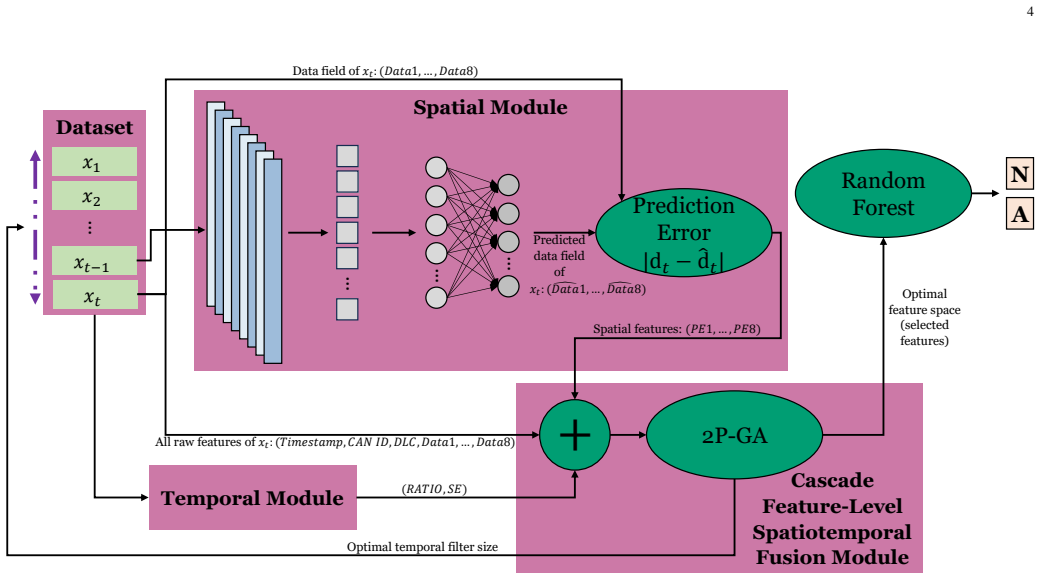
The central object is the cascade feature-level fusion pipeline. It concatenates three feature groups: raw CAN fields (timestamp, ID, DLC, eight data bytes); spatial features, defined as the eight absolute differences between the actual data bytes and the values predicted by a 1D-CNN trained on attack-free traffic; and temporal features SE (Shannon entropy share per CAN ID) and RATIO (the proportion of each CAN ID in a time window). A two-parameter genetic algorithm (2P-GA) simultaneously chooses the temporal window filter size and a binary mask over the feature space, using a decision tree's validation F1-score minus a feature-count penalty as fitness. The selected features then feed a random forest classifier. The mechanism that carries the argument is the complementarity: spatial features cut false positives, temporal features cut false negatives, and the GA picks the combination that maximizes F1.
What would settle it
Run the same pipeline but compute SE and RATIO only from messages inside each partition, or replace the random split with a contiguous chronological split, then re-measure accuracy and AUC-ROC; if the scores drop materially, the reported near-perfect results depended on the leakage.
Extended reading notes
Core claim
The paper claims that a cascade feature-level fusion framework that combines two families of hand-crafted features with raw CAN message fields detects every attack instance in the CAR-HACKING dataset, reaching 100% accuracy on all four attack types, and an overall AUC-ROC of 0.9987 on the first dataset. The authors attribute the gain to complementarity: the spatial module, a 1D-CNN trained on attack-free traffic that predicts the current message from the previous one and feeds the eight absolute prediction errors as features, raises precision by roughly 4%, while the temporal module, which adds Shannon entropy and a RATIO feature computed over a sliding window, restores the recall that spatial features alone lose. A two-parameter genetic algorithm selects the window filter size and the feature subset simultaneously, and a random forest makes the final classification.
Load-bearing premise
The evaluation assumes that a random 70/15/15 split of individual messages keeps training, validation, and test sets independent, although the temporal features are computed over sliding windows whose filter size the paper reports as 9332 messages, so windows crossing the split could leak test information into training or validation features.
Editorial extensions
If this is right
- If the reported results transfer to real vehicles, a CAN intrusion detector could run with a small 1D-CNN and a random forest on modest hardware, unlike heavier LSTM or transformer baselines.
- The spatial module can be pretrained once on normal traffic and reused across vehicles, since the temporal features depend only on message IDs and intervals.
- The GA-selected feature subset (12 of 18 features) indicates that most raw data bytes and two spatial prediction errors are redundant for this dataset, potentially reducing on-wire logging requirements.
- The 5x2cv paired t-test result (t=22.83, p=1.17e-6) is presented as evidence that the fusion gains over raw-feature random forest are not due to chance.
Reading between the lines
- If the time-window independence concern is real, the same framework might perform differently when temporal features are computed separately within each partition; the paper does not test this, so a direct re-run would clarify.
- The cascade structure is transportable to other broadcast in-vehicle protocols such as LIN or FlexRay, which share the same temporal periodicity and data-field manipulation attack patterns, though the paper does not test this.
- The 2P-GA's fitness penalty on feature count suggests the framework could trade a small accuracy loss for a much smaller feature set, which matters for memory-constrained ECUs; the paper reports only the optimal configuration.
- Because the spatial module is trained only on attack-free data, the framework may adapt to new vehicle models by retraining that module alone, while keeping the temporal features unchanged; this is an implication the authors only hint at.
Signed reviews
Editorial analysis
A structured set of objections, weighed in public.
Referee Report
Summary. This paper proposes a cascade feature-level spatiotemporal fusion framework for CAN bus anomaly detection. The framework combines spatial features from a 1D-CNN prediction-error model with temporal features (Shannon entropy and RATIO) from a sliding window, and uses a two-parameter genetic algorithm (2P-GA) to simultaneously select the temporal filter size and a subset of features. The final classifier is a random forest. Evaluations on two CAN datasets claim an AUC-ROC of 0.9987 and 100% accuracy across all attack types on the CAR-HACKING dataset, and a paired t-test is used to claim statistical significance over a raw-feature baseline.
Significance. If the reported results are valid, the proposed approach would be a strong result for CAN bus intrusion detection, with near-perfect detection across attack types and a clear ablation demonstrating the contributions of the spatial and temporal modules. The paper also provides useful comparisons among spatial prediction models (Table IV) and feature-engineering baselines (Table VII), and ships a detailed algorithm for simultaneous filter-size and feature selection. However, the central evaluation is threatened by a potential data leakage in the temporal features, and the statistical reporting is incomplete. Until the leakage is ruled out or fixed, the quantitative claims (0.9952 accuracy, 0.9987 AUC-ROC, 100% per-attack accuracy) cannot be taken at face value.
major comments (3)
- [IV-B and III-B] The random message-level 70/15/15 split is not compatible with the way temporal features are computed. SE and RATIO are extracted using a sliding window of 9332 messages (Table V), yet the paper never states that these features are computed separately within each partition. Under a random split, the window for a training message will in general include validation and test messages, and vice versa. Since attacks appear as bursts with abrupt changes in CAN-ID distribution and timing, this leaks label information across partitions and can inflate all reported metrics, including the 100% accuracy in Table IX and the AUC-ROC in Table VII. The authors must either compute temporal features strictly within each partition, or use an ordered split (e.g., train on an earlier time segment, test on a later one). Without this clarification or fix, the central claim is not evaluable.
- [IV-D] The 5x2cv paired t-test is reported with t=22.83 and p=1.17e-6, but the manuscript does not state which performance metric was used in the paired comparison (accuracy, F1-score, AUC-ROC, or another). The description 'alternating between training and testing' also does not match Dietterich's 5x2cv protocol, which uses five repetitions of two-fold cross-validation. Moreover, the same temporal-feature leakage applies to these random folds, so the t-test does not provide the claimed statistical robustness. The authors should specify the metric, the null hypothesis, and the exact procedure, and re-run the test under a leakage-free temporal split.
- [Tables VI-IX] No measure of variance (standard deviation, confidence interval, or number of repeated runs) is reported for any metric, and the '100% accuracy' figures appear to be from a single run. Given the leakage concern, the absence of error bars or repeated-run statistics is particularly problematic. The authors should report mean and variance over multiple independent runs (or, if using 5x2cv, the per-fold scores), and ensure that the temporal features are split correctly in each run.
minor comments (7)
- [Abstract and IV-G] The metric is called 'AUC-ROC' in the abstract and 'ROC-AUC' in the discussion; please use consistent terminology throughout.
- [III-B] The temporal features SE and RATIO are described as introduced in the authors' prior work [9]; this paper should clearly state that the temporal module does not introduce new features, and instead focuses on the cascade fusion and simultaneous optimization.
- [IV-B] The description of the split says the datasets are divided into training (70%), validation (15%), and test (15%) sets before normalizing all features; it is unclear whether the normalization statistics are computed on the training set only, and if not, scale leakage may also occur.
- [IV-D] The sentence 'It performs five rounds of two-fold cross-validation, where in each round the dataset is split in half, alternating between training and testing' is an inaccurate description of the 5x2cv protocol; please replace it with a correct definition or a more precise citation.
- [Figure 1] The y-axis label 'Time Interval (ms)' appears inconsistent with the values shown (approximately 0.4 for normal messages); please verify the units.
- [Table VI] The inference time for 'Spatial Fusion RF' (0.05938) is substantially higher than for 'Raw RF' (0.01365) and 'Temporal Fusion RF' (0.01481), but the paper does not discuss this overhead when claiming a low computational footprint.
- [Section II] The claim that 'all studies conducted in this area of research lack statistical testing' is too strong given the many works summarized in Table II; please soften or qualify this statement.
Circularity Check
No significant circularity: the reported results are empirical evaluations against external benchmarks, not derivations from the paper's own definitions or fitted quantities.
full rationale
The paper's central claims are empirical: the cascade fusion framework is evaluated on the CAR-HACKING datasets and compared with external baselines. None of the reported metrics are defined as outputs of the fitting procedure. The 2P-GA selects a filter size and feature subset by maximizing F1 on a validation set, but the final reported accuracy, precision, recall, F1, and AUC-ROC are computed on a test set, so they are not the GA's fitness values renamed as predictions. The temporal features SE and RATIO are taken from the authors' prior work [9], but the formula for SE is given explicitly in Eq. (1), and the features are used as inputs to an independently trained classifier; this is a provenance citation, not a load-bearing self-citation that forces the result. The 5x2cv paired t-test compares the proposed model against a raw-feature RF on held-out folds, and the comparison metrics are external. There is a potential concern that sliding-window temporal features may leak information across the random 70/15/15 split, but this is a data-processing validity issue, not a circular derivation: the reported numbers are not equal to the model's inputs by construction. Since no claimed prediction is identical to a fitted parameter, no defined quantity is defined in terms of the target result, and no argument reduces to an unverified self-citation, the derivation chain is self-contained with respect to circularity.
Assumptions & free parameters
free parameters (5)
- Temporal filter size (window length) for SE/RATIO features =
9332
- Selected feature subset =
Timestamp, CAN ID, Data3-Data8, SE, RATIO, PE4, PE6 (12 features)
- Genetic algorithm hyperparameters =
population=25, crossover=0.9, mutation=0.1, generations=5
- Fitness penalty coefficient =
0.001
- Spatial prediction model architecture =
1D-CNN with 64 units, ReLU, dense layer with 8 outputs
assumptions (4)
- domain assumption A CAN message x_t can be predicted from the immediately previous message x_{t-1}, and the prediction error is a useful spatial attack signal.
- domain assumption Shannon entropy and RATIO statistics over a time window capture temporally dominant attacks.
- domain assumption Random split of messages into train/validation/test preserves independence for sliding-window temporal features.
- domain assumption Feature subsets selected by 2P-GA on the validation set generalize to the test set.
Cite this review
Pith. "Pith review of An Optimal Cascade Feature-Level Spatiotemporal Fusion Strategy for Anomaly Detection in CAN Bus." pith.science (2026). https://pith.science/paper/XXHAHWJU
@misc{pith2026250118821,
  author       = {Pith},
  title        = {Pith review of: An Optimal Cascade Feature-Level Spatiotemporal Fusion Strategy for Anomaly Detection in CAN Bus},
  year         = {2026},
  howpublished = {\url{https://pith.science/paper/XXHAHWJU}},
  note         = {Machine review of arXiv:2501.18821}
}
read the original abstract
Intelligent transportation systems (ITS) play a pivotal role in modern infrastructure but face security risks due to the broadcast-based nature of the in-vehicle Controller Area Network (CAN) buses. While numerous machine learning models and strategies have been proposed to detect CAN anomalies, existing approaches lack robustness evaluations and fail to comprehensively detect attacks due to shifting their focus on a subset of dominant structures of anomalies. To overcome these limitations, the current study proposes a cascade feature-level spatiotemporal fusion framework that integrates the spatial features and temporal features through a two-parameter genetic algorithm (2P-GA)-optimized cascade architecture to cover all dominant structures of anomalies. Extensive paired t-test analysis confirms that the model achieves an AUC-ROC of 0.9987, demonstrating robust anomaly detection capabilities. The Spatial Module improves the precision by approximately 4%, while the Temporal Module compensates for recall losses, ensuring high true positive rates. The proposed framework detects all attack types with 100% accuracy on the CAR-HACKING dataset, outperforming state-of-the-art methods. This study provides a validated, robust solution for real-world CAN security challenges.
Figures

Reference graph
Works this paper leans on
-
[1]
Federated learning-based misbehavior detection for the 5G-enabled internet of vehicles,
P. Rani, C. Sharma, J. V . N. Ramesh, S. Verma, R. Sharma, A. Alkhayyat, and S. Kumar, “Federated learning-based misbehavior detection for the 5G-enabled internet of vehicles,” IEEE Transactions on Consumer Electronics , vol. 70, no. 2, pp. 4656–4664, May 2024. [Online]. Available: https://doi.org/10.1109/TCE.2023.3328020
-
[2]
CANival: A multimodal approach to intrusion detection on the vehicle CAN bus,
H. Kang, T. V o, H. K. Kim, and J. B. Hong, “CANival: A multimodal approach to intrusion detection on the vehicle CAN bus,” Vehicular Communications, vol. 50, p. 100845, December 2024. [Online]. Available: https://doi.org/10.1016/j.vehcom.2024.100845
-
[3]
NovelADS: A novel anomaly detection system for intra-vehicular networks,
K. Agrawal, T. Alladi, A. Agrawal, V . Chamola, and A. Benslimane, “NovelADS: A novel anomaly detection system for intra-vehicular networks,” IEEE Transactions on Intelligent Transportation Systems , vol. 23, no. 11, pp. 22 596–22 606, November 2022. [Online]. Available: https://doi.org/10.1109/TITS.2022.3146024
-
[4]
Car hacking and defense competition on in-vehicle network,
H. Kang, B. I. Kwak, Y . H. Lee, H. Lee, H. Lee, and H. K. Kim, “Car hacking and defense competition on in-vehicle network,” in Workshop on Automotive and Autonomous Vehicle Security (AutoSec) , February 2021, pp. 1–6. [Online]. Available: https://dx.doi.org/10.14722/autosec.2021.23035
-
[5]
In-vehicle network intrusion detection using deep convolutional neural network,
H. M. Song, J. Woo, and H. K. Kim, “In-vehicle network intrusion detection using deep convolutional neural network,” Vehicular Communications, vol. 21, p. 100198, January 2020. [Online]. Available: https://doi.org/10.1016/j.vehcom.2019.100198
-
[6]
E. Alalwany and I. Mahgoub, “Classification of normal and malicious traffic based on an ensemble of machine learning for a vehicle CAN-network,” Sensors, vol. 22, no. 23, pp. 1–15, November 2022. [Online]. Available: https://doi.org/10.3390/s22239195
-
[7]
V ANET network traffic anomaly detection using GRU-based deep learning model,
G. ALMahadin, Y . Aoudni, M. Shabaz, A. V . Agrawal, G. Yasmin, E. S. Alomari, H. M. R. Al-Khafaji, D. Dansana, and R. R. Maaliw, “V ANET network traffic anomaly detection using GRU-based deep learning model,” IEEE Transactions on Consumer Electronics , vol. 70, no. 1, pp. 4548–4555, February 2024. [Online]. Available: https://doi.org/10.1109/TCE.2023.3326384
-
[8]
Machine learning based intrusion detection systems for connected autonomous vehicles: A survey,
J. Nagarajan, P. Mansourian, M. A. Shahid, A. Jaekel, I. Saini, N. Zhang, and M. Kneppers, “Machine learning based intrusion detection systems for connected autonomous vehicles: A survey,” Peer-to-Peer Networking and Applications , vol. 16, no. 5, pp. 2153–2185, September 2023. [Online]. Available: https://doi.org/10.1007/s12083-023-01508-7 8
Show all 35 references
-
[9]
Entropy- based genetic feature engineering and multi-classifier fusion for anomaly detection in vehicle controller area networks,
M. Fatahi, D. Sadrian Zadeh, B. Moshiri, and O. Basir, “Entropy- based genetic feature engineering and multi-classifier fusion for anomaly detection in vehicle controller area networks,” Future Generation Computer Systems , p. 107779, 2025. [Online]. Available: https://doi.org...
2025
-
[10]
Novel deep learning-enabled LSTM autoencoder architecture for discovering anomalous events from intelligent transportation systems,
J. Ashraf, A. D. Bakhshi, N. Moustafa, H. Khurshid, A. Javed, and A. Beheshti, “Novel deep learning-enabled LSTM autoencoder architecture for discovering anomalous events from intelligent transportation systems,” IEEE Transactions on Intelligent Transportation Systems, vol. 22...
2021
-
[11]
Self-supervised anomaly detection for in- vehicle network using noised pseudo normal data,
H. M. Song and H. K. Kim, “Self-supervised anomaly detection for in- vehicle network using noised pseudo normal data,” IEEE Transactions on Vehicular Technology , vol. 70, no. 2, pp. 1098–1108, February
-
[12]
A federated learning framework for cyberattack detection in vehicular sensor networks,
M. Driss, I. Almomani, Z. e Huma, and J. Ahmad, “A federated learning framework for cyberattack detection in vehicular sensor networks,” Complex & Intelligent Systems , vol. 8, no. 5, pp. 4221–4235, October
-
[13]
MGA-IDS: Optimal feature subset selection for anomaly detection framework on in-vehicle networks- CAN bus based on genetic algorithm and intrusion detection approach,
D. Aksu and M. A. Aydin, “MGA-IDS: Optimal feature subset selection for anomaly detection framework on in-vehicle networks- CAN bus based on genetic algorithm and intrusion detection approach,” Computers & Security , vol. 118, p. 102717, July 2022. [Online]. Available: https:/...
2022
-
[14]
A novel intrusion detection model for the can bus packet of in-vehicle network based on attention mechanism and autoencoder,
P. Wei, B. Wang, X. Dai, L. Li, and F. He, “A novel intrusion detection model for the can bus packet of in-vehicle network based on attention mechanism and autoencoder,” Digital Communications and Networks, vol. 9, no. 1, pp. 14–21, February 2023. [Online]. Available: https://...
2023 doi
-
[15]
OTIDS: A novel intrusion detection system for in-vehicle network by using remote frame,
H. Lee, S. H. Jeong, and H. K. Kim, “OTIDS: A novel intrusion detection system for in-vehicle network by using remote frame,” in 2017 15th Annual Conference on Privacy, Security and Trust (PST) . Calgary, AB, Canada: IEEE, August 2017, pp. 57–5709. [Online]. Available: https:/...
2017
-
[16]
Deep learning-based anomaly detection for connected autonomous vehicles using spatiotemporal information,
P. Mansourian, N. Zhang, A. Jaekel, and M. Kneppers, “Deep learning-based anomaly detection for connected autonomous vehicles using spatiotemporal information,” IEEE Transactions on Intelligent Transportation Systems, vol. 24, no. 12, pp. 16 006–16 017, December
-
[17]
A lightweight intrusion detection model for in-vehicular CAN networks,
D. S. Divya Raj, G. Renjith, and S. Aji, “A lightweight intrusion detection model for in-vehicular CAN networks,” in Proceedings of Third International Conference on Sustainable Expert Systems , ser. Lecture Notes in Networks and Systems, S. Shakya, V . E. Balas, and W. Haoxia...
2023 doi
-
[18]
Multi-order feature interaction-aware intrusion detection scheme for ensuring cyber security of intelligent connected vehicles,
W. Gong, S. Yang, H. Guang, B. Ma, B. Zheng, Y . Shi, B. Li, and Y . Cao, “Multi-order feature interaction-aware intrusion detection scheme for ensuring cyber security of intelligent connected vehicles,” Engineering Applications of Artificial Intelligence , vol. 135, p. 108815...
2024
-
[19]
Sustainable and lightweight domain-based intrusion detection system for in-vehicle network,
E. Kristianto, P.-C. Lin, and R.-H. Hwang, “Sustainable and lightweight domain-based intrusion detection system for in-vehicle network,” Sustainable Computing: Informatics and Systems , vol. 41, p. 100936, January 2024. [Online]. Available: https://doi.org/10.1016/j.suscom. 20...
2024
-
[20]
SMOTE: Synthetic minority over-sampling technique,
N. V . Chawla, K. W. Bowyer, L. O. Hall, and W. P. Kegelmeyer, “SMOTE: Synthetic minority over-sampling technique,” Journal of Artificial Intelligence Research , vol. 16, pp. 321–357, June 2002. [Online]. Available: https://doi.org/10.1613/jair.953
2002 doi
-
[21]
Deep residual learning for image recognition,
K. He, X. Zhang, S. Ren, and J. Sun, “Deep residual learning for image recognition,” arXiv preprint, December 2015, Published at 2016 IEEE Conference on Computer Vision and Pattern Recognition (CVPR 2016). [Online]. Available: https://arxiv.org/abs/1512.03385v1
2015 arXiv
-
[22]
Forecasting vegetation behavior based on PlanetScope time series data using RNN-based models,
A. Marseti ˇc and U. Kanjir, “Forecasting vegetation behavior based on PlanetScope time series data using RNN-based models,” IEEE Journal of Selected Topics in Applied Earth Observations and Remote Sensing, vol. 17, pp. 5015–5025, February 2024. [Online]. Available: https://do...
2024
-
[23]
Long short-term memory,
S. Hochreiter and J. Schmidhuber, “Long short-term memory,” Neural Computation, vol. 9, no. 8, pp. 1735–1780, November 1997. [Online]. Available: https://doi.org/10.1162/neco.1997.9.8.1735
1997 doi
-
[24]
Gate-variants of gated recurrent unit (GRU) neural networks,
R. Dey and F. M. Salem, “Gate-variants of gated recurrent unit (GRU) neural networks,” in 2017 IEEE 60th International Midwest Symposium on Circuits and Systems (MWSCAS) . Boston, MA, USA: IEEE, August 2017, pp. 1597–1600. [Online]. Available: https://doi.org/10.1109/MWSCAS.20...
2017
-
[25]
xLSTM: Extended long short-term memory,
M. Beck, K. P ¨oppel, M. Spanring, A. Auer, O. Prudnikova, M. Kopp, G. Klambauer, J. Brandstetter, and S. Hochreiter, “xLSTM: Extended long short-term memory,” arXiv preprint, May 2024. [Online]. Available: https://arxiv.org/abs/2405.04517v2
2024 arXiv
-
[26]
A novel model for student’s mental health monitoring based on hard and soft data fusion,
M. Fatahi, M. Alizadeh, and B. Moshiri, “A novel model for student’s mental health monitoring based on hard and soft data fusion,” in 2023 31st International Conference on Electrical Engineering (ICEE) . Tehran, Iran, Islamic Republic of: IEEE, May 2023, pp. 723–728. [Online]....
2023
-
[27]
1D-CNN-IDS: 1D CNN-based intrusion detection system for IIoT,
M. Arsalan, M. Mubeen, M. Bilal, and S. F. Abbasi, “1D-CNN-IDS: 1D CNN-based intrusion detection system for IIoT,” in 2024 29th International Conference on Automation and Computing (ICAC) . Sunderland, United Kingdom: IEEE, August 2024, pp. 1–4. [Online]. Available: https://do...
2024
-
[28]
Liggins II, D
M. Liggins II, D. Hall, and J. Llinas, Handbook of Multisensor Data Fusion: Theory and Practice , 2nd ed. Boca Raton, FL, USA: CRC Press, 2009. [Online]. Available: https://doi.org/10.1201/9781420053098
2009 doi
-
[29]
Cascaded feature fusion with multi-level self-attention mechanism for object detection,
C. Wang and H. Wang, “Cascaded feature fusion with multi-level self-attention mechanism for object detection,” Pattern Recognition , vol. 138, p. 109377, June 2023. [Online]. Available: https://doi.org/10. 1016/j.patcog.2023.109377
2023
-
[30]
HCRL website,
“HCRL website,” https://ocslab.hksecurity.net/welcome, accessed: 2024- 12-09
2024
-
[31]
Approximate statistical tests for comparing supervised classification learning algorithms,
T. G. Dietterich, “Approximate statistical tests for comparing supervised classification learning algorithms,” Neural Computation , vol. 10, no. 7, pp. 1895–1923, October 1998. [Online]. Available: https://doi.org/10.1162/089976698300017197
1923 doi
-
[32]
KAN: Kolmogorov-Arnold Networks,
Z. Liu, Y . Wang, S. Vaidya, F. Ruehle, J. Halverson, M. Solja ˇci´c, T. Y . Hou, and M. Tegmark, “KAN: Kolmogorov-Arnold Networks,” arXiv preprint, April 2024. [Online]. Available: https://arxiv.org/abs/ 2404.19756v4 Mohammad Fatahi received his M.Sc. degree in Control Engine...
2024 arXiv
-
[2021]
Available: https://doi.org/10.1109/TVT.2021.3051026
[Online]. Available: https://doi.org/10.1109/TVT.2021.3051026
2021
-
[2022]
Available: https://doi.org/10.1007/s40747-022-00705-w
[Online]. Available: https://doi.org/10.1007/s40747-022-00705-w
-
[2023]
Available: https://doi.org/10.1109/TITS.2023.3286611
[Online]. Available: https://doi.org/10.1109/TITS.2023.3286611
2023
Reviewed August 9, 2026 · model on record in the stance chip above.
Discussion (0). Continue with ORCID to comment.