REVIEW 4 major objections 5 minor 34 references
Topological flowscape reveals state transitions in nonreciprocal living matter
T0 review · 4 major / 5 minor · reviewed 2026-08-03 · deepseek-v4-flash
Pith's one-line read Weak nonreciprocity orders embryo mixtures into crystals; strong asymmetry fragments them.
desk verdict Topological landscape/flowscape is a genuinely new analysis tool and the experimental transition is credible, but the 'weak nonreciprocity promotes order' result rests on a simulation with hand-set transverse scaling and no noise, so treat the state diagram as tentative. read the letter →
The pith
A machine-rendered reading of the paper's core claim, the machinery that carries it, and where it could break.
The reading
What carries the argument
The load-bearing object is a one-parameter family of pairwise force models built from experimentally inferred interactions: the E1–E2 longitudinal force is split into symmetric and antisymmetric parts and the antisymmetric part is scaled by N. The diagnostics are topological: d_hex counts local T1 bond-flips needed to reach a perfect hexagonal motif; topological landscapes embed roughly 15,000 motifs on a manifold by pairwise T1 distance and plot motif frequencies as height; topological flowscapes track a system state by its KL divergences from M1-like and M2-like reference distributions.
What would settle it
Run the same mixture with independently varied age gaps (for example 12, 36, and 60 hours post-fertilization): if the d_hex minimum does not occur at an intermediate gap, or if the traveling-to-fluctuating transition time does not track the time-segmented inferred N, the central claim fails. In simulation, repeating the state diagram with transverse interactions at 100% instead of 10% of the inferred values is a direct check; losing the N=0.5 order dip would show that the peak is an artifact of that rescaling.
Extended reading notes
Core claim
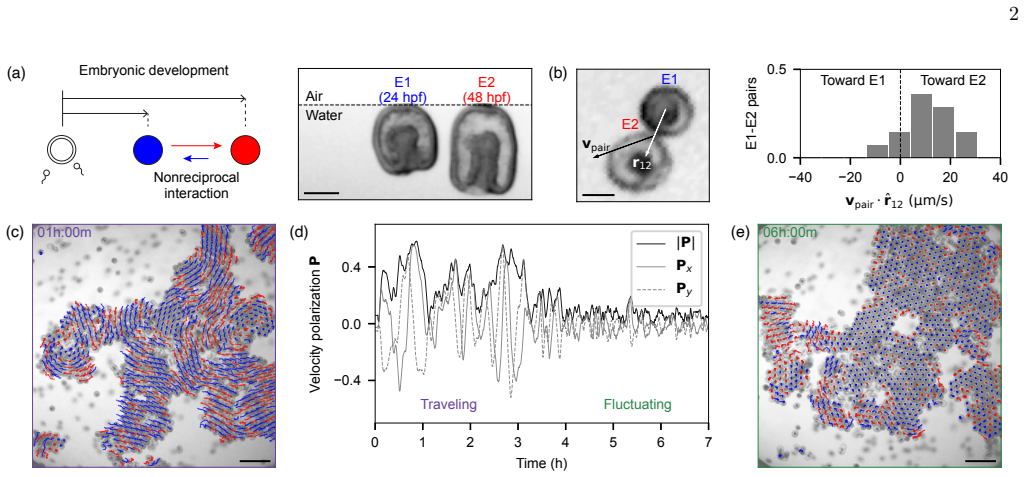
The central claim is that nonreciprocity N, defined by the antisymmetric part of the inferred E1–E2 longitudinal interaction, organizes a state diagram: at N=0 a clockwise crystalline state; for 0<N<1 a self-propelled crystalline state that is more ordered than the reciprocal crystal ('nonreciprocal self-healing'); at the experimentally inferred N=1 a flocking state with merging and fragmenting clusters; and for N>1 a fragmented state. The structural order parameter d_hex — the average number of T1 topological transitions needed to turn each local neighborhood into a perfect hexagon — falls to a minimum near N=0.5 and jumps sharply at N=1. The experimental transition from a traveling to a fl
Load-bearing premise
The quantitative state diagram rests on the simulation assumption that the sideways (transverse) forces between embryos are only 10% of their measured strength and that a weak central trap stands in for the curved air-water surface; if that sideways scaling is inaccurate, the predicted order peak and fragmentation boundary could shift.
Editorial extensions
If this is right
- If N is the control parameter, tuning developmental age differences or any pairwise asymmetry should move a real active mixture continuously through the four states, with peak crystalline order at intermediate N.
- The pair of order parameters — velocity polarization for dynamics and d_hex for structure — distinguishes states that look identical in velocity alone, such as self-propelled crystals versus fragmented clusters.
- The first-order-like coexistence of M1 and M2 motifs near N=1 predicts that the traveling-to-fluctuating transition is an indirect, mediated structural transition rather than a single sharp bond flip.
- The topological flowscape yields a rate shift coinciding with the independently measured polarization transition, so structural information alone can locate a macroscopic state transition.
- Topological motif frequencies and the topological earth-mover distance generalize the structural order parameter to defect-rich and anisotropic arrangements beyond simple crystals.
Reading between the lines
- A testable extension: the 'nonreciprocal self-healing' mechanism suggests that controlled asymmetry could anneal defects that equilibrium crystallization cannot remove, which could be probed in colloidal or active-metamaterial experiments by slowly cycling N.
- Because the inferred N decreases during development, the same framework could serve as a structural developmental clock, reading embryo age from the trajectory of motif distributions rather than from cell labels.
- The experimental transition passes through a hollow-crystal state that the fixed-N simulations do not produce, implying an additional mechanistic ingredient—possibly interface adhesion or cluster-scale elasticity—that a next-generation model would need to include.
- The flowscape is defined for any time series of probability distributions, so in principle it could be applied to neural population activity, tissue morphogenesis, or other high-dimensional evolving states without modification.
Signed reviews
Editorial analysis
A structured set of objections, weighed in public.
Referee Report
Summary. The paper studies starfish-embryo mixtures with two developmental stages (E1, E2) that interact nonreciprocally through fluid-mediated forces. It infers pairwise longitudinal and transverse interactions from experimental trajectories, then builds an overdamped inference-based model in which the longitudinal inter-type nonreciprocity is tuned by a parameter N (with N=0 reciprocal and N=1 the experimentally inferred value). Simulations with varying N produce four states—crystalline, self-propelled crystalline, flocking, and fragmented—summarized in a state diagram (Fig. 2d). The authors introduce a topological metric (distance to hexagonal packing in a T1-motif graph), a topological landscape (kernel-density representation of motif frequencies on a low-dimensional manifold), and a topological flowscape (KL-divergence-based trajectory of time-evolving landscapes). The experimental trajectory is interpreted as a transition from an N≈1 flocking-like state to an N≈0 crystalline state, and the flowscape, entropy-production estimates, and information-rate measures all show a rate shift around 3 h that coincides with the independently measured traveling-to-fluctuating transition.
Significance. If the central claims hold, the paper offers a broadly applicable framework for quantifying nonequilibrium structural transitions in active and living matter, connecting interaction asymmetry to topology and to information-theoretic rate signatures. The combination of quantitative imaging, Bayesian interaction inference, and topological packing statistics is ambitious, and the falsifiable state diagram is a useful organizing hypothesis. The topological landscape/flowscape construction is conceptually novel and could be applied to other soft-matter systems. However, the quantitative conclusions depend on a simulation model whose hand-set ingredients are not stress-tested, and the experimental inference of decreasing nonreciprocity lacks uncertainty quantification. These gaps currently prevent the paper from fully supporting its strongest claims about nonreciprocal self-healing and the precise model–experiment mapping.
major comments (4)
- [SI III.A, Eq. (SI 14); Fig. 2c,d] The central simulation results—the ⟨dhex⟩ minimum near N=0.5 (nonreciprocal self-healing) and the sharp destabilization at N=1—are produced with three hand-set modeling choices: transverse interactions reduced to 10% of inferred values, a central potential fr=2e-4, and zero noise. The inference in Eq. (SI 2) explicitly includes a fitted noise amplitude Δ, and the transverse forces are part of the experimentally inferred interaction set; dropping/scaling these terms by fiat may change the effective dynamics qualitatively. The paper gives no sensitivity analysis. I ask the authors to quantify how the ⟨dhex⟩ curve and the N=1 fragmentation transition depend on (i) the transverse scaling factor (e.g., 0, 0.1, 0.5, 1 times the inferred f_T), (ii) adding noise at the inferred Δ, and (iii) varying fr. Without this, the claim that weak nonreciprocity promotes order is a model prediction resting
- [SI II.B, Fig. S10] The time-segmented inference of N(t) is presented with no error bars or confidence intervals, and the text states the decrease is 'approximately 30%' while Fig. S10 appears to show a decrease from about 1.2 to 0.9 (about 25%). This inferred N(t) is also computed from the same trajectory data that produce the experimental topological landscapes and flowscape, so the model–experiment correspondence is partly a fit to the same data. The authors should provide bootstrap or posterior-uncertainty estimates for N(t), test whether the decrease is statistically significant, and state explicitly whether the N=1→N≈0.9 range is actually sufficient to cross any of the model's distinct states. This matters because the main-text narrative assigns the observed transition to a decrease in nonreciprocity.
- [SI VI.C–D; Fig. S21–S22] The paper candidly states in SI VI.D that the experimental flowscape path deviates from the fixed-N model path, and that the experimental transition state is a 'hollow crystal' not present in any fixed-N steady state. This is a limitation statement in the manuscript itself and it directly qualifies the central quantitative mapping. If the experimental transition cannot be reproduced by any fixed-N model, then the claim that the traveling-to-fluctuating transition is 'captured' by the topological flowscape as a nonreciprocity-driven transition is weakened. The authors should either (a) extend the model to include candidate higher-order mechanisms (e.g., time-dependent interaction changes, density changes, embryo aging, boundary/interface effects) and show which mechanism produces the hollow-crystal states, or (b) explicitly reframe the conclusions so that the flowscape is a phenomenologic
- [Fig. 4e,f; SI VII.A] The sharp rate shift in the flowscape diagonal displacement and the independently estimated entropy-production rate is a key supporting observation, but no error bars or significance tests are provided for either quantity. The EPR estimate in Eq. (25) depends on the choice of time gap τ (set to 20 s) and on the motif transition statistics; the statistical distance and activity shown in Fig. S26 appear smooth, but the resulting rate-shift time is not quantified with confidence intervals. The authors should report bootstrap or block-resampling uncertainties for the rate-shift time, and ideally for the EPR curve, so that the claimed coincidence with the traveling-to-fluctuating transition can be assessed as more than a visual similarity.
minor comments (5)
- [Abstract] The abstract says 'Experiments, interaction inference, and topological analysis yield a nonreciprocal state diagram,' but the state diagram in Fig. 2d is generated from the inference-based simulation, not from the experiments directly. Please rephrase to avoid giving the impression that the experimental data alone determine the phase boundaries.
- [SI III.A] The statement 'We also neglect noise, based on the assumption that self-generated flows captured by pairwise interactions dominate the embryo dynamics' is an assumption that should be tested rather than asserted. At minimum, the authors should report the inferred noise amplitude Δ from Eq. (SI 2) and discuss its magnitude relative to the inferred forces, since the stress-test sensitivity analysis requested above depends on this comparison.
- [SI IV.B, Table I] The motif occurrence cutoff (>10 occurrences) captures 99.7% of probability for N=0.5 but only 50% for N=2.0 and 65% for N=1.5. The claim that the cutoff 'adequately captures the diversity' of the higher-nonreciprocity states should be supported by a convergence check (e.g., recomputing ⟨dhex⟩ with a lower cutoff or with the full motif set), because the high-N behavior is precisely where the paper draws its fragmentation conclusions.
- [Main text, Fig. 4c; SI VI.B] The flowscape coordinates use KL divergences to Gaussian reference distributions whose width σM is matched to the experimental kernel width. The sensitivity of the resulting trajectory to σM is not shown. A small figure or statement showing the trajectory over a plausible range of σ would help establish that the observed rate shift is not an artifact of the chosen reference width.
- [SI VII.A, Eq. (24)] The notation ΣHS is introduced as 'net Hatano-Sasa entropy production' and later used as a per-interval quantity; please define the units and the integration bounds explicitly. Also, the statement that this is a 'well-known speed limit' is fine, but the reader must know that the estimate is a lower bound, not a direct measurement of total EPR.
Circularity Check
N(t) 'confirmation' is partly a normalization artifact (N=1 is the all-time mean, crossed near the temporal midpoint of the transition), and the state diagram rests on a self-cited 10% transverse-force ansatz; the N=0.5 self-healing and N>1 fragmentation remain genuinely un-fitted predictions.
-
self definitional
[SI II.B (Fig. S10) and main text, 'Bayesian inference confirms...' paragraph]
"we identify nonreciprocity N (t) by fitting ( f_12^L −f_21^L )_t = N (t) × (f_12^L −f_21^L )_{all time}. Over the course of experiment, inferred nonreciprocity decreases from N = 1.2 to N = 0.9. ... Bayesian inference confirms that pairwise nonreciprocity between embryos decreases by approximately 30% during the course of the experiment, supporting a striking correspondence between time-driven transitions in the experiment and those induced by varying nonreciprocity in the theoretical model."
N(t) is defined by normalizing the time-segmented antisymmetric longitudinal force by the all-time value, and that all-time value is itself the N=1 anchor of the model. Because the inferred N(t) decreases monotonically from 1.2 to 0.9, the fitted curve crosses 1 near the temporal midpoint of the 6.5 h observation window; the traveling-to-fluctuating transition is independently identified at ~3 h, i.e., the same midpoint. The claim that the experiment transitions 'as N crosses the model's critical value N=1' is therefore partly a consequence of the normalization: a monotone quantity reaches its own mean near its midpoint, so the crossing time is pinned by construction. The non-circular residue is only that the simulated structural jump also occurs near N≈1, which the experimental N range 0.
-
ansatz smuggled in via citation
[SI III.A (inference-based model; Eq. SI 14)]
"We also neglect noise, based on the assumption that self-generated flows captured by pairwise interactions dominate the embryo dynamics. ... we reduce the strength of transverse interactions f_T to 10% of the inferred values, reflecting the size-dependent slow down of cluster rotations reported in [5]. ... To mimic the curved air-water interface of the experimental system, as reported in [5], we introduce a weak central potential term, modeled by fr = 2 × 10⁻⁴."
The structural predictions — the ⟨dhex⟩ minimum at N=0.5 (nonreciprocal self-healing) and the sharp jump at N=1 — are computed from simulations in which the transverse forces are scaled to 10% of the inferred values and noise is dropped. The 10% factor is justified only by a citation to [5] (Tan et al., Nature 2022), the present authors' prior work, which reports a qualitative size-dependent slowdown of cluster rotations, not a 10% factor; the quantitative factor is an ansatz. The flocking at N=1, the |P| peak, and the self-healing are therefore conditioned on a hand-set, self-cited modeling premise, and the paper nowhere shows the state diagram with the full inferred transverse terms or with the fitted noise. This is load-bearing for the state-diagram claims, although it is a modeling inp
full rationale
The derivation chain is: (i) measure run-and-chase pair dynamics and the traveling-to-fluctuating transition; (ii) infer pairwise forces (SI II) from the same many-body trajectories; (iii) integrate Eq. (SI 14) forward with the antisymmetric longitudinal part scaled by N and three hand-set ingredients (10% transverse forces, weak trap fr=2e-4, zero noise); (iv) analyze outputs with the topological metric/landscape/flowscape; (v) compare to the experiment. The state diagram (Fig. 2d) is a forward simulation output, not an input; the ⟨dhex⟩ minimum at N=0.5 and the N>1 fragmentation are un-fitted predictions with no experimental anchor (time-segmented N(t) only reaches 0.9), so the central 'weak nonreciprocity promotes order' claim is not a fit. The paper also states deviations honestly: SI VI.D says the experimental transition states 'do not correspond to a steady state in model simulations under fixed N,' and the main text notes the experimental path deviates from the model; these count against circularity. Two partial loops remain: (i) N(t) is fitted from the same data and normalized to the all-time fit (N=1), so the 'confirmation' that the transition happens as N crosses 1 is partly the normalization-derived statement that the transition happens when N equals its own time average, near the temporal midpoint; (ii) the predictive state diagram depends on a 10% transverse-force ansatz justified by a self-citation to the authors' prior work, and on the zero-noise assumption, so the predictive content is conditioned on a self-cited modeling premise. Neither loop makes any equation equal to its input by construction; hence score 4 rather than 6.
Assumptions & free parameters
free parameters (7)
- Transverse interaction reduction factor =
0.1
- Central confining potential strength fr =
2e-4 (model units)
- Time-segmented nonreciprocity N(t) =
~1.2 decreasing to ~0.9
- Inference basis scale R0 =
not reported
- Motif occurrence cutoff =
>10 occurrences
- Reference Gaussian width sigma_M in flowscape =
0.0606
- EPR time gap tau =
20 s (4 frames)
assumptions (5)
- domain assumption Embryo dynamics are overdamped and pairwise additive: dri/dt = sum_j [f_L(r_ij) rhat_ij + f_T(r_ij) rhat_ij x zhat] + xi with Gaussian white noise (Eq. 2).
- ad hoc to paper Inferred pairwise interactions remain valid across density and time, and transverse forces scaled to 10% still capture chiral rotation.
- domain assumption The time-segmented inference N(t) reflects a true developmental change in nonreciprocity.
- standard math Topological distance on the T1 flip graph and its MDS embedding preserve structural similarity.
- domain assumption The speed-limit bound of Shiraishi applies to the motif-state Markov process and yields a meaningful EPR lower bound.
Cite this review
Pith. "Pith review of Topological flowscape reveals state transitions in nonreciprocal living matter." pith.science (2026). https://pith.science/paper/XXX7KYJI
@misc{pith2026251111815,
  author       = {Pith},
  title        = {Pith review of: Topological flowscape reveals state transitions in nonreciprocal living matter},
  year         = {2026},
  howpublished = {\url{https://pith.science/paper/XXX7KYJI}},
  note         = {Machine review of arXiv:2511.11815}
}
read the original abstract
Nonreciprocal interactions -- where forces between entities are asymmetric -- govern a wide range of nonequilibrium phenomena, yet their role in structural transitions in living and active systems remains elusive. Here, we demonstrate a transition between nonreciprocal states using starfish embryos at different stages of development, where interactions are inherently asymmetric and tunable. Experiments, interaction inference, and topological analysis yield a nonreciprocal state diagram spanning crystalline, flocking, and fragmented states, revealing that weak nonreciprocity promotes structural order while stronger asymmetry disrupts it. To capture these transitions, we introduce topological landscapes, mapping the distribution of structural motifs across state space. We further develop topological flowscapes, a dynamic framework that quantifies transitions between collective states and detects an informational rate shift from the experimental state transition. Together, these results establish a general approach for decoding nonequilibrium transitions and uncover how asymmetric interactions sculpt the dynamical and structural architecture of active and living matter.
Figures


Figures from the paper (1 more)

Reference graph
Works this paper leans on
-
[1]
Top-view experiment, image segmentation and tracking After the preparation of embryos, 30–50 embryos were transferred into each well of the 24-well plate. Once the microscope was focused on a field of view containing a pair of E1 and E2 e mbryos, time-lapse videos were captured at a frame rate of 10 frames per second and 1.25X magnification usin g the disse...
-
[2]
The flask was positioned between the objective and the l ight source of a dissection microscope placed on its side
Side-view experiment, image segmentation and tilt quant ification To capture side-view images of starfish embryos, we pipetted the swi mming embryos into a 25 mL tissue culture flask. The flask was positioned between the objective and the l ight source of a dissection microscope placed on its side. The images were taken at 10 frames per second and at 4X magni...
-
[3]
This is perhaps expected, as inter-embryo interactions are mediated by self-gene rated hydrodynamic flows that evolve with developmental stage [5]
Asymmetric precession underlies nonreciprocity betwee n E1 and E2 We find that starfish embryos at different developmental stages, E1 and E2, exhibit nonreciprocal interac- tions through a run-and-chase dynamic, where E1-E2 pairs drift toward the E2 embryo. This is perhaps expected, as inter-embryo interactions are mediated by self-gene rated hydrodynamic flo...
-
[4]
The ratio of E1 to E2 embryos was kept approximately equal, with 1,000–1,500 E1 embryos and 1,000–1,500 E2 embryos
Mixture experiment, image segmentation and tracking After the preparation of embryos, 2000–3000 embryos were transferred to a singl e well of the 24-well plate. The ratio of E1 to E2 embryos was kept approximately equal, with 1,000–1,500 E1 embryos and 1,000–1,500 E2 embryos. The total volume was maintained at 2 mL. Time-lapse videos were captured at a fr...
2000
-
[5]
The model training set initially comprised crops around all embryo positions fou nd by Trackpy [3, 4] in snapshots of a living chiral crystal (LCC) [5]
Machine learning classification of E1 and E2 embryos As the mixed experiment contains a large number of embryos, we trained a machine learning model to classify embryos as either E1 (24 hours post fertilization) or E2 (48 hour s post fertilization). The model training set initially comprised crops around all embryo positions fou nd by Trackpy [3, 4] in sna...
-
[6]
1d, we show velocity polarization components Px and Py
Velocity polarization rotates clockwise during the trav eling state In the main text Fig. 1d, we show velocity polarization components Px and Py. During the traveling state, the two components show oscillatory behavior with a time lag. Here, we s how the direction of velocity polarization ϕP ≡ arctan(Py/Px). The time series of ϕP shows a constant decline,...
-
[7]
In our system, where E2 embryos “run” from E1, we expect E2 to consistently lead the traveli ng wave, with E1 following behind
E2 embryos lead E1 embryos in collective translation duri ng the traveling state In theory, the nonreciprocity-driven emergent polar order, such as traveling wave in mixed populations, should exhibit spatial asymmetry that reflects underlying run-and -chase dynamics. In our system, where E2 embryos “run” from E1, we expect E2 to consistently lead the trave...
-
[8]
However, this is not the only emergent feature ob served
Many-body behaviors beyond velocity polarization In the main text, we focus on the velocity polarization P ≡ ⟨ ˆv⟩, as a key signature of collective behavior in the embryo system. However, this is not the only emergent feature ob served. In this section, we describe additional aspects of the many-body dynamics seen in the experiment . 6 − π − π /2 0 π /2 ...
Show all 34 references
-
[9]
Breiman, Bagging predictors, Machine Learning 24, 123 (1996)
L. Breiman, Bagging predictors, Machine Learning 24, 123 (1996)
1996
-
[10]
This is recapitulated in Fig
Demixed LCC In the demixed LCC experiment where E2 embryos swim to the air-wat er interface before E1 embryos, the self-organized structure remained almost crystalline. This is recapitulated in Fig. S24a: the peak at the crystalline motif M 1 remains in the topological landsca...
-
[11]
Th is is recapitulated in Fig
Orbiting mixture In the orbiting mixture experiment where the embryos form a bound ary-filling crystal, the structure remains mostly crystalline but with significant internal rearrangements. Th is is recapitulated in Fig. S25a: while the peak occurs at the crystalline motif M 1 ...
-
[12]
Stringer, T
C. Stringer, T. Wang, M. Michaelos, and M. Pachitariu, Cellp ose: a generalist algorithm for cellular segmentation, Nature Methods 18, 100 (2021)
2021
-
[13]
Pachitariu and C
M. Pachitariu and C. Stringer, Cellpose 2.0: how to train your own model, Nature Methods 18, 1634 (2022)
2022
-
[14]
D. B. Allan, T. Caswell, N. C. Keim, C. M. van der Wel, and R. W . Verweij, soft-matter/trackpy: v0.6.4 (2024)
2024
-
[15]
J. C. Crocker and D. G. Grier, Methods of digital video microsco py for colloidal studies, Journal of Colloid and Interface Science 179, 298 (1996)
1996
-
[16]
T. H. Tan, A. Mietke, J. Li, Y. Chen, H. Higinbotham, P. J. F oster, S. Gokhale, J. Dunkel, and N. Fakhri, Odd dynamics of living chiral crystals, Nature 607, 287 (2022)
2022
-
[17]
van der Walt, J
S. van der Walt, J. L. Sch¨ onberger, J. Nunez-Iglesias, F. B oulogne, J. D. Warner, N. Yager, E. Guillart, T. Yu, and the scikit-image contributers, Scikit-image: Image proce ssing in python, PeerJ 2, e453 (2014)
2014
-
[18]
S. R. Sternberg, Biomedical image processing, Computer 16, 22 (1983)
1983
-
[19]
transition states
from the steady-states of nine representative simulations with v arying nonreciprocity N (from N = 0 to 2.0 in steps of 0.25). Probability distributions are projected onto thi s flip graph which comprises O(15, 000) topological motifs. Only motifs which occurred more than ten t...
-
[20]
S. M. Pizer, E. P. Amburn, J. D. Austin, R. Cromartie, A. Geselow itz, T. Greer, B. ter Haar Romeny, J. B. Zimmerman, and K. Zuiderveld, Adaptive histogram equalizatio n and its variations, Computer Vision, Graphics, and Image Processing 39, 355 (1987)
1987
-
[21]
Pedregosa, G
F. Pedregosa, G. Varoquaux, A. Gramfort, V. Michel, B. Thirion , O. Grisel, M. Blondel, P. Prettenhofer, R. Weiss, V. Dubourg, J. Vanderplas, A. Passos, D. Cournapeau, M. B rucher, M. Perrot, and E. Duchesnay, Scikit-learn: Machine learning in Python, J. Mach. Learn. Res. 12, ...
2011
-
[22]
Breiman, J
L. Breiman, J. Friedman, R. A. Olshen, and C. J. Stone, Classification and Regression Trees (Taylor & Francis, New York, NY, USA, 1984)
1984
-
[23]
E. H. Simpson, Measurement of diversity, Nature 163, 10.1038/163688a0 (1949)
1949 doi
-
[24]
C. J. Clopper and E. S. Pearson, On the use of confidence or fi ducial limits illustrated in the case of the binomial, Biometrika 26, 404 (1934)
1934
-
[25]
M. E. Tipping, Sparse Bayesian learning and the relevance v ector machine, J. Mach. Learn. Res. 1, 211 (2001)
2001
-
[26]
D. P. Wipf and B. D. Rao, Sparse Bayesian learning for basis sel ection, IEEE Trans. Signal Process. 52, 2153 (2004)
2004
-
[27]
Krogh and J
A. Krogh and J. Hertz, A Simple Weight Decay Can Improve Gene ralization, in Advances in Neural Information Processing Systems , Vol. 4, edited by J. Moody, S. Hanson, and R. Lippmann (Morgan -Kaufmann, Burlington, MA, 1991)
1991
-
[28]
D. J. MacKay, A practical Bayesian framework for backpropagati on networks, Neural Comput. 4, 448 (1992)
1992
-
[29]
D. J. MacKay, Bayesian interpolation, Neural Comput. 4, 415 (1992)
1992
-
[30]
D. J. Skinner, B. Song, H. Jeckel, E. Jelli, K. Drescher, and J. Dunkel, Topological metric detects hidden order in disordered media, Physical Review Letters 126, 048101 (2021)
2021
-
[31]
Borg and P
I. Borg and P. J. F. Groenen, Modern multidimensional scaling: theory and applications , 2nd ed., Springer Series in Statistics (Springer, New York, 2005)
2005
-
[32]
A. W. Bowman and A. Azzalini, Applied smoothing techniques for data analysis: the kernel approach with S-Plus illustrations, Vol. 18 (OUP Oxford, 1997)
1997
-
[33]
Shiraishi, K
N. Shiraishi, K. Funo, and K. Saito, Speed limit for classi cal stochastic processes, Physical Review Letters 121, 070601 (2018)
2018
-
[34]
Hatano and S.-i
T. Hatano and S.-i. Sasa, Steady-state thermodynamics o f langevin systems, Physical Review Letters 86, 3463 (2001). 34
2001
Reviewed August 3, 2026 · model on record in the stance chip above.
Discussion (0). Continue with ORCID to comment.