REVIEW 4 cited by
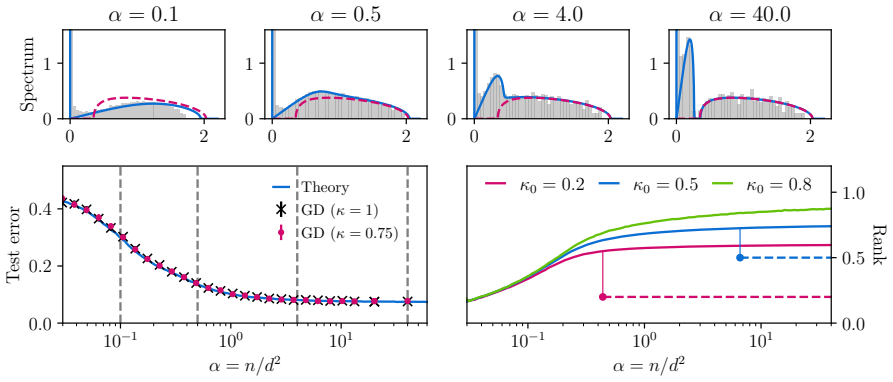
For a high-dimensional Gaussian sequence model, empirical risk minimization in single-head tied attention has exactly computable test error, interpolation and recovery thresholds, and a singular-value spectrum that becomes low-rank under weight decay.
Reviewed by Pith at T0; open to challenge. T0 means a machine referee read the full paper against a public rubric. the ladder, T0–T4 →
T0 review · deepseek-v4-flash
2026-08-04 13:52 UTC pith:XZDXCK6W
Single-Head Attention in High Dimensions: A Theory of Generalization, Weights Spectra, and Scaling Laws
The pith
A machine-rendered reading of the paper's core claim, the machinery that carries it, and where it could break.
The main output is a set of exact formulas for the test error as a function of the sample size, the location of thresholds where the model first interpolates the training data and then generalizes perfectly, and the distribution of singular values of the learned weight matrix. The formulas come from random matrix theory and a message-passing algorithm called AMP. A key finding is that weight decay on the key and query matrices is equivalent to a nuclear-norm penalty on their product, which automatically pushes the learned attention matrix to be low rank. This explains why overparameterized attention can still generalize: the regularization kills the unnecessary directions.
The theory is tested against gradient descent simulations on small systems (d=100) and matches well. One caveat: the central result is presented as a claim with a proof sketch, and several technical steps, including Gaussian universality for multiple tokens and the validity of the replica calculation, are assumed rather than proved. The abstract also promises a result about power-law scaling laws that the body of the paper explicitly leaves for future work.
Core claim
Claim 1 asserts that in the high-dimensional limit (d,n,m -> infinity, alpha=n/d^2=O(1), kappa=m/d=O(1)), any global minimizer W of the ERM loss in Eq.(2) has test error and training loss given exactly by the order parameters (Sigma, m, q, ...) at the global minimum of the variational functional Phi in Eq.(7), and that the empirical singular-value density of W/(md)^(1/4) converges to the shifted, cropped law in Eq.(13), under the replicon condition (Eq.10). If correct, this provides a complete asymptotic characterization of ERM in single-head tied attention.
Load-bearing premise
The derivation of Claim 1 relies on two unproven technical extensions to the multi-token softmax setting: (i) Gaussian universality, replacing the data matrices X_ab(x^mu) by independent GOE matrices (Appendix B, 'Gaussian universality'), and (ii) tightness of the AMP state evolution and absence of replica symmetry breaking for the non-convex loss (Appendix B, 'Analysis of the final ERM problem'). The paper states these 'should not pose any roadblock' and 'would require substantial additional work' (Section 3, Sketch of proof), but provides no proof. Also, the replicon condition (Eq.10) is assumed, with only empirical evidence from AMP convergence. If any of these fail, the predicted test-error curves and spectral law may not describe the actual global minima.
Editorial analysis
A structured set of objections, weighed in public.
Axiom & Free-Parameter Ledger
axioms (4)
- domain assumption Input tokens are i.i.d. Gaussian, x_in,a ~ N(0, I_d), and the limit d,n,m -> infinity is taken with alpha=n/d^2, kappa=m/d, kappa0=m0/d all O(1).
- domain assumption Gaussian universality replaces each data matrix X_ab(x^mu) by an independent GOE(d) matrix without changing the asymptotics for T>1.
- ad hoc to paper The replicon condition (Eq.10) is satisfied at the global minimum.
- domain assumption The AMP state evolution and the replica formula from [35] extend to the multi-token softmax loss; the global minimum is selected by the AMP fixed point with lowest loss.
Cite this review
Pith. "Pith review of Single-Head Attention in High Dimensions: A Theory of Generalization, Weights Spectra, and Scaling Laws." pith.science (2026). https://pith.science/paper/XZDXCK6W
@misc{pith2026250924914,
  author       = {Pith},
  title        = {Pith review of: Single-Head Attention in High Dimensions: A Theory of Generalization, Weights Spectra, and Scaling Laws},
  year         = {2026},
  howpublished = {\url{https://pith.science/paper/XZDXCK6W}},
  note         = {Machine review of arXiv:2509.24914}
}
read the original abstract
Trained attention layers exhibit striking and reproducible spectral structure of the weights, including low-rank collapse, bulk deformation, and isolated spectral outliers, yet the origin of these phenomena and their implications for generalization remain poorly understood. We study empirical risk minimization in a single-head tied-attention layer trained on synthetic high-dimensional sequence tasks generated from the attention-indexed model. Using tools from random matrix theory, spin-glass theory, and approximate message passing, we obtain an exact high-dimensional characterization of training and test error, interpolation and recovery thresholds, and the spectrum of the key and query matrices. Our theory predicts the full singular-value distribution of the trained query-key map, including low-rank structure and isolated spectral outliers, in qualitative agreement with observations in more realistic transformers. Finally, for targets with power-law spectra, we show that learning proceeds through sequential spectral recovery, leading to the emergence of power-law scaling laws.
Figures


Forward citations
Cited by 4 Pith papers
-
Deep Learning as Neural Low-Degree Filtering: A Spectral Theory of Hierarchical Feature Learning
Neural LoFi models deep learning as layer-wise spectral filtering that selects maximal low-degree correlations, yielding a tractable surrogate for hierarchical representation learning beyond the lazy regime.
-
High-Dimensional Theory of LoRA Fine-Tuning in a Solvable Attention Model
In a solvable attention model, pre-training followed by rank-one LoRA admits sharp asymptotic predictions for test errors and representation alignment via an effective noise term.
-
How Does Attention Help? Insights from Random Matrices on Signal Recovery from Sequence Models
Attention pooling produces a free-multiplicative-convolution bulk spectrum and two phase transitions for signal recovery; optimal weights are the top eigenvector of the positional correlation matrix R.
-
How Width and Data Shape Generalization Scaling Laws in Quadratic Neural Networks
Quadratic two-layer networks exhibit data-dependent power-law generalization scaling with distinct regimes in width and sample size, including an interpolation transition whose location depends on target spectrum.
Reference graph
Works this paper leans on
-
[1]
Attention is all you need.Advances in neural information processing systems, 30(1): 261–272, 2017
Ashish Vaswani, Noam Shazeer, Niki Parmar, Jakob Uszkoreit, Llion Jones, Aidan N Gomez, et al. Attention is all you need.Advances in neural information processing systems, 30(1): 261–272, 2017
2017
-
[2]
Bert: Pre-training of deep bidirectional transformers for language understanding
Jacob Devlin, Ming-Wei Chang, Kenton Lee, and Kristina Toutanova. Bert: Pre-training of deep bidirectional transformers for language understanding. InProceedings of the 2019 conference of the North American chapter of the association for computational linguistics: human language technologies, volume 1 (long and short papers), pages 4171–4186, 2019
2019
-
[3]
Alexey Dosovitskiy, Lucas Beyer, Alexander Kolesnikov, Dirk Weissenborn, Xiaohua Zhai, Thomas Unterthiner, Mostafa Dehghani, Matthias Minderer, Georg Heigold, Sylvain Gelly, et al. An image is worth 16x16 words: Transformers for image recognition at scale.arXiv preprint arXiv:2010.11929, 2020
Pith/arXiv arXiv 2010
-
[4]
Lan- guage models are few-shot learners.Advances in neural information processing systems, 33: 1877–1901, 2020
Tom Brown, Benjamin Mann, Nick Ryder, Melanie Subbiah, Jared D Kaplan, Prafulla Dhariwal, Arvind Neelakantan, Pranav Shyam, Girish Sastry, Amanda Askell, et al. Lan- guage models are few-shot learners.Advances in neural information processing systems, 33: 1877–1901, 2020
1901
-
[5]
Predicting trends in the quality of state-of-the-art neural networks without access to training or testing data.Nature Communications, 12(1):4122, 2021
Charles H Martin, Tongsu Peng, and Michael W Mahoney. Predicting trends in the quality of state-of-the-art neural networks without access to training or testing data.Nature Communications, 12(1):4122, 2021
2021
-
[6]
Max Staats, Matthias Thamm, and Bernd Rosenow. Small singular values matter: A random matrix analysis of transformer models.arXiv preprint arXiv:2410.17770, 2024. 11
arXiv 2024
-
[7]
Traditional and heavy tailed self regularization in neural network models
Michael Mahoney and Charles Martin. Traditional and heavy tailed self regularization in neural network models. InInternational Conference on Machine Learning, pages 4284–4293. PMLR, 2019
2019
-
[8]
Weight spectra induced efficient model adaptation.arXiv preprint arXiv:2505.23099, 2025
Chongjie Si, Xuankun Yang, Muqing Liu, Yadao Wang, Xiaokang Yang, Wenbo Su, Bo Zheng, and Wei Shen. Weight spectra induced efficient model adaptation.arXiv preprint arXiv:2505.23099, 2025
Pith/arXiv arXiv 2025
-
[9]
David Yunis, Kumar Kshitij Patel, Samuel Wheeler, Pedro Savarese, Gal Vardi, Karen Livescu, Michael Maire, and Matthew R Walter. Approaching deep learning through the spectral dynamics of weights.arXiv preprint arXiv:2408.11804, 2024
Pith/arXiv arXiv 2024
-
[10]
Lora: Low-rank adaptation of large language models.ICLR, 1(2):3, 2022
Edward J Hu, Yelong Shen, Phillip Wallis, Zeyuan Allen-Zhu, Yuanzhi Li, Shean Wang, Lu Wang, Weizhu Chen, et al. Lora: Low-rank adaptation of large language models.ICLR, 1(2):3, 2022
2022
-
[11]
Weight decay induces low-rank attention layers.Advances in Neural Information Processing Systems, 37:4481–4510, 2024
Seijin Kobayashi, Yassir Akram, and Johannes Von Oswald. Weight decay induces low-rank attention layers.Advances in Neural Information Processing Systems, 37:4481–4510, 2024
2024
-
[12]
Implicit regularization in matrix factorization.Advances in neural information processing systems, 30, 2017
Suriya Gunasekar, Blake E Woodworth, Srinadh Bhojanapalli, Behnam Neyshabur, and Nati Srebro. Implicit regularization in matrix factorization.Advances in neural information processing systems, 30, 2017
2017
-
[13]
Characterizing implicit bias in terms of optimization geometry
Suriya Gunasekar, Jason Lee, Daniel Soudry, and Nathan Srebro. Characterizing implicit bias in terms of optimization geometry. InInternational Conference on Machine Learning, pages 1832–1841. PMLR, 2018
2018
-
[14]
Implicit regularization in deep matrix factorization.Advances in neural information processing systems, 32, 2019
Sanjeev Arora, Nadav Cohen, Wei Hu, and Yuping Luo. Implicit regularization in deep matrix factorization.Advances in neural information processing systems, 32, 2019
2019
-
[15]
Sgd and weight decay secretly minimize the rank of your neural network
Tomer Galanti, Zachary S Siegel, Aparna Gupte, and Tomaso A Poggio. Sgd and weight decay secretly minimize the rank of your neural network. InNeurIPS 2024 Workshop on Mathematics of Modern Machine Learning, 2024
2024
-
[16]
High-dimensional data analysis: The curses and blessings of dimensionality.AMS math challenges lecture, 1(2000):32, 2000
David L Donoho et al. High-dimensional data analysis: The curses and blessings of dimensionality.AMS math challenges lecture, 1(2000):32, 2000
2000
-
[17]
Online stochastic gradient descent on non-convex losses from high-dimensional inference.Journal of Machine Learning Research, 22(106):1–51, 2021
Gerard Ben Arous, Reza Gheissari, and Aukosh Jagannath. Online stochastic gradient descent on non-convex losses from high-dimensional inference.Journal of Machine Learning Research, 22(106):1–51, 2021
2021
-
[18]
The merged-staircase property: a necessary and nearly sufficient condition for sgd learning of sparse functions on two-layer neural networks
Emmanuel Abbe, Enric Boix Adsera, and Theodor Misiakiewicz. The merged-staircase property: a necessary and nearly sufficient condition for sgd learning of sparse functions on two-layer neural networks. InConference on Learning Theory, pages 4782–4887. PMLR, 2022
2022
-
[19]
High-dimensional asymptotics of feature learning: How one gradient step improves the representation.Advances in Neural Information Processing Systems, 35:37932–37946, 2022
Jimmy Ba, Murat A Erdogdu, Taiji Suzuki, Zhichao Wang, Denny Wu, and Greg Yang. High-dimensional asymptotics of feature learning: How one gradient step improves the representation.Advances in Neural Information Processing Systems, 35:37932–37946, 2022
2022
-
[20]
From high- dimensional & mean-field dynamics to dimensionless odes: A unifying approach to sgd in two-layers networks
Luca Arnaboldi, Ludovic Stephan, Florent Krzakala, and Bruno Loureiro. From high- dimensional & mean-field dynamics to dimensionless odes: A unifying approach to sgd in two-layers networks. InThe Thirty Sixth Annual Conference on Learning Theory, pages 1199–1227. PMLR, 2023. 12
2023
-
[21]
Smoothing the landscape boosts the signal for sgd: Optimal sample complexity for learning single index models.Advances in Neural Information Processing Systems, 36:752–784, 2023
Alex Damian, Eshaan Nichani, Rong Ge, and Jason D Lee. Smoothing the landscape boosts the signal for sgd: Optimal sample complexity for learning single index models.Advances in Neural Information Processing Systems, 36:752–784, 2023
2023
-
[22]
On learning Gaussian multi- index models with gradient flow part i: General properties and two-timescale learning
Alberto Bietti, Joan Bruna, and Loucas Pillaud-Vivien. On learning Gaussian multi- index models with gradient flow part i: General properties and two-timescale learning. Communications on Pure and Applied Mathematics, 2025
2025
-
[23]
Learning time-scales in two-layers neural networks.Foundations of Computational Mathematics, pages 1–84, 2024
Raphaël Berthier, Andrea Montanari, and Kangjie Zhou. Learning time-scales in two-layers neural networks.Foundations of Computational Mathematics, pages 1–84, 2024
2024
-
[24]
A phase transition between positional and semantic learning in a solvable model of dot-product attention
Hugo Cui, Freya Behrens, Florent Krzakala, and Lenka Zdeborová. A phase transition between positional and semantic learning in a solvable model of dot-product attention. Advances in Neural Information Processing Systems, 37:36342–36389, 2024
2024
-
[25]
Fun- damental limits of learning in sequence multi-index models and deep attention networks: high-dimensional asymptotics and sharp thresholds
Emanuele Troiani, Hugo Cui, Yatin Dandi, Florent Krzakala, and Lenka Zdeborová. Fun- damental limits of learning in sequence multi-index models and deep attention networks: high-dimensional asymptotics and sharp thresholds. InForty-second International Confer- ence on Machine Learning, 2025
2025
-
[26]
Asymptotics of SGD in sequence-single index models and single-layer attention networks
Luca Arnaboldi, Bruno Loureiro, Ludovic Stephan, Florent Krzakala, and Lenka Zdeborová. Asymptotics of SGD in sequence-single index models and single-layer attention networks. NeurIPS 2025, 2025. arXiv preprint arXiv:2506.02651
arXiv 2025
-
[27]
Bayes optimal learning of attention-indexed models.NeurIPS 2025, 2025
Fabrizio Boncoraglio, Emanuele Troiani, Vittorio Erba, and Lenka Zdeborová. Bayes optimal learning of attention-indexed models.NeurIPS 2025, 2025. arXiv:2506.01582
arXiv 2025
-
[28]
The nuclear route: Sharp asymptotics of erm in overparameterized quadratic networks.NeurIPS 2025,
Vittorio Erba, Emanuele Troiani, Lenka Zdeborová, and Florent Krzakala. The nuclear route: Sharp asymptotics of erm in overparameterized quadratic networks.NeurIPS 2025,
2025
-
[29]
American Mathematical Soc., 1992
Dan V Voiculescu, Ken J Dykema, and Alexandru Nica.Free random variables, volume 1. American Mathematical Soc., 1992
1992
-
[30]
Sofiia Dubova, Yue M Lu, Benjamin McKenna, and Horng-Tzer Yau. Universality for the global spectrum of random inner-product kernel matrices in the polynomial regime.arXiv preprint arXiv:2310.18280, 2023
Pith/arXiv arXiv 2023
-
[31]
Fitting an ellipsoid to random points: predictions using the replica method.IEEE Transactions on Information Theory, 70(10):7273–7296, 2024
Antoine Maillard and Dmitriy Kunisky. Fitting an ellipsoid to random points: predictions using the replica method.IEEE Transactions on Information Theory, 70(10):7273–7296, 2024
2024
-
[32]
Exact threshold for approximate ellipsoid fitting of random points.Electronic Journal of Probability, 30:1–46, 2025
Afonso S Bandeira and Antoine Maillard. Exact threshold for approximate ellipsoid fitting of random points.Electronic Journal of Probability, 30:1–46, 2025
2025
-
[33]
Springer Science & Business Media, 2003
Michel Talagrand.Spin glasses: a challenge for mathematicians: cavity and mean field models, volume 46. Springer Science & Business Media, 2003
2003
-
[34]
Theoretical insights into multiclass classification: A high-dimensional asymptotic view.Advances in Neural Information Processing Systems, 33:8907–8920, 2020
Christos Thrampoulidis, Samet Oymak, and Mahdi Soltanolkotabi. Theoretical insights into multiclass classification: A high-dimensional asymptotic view.Advances in Neural Information Processing Systems, 33:8907–8920, 2020
2020
-
[35]
Matteo Vilucchio, Yatin Dandi, Cedric Gerbelot, and Florent Krzakala. Asymptotics of non-convex generalized linear models in high-dimensions: A proof of the replica formula. arXiv preprint arXiv:2502.20003, 2025. 13
arXiv 2025
-
[36]
The LASSO risk for Gaussian matrices.IEEE Transactions on Information Theory, 58(4):1997–2017, 2011
Mohsen Bayati and Andrea Montanari. The LASSO risk for Gaussian matrices.IEEE Transactions on Information Theory, 58(4):1997–2017, 2011
1997
-
[37]
State evolution for general approximate message passing algorithms, with applications to spatial coupling.Information and Inference: A Journal of the IMA, 2(2):115–144, 2013
Adel Javanmard and Andrea Montanari. State evolution for general approximate message passing algorithms, with applications to spatial coupling.Information and Inference: A Journal of the IMA, 2(2):115–144, 2013
2013
-
[38]
State evolution for approxi- mate message passing with non-separable functions.Information and Inference: A Journal of the IMA, 9(1):33–79, March 2020
Raphaël Berthier, Andrea Montanari, and Phan-Minh Nguyen. State evolution for approxi- mate message passing with non-separable functions.Information and Inference: A Journal of the IMA, 9(1):33–79, March 2020. ISSN 2049-8764, 2049-8772
2020
-
[39]
Graph-based approximate message passing iterations
Cédric Gerbelot and Raphaël Berthier. Graph-based approximate message passing iterations. Information and Inference: A Journal of the IMA, 12(4):2562–2628, 2023
2023
-
[40]
A convergence analysis of approximate message passing with non-separable functions and applications to multi-class classification
Burak Çakmak, Yue M Lu, and Manfred Opper. A convergence analysis of approximate message passing with non-separable functions and applications to multi-class classification. In2024 IEEE International Symposium on Information Theory (ISIT), pages 747–752. IEEE, 2024
2024
-
[41]
Fundamental Limits of Matrix Sensing: Exact Asymptotics, Universality, and Applications, March 2025
Yizhou Xu, Antoine Maillard, Lenka Zdeborová, and Florent Krzakala. Fundamental Limits of Matrix Sensing: Exact Asymptotics, Universality, and Applications, March 2025. arXiv:2503.14121 [stat]
arXiv 2025
-
[42]
Universality of empirical risk minimization
Andrea Montanari and Basil N Saeed. Universality of empirical risk minimization. In Conference on Learning Theory, pages 4310–4312. PMLR, 2022
2022
-
[43]
Lu, and Subhabrata Sen
Rishabh Dudeja, Yue M. Lu, and Subhabrata Sen. Universality of approximate message passing with semirandom matrices.The Annals of Probability, 51(5):1616–1683, 2023
2023
-
[44]
Universality laws for Gaussian mixtures in generalized linear models.Advances in Neural Information Processing Systems, 36:54754–54768, 2023
Yatin Dandi, Ludovic Stephan, Florent Krzakala, Bruno Loureiro, and Lenka Zdeborová. Universality laws for Gaussian mixtures in generalized linear models.Advances in Neural Information Processing Systems, 36:54754–54768, 2023
2023
-
[45]
Adam: A method for stochastic gradient descent
Diederik P Kingma and Jimmy Lei Ba. Adam: A method for stochastic gradient descent. InICLR: international conference on learning representations, pages 1–15, 2015
2015
-
[46]
Implicit self-regularization in deep neural networks: Evidence from random matrix theory and implications for learning.Journal of Machine Learning Research, 22(165):1–73, 2021
Charles H Martin and Michael W Mahoney. Implicit self-regularization in deep neural networks: Evidence from random matrix theory and implications for learning.Journal of Machine Learning Research, 22(165):1–73, 2021
2021
-
[47]
Learning Gaussian mixtures with generalized linear models: Precise asymptotics in high-dimensions.Advances in Neural Information Processing Systems, 34: 10144–10157, 2021
Bruno Loureiro, Gabriele Sicuro, Cédric Gerbelot, Alessandro Pacco, Florent Krzakala, and Lenka Zdeborová. Learning Gaussian mixtures with generalized linear models: Precise asymptotics in high-dimensions.Advances in Neural Information Processing Systems, 34: 10144–10157, 2021
2021
-
[48]
Bayes-optimal learning of an extensive-width neural network from quadratically many samples.Advances in Neural Information Processing Systems, 37:82085–82132, December 2024
Antoine Maillard, Emanuele Troiani, Simon Martin, Lenka Zdeborová, and Florent Krzakala. Bayes-optimal learning of an extensive-width neural network from quadratically many samples.Advances in Neural Information Processing Systems, 37:82085–82132, December 2024
2024
-
[49]
Various thresholds for ℓ1-optimization in compressed sensing.arXiv preprint arXiv:0907.3666, 2009
Mihailo Stojnic. Various thresholds for ℓ1-optimization in compressed sensing.arXiv preprint arXiv:0907.3666, 2009
Pith/arXiv arXiv 2009
-
[50]
The Gaussian min-max theorem in the presence of convexity.arXiv preprint arXiv:1408.4837, 2014
Christos Thrampoulidis, Samet Oymak, and Babak Hassibi. The Gaussian min-max theorem in the presence of convexity.arXiv preprint arXiv:1408.4837, 2014. 14
Pith/arXiv arXiv 2014
-
[51]
Message-passing algorithms for compressed sensing.Proceedings of the National Academy of Sciences, 106(45):18914–18919, 2009
David L Donoho, Arian Maleki, and Andrea Montanari. Message-passing algorithms for compressed sensing.Proceedings of the National Academy of Sciences, 106(45):18914–18919, 2009
2009
-
[52]
An iterative construction of solutions of the tap equations for the sherrington–kirkpatrick model.Communications in Mathematical Physics, 325(1):333–366, 2014
Erwin Bolthausen. An iterative construction of solutions of the tap equations for the sherrington–kirkpatrick model.Communications in Mathematical Physics, 325(1):333–366, 2014
2014
-
[53]
Distribution of eigenvalues for some sets of random matrices.Mat
VA Marchenko and Leonid A Pastur. Distribution of eigenvalues for some sets of random matrices.Mat. Sb.(NS), 72(114):4, 1967
1967
-
[54]
torch.optim.adam — pytorch (stable) documentation.https://docs
PyTorch Core Team. torch.optim.adam — pytorch (stable) documentation.https://docs. pytorch.org/docs/stable/generated/torch.optim.Adam.html, 2025
2025
-
[55]
Norm-based capacity control in neural networks
Behnam Neyshabur, Ryota Tomioka, and Nathan Srebro. Norm-based capacity control in neural networks. InConference on learning theory, pages 1376–1401. PMLR, 2015
2015
-
[56]
The implicit bias of gradient descent on separable data.Journal of Machine Learning Research, 19(70):1–57, 2018
Daniel Soudry, Elad Hoffer, Mor Shpigel Nacson, Suriya Gunasekar, and Nathan Srebro. The implicit bias of gradient descent on separable data.Journal of Machine Learning Research, 19(70):1–57, 2018
2018
-
[57]
Saddle-to-saddle dynamics in diagonal linear networks
Scott Pesme and Nicolas Flammarion. Saddle-to-saddle dynamics in diagonal linear networks. Advances in Neural Information Processing Systems, 36:7475–7505, 2023. 15 A Inductive Nuclear Norm Bias for Tied and Untied weights We briefly recall here the mathematical reasons behind the appearance of theinductive nuclear norm, following arguments that go back t...
2023
discussion (0)
Sign in with ORCID, Apple, or X to comment. Anyone can read and Pith papers without signing in.