REVIEW 4 major objections 5 minor 32 references
MARLINE claims that a centroid-based mapping lets classifiers trained on one concept vote on another, even when the concepts differ.
Reviewed by Pith at T0; open to challenge. T0 means a machine referee read the full paper against a public rubric. the ladder, T0–T4 →
2026-08-04 21:06 UTC pith:Y35D3SEX
load-bearing objection MARLINE offers a genuinely new mechanism for multi-source transfer under concept mismatch, but the centroid-only affine mapping is an unvalidated assumption that needs direct testing before the paper's central claim is secure. the 4 major comments →
MARLINE: Multi-Source Mapping Transfer Learning for Non-Stationary Environments
The pith
A machine-rendered reading of the paper's core claim, the machinery that carries it, and where it could break.
Core claim
MARLINE's central claim is that even when every source concept is different from the current target concept, source-trained sub-classifiers can still contribute if the target example is first mapped into the source concept's space. The mapping is built from the vector joining the two class-conditional centroids of a concept: the transformation that aligns the target concept's centroid vector with the source concept's centroid vector is applied to every incoming target example, and the projected point is fed to sub-classifiers trained on that source concept. Each sub-classifier's weight tracks its success on projected target examples, so the ensemble adapts. The result claimed is that this yi
What carries the argument
The mapping mechanism is an affine transformation R between class-centroid vectors. For a source+ concept p_j_i and the current target concept, the paper forms the vector V = c^+ - c^- for each concept, normalizes those vectors, and computes a matrix R satisfying V_source = R * V_target (Eqs. 2-5). The target example is then projected as x' = c^+_source + R(x_target - c^+_target) (Eqs. 6-8). Centroids are updated online with a forgetting factor, and R is recomputed only when a prediction is needed. This projection carries the whole argument: if the centroid-vector alignment captures enough of the concept relationship, source sub-classifiers can vote on projections; if it does not, the projec
Load-bearing premise
The load-bearing premise is that the relationship between any source concept and the target concept is captured by an affine map computed from the two class-conditional centroid vectors, so that one linear transformation aligns the concepts well enough for source classifiers to be useful.
What would settle it
Construct a source and target with identical class-centroid difference vectors but decision boundaries rotated by 90 degrees (e.g., source separable along the x-axis, target separable along the y-axis with the same centroid gap). MARLINE's centroid-vector map would then be the identity or nearly so, leaving the source classifiers misaligned on the target; if its accuracy is no better than a target-only online ensemble over repeated drifts, the centroid-vector mapping is not capturing the concept correspondence. If it still beats the target-only baseline, the claim holds.
If this is right
- MARLINE extends transfer-based stream learning to regimes prior methods explicitly exclude: sources whose concepts differ from the target.
- Past target concepts are treated as source+ concepts, so after drift the ensemble can keep leveraging old target knowledge through the same mapping, not just external sources.
- Because weights are assigned per sub-classifier on projected target examples, the ensemble can down-weight harmful sources while still using useful sub-classifiers even from globally dissimilar concepts.
- On complex real-world streams, source+ sub-classifiers can carry a large share of the total ensemble weight (about 95% on the weekday dataset), indicating sustained contribution rather than only early-stage bootstrapping.
- On simple artificial concepts, the benefit concentrates at the start of the stream and immediately after drift; on harder real-world concepts, the benefit persists over time.
Where Pith is reading between the lines
- If a single centroid-vector map is enough, a natural testable extension is to replace or augment it with covariance alignment or local piecewise maps, which should help when concept differences are nonlinear or class covariances differ.
- The mapping mechanism is generic and could be paired with other base online learners and drift detectors; the ensemble's diversity may be the real reason weighting projected sub-classifiers works, so gains could grow with more numerous and more diverse sources.
- The observed spikes and drops in source+ weight ratios suggest the weighting is noise-sensitive; a variance-aware or regularized weighting scheme could stabilize transfer and may further improve accuracy.
- The two-centroid vector collapses for multi-class or poorly separated class distributions; extending the mapping to multiple prototype points or per-class maps is a direct implication of the method's geometry.
Editorial analysis
A structured set of objections, weighed in public.
Referee Report
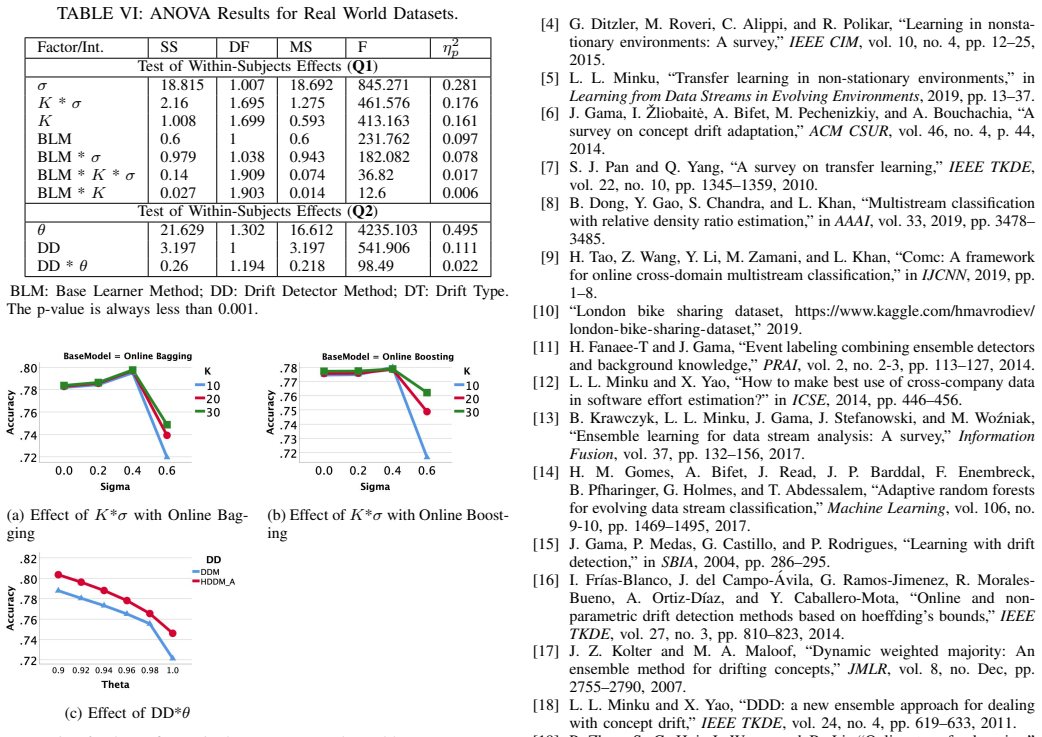
Summary. The paper proposes MARLINE, an online ensemble method for multi-source transfer learning in non-stationary data streams. It maintains a pool of base ensembles, one per concept observed in each source and target stream, and maps each incoming target example into the space of each source+ concept using an affine transformation computed from the class-conditional centroid vectors of the two concepts. Source+ sub-classifiers then vote on the projected example, with weights updated by the sub-classifiers' estimated performance on projected target examples. The method is evaluated on synthetic Gaussian streams (similar and non-similar sources under no, abrupt, and incremental drift) and on London/DC bike-sharing streams, against Melanie, ARF, DWM, online bagging/boosting with and without drift detection, using 30 runs, Friedman/Nemenyi tests, and an ANOVA sensitivity analysis.
Significance. If the mapping mechanism is sound, the paper addresses a real limitation of prior multi-source transfer methods: the requirement that source and target concepts be similar. The empirical study is carefully designed and the authors provide code and supplementary material, which is commendable. The sensitivity analysis is thorough and the use of 30 runs with nonparametric tests is a strength. However, the central geometric assumption--that a single affine map computed from two class centroids is a sufficient correspondence between concepts--is not validated, and some experimental results show that source transfer can hurt. Because the entire method rests on that mapping, the contribution cannot be assessed until the mapping is made precise and its scope demonstrated.
major comments (4)
- [IV-B, Eqs. (2)-(8)] The mapping R is load-bearing but under-specified. The typeset Eqs. (3)-(5) contain vector-level operations such as '− →Vi,j -1' and divisions by vectors that are not standard, and it is unclear whether R is orthogonal, affine, or includes a scaling factor (the norm ratio in Eq. (5) suggests non-isometric). Since every source vote is cast on x' = c^+ + R(x_T - c^+), the method's validity depends on R preserving label-relevant geometry outside the two centroids. Please give a clean derivation with explicit matrix definitions, state what R does to the centroid vectors, and validate it on the non-similar synthetic cases in Table II, where source and target have different covariance matrices. A direct check--e.g., showing that projected target class-conditional distributions align with the source concept, or comparing against an oracle affine map estimated from full data--would substantiate
- [VI-A1 / Table III] The claim that MARLINE benefits from non-similar sources under non-stationarity is not uniformly supported. In the non-similar incremental-drift datasets with class size 5000, MARLINE(DDM(Online Bagging)) with source ranks 14.2 while MARLINE without source ranks 13.0; the corresponding Online Boosting pair is 16.2 vs 14.5. The text states that the exception is only the class-size-500 incremental case, but Table III shows additional cases where using the source is worse. Please report per-concept or per-drift-period accuracies, explain when source transfer helps versus hurts under gradual drift, and qualify the scope of the empirical claim accordingly.
- [V-B] The two most relevant multi-source non-stationary transfer baselines, MSCRDR [8] and COMC [9], are described in the related work and in the benchmark-method section but are not included in the experiments. Since the abstract claims superiority over 'several state-of-the-art data stream learning approaches,' omitting the closest multi-source transfer competitors weakens the evaluation. The authors should either implement and compare against them (or publicly available versions) or provide a specific technical reason why they cannot be included in this comparison.
- [VI / Figures 2-3] Accuracy trajectories are reported as 30-run averages without error bars or confidence bands; Table III reports only Friedman ranks. Given that source vs. no-source differences are sometimes small and the method is stochastic, the main text should show variability (e.g., shaded confidence intervals) or provide pairwise statistical comparisons at representative time points. The supplementary material may contain standard deviations, but the main claims should not depend on accessing the supplement for this basic information.
minor comments (5)
- [VII-B1] The text says 'A large σ = 0.06 is detrimental'; this appears to be a typo for σ = 0.6, since the grid is 0:0.1:1.
- [Figure 3] Panel (d) is labeled 'Weekday' and the caption repeats the Weekday label; please clarify what is shown or renumber the panels.
- [References] The code repository link [21] points to 'MARLENE.git', which may be a typo for the MARLINE repository; please verify the URL and name.
- [IV-B] The notation for source+ in the text is defined but would be easier to follow if a single symbol, e.g., p^j_i with i∈M, were used consistently throughout Algorithm 1 and Section IV-B.
- [VI-A1] The sentence 'We can see that MARLINE with source is amongst the best performers ... except the incremental drifts with the class size of 500' does not fully match Table III; see major comment 2.
Circularity Check
No load-bearing circularity; central mapping is a modeling choice and the weighting is label-driven; only minor non-load-bearing self-citations.
full rationale
MARLINE's derivation is self-contained. The mapping R in Eqs. (3)-(5) is constructed from class-centroid vectors of source+ and target concepts (Eq. (2)), and the projection in Eq. (8) directly applies R. This is a geometric modeling assumption, not a reduction of the target prediction to its inputs: the final prediction is a weighted vote of source/target sub-classifiers on the projected examples, with weights updated from true target labels via Eqs. (13)-(16). The only self-citation that appears in a justificatory role is [2] in Section IV-A ('Ensembles are used here because their diversity increases the chances that at least some of the sub-classifiers become useful for predicting the target [2]'), but this is a heuristic motivation, not a load-bearing theorem: the mapping and weighting are introduced in this paper and evaluated against Melanie, ARF, DWM, and online bagging/boosting baselines. No uniqueness theorem from the authors' prior work is invoked to force the choice. The skeptic's concern that a two-centroid affine map may not preserve covariance is a correctness/robustness risk, not a circular step. Hyperparameter grid search on each dataset is a methodological limitation, not a derivation-level circularity. Consequently, no specific equation or claim reduces by construction to a fitted parameter or to a self-citation.
Axiom & Free-Parameter Ledger
free parameters (3)
- forgetting factor theta =
0.90 to 1.00 in grid steps of 0.01; smaller values 0.9-0.94 favored when drift detection is imperfect
- performance index sigma =
grid 0.1 to 1.0; sensitivity analysis favors 0.4
- base ensemble size K =
tuned in 1:1:30 for bagging and boosting; sensitivity favors K >= 20
axioms (5)
- ad hoc to paper Target and source concepts are geometrically related by an affine map determined by the class-conditional centroids (Eqs. 2-8).
- domain assumption A reliable drift detector is available to segment each stream into concepts and to reset target weights (Algorithm 1, lines 11-19).
- domain assumption Target labels are available immediately for updating sub-classifier weights (Algorithm 1, lines 22-24; Section IV-D).
- domain assumption Classification is binary with labels in {-1,+1} and a shared d-dimensional feature space (Section III).
- domain assumption Online base learners produce probabilistic predictions usable as confidence values.
Cite this review
Pith. "Pith review of MARLINE: Multi-Source Mapping Transfer Learning for Non-Stationary Environments." pith.science (2026). https://pith.science/paper/Y35D3SEX
@misc{pith2026250908176,
  author       = {Pith},
  title        = {Pith review of: MARLINE: Multi-Source Mapping Transfer Learning for Non-Stationary Environments},
  year         = {2026},
  howpublished = {\url{https://pith.science/paper/Y35D3SEX}},
  note         = {Machine review of arXiv:2509.08176}
}
read the original abstract
Concept drift is a major problem in online learning due to its impact on the predictive performance of data stream mining systems. Recent studies have started exploring data streams from different sources as a strategy to tackle concept drift in a given target domain. These approaches make the assumption that at least one of the source models represents a concept similar to the target concept, which may not hold in many real-world scenarios. In this paper, we propose a novel approach called Multi-source mApping with tRansfer LearnIng for Non-stationary Environments (MARLINE). MARLINE can benefit from knowledge from multiple data sources in non-stationary environments even when source and target concepts do not match. This is achieved by projecting the target concept to the space of each source concept, enabling multiple source sub-classifiers to contribute towards the prediction of the target concept as part of an ensemble. Experiments on several synthetic and real-world datasets show that MARLINE was more accurate than several state-of-the-art data stream learning approaches.
Figures


Reference graph
Works this paper leans on
-
[1]
Learning under concept drift: A review,
J. Lu, A. Liu, F. Dong, F. Gu, J. Gama, and G. Zhang, “Learning under concept drift: A review,”IEEE TKDE, 2018
work page 2018
-
[2]
Multi-source transfer learning for non-stationary environments,
H. Du, L. L. Minku, and H. Zhou, “Multi-source transfer learning for non-stationary environments,” inIJCNN, 2019, pp. 1–8
work page 2019
-
[3]
Online non-stationary boosting
A. C. Pocock, P. Yiapanis, J. Singer, M. Luj ´an, and G. Brown, “Online non-stationary boosting.” inMCS, 2010, pp. 205–214
work page 2010
-
[4]
Learning in nonsta- tionary environments: A survey,
G. Ditzler, M. Roveri, C. Alippi, and R. Polikar, “Learning in nonsta- tionary environments: A survey,”IEEE CIM, vol. 10, no. 4, pp. 12–25, 2015
work page 2015
-
[5]
Transfer learning in non-stationary environments,
L. L. Minku, “Transfer learning in non-stationary environments,” in Learning from Data Streams in Evolving Environments, 2019, pp. 13–37
work page 2019
-
[6]
A survey on concept drift adaptation,
J. Gama, I. ˇZliobait˙e, A. Bifet, M. Pechenizkiy, and A. Bouchachia, “A survey on concept drift adaptation,”ACM CSUR, vol. 46, no. 4, p. 44, 2014
work page 2014
-
[7]
A survey on transfer learning,
S. J. Pan and Q. Yang, “A survey on transfer learning,”IEEE TKDE, vol. 22, no. 10, pp. 1345–1359, 2010
work page 2010
-
[8]
Multistream classification with relative density ratio estimation,
B. Dong, Y . Gao, S. Chandra, and L. Khan, “Multistream classification with relative density ratio estimation,” inAAAI, vol. 33, 2019, pp. 3478– 3485
work page 2019
-
[9]
Comc: A framework for online cross-domain multistream classification,
H. Tao, Z. Wang, Y . Li, M. Zamani, and L. Khan, “Comc: A framework for online cross-domain multistream classification,” inIJCNN, 2019, pp. 1–8
work page 2019
-
[10]
London bike sharing dataset, https://www.kaggle.com/hmavrodiev/ london-bike-sharing-dataset,
“London bike sharing dataset, https://www.kaggle.com/hmavrodiev/ london-bike-sharing-dataset,” 2019
work page 2019
-
[11]
Event labeling combining ensemble detectors and background knowledge,
H. Fanaee-T and J. Gama, “Event labeling combining ensemble detectors and background knowledge,”PRAI, vol. 2, no. 2-3, pp. 113–127, 2014
work page 2014
-
[12]
How to make best use of cross-company data in software effort estimation?
L. L. Minku and X. Yao, “How to make best use of cross-company data in software effort estimation?” inICSE, 2014, pp. 446–456
work page 2014
-
[13]
Ensemble learning for data stream analysis: A survey,
B. Krawczyk, L. L. Minku, J. Gama, J. Stefanowski, and M. Wo ´zniak, “Ensemble learning for data stream analysis: A survey,”Information Fusion, vol. 37, pp. 132–156, 2017
2017
-
[14]
Adaptive random forests for evolving data stream classification,
H. M. Gomes, A. Bifet, J. Read, J. P. Barddal, F. Enembreck, B. Pfharinger, G. Holmes, and T. Abdessalem, “Adaptive random forests for evolving data stream classification,”Machine Learning, vol. 106, no. 9-10, pp. 1469–1495, 2017
work page 2017
-
[15]
Learning with drift detection,
J. Gama, P. Medas, G. Castillo, and P. Rodrigues, “Learning with drift detection,” inSBIA, 2004, pp. 286–295
work page 2004
-
[16]
Online and non- parametric drift detection methods based on hoeffding’s bounds,
I. Fr ´ıas-Blanco, J. del Campo- ´Avila, G. Ramos-Jimenez, R. Morales- Bueno, A. Ortiz-D ´ıaz, and Y . Caballero-Mota, “Online and non- parametric drift detection methods based on hoeffding’s bounds,”IEEE TKDE, vol. 27, no. 3, pp. 810–823, 2014
work page 2014
-
[17]
Dynamic weighted majority: An ensemble method for drifting concepts,
J. Z. Kolter and M. A. Maloof, “Dynamic weighted majority: An ensemble method for drifting concepts,”JMLR, vol. 8, no. Dec, pp. 2755–2790, 2007
work page 2007
-
[18]
DDD: a new ensemble approach for dealing with concept drift,
L. L. Minku and X. Yao, “DDD: a new ensemble approach for dealing with concept drift,”IEEE TKDE, vol. 24, no. 4, pp. 619–633, 2011
work page 2011
-
[19]
Online transfer learning,
P. Zhao, S. C. Hoi, J. Wang, and B. Li, “Online transfer learning,” Artificial Intelligence, vol. 216, pp. 76–102, 2014
2014
-
[20]
Concept drift adaptation by exploiting historical knowledge,
Y . Sun, K. Tang, Z. Zhu, and X. Yao, “Concept drift adaptation by exploiting historical knowledge,”IEEE TNNLS, 2018
work page 2018
-
[21]
H. Du, “Code repository for MARLINE: Multi-source mapping transfer- learning for non-stationary environments,” https://github.com/nino2222/ MARLENE.git, 2022
work page 2022
-
[22]
N. C. Oza, “Online bagging and boosting,” inSMC, vol. 3, 2005, pp. 2340–2345
work page 2005
-
[23]
H. Du, L. L. Minku, and H. Zhou, “Supplementary material for MARLINE: Multi-source mapping transferlearning for non-stationary environments,” https://doi.org/10.5281/zenodo.4040990, 2020
-
[24]
A. Bifet, G. Holmes, R. Kirkby, and B. Pfahringer, “Moa: Massive online analysis,”JMLR, vol. 11, no. May, pp. 1601–1604, 2010
work page 2010
-
[25]
Mining high-speed data streams,
P. Domingos and G. Hulten, “Mining high-speed data streams,” inKDD, 2000, pp. 71–80
work page 2000
-
[26]
An overview and comprehensive comparison of ensembles for concept drift,
R. S. M. de Barros and S. G. T. de Carvalho Santos, “An overview and comprehensive comparison of ensembles for concept drift,”Information Fusion, vol. 52, pp. 213–244, 2019
work page 2019
-
[27]
Issues in evaluation of stream learning algorithms,
J. Gama, R. Sebasti ˜ao, and P. P. Rodrigues, “Issues in evaluation of stream learning algorithms,” inKDD, 2009, pp. 329–338
work page 2009
-
[28]
D. C. Montgomery,Design and analysis of experiments. John wiley & sons, 2017
work page 2017
-
[29]
Significance test for sphericity of a normal n-variate distribution,
J. W. Mauchly, “Significance test for sphericity of a normal n-variate distribution,”The Annals of Mathematical Statistics, vol. 11, no. 2, pp. 204–209, 1940
work page 1940
-
[30]
On methods in the analysis of profile data,
S. W. Greenhouse and S. Geisser, “On methods in the analysis of profile data,”Psychometrika, vol. 24, no. 2, pp. 95–112, 1959
work page 1959
-
[31]
H. Huynh and L. S. Feldt, “Estimation of the box correction for degrees of freedom from sample data in randomized block and split- plot designs,”Journal of educational statistics, vol. 1, no. 1, pp. 69–82, 1976
work page 1976
-
[32]
Verma,Repeated measures design for empirical researchers
J. Verma,Repeated measures design for empirical researchers. John Wiley & Sons, 2015
work page 2015
This paper was first reviewed by deepseek-v4-flash on August 4, 2026.
discussion (0)
Sign in with ORCID, Apple, or X to comment. Anyone can read and Pith papers without signing in.