REVIEW 3 major objections 5 minor 4 cited by
This paper claims that the ionized outflows driven by intense star formation in the most massive galaxies at z~3–9 are common but inefficient: they move at speeds below the escape velocity, carry typical mass-loading factors below one, and
Reviewed by Pith at T0; open to challenge. T0 means a machine referee read the full paper against a public rubric. the ladder, T0–T4 →
2026-08-03 11:27 UTC pith:Y57MRIT7
load-bearing objection The observational core — first IFU census of dusty, metal-enriched outflows in massive z=3–9 galaxies — is solid and worth publishing; the 'inefficient feedback' conclusion, however, is hostage to an adopted outflow electron density that could flip η above unity if wrong. the 3 major comments →
GA-NIFS: high prevalence of dusty and metal-enriched outflows in massive and luminous star-forming galaxies at zsim3-9
The pith
A machine-rendered reading of the paper's core claim, the machinery that carries it, and where it could break.
Core claim
The central discovery is that spatially resolved ionized outflows in massive, luminous star-forming galaxies at z~3–9 are common (35% of regions) yet dynamically and energetically modest. The outflowing gas shows enhanced dust attenuation (A_V about 0.59 mag higher) and oxygen abundance (about 0.13 dex higher) than the systemic gas, which the authors take as direct evidence that the broad component is a genuine outflow rather than a merger artifact. Outflow velocities range from 170 to 600 km/s with dispersions 130–340 km/s, and in all but one case the outflow velocity remains below the estimated escape velocity. Mass-loading factors, computed from dust-corrected [OIII] luminosities and spat
What carries the argument
The central object is the broad kinematic component: a second Gaussian component in the [OIII]5007 and Hα line profiles, selected when a Bayesian information criterion favors two components, the broad component has signal-to-noise above 3, and its velocity dispersion exceeds 100–140 km/s. Its properties (dust attenuation from Balmer decrements, oxygen abundance from R3/N2 indicators, velocity, and spatial extent from resolved maps) are compared with the narrow systemic component. The quantitative workhorse is the mass-loading factor η = Ṁ_out/SFR, with Ṁ_out = M_out v_out/r_out; the outflow mass M_out is obtained from the dust-corrected broad [OIII] luminosity divided by metallicity and elec
Load-bearing premise
The conclusions hinge on the adopted electron density of the outflow: it is measured for only a few sources, and for the remaining nine outflows the paper assumes a common value of 500 cm^-3; because the computed outflow mass (and hence the mass-loading factor) is inversely proportional to this density, a true density closer to 100 cm^-3 would raise most η values above unity and overturn the 'inefficient feedback' conclusion.
What would settle it
Measure the [OII] or [SII] doublet ratio in the broad outflow component of a few of these galaxies to obtain a direct electron density; if typical densities are ~100 cm^-3 instead of ~500 cm^-3, the mass-loading factors exceed one, contradicting the central claim. Alternatively, deep observations of neutral or molecular outflow tracers (such as [CII]) in these systems that show most of the outflowing mass is in non-ionized phases would indicate that the ionized phase underestimates the true ejective feedback.
If this is right
- Ionized outflows in massive z≈3–9 starbursts do not by themselves quench star formation: mass-loading factors η≤1 in the majority of cases.
- These winds are likely redistributing dust and metals inside the halo rather than expelling them to the circumgalactic medium, as v_out/vesc<1 in all but one case.
- The high metal content of the broad component rules out a pristine infall or merger-driven origin for the broad emission, strengthening the outflow interpretation.
- Outflow speed correlates with star-formation rate across a wider mass range than previously probed, with a slope similar to that of local ultra-luminous infrared galaxies.
- Detectability of outflows rises with stellar mass and SFR; previous lower-mass samples gave conflicting incidence and η values partly because of resolution and selection criteria.
Where Pith is reading between the lines
- If the true electron density of the outflowing gas is lower than the assumed ~500 cm^-3 (or the measured systemic densities), the mass-loading factors would scale upward proportionally; direct density measurements of the broad component are the single measurement most likely to alter the paper's central conclusion.
- The ionized phase may be only a tracer; if neutral and molecular outflows (e.g., traced by [CII] at these redshifts) carry substantially more mass, the total ejective feedback could still be efficient even though the ionized phase is not.
- The near-identical slope of the v_out–SFR relation between these early galaxies and local ULIRGs suggests a redshift-independent empirical scaling for starburst-driven winds that could be used as a simple sub-grid feedback recipe in simulations.
- The bound, metal-enriched winds imply that heavy elements should remain inside the halo potential, which is testable by searching for extended metal-line halos around these same galaxies at larger radii.
Editorial analysis
A structured set of objections, weighed in public.
Referee Report
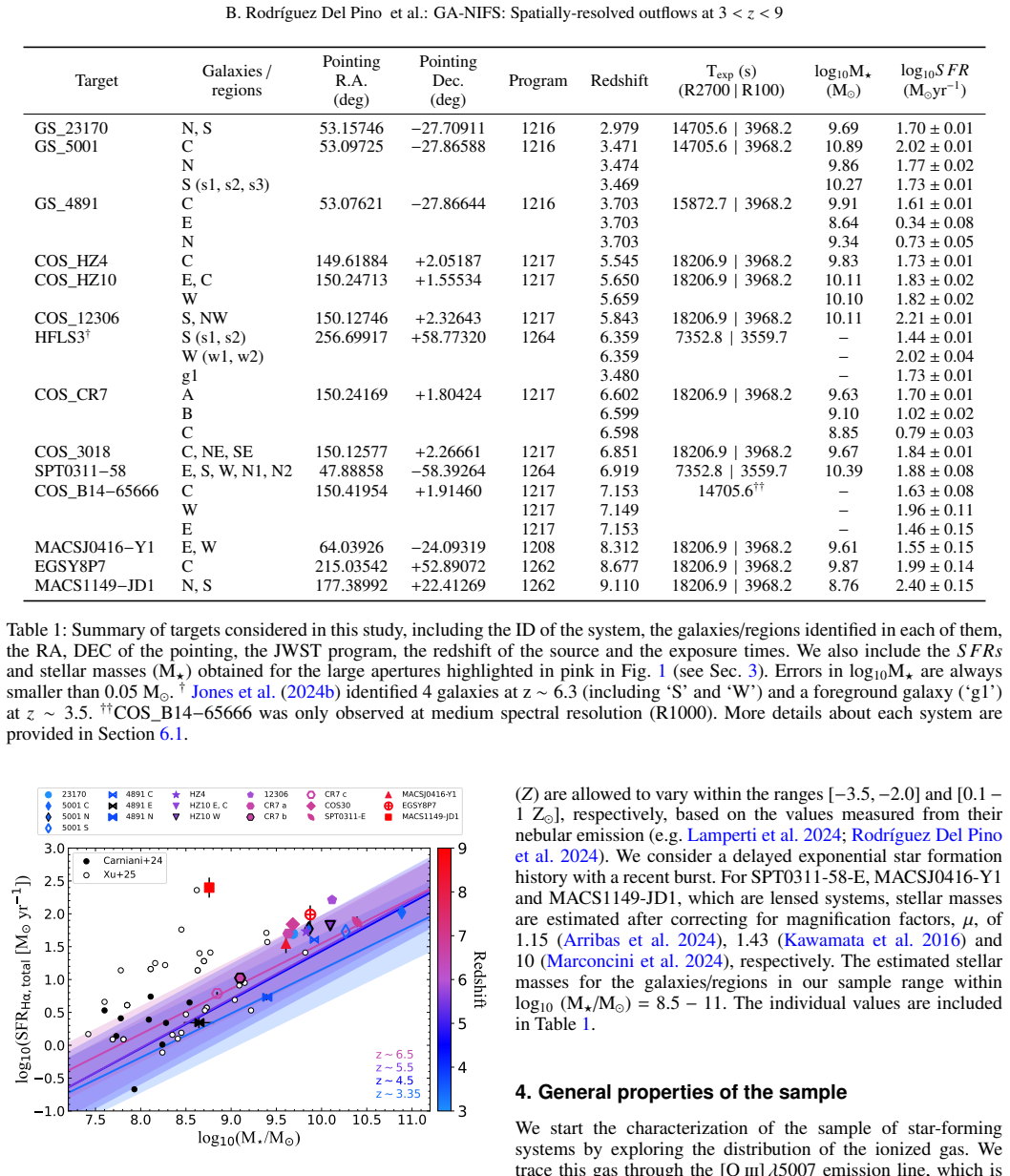
Summary. The paper presents a search for and characterization of ionized outflows in 40 galaxies/regions belonging to 15 star-forming systems at z~3–9, using JWST/NIRSpec IFU data from GA-NIFS. Broad kinematic components are identified in 14/40 regions (≈35% incidence). From two-component spectral fits, the authors report that the broad (outflow) component is on average more dust-attenuated (ΔA_V≈0.59 mag) and more metal-enriched (Δ12+log(O/H)≈0.13 dex) than the narrow (ISM) component. They compute mass-loading factors η=Ṁ_out/SFR using a conical outflow model and the Carniani et al. (2024) formulation for M_out, finding η≤1 in most outflows (10/14 excluding candidates; the abstract says 9/14), and compare v_out with an estimated escape velocity, concluding that most outflows remain bound and that ejective feedback is inefficient in massive, luminous high-z star-forming galaxies.
Significance. If the main result holds, this is a valuable benchmark: it is one of the first large, spatially resolved NIRSpec IFU studies of ionized outflows at z>3 in the high-mass regime (log M*/M⊙≈9.5–11), complementing earlier MOS/WFSS studies of lower-mass galaxies. The paper’s strengths include a homogeneous reduction and MCMC spectral modeling with tied kinematics, direct Balmer-decrement and metallicity measurements for the broad component in a subset, careful discussion of AGN exclusion, and an explicit comparison with previous samples that reveals a significant v_out–SFR correlation. The main limitation is that the central η-based conclusion is inversely proportional to an unmeasured outflow electron density; a realistic lower n_out would flip the headline. The paper is transparent about this and other assumptions, but the conclusions currently overstate the robustness of the 'inefficient ejective feedback' claim.
major comments (3)
- [§7.2.1, Eq. (2)] The mass-loading factor and hence the central claim of inefficient ejective feedback scale as η ∝ M_out ∝ n_out^{-1}. For 9 of 14 outflows the broad-component electron density is not measured and a common n_out=500 cm^-3 is adopted; [OII] and [SII] doublets are blended or low-S/N. If the true outflow density is ~100 cm^-3, as is plausible for expanded outflowing gas, η increases by a factor ~5 and most of the 14 outflows would have η>1. The sensitivity test with n_e=380 cm^-3 only raises η by ~30% and does not bracket this regime. I request an explicit sensitivity analysis over n_out≈100–1000 cm^-3 (or a stacked measurement of broad-component density-sensitive doublets), and conclusions that clearly state this dependence. This is load-bearing because it directly affects the 'η≤1 in 9/14' summary.
- [§5 and §7.2.2] The outflow sample is defined by the presence of a broad component with σ_broad>100 km/s (or a single component with σ>140 km/s) in [OIII]/Hα. The claim that the broad component is metal-enriched and therefore truly an outflow is not an independent test, because the same broad component is used both to define the outflow and to measure Z_broad and A_V,broad. Merger-induced turbulence can also produce broad, high-σ emission, and the selection in merging systems is explicitly subjective (Sec. 5, Appendix B.10). To make the outflow identification load-bearing for the incidence (14/40) and metal-enrichment results, the authors should provide robustness tests (e.g., varying the σ threshold, alternative region definitions, excluding all merger/tidal systems) and, if possible, an independent kinematic or spatial criterion for outflow nature.
- [§6.2.1, Table 2, §7.1] The quoted incidence (≈35%) and average outflow dust/metal enhancements are computed after subjective choices of outflow apertures and after excluding two candidate outflows (HZ10_E and B14). The regions range from nearly the whole broad-emission extension to small nuclear circular apertures in mergers. No uncertainty is propagated from these region definitions into the average A_V, Z, r_out, or η. Since the paper’s headline comparison with previous works and its 'dusty and metal-enriched outflows' claim depend on these choices, a robustness analysis (e.g., including the candidates, using a flux-weighted size, or alternative region boundaries) is needed to demonstrate that the averages and the incidence are stable.
minor comments (5)
- [Abstract and §8] The abstract states 'η≤1, in 9 out of 14 the outflows' while the text and Table 2 (excluding HZ10_E and B14) indicate 10 of 14 outflows have η≤1. Please reconcile the count.
- [Table 2 caption] The caption lists M_out as a column, but the table does not contain M_out. Either add the column or remove the mention.
- [§6.2.3] Text reads 'down to 100 km^-1'; should be 'km/s'.
- [§7.1] The sentence 'with our data is less challenging and subject to lower uncertainties' is grammatically incomplete; the intended meaning is likely that the identification is less challenging and has lower uncertainties.
- [Appendix B.10 vs Table 2] Appendix B.10 says 'we do not consider the presence of a clear outflow in this system' for B14, yet Table 2 lists B14 as a candidate outflow with measured properties. Clarify this apparent inconsistency.
Circularity Check
No significant circularity: outflow properties are measured, not defined into existence; η and v_esc rest on stated assumptions, not fitted predictions.
full rationale
The paper's central quantities are direct spectral measurements (broad-component kinematics, Balmer decrements, line ratios) or model-dependent estimates whose assumptions are stated and tested rather than fitted to the target conclusions. The outflow sample is defined kinematically (two-component fits with σ_broad>100 km/s and spatial association with star formation), and the reported A_V and metallicity enhancements are measured on those components, not imposed by the selection; the paragraph in Sec. 5 using those enhancements to argue against a merger interpretation is a consistency check, not a derivation. The mass-loading factors follow Eqs. 1-2 with adopted n_out values (systemic or 500 cm^-3), and the paper explicitly quantifies the sensitivity to n_e (Sec. 7.2.1); this is an assumption, not a fitted input masquerading as a prediction. The escape-velocity comparison uses an assumed M_dyn=2 M_star (Sec. 7.2.2) from prior work, but this is a parameter assumption with stated direction, not a self-referential derivation. No equation in the paper reduces to its own input, and no load-bearing claim is forced by a self-citation chain. Therefore no significant circularity is found.
Axiom & Free-Parameter Ledger
free parameters (5)
- Outflow electron density n_out =
500 cm^-3 (9 galaxies); systemic n_e for 5
- Outflow radius r_out =
0.5-1.7 kpc; 0.25-0.3'' aperture for mergers
- Dynamical-to-stellar mass ratio M_dyn/M_star =
2
- Outflow selection thresholds =
σ_broad>100 km/s; single σ>140 km/s
- A_V,broad for 4 galaxies =
A_V,broad = A_V,narrow
axioms (5)
- domain assumption A broad, high-σ emission-line component traces a galactic outflow
- domain assumption Calzetti attenuation law and Case B ratios (Hα/Hβ=2.86) apply at z=3-9
- domain assumption BPT and Mazzolari diagnostics reliably separate SF from AGN at high z
- domain assumption Constant mass-outflow-rate conical outflow model (Lutz 2020)
- domain assumption SFR calibration of Clarke et al. (2024) with Z*=0.004 is valid for these galaxies
Cite this review
Pith. "Pith review of GA-NIFS: high prevalence of dusty and metal-enriched outflows in massive and luminous star-forming galaxies at $z\sim3-9$." pith.science (2026). https://pith.science/paper/Y57MRIT7
@misc{pith2026260106255,
  author       = {Pith},
  title        = {Pith review of: GA-NIFS: high prevalence of dusty and metal-enriched outflows in massive and luminous star-forming galaxies at $z\sim3-9$},
  year         = {2026},
  howpublished = {\url{https://pith.science/paper/Y57MRIT7}},
  note         = {Machine review of arXiv:2601.06255}
}
read the original abstract
We present a search for and characterization of ionized outflows in 15 star-forming systems at $z\sim3-9$ with no evidence of Active Galactic Nuclei (AGN), observed with JWST/NIRSpec IFU as part of the GA-NIFS program. The targets often show satellites and complex substructure, from which we isolate 40 galaxies/regions. The sample probes the high-mass end of the galaxy population, with most sources having log$_{10}$~(M$_\star$/M$_\odot$)=$9.5-11$, extending previous studies on high-z star formation driven outflows that mainly focused on lower-mass galaxies. Using the [OIII]5007 and H$\alpha$ emission lines, we identify broad kinematic components consistent with galactic outflows in 14 galaxies/regions. We find that the outflowing gas is more dust attenuated (by $A_{\rm V}$$\sim0.59$ mag on average) and metal-enriched (0.13 dex) than the interstellar medium (ISM) of the host galaxies, but its velocities are insufficient to escape the galaxies and reach the circumgalactic medium, suggesting that outflows mainly redistribute dust and metals around their hosts. The outflows identified in this study display velocity dispersions within $\sigma_{\rm out}=130-340$~km~s$^{-1}$ and outflow velocities $v_{\rm out}=170-600$~km~s$^{-1}$, and, when combined with less luminous and less massive star-forming galaxies from previous works, reveal a statistically significant correlation between $v_{\rm out}$ and star formation rate (SFR). The typically low mass-loading factors ($\eta=\dot{M}_{\rm out}/SFR$$\leq1$, in 9 out of 14 the outflows) indicate that these outflows do not strongly suppress star formation. Overall, our results suggest that ejective feedback via ionized outflows is inefficient in massive, luminous star-forming galaxies within the first 2 Gyr of the Universe.
Figures




Forward citations
Cited by 4 Pith papers
-
Intense and extended CIII] emission suggests a strong outflow in JADES-GS-z14-0
Extended CIII] emission offset from the stars in a z=14.18 galaxy indicates outflows with mass outflow rate ~160 solar masses per year and mass-loading factor 4-15, constraining star-formation efficiency to below 0.08.
-
GLIMPSED: Direct evidence for a fast AGN-driven outflow from a z=6.64 Little Red Dot host galaxy
A z=6.64 LRD host galaxy exhibits a fast AGN-driven outflow with 5500 km/s velocities, dusty gas, and low metallicity, confirming AGN presence in these systems.
-
PhotoIFU: NIRCam as a Photometric Integral Field Unit for Mapping Feedback in Galaxies
PhotoIFU maps stellar mass, star-formation rate, dust, and metallicity pixel-by-pixel from JWST imaging, and finds gas-outflow regions are distinct from host galaxies in three z≈1.3–3.7 systems.
-
DREAMS. JWST Spectroscopy of a $z=8.3$ Galaxy with an ALMA Dust Continuum Detection: Early Dust, Very High $T_{\rm dust}$, and a Multi-wavelength [OIII] Ratio Discrepancy
New JWST spectrum of a z=8.3 galaxy with prior ALMA dust detection shows AGN signatures, 0.15 Zsun metallicity, Mdust ~10^6 Msun, Tdust~91 K, and an [OIII] line ratio higher than nebular models allow.
Reference graph
Works this paper leans on
-
[1]
Álvarez-Márquez, J., Colina, L., Crespo Gómez, A., et al. 2024, Astronomy and Astrophysics, 686, A85 Arribas, S., Colina, L., Bellocchi, E., Maiolino, R., & Villar-Martín, M. 2014, Astronomy and Astrophysics, 568, A14 Article number, page 14 of 39 B. Rodríguez Del Pino et al.: GA-NIFS: Spatially-resolved outflows at 3<z<9 Arribas, S., Perna, M., Rodríguez...
Pith/arXiv arXiv 2024
-
[4]
(2024) already identified a spatially resolved ionized bi-conical outflow with an extension of∼3 kpc along the minor axis of the central galaxy of this system (see their Figure 6)
In their study, Lamperti et al. (2024) already identified a spatially resolved ionized bi-conical outflow with an extension of∼3 kpc along the minor axis of the central galaxy of this system (see their Figure 6). Similarly to their results, we find a region with enhanced velocity dispersion extending to the East and West from the central regions of 5001-C...
2024
-
[5]
To compute these losses, we start by generating a data cube containing the simulated PSF of the NIRSpec IFS mode using the STPSF3 Python package
we apply a correction for the light losses outside the adopted apertures caused by the NIRSpec PSF. To compute these losses, we start by generating a data cube containing the simulated PSF of the NIRSpec IFS mode using the STPSF3 Python package. At this stage we work with a data cube generated in the R100 mode, which allows to compute the losses across th...
2018
-
[6]
Jones et al
observations. Jones et al. (2025) identified the presence of a broad component associated to the integrated spectra of these structures (FW H M∼550−750 km/s), as well as an extended broad emission as traced by theW80 index over a region of about 4 kpc along the direction of the two main cores. They interpreted these features as due to tidal effects or the...
2025
-
[2019]
and [Cii] 157.7µm (Bakx et al. 2020). In a recent study using NIRCam/WFSS data, Ma et al. (2024) estimated highS FRs (∼165M ⊙yr−1), relatively large dust extinctionA V =0.92− 1.10 mag and very young stellar populations (<5 Myr). In our study, we identify a compact (r out =0.5 kpc) ionized outflow in a star-forming region at the East of the system, and σou...
2020
-
[2025]
have revealed three close merging galaxies/structures in the system, HZ4-N, HZ4-C, and HZ4-S, all within a projected distance of about 4 kpc. They detect and characterize ionized outflows in HZ4-C and found that it extends over regions of up to 4 kpc with velocity 4The FoV also includes GS-4923, but this galaxy has a photometric redshift of about 0.2 acco...
2021
This paper was first reviewed by deepseek-v4-flash on August 3, 2026.
discussion (0)
Sign in with ORCID, Apple, or X to comment. Anyone can read and Pith papers without signing in.