REVIEW 3 major objections 5 minor 63 references
Shaping the global drive compresses gate times by ~10× and restores high fidelities under decoherence in a ladder processor.
Reviewed by Pith at T0; open to challenge. T0 means a machine referee read the full paper against a public rubric. the ladder, T0–T4 →
GRAPE-optimized global drives compress Hadamard sequences from ~3000 ns to ~320 ns and raise fidelity under strong relaxation from ~0.64 to ~0.96 in a 15-qubit globally driven ladder.
T0 review reviewed 2026-07-31 challenge →
load-bearing objection Solid open-system numerics on their ladder: GRAPE shortens the global Hadamard ~10× and restores high F under local T1, but the restored-fidelity claim is still mostly for the easy |gg⟩ payload. the 3 major comments →
Mitigating quantum decoherence via global optimal control
The pith
A machine-rendered reading of the paper's core claim, the machinery that carries it, and where it could break.
The reading
Core claim
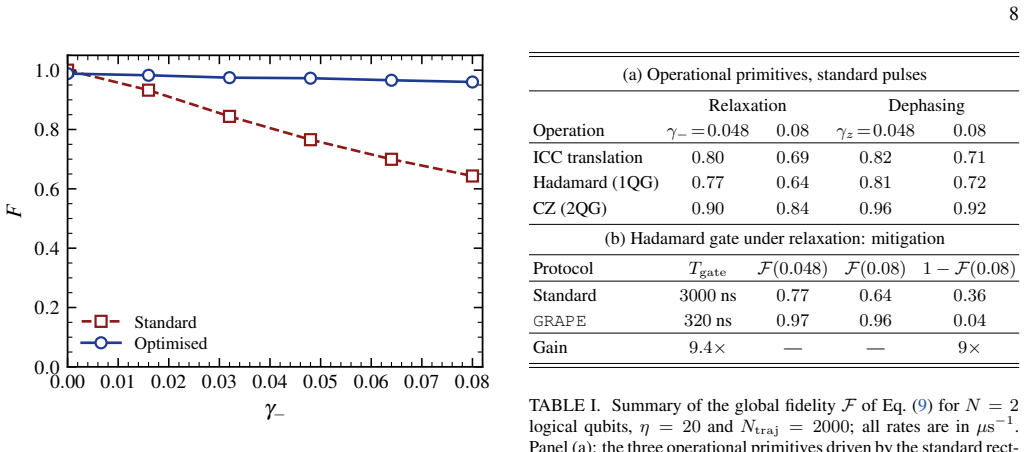
Global optimal control, by compressing gate sequences by nearly an order of magnitude in time, restores high one-qubit gate fidelities under decoherence in a globally driven ladder architecture. For the Hadamard under pure relaxation the standard rectangular protocol falls to F≈0.64 at γ−=0.08 µs−1 while the optimized pulse stays near F≈0.96, and the gain is obtained purely by reshaping the shared drives rather than by shielding any subsystem.
What carries the argument
MPS-based GRAPE pulse optimization on the full 15-qubit ladder: control amplitudes are bounded and discretized at ~1 ns, gradients are obtained by forward/backward TDVP propagation, and the cost is a noiseless fidelity averaged over training states, yielding a ~320 ns Hadamard that still implements the target rotation.
Load-bearing premise
The noise is modeled by simple on-site relaxation and dephasing jumps that stay unchanged after moving to the rotating frame; if the true jumps are dressed by the strong interactions, the reported fidelity gains from shorter pulses need not hold.
What would settle it
Implement the GRAPE-optimized Hadamard on a physical ladder device (or a high-fidelity master-equation simulation with secular dressed jump operators) at γ−≈0.08 µs−1 and check whether measured fidelity remains near 0.96 or collapses toward the standard-pulse value.
If this is right
- Gate duration, not bare channel rates alone, is the primary lever controlling decoherence accumulation in this architecture.
- The same optimized pulses can simultaneously absorb a few-percent static frequency disorder and dynamical relaxation.
- CZ remains comparatively robust because its native duration is already ~π/Ω, leaving little room for further compression.
- Fault-tolerant pulse design for globally driven ladders can start from the same MPS-GRAPE engine.
- Relaxation on spectator qubits that sustain Néel and ferromagnetic order is the dominant error pathway that pulse shortening must outrun.
Where Pith is reading between the lines
- If the compression factor continues to scale with system size, global-drive architectures may remain competitive with locally addressed processors even when T1 is only tens of microseconds.
- The same temporal-shaping idea should transfer to other blockade-based global platforms (Rydberg arrays, spin chains) whose logical subspace is protected by an ordered background.
- Non-Markovian or thermal corrections that reintroduce dressed jumps would be the natural next stress test of the mitigation claim.
Editorial analysis
A structured set of objections, weighed in public.
Referee Report
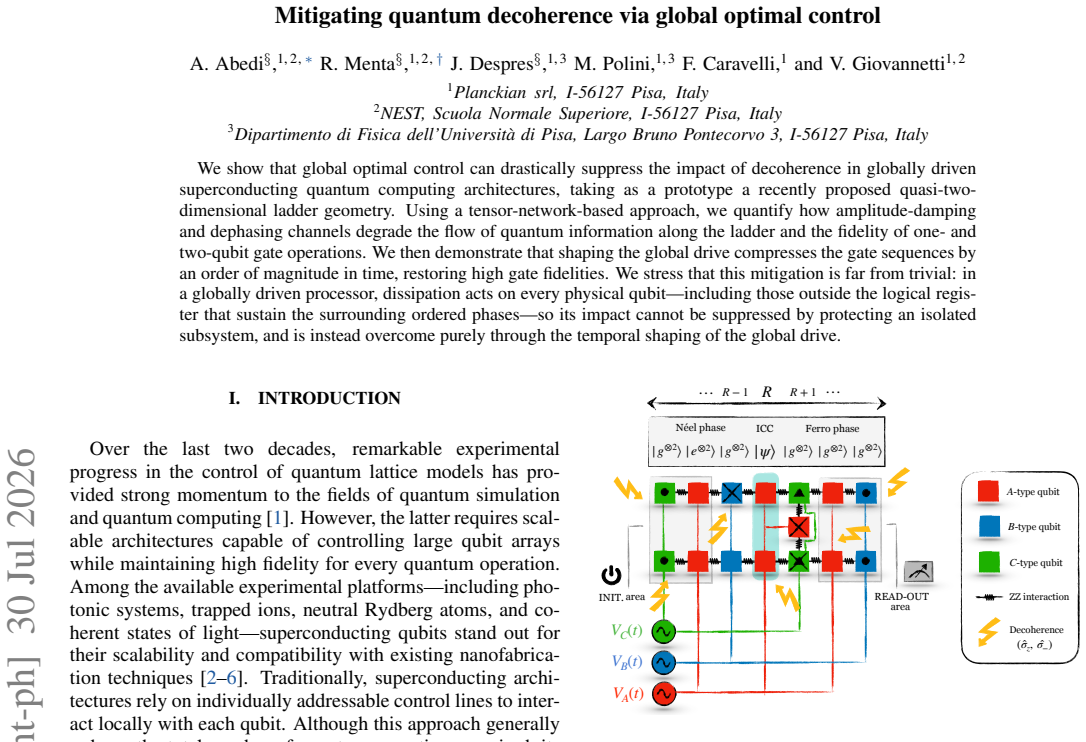
Summary. The manuscript studies decoherence in a globally driven superconducting ladder architecture that encodes logical qubits in domain-wall (well-formed) states. Using an RF+RWA effective Hamiltonian and a local GKSL model with amplitude-damping and dephasing jumps, the authors simulate ICC translation, Hadamard, and CZ operations via MPS quantum trajectories. They find that relaxation is typically more damaging than dephasing at equal bare rates, that CZ is relatively robust because it is short, and that GRAPE-optimized global pulses compress the Hadamard from ~3000 ns to ~320 ns, raising fidelity under relaxation from F≈0.64 to F≈0.96 at γ−=0.08 (including 2% frequency disorder). The central message is that decoherence acting on the entire physical lattice—including spectator qubits that sustain Néel/ferro order—can be mitigated purely by temporal shaping of the global drive.
Significance. If the numerical claims hold under broader logical inputs and a more carefully justified open-system model, the work is a useful and timely contribution to globally controlled superconducting architectures. It connects an existing ladder encoding to concrete decoherence metrics and shows that optimal control can simultaneously address static disorder and dynamical noise without local addressing—an attractive hardware-level message. Strengths include an explicit control decomposition (Appendix B), a documented trajectory/MPS pipeline with stated cutoffs (N_traj=2000, max bond 200, λ=10−12), public data, and a clear Table I / Fig. 6 comparison of standard vs optimized Hadamard performance. The result is incremental relative to the authors’ prior architecture and disorder papers, but the decoherence-mitigation numbers are new and actionable for near-term experiments.
major comments (3)
- [Sec. III–IV, Table I, Fig. 6] Sec. III A–C and Table I(b)/Fig. 6: the restored-fidelity claim under GRAPE is demonstrated almost exclusively for the favorable payload |ψ_in⟩=|g1 g2⟩, which the text itself calls “the most robust payload” (no logical excitations for σ−, no static logical coherences for σz). Fig. 4 only checks the optimized pulse in the noiseless limit over populations at fixed φ=0. The abstract and conclusion state that shaping “restores high gate fidelities” for computation, but that is not yet shown for logical superpositions or |e⟩ under dissipation. Please add at least (i) optimized Hadamard fidelities vs γ− for a small set of logical inputs spanning superpositions (or a Haar/process average on the ICC), and/or (ii) a logical-subspace process fidelity alongside global F (Eq. 9). If the gain shrinks substantially, the abstract wording should be narrowed accordingly.
- [Sec. II, Appendix C] Sec. II and Appendix C: the open-system model uses on-site σ− and σz jumps that remain form-invariant under RF+RWA. The paper correctly flags this as a phenomenological choice and notes that a secular derivation in the strongly interacting (η=20) blockade regime would produce dressed, frequency-dependent jumps. Because the mitigation mechanism is “shorten exposure while preserving blockade,” a qualitative change in jump structure (e.g., correlated or blockade-conditioned loss) could alter the reported gains. A short robustness check—e.g., a comparison with a simple dressed or correlated dissipator on a reduced ladder, or a clear statement of the regime of validity and how it would fail—would make the central claim much more secure.
- [Sec. IV B–C] Sec. IV C: optimization maximizes a noiseless cost over a training set, then fidelity under noise is evaluated post hoc. That is a standard and legitimate workflow, but the manuscript should state the training-set size/composition and confirm that the optimized pulse was not implicitly tuned on the same |gg⟩ dissipative trajectories used in Fig. 6. A brief hold-out (unseen logical inputs under noise) would remove any residual concern that the 0.96 figure is overfit to the reported configuration.
minor comments (5)
- [Sec. III A] Eq. (9) vs Eq. (11): the text mixes “root” fidelity F with the trajectory average of the squared overlap. State once, prominently, which quantity is plotted in every figure (including whether error bars are std. err. of the mean over trajectories).
- [Figs. 2, 3, 6] Fig. 2–3 and Fig. 6: axis labels give γ in µs−1 while the calibration Ωχ=10 µs−1 is in the text; a secondary axis or explicit γ/Ω would help comparison with device T1 values.
- [Sec. IV] The CZ gate is omitted from the optimization study because it is already short; a one-sentence estimate of residual headroom (or a statement that GRAPE was tried and gave negligible further compression) would round out Sec. IV.
- [Throughout / References] Typos/notation: “N ´eel” spacing is inconsistent; “RW A” vs “RWA”; arXiv IDs in the reference list that look like future/placeholder numbers should be checked for correctness before publication.
- [Appendix D] Appendix D: max(m)=200 and λ=10−12 are stated; a one-line bond-dimension convergence check for the longest (standard Hadamard) noisy runs would strengthen reproducibility.
Circularity Check
No meaningful circularity: decoherence-mitigation fidelities are forward trajectory outputs, not identities forced by fits or self-citation.
specific steps
-
self citation load bearing
[Sec. II; Appendix A–B; refs. [27–29, 38]]
"The system we consider here, schematically represented in Fig. 1, is based on the architecture introduced in Ref. [27]. ... A detailed analysis of these effects for the minimal globally driven ladder architecture, both with and without pulse optimization, is presented in Ref. [38]."
The ladder encoding, blockade, and standard gate pulse decompositions are justified primarily by overlapping-author citations rather than re-derived here. This is setup dependence, not circularity of the decoherence-mitigation numbers: those are new trajectory averages under the stated LME and are not forced by the cited construction.
full rationale
The paper’s load-bearing chain is numerical, not definitional. Architecture, well-formed encoding, and standard rectangular pulse sequences are taken from the authors’ prior work ([27–29, 38]), which is ordinary platform setup rather than a uniqueness theorem that forces the mitigation claim. Dissipative dynamics are integrated from a stated GKSL master equation (Eq. 5) via MPS quantum trajectories; fidelities (Eq. 9/11) are ensemble averages over those trajectories. GRAPE maximizes a noiseless overlap cost and produces shorter controls (T_opt≈320 ns vs T_std≈3000 ns); resilience under γ− is then re-simulated, not read off the training objective. Shorter exposure reducing decoherence is a physical consequence of the Lindblad generator, not a fit renamed as prediction. No parameter is fitted to noisy data and then “predicted”; no uniqueness result is imported to forbid alternatives; no known empirical law is merely renamed. Residual score 1 reflects only that the computational setting is group-internal, which does not make Table I / Fig. 6 circular.
Axiom & Free-Parameter Ledger
free parameters (6)
- Rabi calibration Ωχ =
10 µs−1 (angular)
- ZZ coupling ζ / interaction ratio η =
ζ=200 µs−1, η=20
- Dissipation sweep range γ−, γz =
[0, 0.08] µs−1
- GRAPE time step and amplitude bounds =
~1 ns steps, amplitudes in [−1,1]
- Static disorder level in optimized runs =
2% relative
- MPS/trajectory numerical cutoffs =
max m=200, λ=10−12, N_traj=2000
axioms (6)
- domain assumption Laboratory dissipator with local σ− and σz jumps remains valid after RF+RWA and captures dominant noise in the strongly interacting ladder.
- domain assumption Zero-temperature amplitude damping (pure loss) is the relevant relaxation limit for these superconducting qubits.
- domain assumption Markovian GKSL evolution adequately describes decoherence accumulation over gate duration.
- domain assumption In η≫1, global drives implement controlled unitaries via pseudo-Rydberg blockade projectors (well-formed subspace closed under controls).
- standard math Quantum trajectory average of pure MPS states converges to the Lindblad prediction for the reported observables at N_traj=2000.
- ad hoc to paper Noiseless GRAPE cost maximized over a training set yields pulses that implement the target Hadamard for the sampled family of inputs.
invented entities (1)
-
Information carrier column (ICC) / well-formed domain-wall encoding on the globally driven ladder
independent evidence
Cite this review
Pith. "Pith review of Mitigating quantum decoherence via global optimal control." pith.science (2026). https://pith.science/paper/Y65LRR32
@misc{pith2026260728479,
  author       = {Pith},
  title        = {Pith review of: Mitigating quantum decoherence via global optimal control},
  year         = {2026},
  howpublished = {\url{https://pith.science/paper/Y65LRR32}},
  note         = {Machine review of arXiv:2607.28479}
}
read the original abstract
We show that global optimal control can drastically suppress the impact of decoherence in globally driven superconducting quantum computing architectures, taking as a prototype a recently proposed quasi-two-dimensional ladder geometry. Using a tensor-network-based approach, we quantify how amplitude-damping and dephasing channels degrade the flow of quantum information along the ladder and the fidelity of one- and two-qubit gate operations. We then demonstrate that shaping the global drive compresses the gate sequences by an order of magnitude in time, restoring high gate fidelities. We stress that this mitigation is far from trivial: in a globally driven processor, dissipation acts on every physical qubit---including those outside the logical register that sustain the surrounding ordered phases---so its impact cannot be suppressed by protecting an isolated subsystem, and is instead overcome purely through the temporal shaping of the global drive.
Figures


Reference graph
Works this paper leans on
-
[1]
Lloyd, Universal quantum simulators, Science273, 1073 (1996)
S. Lloyd, Universal quantum simulators, Science273, 1073 (1996)
1996
-
[2]
Arute and et al., Quantum supremacy using a programmable superconducting processor, Nature574, 505 (2019)
F. Arute and et al., Quantum supremacy using a programmable superconducting processor, Nature574, 505 (2019)
2019
-
[3]
Wu and et al., Strong quantum computational advantage us- ing a superconducting quantum processor, Phys
T. Wu and et al., Strong quantum computational advantage us- ing a superconducting quantum processor, Phys. Rev. Lett.127, 180501 (2021)
2021
-
[4]
Bravyi, O
S. Bravyi, O. Dial, J. M. Gambetta, D. Gil, and Z. Nazario, The future of quantum computing with superconducting qubits, J. Appl. Phys.132, 160902 (2022)
2022
-
[5]
Ezratty, Perspective on superconducting qubit quantum com- puting, Eur
O. Ezratty, Perspective on superconducting qubit quantum com- puting, Eur. Phys. J. A59, 94 (2023)
2023
-
[6]
Van Damme, S
J. Van Damme, S. Massar, R. Acharya, T. Ivanov, D. Perez Lozano, Y . Canvel, M. Demarets, D. Vangoidsen- hoven, Y . Hermans, J. G. Lai, A. M. Vadiraj, M. Mongillo, D. Wan, J. De Boeck, A. Poto ˇcnik, and K. De Greve, Ad- vanced cmos manufacturing of superconducting qubits on 300 mm wafers, Nature634, 74–79 (2024)
2024
-
[7]
Krinner, S
S. Krinner, S. Storz, P. Kurpiers, P. Magnard, J. Heinsoo, R. Keller, J. L ¨utolf, C. Eichler, and A. Wallraff, Engineering cryogenic setups for 100-qubit scale superconducting circuit systems, EPJ Quantum Technology6(2019)
2019
-
[8]
R. J. Schoelkopf and S. M. Girvin, Wiring up quantum systems, Nature451, 664–669 (2008)
2008
-
[9]
J. M. Gambetta, J. M. Chow, and M. Steffen, Building logi- cal qubits in a superconducting quantum computing system, npj Quantum Inf.3, 2 (2017)
2017
-
[10]
D. Rosenberg, D. Kim, R. Das, D. Yost, S. Gustavsson, D. Hover, P. Krantz, A. Melville, L. Racz, G. O. Samach, S. J. Weber, F. Yan, J. L. Yoder, A. J. Kerman, and W. D. Oliver, 3d integrated superconducting qubits, npj Quantum Information3, 10.1038/s41534-017-0044-0 (2017)
-
[11]
Kjaergaard, M
M. Kjaergaard, M. E. Schwartz, J. Braum ¨uller, P. Krantz, J. I. Wang, S. Gustavsson, and W. D. Oliver, Superconducting qubits: current state of play, Annu. Rev. Condens. Matter Phys. 11, 369 (2020)
2020
-
[12]
M. Mohseni and et al., How to build a quantum supercom- puter: Scaling challenges and opportunities, arXiv:2411.10406 (2024)
Pith/arXiv arXiv 2024
-
[13]
Richter, I
M. Richter, I. Strandberg, S. Gasparinetti, and A. F. Kockum, Overhead in quantum circuits with time-multiplexed qubit con- trol, PRX Quantum7, 020308 (2026)
2026
-
[14]
Lloyd, A potentially realizable quantum computer, Science 261, 1569 (1993)
S. Lloyd, A potentially realizable quantum computer, Science 261, 1569 (1993)
1993
-
[15]
S. C. Benjamin, Simple pulses for universal quantum compu- tation with a heisenberg abab chain, Phys. Rev. A64, 054303 (2001)
2001
-
[16]
S. C. Benjamin, Quantum computing without local control of qubit-qubit interactions, Phys. Rev. Lett.88, 017904 (2001)
2001
-
[17]
Levy, Universal quantum computation with spin-1/2 pairs and heisenberg exchange, Phys
J. Levy, Universal quantum computation with spin-1/2 pairs and heisenberg exchange, Phys. Rev. Lett.89, 147902 (2002)
2002
-
[18]
S. C. Benjamin and S. Bose, Quantum computing with an always-on heisenberg interaction, Phys. Rev. Lett.90, 247901 (2003)
2003
-
[19]
always-on
S. C. Benjamin and S. Bose, Quantum computing in arrays coupled by “always-on” interactions, Phys. Rev. A70, 032314 (2004)
2004
-
[20]
Ivanyos, S
G. Ivanyos, S. Massar, and A. B. Nagy, Quantum computing on lattices using global two-qubit gates, Phys. Rev. A72, 022339 (2005)
2005
-
[21]
Kay and J
A. Kay and J. K. Pachos, Quantum computation in optical lat- tices via global laser addressing, New J. Phys.6, 126 (2004)
2004
-
[22]
Fitzsimons and J
J. Fitzsimons and J. Twamley, Globally controlled quantum wires for perfect qubit transport, mirroring, and computing, Phys. Rev. Lett.97, 090502 (2006)
2006
-
[23]
G. A. Paz-Silva, G. K. Brennen, and J. Twamley, Globally con- trolled universal quantum computation with arbitrary subsys- tem dimension, Phys. Rev. A80, 052318 (2009)
2009
-
[24]
Cesa and H
F. Cesa and H. Pichler, Universal quantum computation in glob- ally driven rydberg atom arrays, Phys. Rev. Lett.131, 170691 (2023)
2023
-
[25]
S. M. Patomaki, M. F. Gonzalez-Zalba, M. A. Fogarty, Z. Cai, S. C. Benjamin, and J. J. L. Morton, Pipeline quantum proces- sor architecture for silicon spin qubits, npj Quantum Inf.10, 31 (2024)
2024
-
[26]
Siegel, Z
A. Siegel, Z. Cai, H. Jnane, B. Koczor, S. Pexton, A. Strikis, and S. Benjamin, Quantum snakes on a plane: Mobile, low- dimensional logical qubits on a 2d surface, PRX Quantum7, 010339 (2026). 10
2026
-
[27]
Menta, F
R. Menta, F. Cioni, R. Aiudi, M. Polini, and V . Giovannetti, Globally driven superconducting quantum computing architec- ture, Phys. Rev. Res.7, L012065 (2025)
2025
-
[28]
Cioni, R
F. Cioni, R. Menta, R. Aiudi, M. Polini, and V . Giovannetti, Conveyor-belt superconducting quantum computer, Phys. Rev. A113, 012439 (2026)
2026
-
[29]
Menta, F
R. Menta, F. Cioni, R. Aiudi, F. Caravelli, M. Polini, and V . Gio- vannetti, Building globally controlled quantum processors with zzinteractions, Phys. Rev. A113, 012614 (2026)
2026
-
[30]
A. Bririd, S. C. Benjamin, and A. Kay, Quantum error correc- tion in globally controlled arrays, quant-ph/0308113 (2004)
Pith/arXiv arXiv 2004
-
[31]
Kay, Error correcting the control unit in global control schemes, quant-ph/0504197 (2005)
A. Kay, Error correcting the control unit in global control schemes, quant-ph/0504197 (2005)
Pith/arXiv arXiv 2005
-
[32]
Kay, Deriving a fault-tolerant threshold for a global control scheme, quant-ph/0702239 (2007)
A. Kay, Deriving a fault-tolerant threshold for a global control scheme, quant-ph/0702239 (2007)
Pith/arXiv arXiv 2007
-
[33]
J. Fitzsimons and J. Twamley, Globally controlled fault tolerant quantum computation, 0707.1119 (2007)
Pith/arXiv arXiv 2007
-
[34]
Fitzsimons and J
J. Fitzsimons and J. Twamley, Quantum fault tolerance in sys- tems with restricted control, Electronic Notes in Theoretical Computer Science258, 35–49 (2009)
2009
-
[35]
M. Riccardi, A. Glezer Moshe, G. Menichetti, R. Aiudi, C. Cosenza, A. Abedi, R. Menta, H. G. Ahmad, D. Nieri Orfatti, F. Cioni, D. Massarotti, F. Tafuri, V . Giovannetti, M. Polini, F. Caravelli, and D. Szombati, Experimental observation of dy- namical blockade between transmon qubits via zz interaction engineering, arXiv:2601.11714 (2026)
arXiv 2026
-
[36]
Gorini, A
V . Gorini, A. Kossakowski, and E. C. G. Sudarshan, Completely positive dynamical semigroups of n-level systems, Journal of Mathematical Physics17, 821 (1976)
1976
-
[37]
Lindblad, On the generators of quantum dynamical semi- groups, Communications in Mathematical Physics48, 119 (1976)
G. Lindblad, On the generators of quantum dynamical semi- groups, Communications in Mathematical Physics48, 119 (1976)
1976
-
[38]
Aiudi, J
R. Aiudi, J. Despres, R. Menta, A. Abedi, G. Menichetti, V . Giovannetti, M. Polini, and F. Caravelli, Overcoming dis- order in superconducting globally driven quantum computing, Phys. Rev. A113, 012616 (2026)
2026
-
[39]
M. Werner, Polynomial equivalence of the global transverse- field ising model and the gate model of quantum computation, arXiv:2607.01227 (2026)
Pith/arXiv arXiv 2026
-
[40]
Menta, F
R. Menta, F. Caravelli, and V . Giovannetti, in preparation
-
[41]
Khaneja, T
N. Khaneja, T. Reiss, C. Kehlet, T. Schulte-Herbr ¨uggen, and S. J. Glaser, Optimal control of coupled spin dynamics: design of nmr pulse sequences by gradient ascent algorithms, Journal of Magnetic Resonance172, 296–305 (2005)
2005
-
[42]
D. P. Kingma and J. Ba, Adam: A method for stochastic opti- mization (2017), arXiv:1412.6980 [cs.LG]
Pith/arXiv arXiv 2017
-
[43]
H.-Y . Hu, A. M. Gomez, L. Chen, A. Trowbridge, A. J. Gold- schmidt, Z. Manchester, F. T. Chong, A. Jaffe, and S. F. Yelin, Universal dynamics with globally controlled analog quantum simulators, arXiv:2508.19075 (2025)
arXiv 2025
-
[44]
R. Gargiulo, R. Menta, V . Giovannetti, and R. Zeier, Ob- structions to universality in globally controlled qubit graphs, arXiv:2604.18699 (2026)
Pith/arXiv arXiv 2026
-
[45]
D. I. Bondar, L. m. c. B. Gaggioli, G. Korpas, J. Marecek, J. Vala, and K. Jacobs, Globally optimal control of quantum dynamics, Phys. Rev. Res.7, 043202 (2025)
2025
-
[46]
G. Pellitteri, V . Cavina, and V . Giovannetti, Controlling the non- markovianity of quantum brownian motion, arXiv:2606.30730 (2026)
Pith/arXiv arXiv 2026
-
[47]
Mitigating quantum decoher- ence via global optimal control
A. Abedi, J. Despres, R. Menta, M. Polini, F. Caravelli, and V . Giovannetti. Data for “Mitigating quantum decoher- ence via global optimal control”.https://doi.org/10. 5281/zenodo.21509982
-
[48]
M. A. Nielsen and I. L. Chuang, Quantum computation and quantum information, Cambridge University Press (2010)
2010
-
[49]
Dalibard, Y
J. Dalibard, Y . Castin, and K. Mølmer, Wave-function approach to dissipative processes in quantum optics, Phys. Rev. Lett.68, 580 (1992)
1992
-
[50]
R. Dum, P. Zoller, and H. Ritsch, Monte carlo simulation of the atomic master equation for spontaneous emission, Phys. Rev. A 45, 4879 (1992)
1992
-
[51]
Mølmer, Y
K. Mølmer, Y . Castin, and J. Dalibard, Monte carlo wave- function method in quantum optics, J. Opt. Soc. Am. B10, 524 (1993)
1993
-
[52]
C. W. Gardiner, A. S. Parkins, and P. Zoller, Wave-function quantum stochastic differential equations and quantum-jump simulation methods, Phys. Rev. A46, 4363 (1992)
1992
-
[53]
H. J. Carmichael,An open systems approach to quantum optics (Springer-Verlag, Berlin Heidelberg, 1993)
1993
-
[54]
A. J. Daley, Quantum trajectories and open many-body quan- tum systems, Advances in Physics63, 77 (2014)
2014
-
[55]
Schollw ¨ock, The density-matrix renormalization group, Rev
U. Schollw ¨ock, The density-matrix renormalization group, Rev. Mod. Phys.77, 259 (2005)
2005
-
[56]
Schollw ¨ock, The density-matrix renormalization group in the age of matrix product states, Annals of Physics326, 96 (2011)
U. Schollw ¨ock, The density-matrix renormalization group in the age of matrix product states, Annals of Physics326, 96 (2011)
2011
-
[57]
Haegeman, J
J. Haegeman, J. I. Cirac, T. J. Osborne, I. Pi ˇzorn, H. Ver- schelde, and F. Verstraete, Time-dependent variational principle for quantum lattices, Phys. Rev. Lett.107, 070601 (2011)
2011
-
[58]
Yang and S
M. Yang and S. R. White, Time-dependent variational princi- ple with ancillary krylov subspace, Phys. Rev. B102, 094315 (2020)
2020
-
[59]
Fishman, S
M. Fishman, S. R. White, and E. M. Stoudenmire, The ITen- sor Software Library for Tensor Network Calculations, SciPost Phys. Codebases , 4 (2022)
2022
-
[60]
Fishman, S
M. Fishman, S. R. White, and E. M. Stoudenmire, Codebase release 0.3 for ITensor, SciPost Phys. Codebases , 4 (2022). Appendix A: The ladder architecture We summarize the physical properties of the globally driven ladder architecture proposed in Ref. [27], and provide the explicit Hamiltonian and encoding details referenced in the main text. The architect...
2022
-
[61]
The total observation time is denotedTand defined asT= max(τtot), whereτ tot is the total time window
Universal global control The real-time evolution of the ladder architecture is gov- erned by the time-dependent drive Hamiltonian ˆH eff drive(t). The total observation time is denotedTand defined asT= max(τtot), whereτ tot is the total time window. The latter is partitioned into several sub-windows; during each windowτχ, the control signalV χ(t)is active...
-
[62]
The explicit pulse sequences are as follows
Quantum information flow The quantum information flow is described by the shift uni- tary ˆUshift = ˆΠAr ˆΠB ˆΠC ˆΠAr ,(B16) where ˆΠχ denotes global pulses on allχ ξ-type qubits with ξ∈ {r,×}andχ∈ S. The explicit pulse sequences are as follows. The operator ˆΠB is decomposed as ˆΠB = ˆU (4) B ˆU (3) B ˆU (2) B ˆU (1) B , with each step defined by: (a) ˆU...
-
[63]
Using Eq
One- and two-qubit gates Whenever the ICC is located in aχ-type column with χ∈ {B, C}, single-qubit gates are realized by composing sequences of the form ˆUχ,1 = ˆWA(π, ⃗ z,0, ⃗ u)ˆWχ(0, ⃗ u, θ/2,−⃗ n) × ˆWA(π, ⃗ z,0, ⃗ u)ˆWχ(0, ⃗ u, θ/2, ⃗ n),(B17) where the latter implements a single-qubit gate on theχ-type crossed element,⃗ nis a unit vector in thexy-p...
2000
This paper was first reviewed by grok-4.5 on July 31, 2026.
discussion (0)
Sign in with ORCID, Apple, or X to comment. Anyone can read and Pith papers without signing in.