REVIEW 3 major objections 5 minor 65 references
ParaStudent: Generating and Evaluating Realistic Student Code by Teaching LLMs to Struggle
T0 review · 3 major / 5 minor · reviewed 2026-08-06 · deepseek-v4-flash
Pith's one-line read Fine-tuning a 7B code model on real student submissions makes it generate code that matches real students' errors, style, and step-by-step progress far better than prompting GPT-4.1 or an instruct model.
desk verdict Fine-tuning on real student code beats prompting on student-likeness metrics, but the largest gains are on problems seen in training, so the memorization confound needs ruling out before the headline claim is fully safe. read the letter →
The pith
A machine-rendered reading of the paper's core claim, the machinery that carries it, and where it could break.
The reading
What carries the argument
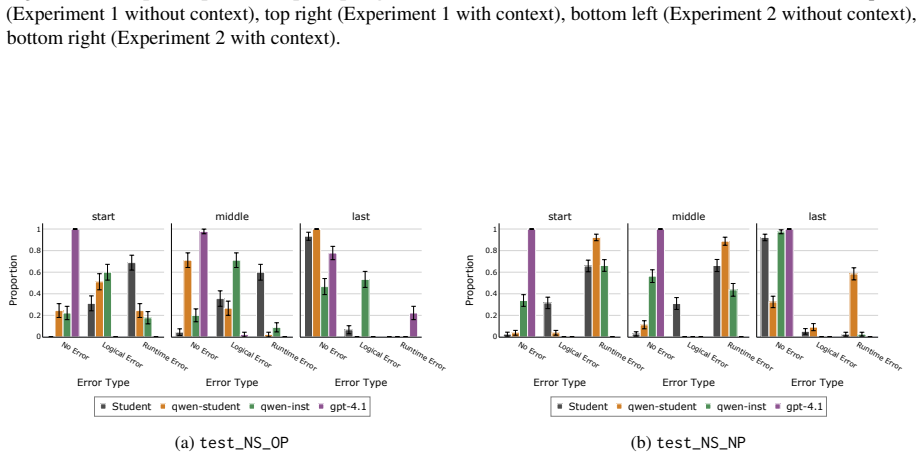
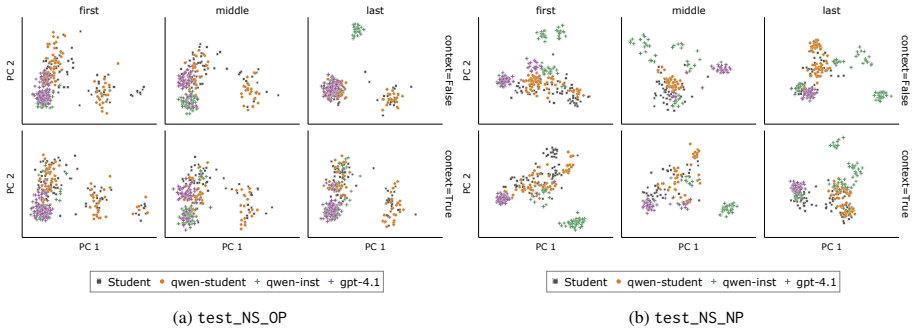
The load-bearing mechanism is supervised fine-tuning over submission streams, which trains the model on all attempts rather than only final answers. The evaluation machinery has four parts: SFR-Embedding-Code-400M code embeddings for cosine similarity, KNN distance, and coverage; autograder error categories (no_error, logical, runtime, compile) plus pass@1; style features (verbosity, AST depth, width, and node count, and PEP 8 violations aggregated as the first principal component); and progress metrics (doctest pass-rate change, style-score change, and Levenshtein edit distance between consecutive submissions). Experiments run at two temporal resolutions: low-resolution first/middle/last snapshots, and high-resolution next-step generation conditioned on the prior 1 or 3 attempts, with an optional student-context branch that feeds in a prior problem's submission at the same relative position.
What would settle it
Give experienced CS educators a blind mix of real and qwen-student-generated submissions from the same problems and ask them to pick the real ones; if they can reliably identify generated code, or if qwen-student's generated bugs share no more failing-test-case overlap with the matched student's bugs than random code does, the claim of trajectory-level realism fails.
Extended reading notes
Core claim
On its own terms, the paper's discovery is that novice 'struggle' is a learnable distribution, not a promptable pose. Fine-tuning on real submission streams makes the model reproduce the signature of learning: early attempts with mixed logical, runtime, and compile errors; pass rates that rise gradually rather than jumping to 100 percent; style that stays verbose and PEP 8-violating; and edits between attempts that are small in Levenshtein distance rather than large rewrites. On the test set for new students solving familiar problems, qwen-student's average KNN distance to student code drops to 0.058 with 71.9 percent coverage, improving over the instruction-tuned baseline by 0.021 in distance and 15.6 percent in coverage, and its final style score (0.41) is much closer to the student mean (0.89) than GPT-4.1's (-0.96). The same signals weaken on entirely new problems, where qwen-student underpredicts final-stage correctness and loses coverage, so the paper's claim is specifically that fine-tuning transfers across students on familiar problems, with generalization to new problems remaining an open limitation.
Load-bearing premise
The load-bearing premise is that the chosen metrics—embedding proximity, error-type distributions, style statistics, and edit distance—capture genuine student-likeness, and that four semesters of one Python course represent student code generally; if either fails, the fine-tuned model could win the comparison without truly simulating learners.
Editorial extensions
If this is right
- qwen-student can generate synthetic student submissions on familiar problems whose error mix, style statistics, and pass-rate curve match real logs, so it can expand scarce student datasets or benchmark educational models.
- Instruction-tuned and proprietary prompting models default to correct, clean code, so any system that relies on them for student simulation will overestimate learner skill.
- Evaluating student-code simulators requires stream-level metrics; comparing final code or pass rate alone would rank GPT-4.1 as best despite its non-studentlike trajectory.
- Fine-tuning on intermediate attempts is what produces incremental edit behavior; conditioning on prior attempts reproduces small Levenshtein steps, matching how students revise.
- On unseen problems the model's learning-progress signals degrade, so realistic simulation is currently tied to problem familiarity.
Reading between the lines
- Beyond the paper's results, the same recipe could generate synthetic 'misconception-consistent' buggy submissions for training autograder feedback or misconception detectors, but only if the generated bugs are checked for semantic root-cause overlap with real novice bugs.
- The paper's reliance on embedding similarity leaves open that a model could rank as student-like by imitating surface style while being wrong in the wrong way; a direct behavioral test comparing failing-test-case overlap between generated and real submissions would settle whether trajectory alignment is pedagogical or merely statistical.
- Because fine-tuned models memorize student code, public release of such a simulator would need differential privacy or data filtering, a step the paper itself flags in its limitations.
- Cross-course transfer is untested; the framework's success on one Python course suggests that each new course or language would need its own fine-tuning data rather than a universal student simulator.
Editorial analysis
A structured set of objections, weighed in public.
Referee Report
Summary. The paper introduces ParaStudent, a framework for generating 'student-like' code from LLMs. Using 689,023 timestamped submissions from an introductory programming course over four semesters, the authors fine-tune Qwen-2.5 Coder 7B with LoRA on student streams and compare it with Qwen-2.5 Coder 7B Instruct and GPT-4.1 under prompting. They define low-resolution (start/middle/end) and high-resolution (next-step conditioned on prior attempts) experiments, and evaluate along embedding-based semantic similarity, functionality (autograder error types and pass rate), style (verbosity, AST metrics, PEP 8 violations), and progress (edit distance, pass-rate/style evolution). The main claim is that fine-tuning (qwen-student) yields code that is more aligned with real student code and trajectories than prompting baselines, especially on test_NS_OP (new students, old problems), and that it also better matches pass-rate and style MAE on new problems (test_NS_NP). The paper includes ablations across model families and an appendix with extended results.
Significance. If the central claim survives scrutiny, the paper makes a useful contribution to AI-in-education: a reproducible recipe for generating synthetic student code with plausible error patterns and incremental edits, plus a multi-dimensional evaluation suite. Strengths include the large real dataset, temporal train/test split by semester, separate in-distribution and out-of-distribution test sets, transparent compute reporting, and public code release. The paper also honestly acknowledges limits (single course, strong supervision in high-resolution setting, lack of privacy guarantees). The main risk is that the headline results on old problems may partly reflect retrieval of training submissions rather than learned student behavior; if the authors can control for that, the framework's value is substantially established.
major comments (3)
- [§3 and §5.1, Table 1] The test_NS_OP split is defined as new students on problems that also appear in the training set, and qwen-student is fine-tuned on submissions to those same problems. The largest gains are reported on this split (e.g., Table 1a: first-stage KNN distance 0.054 vs 0.080 and coverage 77.8% vs 44.4% for qwen-student vs qwen-inst, context F). Since the problem statements, fixed code, and skeleton code recur across semesters, a model that emits near-verbatim training submissions for the same problem would score as highly student-like under the KNN and coverage metrics without acquiring any general notion of student behavior. The paper does not report any memorization or training-set-overlap analysis, and Section 8 lists privacy but not this evaluation confound. Please add (a) the fraction of generated submissions that are exact or near-duplicates (e.g., by normalized edit distance or n-gram overlap) of training submissions for the same problem, (b) a re-evaluation on a version of test_NS_OP with such near-duplicates removed, or (c) a held-out-problem analogue of the old-problem setting. If the advantage persists after removing near-duplicates, the central claim is supported; if not, the headline comparison is largely retrieval.
- [§5, Tables 1–3] The abstract and Section 6 state that fine-tuning 'significantly improves' alignment, but no statistical significance tests are reported for the distribution-level embedding metrics. Table 1 reports KNN coverage in percentage increments that suggest small cell sizes (e.g., a 2.2% step implies about 45 observations), Tables 2–3 report standard deviations but no confidence intervals or p-values, and there are no multiple-comparison corrections across stages, contexts, and test sets. Without uncertainty quantification, differences such as the test_NS_NP first-stage distance (0.073 vs 0.072 for qwen-student vs gpt-4.1) or the coverage gaps at several cells cannot be distinguished from noise. Please provide bootstrap confidence intervals or permutation tests for each metric and test set, or rephrase 'significantly' as descriptive rather than inferential.
- [§4.3.1 and Figure 1] The embedding metrics are built on SFR-Embedding-Code-400M, a code-retrieval model, and the paper treats low KNN distance and high coverage as evidence of 'student-like' semantics. This is a plausible proxy, but the manuscript does not validate that proximity in this embedding space corresponds to behavioral or pedagogical realism rather than to surface similarity. Since the memorization confound in comment 1 operates through exactly this metric, the paper would be substantially strengthened by a small validation study: for example, showing that the embedding metric separates student code from expert/LLM code on held-out problems, or correlating embedding distances with human judgments of student-likeness on a sample of outputs. As written, the semantic dimension of the evaluation is not independently grounded.
minor comments (5)
- [§5.1, first paragraph] The sentence 'under in-distribution (test_NS_OP) and out-of-distribution (test_NS_OP)' should read 'test_NS_OP' and 'test_NS_NP', respectively.
- [Table 3 caption] The caption 'qwen-student generates code closest to that of students across all metrics for both test scenarios' is accurate for Table 3, but Table 1b shows gpt-4.1 achieving lower KNN distance on the first and middle no-context stages; consider qualifying the caption to avoid overgeneralization.
- [§4.1 and §4.3.1] The symbol k is used both for the number of prior attempts (k ∈ {1,3}) and for the KNN neighborhood size (k=3 and k=10); please rename one of them to avoid confusion.
- [Figure 1 caption] The caption introduces a feature space Φ but the main text never defines Φ; either define the notation or describe the space informally in the caption.
- [Table 1] Please report the number of student-problem pairs contributing to each cell so that the coverage percentages can be interpreted in light of the small sample sizes.
Circularity Check
No circularity: the fine-tuning advantage is measured against held-out students, so the central claim is empirical rather than definitional.
full rationale
The paper's central claim is that fine-tuning Qwen-2.5 Coder 7B on real student submissions yields code more aligned with real student code than prompting-only baselines. The evaluation is not circular: qwen-student is fine-tuned on training submissions (244,483 submissions from Spring 2021 and Fall 2021) and evaluated on held-out test students from Spring 2022 and Fall 2022, with separate test subsets test_NS_OP (new students, old problems) and test_NS_NP (new students, new problems). The embedding, functionality, and style metrics are all computed against real student code that was not used for fine-tuning, so the comparison is an empirical generalization claim rather than a definitional reduction. The closest concern is that test_NS_OP reuses problems seen in training, so a model could in principle score well by retrieving near-exact training submissions; but this is a potential validity or memorization threat, not circularity by construction, and the paper's own limitations explicitly acknowledge the single-course scope and the strong-supervision regime in Experiment 2. The few self-citations in related work (Packer et al., Patil et al., with co-author Joseph E. Gonzalez) are contextual and not load-bearing for any derivation. No equation, metric, or fitted parameter is defined in terms of the quantity it is used to predict.
Assumptions & free parameters
free parameters (3)
- k in KNN metrics =
k=3 for distance, k=10 for coverage
- LoRA hyperparameters =
r=16, alpha=32, dropout=0.05
- Number of prior attempts k in high-resolution experiment =
1 and 3
assumptions (3)
- domain assumption SFR-Embedding-Code-400M provides a meaningful representation of code semantics for measuring student-likeness.
- domain assumption The autograder error categories (no_error, logical, runtime, compile) exhaustively capture the functional state of student code.
- domain assumption Student code from Spring 2021 and Fall 2021 is representative of student code in Spring 2022 and Fall 2022 for the same problems.
Cite this review
Pith. "Pith review of ParaStudent: Generating and Evaluating Realistic Student Code by Teaching LLMs to Struggle." pith.science (2026). https://pith.science/paper/Y6ZCZXS7
@misc{pith2026250712674,
  author       = {Pith},
  title        = {Pith review of: ParaStudent: Generating and Evaluating Realistic Student Code by Teaching LLMs to Struggle},
  year         = {2026},
  howpublished = {\url{https://pith.science/paper/Y6ZCZXS7}},
  note         = {Machine review of arXiv:2507.12674}
}
read the original abstract
Large Language Models (LLMs) have shown strong performance on programming tasks, but can they generate student-like code like real students - imperfect, iterative, and stylistically diverse? We present ParaStudent, a systematic study of LLM-based "student-like" code generation in an introductory programming course setting. Using a dataset of timestamped student submissions across multiple semesters, we design low- and high-resolution experiments to model student progress and evaluate code outputs along semantic, functional, and stylistic dimensions. Our results show that fine-tuning significantly improves alignment with real student trajectories and captures error patterns, incremental improvements, and stylistic variations more faithfully. This study shows that modeling realistic student code requires capturing learning dynamics through context-aware generation, temporal modeling, and multi-dimensional evaluation. Code for experiments and evaluation is available at https://github.com/mmiroyan/ParaStudent.
Figures


Figures from the paper (9 more)






Reference graph
Works this paper leans on
-
[1]
online" 'onlinestring :=
ENTRY address archivePrefix author booktitle chapter edition editor eid eprint eprinttype howpublished institution journal key month note number organization pages publisher school series title type volume year doi pubmed url lastchecked label extra.label sort.label short.list INTEGERS output.state before.all mid.sentence after.sentence after.block STRING...
-
[2]
write newline
" write newline "" before.all 'output.state := FUNCTION n.dashify 't := "" t empty not t #1 #1 substring "-" = t #1 #2 substring "--" = not "--" * t #2 global.max substring 't := t #1 #1 substring "-" = "-" * t #2 global.max substring 't := while if t #1 #1 substring * t #2 global.max substring 't := if while FUNCTION word.in bbl.in capitalize " " * FUNCT...
-
[4]
Amjad Altadmri and Neil C.C. Brown. 2015. https://doi.org/10.1145/2676723.2677258 37 million compilations: Investigating novice programming mistakes in large-scale student data . In Proceedings of the 46th ACM Technical Symposium on Computer Science Education, SIGCSE '15, page 522–527. Association for Computing Machinery
-
[5]
Anthropic. 2025. https://www.anthropic.com/news/claude-3-7-sonnet Claude 3.7 sonnet and claude code
work page 2025
-
[6]
Benjamin S Bloom. 1984. The 2 sigma problem: The search for methods of group instruction as effective as one-to-one tutoring. Educational researcher, 13(6):4--16
work page 1984
-
[8]
Mark Chen, Jerry Tworek, Heewoo Jun, Qiming Yuan, Henrique Ponde De Oliveira Pinto, Jared Kaplan, Harri Edwards, Yuri Burda, Nicholas Joseph, Greg Brockman, and 1 others. 2021 b . Evaluating large language models trained on code. arXiv preprint arXiv:2107.03374
arXiv 2021
-
[9]
Xinyun Chen, Maxwell Lin, Nathanael Sch \"a rli, and Denny Zhou. 2024. https://openreview.net/forum?id=KuPixIqPiq Teaching large language models to self-debug . In The Twelfth International Conference on Learning Representations
work page 2024
-
[10]
Albert T Corbett, Kenneth R Koedinger, and John R Anderson. 1997. Intelligent tutoring systems. In Handbook of human-computer interaction, pages 849--874. Elsevier
work page 1997
Show all 65 references
-
[11]
Rowe, and Nasser Giacaman
Giuseppe De Ruvo, Ewan Tempero, Andrew Luxton-Reilly, Gerard B. Rowe, and Nasser Giacaman. 2018. https://doi.org/10.1145/3160489.3160500 Understanding semantic style by analysing student code . In Proceedings of the 20th Australasian Computing Education Conference, ACE '18, pa...
2018
-
[12]
Google Deepmind. 2025. https://deepmind.google/technologies/gemini/pro/ Gemini 2.5 pro
2025
-
[13]
Wu, Yukun Li, Huazuo Gao, Shirong Ma, Wangding Zeng, Xiao Bi, Zihui Gu, Hanwei Xu, Damai Dai, Kai Dong, Liyue Zhang, Yishi Piao, and 21 others
DeepSeek-AI, Qihao Zhu, Daya Guo, Zhihong Shao, Dejian Yang, Peiyi Wang, Runxin Xu, Y. Wu, Yukun Li, Huazuo Gao, Shirong Ma, Wangding Zeng, Xiao Bi, Zihui Gu, Hanwei Xu, Damai Dai, Kai Dong, Liyue Zhang, Yishi Piao, and 21 others. 2024. https://doi.org/10.48550/arXiv.2406.1193...
-
[14]
Paul Denny, Andrew Luxton-Reilly, Ewan Tempero, and Jacob Hendrickx. 2011. https://doi.org/10.1145/1999747.1999807 Understanding the syntax barrier for novices . In Proceedings of the 16th Annual Joint Conference on Innovation and Technology in Computer Science Education, ITiC...
2011
- [15]
-
[16]
Ryan Ehrlich, Bradley Brown, Jordan Juravsky, Ronald Clark, Christopher Ré, and Azalia Mirhoseini. 2025. https://arxiv.org/abs/2501.14723 Codemonkeys: Scaling test-time compute for software engineering . Preprint, arXiv:2501.14723
2025 arXiv
-
[17]
Andrew Ettles, Andrew Luxton-Reilly, and Paul Denny. 2018. https://doi.org/10.1145/3160489.3160493 Common logic errors made by novice programmers . In Proceedings of the 20th Australasian Computing Education Conference, ACE '18, page 83–89. Association for Computing Machinery
2018
-
[18]
Aaron Grattafiori, Abhimanyu Dubey, Abhinav Jauhri, Abhinav Pandey, Abhishek Kadian, Ahmad Al-Dahle, Aiesha Letman, Akhil Mathur, Alan Schelten, Alex Vaughan, Amy Yang, Angela Fan, Anirudh Goyal, Anthony Hartshorn, Aobo Yang, Archi Mitra, Archie Sravankumar, Artem Korenev, Art...
2024 arXiv
-
[19]
Xiaodong Gu, Meng Chen, Yalan Lin, Yuhan Hu, Hongyu Zhang, Chengcheng Wan, Zhao Wei, Yong Xu, and Juhong Wang. 2025. https://doi.org/10.1145/3697012 On the effectiveness of large language models in domain-specific code generation . ACM Trans. Softw. Eng. Methodol., 34(3)
2025 doi
-
[20]
Goodman, and Emma Brunskill
Joy He-Yueya, Noah D. Goodman, and Emma Brunskill. 2024. https://doi.org/10.5281/zenodo.12729776 Evaluating and optimizing educational content with large language model judgments . In Proceedings of the 17th International Conference on Educational Data Mining, pages 68--82. In...
2024 doi
-
[21]
Samuel Holt, Max Ruiz Luyten, and Mihaela van der Schaar. 2024. https://openreview.net/forum?id=EhrzQwsV4K L2 MAC : Large language model automatic computer for extensive code generation . In The Twelfth International Conference on Learning Representations
2024
-
[22]
Edward J Hu, yelong shen, Phillip Wallis, Zeyuan Allen-Zhu, Yuanzhi Li, Shean Wang, Lu Wang, and Weizhu Chen. 2022. https://openreview.net/forum?id=nZeVKeeFYf9 Lo RA : Low-rank adaptation of large language models . In International Conference on Learning Representations
2022
-
[23]
Binyuan Hui, Jian Yang, Zeyu Cui, Jiaxi Yang, Dayiheng Liu, Lei Zhang, Tianyu Liu, Jiajun Zhang, Bowen Yu, Keming Lu, and 1 others. 2024. Qwen2. 5-coder technical report. arXiv preprint arXiv:2409.12186
2024 arXiv
-
[24]
Juyong Jiang, Fan Wang, Jiasi Shen, Sungju Kim, and Sunghun Kim. 2024 a . https://arxiv.org/abs/2406.00515 A survey on large language models for code generation . Preprint, arXiv:2406.00515
2024 arXiv
-
[25]
Xue Jiang, Yihong Dong, Lecheng Wang, Zheng Fang, Qiwei Shang, Ge Li, Zhi Jin, and Wenpin Jiao. 2024 b . https://doi.org/10.1145/3672456 Self-planning code generation with large language models . ACM Trans. Softw. Eng. Methodol., 33(7)
2024 doi
-
[26]
Carlos E Jimenez, John Yang, Alexander Wettig, Shunyu Yao, Kexin Pei, Ofir Press, and Karthik R Narasimhan. 2024. https://openreview.net/forum?id=VTF8yNQM66 SWE -bench: Can language models resolve real-world github issues? In The Twelfth International Conference on Learning Re...
2024
-
[27]
Mohammad Khalil, Farhad Vadiee, Ronas Shakya, and Qinyi Liu. 2025. https://doi.org/10.1145/3706468.3706523 Creating artificial students that never existed: Leveraging large language models and ctgans for synthetic data generation . In Proceedings of the 15th International Lear...
2025
-
[28]
Hung Le, Yue Wang, Akhilesh Deepak Gotmare, Silvio Savarese, and Steven Chu Hong Hoi. 2022. https://proceedings.neurips.cc/paper_files/paper/2022/file/8636419dea1aa9fbd25fc4248e702da4-Paper-Conference.pdf Coderl: Mastering code generation through pretrained models and deep rei...
2022
-
[29]
Juho Leinonen, Paul Denny, Olli Kiljunen, Stephen MacNeil, Sami Sarsa, and Arto Hellas. 2025. https://doi.org/10.1145/3716640.3716647 Llm-itation is the sincerest form of data: Generating synthetic buggy code submissions for computing education . In Proceedings of the 27th Aus...
2025
-
[30]
Jia Li, Chongyang Tao, Jia Li, Ge Li, Zhi Jin, Huangzhao Zhang, Zheng Fang, and Fang Liu. 2025. https://doi.org/10.1145/3715908 Large language model-aware in-context learning for code generation . ACM Trans. Softw. Eng. Methodol
2025 doi
-
[31]
Junjie Li, Fazle Rabbi, Cheng Cheng, Aseem Sangalay, Yuan Tian, and Jinqiu Yang. 2024 a . https://arxiv.org/abs/2408.09078 An exploratory study on fine-tuning large language models for secure code generation . Preprint, arXiv:2408.09078
2024
- [32]
-
[33]
Jiate Liu, Yiqin Zhu, Kaiwen Xiao, QIANG FU, Xiao Han, Yang Wei, and Deheng Ye. 2023. https://openreview.net/forum?id=hjYmsV6nXZ RLTF : Reinforcement learning from unit test feedback . Transactions on Machine Learning Research
2023
-
[34]
Jiawei Liu, Songrun Xie, Junhao Wang, Yuxiang Wei, Yifeng Ding, and Lingming Zhang. 2024 a . https://openreview.net/forum?id=IBCBMeAhmC Evaluating language models for efficient code generation . In First Conference on Language Modeling
2024
-
[35]
Ye Liu, Rui Meng, Shafiq Joty, Silvio Savarese, Caiming Xiong, Yingbo Zhou, and Semih Yavuz. 2024 b . https://arxiv.org/abs/2411.12644 Codexembed: A generalist embedding model family for multiligual and multi-task code retrieval . Preprint, arXiv:2411.12644
2024 arXiv
-
[36]
Anton Lozhkov, Raymond Li, Loubna Ben Allal, Federico Cassano, Joel Lamy-Poirier, Nouamane Tazi, Ao Tang, Dmytro Pykhtar, Jiawei Liu, Yuxiang Wei, Tianyang Liu, Max Tian, Denis Kocetkov, Arthur Zucker, Younes Belkada, Zijian Wang, Qian Liu, Dmitry Abulkhanov, Indraneil Paul, a...
2024 arXiv
-
[37]
Xinyi Lu and Xu Wang. 2024. https://doi.org/10.1145/3657604.3662031 Generative students: Using llm-simulated student profiles to support question item evaluation . In Proceedings of the Eleventh ACM Conference on Learning @ Scale, L@S '24, page 16–27. Association for Computing...
2024
-
[38]
Ziyang Luo, Can Xu, Pu Zhao, Qingfeng Sun, Xiubo Geng, Wenxiang Hu, Chongyang Tao, Jing Ma, Qingwei Lin, and Daxin Jiang. 2024. https://openreview.net/forum?id=UnUwSIgK5W Wizardcoder: Empowering code large language models with evol-instruct . In The Twelfth International Confe...
2024
- [39]
-
[40]
Stephen MacNeil, Magdalena Rogalska, Juho Leinonen, Paul Denny, Arto Hellas, and Xandria Crosland. 2024. https://doi.org/10.1145/3649165.3690100 Synthetic students: A comparative study of bug distribution between large language models and computing students . In Proceedings of...
2024
-
[41]
Markel, Steven G
Julia M. Markel, Steven G. Opferman, James A. Landay, and Chris Piech. 2023. https://doi.org/10.1145/3573051.3593393 Gpteach: Interactive ta training with gpt-based students . In Proceedings of the Tenth ACM Conference on Learning @ Scale, L@S '23, page 226–236. Association fo...
2023
-
[42]
Nikolaos Nikolaidis, Karolos Flamos, Khanak Gulati, Daniel Feitosa, Apostolos Ampatzoglou, and Alexander Chatzigeorgiou. 2024. https://doi.org/10.1109/SANER-C62648.2024.00018 A comparison of the effectiveness of chatgpt and co-pilot for generating quality python code solutions...
2024
-
[43]
Robert E. Noonan. 1985. https://doi.org/10.1016/0096-0551(85)90018-9 An algorithm for generating abstract syntax trees . Comput. Lang., 10(3–4):225–236
1985 doi
-
[44]
Olausson, Jeevana Priya Inala, Chenglong Wang, Jianfeng Gao, and Armando Solar-Lezama
Theo X. Olausson, Jeevana Priya Inala, Chenglong Wang, Jianfeng Gao, and Armando Solar-Lezama. 2023. https://doi.org/10.48550/arXiv.2306.09896 Demystifying gpt self-repair for code generation . CoRR, abs/2306.09896
-
[45]
OpenAI. 2025. https://openai.com/index/gpt-4-1/ Introducing gpt-4.1 in the api
2025
-
[46]
Patil, Ion Stoica, and Joseph E
Charles Packer, Sarah Wooders, Kevin Lin, Vivian Fang, Shishir G. Patil, Ion Stoica, and Joseph E. Gonzalez. 2024. https://arxiv.org/abs/2310.08560 Memgpt: Towards llms as operating systems . Preprint, arXiv:2310.08560
2024 arXiv
-
[47]
Jiayi Pan, Xingyao Wang, Graham Neubig, Navdeep Jaitly, Heng Ji, Alane Suhr, and Yizhe Zhang. 2024. https://arxiv.org/abs/2412.21139 Training software engineering agents and verifiers with swe-gym . Preprint, arXiv:2412.21139
2024 arXiv
-
[48]
Patil, Tianjun Zhang, Xin Wang, and Joseph E
Shishir G. Patil, Tianjun Zhang, Xin Wang, and Joseph E. Gonzalez. 2024. https://proceedings.neurips.cc/paper_files/paper/2024/file/e4c61f578ff07830f5c37378dd3ecb0d-Paper-Conference.pdf Gorilla: Large language model connected with massive apis . In Advances in Neural Informati...
2024
-
[49]
Thai Tang Quoc, Duc Ha Minh, Tho Quan Thanh, and Anh Nguyen-Duc. 2024. https://arxiv.org/abs/2408.15658 An empirical study on self-correcting large language models for data science code generation . Preprint, arXiv:2408.15658
2024 arXiv
-
[50]
Baptiste Rozière, Jonas Gehring, Fabian Gloeckle, Sten Sootla, Itai Gat, Xiaoqing Ellen Tan, Yossi Adi, Jingyu Liu, Romain Sauvestre, Tal Remez, Jérémy Rapin, Artyom Kozhevnikov, Ivan Evtimov, Joanna Bitton, Manish Bhatt, Cristian Canton Ferrer, Aaron Grattafiori, Wenhan Xiong...
2024 arXiv
-
[51]
Ben Shi, Michael Tang, Karthik R Narasimhan, and Shunyu Yao. 2024. https://openreview.net/forum?id=kGa4fMtP9l Can language models solve olympiad programming? In First Conference on Language Modeling
2024
-
[52]
Parshin Shojaee, Aneesh Jain, Sindhu Tipirneni, and Chandan K. Reddy. 2023. https://openreview.net/forum?id=0XBuaxqEcG Execution-based code generation using deep reinforcement learning . Transactions on Machine Learning Research
2023
-
[53]
Zhihong Sun, Chen Lyu, Bolun Li, Yao Wan, Hongyu Zhang, Ge Li, and Zhi Jin. 2024. https://aclanthology.org/2024.lrec-main.521/ Enhancing code generation performance of smaller models by distilling the reasoning ability of LLM s . In Proceedings of the 2024 Joint International ...
2024
- [54]
-
[55]
Guido van Rossum, Barry Warsaw, and Alyssa Coghlan. 2025. https://peps.python.org/pep-0008/ Pep 8 -- style guide for python code
2025
-
[56]
Martin Weyssow, Xin Zhou, Kisub Kim, David Lo, and Houari Sahraoui. 2025. https://doi.org/10.1145/3714461 Exploring parameter-efficient fine-tuning techniques for code generation with large language models . ACM Trans. Softw. Eng. Methodol
2025 doi
-
[57]
Thomas Wolf, Lysandre Debut, Victor Sanh, Julien Chaumond, Clement Delangue, Anthony Moi, Pierric Cistac, Tim Rault, Rémi Louf, Morgan Funtowicz, Joe Davison, Sam Shleifer, Patrick von Platen, Clara Ma, Yacine Jernite, Julien Plu, Canwen Xu, Teven Le Scao, Sylvain Gugger, and ...
2020 arXiv
-
[58]
Man Fai Wong and Chee Wei Tan. 2024. https://doi.org/10.1109/CAI59869.2024.00037 Aligning crowd-sourced human feedback for code generation with bayesian inference . In 2024 IEEE Conference on Artificial Intelligence (CAI), pages 158--163
2024
-
[59]
Weixiang Yan, Haitian Liu, Yunkun Wang, Yunzhe Li, Qian Chen, Wen Wang, Tingyu Lin, Weishan Zhao, Li Zhu, Hari Sundaram, and Shuiguang Deng. 2024. https://doi.org/10.18653/v1/2024.acl-long.301 C ode S cope: An execution-based multilingual multitask multidimensional benchmark f...
2024 doi
-
[60]
Guang Yang, Yu Zhou, Xiang Chen, Xiangyu Zhang, Terry Yue Zhuo, and Taolue Chen. 2024 a . https://doi.org/10.1109/TSE.2024.3440503 Chain-of-thought in neural code generation: From and for lightweight language models . IEEE Transactions on Software Engineering, 50(9):2437--2457
2024
-
[61]
Jimenez, Alexander Wettig, Kilian Lieret, Shunyu Yao, Karthik Narasimhan, and Ofir Press
John Yang, Carlos E. Jimenez, Alexander Wettig, Kilian Lieret, Shunyu Yao, Karthik Narasimhan, and Ofir Press. 2024 b . https://proceedings.neurips.cc/paper_files/paper/2024/file/5a7c947568c1b1328ccc5230172e1e7c-Paper-Conference.pdf Swe-agent: Agent-computer interfaces enable ...
2024
-
[62]
Da Yu, Saurabh Naik, Arturs Backurs, Sivakanth Gopi, Huseyin A Inan, Gautam Kamath, Janardhan Kulkarni, Yin Tat Lee, Andre Manoel, Lukas Wutschitz, Sergey Yekhanin, and Huishuai Zhang. 2022. https://openreview.net/forum?id=Q42f0dfjECO Differentially private fine-tuning of lang...
2022
-
[63]
Murong Yue, Wijdane Mifdal, Yixuan Zhang, Jennifer Suh, and Ziyu Yao. 2024. https://doi.org/10.48550/arXiv.2404.06711 Mathvc: An llm-simulated multi-character virtual classroom for mathematics education . CoRR, abs/2404.06711
2024 doi
-
[64]
Tenenbaum, and Chuang Gan
Shun Zhang, Zhenfang Chen, Yikang Shen, Mingyu Ding, Joshua B. Tenenbaum, and Chuang Gan. 2023. https://openreview.net/forum?id=Lr8cOOtYbfL Planning with large language models for code generation . In The Eleventh International Conference on Learning Representations
2023
-
[65]
Jiasheng Zheng, Boxi Cao, Zhengzhao Ma, Ruotong Pan, Hongyu Lin, Yaojie Lu, Xianpei Han, and Le Sun. 2024. https://openreview.net/forum?id=diXvBHiRyE Beyond correctness: Benchmarking multi-dimensional code generation for large language models
2024
-
[66]
Li Zhong, Zilong Wang, and Jingbo Shang. 2024. https://doi.org/10.18653/v1/2024.findings-acl.49 Debug like a human: A large language model debugger via verifying runtime execution step by step . In Findings of the Association for Computational Linguistics: ACL 2024, pages 851-...
2024 doi
-
[67]
Terry Yue Zhuo, Armel Zebaze, Nitchakarn Suppattarachai, Leandro von Werra, Harm de Vries, Qian Liu, and Niklas Muennighoff. 2024. https://arxiv.org/abs/2401.00788 Astraios: Parameter-efficient instruction tuning code large language models . Preprint, arXiv:2401.00788
2024 arXiv
Reviewed August 6, 2026 · model on record in the stance chip above.
Discussion (0). Continue with ORCID to comment.