REVIEW 3 major objections 5 minor 1 cited by
Multifunctional Composites for Elastic and Electromagnetic Wave Propagation
T0 review · 3 major / 5 minor · reviewed 2026-08-14 · deepseek-v4-flash
Pith's one-line read Two-phase composites obey cross-property relations linking their dynamic dielectric constant to their elastic moduli, so light and sound wave responses predict each other.
desk verdict Dynamic cross-property relations are a genuinely new idea, but the central intermediate-wavelength formulas are only validated in a missing SI. read the letter →
The pith
A machine-rendered reading of the paper's core claim, the machinery that carries it, and where it could break.
The reading
What carries the argument
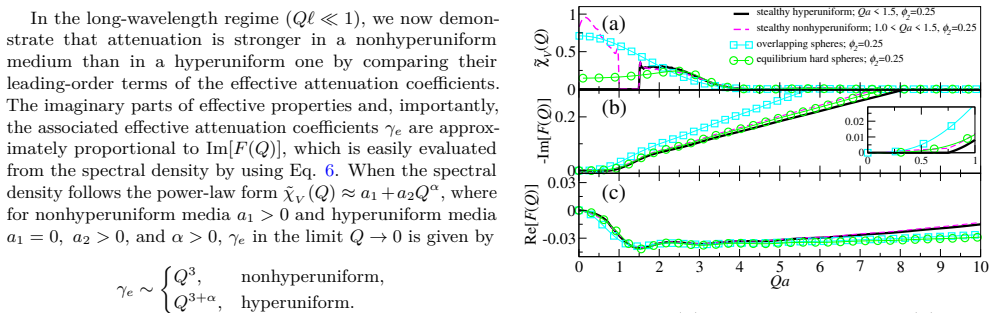
The central object is the attenuation function $F(Q)$, a wavenumber-dependent functional of the spectral density $\tilde\chi_V(Q)$—the Fourier transform of the two-point autocovariance function $\chi_V(r)=S_2^{(i)}(r)-\phi_i^2$, measurable in scattering experiments. Its imaginary part is a direct integral of $\tilde\chi_V(Q)$ up to wavenumber $2Q$, and its real part follows from a principal-value integral, so the whole function is fixed by one microstructural statistic. The paper's key move is to modify the long-wavelength strong-contrast formulas by inserting the plane-wave phase factor $e^{-iQ\hat{k}\cdot r}$ into the Green's-function integral that defines the long-wavelength $F(Q)$—a Born-approximation correction for the spatial variation of the incident wave—which extends the formulas' validity to $k\ell \lesssim 1$. Because the same $F$ appears in the dielectric, bulk, and shear formulas, it can be eliminated between them, which is what produces the microstructure-independent cross-property relations.
What would settle it
Direct full-wave numerical simulations of a well-characterized stealthy hyperuniform dispersion of identical spheres with $\phi_2=0.25$ and $\tilde\chi_V(Q)=0$ for $Qa<1.5$ could settle the claim: one would check whether the attenuation coefficients vanish for $0<k_1a<0.375$ (as predicted) and whether the measured $(\epsilon_e,K_e)$ pairs at each wavenumber lie on the universal surface of Eq. (13). A violation of either prediction beyond numerical error would refute the central claim.
Extended reading notes
Core claim
The central claim is that for macroscopically isotropic two-phase composites, the wavenumber-dependent effective dielectric constant $\epsilon_e(k_1)$, bulk modulus $K_e(k_1^{\mathrm L})$, and shear modulus $G_e(k_1^{\mathrm L})$ are all controlled by the same microstructural functional, the attenuation function $F(Q)$ built from the spectral density $\tilde\chi_V(Q)$. Eliminating this common factor yields approximate cross-property relations—the explicit example is Eq. (13), which maps $\epsilon_e$ onto $K_e$ at the same wavenumber—that depend only on phase properties and volume fraction, not on the detailed microstructure; different microstructures trace different paths on one universal surface. The paper further claims that stealthy hyperuniform dispersions are transparent (dissipationless) to both electromagnetic and elastic waves up to a finite wavenumber, and it demonstrates a composite that is transparent at infrared wavelengths yet exhibits resonance-like attenuation of sound. These predictions are supported, according to the paper, by numerical simulations reported in the supplementary information.
Load-bearing premise
The entire extension beyond the long-wavelength regime rests on the assumption that replacing the attenuation function by its Born-approximation form keeps the strong-contrast formulas accurate up to $k\ell \lesssim 1$ for every microstructure considered, a heuristic step whose error is not controlled in the main text and whose validation is deferred to the supplementary information.
Editorial extensions
If this is right
- If Eqs. (4), (8), and (9) are accurate, the wavenumber-dependent effective bulk and shear moduli—and hence elastic wave speeds and attenuation—can be read off from measured wavenumber-dependent dielectric constants, and vice versa.
- Stealthy hyperuniform composites act as low-pass filters for both light and sound: they are dissipationless up to a finite wavenumber, while ordinary disordered composites attenuate at all finite wavenumbers.
- The cross-property relations enable inverse design of multifunctional parts—for example, a CPU heat sink that radiates thermally (infrared-transparent) but suppresses mechanical vibrations, or a motor housing that absorbs sound while allowing radiative cooling.
- The formulas apply to a broad class of disordered dispersions beyond the long-wavelength regime where Maxwell-Garnett and quasicrystalline approximations fail, making the predicted wave characteristics microstructure-dependent.
Reading between the lines
- The same elimination trick could be applied to other dynamic effective properties built from the same strong-contrast formalism, such as thermal or electrical transport in the same composite, yielding dynamic cross-property maps beyond the electromagnetic-elastic pair the paper considers.
- A field trial on rocks or concrete—comparing microwave dielectric measurements with ultrasonic elastic measurements on the same specimen—would test whether the microstructure-independent relations survive real pore geometries, where the spectral density may not be known perfectly.
- If the Born-approximation modification holds, the attenuation-function route suggests a direct spectral-inversion design method: prescribe a target attenuation window, back out the required spectral density, and then realize it with Fourier-space construction techniques; the paper sketches this but does not demonstrate a full closed-loop inverse design.
- The transparency-window prediction for stealthy hyperuniform media might be checked with existing experimental platforms that measure transmission through 3D-printed hyperuniform structures, where samples with known spectral densities are available.
Signed reviews
Editorial analysis
A structured set of objections, weighed in public.
Referee Report
Summary. The manuscript derives microstructure-dependent formulas for the effective dynamic dielectric constant, bulk modulus, and shear modulus of two-phase composites, and uses them to establish cross-property relations linking electromagnetic and elastic wave speeds and attenuation coefficients. The formulas are based on strong-contrast expansions whose long-wavelength form is modified by replacing the attenuation function F(Q) with a Born-type version (Eqs. 17–18). The authors apply these formulas to four disordered microstructures, including stealthy hyperuniform and stealthy nonhyperuniform dispersions, and report transparency windows, low-pass filter behavior, and examples of multifunctional design. The central contributions claimed are the cross-property relations in Eqs. 13–14 and the demonstration that exotic disordered microstructures can have targeted wave characteristics.
Significance. If the modified strong-contrast formulas are valid, the cross-property relations constitute a novel and practically useful bridge between electromagnetic and elastodynamic characterization, enabling non-destructive inference of elastic moduli from dielectric measurements and inverse design of multifunctional composites. The paper has notable strengths: the algebra is internally consistent, Table 1 confirms that the shear-modulus cross-property relation (Eq. 14) is numerically consistent with the direct formula (Eq. 9), the model uses no fitted parameters (microstructure enters through the spectral density), and the predicted transparency of stealthy hyperuniform composites is a falsifiable, physically interesting claim. However, the analysis rests on a heuristic modification of the attenuation function whose accuracy is asserted but not demonstrated within the submitted manuscript.
major comments (3)
- [Results, Eqs. 4–11 and 17–18] The central claim of the paper rests on replacing the long-wavelength attenuation function F(Q) of Eq. 15 with the Born-modified F(Q) of Eqs. 17–18 inside the strong-contrast approximations (Eqs. 4, 8, and 9). This replacement is presented as a heuristic modification justified by two observations (Materials and Methods, Derivation of Eqs. 8–9), and all validation is referred to Sec. V of the Supporting Information, which is absent from the arXiv version. No controlled derivation or error estimate bounds the error of this replacement at finite volume fraction, high contrast, and k_ell ~ 1. Because the transparency conditions, the cross-property relations (Eqs. 13–14), and the design in Fig. 5 all build on these formulas, the central result is conditional on validation that is not provided. Please include the missing SI or an equivalent reproducible validation (e.g., full-wave simulations for overlapping spheres, where the spectral density is known exactly) and quantify the error of the Born-modified F.
- [Eq. 11; Materials and Methods, Derivation of Eqs. 8–9] The modified two-point parameter D2 in Eq. 11 uses the weighted combination d c_{L1}^2 F(k_{T1}) + 2 c_{T1}^2 F(k_{L1}) in place of the original expression in Eq. 24. The manuscript states this replacement is justified because F(Q) involves the Helmholtz Green's function and the incident wave has wavenumber Q, but no derivation from the elastodynamic Green's function is given. Mode conversion and correlation effects at intermediate wavelengths could enter differently for the shear modulus than for the bulk or electromagnetic cases. A derivation of Eq. 11 from the strong-contrast expansion, or a numerical test of Ge against elastodynamic simulations, is needed to support the cross-property relation Eq. 14.
- [Data Availability and Conclusions] The paper repeatedly claims that the modified formulas show 'excellent agreement with numerical simulations' (e.g., Results, Microstructure-dependent approximation formulas) and that this agreement 'justifies their use' (Conclusions). However, the arXiv manuscript contains no simulations, the Data Availability statement says there is no data, and the Supporting Information is not included. This makes the accuracy claims unreproducible. Please make the validation available or, at minimum, clearly state the extent to which the conclusions depend on the deferred SI.
minor comments (5)
- [Eq. 14] The cross-property relation for Ge in Eq. 14 is typeset with garbled parentheses and superscripts in the provided manuscript; as printed it is unusable and must be corrected.
- [Throughout] The manuscript repeatedly cites 'Sec. IV in the SI' and 'Sec. V in the SI' without including the SI; the authors should provide the SI or point to published prior work containing the validations.
- [Data Availability] The statement 'There is no data associated with the manuscript' conflicts with the claimed simulation validation; please clarify whether simulation data exist and where they can be accessed.
- [Abstract and Conclusions] The word 'accurate' is used to describe the approximations before the missing validation is made available; the claims should be qualified until the deferred validation is supplied.
- [Effective elastic wave characteristics] The text states the approximations are valid down to intermediate wavelengths (k_L1 a < 1.5) but the figures plot results up to k_L1 a = 3; either restrict the plots to the stated validity range or justify the extrapolation.
Circularity Check
No significant circularity in the central derivation; the only by-construction element is a minor consistency check in Table 1.
-
self definitional
[Cross-property relations section (Eqs. 13-14) and Table 1 caption]
"Similarly, we can obtain cross-property relations that links ϵe to Ge or Ge to Ke. The former case is explicitly given as [Eq. 14] ... Those two formulas give consistent values for Ge at two distinct wavenumbers which vividly demonstrates that Ge can be indirectly evaluated from the wavenumber-dependent ϵe(k1)."
Eq. 14 is derived from Eq. 9 (together with Eq. 4) by eliminating the shared attenuation function F(Q); therefore, substituting the ϵe values produced by Eq. 4 into Eq. 14 is guaranteed to return Eq. 9 to within numerical round-off. The agreement exhibited in Table 1 is an algebraic identity of the construction, not an independent numerical demonstration that Ge can be inferred from dielectric measurements. It provides no additional evidence for the accuracy of the underlying formulas; the load-bearing validation is deferred to simulations in the omitted SI. This is a minor, non-central circularity: the consistency check confirms only that the cross-property formula was rearranged consistently.
full rationale
The central derivation chain is not circular. The effective-property formulas (Eqs. 4, 8, and 9) take phase properties, volume fraction, and the spectral density χ~V(Q) as inputs; the attenuation function F(Q) is computed from χ~V(Q) via Eqs. 6-7 and 17-18, and no parameter is fitted to the predicted outputs. The cross-property relations (Eqs. 13-14) are obtained by explicitly eliminating F(Q) between these formulas, so their microstructure-independence is a mathematical consequence of the shared dependence on F, not a fitted result. The transparency of stealthy hyperuniform composites follows directly from Im F(Q)=0 when χ~V(Q)=0 over the relevant wavenumber range, which is again a definitional consequence of the input microstructure rather than a circular fit. Heavy self-citation (Refs. 11, 12, 57-68) supplies the base strong-contrast formulas and hyperuniform constructions; these are published results used as starting points, not assumed proofs of the new conclusion. The manuscript does contain support gaps, but they are not circularity: the Born-approximation modification of F is an ansatz whose validation is deferred to a Sec. V in the SI that is absent from the arXiv version, the Data Availability statement says 'There is no data associated with the manuscript,' and the exact elastic strong-contrast expansions are stated as derived 'elsewhere' without proof. These omissions weaken the verification of the formulas but do not make the paper's claims equivalent to its inputs. The only genuine by-construction element is the Table 1 consistency check described above, which is minor and not load-bearing for the paper's central conclusions.
Assumptions & free parameters
assumptions (5)
- domain assumption The strong-contrast expansion truncated at the two-point level converges rapidly for the dispersions considered, so that C2 and D2 capture the essential microstructural information.
- ad hoc to paper Replacing the long-wavelength attenuation function F by the Born-modified F of Eqs. 17-18 extends the validity of the formulas to k ell <~ 1.
- domain assumption Equal mass densities of the two phases (rho1 = rho2) for the elastodynamic problem.
- domain assumption Phase dielectric and elastic properties are real, frequency-independent, with no intrinsic dissipation.
- domain assumption The cross-property relations derived by eliminating F between the approximate formulas are accurate for the exact effective properties.
Cite this review
Pith. "Pith review of Multifunctional Composites for Elastic and Electromagnetic Wave Propagation." pith.science (2026). https://pith.science/paper/YBM2FONP
@misc{pith2026190806662,
  author       = {Pith},
  title        = {Pith review of: Multifunctional Composites for Elastic and Electromagnetic Wave Propagation},
  year         = {2026},
  howpublished = {\url{https://pith.science/paper/YBM2FONP}},
  note         = {Machine review of arXiv:1908.06662}
}
read the original abstract
Composites are ideally suited to achieve desirable multifunctional effective properties since the best properties of different materials can be judiciously combined with designed microstructures. Here we establish cross-property relations for two-phase composite media that link effective elastic and electromagnetic wave characteristics to one another, including the respective effective wave speeds and attenuation coefficients, which facilitate multifunctional material design. This is achieved by deriving accurate formulas for the effective electromagnetic and elastodynamic properties that depend on the wavelengths of the incident waves and the microstructure via the spectral density. Our formulas enable us to explore the wave characteristics of a broad class of disordered microstructures because they apply, unlike conventional formulas, for a wide range of incident wavelengths, i.e., well beyond the long-wavelength regime. This capability enables us to study the dynamic properties of exotic disordered ``hyperuniform'' composites that can have advantages over crystalline ones, such as nearly optimal, direction-independent properties and robustness against defects. We specifically show that disordered ``stealthy'' hyperuniform microstructures exhibit novel wave characteristics, e.g., low-pass filters that transmit waves ``isotropically'' up to a finite wavenumber. Our cross-property relations for the effective wave characteristics can be applied to design multifunctional composites via inverse techniques. Design examples include structural components that require high stiffness and electromagnetic absorption, heat-sinks for CPUs, and sound-absorbing housings for motors that have to efficiently emit thermal radiation and suppress mechanical vibrations, and nondestructive evaluation of the elastic moduli of materials from the effective dielectric response.
Figures


Figures from the paper (2 more)


Forward citations
Cited by 1 Pith paper
-
Ultradense Sphere Packings Derived From Disordered Stealthy Hyperuniform Ground States
Soft-core repulsions convert disordered stealthy hyperuniform ground states into ultradense, size-independent sphere packings, with packing fractions approaching those of jammed disk and MRJ sphere packings in the low...
Reference graph
Works this paper leans on
-
[1]
from the strong-contrast expansions (Eqs. 19 and 20) at the two-point level: Ke ( kL 1 ) K1 = 1−κφ2 2[1 + 2(1−1/d)G1/K1)][ C2 ( kL 1 ) +φ2 (κφ2−1) ], [8] Ge ( kL 1 ) G1 = 1− (d + 2)µφ2 2[1 + 2(1−1/d)G1/K1] 2(1 + 2G1/K1) [ D2 ( kL 1 ) +φ2(µφ2−1) ], [9] where C2 ( kL 1 ) and D2 ( kL 1 ) are microstructural parameters that depend onkL 1 because kT 1 = (cL 1/...
-
[2]
reference
∂2ul ∂xi∂xl +cT p 2 ∂2ui ∂xl∂xl = 0, where a displacement field oscillates sinusoidally with a fre- quency ω[i.e., ui(x,t ) = ui(x)e−iωt], indices span integers between 1 andd, and the Einstein summation is implied. Here, cL p and cT p represent the longitudinal and transverse wave speeds∗ in phasep, respectively, and they are given as cL p 2≡[Kp + 2(1−1/d...
2020
-
[3]
(Springer Science & Business Media, Berlin, Heidelberg) Vol
Zohdi TI (2012) Electromagnetic properties of multiphase dielectrics: a primer on modeling, theory and computation. (Springer Science & Business Media, Berlin, Heidelberg) Vol. 64
2012
-
[4]
(Longman London) Vol
Neville AM (1995) Properties of concrete. (Longman London) Vol. 4
1995
-
[5]
(Springer-Verlag, New Y ork) Vol
Sahimi M (2003) Heterogeneous Materials I: Linear Transport and Optical Properties . (Springer-Verlag, New Y ork) Vol. 22
2003
-
[6]
7; see Sec
The associated real parts are then computed from an approximation of Eq. 7; see Sec. IV in theSI. For various types of dispersions, while the values of˜χV (Q) up to intermediate wavenumbers (Qa ≲ 3) are considerably different from one another, all of the curves approximately collapse onto a single curve forQa≫5; see Fig. 2(a). Effective elastic wave charac...
2020
-
[7]
polarizabilities
Importantly, comparison of the modified attenuation function (Eq. 17) to Eq. 15 reveals that the former has an additional factor exp ( −iQˆk·r ) in its integrand which account for the spatial variation of the incident waves. This change enables us to include the contributions from all scattered waves at wavevectorsq +Qˆk; see Eq. 18. We note that the modifi...
-
[8]
(Springer Science & Business Media)
Torquato S (2002) Random Heterogeneous Materials: Microstructure and Macroscopic Prop- erties, Interdisciplinary Applied Mathematics. (Springer Science & Business Media)
2002
Show all 96 references
-
[9]
and the cross-property relation (Eq. 14). 3D models kL 1a ϵe ( kL 1 ) /ϵ1 ϵe ( cL 1kL 1/c T 1 ) /ϵ1 Ge ( kL 1 ) /G1 From Eq. 14 From Eq. 9 Overlapping spheres 0.3 1.724 +i8.239×10−3 1.808 +i7.455×10−2 1.650 −i 2.941×10⁻² 1.650 −i 2.941×10⁻² 0.5 1.776 +i4.135×10−2 1.843 +i3.420...
-
[10]
(Cambridge University Press, Cambridge)
Milton GW (2002) The Theory of Composites, Cambridge Monographs on Applied and Com- putational Mathematics. (Cambridge University Press, Cambridge)
2002
-
[11]
exact series expansions
Torquato S (1997) Effective stiffness tensor of composite media—I. exact series expansions. J. Mech. Phys. Solids 45(9):1421–1448
1997
-
[12]
Turner MD, Schröder-Turk GE, Gu M (2011) Fabrication and characterization of three- dimensional biomimetic chiral composites. Opt. Express 19(10):10001–10008
2011
-
[13]
(Interscience Publishers Inc)
Beran MJ (1968) Statistical continuum theories, Monographs in Statistical Physics and Ther- modynamics. (Interscience Publishers Inc)
1968
-
[14]
Dederichs PH, Zeller R (1973) Variational treatment of the elastic constants of disordered materials. Z. Physik A 259(2):103–116
1973
-
[15]
Torquato S (1985) Effective electrical conductivity of two-phase disordered composite media. J. Appl. Phys. 58(10):3790–3797. 10 | www.pnas.org/cgi/doi/10.1073/pnas.XXXXXXXXXX Jaeuk Kim et al
1985 doi
-
[16]
Sen AK, Torquato S (1989) Effective conductivity of anisotropic two-phase composite media. Phys. Rev. B39(7):4504–4515
1989
-
[17]
The reader is referred toMaterials and Methods and Sec
Physically, the attenuation functionF (Q) incorporates the contributions from all diffracted waves due to single, elastic scattering events when the wavenumber of the incident waves isQ. The reader is referred toMaterials and Methods and Sec. IV in theSI for a derivation ofF (Q...
-
[18]
Rechtsman MC, Torquato S (2008) Effective dielectric tensor for electromagnetic wave prop- agation in random media. J. Appl. Phys. 103(8):084901
2008
-
[19]
Torquato S (1990) Relationship between permeability and diffusion-controlled trapping con- stant of porous media. Phys. Rev. Lett.64(22):2644–2646
1990
-
[20]
Gibiansky LV, Torquato S (1993) Link between the conductivity and elastic moduli of compos- ite materials. Phys. Rev. Lett.71(18):2927–2930
1993
-
[21]
Torquato S, Hyun S, Donev A (2002) Multifunctional composites: Optimizing microstructures for simultaneous transport of heat and electricity. Phys. Rev. Lett.89(26):266601
2002
-
[22]
Torquato S, Chen D (2018) Multifunctionality of particulate composites via cross-property maps. Phys. Rev. Mater.2(9):095603
2018
-
[23]
Milton GW (1981) Bounds on the transport and optical properties of a two-component com- posite material. J. Appl. Phys. 52(8):5294–5304
1981
-
[24]
Silvestre L (2007) A characterization of optimal two-phase multifunctional composite designs. Proc. Royal Soc. A 463(2086):2543–2556
2007
-
[25]
Wang Y , Luo Z, Zhang N, Qin Q (2016) Topological shape optimization of multifunctional tissue engineering scaffolds with level set method. Struct. Multidisc. Optim. 54(2):333–347
2016
-
[26]
Soft Matter 5(6):1157–1173
Torquato S (2009) Inverse optimization techniques for targeted self-assembly. Soft Matter 5(6):1157–1173
2009
-
[27]
Tsang LK (John Wiley & Sons, New Y ork, 1985) Theory of Microwave Remote Sensing
1985
-
[28]
(IET Digital Library)
Sihvola A (1999) Electromagnetic Mixing Formulas and Applications. (IET Digital Library)
1999
-
[29]
Zhuck NP (1994) Strong-fluctuation theory for a mean electromagnetic field in a statistically homogeneous random medium with arbitrary anisotropy of electrical and statistical properties. Phys. Rev. B50(21):15636–15645
1994
-
[30]
(Jerusalem: Israel Program for Scientific Translations, Springfield)
Tatarskii VI (1971) The Effects of the Turbulent Atmosphere on Wave Propagation . (Jerusalem: Israel Program for Scientific Translations, Springfield)
1971
-
[31]
McPhedran RC, McKenzie DR (1980) Electrostatic and optical resonances of arrays of cylin- ders. Appl. phys. 23(3):223–235
1980
-
[32]
PLoS One 12(10):e0185921
Wu BY , Sheng XQ, Hao Y (2017) Effective media properties of hyperuniform disordered com- posite materials. PLoS One 12(10):e0185921
2017
-
[33]
Biot MA (1956) Theory of propagation of elastic waves in a fluid-saturated porous solid. I. Low-frequency range. J. Acous. Soc. Am. 28(2):168–178
1956
-
[34]
Theoretical formulations
Kuster GT, Toksöz MN (1974) Velocity and attenuation of seismic waves in two-phase media: Part I. Theoretical formulations. Geophys. 39(5):587–606
1974
-
[35]
(Cambridge university press), 2nd edition
Sheriff RE, Geldart LP (1995) Exploration Seismology. (Cambridge university press), 2nd edition
1995
-
[36]
Ultrasound Med Biol 39(7):1133–46
Sarvazyan AP , Urban MW, Greenleaf JF (2013) Acoustic waves in medical imaging and diag- nostics. Ultrasound Med Biol 39(7):1133–46
2013
-
[37]
Radiophys
Sutin A, Nazarov V (1995) Nonlinear acoustic methods of crack diagnostics. Radiophys. Quantum Electron. 38(3-4):109–120
1995
-
[38]
(John Wiley & Sons, Inc., New Y ork)
Watson FR (1923) Acoustics of Buildings: Including Acoustics of Auditoriums and Sound- proofing of Rooms. (John Wiley & Sons, Inc., New Y ork)
1923
-
[39]
Micromachines 10(1):48
Yuan M, Cao Z, Luo J, Chou X (2019) Recent developments of acoustic energy harvesting: A review. Micromachines 10(1):48
2019
-
[40]
Ekmekci E, Turhan-Sayan G (2013) Multi-functional metamaterial sensor based on a broad- side coupled SRR topology with a multi-layer substrate. Appl. Phys. A 110(1):189–197
2013
-
[41]
(2019) Design and comparative analysis of conventional and metamaterial-based textile antennas for wearable applications.Int
Ali U, et al. (2019) Design and comparative analysis of conventional and metamaterial-based textile antennas for wearable applications.Int. J. Numer. Model. Electron. Netw. Device Fields 32(6):e2567. WOS:000494229700012
2019
-
[42]
Mikoshiba K, Manimala JM, Sun C (2013) Energy harvesting using an array of multifunctional resonators. J. Intell. Mater. Syst. Struct. 24(2):168–179
2013
-
[43]
(2017) Hybrid acoustic metamaterial as super absorber for broadband low- frequency sound
Tang Y , et al. (2017) Hybrid acoustic metamaterial as super absorber for broadband low- frequency sound. Sci. Rep. 7:43340
2017
-
[44]
Yu K, Fang NX, Huang G, Wang Q (2018) Magnetoactive Acoustic Metamaterials.Adv. Mater. 30(21):1706348
2018
-
[45]
Multifunct
Lincoln R, Scarpa F , Ting V, Trask RS (2019) Multifunctional composites: A metamaterial perspective. Multifunct. Mater. 2(4):043001
2019
-
[46]
WF (1955) Solid mixture permittivities
Brown Jr. WF (1955) Solid mixture permittivities. J. Chem. Phys. 23(8):1514–1517
1955
-
[47]
Milton GW (1987) Multicomponent composites, electrical networks and new types of contin- ued fraction I. Commun. Math. Phys. 111(2):281–327
1987
-
[48]
Milton GW (1987) Multicomponent composites, electrical networks and new types of contin- ued fraction II. Commun. Math. Phys. 111(3):329–372
1987
-
[49]
Debye P , Bueche AM (1949) Scattering by an inhomogeneous solid.J. Appl. Phys.20(6):518– 525
1949
-
[50]
Markel VA (2016) Maxwell Garnett approximation (advanced topics): tutorial. J. Opt. Soc. Am. A 33(11):2237
2016
-
[51]
Surzhikov AP , Fursa TV (2008) Mechanoelectrical transformations upon the elastic impact excitation of composite dielectric materials. Tech. Phys.53(4):462–465
2008
-
[52]
Fursa TV, Lyukshin BA, Utsyn GE (2013) Relation between the electric response and the characteristics of elastic waves under shock excitation of heterogeneous dielectric materials with piezoelectric inclusions. Tech. Phys.58(2):263–266
2013
-
[53]
Carcione JM, Ursin B, Nordskag JI (2007) Cross-property relations between electrical con- ductivity and the seismic velocity of rocks. Geophys. 72(5):E193–E204
2007
-
[54]
Florescu M, Torquato S, Steinhardt PJ (2009) Designer disordered materials with large, com- plete photonic band gaps. Proc. Natl. Acad. Sci. U.S.A. 106(49):20658–20663
2009
-
[55]
(2013) Isotropic band gaps and freeform waveguides observed in hyperuniform disordered photonic solids
Man W, et al. (2013) Isotropic band gaps and freeform waveguides observed in hyperuniform disordered photonic solids. Proc. Natl. Acad. Sci. U.S.A. 110(40):15886–15891
2013
-
[56]
Redding B, Liew SF , Sarma R, Cao H (2013) Compact spectrometer based on a disordered photonic chip. Nat. Photonics 7(9):746–751
2013
-
[57]
Wiersma DS (2013) Disordered photonics. Nat. Photonics 7(3):188–196
2013
-
[58]
(2016) Hyperuniform disordered terahertz quantum cascade laser
Degl’Innocenti R, et al. (2016) Hyperuniform disordered terahertz quantum cascade laser. Sci. Rep. 6:19325
2016
-
[59]
Rabiei A, Vendra LJ (2009) A comparison of composite metal foam’s properties and other comparable metal foams. mater. lett. 63(5):533–536
2009
-
[60]
(2014) Sintered metallic foams for biodegradable bone replacement materials
Ori ˇnák A, et al. (2014) Sintered metallic foams for biodegradable bone replacement materials. J. Porous Mater. 21(2):131–140
2014
-
[61]
Procedia Mater
Garcia-Avila M, Portanova M, Rabiei A (2014) Ballistic performance of a composite metal foam-ceramic armor system. Procedia Mater. Sci. 4:151–156
2014
-
[62]
Marx J, Portanova M, Rabiei A (2019) Ballistic performance of composite metal foam against large caliber threats. Compos. Struct. p. 111032
2019
-
[63]
Torquato S, Stillinger FH (2003) Local density fluctuations, hyperuniformity, and order metrics. Phys. Rev. E68(4):041113
2003
-
[64]
Zachary CE, Torquato S (2009) Hyperuniformity in point patterns and two-phase random heterogeneous media. J. Stat. Mech: Theory Exp. 2009(12):P12015
2009
-
[65]
Torquato S (2018) Hyperuniform States of Matter. Phys. Rep. 745:1 – 95
2018
-
[66]
Uche OU, Stillinger FH, Torquato S (2004) Constraints on collective density variables: Two dimensions. Phys. Rev. E70(4):046122
2004
-
[67]
Torquato S, Zhang G, Stillinger F (2015) Ensemble theory for stealthy hyperuniform disor- dered ground states. Phys. Rev. X5(2):021020
2015
-
[68]
Entropically favored configurations
Zhang G, Stillinger FH, Torquato S (2015) Ground states of stealthy hyperuniform potentials: I. Entropically favored configurations. Phys. Rev. E92(2):022119
2015
-
[69]
Acta Mater
Chen D, Torquato S (2018) Designing disordered hyperuniform two-phase materials with novel physical properties. Acta Mater. 142:152–161
2018
-
[70]
Optica 3(7):763–767
Leseur O, Pierrat R, Carminati R (2016) High-density hyperuniform materials can be trans- parent. Optica 3(7):763–767
2016
-
[71]
Zhang G, Stillinger F , Torquato S (2016) Transport, geometrical, and topological properties of stealthy disordered hyperuniform two-phase systems. J. Chem. Phys. 145(24):244109
2016
-
[72]
Crystals 7(12):353
Gkantzounis G, Florescu M (2017) Freeform phononic waveguides. Crystals 7(12):353
2017
-
[73]
Bigourdan F , Pierrat R, Carminati R (2019) Enhanced absorption of waves in stealth hyper- uniform disordered media. Opt. Express 27(6):8666–8682
2019
-
[74]
Batten RD, Stillinger FH, Torquato S (2008) Classical disordered ground states: Super-ideal gases and stealth and equi-luminous materials. J. Appl. Phys. 104(3):033504
2008
-
[75]
Ma G, Y ang M, Y ang Z, Sheng P (2013) Low-frequency narrow-band acoustic filter with large orifice. Appl. Phys. Lett. 103(1):011903
2013
-
[76]
Chen C, Du Z, Hu G, Y ang J (2017) A low-frequency sound absorbing material with subwave- length thickness. Appl. Phys. Lett. 110(22):221903
2017
-
[77]
Khelif A, Deymier PA, Djafari-Rouhani B, Vasseur JO, Dobrzynski L (2003) Two-dimensional phononic crystal with tunable narrow pass band: Application to a waveguide with selective frequency. J. Appl. Phys. 94(3):1308–1311
2003
-
[78]
Romero-Garíca V, Lamothe N, Theocharis G, Richoux O, García-Raffi LM (2019) Stealth acoustic materials. Phys. Rev. Applied11(5):054076
2019
-
[79]
(John Wiley & Sons, Inc., New Y ork), 3rd edition
Jackson JD (1999) Classical Electrodynamics. (John Wiley & Sons, Inc., New Y ork), 3rd edition
1999
-
[80]
(Brooks/Cole, Cengage Learning, 10 Davis Drive, Belmont)
Ashcroft NW, Mermin ND (1976) Solid state physics. (Brooks/Cole, Cengage Learning, 10 Davis Drive, Belmont)
1976
-
[81]
(Pergamon Press Ltd.), 1st edition
Landau L, Lifshitz E (1959) Theory of Elasticity, Course of Theoretical Physics. (Pergamon Press Ltd.), 1st edition
1959
-
[82]
Kerr FH (1992) The scattering of a plane elastic wave by spherical elastic inclusions. Int. J. Eng. Sci. 30(2):169–186
1992
-
[83]
Hashin Z (1962) The elastic moduli of heterogeneous materials. J. Appl. Mech. 29(1):143– 150
1962
-
[84]
Rintoul MD, Torquato S (1997) Precise determination of the critical threshold and exponents in a three-dimensional continuum percolation model. J. Phys. A: Math. Gen. 30(16):L585– L592
1997
-
[85]
(Elsevier, Amsterdam)
Hansen JP , McDonald IR (1990) Theory of Simple Liquids. (Elsevier, Amsterdam)
1990
-
[86]
Torquato S, Stell G (1985) Microstructure of two-phase random media. V. The n-point matrix probability functions for impenetrable spheres. J. Chem. Phys. 82(2):980–987
1985
-
[87]
Milton GW (1992) Composite materials with Poisson’s ratios close to -1.J. Mech. Phys. Solids 40(5):1105–1137
1992
-
[88]
(2018) Electromagnetic wave absorption and compressive behavior of a three- dimensional metamaterial absorber based on 3D printed honeycomb
Jiang W, et al. (2018) Electromagnetic wave absorption and compressive behavior of a three- dimensional metamaterial absorber based on 3D printed honeycomb. Sci. Rep. 8(1):4817
2018
-
[89]
Guan H, Liu S, Duan Y , Cheng J (2006) Cement based electromagnetic shielding and absorb- ing building materials. Cem. Concr. Compos. 28(5):468–474
2006
-
[90]
ISRN Mech
Wong KV, Hernandez A (2012) A Review of Additive Manufacturing. ISRN Mech. Eng. 2012:1–10
2012
-
[91]
Zhao K, Mason TG (2018) Assembly of Colloidal Particles in Solution. Rep. Prog. Phys. 80:126601
2018
-
[92]
Tereshchenko OV, Buesink FJK, Leferink FBJ (IEEE, Istanbul, Turkey, 2011) An overview of the techniques for measuring the dielectric properties of materials in 2011 XXXth URSI General Assembly and Scientific Symposium. pp. 1–4
2011
-
[93]
Gibiansky LV, Torquato S (1997) On the use of homogenization theory to design optimal piezocomposites for hydrophone applications. J. Mech. Phys. Solids 45(5):689–708
1997
-
[94]
Hashin Z, Shtrikman S (1963) A variational approach to the theory of the elastic behaviour of multiphase materials. J. Mech. Phys. Solids 11(2):127–140
1963
-
[95]
Francfort GA, Murat F (1986) Homogenization and optimal bounds in linear elasticity. Arch. Ration. Mech. Anal. 94(4):307–334
1986
-
[96]
stealthy
Zhang G, Stillinger FH, Torquato S (2017) Can exotic disordered “stealthy" particle configura- tions tolerate arbitrarily large holes? Soft Matter 13(36):6197–6207. Jaeuk Kim et al. PNAS | May 13, 2020 | vol. XXX | no. XX | 11
2017
Reviewed August 14, 2026 · model on record in the stance chip above.
Discussion (0). Continue with ORCID to comment.