The impact of evolving cosmic filaments on mass and spin evolution of dark matter halos
Pith reviewed 2026-06-26 19:42 UTC · model grok-4.3
The pith
Halos approaching dense filaments see suppressed mass accretion from the outskirts and non-random spin alignments.
A machine-rendered reading of the paper's core claim, the machinery that carries it, and where it could break.
Core claim
Reconstructing the evolutionary histories of individual filaments through spatial similarity matching allows halo phase-space trajectories to be analyzed in a time-evolving filament-centric frame. This shows that mass accretion rates onto halos are systematically suppressed as they approach high-density filaments, beginning at the filament outskirts. The evolution of halo spin alignments departs from stochastic random-walk expectations, suggesting that distinct mass flow regimes around filaments apply different torques to infalling halos.
What carries the argument
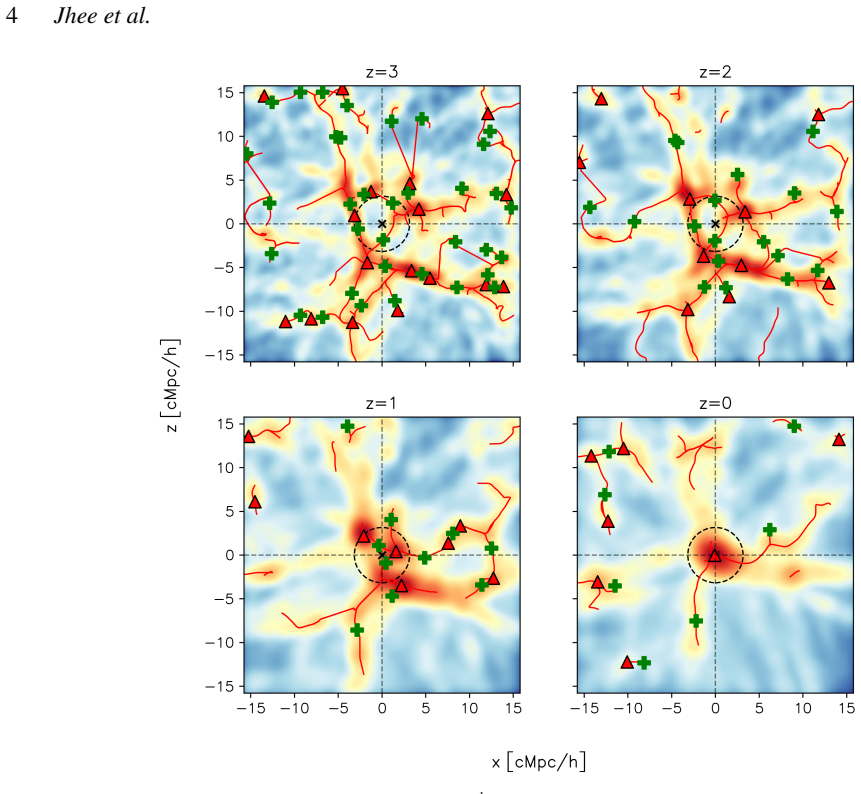
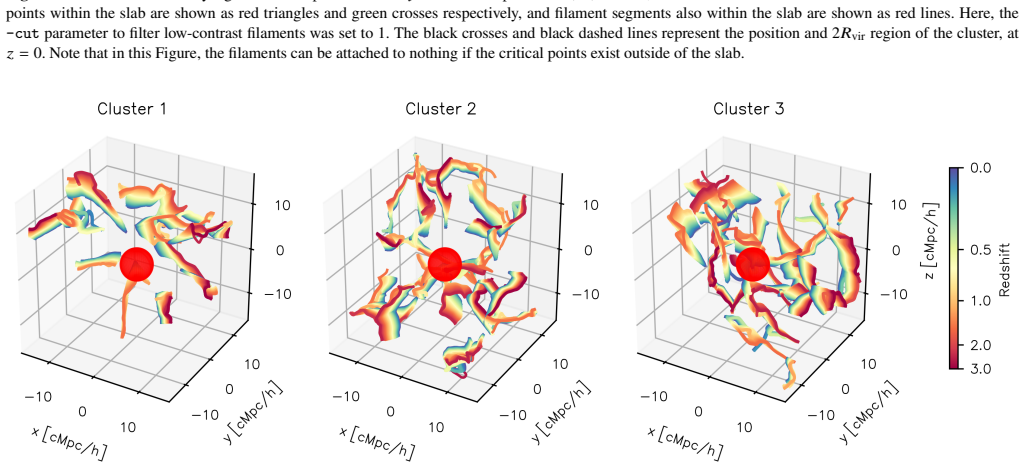
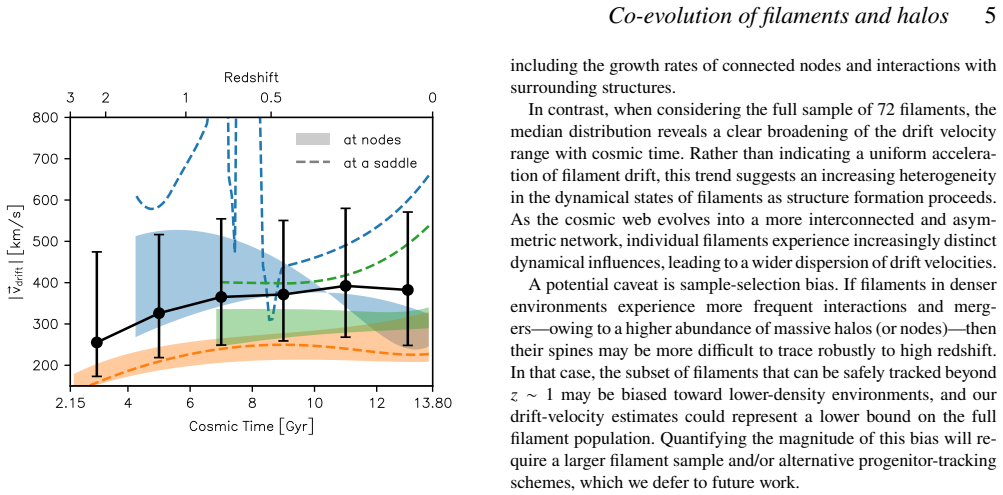
An algorithm tracing filament progenitors via spatial similarity quantification, which reconstructs bulk drift and density evolution to create a dynamic filament-centric frame separating halo motions from filament motions.
If this is right
- Mass accretion rates are suppressed beginning at filament outskirts, suggesting tidal stripping or reduced net accretion.
- Halo spin alignments depart from random-walk expectations due to torques from anisotropic flows.
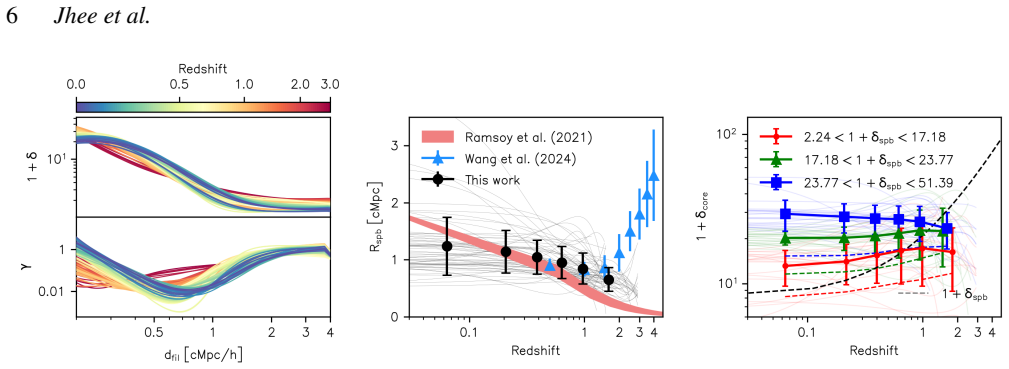
- Filament properties like splashback radii and core overdensities can be tracked over time.
- Environmental effects are characterized without contamination from major mergers.
- Simultaneous tracking of filaments and halos is required for accurate description of large-scale influences.
Where Pith is reading between the lines
- Galaxy formation simulations may need to incorporate time-dependent filament environments to predict accurate mass assembly histories.
- The observed spin changes could be tested using weak lensing or galaxy shape measurements around filaments.
- Applying the tracing method to other cosmic web elements could reveal similar environmental impacts.
- This approach might help reconcile discrepancies between observed and simulated halo properties in dense regions.
Load-bearing premise
The spatial similarity algorithm correctly identifies filament progenitors and reconstructs their histories including drift and density changes without major biases.
What would settle it
If mass accretion rates measured in an evolving filament frame do not show suppression starting at the outskirts of high-density filaments, or if spin alignments follow random walks, the central findings would be falsified.
Figures
read the original abstract
The evolution of galaxies is closely tied to that of their host dark matter halos, which is in turn strongly modulated by the surrounding large-scale environment. Cosmic filaments are expected to influence the peculiar motions, mass assembly and angular momentum of nearby halos through highly anisotropic matter flows. In order to fully capture the dynamic interplay between the filaments and halos, we develop an algorithm to trace the progenitors of individual filaments identified at z=0 with DisPerSE in a cosmological N-body simulation, by quantifying the spatial similarity between a descendant filament and progenitor candidates. This enables us to reconstruct filament-by-filament evolutionary histories, including their bulk drift and the evolution of density profiles, from which splashback radii and core overdensities are derived. Using these time-dependent properties, we re-examine halo phase-space trajectories in a filament-centric frame that evolves with time. This eliminates biases inherent to static models by separating halo motions from the motion of the filaments, allowing trajectories to be identified more reliably. We find that as halos approach high-density filaments, their mass accretion rates are systematically suppressed beginning at the filament outskirts, suggestive of tidal stripping or suppressed net accretion. Furthermore, the evolution of halo spin alignments exhibits a clear departure from stochastic random-walk expectations. This suggests that distinct mass flow regimes in and around filaments exert different torques on infalling halos, thereby changing their angular momentum. Our findings, derived from a sample screened for major mergers, highlight the pure dynamical impact of the filamentary environment. Ultimately, we demonstrate that tracking the simultaneous co-evolution of filaments and halos is essential for accurately characterizing environmental effects.
Editorial analysis
A structured set of objections, weighed in public.
Referee Report
Summary. The paper develops an algorithm to trace progenitors of z=0 filaments identified with DisPerSE in cosmological N-body simulations by quantifying spatial similarity between descendant and candidate filaments. This reconstructs filament evolutionary histories including bulk drift and density profile evolution, from which splashback radii and core overdensities are derived. Halos are then analyzed in a time-evolving filament-centric frame to separate their motions from filament motion. The central findings are that mass accretion rates are systematically suppressed as halos approach high-density filaments, beginning at the outskirts (suggestive of tidal stripping or suppressed accretion), and that halo spin alignments depart from stochastic random-walk expectations, indicating distinct torques from filamentary mass flows. The sample is screened for major mergers to isolate pure dynamical effects.
Significance. If the filament-tracing procedure is shown to be unbiased, the work demonstrates the necessity of co-evolving filaments and halos to avoid biases from static environmental models, providing direct evidence for environmental modulation of halo mass assembly and angular momentum via anisotropic flows. The approach uses raw simulation outputs without fitted parameters and yields falsifiable predictions about accretion suppression and spin evolution that can be tested in other simulations or observations. This has implications for galaxy formation models that incorporate filamentary environments.
major comments (3)
- [Methods] Methods (filament progenitor tracing): The spatial similarity algorithm for matching descendant filaments to progenitors is described but supplies no quantitative validation, such as recovery fractions on controlled test cases, sensitivity analysis to the similarity threshold, or cross-checks against alternative tracers (e.g., density peak tracking). This is load-bearing for the central claims because systematic mismatches in bulk drift or density gradients would shift the inferred filament outskirts and splashback radii, directly altering the reported accretion-rate suppression and spin-alignment results.
- [Results] Results (mass accretion rates): The claim of systematic suppression beginning at filament outskirts lacks reported error bars, sample statistics (number of halos per filament density bin), and explicit controls confirming that the screening for major mergers fully removes merger-driven accretion signals. Without these, it is unclear whether the suppression is statistically robust or could be influenced by residual selection effects.
- [Results] Results (spin alignments): The departure from stochastic random-walk expectations is stated but the quantitative measure (e.g., the specific statistic or model for the random-walk null hypothesis) and its significance level are not detailed in the provided description, making it difficult to assess whether the departure is load-bearing or could arise from the evolving frame definition itself.
minor comments (1)
- [Abstract/Methods] The abstract and methods would benefit from a brief statement of the similarity metric's functional form (e.g., whether it is a simple overlap integral or includes density weighting) to aid reproducibility.
Simulated Author's Rebuttal
We thank the referee for the constructive and detailed report. We address each major comment below and will revise the manuscript to incorporate the suggested improvements.
read point-by-point responses
-
Referee: [Methods] Methods (filament progenitor tracing): The spatial similarity algorithm for matching descendant filaments to progenitors is described but supplies no quantitative validation, such as recovery fractions on controlled test cases, sensitivity analysis to the similarity threshold, or cross-checks against alternative tracers (e.g., density peak tracking). This is load-bearing for the central claims because systematic mismatches in bulk drift or density gradients would shift the inferred filament outskirts and splashback radii, directly altering the reported accretion-rate suppression and spin-alignment results.
Authors: We agree that the current manuscript lacks explicit quantitative validation of the progenitor-tracing algorithm. In the revised version we will add a dedicated subsection (or appendix) presenting recovery fractions from controlled test cases with injected filament evolutions, a sensitivity analysis on the similarity threshold, and direct comparisons against density-peak tracking. These additions will demonstrate that the algorithm does not introduce systematic biases capable of altering the reported accretion and spin results. revision: yes
-
Referee: [Results] Results (mass accretion rates): The claim of systematic suppression beginning at filament outskirts lacks reported error bars, sample statistics (number of halos per filament density bin), and explicit controls confirming that the screening for major mergers fully removes merger-driven accretion signals. Without these, it is unclear whether the suppression is statistically robust or could be influenced by residual selection effects.
Authors: The manuscript already applies a major-merger screen to isolate dynamical effects, but we acknowledge that error bars, per-bin halo counts, and explicit validation of the screen are not presented with sufficient detail. The revision will include error bars on all accretion-rate measurements, tabulate the number of halos per filament-density bin, and add a supplementary test (e.g., comparison of screened versus unscreened samples) confirming that residual merger-driven accretion is negligible. revision: yes
-
Referee: [Results] Results (spin alignments): The departure from stochastic random-walk expectations is stated but the quantitative measure (e.g., the specific statistic or model for the random-walk null hypothesis) and its significance level are not detailed in the provided description, making it difficult to assess whether the departure is load-bearing or could arise from the evolving frame definition itself.
Authors: We will expand the spin-alignment section to specify the exact statistic employed, the precise random-walk null model (including how the evolving filament-centric frame is accounted for), and the numerical significance level of the observed departure. This clarification will allow readers to evaluate whether the result is robust against frame-definition artifacts. revision: yes
Circularity Check
No circularity: results from direct simulation analysis with novel algorithm
full rationale
The paper develops a new spatial-similarity algorithm to trace filament progenitors in N-body simulation data, then applies it to re-express halo trajectories in an evolving filament-centric frame. No quoted step reduces a claimed result to a fitted parameter renamed as prediction, a self-citation chain, or a self-definitional equivalence. The central findings (suppressed accretion rates and non-random spin evolution) are presented as empirical outputs from the screened simulation sample, with the algorithm described as an original contribution rather than imported via prior self-citation. The derivation chain therefore remains self-contained against external benchmarks.
Axiom & Free-Parameter Ledger
axioms (1)
- domain assumption The spatial similarity metric accurately identifies true filament progenitors across simulation snapshots.
Reference graph
Works this paper leans on
-
[1]
Galaxy transformation across the cosmic web: The influence zone of filaments. , keywords =. doi:10.1051/0004-6361/202555828 , archivePrefix =. 2601.13309 , primaryClass =
-
[2]
Spin alignment of dark matter haloes in filaments and walls
Spin Alignment of Dark Matter Halos in Filaments and Walls. , keywords =. doi:10.1086/511633 , archivePrefix =. astro-ph/0610249 , primaryClass =
work page internal anchor Pith review Pith/arXiv arXiv doi:10.1086/511633
-
[3]
The MIP ensemble simulation: local ensemble statistics in the Cosmic Web. , keywords =. doi:10.1093/mnras/stv2301 , archivePrefix =. 1210.7871 , primaryClass =
-
[4]
The Rockstar Phase-Space Temporal Halo Finder and the Velocity Offsets of Cluster Cores
The ROCKSTAR Phase-space Temporal Halo Finder and the Velocity Offsets of Cluster Cores. , keywords =. doi:10.1088/0004-637X/762/2/109 , archivePrefix =. 1110.4372 , primaryClass =
work page internal anchor Pith review Pith/arXiv arXiv doi:10.1088/0004-637x/762/2/109
-
[5]
Gravitationally Consistent Halo Catalogs and Merger Trees for Precision Cosmology
Gravitationally Consistent Halo Catalogs and Merger Trees for Precision Cosmology. , keywords =. doi:10.1088/0004-637X/763/1/18 , archivePrefix =. 1110.4370 , primaryClass =
work page internal anchor Pith review Pith/arXiv arXiv doi:10.1088/0004-637x/763/1/18
-
[6]
How filaments of galaxies are woven into the cosmic web. , keywords =. doi:10.1038/380603a0 , archivePrefix =. astro-ph/9512141 , primaryClass =
work page internal anchor Pith review Pith/arXiv arXiv doi:10.1038/380603a0
-
[7]
ZOMG-I. How the cosmic web inhibits halo growth and generates assembly bias
ZOMG - I. How the cosmic web inhibits halo growth and generates assembly bias. , keywords =. doi:10.1093/mnras/stx873 , archivePrefix =. 1610.04231 , primaryClass =
work page internal anchor Pith review Pith/arXiv arXiv doi:10.1093/mnras/stx873
-
[8]
The VIMOS Public Extragalactic Redshift Survey (VIPERS): galaxy segregation inside filaments at z ≃ 0.7. , keywords =. doi:10.1093/mnras/stw2864 , archivePrefix =. 1611.07045 , primaryClass =
work page internal anchor Pith review Pith/arXiv arXiv doi:10.1093/mnras/stw2864
-
[9]
, title = "
Bhattacharyya, T. , title = ". Bulletin of the Calcutta Mathematical Society , volume =
-
[10]
Cautun, Marius and van de Weygaert, Rien and Jones, Bernard J. T. and Frenk, Carlos S. , title = ". Monthly Notices of the Royal Astronomical Society , volume =. 2014 , month =. doi:10.1093/mnras/stu768 , url =
-
[11]
Tracing the filamentary structure of the galaxy distribution at z -0.5ex 0.8. , keywords =. doi:10.1111/j.1365-2966.2010.16707.x , archivePrefix =. 1003.3239 , primaryClass =
-
[12]
Kyungwon Chun and Jihye Shin and Rory Smith and Jongwan Ko and Jaewon Yoo , title =. 2022 , month =. doi:10.3847/1538-4357/ac2cbe , url =
-
[13]
Connecting the cosmic web to the spin of dark haloes: implications for galaxy formation. , keywords =. doi:10.1111/j.1365-2966.2012.21636.x , archivePrefix =. 1201.5794 , primaryClass =
-
[14]
Spin alignments within the cosmic web: a theory of constrained tidal torques near filaments
Spin alignments within the cosmic web: a theory of constrained tidal torques near filaments. , keywords =. doi:10.1093/mnras/stv1570 , archivePrefix =. 1504.06073 , primaryClass =
work page internal anchor Pith review Pith/arXiv arXiv doi:10.1093/mnras/stv1570
-
[15]
Dependence of the outer density profiles of halos on their mass accretion rate
Dependence of the Outer Density Profiles of Halos on Their Mass Accretion Rate. , keywords =. doi:10.1088/0004-637X/789/1/1 , archivePrefix =. 1401.1216 , primaryClass =
work page internal anchor Pith review Pith/arXiv arXiv doi:10.1088/0004-637x/789/1/1
-
[16]
A universal model for halo concentrations
A Universal Model for Halo Concentrations. , keywords =. doi:10.1088/0004-637X/799/1/108 , archivePrefix =. 1407.4730 , primaryClass =
work page internal anchor Pith review Pith/arXiv arXiv doi:10.1088/0004-637x/799/1/108
-
[17]
Statistics of tidal and deformation eigenvalue fields in the primordial Gaussian matter distribution: the two-dimensional case. , keywords =. doi:10.1093/mnras/stad2777 , archivePrefix =. 2301.07200 , primaryClass =
-
[18]
Evolution of cosmic filaments in the MTNG simulation. , keywords =. doi:10.1051/0004-6361/202347982 , archivePrefix =. 2309.08659 , primaryClass =
-
[19]
The Cosmic Ballet: spin and shape alignments of haloes in the cosmic web
The Cosmic Ballet: spin and shape alignments of haloes in the cosmic web. , keywords =. doi:10.1093/mnras/sty2270 , archivePrefix =. 1805.00033 , primaryClass =
work page internal anchor Pith review Pith/arXiv arXiv doi:10.1093/mnras/sty2270
-
[20]
, year = 2006, month = may, journal =
Properties of dark matter haloes in clusters, filaments, sheets and voids. , keywords =. doi:10.1111/j.1365-2966.2006.11318.x , archivePrefix =. astro-ph/0610280 , primaryClass =
-
[21]
Tidal effects and the environment dependence of halo assembly. , keywords =. doi:10.1111/j.1365-2966.2009.15271.x , archivePrefix =. 0803.4211 , primaryClass =
-
[22]
The MillenniumTNG Project: high-precision predictions for matter clustering and halo statistics. , keywords =. doi:10.1093/mnras/stad1657 , archivePrefix =. 2210.10059 , primaryClass =
-
[23]
Hannah Jhee and Hyunmi Song and Rory Smith and Jihye Shin and Inkyu Park and Clotilde Laigle , title =. 2022 , month =. doi:10.3847/1538-4357/ac990a , url =
-
[24]
Three-dimensional numerical model of the formation of large-scale structure in the Universe. , keywords =. doi:10.1093/mnras/204.3.891 , adsurl =
-
[25]
Galaxy evolution in the metric of the cosmic web. , keywords =. doi:10.1093/mnras/stx2638 , archivePrefix =. 1710.02676 , primaryClass =
-
[26]
Cosmic Web Dynamics: Forces and Strains. arXiv e-prints , keywords =. doi:10.48550/arXiv.2407.16489 , archivePrefix =. 2407.16489 , primaryClass =
-
[27]
Swirling around filaments: are large-scale structure vortices spinning up dark halos?
Swirling around filaments: are large-scale structure vortices spinning up dark haloes?. , keywords =. doi:10.1093/mnras/stu2289 , archivePrefix =. 1310.3801 , primaryClass =
work page internal anchor Pith review Pith/arXiv arXiv doi:10.1093/mnras/stu2289
-
[28]
COSMOS2015 photometric redshifts probe the impact of filaments on galaxy properties
COSMOS2015 photometric redshifts probe the impact of filaments on galaxy properties. , keywords =. doi:10.1093/mnras/stx3055 , archivePrefix =. 1702.08810 , primaryClass =
work page internal anchor Pith review Pith/arXiv arXiv doi:10.1093/mnras/stx3055
-
[29]
Deviations from tidal torque theory: Evolution of the halo spin-filament alignment. , keywords =. doi:10.1093/mnras/stab451 , archivePrefix =. 2012.01638 , primaryClass =
-
[30]
Surhud More and Benedikt Diemer and Andrey V. Kravtsov , title =. 2015 , month =. doi:10.1088/0004-637X/810/1/36 , url =
-
[31]
Mon Not R Astron Soc , author =
The MillenniumTNG Project: the hydrodynamical full physics simulation and a first look at its galaxy clusters. , keywords =. doi:10.1093/mnras/stac3620 , archivePrefix =. 2210.10060 , primaryClass =
-
[32]
Halo assembly bias and the tidal anisotropy of the local halo environment
Halo assembly bias and the tidal anisotropy of the local halo environment. , keywords =. doi:10.1093/mnras/sty496 , archivePrefix =. 1706.09906 , primaryClass =
work page internal anchor Pith review Pith/arXiv arXiv doi:10.1093/mnras/sty496
-
[33]
Mass and Environment as Drivers of Galaxy Evolution in SDSS and zCOSMOS and the Origin of the Schechter Function. , keywords =. doi:10.1088/0004-637X/721/1/193 , archivePrefix =. 1003.4747 , primaryClass =
work page internal anchor Pith review Pith/arXiv arXiv doi:10.1088/0004-637x/721/1/193
-
[34]
Rigging dark haloes: why is hierarchical galaxy formation consistent with the inside-out build-up of thin discs?. , keywords =. doi:10.1111/j.1365-2966.2011.19640.x , archivePrefix =. 1105.0210 , primaryClass =
-
[35]
Alignment of voids in the cosmic web. , keywords =. doi:10.1111/j.1365-2966.2008.13019.x , archivePrefix =. 0711.2480 , primaryClass =
-
[36]
Unveiling the properties of high redshift filaments
Rivers of gas - I. Unveiling the properties of high redshift filaments. , keywords =. doi:10.1093/mnras/stab015 , archivePrefix =. 2101.00844 , primaryClass =
-
[37]
The multi-stream flows and the dynamics of the cosmic web
The multi-stream flows and the dynamics of the cosmic web. , keywords =. doi:10.1088/1475-7516/2011/05/015 , archivePrefix =. 1011.1924 , primaryClass =
work page internal anchor Pith review Pith/arXiv arXiv doi:10.1088/1475-7516/2011/05/015 2011
-
[38]
Beyond halo mass: quenching galaxy mass assembly at the edge of filaments. , keywords =. doi:10.1093/mnras/staa3981 , archivePrefix =. 2009.00013 , primaryClass =
-
[39]
title The power of blazar jets
The 3D skeleton: tracing the filamentary structure of the Universe. , keywords =. doi:10.1111/j.1365-2966.2007.12685.x , archivePrefix =. 0707.3123 , primaryClass =
-
[40]
Sousbie, T. , title = ". Monthly Notices of the Royal Astronomical Society , volume =. 2011 , month =. doi:10.1111/j.1365-2966.2011.18394.x , url =
-
[41]
Exploring the causal effect of cosmic filaments on dark matter haloes. , keywords =. doi:10.1093/mnras/staf523 , archivePrefix =. 2409.13010 , primaryClass =
-
[42]
A 15 Mpc rotating galaxy filament at redshift z = 0.032. , keywords =. doi:10.1093/mnras/staf2005 , archivePrefix =. 2508.13053 , primaryClass =
-
[43]
Internal properties and environments of dark matter haloes. , keywords =. doi:10.1111/j.1365-2966.2011.18301.x , archivePrefix =. 1007.0612 , primaryClass =
-
[44]
Possible observational evidence for cosmic filament spin. Nature Astronomy , keywords =. doi:10.1038/s41550-021-01380-6 , archivePrefix =. 2106.05989 , primaryClass =
-
[45]
The boundary of cosmic filaments. , keywords =. doi:10.1093/mnras/stae1801 , archivePrefix =. 2402.11678 , primaryClass =
-
[46]
The SAMI Galaxy Survey: first detection of a transition in spin orientation with respect to cosmic filaments in the stellar kinematics of galaxies. , keywords =. doi:10.1093/mnras/stz2860 , archivePrefix =. 1909.12371 , primaryClass =
-
[47]
On the Width and Profiles of Cosmic Filaments. , keywords =. doi:10.3847/1538-4357/adeca3 , archivePrefix =. 2507.02476 , primaryClass =
-
[48]
Universal Dark-matter Density Profiles of Cosmic Filaments
Universal Dark-matter Density Profiles of Cosmic Filaments. arXiv e-prints , keywords =. doi:10.48550/arXiv.2604.05033 , archivePrefix =. 2604.05033 , primaryClass =
work page internal anchor Pith review Pith/arXiv arXiv doi:10.48550/arxiv.2604.05033
-
[49]
Profiles of Cosmic Filaments Since z = 4.0 in Cosmological Hydrodynamical Simulation. , keywords =. doi:10.3847/1538-4357/ac15f1 , archivePrefix =. 2107.08663 , primaryClass =
discussion (0)
Sign in with ORCID, Apple, or X to comment. Anyone can read and Pith papers without signing in.