SEEDZ: Rapid Galaxy Assembly as a Pathway to Supermassive Stars, Dense Stellar Environments and Massive Black Hole Seeds
Pith reviewed 2026-06-29 02:02 UTC · model grok-4.3
The pith
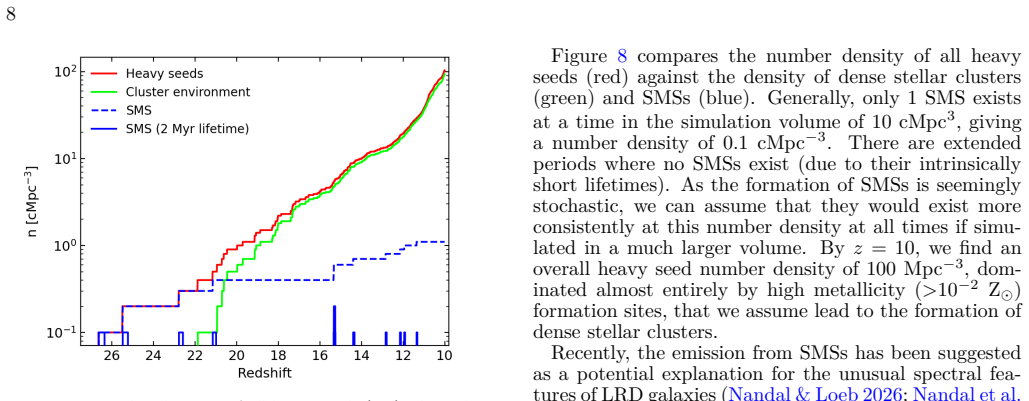
Rapidly growing early galaxies sustain the inflows needed to form supermassive stars at a comoving density of 0.1 per cubic megaparsec by redshift 10.
A machine-rendered reading of the paper's core claim, the machinery that carries it, and where it could break.
Core claim
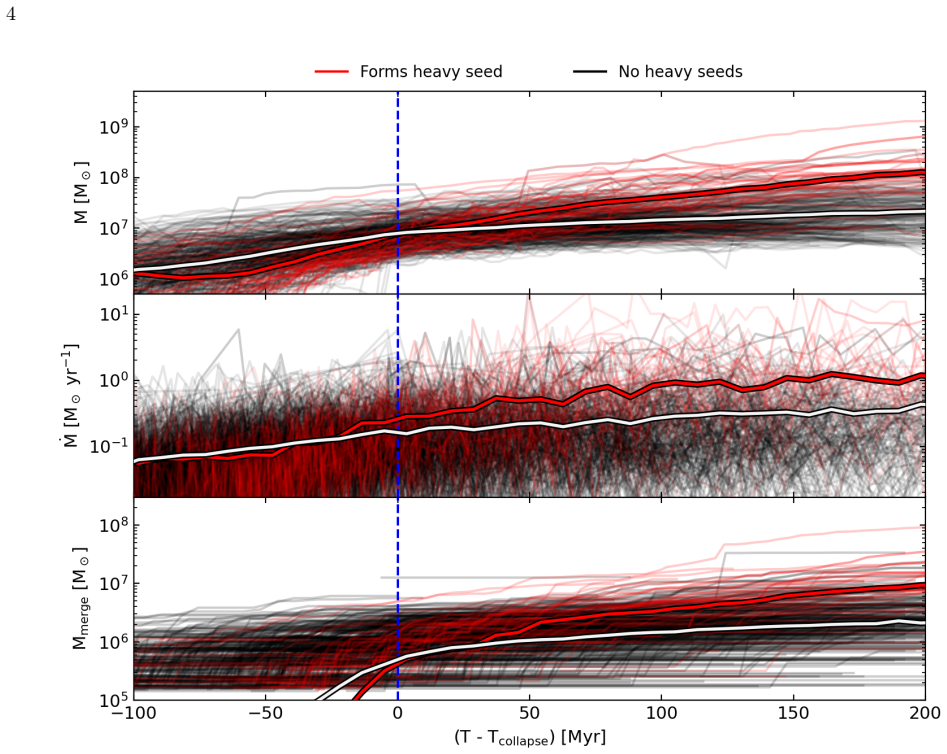
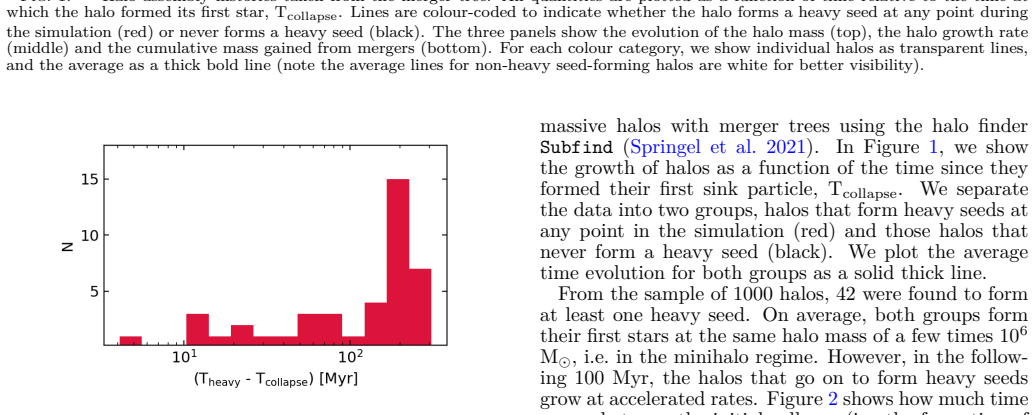
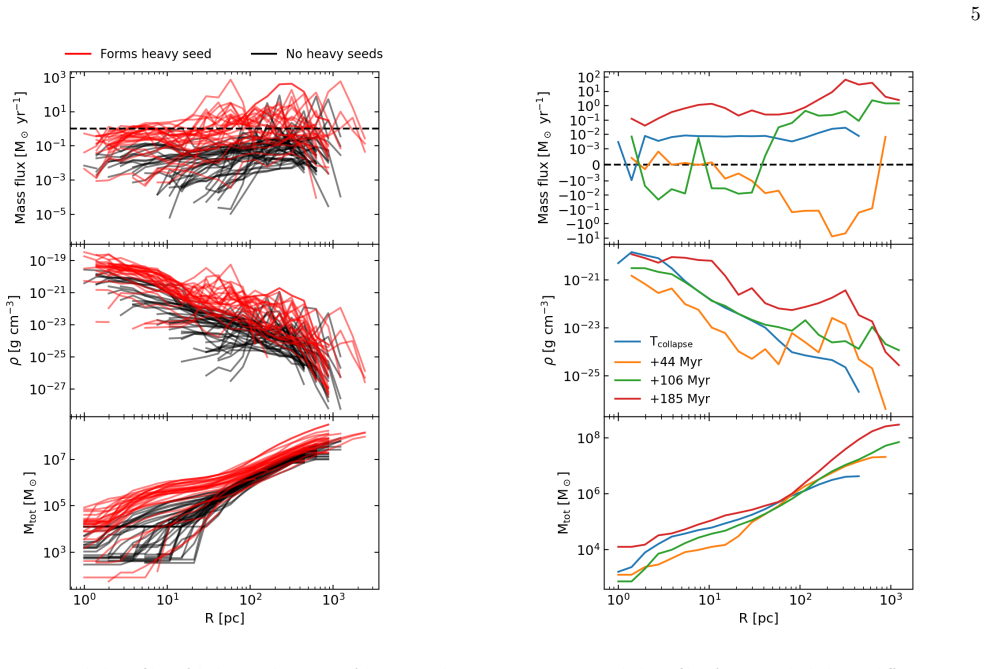
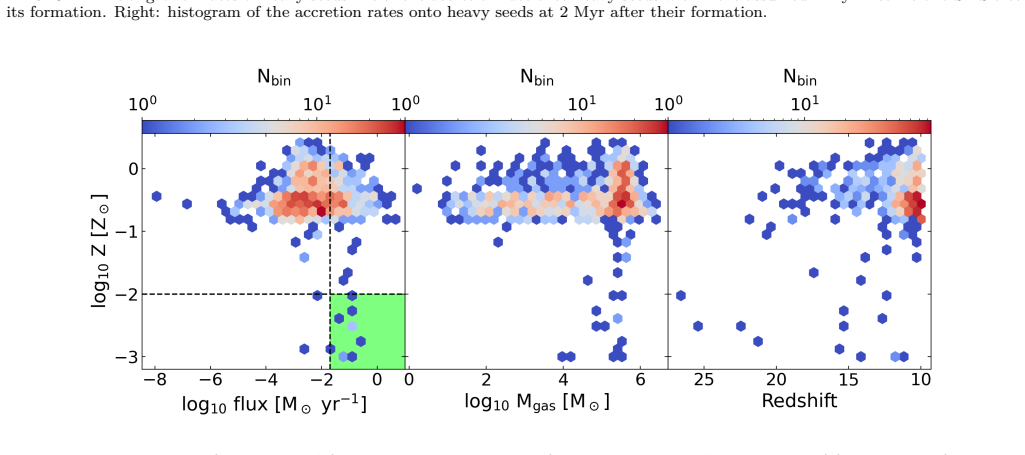
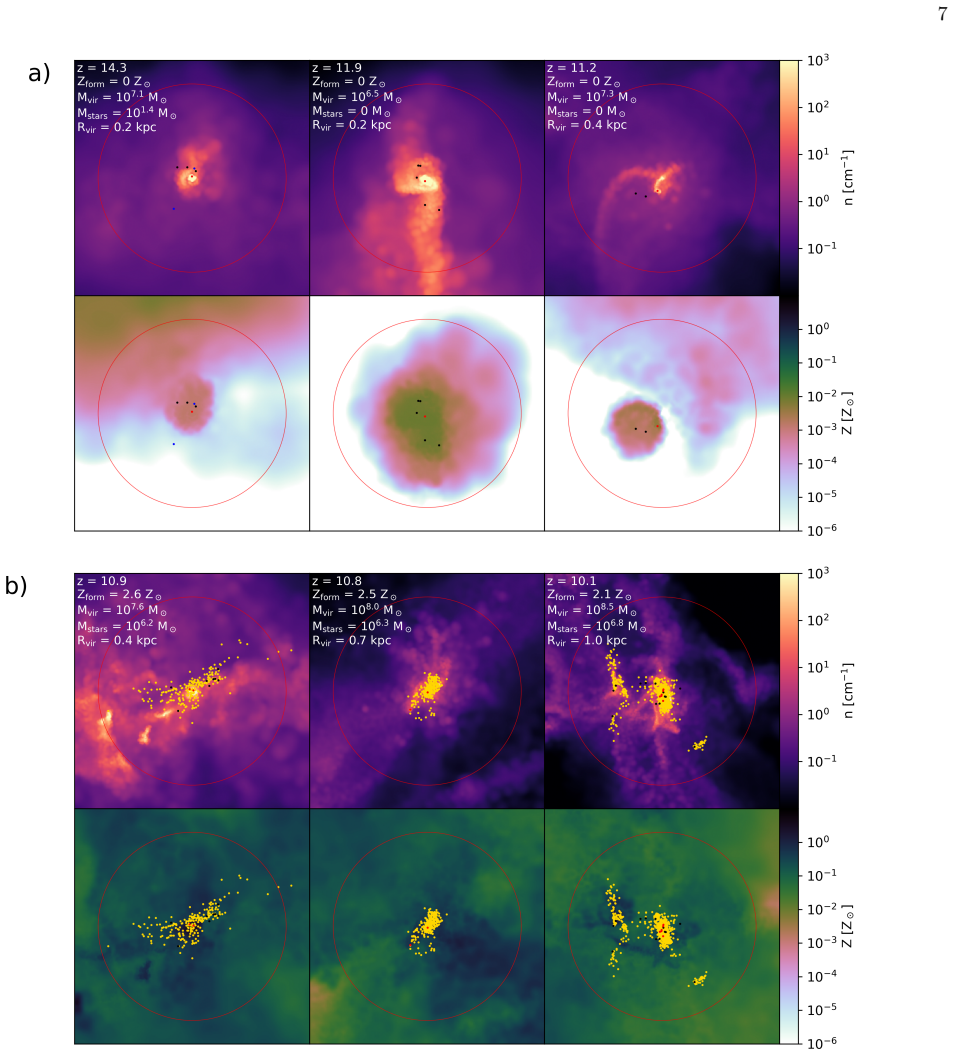
Halos that maintain growth rates of at least 1 solar mass per year at their virial radius sustain inflows of 0.1 solar masses per year into their central parsec and therefore meet the heavy-seed formation criterion of more than 1 solar mass per year into 10-parsec regions. These halos form heavy seeds about 100 million years after their first stars. By redshift 10 most seeds occur in near-solar metallicity gas, although some continue to form in 0.01 solar metallicity gas. When the additional requirement is imposed that a supermassive star must form in 0.01 solar metallicity gas and sustain accretion above 0.02 solar masses per year for its full 2-million-year lifetime, the simulations produc
What carries the argument
The inflow threshold of more than 1 solar mass per year into 10-parsec regions, which selects rapidly assembling halos that can maintain the inner accretion flows required for heavy seeds.
If this is right
- Rapidly growing halos produce heavy seeds after their first stars but still at high redshift.
- Most heavy seeds by redshift 10 form in near-solar metallicity environments.
- A minority of heavy seeds form in low-metallicity gas that satisfies the supermassive-star progenitor conditions.
- The calculated supermassive-star density requires that only a fraction of 10 to the minus 4 be visible to match the observed count of Little Red Dot galaxies.
Where Pith is reading between the lines
- Seed formation would be concentrated in the subset of galaxies that assemble fastest rather than in typical halos.
- The low-metallicity fraction among the seeds would set an upper bound on how much this channel can contribute to the total early black-hole population.
- Observations that map Little Red Dots to their large-scale environments could test whether they sit in regions consistent with rapid halo growth.
Load-bearing premise
The specific inflow rate and metallicity thresholds used to decide which gas flows produce supermassive stars that become heavy seed progenitors.
What would settle it
A measured number density of supermassive-star candidates or heavy seeds at redshift near 10 that lies well below or well above 0.1 per comoving cubic megaparsec.
Figures
read the original abstract
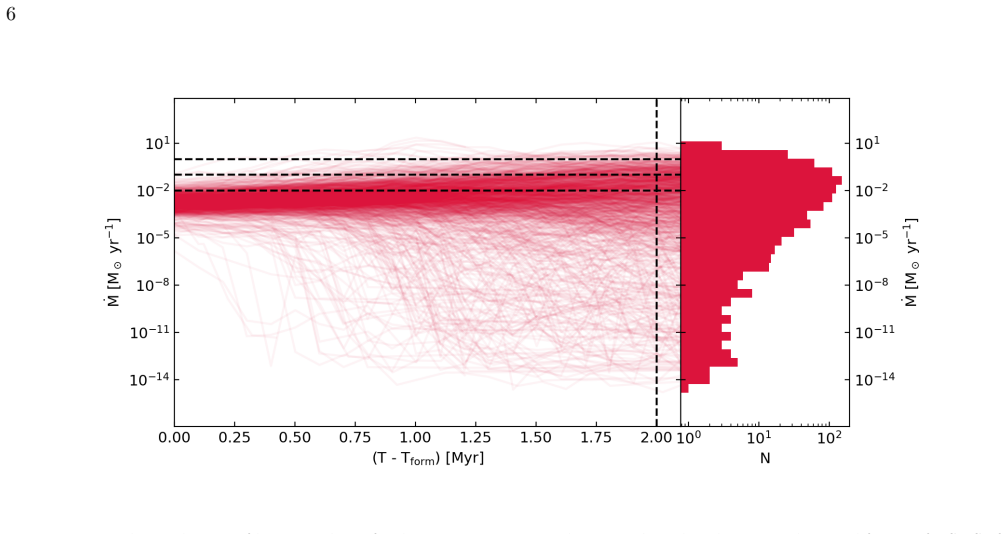
We investigate the assembly history of early galaxies in the SEEDZ hydrodynamic simulations, to investigate the high inflow rates believed to be required for the formation of supermassive stars (SMSs), dense stellar clusters and subsequently heavy seed black holes. Using a heavy seed formation criteria of $>$1 M$_\odot$ yr$^{-1}$ flowing into 10 pc regions, we find that heavy seeds form in halos that grow rapidly compared to those halos that never meet the criteria. Halos with growth rates of $\gtrsim$1 M$_\odot$ yr$^{-1}$ at their virial radius (scales of a few hundred pc) are able to sustain a flow rate of 0.1 M$_\odot$ yr$^{-1}$ into the inner 1 pc of the halo, maintaining higher density environments within the central 10 - 100~pc. These halos continue to grow rapidly after their initial collapse, typically forming heavy seeds $\sim$100 Myr after forming their first stars and stellar mass black holes. By $z=10$, most heavy seeds form in regions of near-solar metallicity, although a minority of heavy seeds do continue to form in low metallicity (10$^{-2}$ Z$_\odot$) regions. Under the assumption that a SMS forms as the progenitor to a heavy seed if it forms in a region of low (10$^{-2}$ Z$_\odot$) metallicity, and can sustain high accretion rates above 0.02 M$_\odot$ yr$^{-1}$ throughout the SMS lifetime of 2 Myr, we find a number density of SMSs of 0.1 cMpc$^{-3}$, meaning that only a fraction of 10$^{-4}$ of these SMSs would need to be visible to JWST to account for the observed population of Little Red Dot galaxies.
Editorial analysis
A structured set of objections, weighed in public.
Referee Report
Summary. The paper analyzes the SEEDZ hydrodynamic simulations of early galaxy assembly to identify conditions for supermassive star (SMS) formation as progenitors to heavy seed black holes. Using a heavy-seed criterion of >1 M_⊙ yr^{-1} inflow into 10 pc regions, the authors find that such seeds arise in rapidly growing halos that sustain high central densities and typically form ~100 Myr after first stars. By z=10 most heavy seeds occur at near-solar metallicity, but under the explicit assumption that SMSs arise only in the low-metallicity (10^{-2} Z_⊙) subset that also maintains accretion >0.02 M_⊙ yr^{-1} throughout a 2 Myr lifetime, they report an SMS number density of 0.1 cMpc^{-3} and note that a visible fraction of only 10^{-4} would suffice to explain the observed Little Red Dot population.
Significance. If the reported density is robust, the work supplies a concrete, simulation-derived pathway connecting rapid halo growth to SMS and heavy-seed formation, with direct implications for JWST observations of high-redshift compact objects. The hydrodynamic tracking of inflows, metallicities, and central densities yields falsifiable number-density predictions that can be tested against future observations or higher-resolution runs.
major comments (3)
- [Abstract] Abstract: the headline SMS number density of 0.1 cMpc^{-3} is obtained only after applying two sharp, externally imposed thresholds (heavy-seed inflow >1 M_⊙ yr^{-1} into 10 pc; SMS progenitor accretion >0.02 M_⊙ yr^{-1} sustained for the full 2 Myr at 10^{-2} Z_⊙). No sensitivity analysis, variation of the cut values, or justification for these particular numbers versus alternatives (e.g., 0.5 or 2 M_⊙ yr^{-1}) is reported, yet these cuts directly determine which halos contribute to the final count.
- [Abstract] Abstract: the manuscript states that most heavy seeds form at near-solar metallicity while only a minority continue to form at 10^{-2} Z_⊙, but provides neither the numerical fraction of low-Z heavy seeds nor error bars or volume uncertainties on the derived 0.1 cMpc^{-3} SMS density; without these, the claim that a 10^{-4} visible fraction accounts for Little Red Dots cannot be evaluated quantitatively.
- [Abstract] Abstract (and methods description of SEEDZ runs): no convergence tests with respect to spatial resolution, alternative inflow-radius definitions, or changes in the metallicity floor are presented for the halo-growth and inflow-rate statistics that underpin the heavy-seed identification; these statistics are load-bearing for the central claim that rapid growth enables sustained central accretion.
minor comments (2)
- [Abstract] The abstract uses 'cMpc^{-3}' without defining whether the volume is comoving or proper; a brief clarification in the methods would remove ambiguity when comparing to observational number densities.
- [Abstract] The simulation suite (SEEDZ) is referenced only by name; a citation to the methods paper or a short description of box size, particle mass, and feedback implementation would allow readers to assess the statistical robustness of the reported densities.
Simulated Author's Rebuttal
We thank the referee for their constructive and detailed comments, which highlight important aspects of robustness and clarity in our analysis. We respond to each major comment below.
read point-by-point responses
-
Referee: [Abstract] Abstract: the headline SMS number density of 0.1 cMpc^{-3} is obtained only after applying two sharp, externally imposed thresholds (heavy-seed inflow >1 M_⊙ yr^{-1} into 10 pc; SMS progenitor accretion >0.02 M_⊙ yr^{-1} sustained for the full 2 Myr at 10^{-2} Z_⊙). No sensitivity analysis, variation of the cut values, or justification for these particular numbers versus alternatives (e.g., 0.5 or 2 M_⊙ yr^{-1}) is reported, yet these cuts directly determine which halos contribute to the final count.
Authors: The adopted thresholds are motivated by theoretical expectations in the SMS formation literature for the minimum sustained accretion rates needed to reach supermassive masses before radiative feedback halts growth. We agree that the lack of explicit sensitivity tests limits the ability to assess robustness. In the revised manuscript we will add a dedicated subsection performing a sensitivity analysis, varying the heavy-seed inflow threshold between 0.5 and 2 M_⊙ yr^{-1} and the SMS accretion threshold between 0.01 and 0.05 M_⊙ yr^{-1}, and will report the resulting range of SMS number densities. revision: yes
-
Referee: [Abstract] Abstract: the manuscript states that most heavy seeds form at near-solar metallicity while only a minority continue to form at 10^{-2} Z_⊙, but provides neither the numerical fraction of low-Z heavy seeds nor error bars or volume uncertainties on the derived 0.1 cMpc^{-3} SMS density; without these, the claim that a 10^{-4} visible fraction accounts for Little Red Dots cannot be evaluated quantitatively.
Authors: We will include the explicit numerical fraction of heavy seeds forming in low-metallicity (10^{-2} Z_⊙) gas in the revised manuscript. We will also report Poisson uncertainties on the SMS number density derived from the number of qualifying objects in the simulated volume. A full treatment of cosmic variance would require additional independent realizations, which are not available; we will explicitly note this limitation when discussing the 10^{-4} visibility fraction. revision: partial
-
Referee: [Abstract] Abstract (and methods description of SEEDZ runs): no convergence tests with respect to spatial resolution, alternative inflow-radius definitions, or changes in the metallicity floor are presented for the halo-growth and inflow-rate statistics that underpin the heavy-seed identification; these statistics are load-bearing for the central claim that rapid growth enables sustained central accretion.
Authors: The SEEDZ resolution was selected to resolve the central 10 pc inflow regions, consistent with prior convergence studies using the same code base. In the revised manuscript we will expand the methods section to justify the resolution choice and will test the sensitivity of the inflow statistics to alternative radii (5 pc and 20 pc). Full resolution-convergence re-runs and variations of the metallicity floor are computationally prohibitive for this revision and will be noted as a limitation. revision: partial
Circularity Check
No significant circularity detected
full rationale
The SMS number density of 0.1 cMpc^{-3} is obtained by direct counting of halos in the SEEDZ hydrodynamic simulations that satisfy the stated a priori thresholds (>1 M⊙ yr^{-1} inflow into 10 pc; low-Z plus sustained >0.02 M⊙ yr^{-1} accretion for 2 Myr). These thresholds function as external filters applied to simulation outputs rather than quantities derived from or fitted to the target density. No equations, self-citations, or ansatzes reduce the reported density to the inputs by construction. The result remains an independent numerical measurement from the hydro runs.
Axiom & Free-Parameter Ledger
free parameters (4)
- Heavy seed inflow threshold =
>1 M_⊙ yr^{-1} into 10 pc
- SMS sustained accretion rate =
0.02 M_⊙ yr^{-1}
- SMS lifetime =
2 Myr
- Low-metallicity threshold for SMS =
10^{-2} Z_⊙
axioms (2)
- standard math Lambda-CDM cosmology governs halo assembly and gas accretion
- domain assumption Subgrid models for cooling, star formation, and feedback accurately capture central gas flows
Reference graph
Works this paper leans on
-
[1]
Akins, H. B., Casey, C. M., Lambrides, E., et al. 2024, COSMOS-Web: The over-Abundance and Physical Nature of "Little Red Dots"–Implications for Early Galaxy and SMBH Assembly, arXiv, doi: 10.48550/arXiv.2406.10341
-
[2]
Hickox, R. C. 2024, X-Ray View of Little Red Dots: Do They Host Supermassive Black Holes?, arXiv, doi: 10.48550/arXiv.2404.19010
-
[3]
2019, Monthly Notices of the Royal Astronomical Society, 486, 5008
Antonini, F., Gieles, M., & Gualandris, A. 2019, Monthly Notices of the Royal Astronomical Society, 486, 5008
2019
-
[4]
Baggen, J. F. W., van Dokkum, P., Brammer, G., et al. 2024, The Small Sizes and High Implied Densities of ‘Little Red Dots’ with Balmer Breaks Could Explain Their Broad Emission Lines Without an AGN, arXiv, doi: 10.48550/arXiv.2408.07745
-
[5]
C., & Monaco, P
Banik, N., Tan, J. C., & Monaco, P. 2019, Monthly Notices of the Royal Astronomical Society, 483, 3592
2019
-
[6]
Begelman, M. C. 2010, Monthly Notices of the Royal Astronomical Society, 402, 673
2010
-
[7]
Begelman, M. C., & Dexter, J. 2026, The Astrophysical Journal, 996, 48 Bogdán, Á., Goulding, A. D., Natarajan, P., et al. 2024, Nature Astronomy, 8, 126, doi: 10.1038/s41550-023-02111-9
-
[8]
2026, arXiv e-prints, arXiv:2601.22214, doi: 10.48550/arXiv.2601.22214
Brazzini, M., D’Eugenio, F., Maiolino, R., et al. 2026, arXiv e-prints, arXiv:2601.22214, doi: 10.48550/arXiv.2601.22214
-
[9]
C., et al
Cammelli, V., Monaco, P., Tan, J. C., et al. 2025, Monthly Notices of the Royal Astronomical Society, 536, 851
2025
-
[10]
2025, MNRAS, 539, 2561, doi: 10.1093/mnras/staf598
Chon, S., & Omukai, K. 2025, MNRAS, 539, 2561, doi: 10.1093/mnras/staf598
-
[11]
Coughlin, E. R., & Begelman, M. C. 2024, The Astrophysical Journal, 970, 158 de Graaff, A., Hviding, R. E., Naidu, R. P., et al. 2025a, arXiv e-prints, arXiv:2511.21820, doi: 10.48550/arXiv.2511.21820 de Graaff, A., Rix, H.-W., Naidu, R. P., et al. 2025b, A&A, 701, A168, doi: 10.1051/0004-6361/202554681
-
[12]
A., & Silk, J
Fragione, G., Kocsis, B., Rasio, F. A., & Silk, J. 2022, The Astrophysical Journal, 927, 231
2022
-
[13]
Greene, J. E., & Ho, L. C. 2005, ApJ, 630, 122, doi: 10.1086/431897
work page internal anchor Pith review doi:10.1086/431897 2005
-
[14]
A., Pacucci, F., & Kocevski, D
Guia, C. A., Pacucci, F., & Kocevski, D. D. 2024, Research Notes of the AAS, 8, 207, doi: 10.3847/2515-5172/ad7262 Haemmerlé, L., Klessen, R. S., Mayer, L., & Zwick, L. 2021, Astronomy & Astrophysics, 652, L7, doi: 10.1051/0004-6361/202141376 Haemmerlé, L., Woods, T. E., Klessen, R. S., Heger, A., &
-
[15]
Whalen, D. J. 2018, Monthly Notices of the Royal Astronomical Society, 474, 2757, doi: 10.1093/mnras/stx2919
-
[16]
Hahn, O., & Abel, T. 2011, Monthly Notices of the Royal Astronomical Society, 415, 2101, doi: 10.1111/j.1365-2966.2011.18820.x
-
[17]
B., Perna, R., Cantiello, M., et al
Hassan, J. B., Perna, R., Cantiello, M., et al. 2026, The Astrophysical Journal, 998, 65
2026
-
[18]
2013, The Astrophysical Journal, 778, 178, doi: 10.1088/0004-637X/778/2/178
Yoshida, N. 2013, The Astrophysical Journal, 778, 178, doi: 10.1088/0004-637X/778/2/178
-
[19]
2025, ApJ, 980, L27, doi: 10.3847/2041-8213/adaebd
Inayoshi, K., & Maiolino, R. 2025, ApJ, 980, L27, doi: 10.3847/2041-8213/adaebd
-
[20]
Inayoshi, K., Murase, K., & Kashiyama, K. 2025, Spectral Uniformity of Little Red Dots: A Natural Outcome of Coevolving Seed Black Holes and Nascent Starbursts, arXiv, doi: 10.48550/arXiv.2509.19422 10
work page internal anchor Pith review Pith/arXiv arXiv doi:10.48550/arxiv.2509.19422 2025
-
[21]
Jaura, O., Glover, S. C. O., Wollenberg, K. M. J., et al. 2022, Monthly Notices of the Royal Astronomical Society, 512, 116, doi: 10.1093/mnras/stac487 Juodžbalis, I., Maiolino, R., Baker, W. M., et al. 2024, Nature, 636, 594, doi: 10.1038/s41586-024-08210-5
-
[22]
Kocevski, D. D., Finkelstein, S. L., Barro, G., et al. 2025, The Astrophysical Journal, 986, 126, doi: 10.3847/1538-4357/adbc7d Kovács, O. E., Bogdán, Á., Natarajan, P., et al. 2024, The Astrophysical Journal Letters, 965, L21, doi: 10.3847/2041-8213/ad391f
-
[23]
Labbe, I., Greene, J. E., Bezanson, R., et al. 2023, UNCOVER: Candidate Red Active Galactic Nuclei at 3, arXiv, doi: 10.48550/arXiv.2306.07320
-
[24]
Woods, T. E. 2022, Nature, 607, 48, doi: 10.1038/s41586-022-04813-y
-
[25]
Madau, P., & Rees, M. J. 2001, The Astrophysical Journal, 551, L27, doi: 10.1086/319848
-
[26]
2024, Nature, 627, 59, doi: 10.1038/s41586-024-07052-5
Maiolino, R., Scholtz, J., Witstok, J., et al. 2024, Nature, 627, 59, doi: 10.1038/s41586-024-07052-5
-
[27]
Matthee, J., Naidu, R. P., Brammer, G., et al. 2024, The Astrophysical Journal, 963, 129, doi: 10.3847/1538-4357/ad2345
-
[28]
Mehta, D., Regan, J. A., & Prole, L. 2024, The Open Journal of Astrophysics, 7, doi: 10.33232/001c.126629
-
[29]
H., Regan, J
Mehta, D. H., Regan, J. A., & Prole, L. 2026, Nature Astronomy, 1
2026
-
[30]
A "Black Hole Star" Reveals the Remarkable Gas-Enshrouded Hearts of the Little Red Dots
Naidu, R. P., Matthee, J., Katz, H., et al. 2025, arXiv e-prints, arXiv:2503.16596, doi: 10.48550/arXiv.2503.16596
work page internal anchor Pith review Pith/arXiv arXiv doi:10.48550/arxiv.2503.16596 2025
-
[31]
2026, arXiv preprint arXiv:2604.19988
Nandal, D., Chilingarian, I., Nagele, C., et al. 2026, arXiv preprint arXiv:2604.19988
Pith/arXiv arXiv 2026
-
[32]
Pulsational mass loss from supermassive stars creates the compact shells of Little Red Dots
Nandal, D., Chilingarian, I., Nagele, C., et al. 2026, arXiv e-prints, arXiv:2604.19988, doi: 10.48550/arXiv.2604.19988
work page internal anchor Pith review Pith/arXiv arXiv doi:10.48550/arxiv.2604.19988 2026
-
[33]
2026, ApJ, 999, 110, doi: 10.3847/1538-4357/ae40bb
Nandal, D., & Chon, S. 2026, ApJ, 999, 110, doi: 10.3847/1538-4357/ae40bb
-
[34]
2026, The Astrophysical Journal, 998, 124
Nandal, D., & Loeb, A. 2026, The Astrophysical Journal, 998, 124
2026
-
[35]
Nandal, D., Regan, J. A., Woods, T. E., et al. 2023, Astronomy & Astrophysics, 677, A155, doi: 10.1051/0004-6361/202346938
-
[36]
2006, Nuclear Physics A, 777, 424, doi: 10.1016/j.nuclphysa.2006.05.008
Nomoto, K., Tominaga, N., Umeda, H., Kobayashi, C., & Maeda, K. 2006, Nuclear Physics A, 777, 424, doi: 10.1016/j.nuclphysa.2006.05.008
-
[37]
Ortiz, O. A. C., Finkelstein, S. L., Plat, A., et al. 2025, Significant Evidence of an AGN Contribution in GHZ2 at z = 12.34, arXiv, doi: 10.48550/arXiv.2511.03035
-
[38]
A., Mestichelli, B., & Ugolini, C
Paiella, L., Sedda, M. A., Mestichelli, B., & Ugolini, C. 2026, Astronomy & Astrophysics, 708, A200
2026
-
[39]
2016, Monthly Notices of the Royal Astronomical Society, 455, 1134, doi: 10.1093/mnras/stv2380
Pakmor, R., Springel, V., Bauer, A., et al. 2016, Monthly Notices of the Royal Astronomical Society, 455, 1134, doi: 10.1093/mnras/stv2380
-
[40]
Pakmor, R., Springel, V., Coles, J. P., et al. 2023, Monthly Notices of the Royal Astronomical Society, 524, 2539, doi: 10.1093/mnras/stac3620 Pérez-González, P. G., Barro, G., Rieke, G. H., et al. 2024, The Astrophysical Journal, 968, 4, doi: 10.3847/1538-4357/ad38bb
-
[41]
Prole, L. R., Clark, P. C., Klessen, R. S., & Glover, S. C. O. 2022a, Monthly Notices of the Royal Astronomical Society, 510, 4019, doi: 10.1093/mnras/stab3697
-
[42]
2022b, Monthly Notices of the Royal Astronomical Society, 516, 2223, doi: 10.1093/mnras/stac2327
Pakmor, R. 2022b, Monthly Notices of the Royal Astronomical Society, 516, 2223, doi: 10.1093/mnras/stac2327
-
[43]
Prole, L. R., Regan, J. A., Glover, S. C. O., et al. 2024a, Astronomy & Astrophysics, 685, A31, doi: 10.1051/0004-6361/202348903
-
[44]
Klessen, R. S. 2024b, Astronomy & Astrophysics, 692, A213, doi: 10.1051/0004-6361/202452486
-
[45]
Prole, L. R., Schauer, A. T. P., Clark, P. C., et al. 2023, Monthly Notices of the Royal Astronomical Society, 520, 2081, doi: 10.1093/mnras/stad188
-
[46]
Black Hole Feedback, Galaxy Quenching and Outflows at Cosmic Dawn: Analysis of the SEEDZ Simulations
Prole, L. R., Regan, J. A., Mehta, D., et al. 2026a, ArXiv e-prints, doi: 10.48550/arXiv.2602.09104 —. 2026b, arXiv preprint arXiv:2602.09104
work page internal anchor Pith review Pith/arXiv arXiv doi:10.48550/arxiv.2602.09104
-
[47]
J., & Iorio, G
Rantala, A., Lahén, N., Naab, T., Escobar, G. J., & Iorio, G. 2025, Monthly Notices of the Royal Astronomical Society, 543, 2130
2025
-
[48]
Rantala, A., & Naab, T. 2025, Monthly Notices of the Royal Astronomical Society: Letters, 542, L78, doi: 10.1093/mnrasl/slaf064
-
[49]
2026, MNRAS, doi: 10.1093/mnras/stag986
Rantala, A., Naab, T., Lahén, N., et al. 2026, MNRAS, doi: 10.1093/mnras/stag986
-
[50]
2024, The Open Journal of Astrophysics, 7, doi: 10.33232/001c.123239
Regan, J., & Volonteri, M. 2024, The Open Journal of Astrophysics, 7, doi: 10.33232/001c.123239
-
[51]
Regan, J. A., Johansson, P. H., & Wise, J. H. 2014, The Astrophysical Journal, 795, 137, doi: 10.1088/0004-637X/795/2/137
-
[52]
2025, arXiv preprint arXiv:2503.16595 —
Rusakov, V., Watson, D., Nikopoulos, G., et al. 2025, arXiv preprint arXiv:2503.16595 —. 2026, Nature, 649, 574
arXiv 2025
-
[53]
F., Davies, F
Schindler, J.-T., Hennawi, J. F., Davies, F. B., et al. 2025, Nature Astronomy, 9, 1732
2025
-
[54]
Schleicher, D. R. G., Reinoso, B., & Klessen, R. S. 2023, Monthly Notices of the Royal Astronomical Society, 521, 3972, doi: 10.1093/mnras/stad807
-
[55]
Shibata, M., & Shapiro, S. L. 2002, The Astrophysical Journal Letters, 572, L39
2002
-
[56]
Singh, J., Monaco, P., & Tan, J. C. 2023, Monthly Notices of the Royal Astronomical Society, 525, 969
2023
-
[57]
Smith, B. D., Regan, J. A., Downes, T. P., et al. 2018, Monthly Notices of the Royal Astronomical Society, 480, 3762, doi: 10.1093/mnras/sty2103
-
[58]
Springel, V. 2010, Monthly Notices of the Royal Astronomical Society, 401, 791, doi: 10.1111/j.1365-2966.2009.15715.x
-
[59]
2021, Monthly Notices of the Royal Astronomical Society, 506, 2871, doi: 10.1093/mnras/stab1855
Springel, V., Pakmor, R., Zier, O., & Reinecke, M. 2021, Monthly Notices of the Royal Astronomical Society, 506, 2871, doi: 10.1093/mnras/stab1855
-
[60]
Sun, W. Q., Naidu, R. P., Matthee, J., et al. 2026, arXiv preprint arXiv:2601.20929
Pith/arXiv arXiv 2026
-
[61]
Taylor, A. J., Kokorev, V., Kocevski, D. D., et al. 2025a, CAPERS-LRD-z9: A Gas Enshrouded Little Red Dot Hosting a Broad-line AGN at Z=9.288, arXiv, doi: 10.48550/arXiv.2505.04609
-
[62]
Taylor, A. J., Finkelstein, S. L., Kocevski, D. D., et al. 2025b, The Astrophysical Journal, 986, 165, doi: 10.3847/1538-4357/add15b
-
[63]
2016, The Astrophysical Journal Letters, 830, L34, doi: 10.3847/2041-8205/830/2/L34
Umeda, H., Hosokawa, T., Omukai, K., & Yoshida, N. 2016, The Astrophysical Journal Letters, 830, L34, doi: 10.3847/2041-8205/830/2/L34
-
[64]
Volonteri, M., Trebitsch, M., Dubois, Y., et al. 2024, Exploring Active Galactic Nuclei and Little Red Dots with the Obelisk Simulation, arXiv, doi: 10.48550/arXiv.2408.12854
-
[65]
Wise, J. H., Regan, J. A., O’Shea, B. W., et al. 2019, Nature, 566, 85, doi: 10.1038/s41586-019-0873-4
-
[66]
Wollenberg, K. M. J., Glover, S. C. O., Clark, P. C., & Klessen, R. S. 2020, Monthly Notices of the Royal Astronomical Society, 494, 1871, doi: 10.1093/mnras/staa289
-
[67]
Woods, T. E., Heger, A., & Haemmerlé, L. 2020, Monthly Notices of the Royal Astronomical Society, 494, 2236, doi: 10.1093/mnras/staa763
-
[68]
Klessen, R. S. 2017, The Astrophysical Journal Letters, 842, L6, doi: 10.3847/2041-8213/aa7412
-
[69]
S., Zwart, S
Yungelson, L., Van Den Heuvel, E., Vink, J. S., Zwart, S. P., & de Koter, A. 2008, Astronomy & Astrophysics, 477, 223
2008
-
[70]
2013, Monthly Notices of The Royal Astronomical Society, 433, 1114
Yusof, N., Hirschi, R., Meynet, G., et al. 2013, Monthly Notices of The Royal Astronomical Society, 433, 1114
2013
-
[71]
2026, The Astrophysical Journal, 1002, 7 This paper was built using the Open Journal of As- trophysics LATEX template
Zwick, L., Tiede, C., & Mayer, L. 2026, The Astrophysical Journal, 1002, 7 This paper was built using the Open Journal of As- trophysics LATEX template. The OJA is a journal which provides fast and easy peer review for new papers in the astro-ph section of the arXiv, making the reviewing pro- cess simpler for authors and referees alike. Learn more at http...
2026
discussion (0)
Sign in with ORCID, Apple, or X to comment. Anyone can read and Pith papers without signing in.