REVIEW 3 major objections 4 minor 30 references
SIMSplat: Language-Aligned 4D Gaussian Splatting for Driving Scenario Generation
T0 review · 3 major / 4 minor · reviewed 2026-08-04 · deepseek-v4-flash
Pith's one-line read A single language prompt can locate, edit, and reactively simulate road agents inside a 4D Gaussian reconstruction of a real driving scene.
desk verdict SIMSplat's temporal alignment is a genuine step forward, but the edited-scenario evaluation leans on its own predictor; fix that and it's a solid conference paper. read the letter →
The pith
A machine-rendered reading of the paper's core claim, the machinery that carries it, and where it could break.
The reading
What carries the argument
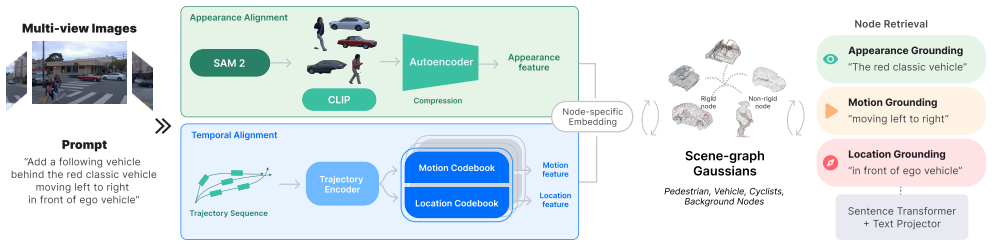
The central mechanism is a language-aligned Gaussian scene graph. A 3D Gaussian splatting scene is a set of scaled, oriented Gaussian blobs with color and opacity; the 4D version lets those blobs move over time. Each object node carries an appearance feature distilled from a masked vision-language encoder, plus a temporal feature from a trajectory encoder that maps the object's motion into two codebooks—motion prototypes (e.g., turning left, moving right to left) and location prototypes (e.g., in front of ego, left side of ego)—with separate motion codebooks for vehicles and pedestrians. At query time, a text prompt is embedded and matched by cosine similarity to these node features. The sel
What would settle it
Ground an object with a query describing a behavior absent from the codebook prototypes (e.g., 'the vehicle reversing along the shoulder at constant speed'); if the retriever chooses the wrong object, the open-vocabulary claim is bounded. Then force one vehicle in a reconstructed scene to make an extreme out-of-distribution maneuver and inspect the multi-agent refinement output: if surrounding agents still yield or detour in a collision-free way, the reactive claim holds; if the predictor produces overlapping trajectories or ignores the edit, the claim is falsified.
Extended reading notes
Core claim
The central claim is that language can serve as the sole interface to a 4D Gaussian scene of a road environment. Appearance, motion, and location semantics are embedded into each node of a scene graph, so that a natural-language query can localize the right object; an LLM agent then converts an edit instruction into concrete operations; and a learned multi-agent motion predictor refines the edited trajectory into globally consistent futures for every agent, including pedestrians. The paper positions this as a unification of capabilities prior systems offered separately or not at all, in particular fine-grained pedestrian-level editing and validation beyond the ego-and-target pair. Supporting
Load-bearing premise
The load-bearing assumption is that the motion model, which learned from ordinary recorded traffic, will still react sensibly when an edited agent does something that never happened in that data, such as a pedestrian jaywalking mid-intersection; if that assumption fails, the reactive-simulation claim collapses.
Editorial extensions
If this is right
- A user can locate and modify a specific road agent, vehicle or pedestrian, with a natural-language description alone, eliminating manual bounding-box input.
- Edits propagate to the whole scene: a braking, turning, or newly inserted agent causes neighboring vehicles and pedestrians to yield, detour, or stop, making the edited scene usable as a reactive simulation.
- Pedestrian-level editing is supported, including inserting realistic pedestrian assets with natural joint motions, enabling safety-critical cases such as jaywalking or wheelchair crossings.
- The reported numbers imply that multi-agent path refinement changes edit-failure rates from about two-thirds to roughly one-tenth, a large improvement in scenario plausibility.
- Because the scene graph is language-queryable, the same alignment supports automated scenario mining when paired with a vision-language model.
Reading between the lines
- If the alignment transfers across cities and sensor configurations, this recipe could convert large autonomous-driving archives into interactive, editable testbeds without hand-built asset libraries.
- The semantic vocabulary is bounded by the finite set of motion and location prototypes; queries describing behaviors outside that set are likely to fail, so an automatic way to grow the codebook from data would extend the open-vocabulary claim.
- The reactive-simulation claim hinges on the learned predictor generalizing to counterfactual edits; a harder test than the reported failure rates is whether the predictor still behaves sensibly when the edited trajectory is far outside recorded traffic patterns.
- Combining the queryable scene graph with the LLM agent points to a practical safety-testing loop: a user or model proposes an edge case in words, the system renders it, and the multi-agent refinement estimates whether surrounding traffic can cope.
Editorial analysis
A structured set of objections, weighed in public.
Referee Report
Summary. The paper presents SIMSplat, a driving-scene editing framework built on scene-graph-based 4D Gaussian Splatting with language-aligned features. It embeds appearance, motion, and location semantics into Gaussian nodes, enabling open-vocabulary querying of road agents. A language-model agent coordinates editing (adding/removing/modifying vehicles and pedestrians), and a multi-agent path refinement module based on SMART-1B predicts reactive trajectories for all agents after an edit. Experiments on Waymo report higher grounding accuracy than LangSplat/4DLangSplat (Table 1), higher task completion than ChatSim/OmniRe (Table 2), and lower collision/off-road failure rates than the baselines (Table 3). Qualitative results illustrate a broad range of edits, including pedestrian insertion and multi-agent response.
Significance. If the quantitative claims hold, SIMSplat would be a meaningful advance: it demonstrates language-queryable 4D Gaussian scene graphs for dynamic driving scenes, supports fine-grained pedestrian editing, and moves beyond single-agent validation through a learned multi-agent refinement step. The grounding evaluation uses external baselines on held-out frames, and the qualitative demonstrations are compelling. However, the paper's load-bearing numbers are not currently supported by the reported evidence: the simulation evaluation appears self-referential, the sample sizes are small, and the codebook-based motion/location vocabulary may be narrower than the 'free-form language' claim. These issues must be addressed before the central claims can be accepted.
major comments (3)
- [§3.4, Table 3] The central claim of 'reactive, physically plausible simulations' is supported mainly by Table 3, but the paper does not specify how collision, off-road, and failure rates are computed. Since SMART-1B both refines the trajectories and is used to simulate the scene, the low 10.4% failure rate may reflect the predictor's own inductive biases rather than physical plausibility. Please report an independent evaluation: e.g., a rule-based collision checker, a map/lane off-road test, or a different validated simulator, applied to the same edited scenes. Also report results on scenes where the edited input is deliberately counterfactual (jaywalker, merged truck, inserted cone), since these are out of the SMART-1B training distribution.
- [Tables 1–3] All quantitative comparisons are point estimates with no error bars, confidence intervals, or significance tests, and the per-cell percentages imply small prompt counts (e.g., 83.3% = 5/6, 88.9% = 8/9, 85.7% = 6/7 in Table 2; rates in Table 3 similarly suggest tens of completed tasks). The headline claims that SIMSplat 'more than doubles' baseline accuracy and achieves the 'highest task completion rate' may be within sampling noise. Please report the raw number of prompts per cell, total completed tasks per method, and appropriate uncertainty quantification (e.g., bootstrap CIs or McNemar tests for paired comparisons).
- [§3.2, codebook definitions] The temporal alignment module maps trajectories to a fixed set of hand-authored motion and location prototypes (C_motion, C_location). The paper does not evaluate how well this closed vocabulary covers the space of natural-language queries, yet the abstract claims 'free-form natural language' querying. A query describing a motion or relative position not represented among the prototypes (e.g., 'zigzagging', 'waiting at the curb', 'two car lengths ahead') may be unmappable. Please add an analysis of query coverage, report performance on held-out motion/location phrases not in the prototype set, and discuss how the codebook size and canonical descriptions were chosen.
minor comments (4)
- [§4.3] Typo: 'fariness' should be 'fairness'.
- [Table 2, Table 3] Add the number of prompts in each column/row and the total N for each method; otherwise the percentages are difficult to interpret.
- [§4.3, Table 3] The baseline name 'GPT2Motion' and the description 'using GPT-5 directly as a motion generator' are inconsistent. Please clarify which model is used and cite it properly.
- [Figure 6] The caption 'Vehicle stuck during parallel parking' is vague; state whether the 'stuck' behavior is produced by the refinement module or is a failure of the predictor, as this affects interpretation.
Circularity Check
No circular derivation: grounding and task evaluations are benchmarked externally; path refinement relies on an independently published predictor; the under-specified Table 3 protocol is not demonstrated to be self-referential.
full rationale
The paper's derivation chain is largely non-circular. The language-Gaussian alignment (§3.2) is trained on CLIP features and trajectory/codebook prototypes, then evaluated against LangSplat and 4DLangSplat on held-out frames (Table 1); this is an external benchmark, not a self-defined metric. LLM-based editing (§3.3) and task completion (Table 2) are compared with ChatSim and OmniRe on prompt execution, again external. The multi-agent path refinement (§3.4) uses SMART-1B [22], an independently published motion predictor with no author overlap, conditioned on the edited trajectory; no self-citation or uniqueness theorem forces the architecture. Table 3 reports collision/off-road failure rates, but the paper does not state that these rates are computed by the same SMART-1B rollouts; without an explicit statement that the evaluator is the generator, there is no quotable reduction. The codebook prototypes define a finite semantic vocabulary, which limits open-vocabulary coverage but is not a circular derivation. There are no load-bearing self-citations, no fitted parameters renamed as predictions, and no ansatz smuggled in via citation. Hence the proper finding is no significant circularity.
Assumptions & free parameters
free parameters (5)
- Motion codebook size K_m and location codebook size K_l
- Canonical prototype descriptions (e.g., 'turning left', 'moving right to left', 'in front of ego')
- Temporal alignment loss weights λ_align, λ_commit
- Latent dimensionality d (appearance and trajectory encoders)
- Trajectory context length and prediction horizon for SMART-1B =
11 timesteps in, 80 out
assumptions (5)
- domain assumption OmniRe-style scene-graph 4DGS (rigid/non-rigid/background nodes, Eqs. 2–3) reconstructs the Waymo scene well enough for per-node language features and editing.
- domain assumption SAM-2 masks prompted with bounding boxes isolate individual road agents for appearance feature extraction.
- domain assumption Compressed CLIP features (autoencoder, h_t(o)=E(f_CLIP)) remain comparable to E5 text embeddings after decoding.
- domain assumption SMART-1B, trained on observed Waymo futures, produces reliable rollouts when conditioned on counterfactual edited trajectories.
- standard math Standard Gaussian alpha-blending projection (Eq. 1) and SE(3) node transforms (Eq. 2) correctly render edited scenes.
invented entities (2)
-
Motion codebook C_motion (separate vehicle/pedestrian variants)
-
Location codebook C_location (shared across object types)
Cite this review
Pith. "Pith review of SIMSplat: Language-Aligned 4D Gaussian Splatting for Driving Scenario Generation." pith.science (2026). https://pith.science/paper/YG2ILDQ2
@misc{pith2026251002469,
  author       = {Pith},
  title        = {Pith review of: SIMSplat: Language-Aligned 4D Gaussian Splatting for Driving Scenario Generation},
  year         = {2026},
  howpublished = {\url{https://pith.science/paper/YG2ILDQ2}},
  note         = {Machine review of arXiv:2510.02469}
}
read the original abstract
Driving scene manipulation using real-world sensor data has emerged as a promising alternative to traditional driving simulators. Despite advances in language control and neural scene representations, existing methods treat grounding, editing, and simulation as loosely connected stages, relying on heuristic object localization, manual guidance, and single-agent validation, thereby constraining semantic expressiveness and hindering scalable, reactive scenario generation. We introduce SIMSplat, a driving scene editor built on scene-graph-based 4D Gaussian Splatting augmented with language-aligned features. By embedding appearance, motion, and location semantics directly into Gaussian scene-graph nodes, SIMSplat makes reconstructed scenes queryable through free-form natural language, bridging language understanding to object-level editing and multi-agent simulation within a single framework. Building on this language-grounded scene graph, SIMSplat supports diverse edits including fine-grained pedestrian manipulation, while a multi-agent path refinement module propagates changes across all agents to ensure reactive, physically plausible simulations. The pipeline further integrates with Vision-Language Models for automated scenario mining. Experiments show that SIMSplat more than doubles baseline grounding accuracy, achieves the highest task completion rate, and produces the lowest failure rates across diverse driving scenarios.
Figures


Figures from the paper (2 more)


Reference graph
Works this paper leans on
-
[1]
Omnire: Omni urban scene reconstruction, 2025
Ziyu Chen, Jiawei Yang, Jiahui Huang, Riccardo de Lutio, Janick Martinez Esturo, Boris Ivanovic, Or Litany, Zan Go- jcic, Sanja Fidler, Marco Pavone, Li Song, and Yue Wang. Omnire: Omni urban scene reconstruction, 2025. 2, 3, 6, 8
2025
-
[2]
CARLA: An open urban driving simulator
Alexey Dosovitskiy, German Ros, Felipe Codevilla, Antonio Lopez, and Vladlen Koltun. CARLA: An open urban driving simulator. InProceedings of the 1st Annual Conference on Robot Learning, pages 1–16, 2017. 2
2017
-
[3]
Freesim: Toward free-viewpoint camera simu- lation in driving scenes, 2024
Lue Fan, Hao Zhang, Qitai Wang, Hongsheng Li, and Zhaox- iang Zhang. Freesim: Toward free-viewpoint camera simu- lation in driving scenes, 2024. 2
2024
-
[4]
4-legs: 4d language em- bedded gaussian splatting.arXiv preprint arXiv:2410.10719,
Gal Fiebelman, Tamir Cohen, Ayellet Morgenstern, Peter Hedman, and Hadar Averbuch-Elor. 4-legs: 4d language em- bedded gaussian splatting.arXiv preprint arXiv:2410.10719,
-
[5]
Streetsurf: Extending multi-view implicit surface reconstruction to street views, 2023
Jianfei Guo, Nianchen Deng, Xinyang Li, Yeqi Bai, Bo- tian Shi, Chiyu Wang, Chenjing Ding, Dongliang Wang, and Yikang Li. Streetsurf: Extending multi-view implicit surface reconstruction to street views, 2023. 2
2023
-
[6]
Dist-4d: Disentangled spa- tiotemporal diffusion with metric depth for 4d driving scene generation, 2025
Jiazhe Guo, Yikang Ding, Xiwu Chen, Shuo Chen, Bohan Li, Yingshuang Zou, Xiaoyang Lyu, Feiyang Tan, Xiaojuan Qi, Zhiheng Li, and Hao Zhao. Dist-4d: Disentangled spa- tiotemporal diffusion with metric depth for 4d driving scene generation, 2025. 2
2025
-
[7]
Dgd: Dynamic 3d gaussians distillation, 2024
Isaac Labe, Noam Issachar, Itai Lang, and Sagie Benaim. Dgd: Dynamic 3d gaussians distillation, 2024. 3
2024
-
[8]
Uniscene: Unified occupancy-centric driving scene generation, 2025
Bohan Li, Jiazhe Guo, Hongsi Liu, Yingshuang Zou, Yikang Ding, Xiwu Chen, Hu Zhu, Feiyang Tan, Chi Zhang, Tiancai Wang, Shuchang Zhou, Li Zhang, Xiaojuan Qi, Hao Zhao, Mu Yang, Wenjun Zeng, and Xin Jin. Uniscene: Unified occupancy-centric driving scene generation, 2025. 2
2025
Show all 30 references
-
[9]
Mtgs: Multi- traversal gaussian splatting, 2025
Tianyu Li, Yihang Qiu, Zhenhua Wu, Carl Lindstr ¨om, Peng Su, Matthias Nießner, and Hongyang Li. Mtgs: Multi- traversal gaussian splatting, 2025. 2
2025
-
[10]
4d langsplat: 4d language gaussian splatting via mul- timodal large language models, 2025
Wanhua Li, Renping Zhou, Jiawei Zhou, Yingwei Song, Jo- hannes Herter, Minghan Qin, Gao Huang, and Hanspeter Pfister. 4d langsplat: 4d language gaussian splatting via mul- timodal large language models, 2025. 2, 3, 4, 6
2025
-
[11]
Drivegen: Generalized and robust 3d detection in driving via controllable text-to-image diffusion generation, 2025
Hongbin Lin, Zilu Guo, Yifan Zhang, Shuaicheng Niu, Yafeng Li, Ruimao Zhang, Shuguang Cui, and Zhen Li. Drivegen: Generalized and robust 3d detection in driving via controllable text-to-image diffusion generation, 2025. 2
2025
-
[12]
Recon- dreamer: Crafting world models for driving scene recon- struction via online restoration, 2024
Chaojun Ni, Guosheng Zhao, Xiaofeng Wang, Zheng Zhu, Wenkang Qin, Guan Huang, Chen Liu, Yuyin Chen, Yida Wang, Xueyang Zhang, Yifei Zhan, Kun Zhan, Peng Jia, Xianpeng Lang, Xingang Wang, and Wenjun Mei. Recon- dreamer: Crafting world models for driving scene recon- struction v...
2024
-
[13]
Langsplat: 3d language gaussian splatting,
Minghan Qin, Wanhua Li, Jiawei Zhou, Haoqian Wang, and Hanspeter Pfister. Langsplat: 3d language gaussian splatting,
-
[14]
Learning transferable visual models from natural language supervision, 2021
Alec Radford, Jong Wook Kim, Chris Hallacy, Aditya Ramesh, Gabriel Goh, Sandhini Agarwal, Girish Sastry, Amanda Askell, Pamela Mishkin, Jack Clark, Gretchen Krueger, and Ilya Sutskever. Learning transferable visual models from natural language supervision, 2021. 3
2021
-
[15]
Sam 2: Segment anything in images and videos,
Nikhila Ravi, Valentin Gabeur, Yuan-Ting Hu, Ronghang Hu, Chaitanya Ryali, Tengyu Ma, Haitham Khedr, Roman R¨adle, Chloe Rolland, Laura Gustafson, Eric Mintun, Junt- ing Pan, Kalyan Vasudev Alwala, Nicolas Carion, Chao- Yuan Wu, Ross Girshick, Piotr Doll´ar, and Christoph Feic...
-
[16]
Airsim: High-fidelity visual and physical simula- tion for autonomous vehicles, 2017
Shital Shah, Debadeepta Dey, Chris Lovett, and Ashish Kapoor. Airsim: High-fidelity visual and physical simula- tion for autonomous vehicles, 2017. 2
2017
-
[17]
Scalability in perception for autonomous driving: Waymo open dataset
Pei Sun, Henrik Kretzschmar, Xerxes Dotiwalla, Aurelien Chouard, Vijaysai Patnaik, Paul Tsui, James Guo, Yin Zhou, Yuning Chai, Benjamin Caine, Vijay Vasudevan, Wei Han, Jiquan Ngiam, Hang Zhao, Aleksei Timofeev, Scott Et- tinger, Maxim Krivokon, Amy Gao, Aditya Joshi, Yu Zhan...
2020
-
[18]
Improving text embeddings with large language models, 2024
Liang Wang, Nan Yang, Xiaolong Huang, Linjun Yang, Ran- gan Majumder, and Furu Wei. Improving text embeddings with large language models, 2024. 5, 6
2024
-
[19]
Drivedreamer: Towards real-world- driven world models for autonomous driving, 2023
Xiaofeng Wang, Zheng Zhu, Guan Huang, Xinze Chen, Jia- gang Zhu, and Jiwen Lu. Drivedreamer: Towards real-world- driven world models for autonomous driving, 2023. 2
2023
-
[20]
Internvid: A large-scale video-text dataset for multimodal understanding and generation, 2024
Yi Wang, Yinan He, Yizhuo Li, Kunchang Li, Jiashuo Yu, Xin Ma, Xinhao Li, Guo Chen, Xinyuan Chen, Yaohui Wang, Conghui He, Ping Luo, Ziwei Liu, Yali Wang, Limin Wang, and Yu Qiao. Internvid: A large-scale video-text dataset for multimodal understanding and generation, 2024. 3
2024
-
[21]
Editable scene simulation for autonomous driving via collaborative llm- agents, 2024
Yuxi Wei, Zi Wang, Yifan Lu, Chenxin Xu, Changxing Liu, Hao Zhao, Siheng Chen, and Yanfeng Wang. Editable scene simulation for autonomous driving via collaborative llm- agents, 2024. 2, 3, 6, 8
2024
-
[22]
Smart: Scalable multi-agent real-time motion generation via next- token prediction, 2024
Wei Wu, Xiaoxin Feng, Ziyan Gao, and Yuheng Kan. Smart: Scalable multi-agent real-time motion generation via next- token prediction, 2024. 6
2024
-
[23]
Springer Nature Singapore,
Zirui Wu, Tianyu Liu, Liyi Luo, Zhide Zhong, Jianteng Chen, Hongmin Xiao, Chao Hou, Haozhe Lou, Yuantao Chen, Runyi Yang, Yuxin Huang, Xiaoyu Ye, Zike Yan, Yongliang Shi, Yiyi Liao, and Hao Zhao.MARS: An Instance-Aware, Modular and Realistic Simulator for Au- tonomous Driving,...
-
[24]
Street gaussians: Modeling dynamic urban scenes with gaussian splatting
Yunzhi Yan, Haotong Lin, Chenxu Zhou, Weijie Wang, Haiyang Sun, Kun Zhan, Xianpeng Lang, Xiaowei Zhou, and Sida Peng. Street gaussians: Modeling dynamic urban scenes with gaussian splatting. InECCV, 2024. 2
2024
-
[25]
Ivanovic, Or Litany, Xinshuo Weng, Se- ung Wook Kim, Boyi Li, Tong Che, Danfei Xu, Sanja Fidler, Marco Pavone, and Yue Wang
Jiawei Yang, B. Ivanovic, Or Litany, Xinshuo Weng, Se- ung Wook Kim, Boyi Li, Tong Che, Danfei Xu, Sanja Fidler, Marco Pavone, and Yue Wang. Emernerf: Emergent spatial- temporal scene decomposition via self-supervision.ArXiv, abs/2311.02077, 2023. 2
2023 arXiv
-
[26]
Deformable 3d gaussians for high- fidelity monocular dynamic scene reconstruction, 2023
Ziyi Yang, Xinyu Gao, Wen Zhou, Shaohui Jiao, Yuqing Zhang, and Xiaogang Jin. Deformable 3d gaussians for high- fidelity monocular dynamic scene reconstruction, 2023. 3
2023
-
[27]
Drivedreamer4d: World models are effective data ma- chines for 4d driving scene representation, 2024
Guosheng Zhao, Chaojun Ni, Xiaofeng Wang, Zheng Zhu, Xueyang Zhang, Yida Wang, Guan Huang, Xinze Chen, Boyuan Wang, Youyi Zhang, Wenjun Mei, and Xingang Wang. Drivedreamer4d: World models are effective data ma- chines for 4d driving scene representation, 2024. 2
2024
-
[28]
Hugs: Holistic urban 3d scene understanding via gaus- sian splatting, 2024
Hongyu Zhou, Jiahao Shao, Lu Xu, Dongfeng Bai, Weichao Qiu, Bingbing Liu, Yue Wang, Andreas Geiger, and Yiyi Liao. Hugs: Holistic urban 3d scene understanding via gaus- sian splatting, 2024. 2
2024
-
[29]
Drivinggaussian: Composite gaussian splatting for surrounding dynamic au- tonomous driving scenes, 2024
Xiaoyu Zhou, Zhiwei Lin, Xiaojun Shan, Yongtao Wang, Deqing Sun, and Ming-Hsuan Yang. Drivinggaussian: Composite gaussian splatting for surrounding dynamic au- tonomous driving scenes, 2024. 2
2024
-
[30]
Scenecrafter: Controllable multi-view driving scene editing, 2025
Zehao Zhu, Yuliang Zou, Chiyu Max Jiang, Bo Sun, Vin- cent Casser, Xiukun Huang, Jiahao Wang, Zhenpei Yang, Ruiqi Gao, Leonidas Guibas, Mingxing Tan, and Dragomir Anguelov. Scenecrafter: Controllable multi-view driving scene editing, 2025. 2, 3
2025
Reviewed August 4, 2026 · model on record in the stance chip above.
Discussion (0). Continue with ORCID to comment.