REVIEW 4 major objections 6 minor 41 references
One Step Closer: Creating the Future to Boost Monocular Semantic Scene Completion
T0 review · 4 major / 6 minor · reviewed 2026-08-06 · deepseek-v4-flash
Pith's one-line read CF-SSC reaches state-of-the-art monocular semantic scene completion by predicting pseudo-future frames and fusing them with past and current frames in a unified 3D space, reporting 16.4% mIoU on SemanticKITTI and 19.1% on…
desk verdict Solid empirical paper with a genuinely new idea, but the 'seeing ahead' claim outruns the evidence—the gain may largely come from hallucinated content and an extra temporal frame. read the letter →
The pith
A machine-rendered reading of the paper's core claim, the machinery that carries it, and where it could break.
The reading
What carries the argument
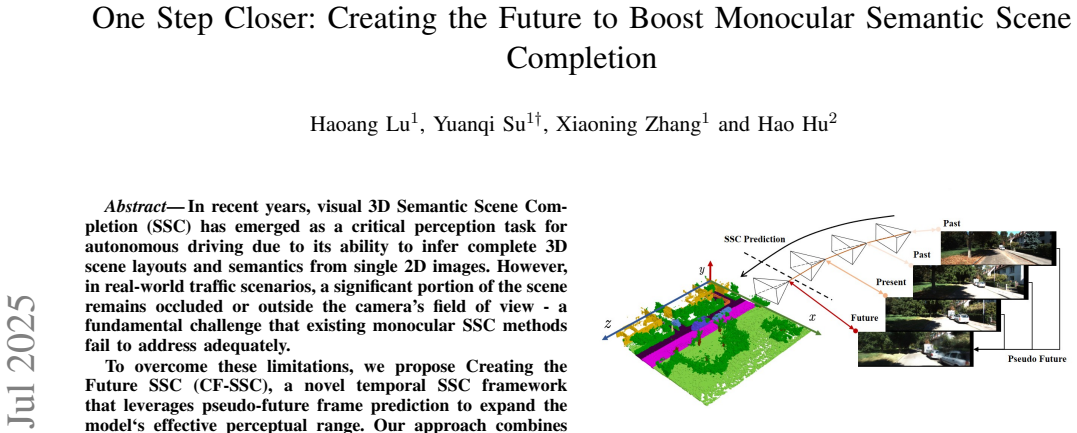
The load-bearing machinery is the pseudo-future frame prediction pipeline joined to a depth-consistent temporal fusion module. FuturePoseNet encodes the past pose sequence into a momentum feature and modulates a single-frame 3D feature with adaptive batch normalization in a 3D U-Net to predict the next pose. FutureSynthNet reprojects past and current images and depth maps onto that pose to create preliminary pseudo-future frames, which it refines under L1 and SSIM losses in image space and an L1 loss in the SSC backbone's feature space. The SpatioTemporal SSC module then projects every voxel in the current scene range onto each temporal frame's image plane, keeps voxels whose projected depth agrees with the frame's predicted depth within $\theta_d = 0.5$ m, and concatenates the sampled 2D features of visible 4$\times$4$\times$4 voxel blocks into a unified 3D feature volume for a 3D U-Net. This depth-visibility check is what separates the method from naive multi-frame concatenation, because it enforces geometric consistency across time.
What would settle it
Train the pipeline with pseudo-future frames replaced by unrefined warped images that have all newly exposed regions masked out, and compare mIoU to the full model; if the drop is negligible, FutureSynthNet's hallucinated content is not the source of the gain. A complementary check is to compute the overlap between voxels that become visible in the pseudo-future depth map and voxels already visible in the current depth map: an overlap near 100% would indicate the 'seeing ahead' benefit is mostly re-projection.
Extended reading notes
Core claim
On its own terms, the central discovery is that a monocular SSC system can extend its effective perceptual range by generating the future rather than waiting for it. The framework, Creating the Future SSC (CF-SSC), first predicts the next ego-vehicle pose from the past pose sequence and the current image-derived 3D feature, then warps past and current image-depth pairs onto that predicted viewpoint to form coarse pseudo-future frames, and finally refines them with a U-Net under image, depth, and feature-space supervision. All frames are lifted into a unified 3D volume where each voxel's projected depth is compared against the predicted depth of the target frame (threshold $\theta_d = 0.5$ m), so features from different times are fused only where they are geometrically consistent. The online model attains 46.21% IoU and 16.40% mIoU on SemanticKITTI's hidden test set and 45.79% IoU and 19.10% mIoU on SSCBench-KITTI-360, which the paper reports as exceeding every existing monocular SSC method and, on SemanticKITTI, the stereo method StereoScene. An offline variant supplied with ground-truth future frames reaches 48.25% IoU and 17.70% mIoU on SemanticKITTI, bounding the online design's potential.
Load-bearing premise
The gain rests on the premise that the synthesized pseudo-future frames carry genuinely new information about occluded or out-of-view regions, rather than merely re-arranging pixels the model has already seen, because warping can only move existing pixels and any truly unseen content must be invented by the refinement network.
Editorial extensions
If this is right
- Monocular SSC can surpass the previous state of the art by adding synthesized future observations, without requiring any new sensor or additional camera.
- Geometrically consistent 3D temporal fusion is worth substantially more than 2D feature concatenation: the paper's ablation reports IoU 48.6 vs 44.5 and mIoU 17.0 vs 14.7 for the same inputs.
- In the online ablation, adding pseudo-future frames together with predicted poses and depths lifts mIoU beyond the configuration using only current and past frames, showing the gain is additional rather than a re-parameterization of past context.
- The offline variant with ground-truth future frames (17.7% mIoU on SemanticKITTI, 19.83% on SSCBench-KITTI-360) provides an upper bound that online pseudo-future prediction approaches.
Reading between the lines
- Inference: because warping can only move already-visible pixels, the improvement attributed to occluded or out-of-view regions must come from the refinement network's capacity to invent content; measuring how often the depth-visibility mask accepts or rejects pseudo-future features would separate genuine new information from re-projected old information.
- Inference: a controlled experiment that corrupts occluded regions in the pseudo-future frames, or replaces refined frames with unrefined warps, would isolate how much of the mIoU gain is due to hallucinated scene content versus the geometric fusion of shifted pixels.
- Inference: the same 'create the future' strategy could transfer to multi-camera or LiDAR-based SSC systems, where synthesized future views might close gaps left by finite sensor fields of view; the paper does not test this extension.
- Inference: the fixed frame interval of 5 frames (roughly 0.5 s at 10 Hz) interacts with vehicle speed; at higher speeds the predicted viewpoint advances further, increasing both the new ground covered and the hallucination risk, so the optimal interval is likely speed-dependent.
Editorial analysis
A structured set of objections, weighed in public.
Referee Report
Summary. The paper introduces CF-SSC, a monocular Semantic Scene Completion (SSC) framework that predicts a future camera pose, synthesizes pseudo-future RGB images and depth maps by warping past/current frames onto the future viewpoint and refining them with a U-Net (FutureSynthNet), and fuses all temporal inputs in a single 3D feature volume via a visibility-aware projection module. FuturePoseNet is supervised with ground-truth pose; the pseudo-future synthesis is supervised with L1, SSIM, and feature-space losses. On the SemanticKITTI hidden test set, the online version reports 16.4% mIoU (46.21 IoU), surpassing prior monocular and even stereo methods, and on SSCBench-KITTI-360 it reports 19.1% mIoU. Ablations on the SemanticKITTI validation set show that the spatiotemporal fusion module and pseudo-future inputs improve over 2D concatenation and current-frame-only baselines.
Significance. If the performance gain truly comes from expanding perception into occluded or out-of-FoV regions, this is a meaningful step for monocular SSC. The paper has several strengths: the headline numbers are evaluated on external hidden test sets rather than fitted constants; the ablations are internally consistent and show that the spatiotemporal module and pseudo-future inputs each contribute; and the design avoids circular definition of the SOTA metric. The method is also relatively simple and builds on standard components. However, the interpretation that the gain comes from genuinely new future-visible content is not yet established, and the absence of uncertainty quantification makes the SOTA claim fragile.
major comments (4)
- [III-C, IV-C, Table IV] The 'seeing ahead' interpretation is underdetermined by the reported experiments. The pseudo-future frame is generated by reprojecting previously observed pixels onto a predicted future viewpoint and refining them with FutureSynthNet; any voxel that is occluded in all input frames or lies outside the input FoV can only be filled by hallucination. The large improvement of the +5p configuration over current/past-only inputs could therefore be explained by (a) adding a temporal frame, (b) resampling already-visible distant geometry from a forward-shifted viewpoint at higher effective resolution, or (c) a learned prior that hallucinates plausible content. I ask for an ablation that controls total frame count (e.g., replacing +5p with a real past frame sampled at the same temporal offset) and an evaluation over the subset of voxels that are visible only from the predicted future viewpoint (using future ground-truth depth to define the mask). Without such evidence, the central claim that CF-SSC 'sees ahead' to reason about occluded structure is not isolated.
- [IV-C, Tables I-II] All headline results are single-run scores on hidden test sets, with no error bars, multiple seeds, or significance tests. The claimed SOTA on SemanticKITTI rests on a 16.40 vs 15.63 mIoU margin over MonoOcc-L, and on SSCBench-KITTI-360 the margin over Symphonies is 19.10 vs 18.58. Given typical run-to-run variance in 3D occupancy networks, these differences may not be meaningful. Please report at least mean and standard deviation across several training runs on the validation set and, if possible, a significance test on the test split. This is a standard expectation for a journal-level comparison.
- [III-D, Eq. (1)] The visibility mask in Eq. (1) admits a voxel if its projected depth is within theta_d of the predicted depth map D(xv, yv). For pseudo-future frames, D is a synthesized depth map whose errors are not measured anywhere in the paper. If D is systematically biased in the pseudo-future frame, the mask will consistently inject hallucinated geometry into the 3D feature volume. Please report pseudo-future depth accuracy against ground-truth future depth, and/or run an ablation with the visibility mask disabled for the pseudo-future branch, to show that the fusion is not dominated by depth artifacts.
- [IV-D, Table III] The comparison between 'Concatenation' and 'Spatiotemporal Module' is the main evidence for the 3D-aware fusion claim, but the baseline is not described in enough detail and may be weak. The table says both models take 4 past frames and 1 future frame, but it does not specify how the concatenation baseline handles the differing poses and depth maps of those frames, nor whether it uses the same visibility mask. If the baseline simply concatenates 2D features before lifting them with the current frame's depth, the +4.1 IoU may overstate the benefit of the module. Please give the exact architecture of the baseline and consider a stronger temporal baseline, such as VoxFormer-T-style feature stacking with per-frame depth.
minor comments (6)
- [IV-A] The sentence 'Consistent with prior SSC tasks,' is duplicated in the datasets paragraph.
- [I] The contributions mention 'TempSSC framework' while the rest of the paper uses 'CF-SSC'; please unify the framework name.
- [Tables I-II] Table II lists 'Symphonies' while the text and reference [12] use 'Symphonize', and Table I uses 'VoxFormer-T' while Table II uses 'VoxFormer'; please make method names consistent.
- [IV-C] The paragraph beginning 'As shown in the Fig.5, we use L1 loss on primary features...' appears to be a limitation/future-work discussion placed in the main results; it should be moved to the appropriate section or clearly framed as a limitation.
- [Throughout] There are formatting issues such as 'model‘s' with a curly apostrophe and missing spaces in 'Fig.1' and 'Fig.2'.
- [IV-B] No code or pretrained models are released; given the number of hyperparameters and the decoupled training schedule, a public code release or a detailed training schedule would substantially help reproducibility.
Circularity Check
No significant circularity: CF-SSC's headline numbers come from external benchmarks, and the pseudo-future frames are trained predictions rather than fitted constants; the 'seeing ahead' claim is an empirical interpretation with limited ablation support, not a definitional reduction.
full rationale
CF-SSC's claimed derivation chain is not circular in the technical sense. The pseudo-future frames are generated in Section III-C by reprojecting past and current images and depths onto a predicted future viewpoint and then refining with FutureSynthNet; while this means genuinely new occluded or out-of-view content must be hallucinated rather than observed, the paper does not define the SSC objective in terms of these frames, and the final 16.4/19.1 mIoU numbers are evaluated on the hidden test sets of SemanticKITTI and SSCBench-KITTI-360 against external methods. FuturePoseNet and FutureSynthNet are supervised with ground-truth future poses, images, and depths (Eq. 3), and SpatioTemporal SSC is trained with the standard Scene-Class Affinity and cross-entropy losses (Eq. 2), so no headline metric is a fitted constant renamed as a prediction. The only caveat is interpretive: the paper attributes the gain to 'seeing ahead' (Sections I and IV-C), but its own ablations (Table IV) do not isolate whether the improvement comes from genuinely new future-visible structure, from resampling already-visible far geometry at higher resolution after forward viewpoint shifting, or from learned priors; Section IV-C even concedes that 'severe occlusions remain challenging' and that L1-based refinement yields blurry outputs. These are limitations of experimental support, not circularity by construction. There are no load-bearing self-citations: the cited depth predictor [13], DeepVO-style pose supervision [38], and MaskDINO initialization [41] are external and independently established. Overall, the derivation is self-contained against external benchmarks, so the circularity score is minimal.
Assumptions & free parameters
free parameters (4)
- visibility depth threshold theta_d =
0.5 meters
- frame interval between temporal inputs =
5 frames
- loss weights =
w_p_mse=0.1, other losses=1.0
- temporal input window size =
up to 5 past frames plus 1 future frame (ablation-dependent)
assumptions (4)
- domain assumption Off-the-shelf depth predictions are accurate enough for the 0.5m visibility threshold and 3D projection.
- domain assumption Dataset poses and predicted future poses are accurate enough for cross-frame alignment.
- ad hoc to paper Warped and refined pseudo-future frames contain useful new information about occluded or out-of-view regions.
- domain assumption Single-run benchmark evaluations on the two test sets are representative and protocol-compliant.
Cite this review
Pith. "Pith review of One Step Closer: Creating the Future to Boost Monocular Semantic Scene Completion." pith.science (2026). https://pith.science/paper/YIPTY5IP
@misc{pith2026250713801,
  author       = {Pith},
  title        = {Pith review of: One Step Closer: Creating the Future to Boost Monocular Semantic Scene Completion},
  year         = {2026},
  howpublished = {\url{https://pith.science/paper/YIPTY5IP}},
  note         = {Machine review of arXiv:2507.13801}
}
read the original abstract
In recent years, visual 3D Semantic Scene Completion (SSC) has emerged as a critical perception task for autonomous driving due to its ability to infer complete 3D scene layouts and semantics from single 2D images. However, in real-world traffic scenarios, a significant portion of the scene remains occluded or outside the camera's field of view -- a fundamental challenge that existing monocular SSC methods fail to address adequately. To overcome these limitations, we propose Creating the Future SSC (CF-SSC), a novel temporal SSC framework that leverages pseudo-future frame prediction to expand the model's effective perceptual range. Our approach combines poses and depths to establish accurate 3D correspondences, enabling geometrically-consistent fusion of past, present, and predicted future frames in 3D space. Unlike conventional methods that rely on simple feature stacking, our 3D-aware architecture achieves more robust scene completion by explicitly modeling spatial-temporal relationships. Comprehensive experiments on SemanticKITTI and SSCBench-KITTI-360 benchmarks demonstrate state-of-the-art performance, validating the effectiveness of our approach, highlighting our method's ability to improve occlusion reasoning and 3D scene completion accuracy.
Figures


Figures from the paper (2 more)


Reference graph
Works this paper leans on
-
[1]
Semantickitti: A dataset for semantic scene understanding of lidar sequences,
J. Behley, M. Garbade, A. Milioto, J. Quenzel, S. Behnke, C. Stach- niss, and J. Gall, “Semantickitti: A dataset for semantic scene understanding of lidar sequences,” in Proceedings of the IEEE/CVF international conference on computer vision , 2019, pp. 9297–9307
work page 2019
-
[2]
Sscbench: A large-scale 3d semantic scene completion benchmark for autonomous driving,
Y . Li, S. Li, X. Liu, M. Gong, K. Li, N. Chen, Z. Wang, Z. Li, T. Jiang, F. Yu, Y . Wang, H. Zhao, Z. Yu, and C. Feng, “Sscbench: A large-scale 3d semantic scene completion benchmark for autonomous driving,” in 2024 IEEE/RSJ International Conference on Intelligent Robots and Systems (IROS) , 2024
work page 2024
-
[3]
Kitti-360: A novel dataset and benchmarks for urban scene understanding in 2d and 3d,
Y . Liao, J. Xie, and A. Geiger, “Kitti-360: A novel dataset and benchmarks for urban scene understanding in 2d and 3d,” IEEE Transactions on Pattern Analysis and Machine Intelligence , vol. 45, no. 3, pp. 3292–3310, 2022
2022
-
[4]
Semantic scene completion from a single depth image,
S. Song, F. Yu, A. Zeng, A. X. Chang, M. Savva, and T. Funkhouser, “Semantic scene completion from a single depth image,” in Pro- ceedings of the IEEE conference on computer vision and pattern recognition, 2017, pp. 1746–1754
work page 2017
-
[5]
Lmscnet: Lightweight multiscale 3d semantic completion,
L. Roldao, R. De Charette, and A. Verroust-Blondet, “Lmscnet: Lightweight multiscale 3d semantic completion,” in 2020 Interna- tional Conference on 3D Vision (3DV) . IEEE, 2020, pp. 111–119
work page 2020
-
[6]
X. Yan, J. Gao, J. Li, R. Zhang, Z. Li, R. Huang, and S. Cui, “Sparse single sweep lidar point cloud segmentation via learning contextual shape priors from scene completion,” in Proceedings of the AAAI conference on artificial intelligence , vol. 35, no. 4, 2021, pp. 3101– 3109
work page 2021
-
[7]
B. Li, Y . Sun, Z. Liang, D. Du, Z. Zhang, X. Wang, Y . Wang, X. Jin, and W. Zeng, “Bridging stereo geometry and bev representation with reliable mutual interaction for semantic scene completion,” arXiv preprint arXiv:2303.13959, 2023
arXiv 2023
-
[8]
Hierarchical Temporal Context Learning for Camera-based Semantic Scene Completion
B. Li, J. Deng, W. Zhang, Z. Liang, D. Du, X. Jin, and W. Zeng, “Hierarchical temporal context learning for camera-based semantic scene completion,” arXiv preprint arXiv:2407.02077 , 2024
work page Pith review arXiv 2024
Show all 41 references
-
[9]
Tri-perspective view for vision-based 3d semantic occupancy prediction,
Y . Huang, W. Zheng, Y . Zhang, J. Zhou, and J. Lu, “Tri-perspective view for vision-based 3d semantic occupancy prediction,” inProceed- ings of the IEEE/CVF conference on computer vision and pattern recognition, 2023, pp. 9223–9232
2023
-
[10]
Monoscene: Monocular 3d semantic scene completion,
A.-Q. Cao and R. De Charette, “Monoscene: Monocular 3d semantic scene completion,” in Proceedings of the IEEE/CVF Conference on Computer Vision and Pattern Recognition , 2022, pp. 3991–4001
2022
-
[11]
Ndc- scene: Boost monocular 3d semantic scene completion in normalized device coordinates space,
J. Yao, C. Li, K. Sun, Y . Cai, H. Li, W. Ouyang, and H. Li, “Ndc- scene: Boost monocular 3d semantic scene completion in normalized device coordinates space,” in 2023 IEEE/CVF International Confer- ence on Computer Vision (ICCV) . IEEE Computer Society, 2023, pp. 9421–9431
2023
-
[12]
Symphonize 3d semantic scene completion with contextual instance queries,
H. Jiang, T. Cheng, N. Gao, H. Zhang, T. Lin, W. Liu, and X. Wang, “Symphonize 3d semantic scene completion with contextual instance queries,” in Proceedings of the IEEE/CVF Conference on Computer Vision and Pattern Recognition , 2024, pp. 20 258–20 267
2024
-
[13]
V oxformer: Sparse voxel transformer for camera-based 3d semantic scene completion,
Y . Li, Z. Yu, C. Choy, C. Xiao, J. M. Alvarez, S. Fidler, C. Feng, and A. Anandkumar, “V oxformer: Sparse voxel transformer for camera-based 3d semantic scene completion,” in Proceedings of the IEEE/CVF conference on computer vision and pattern recognition , 2023, pp. 9087–9098
2023
-
[14]
H2gformer: Horizontal-to-global voxel trans- former for 3d semantic scene completion,
Y . Wang and C. Tong, “H2gformer: Horizontal-to-global voxel trans- former for 3d semantic scene completion,” in Proceedings of the AAAI Conference on Artificial Intelligence , vol. 38, no. 6, 2024, pp. 5722–5730
2024
-
[15]
Monoocc: Digging into monocular semantic occupancy prediction,
Y . Zheng, X. Li, P. Li, Y . Zheng, B. Jin, C. Zhong, X. Long, H. Zhao, and Q. Zhang, “Monoocc: Digging into monocular semantic occupancy prediction,” in 2024 IEEE International Conference on Robotics and Automation (ICRA) . IEEE, 2024, pp. 18 398–18 405
2024
-
[16]
Anisotropic convolu- tional networks for 3d semantic scene completion,
J. Li, K. Han, P. Wang, Y . Liu, and X. Yuan, “Anisotropic convolu- tional networks for 3d semantic scene completion,” in Proceedings of the IEEE/CVF Conference on Computer Vision and Pattern Recog- nition, 2020, pp. 3351–3359
2020
-
[17]
S3cnet: A sparse semantic scene completion network for lidar point clouds,
R. Cheng, C. Agia, Y . Ren, X. Li, and L. Bingbing, “S3cnet: A sparse semantic scene completion network for lidar point clouds,” in Conference on Robot Learning . PMLR, 2021, pp. 2148–2161
2021
-
[18]
Bevformer: learning bird’s-eye-view representation from lidar-camera via spatiotemporal transformers,
Z. Li, W. Wang, H. Li, E. Xie, C. Sima, T. Lu, Q. Yu, and J. Dai, “Bevformer: learning bird’s-eye-view representation from lidar-camera via spatiotemporal transformers,” IEEE Transactions on Pattern Analysis and Machine Intelligence , 2024
2024
-
[19]
Cvt-occ: Cost volume temporal fusion for 3d occupancy prediction,
Z. Ye, T. Jiang, C. Xu, Y . Li, and H. Zhao, “Cvt-occ: Cost volume temporal fusion for 3d occupancy prediction,” in European Confer- ence on Computer Vision . Springer, 2024, pp. 381–397
2024
-
[20]
Not all voxels are equal: Hardness-aware semantic scene completion with self-distillation,
S. Wang, J. Yu, W. Li, W. Liu, X. Liu, J. Chen, and J. Zhu, “Not all voxels are equal: Hardness-aware semantic scene completion with self-distillation,” in Proceedings of the IEEE/CVF Conference on Computer Vision and Pattern Recognition , 2024, pp. 14 792–14 801
2024
-
[21]
Optimizing video prediction via video frame interpolation,
Y . Wu, Q. Wen, and Q. Chen, “Optimizing video prediction via video frame interpolation,” in Proceedings of the IEEE/CVF Conference on Computer Vision and Pattern Recognition , 2022, pp. 17 814–17 823
2022
-
[22]
A dynamic multi- scale voxel flow network for video prediction,
X. Hu, Z. Huang, A. Huang, J. Xu, and S. Zhou, “A dynamic multi- scale voxel flow network for video prediction,” in Proceedings of the IEEE/CVF Conference on Computer Vision and Pattern Recognition , 2023, pp. 6121–6131
2023
-
[23]
Channel attention is all you need for video frame interpolation,
M. Choi, H. Kim, B. Han, N. Xu, and K. M. Lee, “Channel attention is all you need for video frame interpolation,” in Proceedings of the AAAI conference on artificial intelligence , vol. 34, no. 07, 2020, pp. 10 663–10 671
2020
-
[24]
Video frame interpolation with transformer,
L. Lu, R. Wu, H. Lin, J. Lu, and J. Jia, “Video frame interpolation with transformer,” in Proceedings of the IEEE/CVF Conference on Computer Vision and Pattern Recognition , 2022, pp. 3532–3542
2022
-
[25]
Mspred: Video prediction at multiple spatio-temporal scales with hierarchical recurrent networks,
A. Villar-Corrales, A. Karapetyan, A. Boltres, and S. Behnke, “Mspred: Video prediction at multiple spatio-temporal scales with hierarchical recurrent networks,” arXiv preprint arXiv:2203.09303 , 2022
2022 arXiv
-
[26]
Biformer: Learning bilateral motion estimation via bilateral transformer for 4k video frame interpolation,
J. Park, J. Kim, and C.-S. Kim, “Biformer: Learning bilateral motion estimation via bilateral transformer for 4k video frame interpolation,” in Proceedings of the IEEE/CVF Conference on Computer Vision and Pattern Recognition, 2023, pp. 1568–1577
2023
-
[27]
Stochastic latent residual video prediction,
J.-Y . Franceschi, E. Delasalles, M. Chen, S. Lamprier, and P. Gal- linari, “Stochastic latent residual video prediction,” in International Conference on Machine Learning . PMLR, 2020, pp. 3233–3246
2020
-
[28]
Greedy hierarchical variational autoencoders for large-scale video predic- tion,
B. Wu, S. Nair, R. Martin-Martin, L. Fei-Fei, and C. Finn, “Greedy hierarchical variational autoencoders for large-scale video predic- tion,” in Proceedings of the IEEE/CVF Conference on Computer Vision and Pattern Recognition , 2021, pp. 2318–2328
2021
-
[29]
Denoising diffusion probabilistic models,
J. Ho, A. Jain, and P. Abbeel, “Denoising diffusion probabilistic models,” Advances in neural information processing systems, vol. 33, pp. 6840–6851, 2020
2020
-
[30]
High-resolution image synthesis with latent diffusion models,
R. Rombach, A. Blattmann, D. Lorenz, P. Esser, and B. Ommer, “High-resolution image synthesis with latent diffusion models,” in Proceedings of the IEEE/CVF conference on computer vision and pattern recognition, 2022, pp. 10 684–10 695
2022
-
[31]
Align your latents: High-resolution video synthe- sis with latent diffusion models,
A. Blattmann, R. Rombach, H. Ling, T. Dockhorn, S. W. Kim, S. Fi- dler, and K. Kreis, “Align your latents: High-resolution video synthe- sis with latent diffusion models,” in Proceedings of the IEEE/CVF conference on computer vision and pattern recognition , 2023, pp. 22 563–22 575
2023
-
[32]
Surroundocc: Multi-camera 3d occupancy prediction for autonomous driving,
Y . Wei, L. Zhao, W. Zheng, Z. Zhu, J. Zhou, and J. Lu, “Surroundocc: Multi-camera 3d occupancy prediction for autonomous driving,” in Proceedings of the IEEE/CVF International Conference on Computer Vision, 2023, pp. 21 729–21 740
2023
-
[33]
Occformer: Dual-path transformer for vision-based 3d semantic occupancy prediction,
Y . Zhang, Z. Zhu, and D. Du, “Occformer: Dual-path transformer for vision-based 3d semantic occupancy prediction,” in Proceedings of the IEEE/CVF International Conference on Computer Vision , 2023, pp. 9433–9443
2023
-
[34]
Instance-aware monocular 3d semantic scene completion,
H. Xiao, H. Xu, W. Kang, and Y . Li, “Instance-aware monocular 3d semantic scene completion,” IEEE Transactions on Intelligent Transportation Systems, vol. 25, no. 7, pp. 6543–6554, 2024
2024
-
[35]
Depthssc: Depth-spatial alignment and dynamic voxel resolution for monocular 3d semantic scene completion,
J. Yao and J. Zhang, “Depthssc: Depth-spatial alignment and dynamic voxel resolution for monocular 3d semantic scene completion,” arXiv preprint arXiv:2311.17084, 2023
2023 arXiv
-
[36]
Batch normalization: Accelerating deep network training by reducing internal covariate shift,
S. Ioffe and C. Szegedy, “Batch normalization: Accelerating deep network training by reducing internal covariate shift,” inInternational conference on machine learning . pmlr, 2015, pp. 448–456
2015
-
[37]
Arbitrary style transfer in real-time with adaptive instance normalization,
X. Huang and S. Belongie, “Arbitrary style transfer in real-time with adaptive instance normalization,” in Proceedings of the IEEE international conference on computer vision , 2017, pp. 1501–1510
2017
-
[38]
Deepvo: Towards end-to-end visual odometry with deep recurrent convolutional neural networks,
S. Wang, R. Clark, H. Wen, and N. Trigoni, “Deepvo: Towards end-to-end visual odometry with deep recurrent convolutional neural networks,” in 2017 IEEE international conference on robotics and automation (ICRA). IEEE, 2017, pp. 2043–2050
2017
-
[39]
Decoupled weight decay regularization,
I. Loshchilov and F. Hutter, “Decoupled weight decay regularization,” arXiv preprint arXiv:1711.05101 , 2017
2017 arXiv
-
[40]
Deep residual learning for image recognition,
K. He, X. Zhang, S. Ren, and J. Sun, “Deep residual learning for image recognition,” in Proceedings of the IEEE conference on computer vision and pattern recognition , 2016, pp. 770–778
2016
-
[41]
Mask dino: Towards a unified transformer-based framework for object detection and segmentation,
F. Li, H. Zhang, H. Xu, S. Liu, L. Zhang, L. M. Ni, and H.-Y . Shum, “Mask dino: Towards a unified transformer-based framework for object detection and segmentation,” in Proceedings of the IEEE/CVF conference on computer vision and pattern recognition , 2023, pp. 3041–3050
2023
Reviewed August 6, 2026 · model on record in the stance chip above.
Discussion (0). Sign in to comment.