An Exploration of Collision-based Enemy Morphology Generation
Pith reviewed 2026-06-28 14:15 UTC · model grok-4.3
The pith
Three collision-based approaches generate video game enemy morphologies with performance matching or exceeding an evolutionary baseline from robotics.
A machine-rendered reading of the paper's core claim, the machinery that carries it, and where it could break.
Core claim
Three novel approaches to generating enemy morphologies based on player collision information each provide different strengths and weaknesses, but all achieve equivalent or better performance than an evolutionary baseline adapted from prior robotics morphology work.
What carries the argument
Player collision information used to construct enemy body plans and collision shapes.
If this is right
- Designers gain multiple options for generating varied enemy types suited to different game genres.
- Collision-based generation provides a viable alternative to evolutionary methods for morphology tasks in games.
- The approaches support procedural creation of enemies that interact meaningfully with player movement.
- Metrics originally developed for robotics can guide evaluation in game contexts with minimal adjustment.
Where Pith is reading between the lines
- These methods could support real-time enemy adaptation during play sessions rather than pre-generation only.
- Similar collision-driven techniques might apply to generating shapes for non-enemy elements such as platforms or items.
- Combining the approaches with existing level-generation tools could produce more integrated game content.
Load-bearing premise
Performance metrics and evaluation setups adapted from robotics morphology generation are valid for judging whether generated enemy shapes produce playable and fun video game experiences.
What would settle it
A controlled playtest in which human players consistently rate the generated enemies as unplayable or unfun despite the morphologies scoring well on the adapted robotics metrics.
Figures
read the original abstract
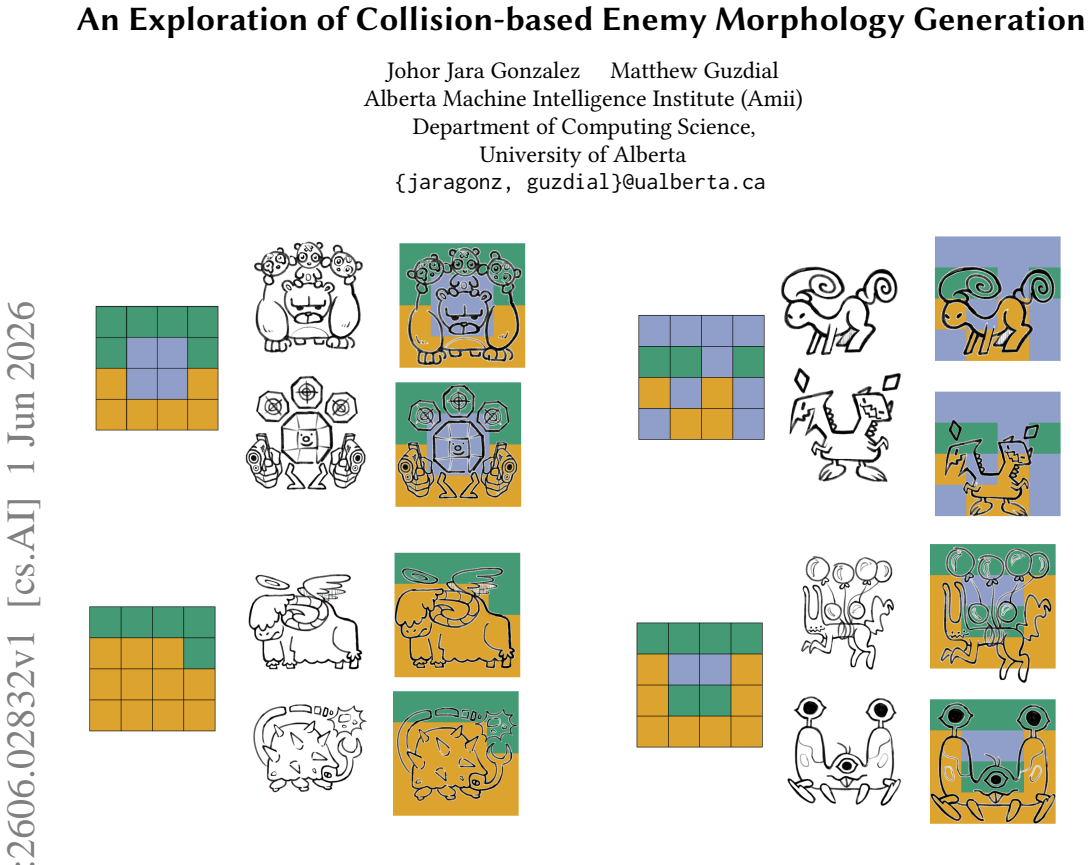
Despite a great deal of prior research into Procedural Content Generation (PCG), relatively little prior work has explored generating enemies for video games. In particular, there is almost no work on generating enemy morphologies, the basic body plan or collision information for in-game enemies, despite the existence of related morphology generation work in robotics. In this paper, we explore three different novel approaches to generate enemy morphologies based on player collision information. We found that each approach provides different strengths and weaknesses, but all had equivalent or better performance than an evolutionary baseline adapted from prior robotics morphology work.
Editorial analysis
A structured set of objections, weighed in public.
Referee Report
Summary. The manuscript claims to introduce three novel collision-based approaches for generating enemy morphologies in video games, each with distinct strengths and weaknesses, and reports that all three achieve equivalent or better performance than an evolutionary baseline adapted from prior robotics morphology work.
Significance. If the results hold under game-appropriate evaluation, the work would address a documented gap in PCG for enemy design by providing concrete generation methods and a direct comparison to an external baseline. The experimental framing is a strength, but the transfer of robotics-derived metrics requires explicit validation to establish relevance to playable game content.
major comments (1)
- [Evaluation / Results] The central performance claim rests on metrics and protocols adapted from robotics morphology generation. No evidence is provided that these metrics (e.g., locomotion efficiency or structural stability) correlate with game-relevant properties such as challenge balance, fairness, or engagement. This directly affects whether the reported superiority supports the paper's goal of generating playable enemies.
minor comments (1)
- [Abstract] The abstract states the performance finding at a high level but supplies no information on the three approaches, the exact metrics, sample sizes, or statistical tests, limiting immediate assessment of the result.
Simulated Author's Rebuttal
We thank the referee for their constructive feedback. We address the major comment on evaluation metrics below and outline a targeted revision to improve clarity without altering the core contributions.
read point-by-point responses
-
Referee: [Evaluation / Results] The central performance claim rests on metrics and protocols adapted from robotics morphology generation. No evidence is provided that these metrics (e.g., locomotion efficiency or structural stability) correlate with game-relevant properties such as challenge balance, fairness, or engagement. This directly affects whether the reported superiority supports the paper's goal of generating playable enemies.
Authors: We agree that the manuscript does not provide direct evidence correlating the robotics-derived metrics (locomotion efficiency, structural stability) with game-specific properties such as challenge balance, fairness, or engagement. The evaluation protocol was chosen to enable a consistent, apples-to-apples comparison with the adapted evolutionary baseline from prior robotics work. To address this gap, we will add a dedicated paragraph in the Discussion section acknowledging the transfer limitations of these metrics to playable game content and explicitly noting that future validation through human-subject playtesting would be required to establish relevance to engagement and balance. This revision clarifies the scope of the performance claims without changing any reported results. revision: yes
Circularity Check
No circularity: empirical comparison to external robotics baseline
full rationale
The paper reports an experimental study generating enemy morphologies via three collision-based methods and directly compares their performance metrics against an evolutionary baseline adapted from prior (non-author-overlapping) robotics work. No derivation chain reduces a result to its own inputs by definition, no fitted parameters are relabeled as predictions, and no load-bearing claims rest on self-citations or imported uniqueness theorems. The central claim is an empirical ranking under stated metrics; any concern about metric suitability for games is an external-validity issue, not circularity.
Axiom & Free-Parameter Ledger
Reference graph
Works this paper leans on
-
[1]
Eric Butler, Kristin Siu, and Alexander Zook. 2017. Program synthesis as a generative method. InProceedings of the 12th International Conference on the Foundations of Digital Games. 1–10
2017
-
[2]
Raúl Lara Cabrera, Mariela Nogueira Collazo, Carlos Cotta Porras, and Antonio José Fernández Leiva. 2015. Procedural content generation for real-time strategy games.IJIMAI3, 2 (2015), 40–48
2015
-
[3]
Michael Cook and Simon Colton. 2014. A rogue dream: Automatically generating meaningful content for games. InProceedings of the AAAI Conference on Artificial Intelligence and Interactive Digital Entertainment, Vol. 10. 2–7
2014
-
[4]
Michael Cook, Simon Colton, Azalea Raad, and Jeremy Gow. 2013. Mechanic miner: Reflection-driven game mechanic discovery and level design. InEuropean Conference on the Applications of Evolutionary Computation. Springer, 284–293
2013
-
[5]
Sam Earle, Maria Edwards, Ahmed Khalifa, Philip Bontrager, and Julian Togelius
-
[6]
In2021 IEEE Conference on Games (CoG)
Learning controllable content generators. In2021 IEEE Conference on Games (CoG). IEEE, 1–9
-
[7]
Sam Earle, Zehua Jiang, and Julian Togelius. 2024. Scaling, control and general- ization in reinforcement learning level generators. In2024 IEEE Conference on Games (CoG). IEEE, 1–8
2024
-
[8]
Roberto Gallotta, Graham Todd, Marvin Zammit, Sam Earle, Antonios Liapis, Julian Togelius, and Georgios N Yannakakis. 2024. Large language models and games: A survey and roadmap.IEEE Transactions on Games(2024)
2024
-
[9]
Johor Jara Gonzalez, Seth Cooper, and Matthew Guzdial. 2023. Mechanic Maker 2.0: reinforcement learning for evaluating generated rules. InProceedings of the AAAI Conference on Artificial Intelligence and Interactive Digital Entertainment, Vol. 19. 266–275
2023
-
[10]
Pablo Gutiérrez-Sánchez, Marco A Gómez-Martín, Pedro A González-Calero, and Pedro P Gómez-Martín. 2021. Reinforcement learning methods to evaluate the impact of AI changes in game design. InProceedings of the AAAI Conference on Artificial Intelligence and Interactive Digital Entertainment, Vol. 17. 10–17
2021
-
[11]
2025.Procedural content generation via machine learning: An Overview
Matthew Guzdial, Sam Snodgrass, and Adam J Summerville. 2025.Procedural content generation via machine learning: An Overview. Springer
2025
-
[12]
David Ha. 2019. Reinforcement learning for improving agent design.Artificial life25, 4 (2019), 352–365
2019
- [13]
-
[14]
Hart, Nils J
Peter E. Hart, Nils J. Nilsson, and Bertram Raphael. 1968. A Formal Basis for the Heuristic Determination of Minimum Cost Paths.IEEE Transactions on Systems Science and CyberneticsSSC-4, 2 (1968), 100–107
1968
-
[15]
Yomna MI Hassan and Amal Aboulhassan. 2024. A Framework for Adaptive Game Play and Adversary Creation Based on Gamer Behavioral Analysis and Large Language (LLM) Models. In2024 International Mobile, Intelligent, and Ubiquitous Computing Conference (MIUCC). IEEE, 413–417
2024
-
[16]
Mark Hendrikx, Sebastiaan Meijer, Joeri Van Der Velden, and Alexandru Iosup
-
[17]
Procedural content generation for games: A survey.ACM Transactions on Multimedia Computing, Communications, and Applications (TOMM)9, 1 (2013), 1–22
2013
-
[18]
Nicholas Jennings and Björn Hartmann. 2024. Towards Runtime Behavior Gen- eration in Games. (2024)
2024
-
[19]
Arthur Juliani, Vincent-Pierre Berges, Ervin Teng, Andrew Cohen, Jonathan Harper, Chris Elion, Chris Goy, Yuan Gao, Hunter Henry, Marwan Mattar, and Danny Lange. 2020. Unity: A general platform for intelligent agents.arXiv preprint arXiv:1809.02627(2020). https://arxiv.org/pdf/1809.02627.pdf
-
[20]
Joel Lehman and Kenneth O Stanley. 2011. Evolving a diversity of virtual creatures through novelty search and local competition. InProceedings of the 13th annual conference on Genetic and evolutionary computation. 211–218
2011
-
[21]
Mahdi Farrokhi Maleki and Richard Zhao. 2024. Procedural content generation in games: A survey with insights on emerging llm integration. InProceedings of the AAAI Conference on Artificial Intelligence and Interactive Digital Entertainment, Vol. 20. 167–178
2024
-
[22]
Sudhanshu Maurya, Arnav Kotiyal, Pankaj Prusty, Nilesh Shelke, Abhishek Bhat- tacherjee, and Tiyas Sarkar. 2025. Optimizing NPC Behavior in Video Games Using Unity ML-Agents: A Reinforcement Learning-Based Approach. In2025 3rd International Conference on Disruptive Technologies (ICDT). IEEE, 1601–1606
2025
-
[23]
Kathryn Merrick and Mary Lou Maher. 2006. Motivated reinforcement learning for non-player characters in persistent computer game worlds. InProceedings of the 2006 ACM SIGCHI international conference on Advances in computer entertain- ment technology. 3–es. An Exploration of Collision-based Enemy Morphology Generation Conference acronym ’XX, June 03–05, 20...
2006
-
[24]
Tim Nämerforslund. 2021. Machine Learning Adversaries in Video Games: Using reinforcement learning in the Unity Engine to create compelling enemy characters
2021
-
[25]
Leonardo T Pereira, Breno MF Viana, and Claudio FM Toledo. 2021. Procedural enemy generation through parallel evolutionary algorithm. In2021 20th Brazilian Symposium on Computer Games and Digital Entertainment (SBGames). IEEE, 126–135
2021
-
[26]
David Ponton, Yannick Francillette, Hugo Tremblay, and Bruno Bouchard. 2025. Analyzing Enemy Behavior Difficulty: An Automated Framework Exploiting Behavior Trees. In2025 IEEE Gaming, Entertainment, and Media Conference (GEM). IEEE, 1–6
2025
-
[27]
John Schulman, Filip Wolski, Prafulla Dhariwal, Alec Radford, and Oleg Klimov
-
[28]
Proximal policy optimization algorithms.arXiv preprint arXiv:1707.06347 (2017)
work page internal anchor Pith review Pith/arXiv arXiv 2017
-
[29]
Karl Sims. 2023. Evolving virtual creatures. InSeminal Graphics Papers: Pushing the Boundaries, Volume 2. 699–706
2023
-
[30]
Junru Song, Yang Yang, Wei Peng, Weien Zhou, Feifei Wang, and Wen Yao. 2024. MorphVAE: advancing morphological design of voxel-based soft robots with variational autoencoders. InProceedings of the AAAI Conference on Artificial Intelligence, Vol. 38. 10368–10376
2024
- [31]
-
[32]
Megan Sumner, Vardan Saini, and Matthew Guzdial. 2024. Mechanic maker: accessible game development via symbolic learning program synthesis. InPro- ceedings of the AAAI Conference on Artificial Intelligence and Interactive Digital Entertainment, Vol. 20. 235–244
2024
-
[33]
Julian Togelius, Noor Shaker, and Mark J Nelson. 2014. Procedural content generation in games: A textbook and an overview of current research.Togelius N. Shaker M. Nelson Berlin: Springer1 (2014)
2014
-
[34]
Julian Togelius, Georgios N Yannakakis, Kenneth O Stanley, and Cameron Browne
-
[35]
InEuropean Conference on the Applications of Evolutionary Computation
Search-based procedural content generation. InEuropean Conference on the Applications of Evolutionary Computation. Springer, 141–150
-
[36]
Andrew Wood and Adam Summerville. 2019. Understanding Boss Battles: A Case Study of Cuphead.California State Polytech. Univ., San Luis Obispo, CA, USA, Tech. Rep(2019)
2019
-
[37]
Chao Yu, Akash Velu, Eugene Vinitsky, Jiaxuan Gao, Yu Wang, Alexandre Bayen, and Yi Wu. 2022. The surprising effectiveness of ppo in cooperative multi-agent games.Advances in neural information processing systems35 (2022), 24611–24624
2022
-
[38]
Yuzhong Zhang, Guixuan Zhang, and Xinyuan Huang. 2022. A survey of proce- dural content generation for games. In2022 International Conference on Culture- Oriented Science and Technology (CoST). IEEE, 186–190
2022
-
[39]
Mohammad Zohaib. 2018. Dynamic difficulty adjustment (DDA) in computer games: A review.Advances in Human-Computer Interaction2018, 1 (2018), 5681652
2018
-
[40]
Alexander Zook and Mark Riedl. 2014. Automatic game design via mechanic generation. InProceedings of the AAAI Conference on Artificial Intelligence, Vol. 28
2014
-
[41]
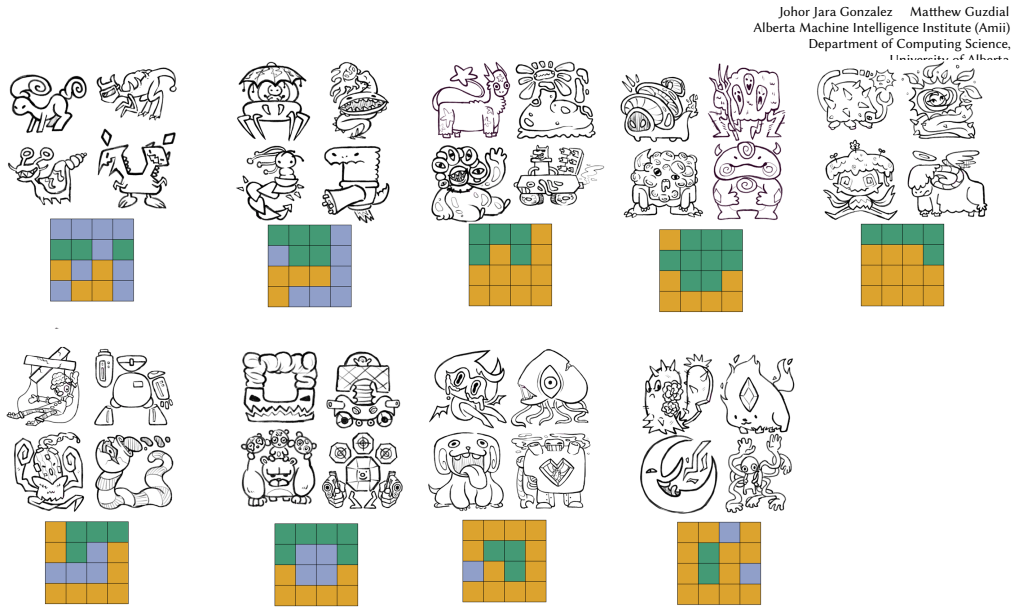
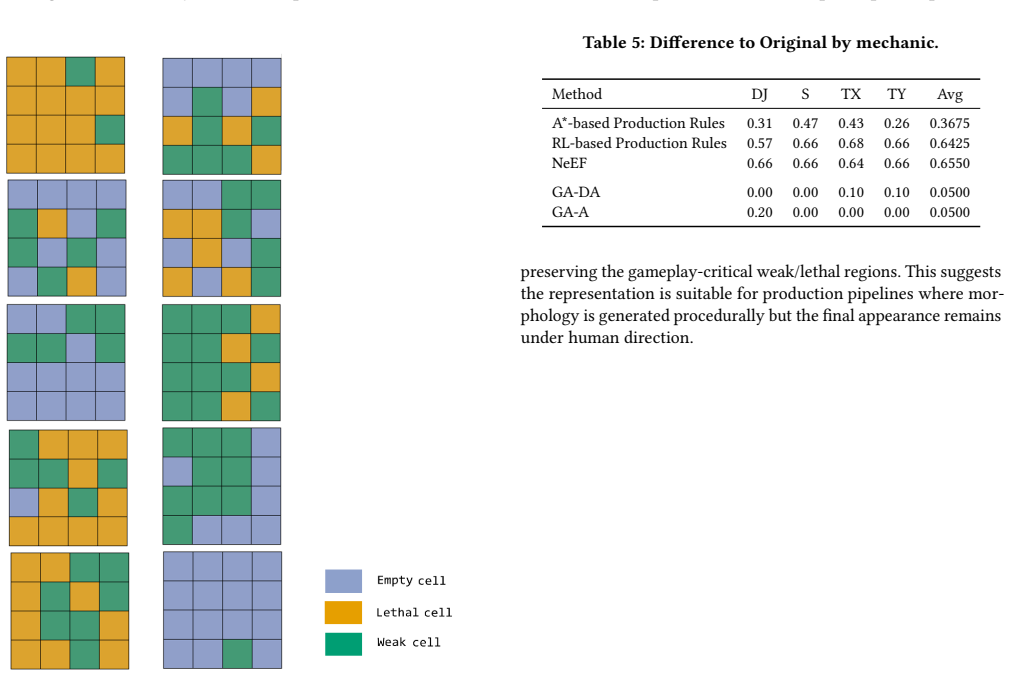
Alexander Zook and Mark O Riedl. 2014. Generating and adapting game me- chanics. InProceedings of the 2014 Foundations of Digital Games Workshop on Procedural Content Generation in Games. A Random Enemies Initialization Visualization This appendix reports the randomly generated initial enemy set used to initialize all experimental runs. The intent of incl...
2014
discussion (0)
Sign in with ORCID, Apple, or X to comment. Anyone can read and Pith papers without signing in.