REVIEW 4 major objections 4 minor 45 references
SatVision-TOA: A Geospatial Foundation Model for Coarse-Resolution All-Sky Remote Sensing Imagery
T0 review · 4 major / 4 minor · reviewed 2026-08-12 · deepseek-v4-flash
Pith's one-line read A 3-billion-parameter vision transformer pre-trained on 100 million all-sky MODIS radiance chips doubles the cloud-mask mIOU of an FCN baseline after fine-tuning on a different instrument.
desk verdict A genuinely large all-sky RS pretraining effort with open weights, but the headline downstream gain is asserted without the one control that would prove it. read the letter →
The pith
A machine-rendered reading of the paper's core claim, the machinery that carries it, and where it could break.
The reading
What carries the argument
The engine is masked image modeling (MIM), a self-supervised objective in which random 8x8 patches of a 128x128 input chip are erased and the network must predict the original reflectance or brightness-temperature values; this forces the model to encode spatial and spectral context without any label. The backbone is SwinV2, a hierarchical vision transformer with shifted-window attention, and the Giant variant used here has 3 billion parameters. The third load-bearing component is the dataset: 100 million all-sky MODIS L1B TOA chips, aggregated to 1 km through elliptical weighted averaging, and sampled by a clustering strategy across land and cloud cover types to avoid geographic over-sampling. Together these components are what produce the transferable representation used for fine-tuning.
What would settle it
Train the same SwinV2 encoder from scratch on the same 7,000 labeled ABI chips with the same decoder and training setup; if its mIOU is close to 0.4638, the reported gain is not caused by the all-sky MODIS pre-training, while if it stays near 0.22, the pre-training claim is supported. A second check is to run the fine-tuned model on night-time ABI chips, where the daytime-only Terra training gives no representation.
Extended reading notes
Core claim
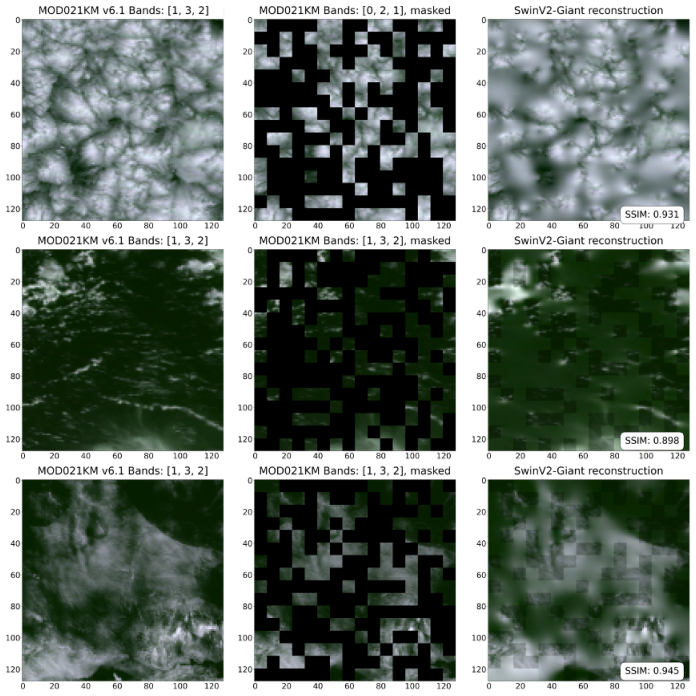
Pre-training on top-of-atmosphere radiance that includes clouds, rather than on cloud-cleared high-resolution imagery, is what lets a downstream model see the vertical structure of clouds. The paper demonstrates this by training SwinV2-Giant with masked image modeling on 100 million 128x128, 14-band MODIS chips drawn from daily all-sky composites, then fine-tuning on ABI chips along CloudSat/CALIPSO transects to predict 3D cloud masks. The best configuration attains a mean intersection over union of 0.4638, accuracy of 0.9574, and AUC of 0.98, versus 0.2185, 0.9320, and 0.93 for the from-scratch FCN; scaling the pre-training corpus from 2 million to 100 million chips raises mIOU from 0.3695 to 0.4638. The paper also reports an SSIM of 0.9289 on held-out reconstruction chips, viewing both results as evidence that the all-sky representation generalizes across cloud and land types and from one MODIS-like instrument to another.
Load-bearing premise
The load-bearing premise is that the better cloud predictions come from the all-sky pre-training rather than from simply swapping in a much larger, different model as the image-encoding backbone; the paper's comparison does not separate those two changes.
Editorial extensions
If this is right
- A pre-trained all-sky TOA model can be fine-tuned on a different instrument (ABI) with the same 14 spectral channels and outperform a from-scratch convolutional baseline without extra calibration or regridding.
- Scaling the pre-training corpus from 2 million to 100 million chips improves 3D cloud retrieval mIOU from 0.3695 to 0.4638, so larger all-sky data yields measurable downstream gains.
- The more than 50% reduction in false negatives implies improved detection of thin boundary-layer and multi-layer clouds, the cases that passive-imager cloud products most often miss.
- A reconstruction SSIM of 0.9289 on held-out chips is compatible with the model having learned structure across cloud and land transitions, which is the property the downstream task relies on.
Reading between the lines
- A decisive test the paper leaves implicit is to fine-tune the identical SwinV2 encoder from scratch on the same 7,000 ABI chips; if its mIOU approaches 0.4638, the gain would be attributable to architecture rather than to MIM pre-training.
- Because the model was pre-trained only on daytime Terra overpasses, night-time ABI chips may expose a systematic weakness; including Aqua or night-time composites would test how strongly the fixed local-time sampling limits transfer.
- The same recipe should transfer to other MODIS-like instruments (VIIRS, ABI, AHI, MTG) that share band frequencies; the paper names these targets but does not run those experiments.
Editorial analysis
A structured set of objections, weighed in public.
Referee Report
Summary. The paper introduces SatVision-TOA, a 3-billion-parameter SwinV2 model pre-trained with masked image modeling on 100 million 14-band MODIS top-of-atmosphere (TOA) image chips. The authors describe a global daily compositing pipeline, a stratified and cluster-based chip sampling strategy, and scaling experiments over model size (658M vs. 3B parameters) and pre-training corpus size (2M, 26M, 100M chips). The model is evaluated in two ways: reconstruction of masked MODIS chips, where it obtains SSIM 0.9289, and a downstream 3D cloud retrieval task on GOES-ABI imagery with CloudSat/CALIPSO vertical masks, where it reports mIOU 0.4638 and accuracy 0.9574 versus 0.2185 and 0.9320 for an FCN baseline. The paper further claims that the downstream gain is 'strictly due to the difference in the encoder backbone' and that false negatives were reduced by more than 50%.
Significance. If the central claim were established, this would be a notable contribution: it is, to my knowledge, the largest vision foundation model trained exclusively on satellite remote sensing data, it targets an underexplored niche (moderate/coarse-resolution all-sky TOA imagery), and it demonstrates a plausible cross-sensor transfer from MODIS pre-training to ABI fine-tuning. The authors deserve credit for releasing weights and workflows, for describing the pre-training dataset construction in detail, and for conducting scaling experiments across model and dataset size. The downstream evaluation is not circular: the labels come from CloudSat/CALIPSO and the inputs from ABI, both independent of the MODIS pre-training data. However, the main causal claim that pre-training on 100M MODIS chips is what drives the downstream improvement is not yet supported by the experimental design, which varies architecture, parameter count, and initialization simultaneously. The significance of the paper therefore currently rests on an unproven attribution.
major comments (4)
- [Section 5.2 and Table 2] The claim that the downstream difference is 'strictly due to the difference in the encoder backbone' is not supported by the experimental design. The comparison varies the encoder architecture (SwinV2 Transformer vs. FCN), the parameter count (3B vs. the FCN encoder), and the initialization (pre-trained vs. from scratch) at the same time. To isolate the contribution of MIM pre-training, the authors need a same-architecture control, e.g., SwinV2-Giant fine-tuned from random initialization on the same 7000 labeled ABI chips, or a pre-trained FCN encoder. Appendix Table 5 further shows that model size and architecture affect downstream mIOU independently of the 100M pre-training corpus: SVTOA-Huge-2M reaches 0.3838 while SVTOA-Giant-2M reaches 0.3695. Without the missing control, the headline mIOU gain cannot be attributed to pre-training rather than to model scale or Transformer inductive bias.
- [Section 4.2 and Table 2] All downstream results are reported on a single validation split (1300 ABI chips) with no separate test set and no error bars or repeated splits. Because the validation set may have been used for model selection or early stopping, the reported mIOU, accuracy, and AUC are potentially optimistic. Please provide a held-out test set, or cross-validated estimates with confidence intervals, to support the quantitative comparisons.
- [Section 4.2 and Section 5.2] The statement that false negatives were reduced by more than 50% relative to the baseline is not directly supported by the reported metrics. mIOU combines false positives and false negatives, so an mIOU increase from 0.2185 to 0.4638 does not by itself imply a halving of false negatives, particularly under class imbalance. Please report confusion matrices, per-class recall, or explicit false-negative counts for both models.
- [Section 4.1 and Table 4] The reconstruction evaluation uses the same masked-image objective as pre-training; a high SSIM on held-out MODIS chips shows that the model performs the pre-training task well, but it does not, by itself, demonstrate that the learned representations generalize to other tasks. The heading 'Reconstruction Insights: Learning Generalizable Representations' overstates what this experiment can establish, and the reconstruction evidence should be presented as a sanity check on pre-training rather than as evidence of transferability.
minor comments (4)
- [Section 1.2] The text states that SEVIRI is onboard 'European's polar-orbiting Meteosat series'; SEVIRI is on geostationary Meteosat Second Generation satellites, not a polar-orbiting series, and this should be corrected.
- [Section 5.3 and Introduction] There are several instrument-name typos, including 'HIMAW ARI-Advanced Himawari Imager' and 'METEOSAT-MTG'; these should be cleaned up for readability.
- [Appendix Tables 3 and 5] Table 3 would benefit from clearer formatting, and the authors should double-check the per-channel SSIM entries for SVTOA-Giant-26M in Ch28 (0.87), which appears anomalously low compared with neighboring entries; a typo in the table would be easy to fix.
- [Section 4.2] The distinction between the 1300 validation chips and any test set should be made explicit in the main text; the current wording says only that 1300 chips are 'kept for independent validation', which is ambiguous about whether any additional holdout exists.
Circularity Check
No significant circularity: the downstream 3D cloud retrieval evaluation uses independent ABI imagery and CloudSat/CALIPSO labels, and the pre-training objective is validated on held-out chips rather than on the training set.
full rationale
The claimed derivation chain is not circular in the sense defined by the review criteria. The central predictive claim is the 3D cloud retrieval result in Table 2 (Section 4.2), where SatVision-TOA-Giant is fine-tuned on 7000 ABI chips and evaluated on 1300 held-out chips against CloudSat/CALIPSO-derived vertical cloud masks. These labels and inputs are external to the pre-training objective, so the mIOU improvement is not a fitted constant renamed as a prediction. The reconstruction evaluation (Section 4.1, Table 4) uses the same masked-image objective as pre-training, but on chips withheld from pre-training, which is a standard self-supervised validation rather than a definitional identity. Section 5.2's claim that the downstream gain is 'strictly due to the difference in the encoder backbone' is an experimental attribution overreach because the comparison simultaneously varies encoder architecture, parameter count, and initialization; however, this is a confound/validity concern, not a circularity, and no equation or fitted parameter reduces the result to the input. The cited author-overlapping references ([11], [34], [38]) are background or physical-context citations and are not load-bearing for the foundation-model claim. The paper also candidly states limitations, such as training only on daytime Terra-MODIS data and not recalibrating ABI to MODIS footprints, which further indicates the evaluation is not rigged by construction. No self-definitional step, fitted-input-as-prediction step, or uniqueness-imported-from-authors step is present.
Assumptions & free parameters
free parameters (1)
- Global min and max brightness temperature for min-max scaling =
Not reported
assumptions (4)
- standard math MODIS L1B calibration equations (reflectance and brightness temperature) correctly convert digital numbers to physical quantities.
- domain assumption The 14 selected MODIS bands are spectrally close enough to the 14 ABI channels to enable transfer without calibration or regridding.
- domain assumption CloudSat/CALIPSO vertical cloud masks are a valid ground truth for 3D cloud structure.
- domain assumption The performance difference between SatVision-TOA and the baseline is attributable to the encoder backbone and pre-training.
Cite this review
Pith. "Pith review of SatVision-TOA: A Geospatial Foundation Model for Coarse-Resolution All-Sky Remote Sensing Imagery." pith.science (2026). https://pith.science/paper/YKYVYEU2
@misc{pith2026241117000,
  author       = {Pith},
  title        = {Pith review of: SatVision-TOA: A Geospatial Foundation Model for Coarse-Resolution All-Sky Remote Sensing Imagery},
  year         = {2026},
  howpublished = {\url{https://pith.science/paper/YKYVYEU2}},
  note         = {Machine review of arXiv:2411.17000}
}
read the original abstract
Foundation models have the potential to transform the landscape of remote sensing (RS) data analysis by enabling large computer vision models to be pre-trained on vast amounts of remote sensing data. These models can then be fine-tuned with small amounts of labeled training and applied to a variety of applications. Most existing foundation models are designed for high spatial resolution, cloud-free satellite imagery or photos, limiting their applicability in scenarios that require frequent temporal monitoring or broad spectral profiles. As a result, foundation models trained solely on cloud-free images have limited utility for applications that involve atmospheric variables or require atmospheric corrections. We introduce SatVision-TOA, a novel foundation model pre-trained on 14-band MODIS L1B Top-Of-Atmosphere (TOA) radiance imagery, addressing the need for models pre-trained to handle moderate- and coarse-resolution all-sky remote sensing data. The SatVision-TOA model is pre-trained using a Masked-Image-Modeling (MIM) framework and the SwinV2 architecture, and learns detailed contextual representations through self-supervised learning without the need for labels. It is a 3 billion parameter model that is trained on 100 million images. To our knowledge this is the largest foundation model trained solely on satellite RS imagery. Results show that SatVision-TOA achieves superior performance over baseline methods on downstream tasks such as 3D cloud retrieval. Notably, the model achieves a mean intersection over union (mIOU) of 0.46, a substantial improvement over the baseline mIOU of 0.22. Additionally, the rate of false negative results in the fine-tuning task were reduced by over 50% compared to the baseline. Our work advances pre-trained vision modeling for multispectral RS by learning from a variety of atmospheric and aerosol conditions to improve cloud and land surface monitoring.
Figures


Figures from the paper (2 more)


Reference graph
Works this paper leans on
-
[1]
Satmae: Pre-training transformers for temporal and multi-spectral satellite imagery
Yezhen Cong, Samar Khanna, Chenlin Meng, Patrick Liu, Erik Rozi, Yutong He, Marshall Burke, David Lobell, and Stefano Ermon. Satmae: Pre-training transformers for temporal and multi-spectral satellite imagery. Advances in Neural Information Processing Systems, 35:197–211, 2022
work page 2022
-
[2]
Foundation models for generalist geospatial artificial intelligence
J Jakubik, S Roy, C Phillips, P Fraccaro, D Godwin, B Zadrozny, D Szwarcman, C Gomes, G Nyirjesy, B Ed- wards, et al. Foundation models for generalist geospatial artificial intelligence. arxiv 2023. arXiv preprint arXiv:2310.18660, 2023
arXiv 2023
-
[3]
Scale-mae: A scale-aware masked autoencoder for multiscale geospatial representation learning
Colorado J Reed, Ritwik Gupta, Shufan Li, Sarah Brockman, Christopher Funk, Brian Clipp, Kurt Keutzer, Salvatore Candido, Matt Uyttendaele, and Trevor Darrell. Scale-mae: A scale-aware masked autoencoder for multiscale geospatial representation learning. In Proceedings of the IEEE/CVF International Conference on Computer Vision, pages 4088–4099, 2023
work page 2023
-
[4]
Xingming Liang, Alexander Ignatov, Maxim Kramar, and Fangfang Yu. Preliminary Inter-Comparison between AHI, VIIRS and MODIS Clear-Sky Ocean Radiances for Accurate SST Retrievals. Remote Sensing, 8(3):203, March 2016
work page 2016
-
[5]
Tiejun Chang and Xiaoxiong Xiong. Assessment of GOES-16/ABI middle wave infrared band using references of Himawari-8/AHI and Aqua/MODIS. In James J. Butler, Xiaoxiong (Jack) Xiong, and Xingfa Gu, editors, Earth Observing Systems XXIV, page 28, San Diego, United States, September 2019. SPIE
work page 2019
-
[6]
Deep residual learning for image recognition
Kaiming He, Xiangyu Zhang, Shaoqing Ren, and Jian Sun. Deep residual learning for image recognition. In Proceedings of the IEEE conference on computer vision and pattern recognition, pages 770–778, 2016
2016
-
[7]
Imagenet classification with deep convolutional neural networks
Alex Krizhevsky, Ilya Sutskever, and Geoffrey E Hinton. Imagenet classification with deep convolutional neural networks. Advances in neural information processing systems, 25, 2012
2012
-
[8]
Very deep convolutional networks for large-scale image recognition
Karen Simonyan and Andrew Zisserman. Very deep convolutional networks for large-scale image recognition. arXiv preprint arXiv:1409.1556, 2014
arXiv 2014
Show all 45 references
-
[9]
Overfeat: Integrated recognition, localization and detection using convolutional networks
P Sermanet. Overfeat: Integrated recognition, localization and detection using convolutional networks. arXiv preprint arXiv:1312.6229, 2013
2013 arXiv
-
[10]
Fully convolutional networks for semantic segmentation
Jonathan Long, Evan Shelhamer, and Trevor Darrell. Fully convolutional networks for semantic segmentation. In Proceedings of the IEEE conference on computer vision and pattern recognition, pages 3431–3440, 2015
2015
-
[11]
Optimizing worldview-2,-3 cloud masking using machine learning approaches
JA Caraballo-Vega, ML Carroll, CSR Neigh, M Wooten, B Lee, A Weis, M Aronne, WG Alemu, and Z Williams. Optimizing worldview-2,-3 cloud masking using machine learning approaches. Remote Sensing of Environment, 284:113332, 2023
2023
-
[12]
Deep learning in remote sensing: A comprehensive review and list of resources
Xiao Xiang Zhu, Devis Tuia, Lichao Mou, Gui-Song Xia, Liangpei Zhang, Feng Xu, and Friedrich Fraundorfer. Deep learning in remote sensing: A comprehensive review and list of resources. IEEE geoscience and remote sensing magazine, 5(4):8–36, 2017
2017
-
[13]
Attention is all you need
A Vaswani. Attention is all you need. Advances in Neural Information Processing Systems, 2017
2017
-
[14]
An image is worth 16x16 words: Transformers for image recognition at scale
Alexey Dosovitskiy, Lucas Beyer, Alexander Kolesnikov, Dirk Weissenborn, Xiaohua Zhai, Thomas Unterthiner, Mostafa Dehghani, Matthias Minderer, Georg Heigold, Sylvain Gelly, Jakob Uszkoreit, and Neil Houlsby. An image is worth 16x16 words: Transformers for image recognition at...
2021
-
[15]
How do vision transformers work? arXiv preprint arXiv:2202.06709, 2022
Namuk Park and Songkuk Kim. How do vision transformers work? arXiv preprint arXiv:2202.06709, 2022
2022 arXiv
-
[16]
Hls operational land imager surface reflectance and toa brightness daily global 30 m v2
J Masek, J Ju, J Roger, S Skakun, E Vermote, M Claverie, J Dungan, Z Yin, B Freitag, and C Justice. Hls operational land imager surface reflectance and toa brightness daily global 30 m v2. 0. NASA EOSDIS L. Process. DAAC, 2021
2021
-
[17]
MOD021KM MODIS/Terra Calibrated Radiances 5-Min L1B Swath 1km, 2017
MODIS Science Team. MOD021KM MODIS/Terra Calibrated Radiances 5-Min L1B Swath 1km, 2017
2017
-
[18]
Creating reprojected true color modis images: A tutorial
Liam Gumley, Jacques Descloitres, and Jeffrey Schmaltz. Creating reprojected true color modis images: A tutorial. University of Wisconsin–Madison, 19, 2003
2003
-
[19]
Creating raster omnimax images from multiple perspective views using the elliptical weighted average filter
Ned Greene and Paul S Heckbert. Creating raster omnimax images from multiple perspective views using the elliptical weighted average filter. IEEE Computer Graphics and Applications, 6(6):21–27, 1986
1986
-
[20]
MODIS level 1b product user’s guide, 2019
MODIS Software Support Team. MODIS level 1b product user’s guide, 2019
2019
-
[21]
Satpy: A python library for weather satellite processing
D Hoese. Satpy: A python library for weather satellite processing. In 99th American Meteorological Society Annual Meeting. AMS, 2019. 11
2019
-
[22]
Batch normalization: accelerating deep network training by reducing internal covariate shift
Sergey Ioffe and Christian Szegedy. Batch normalization: accelerating deep network training by reducing internal covariate shift. In Proceedings of the 32nd International Conference on International Conference on Machine Learning - Volume 37, ICML’15, page 448–456. JMLR.org, 2015
2015
-
[23]
Effects of training set size on supervised machine-learning land-cover classification of large-area high-resolution remotely sensed data
Christopher A Ramezan, Timothy A Warner, Aaron E Maxwell, and Bradley S Price. Effects of training set size on supervised machine-learning land-cover classification of large-area high-resolution remotely sensed data. Remote Sensing, 13(3):368, 2021
2021
-
[24]
Shobitha Shetty, Prasun Kumar Gupta, Mariana Belgiu, and SK Srivastav. Assessing the effect of training sampling design on the performance of machine learning classifiers for land cover mapping using multi-temporal remote sensing data and google earth engine. Remote Sensing, 1...
2021
-
[25]
Transformers in remote sensing: A survey
Abdulaziz Amer Aleissaee, Amandeep Kumar, Rao Muhammad Anwer, Salman Khan, Hisham Cholakkal, Gui- Song Xia, and Fahad Shahbaz Khan. Transformers in remote sensing: A survey. Remote Sensing, 15(7):1860, 2023
2023
-
[26]
Simmim: A simple framework for masked image modeling
Zhenda Xie, Zheng Zhang, Yue Cao, Yutong Lin, Jianmin Bao, Zhuliang Yao, Qi Dai, and Han Hu. Simmim: A simple framework for masked image modeling. In Proceedings of the IEEE/CVF conference on computer vision and pattern recognition, pages 9653–9663, 2022
2022
-
[27]
Massively multilingual neural machine translation
Roee Aharoni, Melvin Johnson, and Orhan Firat. Massively multilingual neural machine translation. In Jill Burstein, Christy Doran, and Thamar Solorio, editors, Proceedings of the 2019 Conference of the North American Chapter of the Association for Computational Linguistics: Hu...
2019
-
[28]
A survey of the self supervised learning mechanisms for vision transformers
Asifullah Khan, Anabia Sohail, Mustansar Fiaz, Mehdi Hassan, Tariq Habib Afridi, Sibghat Ullah Marwat, Farzeen Munir, Safdar Ali, Hannan Naseem, Muhammad Zaigham Zaheer, et al. A survey of the self supervised learning mechanisms for vision transformers. arXiv preprint arXiv:24...
2024 arXiv
-
[29]
Swin transformer v2: Scaling up capacity and resolution
Ze Liu, Han Hu, Yutong Lin, Zhuliang Yao, Zhenda Xie, Yixuan Wei, Jia Ning, Yue Cao, Zheng Zhang, Li Dong, et al. Swin transformer v2: Scaling up capacity and resolution. In Proceedings of the IEEE/CVF conference on computer vision and pattern recognition, pages 12009–12019, 2022
2022
-
[30]
Image quality assessment: from error visibility to structural similarity
Zhou Wang, Alan C Bovik, Hamid R Sheikh, and Eero P Simoncelli. Image quality assessment: from error visibility to structural similarity. IEEE transactions on image processing, 13(4):600–612, 2004
2004
-
[31]
Jonathan K. P. Shonk, Robin J. Hogan, John M. Edwards, and Gerald G. Mace. Effect of improving representation of horizontal and vertical cloud structure on the Earth’s global radiation budget. Part I: Review and parametrization. Quarterly Journal of the Royal Meteorological So...
2010
-
[32]
Kirk Ayers
Jiming Li, Yuhong Yi, Patrick Minnis, Jianping Huang, Hongru Yan, Yuejie Ma, Wencai Wang, and J. Kirk Ayers. Radiative effect differences between multi-layered and single-layer clouds derived from CERES, CALIPSO, and CloudSat data. Journal of Quantitative Spectroscopy and Radi...
2011
-
[33]
A study of vertical cloud structure of the indian summer monsoon using cloudsat data
M Rajeevan, P Rohini, K Niranjan Kumar, J Srinivasan, and CK Unnikrishnan. A study of vertical cloud structure of the indian summer monsoon using cloudsat data. Climate dynamics, 40:637–650, 2013
2013
-
[34]
Jie Gong, Xiping Zeng, Dong L. Wu, S. Joseph Munchak, Xiaowen Li, Stefan Kneifel, Davide Ori, Liang Liao, and Donifan Barahona. Linkage among Ice Crystal Microphysics, Mesoscale Dynamics and Cloud and Precipitation Structures Revealed by Collocated Microwave Radiometer and Mul...
2020
-
[35]
C. J. Stubenrauch, W. B. Rossow, S. Kinne, S. Ackerman, G. Cesana, H. Chepfer, L. Di Girolamo, B. Getzewich, A. Guignard, A. Heidinger, B. C. Maddux, W. P. Menzel, P. Minnis, C. Pearl, S. Platnick, C. Poulsen, J. Riedi, S. Sun-Mack, A. Walther, D. Winker, S. Zeng, and G. Zhao....
2013
-
[36]
Meyer, Michael D
Steven Platnick, Kerry G. Meyer, Michael D. King, Galina Wind, Nandana Amarasinghe, Benjamin Marchant, G. Thomas Arnold, Zhibo Zhang, Paul A. Hubanks, Robert E. Holz, Ping Yang, William L. Ridgway, and Jerome Riedi. The MODIS Cloud Optical and Microphysical Products: Collectio...
2017
-
[37]
Haynes, Steven D
Yoo-Jeong Noh, John M. Haynes, Steven D. Miller, Curtis J. Seaman, Andrew K. Heidinger, Jeffrey Weinrich, Mark S. Kulie, Mattie Niznik, and Brandon J. Daub. A Framework for Satellite-Based 3D Cloud Data: An Overview of the VIIRS Cloud Base Height Retrieval and User Engagement ...
2022
-
[38]
Wu, and Leah Ding
Yiding Wang, Jie Gong, Dong L. Wu, and Leah Ding. Toward Physics-Informed Neural Networks for 3-D Multilayer Cloud Mask Reconstruction. IEEE Transactions on Geoscience and Remote Sensing, 61:1–14, 2023. 12
2023
-
[39]
Foley, Kirk D
Sean R. Foley, Kirk D. Knobelspiesse, Andrew M. Sayer, Meng Gao, James Hays, and Judy Hoffman. 3-D Cloud Masking Across a Broad Swath using Multi-angle Polarimetry and Deep Learning, January 2024
2024
-
[40]
Evaluation of the MODIS Collection 6 multilayer cloud detection algorithm through comparisons with CloudSat Cloud Profiling Radar and CALIPSO CALIOP products
Benjamin Marchant, Steven Platnick, Kerry Meyer, and Galina Wind. Evaluation of the MODIS Collection 6 multilayer cloud detection algorithm through comparisons with CloudSat Cloud Profiling Radar and CALIPSO CALIOP products. Atmospheric Measurement Techniques, 13(6):3263–3275,...
2020
-
[41]
Pytorch: An imperative style, high-performance deep learning library
Adam Paszke, Sam Gross, Francisco Massa, Adam Lerer, James Bradbury, Gregory Chanan, Trevor Killeen, Zeming Lin, Natalia Gimelshein, Luca Antiga, et al. Pytorch: An imperative style, high-performance deep learning library. Advances in neural information processing systems, 32, 2019
2019
-
[42]
Deepspeed: System optimizations enable training deep learning models with over 100 billion parameters
Jeff Rasley, Samyam Rajbhandari, Olatunji Ruwase, and Yuxiong He. Deepspeed: System optimizations enable training deep learning models with over 100 billion parameters. In Proceedings of the 26th ACM SIGKDD International Conference on Knowledge Discovery & Data Mining, pages 3...
2020
-
[43]
Decoupled weight decay regularization
Ilya Loshchilov and Frank Hutter. Decoupled weight decay regularization. In International Conference on Learning Representations, 2019
2019
-
[44]
Super-convergence: Very fast training of neural networks using large learning rates
Leslie N Smith and Nicholay Topin. Super-convergence: Very fast training of neural networks using large learning rates. In Artificial intelligence and machine learning for multi-domain operations applications, volume 11006, pages 369–386. SPIE, 2019
2019
-
[45]
A Study of BFLOAT16 for Deep Learning Training, June 2019
Dhiraj Kalamkar, Dheevatsa Mudigere, Naveen Mellempudi, Dipankar Das, Kunal Banerjee, Sasikanth Avancha, Dharma Teja V ooturi, Nataraj Jammalamadaka, Jianyu Huang, Hector Yuen, Jiyan Yang, Jongsoo Park, Alexander Heinecke, Evangelos Georganas, Sudarshan Srinivasan, Abhisek Kun...
2019 arXiv
Reviewed August 12, 2026 · model on record in the stance chip above.
Discussion (0). Continue with ORCID to comment.