REVIEW 4 major objections 7 minor 13 references
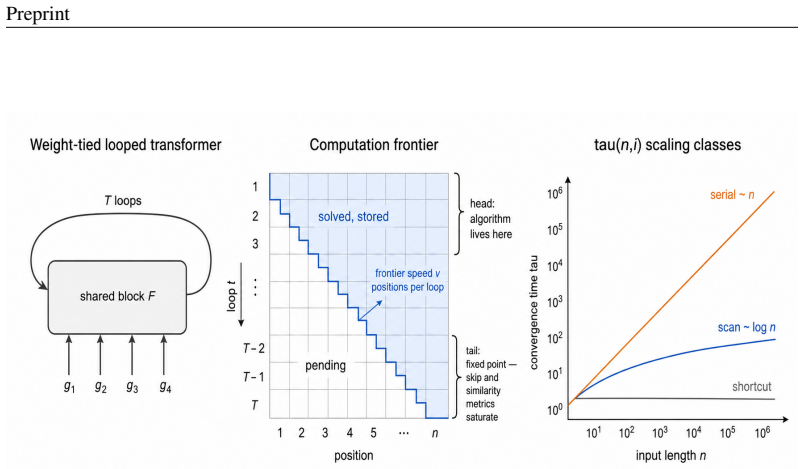
A trained weight-tied looped transformer runs a linear computation frontier whose speed is set by the training budget, v ≈ n_train/T_train—not a fixed-point or log-depth scan.
Reviewed by Pith at T0; open to challenge. T0 means a machine referee read the full paper against a public rubric. the ladder, T0–T4 →
T0 review · deepseek-v4-flash
2026-08-01 10:08 UTC pith:YL3LKNA6
load-bearing objection Strong instrument paper whose headline 'budget law' is better read as a necessary-condition regularity than a selection principle. the 4 major comments →
When Does Recurrence Become an Algorithm? Convergence Selection in Weight-Tied Looped Transformers
The pith
A machine-rendered reading of the paper's core claim, the machinery that carries it, and where it could break.
Core claim
The central discovery is the budget law. Across dozens of weight-tied looped transformers trained on prefix products over Z60, S4, A5, and S5, every model that learns the task implements a computation frontier: the contiguous solved prefix advances by a constant v positions per loop, uniform across input lengths, and v is priced by the training contract. Empirically v ≈ n_tr/T_tr with exponent 0.98 ± 0.04 and R²=0.99 over 23 models spanning an 8× demand range, and exactly v=1.0 under the T=n contract. The paper interprets SGD as selecting the minimum speed the contract demands—meeting it, never exceeding it. A paired discovery is that the mechanism lives in the head of the trajectory: the co
What carries the argument
The paper's central object is the linear computation frontier: the boundary of the contiguous solved prefix in a (position, loop) grid, advancing by v positions per loop with v constant per model. The key instrument is convergence-time scaling τ(n,i), defined as the first loop k at which the decoded output at position i reaches its final value and stays there; the scaling class of τ_max(n)—flat, log n, or linear—identifies the mechanism as shortcut, parallel scan, or serial step-indexed computation. The argument rests on a tail-blindness proposition: once the loop map reaches a fixed point, skipping loops, cross-step Jacobian similarity, and feature-dictionary attributions all become constan
Load-bearing premise
The load-bearing premise is that the budget law reflects SGD actively selecting the minimum demanded speed, which requires that faster-but-equally-trainable solutions exist at the same contract—the paper does not constructively demonstrate this.
What would settle it
Train a large population at a consistent contract such as T=n/4 on S4, searching over seeds, learning rates, and small curriculum variations. If any run that reaches full in-distribution accuracy and OOD generalization shows a measured frontier speed v significantly above ~4 (the demand), the 'never exceeded' part of the law is falsified. Conversely, if a constructive search exhibits a faster-but-trainable solution that SGD never finds, the selection principle is confirmed; if no such solution exists, the law reduces to a tautological lower bound.
If this is right
- Test-time loops buy frontier completion, not convergence: the halting rule T* = ceil(n/v-hat) recovers near-oracle accuracy and avoids the overthinking collapse of overlong budgets, giving looped models a principled compute setting.
- Standard interpretability instruments—skip tolerance, cross-step similarities, shared-dictionary attribution—are uninformative for looped models whenever trajectories converge with slack; head instruments like τ are required to see the algorithm.
- Architecture prior, not expressivity, selects the algorithm: weight tying flips SGD from parallel scans (standard-depth) to the serial frontier, even with positional addressing for a log-depth scan, and tied models learn A5 where untied ones fail.
- Learning walls on group word problems are optimization pathologies, not complexity results: NC1-complete A5 trains fully, while S5's 120×120 operator deadlocks joint learning—until an operator-first curriculum cracks it in every seed.
- Mechanism portability: warm-starting across loop budgets transfers the learned algorithm in every seed, re-pricing its frontier speed to the new contract, while imposed seriality through streaming input schedules fails where free training succeeds.
Where Pith is reading between the lines
- The budget law's 'never exceeded' claim is a selection principle only if faster-but-equally-trainable solutions exist at the same contract; a natural extension is to search deliberately for such faster frontiers (e.g., with curricula or regularization) and check whether SGD avoids them—if they are learnable and still avoided, selection is confirmed.
- The frontier speed v could serve as a test-time compute cost model: training budget and loops can be traded along the v ≈ n_tr/T_tr curve, and the halting rule T* could be integrated into serving of looped language models to allocate compute per input length.
- On the easy-to-hard benchmark, the learned frontier breaks at 128–256 bits while convolutional Deep Thinking nets reach 512; this suggests global attention's length fragility, not the frontier mechanism, bounds extrapolation—so local or masked attention is a concrete testable extension.
- Since τ is forward-only and defined on solved inputs, a drop in τ slope as length grows could serve as an early OOD-failure detector during training, a signal that tail metrics cannot provide within a mechanism class.
Editorial analysis
A structured set of objections, weighed in public.
Referee Report
Summary. This paper studies weight-tied looped transformers—one block applied T times—trained on per-position group word problems. Its central claim is a 'budget law': free training installs a linear computation frontier whose speed v (positions solved per loop) tracks the training contract, v ≈ n_tr/T_tr (exponent 0.98±0.04, R²=0.99), and a model never exceeds the demanded minimum. The paper introduces a convergence-time scaling instrument τ(n,i), proves a saturation proposition for tail instruments, reports that weight tying flips SGD from parallel scans to serial frontiers, finds that NC1-completeness is not the binding difficulty (A5 learns while S5 deadlocks, and an operator-first curriculum dissolves the S5 wall), and shows warm-starting transfers mechanisms across loop budgets. Results are replicated on an easy-to-hard prefix-sum benchmark.
Significance. If the central claims hold, the paper is significant: it offers a predictive account of what test-time loops buy in weight-tied transformers, a principled halting rule, an instrument-validity constraint (Proposition 1 is simple but useful), and evidence that optimization/curriculum can dominate circuit-complexity predictions. The paper is commendably transparent about its main weakness—the absence of a constructive search for faster solutions—and it ships substantial empirical support in the form of activation-patching damage cones, tying-degree controls, and an open-benchmark replication. However, the headline budget law currently rests on the saturation of a necessity bound and on several inferred parameters, so the empirical content needs sharpening before the selection claim can be accepted.
major comments (4)
- [§6, Fig. 4/Table 1] The 'selection' claim in the budget law is indistinguishable from lower-bound saturation. For any model that solves all training positions by the final training loop T_tr, a contiguous frontier advancing v positions per loop must satisfy v ≥ n_tr/T_tr. The consistent-demand rows of Table 1 (v=0.51, 1.00, 2.00, 4.00 for demands 0.5, 1, 2, 4) are exactly the signature of a quantity pinned to its lower bound. The R²=0.99 fit of v against n_tr/T_tr is therefore not independent evidence, and the paper's own admission that no constructive search for faster-but-equally-trainable solutions was performed (§6) means 'SGD never exceeds the demand' is supported only as a necessity condition, not as a selection principle. Please add one of: (a) a constructive search over seeds/curricula/regularizers at a fixed contract for solutions with v > demand on S4/A5; (b) a negative control with a known cheap
- [§6, 'Cross-task form of the law'] The general form v ≈ clip(n_tr/T_tr, v_free, v_max) has at least three quantities—the exponent, v_free, and v_max—inferred from the same data used to report the law. For parity, v_free is defined as the measured floor; for A5, v_max is invoked where demand 4 yields v≈2.5. Without an independent measurement or a pre-specified generative model, the clip form is highly flexible and its agreement with the 8× demand sweep is not strong evidence for a law. Please quantify the number of free parameters per task, estimate them on training data only, and test the clip form on a held-out contract or task to make the law falsifiable.
- [Abstract and §7, Table 7] The claim 'NC1-completeness costs nothing (A5 generalizes fully)' overstates the evidence. Table 7 reports only 8/22 from-scratch T=n seeds cracking chained A5, with the remaining seeds never passing the second position; the abstract's 'generalizes fully' applies only to a subset with a favorable seed lottery. The paper does disclose this in §7, but the abstract and contribution (3) should carry the qualification, or report the median/range separately for cracked seeds. As written, the headline finding (3) is not supported by the full population.
- [§8, Table 8] The prediction race may be partly circular in the bimodal cells. 'Frontier completion at n=32' is defined only for seeds that have already learned the task at training lengths; failed seeds have no measurable frontier, and assigning them a zero makes the predictor essentially 'did the seed crack by the training length.' Reporting AUROC up to 1.00 for such a predictor overstates the instrument's value. Please restrict the race to seeds with a measurable frontier, or report the predictor's performance separately within the cracked-seed population, where the head instrument is claimed to retain signal.
minor comments (7)
- [§6, 'The frontier is causal'] The cone validation is based on only two models ('both models tested' in all 72 grid cells). This is a strong but narrow validation; please state explicitly that the causal cones are illustrative for the population, or extend to a representative sample of frontier models.
- [References] Several references are incomplete: 'et al. Blayney', 'et al. Kaissis', 'DifFRACT authors', and 'et al. Yu' lack proper author lists. Please fix.
- [Table 1] The A5 row pools cracked and non-cracked seeds. Report the frontier speed v for cracked seeds separately; the pooled median (0.96) with range [0.08, 1.03] hides the bimodality that is central to §7.
- [Table 2] The 'overthinking' degradation for tight-budget models is reported on group means. Clarify whether accuracy is computed on solved examples only or on all examples, and report the number of seeds per cell.
- [Definition 1] The definition of τ_max(n) as 'median over inputs' should specify the tie-breaking rule and the number of solved inputs required; Appendix C's 'at least 3 lengths' rule appears only later.
- [§7] The annealing arms report '4/4 seeds' with no individual values or variance. Given the small N and the importance of the re-pricing result, show the per-seed v before/after transfers.
- [§3] The term 'free training' is used to mean 'no imposed seriality,' which may be confused with parameter-free training. Define the term at first use.
Circularity Check
Budget law's v≈n_tr/T_tr is partly a definitional lower bound; the 'SGD selects the minimum' claim is explicitly unsearched.
specific steps
-
self definitional
[§6 'The budget law' (Fig. 4, Table 1)]
"so SGD consistently arrives at a frontier whose speed matches the minimum the contract demands, and v is an experimenter-controllable knob (Fig. 3, left). We state this as a robust empirical regularity rather than a selection theorem: demonstrating that faster-but-equally-trainable solutions exist at the same contract (and are avoided) would require a constructive search over solutions we have not performed; what the data establish is that the demanded minimum is met, never exceeded, across an 8× range of consistent demands."
v is measured as positions-solved per loop on models trained to exact match all n_tr positions by the final training loop T_tr. Any such successful model has average throughput n_tr/T_tr over the training interval; a linear frontier from the start to the completed prefix must reproduce this chord slope. Hence the observed v≈n_tr/T_tr (and the R²=0.99 fit) is a necessary consequence of training success at least as much as a discovery about SGD's selection. The paper's own caveat—that a selection claim would require a constructive search for faster-but-equally-trainable solutions, which it has not performed—concedes the equality alone cannot distinguish 'the demanded minimum is met' from 'the demanded minimum is all that is possible'. Independent content (cross-length constancy, damage cones
full rationale
The only load-bearing circularity I can exhibit is in the budget law itself. Because v is defined as the speed of the solved-prefix frontier on models trained to solve all n_tr positions by the final training loop T_tr, the average speed over that interval is n_tr/T_tr by construction. Regressing v against n_tr/T_tr therefore partly correlates a measured quantity with its own lower bound, especially in the T=n case where the table reports v=1.00 [1.00, 1.00]. The paper explicitly limits the claim: it is 'a robust empirical regularity rather than a selection theorem,' and admits no constructive search for faster-but-equally-trainable solutions was performed. That admission is the key circularity-relevant fact. I found no load-bearing self-citation: the cited complexity results (Barrington, Merrill & Sabharwal, Liu et al.) are external and used as a hardness ladder, not to establish the budget law. The frontier mechanism itself is supported by independent evidence—cross-length constancy of v, fixed-length rescue, causal damage cones whose slopes reproduce v, and annealing that re-prices speed—so the paper is not wholly circular. The moderate score reflects that the central pricing relation is partly definitional while the mechanism claims retain independent empirical content.
Axiom & Free-Parameter Ledger
free parameters (3)
- power-law exponent for budget law =
0.98 ± 0.04
- parity speed floor v_free =
≈1–1.5
- A5 operator cap v_max =
≈2.5
axioms (4)
- standard math Fixed-point saturation: at a fixed point h* of the loop map, skip tolerance, Jacobian agreement, and feature-dictionary agreement are uninformative about earlier loops.
- domain assumption The training contract can be summarized by the demand ratio n_tr/T_tr and frontier speed is a per-model constant across lengths.
- domain assumption The decoded output's stabilization time τ(n,i) is a valid upper bound on when the underlying computation finished, and causal damage cones on a subset of models license mechanistic reading for all frontier models.
- domain assumption Per-position supervision on prefix products with a linear readout head is sufficient to identify whether models implement an algorithm as opposed to memorization.
invented entities (2)
-
Linear computation frontier
independent evidence
-
Convergence-time scaling τ(n,i)
independent evidence
read the original abstract
When does a weight-tied looped transformer -- one block applied T times -- implement an actual algorithm? We answer with four findings from controlled populations on group word problems. (1) The budget law: free training installs a linear computation frontier, a mechanism that solves v positions per loop, whose speed is priced by the training contract: v ~ n_train/T_train (exponent 0.98 +/- 0.04, R^2=0.99), exactly unity under T=n training. SGD selects a frontier matching the minimum the contract demands; granting more test-time loops than ever trained rescues late positions at fixed input length, yielding a principled halting rule T* = ceil(n / v-hat). (2) Architecture prior, not expressivity, picks the algorithm: standard-depth transformers learn parallel scans on this family; weight tying flips the selection to the serial frontier, even when positional addressing for a log-depth scan is supplied. At matched depth and parameters, untied models extrapolate worst and fail to learn A5 at all. (3) The walls are not where circuit complexity says: NC1-completeness costs nothing (A5 generalizes fully), while group order does (S5's 120x120 operator deadlocks joint learning) -- and an operator-first curriculum dissolves the wall in every seed. (4) Mechanisms are portable, not mandatable: warm-starting across budget contracts transfers the algorithm in every seed, re-pricing its speed, while imposing seriality through the input schedule fails where free training succeeds. These results are invisible to standard instruments, which provably saturate at the fixed points trained loops converge to. We introduce a head instrument, the convergence-time scaling tau(n,i), validate it causally via damage cones whose slope reproduces v, and show in-distribution head measurements predict out-of-distribution fate where tail metrics do not. Results replicate on the public easy-to-hard benchmark.
Figures


Reference graph
Works this paper leans on
-
[4]
Looped transformers for length generalization.arXiv preprint arXiv:2409.15647,
Ying Fan, Yilun Du, Kannan Ramchandran, and Kangwook Lee. Looped transformers for length generalization.arXiv preprint arXiv:2409.15647,
-
[6]
Peter Hase, Mohit Bansal, Been Kim, and Asma Ghandeharioun
arXiv:2402.09963. Peter Hase, Mohit Bansal, Been Kim, and Asma Ghandeharioun. Does localization inform editing? surprising differences in causality-based localization vs. knowledge editing in language models. NeurIPS,
-
[8]
et al. Kohli. Loop, think, & generalize: Implicit reasoning in recurrent-depth transformers.arXiv preprint arXiv:2604.07822,
-
[10]
arXiv:2503.03961. 12 Preprint Table 10: Frontier-state transplant (A’s prefix states spliced intoB’s run at the frontier, loopt=16): retention vs. repair is governed by the storage phenotype of Table
-
[11]
Gleb Rodionov and Liudmila Prokhorenkova
arXiv:2404.08819. Gleb Rodionov and Liudmila Prokhorenkova. Neural algorithmic reasoning without intermediate supervision.NeurIPS,
-
[13]
arXiv:2502.08482. A LOCALIZATION,TRANSPORT,AND EDITING UNDER WEIGHT TYING The survey lines that dominate interpretability—neuron localization (Dai et al., 2022; Wang et al., 2022; Tang et al., 2024), causal-tracing-guided editing (Meng et al., 2022), and circuit discov- ery (Conmy et al., 2023; Yao et al., 2024)—all index structure byparameter address(lay...
Pith/arXiv arXiv 2022
-
[1989]
et al. Blayney. A mechanistic analysis of looped reasoning language models.arXiv preprint arXiv:2604.11791,
-
[2019]
Diffract: Diffusion feature reconstruction and attribution for circuit tracing
DifFRACT authors. Diffract: Diffusion feature reconstruction and attribution for circuit tracing. arXiv preprint arXiv:2606.15796,
-
[2022]
Looped transformers are better at learning learning algorithms.arXiv preprint arXiv:2311.12424,
Liu Yang, Kangwook Lee, Robert Nowak, and Dimitris Papailiopoulos. Looped transformers are better at learning learning algorithms.arXiv preprint arXiv:2311.12424,
-
[2023]
et al. Kaissis. Step-resolved data attribution for looped transformers.arXiv preprint arXiv:2602.10097,
-
[2024]
Bartoldson, Bhavya Kailkhura, Abhinav Bhatele, and Tom Goldstein
Jonas Geiping, Sean McLeish, Neel Jain, John Kirchenbauer, Siddharth Singh, Brian R. Bartoldson, Bhavya Kailkhura, Abhinav Bhatele, and Tom Goldstein. Scaling up test-time compute with latent reasoning: A recurrent depth approach.arXiv preprint arXiv:2502.05171,
-
[2025]
Kevin Meng, David Bau, Alex Andonian, and Yonatan Belinkov
arXiv:2507.02199. Kevin Meng, David Bau, Alex Andonian, and Yonatan Belinkov. Locating and editing factual associations in GPT.NeurIPS,
-
[2026]
Ouro: Looped language models.arXiv preprint arXiv:2510.25741,
ByteDance Seed. Ouro: Looped language models.arXiv preprint arXiv:2510.25741,
discussion (0)
Sign in with ORCID, Apple, or X to comment. Anyone can read and Pith papers without signing in.