Learning Preference-Based Objectives from Clinical Narratives for Dynamic Sepsis Treatment
Pith reviewed 2026-05-10 15:33 UTC · model grok-4.3
The pith
Clinical narratives supply preference signals that train rewards yielding better recovery in sequential treatment policies.
A machine-rendered reading of the paper's core claim, the machinery that carries it, and where it could break.
Core claim
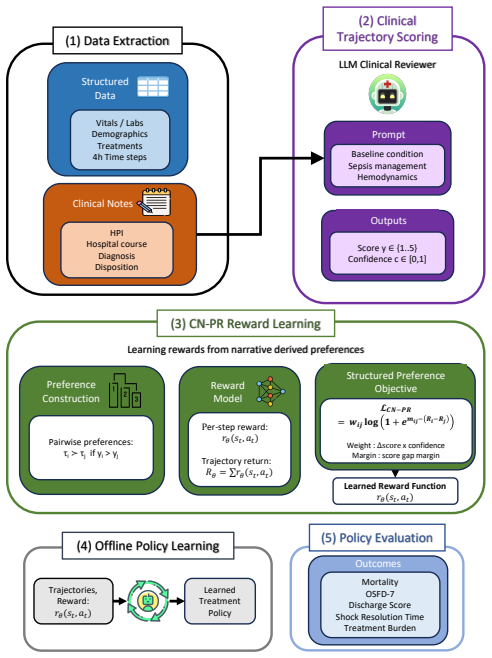
The authors claim that treating discharge summaries as sources of trajectory quality scores and pairwise preferences, processed through a large language model and weighted by narrative confidence, allows training of a reward function via a structured preference objective. This reward correlates with trajectory quality and supports policies that increase organ support-free days, accelerate shock resolution, and maintain comparable mortality performance, with the gains persisting in external validation.
What carries the argument
The Clinical Narrative-informed Preference Rewards (CN-PR) framework, which derives trajectory quality scores and pairwise preferences from discharge summaries to train a weighted preference-based reward objective for reinforcement learning.
If this is right
- Policies trained with the learned reward produce measurable gains in recovery-related outcomes such as organ support-free days and time to shock resolution.
- Mortality rates remain comparable to those achieved by baseline reward designs.
- The alignment between the learned reward and trajectory quality reaches a Spearman correlation of 0.63.
- Performance improvements hold when the policies are tested on external data.
- Narrative-based supervision offers a scalable substitute for handcrafted or purely outcome-driven reward functions in dynamic treatment regimes.
Where Pith is reading between the lines
- The same narrative preference pipeline could be adapted to encode explicit patient or family goals by modifying the preference construction step.
- Narrative rewards might complement rather than replace physiological data, creating hybrid objectives that capture both numeric stability and overall trajectory quality.
- Testing the framework on non-ICU datasets or with different language models would reveal how sensitive the gains are to narrative style and model choice.
- If the method generalizes, it could reduce the data engineering burden when moving reinforcement learning from research cohorts to new clinical sites.
Load-bearing premise
Large language model assessments of trajectory quality drawn from discharge summaries accurately and without bias capture true clinical effectiveness and patient experience.
What would settle it
A prospective trial in which policies trained on the learned reward fail to produce statistically significant gains in organ support-free days or shock resolution time compared with standard or outcome-based rewards.
Figures


read the original abstract
Designing reward functions for reinforcement learning (RL) in healthcare remains challenging because clinically meaningful outcomes are sparse, delayed, and difficult to explicitly specify. Although structured clinical data capture physiologic states, they often fail to reflect broader aspects of patient trajectories such as treatment response, recovery dynamics, and intervention burden. Clinical narratives, by contrast, encode longitudinal clinician assessments of disease progression, treatment effectiveness, and recovery, providing a potential source of trajectory-level supervision beyond predefined outcome metrics. We propose Clinical Narrative-informed Preference Rewards (CN-PR), a framework that learns reward functions directly from discharge summaries by treating clinical narratives as scalable supervision for trajectory-level preferences. Using a large language model, we derive trajectory quality scores and construct pairwise preferences between patient trajectories to learn rewards through preference-based optimization. To account for variability in narrative informativeness, we incorporate a task relevance signal that weights supervision according to its relevance to the downstream decision-making task. We evaluate CN-PR in dynamic sepsis treatment using offline RL. The learned reward demonstrated strong monotonic alignment with trajectory quality scores and produced policies associated with improved recovery-related outcomes, including increased organ support-free days and faster shock resolution, while maintaining mortality performance comparable to outcome-based reward baselines. These findings were preserved under external validation. Our results suggest that clinical narratives provide a scalable and expressive source of supervision for reward learning in dynamic treatment regimes.
Editorial analysis
A structured set of objections, weighed in public.
Referee Report
Summary. The manuscript presents Clinical Narrative-informed Preference Rewards (CN-PR), a method to learn reward functions for reinforcement learning in clinical sequential decision-making by extracting trajectory quality scores (TQS) and pairwise preferences from discharge summaries using a large language model. The approach incorporates a confidence signal to weight the supervision and reports a Spearman rank correlation of 0.63 between the learned reward and trajectory quality, along with policies that improve recovery outcomes such as organ support-free days and shock resolution in both internal and external validation.
Significance. Should the central results prove robust, the work offers a valuable contribution to reward design in healthcare RL by providing a scalable, narrative-based alternative to hand-engineered rewards. The use of external validation and focus on clinically meaningful outcomes beyond mortality strengthen the potential applicability to real-world dynamic treatment regimes.
major comments (3)
- Abstract: The reported Spearman rho = 0.63 is given without associated p-value, confidence interval, or comparison to alternative reward functions or random baselines, which is necessary to establish that the alignment is not due to chance or trivial correlations.
- Methods: The paper does not sufficiently detail how the LLM-derived pairwise preferences are converted into the structured preference-based objective or how the confidence signal is mathematically incorporated into the reward learning loss; this information is load-bearing for reproducing the claimed alignment and policy improvements.
- Results: The external validation lacks explicit reporting of sample sizes, statistical tests for differences in organ support-free days and shock resolution, and analysis of potential confounders or selection biases in the validation cohort.
minor comments (2)
- Clarify the exact definition of 'trajectory quality' used in the TQS and how it relates to the clinical outcomes measured.
- Provide more information on the RL algorithm and state-action space used for policy learning to aid reproducibility.
Simulated Author's Rebuttal
We thank the referee for their constructive and detailed review. The comments highlight important areas for improving statistical rigor, methodological transparency, and reporting completeness. We address each major comment below and will incorporate revisions to strengthen the manuscript.
read point-by-point responses
-
Referee: Abstract: The reported Spearman rho = 0.63 is given without associated p-value, confidence interval, or comparison to alternative reward functions or random baselines, which is necessary to establish that the alignment is not due to chance or trivial correlations.
Authors: We agree that reporting the p-value, confidence interval, and baseline comparisons is essential for interpreting the Spearman correlation. In the revised manuscript, we will update the abstract and corresponding results section to include the p-value and 95% confidence interval for rho = 0.63. We will also add explicit comparisons to random baselines and alternative reward functions (e.g., those derived from structured physiological data alone) to demonstrate that the observed alignment is not attributable to chance or trivial correlations. revision: yes
-
Referee: Methods: The paper does not sufficiently detail how the LLM-derived pairwise preferences are converted into the structured preference-based objective or how the confidence signal is mathematically incorporated into the reward learning loss; this information is load-bearing for reproducing the claimed alignment and policy improvements.
Authors: We acknowledge that greater mathematical detail is needed for full reproducibility. The pairwise preferences are converted via a structured ranking objective based on the Bradley-Terry model applied at the trajectory level, and the confidence signal is incorporated as a per-preference weight in the loss to modulate supervision strength according to narrative informativeness. We will expand the methods section with the explicit loss formulation, the precise weighting mechanism, and pseudocode for the full reward learning procedure. revision: yes
-
Referee: Results: The external validation lacks explicit reporting of sample sizes, statistical tests for differences in organ support-free days and shock resolution, and analysis of potential confounders or selection biases in the validation cohort.
Authors: We thank the referee for identifying these reporting gaps. In the revised results and supplementary materials, we will report the exact sample sizes for the external validation cohort. We will include statistical tests (e.g., Mann-Whitney U or t-tests with p-values and effect sizes) for differences in organ support-free days and shock resolution. We will also add a dedicated subsection analyzing potential confounders and selection biases, including baseline cohort characteristics and any adjustments (such as propensity weighting) applied to mitigate them. revision: yes
Circularity Check
No significant circularity; derivation uses external LLM extraction then validates on independent clinical outcomes
full rationale
The paper extracts TQS and pairwise preferences via LLM from discharge summaries, trains a reward model on those preferences, then evaluates the resulting policies on separate clinical metrics (organ support-free days, shock resolution, mortality) under external validation. The reported Spearman rho=0.63 measures how well the learned reward recovers the LLM-derived TQS, which is a standard reward-model validation step rather than a reduction by construction. No self-citations, uniqueness theorems, or ansatzes are invoked as load-bearing; the central claims rest on observable downstream outcomes that are not part of the preference inputs.
Axiom & Free-Parameter Ledger
free parameters (1)
- confidence signal weights
axioms (1)
- domain assumption Discharge summaries contain scalable, reliable supervision for trajectory-level preferences and quality
discussion (0)
Sign in with ORCID, Apple, or X to comment. Anyone can read and Pith papers without signing in.