REVIEW 4 major objections 6 minor 63 references
Bias in text-to-image models is fixed by jointly aligning concept graphs in the text encoder and denoiser, not by editing one side alone.
Reviewed by Pith at T0; open to challenge. T0 means a machine referee read the full paper against a public rubric. the ladder, T0–T4 →
T0 review · grok-4.5
2026-07-12 02:47 UTC pith:YMPOEIWF
load-bearing objection Joint TE+denoiser concept-graph registration is a clean, usable fix for the fairness–coherence trade-off on SD1.5, with a real unlearning side-effect; the ontology story is still correlational. the 4 major comments →
Efficient bias mitigation in T2I diffusion models using Concept Graphs
The pith
A machine-rendered reading of the paper's core claim, the machinery that carries it, and where it could break.
Core claim
Effective debiasing of text-to-image diffusion requires joint registration of concept graphs extracted from the text encoder and the denoiser toward a common target topology; single-component edits break the geometric coupling between the two and trade residual bias for semantically incoherent outputs, whereas CO-ALIGN simultaneously improves fairness, image quality, fidelity, and coherence, and further strengthens post-hoc unlearning against adversarial prompts.
What carries the argument
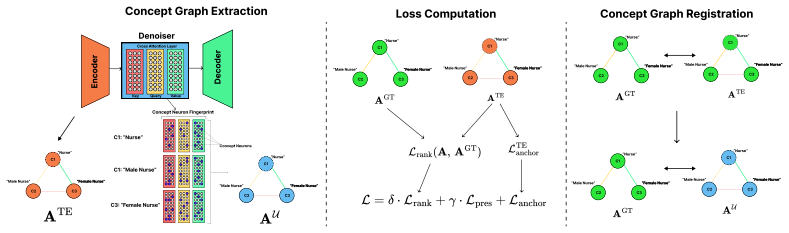
CO-ALIGN: extract a text-encoder concept graph from cosine similarities of mean-pooled embeddings and a denoiser concept graph from average cosine of masked concept-neuron gradient fingerprints over cross-attention K/Q/V weights, then align both adjacency matrices to a target graph that equalizes the target concept’s proximity to its attribute anchors via a differentiable ranking loss plus static-anchor and preservation terms.
Load-bearing premise
The premise that these particular graphs of embedding similarities and shared concept-neuron fingerprints truly capture the causal internal concept ontology whose edge rebalancing will produce fairer generations.
What would settle it
Run the same joint-alignment pipeline on Stable Diffusion v1.5 but replace the concept-graph registration loss with a matched control that randomizes edge targets or freezes one component; if fairness, coherence, and unlearning gains disappear while image quality stays intact, the claim that graph alignment itself is the causal mechanism is falsified.
Editorial analysis
A structured set of objections, weighed in public.
Referee Report
Summary. The paper proposes CO-ALIGN, a bias-mitigation method for text-to-image diffusion models that extracts concept graphs from the text encoder (pairwise cosine of mean-pooled embeddings, Eq. 4) and the denoiser (average cosine of masked K/Q/V concept-neuron gradient fingerprints, Eqs. 5–8), then registers a hand-specified target topology of equal proximity between an underspecified concept and demographic anchors (Eq. 9) via a differentiable ranking loss (Eqs. 10–12), applied sequentially to both components with anchor and preservation regularizers. On Stable Diffusion v1.5 under the DiffLens four-occupation protocol, joint alignment is reported to improve fairness discrepancy (e.g., gender FD 0.032), FID, CLIP-I, and to cut semantic incoherence relative to single-component baselines (Table 2, Fig. 2b), with a secondary application in which pre-aligning adversarial bypass concepts improves post-hoc unlearning robustness (Table 3) via an observed neighbourhood-pulling effect (Fig. 5).
Significance. If the empirical claims hold under broader scrutiny, the work is significant for two reasons. First, it directly targets a documented failure mode of current debiasing—fairness gains that trade off into incoherent generations when only the text encoder or only the denoiser is edited—and places joint ontology-style alignment on a better fairness–coherence Pareto front than several strong baselines. Second, the neighbourhood-propagation observation and its use as a pre-alignment step for UCE/ESD/SAFREE is a concrete, reusable idea for strengthening concept unlearning without changing the unlearning procedure. The manuscript also supplies extraction/alignment algorithms, a reproducibility appendix with hyperparameters and wall-clock costs, and multi-metric reporting (FD, FID, CLIP-I/T, VLM incoherence), which strengthens the contribution relative to purely inference-time steering papers.
major comments (4)
- [§4–5, Eqs. 4–9] §4–5, Eqs. (4)–(9) and the central ontology claim: the load-bearing premise is that A_TE and A_U are faithful proxies for the causal internal concept ontology, so that equalizing target–attribute edge weights produces demographic balance. Table 2 and Figs. 2b/4 show that joint registration improves FD/FID/CLIP-I and restores coherence relative to single-component baselines, but these are output correlations. There is no intervention or ablation that isolates the registered edges (e.g., randomizing off-target graph rows, matching FD with a non-graph control that only applies L_pres/L_anchor, or intervening on non-CA pathways) from residual-stream geometry, non-CA layers, or the regularizers. Without such evidence, the method’s gains may be real while the “concept-ontology alignment” causal story remains under-supported; please add at least one edge-level or pathway-control experiment.
- [§6, Table 2] Experimental setup / Table 2: all primary debiasing claims rest on four occupations (nurse, doctor, firefighter, receptionist) and three axes under the DiffLens protocol, with FD/FID/CLIP averaged over that set. That protocol is a reasonable starting point, but the abstract’s SOTA claims (30% fairness, ΔFID=11.4, 2.8% fidelity, 88% incoherence reduction) are stated generally. The manuscript needs either a broader occupation/prompt suite (including non-face and multi-attribute prompts) or a clearly scoped claim limited to this protocol, plus per-occupation breakdowns and variance over seeds so that the averages cannot be driven by one easy profession.
- [Abstract; §5–6; Fig. 4] Abstract and §5 claim effectiveness “across three paradigms: text-encoders, denoisers and joint,” yet Table 2 reports only joint CO-ALIGN against external baselines. Fig. 4 qualitatively shows TE-only incoherence repaired by subsequent denoiser alignment, and Fig. 2b places other methods, but the paper lacks a controlled within-framework ablation (same loss, same anchors, TE-only vs UNet-only vs joint) with the full metric suite. That ablation is necessary to substantiate the joint-alignment hypothesis as the reason for the Pareto improvement rather than the particular ranking objective or LoRA/UNet fine-tuning recipe.
- [§5, Eq. 9; Appendix E] §5, Eq. (9) and free design choices: the target topology fixes s*=1.0 (equal proximity to all anchors) and a small supervised row set S={c*}, with free parameters τ, δ, ξ, LoRA rank/scale, and sequential TE-then-denoiser order. Fairness is then measured by FD against a uniform demographic target. The paper should report sensitivity of FD/FID/incoherence to s*, to the choice of anchors, and to TE↔denoiser order; otherwise it is unclear whether success depends on a narrow hyperparameter island or on the graph-registration idea itself. A short sensitivity table would make the central claim much more robust.
minor comments (6)
- [Abstract; §6] Several abstract/intro percentages (30%, ΔFID=11.4, 2.8%, 88%) should be tied explicitly to the exact baseline and metric column in Table 2 / Fig. 2b so readers can recompute them.
- [Fig. 1; Abstract] Figure 1 and related captions contain OCR-like artifacts (“T xt Enc”, “corr ection”, “CG G T”) and the abstract has a missing space (“intosemantically”); clean for camera-ready.
- [Table 1; Appendix E] Table 1 marks CO-ALIGN as not training-free and with no added inference cost, which is fair, but wall-clock (TE ~5 min, UNet ~3 h on A100) belongs in the main comparison discussion so efficiency claims are not only in Appendix E.
- [Appendix F; Fig. 2b; Table 3] Incoherence and nudity metrics rely on LLaVA zero-shot prompts (Appendix F). Please report inter-rater agreement against a human sample or a second VLM, and release the exact matching rules used for “None” / “yes”.
- [§7, Table 3] Table 3: CO-ALIGN alone raises average flagged nudity (60.4% vs 48.4%) before unlearning; discuss this side effect briefly so the pre-alignment step is not read as universally safety-improving in isolation.
- [§4] Notation: A_TE / A_U / A_GT and G_TE / G_U are clear, but “concept neuron fingerprint” vs TRUST’s unlearning use could be one sentence sharper to avoid conflating methods.
Circularity Check
No load-bearing circularity: target topology is hand-prescribed independently of FD/FID, graphs are extracted from embeddings/gradients without fitting to evaluation metrics, and results are empirical.
specific steps
-
self citation load bearing
[§4 Background on Concept Neurons / Eqs. 1–2]
"Following TRUST [Mansi et al., 2026], we define a parameter θcu as a concept neuron for concept cu if perturbing its value produces a measurable change in the model’s alignment to cu, quantified via CLIP score: Lcu = CLIPScore(Icu, cu), Mr(cu) = η(E[|∇θ=θ0 Lcu|] > γ)r"
The denoiser concept-graph construction (Eqs. 5–8) inherits its node/edge definition from a prior paper by overlapping authors. This is a definitional convenience rather than a uniqueness theorem that forces the fairness results; the subsequent ranking loss and evaluation remain independent of that citation. Flagged only as minor non-load-bearing self-citation.
full rationale
CO-ALIGN is an empirical editing method, not a first-principles derivation that claims to predict fairness from independent axioms. The text-encoder graph (Eq. 4: cosine of mean-pooled embeddings) and denoiser graph (Eqs. 5–8: average cosine of masked concept-neuron gradient fingerprints) are constructed from model internals before any fairness metric is computed. The target topology (Eq. 9) simply sets equal proximity AGT_c*,c = s* (typically 1.0) by design choice; it is not fitted to FairFace FD, FID, or incoherence rates. The ranking loss (Eqs. 10–12) then registers the extracted graphs to this fixed target, after which generations are evaluated on held-out demographic classifiers and quality metrics (Table 2, Fig. 2b). No parameter is fitted on the reported fairness numbers and then re-presented as a prediction. The sole minor self-citation is the definition of concept neurons taken from TRUST (Mansi et al., 2026, overlapping authors); this supplies a construction tool for the denoiser graph but does not justify uniqueness of the debiasing claim or force the FD/FID numbers. The central empirical claim (joint alignment improves fairness–coherence Pareto frontier relative to single-component baselines) therefore stands or falls on the reported experiments, not on a definitional or self-citation reduction. Score 1 only for the non-load-bearing definitional self-citation; central chain is independent.
Axiom & Free-Parameter Ledger
free parameters (6)
- ranking temperature τ =
0.05
- ranking loss weight δ =
1.0
- concept-neuron sensitivity ξ =
2.0
- target similarity s* =
1.0
- LoRA rank r and scale α =
r=8, α=16
- learning rate and schedule =
1e-5, 3×300
axioms (6)
- domain assumption Information about a concept is concentrated in a sparse subset of cross-attention parameters (concept neurons) whose importance can be read from CLIP-score gradients.
- ad hoc to paper Pairwise cosine similarity of mean-pooled text-encoder embeddings is a faithful concept-graph edge weight.
- ad hoc to paper Average cosine of masked K/Q/V concept-neuron fingerprints is a faithful denoiser concept-graph edge weight.
- domain assumption Equal proximity of an underspecified concept to its demographic attribute variants is the correct target topology for fairness.
- domain assumption FairFace ResNet-34 and LLaVA-v1.6-Mistral-7B supply reliable demographic and incoherence/nudity labels.
- domain assumption Graph smoothness propagates alignment from supervised nodes to unsupervised neighbors (label-propagation analogy).
invented entities (4)
-
Text-encoder concept graph A_TE
no independent evidence
-
Denoiser concept graph A_U via concept-neuron fingerprints
no independent evidence
-
Differentiable ranking loss L_rank for concept-graph registration
no independent evidence
-
Semantic neighbourhood propagation / pulling effect under CO-ALIGN
no independent evidence
read the original abstract
Text-to-Image diffusion models often propagate harmful bias inherited from the training data. Existing bias mitigation techniques typically intervene only at the text encoder or provide inference-time guidance, often leading to generations that collapse into semantically incoherent outputs. To address these limitations, we introduce CO-ALIGN (Concept Ontology Alignment), a novel bias mitigation approach based on concept-graph alignment that operates on the model's internal concept ontology. By aligning concepts within the text encoder and denoiser, CO-ALIGN achieves substantial bias reduction while preserving generative integrity. We demonstrate the effectiveness of concept-graph alignment across three paradigms: text-encoders, denoisers and joint text-denoiser ontology alignment. CO-ALIGN outperforms the state of the art, improving fairness by $30\%$, $\Delta FID=11.4$ in image quality, $2.8\%$ in image fidelity, all while reducing semantically incoherent outputs by $88\%$. Beyond bias mitigation, we show that CO-ALIGN benefits other downstream tasks as well. In particular, our experiments demonstrate that better-aligned internal ontologies enhance concept unlearning robustness across multiple unlearning techniques.
Figures




Reference graph
Works this paper leans on
-
[1]
2022 , publisher =
Schuhmann, Christoph and Beaumont, Romain and Vencu, Richard and Gordon, Cade and Wightman, Ross and Cherti, Mehdi and Coombes, Theo and Katta, Aarush and Mullis, Clayton and Wortsman, Mitchell and Schramowski, Patrick and Kundurthy, Srivatsa and Crowson, Katherine and Schmidt, Ludwig and Kaczmarczyk, Robert and Jitsev, Jenia , booktitle =. 2022 , publisher =
2022
-
[2]
Proceedings of the 2023 ACM Conference on Fairness, Accountability, and Transparency , series =
Easily Accessible Text-to-Image Generation Amplifies Demographic Stereotypes at Large Scale , author =. Proceedings of the 2023 ACM Conference on Fairness, Accountability, and Transparency , series =. 2023 , publisher =
2023
-
[3]
Cho, Jaemin and Zala, Abhay and Bansal, Mohit , booktitle =
-
[4]
arXiv preprint arXiv:2304.06034 , year =
Social Biases through the Text-to-Image Generation Lens , author =. arXiv preprint arXiv:2304.06034 , year =
-
[5]
Proceedings of the 2024 Conference of the North American Chapter of the Association for Computational Linguistics: Human Language Technologies (Volume 1: Long Papers) , pages =
The Bias Amplification Paradox in Text-to-Image Generation , author =. Proceedings of the 2024 Conference of the North American Chapter of the Association for Computational Linguistics: Human Language Technologies (Volume 1: Long Papers) , pages =. 2024 , address =
2024
-
[6]
2023 IEEE International Joint Conference on Biometrics (IJCB) , pages =
Analyzing Bias in Diffusion-based Face Generation Models , author =. 2023 IEEE International Joint Conference on Biometrics (IJCB) , pages =. 2023 , publisher =
2023
-
[7]
Journal of Imaging , volume =
Revealing Gender Bias from Prompt to Image in Stable Diffusion , author =. Journal of Imaging , volume =. 2025 , publisher =
2025
-
[8]
Roos, Nathan and Iakovleva, Ekaterina and Gjergji, Ani and Pastore, Vito Paolo and Tartaglione, Enzo , booktitle =. How
-
[9]
arXiv preprint arXiv:2302.10893 , year =
Fair Diffusion: Instructing Text-to-Image Generation Models on Fairness , author =. arXiv preprint arXiv:2302.10893 , year =
-
[10]
Brack, Manuel and Friedrich, Felix and Hintersdorf, Dominik and Struppek, Lukas and Schramowski, Patrick and Kersting, Kristian , booktitle =
-
[11]
Advances in Neural Information Processing Systems , volume =
Debiasing Vision-Language Models via Biased Prompts , author =. Advances in Neural Information Processing Systems , volume =
-
[12]
Proceedings of the IEEE/CVF Conference on Computer Vision and Pattern Recognition , year =
Rethinking Training for De-biasing Text-to-Image Generation: Unlocking the Potential of Stable Diffusion , author =. Proceedings of the IEEE/CVF Conference on Computer Vision and Pattern Recognition , year =
-
[13]
Proceedings of the IEEE/CVF International Conference on Computer Vision , pages =
Editing Implicit Assumptions in Text-to-Image Diffusion Models , author =. Proceedings of the IEEE/CVF International Conference on Computer Vision , pages =
-
[14]
Proceedings of the IEEE/CVF Winter Conference on Applications of Computer Vision , pages =
Unified Concept Editing in Diffusion Models , author =. Proceedings of the IEEE/CVF Winter Conference on Applications of Computer Vision , pages =
-
[15]
International Conference on Learning Representations , year =
Diffusion Models Already Have a Semantic Latent Space , author =. International Conference on Learning Representations , year =
-
[16]
Proceedings of the IEEE/CVF Conference on Computer Vision and Pattern Recognition , pages =
Balancing Act: Distribution-Guided Debiasing in Diffusion Models , author =. Proceedings of the IEEE/CVF Conference on Computer Vision and Pattern Recognition , pages =
-
[17]
Proceedings of the IEEE/CVF Conference on Computer Vision and Pattern Recognition , pages =
Self-Discovering Interpretable Diffusion Latent Directions for Responsible Text-to-Image Generation , author =. Proceedings of the IEEE/CVF Conference on Computer Vision and Pattern Recognition , pages =
-
[18]
Proceedings of the IEEE/CVF Winter Conference on Applications of Computer Vision , year =
Fully Unsupervised Self-debiasing of Text-to-Image Diffusion Models , author =. Proceedings of the IEEE/CVF Winter Conference on Applications of Computer Vision , year =
-
[19]
Proceedings of the IEEE/CVF Conference on Computer Vision and Pattern Recognition , pages =
Dissecting and Mitigating Diffusion Bias via Mechanistic Interpretability , author =. Proceedings of the IEEE/CVF Conference on Computer Vision and Pattern Recognition , pages =
-
[20]
Chakraborty, Rajatsubhra and Che, Xujun and Faklaris, Cori and Niu, Xi and Xu, Depeng and Yuan, Shuhan , journal =
-
[21]
Locating Demographic Bias at the Attention-Head Level in
Yasser, Alaa and Phunjanna, Kittipat and Escudero Vi. Locating Demographic Bias at the Attention-Head Level in. arXiv preprint arXiv:2603.11793 , year =
-
[22]
Zhixuan and Chen, Yuhao and Wong, Alexander , booktitle =
Zeng, E. Zhixuan and Chen, Yuhao and Wong, Alexander , booktitle =
-
[23]
International Conference on Learning Representations , year =
Finetuning Text-to-Image Diffusion Models for Fairness , author =. International Conference on Learning Representations , year =
-
[24]
arXiv preprint arXiv:2402.14577 , year =
Debiasing Text-to-Image Diffusion Models , author =. arXiv preprint arXiv:2402.14577 , year =
-
[25]
arXiv preprint arXiv:2511.07091 , year =
How Bias Binds: Measuring Hidden Associations for Bias Control in Text-to-Image Compositions , author =. arXiv preprint arXiv:2511.07091 , year =
-
[26]
arXiv preprint arXiv:2512.08486 , year =
Temporal Concept Dynamics in Diffusion Models via Prompt-Conditioned Interventions , author =. arXiv preprint arXiv:2512.08486 , year =
-
[27]
Under review at ICLR 2026 , year =
Disentangling Primitive Representation Structures for Image Generation , author =. Under review at ICLR 2026 , year =
2026
-
[28]
Anonymous , journal =
-
[29]
arXiv preprint arXiv:2503.23398 , year =
A Large Scale Analysis of Gender Biases in Text-to-Image Generative Models , author =. arXiv preprint arXiv:2503.23398 , year =
-
[30]
arXiv preprint arXiv:2603.28114 , year =
Model-Agnostic Gender Bias Control for Text-to-Image Generation , author =. arXiv preprint arXiv:2603.28114 , year =
-
[31]
2025 , doi =
Batzilis, Dimitris and others , journal =. 2025 , doi =
2025
-
[32]
arXiv preprint arXiv:2303.11408 , year =
Stable Bias: Analyzing Societal Representations in Diffusion Models , author =. arXiv preprint arXiv:2303.11408 , year =
-
[33]
Proceedings of the 36th International Conference on Neural Information Processing Systems , articleno =
Schuhmann, Christoph and Beaumont, Romain and Vencu, Richard and Gordon, Cade and Wightman, Ross and Cherti, Mehdi and Coombes, Theo and Katta, Aarush and Mullis, Clayton and Wortsman, Mitchell and Schramowski, Patrick and Kundurthy, Srivatsa and Crowson, Katherine and Schmidt, Ludwig and Kaczmarczyk, Robert and Jitsev, Jenia , title =. Proceedings of the...
2022
-
[34]
Rombach, Robin and Blattmann, Andreas and Lorenz, Dominik and Esser, Patrick and Ommer, Bjorn , booktitle =. 2022 , volume =. doi:10.1109/CVPR52688.2022.01042 , url =
-
[35]
The Eleventh International Conference on Learning Representations , year=
Diffusion Models Already Have A Semantic Latent Space , author=. The Eleventh International Conference on Learning Representations , year=
-
[36]
Proceedings of the IEEE/CVF International Conference on Computer Vision , year =
Fair Generation without Unfair Distortions: Debiasing Text-to-Image Generation with Entanglement-Free Attention , author =. Proceedings of the IEEE/CVF International Conference on Computer Vision , year =
-
[37]
Advances in Neural Information Processing Systems , volume =
Association of Objects May Engender Stereotypes: Mitigating Association-Engendered Stereotypes in Text-to-Image Generation , author =. Advances in Neural Information Processing Systems , volume =
-
[38]
2025 , publisher =
Kang, Mintong and Kumar, Vinayshekhar Bannihatti and Roy, Shamik and Kumar, Abhishek and Khosla, Sopan and Narayanaswamy, Balakrishnan Murali and Gangadharaiah, Rashmi , booktitle =. 2025 , publisher =
2025
-
[39]
Proceedings of the AAAI Conference on Artificial Intelligence , volume =
Fair Text-to-Image Diffusion via Fair Mapping , author =. Proceedings of the AAAI Conference on Artificial Intelligence , volume =. 2025 , doi =
2025
-
[40]
arXiv preprint arXiv:2509.22723 , year =
Responsible Diffusion: A Comprehensive Survey on Safety, Ethics, and Trust in Diffusion Models , author =. arXiv preprint arXiv:2509.22723 , year =
-
[41]
The Thirteenth International Conference on Learning Representations , year=
Fantastic Targets for Concept Erasure in Diffusion Models and Where To Find Them , author=. The Thirteenth International Conference on Learning Representations , year=
-
[42]
Advances in Neural Information Processing Systems , volume =
Learning with Local and Global Consistency , author =. Advances in Neural Information Processing Systems , volume =
-
[43]
Proceedings of the Twentieth International Conference on Machine Learning , pages =
Semi-Supervised Learning Using Gaussian Fields and Harmonic Functions , author =. Proceedings of the Twentieth International Conference on Machine Learning , pages =
-
[44]
Proceedings of the IEEE/CVF Conference on Computer Vision and Pattern Recognition , pages =
Label Propagation for Deep Semi-supervised Learning , author =. Proceedings of the IEEE/CVF Conference on Computer Vision and Pattern Recognition , pages =
-
[45]
Journal of Machine Learning Research , volume =
Manifold Regularization: A Geometric Framework for Learning from Labeled and Unlabeled Examples , author =. Journal of Machine Learning Research , volume =
-
[46]
Learning Transferable Visual Models From Natural Language Supervision , booktitle =
Alec Radford and Jong Wook Kim and Chris Hallacy and Aditya Ramesh and Gabriel Goh and Sandhini Agarwal and Girish Sastry and Amanda Askell and Pamela Mishkin and Jack Clark and Gretchen Krueger and Ilya Sutskever , editor =. Learning Transferable Visual Models From Natural Language Supervision , booktitle =. 2021 , url =
2021
-
[47]
The Twelfth International Conference on Learning Representations , year=
SalUn: Empowering Machine Unlearning via Gradient-based Weight Saliency in Both Image Classification and Generation , author=. The Twelfth International Conference on Learning Representations , year=
-
[48]
Proceedings of the 41st International Conference on Machine Learning , articleno =
Basu, Samyadeep and Rezaei, Keivan and Kattakinda, Priyatham and Morariu, Vlad I and Zhao, Nanxuan and Rossi, Ryan A and Manjunatha, Varun and Feizi, Soheil , title =. Proceedings of the 41st International Conference on Machine Learning , articleno =. 2024 , publisher =
2024
-
[49]
Proceedings of the 40th International Conference on Machine Learning , articleno =
Liu, Zhiheng and Feng, Ruili and Zhu, Kai and Zhang, Yifei and Zheng, Kecheng and Liu, Yu and Zhao, Deli and Zhou, Jingren and Cao, Yang , title =. Proceedings of the 40th International Conference on Machine Learning , articleno =. 2023 , publisher =
2023
-
[50]
2026 , eprint=
Selective Fine-Tuning for Targeted and Robust Concept Unlearning , author=. 2026 , eprint=
2026
-
[51]
FairFace: Face Attribute Dataset for Balanced Race, Gender, and Age for Bias Measurement and Mitigation , year=
Kärkkäinen, Kimmo and Joo, Jungseock , booktitle=. FairFace: Face Attribute Dataset for Balanced Race, Gender, and Age for Bias Measurement and Mitigation , year=
-
[52]
2022 , url=
Christoph Schuhmann and Romain Beaumont and Richard Vencu and Cade W Gordon and Ross Wightman and Mehdi Cherti and Theo Coombes and Aarush Katta and Clayton Mullis and Mitchell Wortsman and Patrick Schramowski and Srivatsa R Kundurthy and Katherine Crowson and Ludwig Schmidt and Robert Kaczmarczyk and Jenia Jitsev , booktitle=. 2022 , url=
2022
-
[53]
2023 , eprint=
Analyzing Bias in Diffusion-based Face Generation Models , author=. 2023 , eprint=
2023
-
[54]
Heusel, Martin and Ramsauer, Hubert and Unterthiner, Thomas and Nessler, Bernhard and Hochreiter, Sepp , booktitle =
-
[55]
Proceedings of the IEEE/CVF International Conference on Computer Vision , pages=
Erasing Concepts from Diffusion Models , author=. Proceedings of the IEEE/CVF International Conference on Computer Vision , pages=
-
[56]
2025 , url=
Jaehong Yoon and Shoubin Yu and Vaidehi Patil and Huaxiu Yao and Mohit Bansal , booktitle=. 2025 , url=
2025
-
[57]
2023 , eprint=
Visual Instruction Tuning , author=. 2023 , eprint=
2023
-
[58]
Safe Latent Diffusion: Mitigating Inappropriate Degeneration in Diffusion Models , year=
Schramowski, Patrick and Brack, Manuel and Deiseroth, Björn and Kersting, Kristian , booktitle=. Safe Latent Diffusion: Mitigating Inappropriate Degeneration in Diffusion Models , year=
-
[59]
Scalable Diffusion Models with Transformers , year=
Peebles, William and Xie, Saining , booktitle=. Scalable Diffusion Models with Transformers , year=
-
[60]
The Twelfth International Conference on Learning Representations , year=
Dustin Podell and Zion English and Kyle Lacey and Andreas Blattmann and Tim Dockhorn and Jonas M. The Twelfth International Conference on Learning Representations , year=
-
[61]
2024 , url =
LLaVA-NeXT: Improved reasoning, OCR, and world knowledge , author =. 2024 , url =
2024
-
[62]
2022 , url =
Diffusers: State-of-the-art diffusion models , author =. 2022 , url =
2022
-
[63]
ECCV , year =
Microsoft COCO: Common objects in context , author =. ECCV , year =
discussion (0)
Sign in with ORCID, Apple, or X to comment. Anyone can read and Pith papers without signing in.