REVIEW 2 major objections 6 minor 89 references
Pauli-noise shortcuts can misjudge quantum error correction by 10x
Reviewed by Pith at T0; open to challenge. T0 means a machine referee read the full paper against a public rubric. the ladder, T0–T4 →
T0 review · glm-5.2
2026-07-10 01:31 UTC pith:YQN5LQAY
load-bearing objection New simulation method (XPauli) for leakage and environmental noise in QEC, validated at small scale but with unverified approximation at the distances where the headline claims live the 2 major comments →
Plaquette: A hardware-aware design platform for fault-tolerant quantum computers
The pith
A machine-rendered reading of the paper's core claim, the machinery that carries it, and where it could break.
Core claim
The XPauli sampler rests on a specific structural assumption about quantum noise: that coherence between different leaked levels, environment sectors, or between leaked and computational subspaces can be discarded without losing the information that matters for logical error correction. Under this assumption, the state of a multi-qubit system with leakage and environmental coupling factors into a stabilizer state on the computational qubits tensored with classical labels for everything else. A generalized Pauli twirl converts any CPTP channel into a transition table over these labels plus conditional Pauli errors on computational qubits. Sampling then proceeds in two stages — first a random-
What carries the argument
The XPauli sampler's state representation: a stabilizer state on computational qubits, tensored with classical leakage-level labels and classical sector labels for environmental states. A generalized Pauli twirl converts hardware-derived Kraus channels into transition tables among these labels, with conditional Pauli errors on remaining computational qubits. The near-Clifford samplers decompose non-Clifford channels or unitaries as signed sums of Clifford elements, sampling Clifford circuits with quasiprobability weights that reconstruct the original channel in expectation.
Load-bearing premise
The XPauli sampler assumes that quantum coherence between different leaked levels, between leaked and computational subspaces, or between different environment sectors can be safely discarded — that these degrees of freedom behave classically. If leaked levels or environmental modes retain phase coherence that influences syndrome extraction, the generalized Pauli twirl underlying XPauli would introduce approximation errors whose magnitude the paper does not bound.
What would settle it
Construct a hardware noise model where leaked levels or environment sectors retain quantum coherence that affects logical error rates, and show that XPauli's logical error rate estimate diverges from full-state simulation beyond statistical uncertainty while a method that retains that coherence does not.
If this is right
- Hardware teams evaluating whether their device is below threshold should not rely on Pauli-twirled approximations alone — the resulting threshold and logical error rate estimates can be off by an order of magnitude or more, leading to misallocated engineering effort.
- The XPauli sampler's classical-label approach could be extended to other non-Pauli noise structures beyond leakage and heating, such as crosstalk with classical memory or time-correlated noise, as long as the incoherence assumption holds for the additional degrees of freedom.
- The separation between sampler representation and decoder model means decoders initialized from Pauli-twirled detector error models may be suboptimal for leakage or coherent noise — richer decoder models (correlated, leakage-aware, trajectory-conditioned) could improve correction performance beyond what current decoders achieve.
- Threshold surfaces in multi-parameter hardware noise spaces, as demonstrated for neutral atoms, could become a standard design tool: rather than reporting a single threshold number, hardware characterization would map the full tradeoff surface among competing imperfections.
Where Pith is reading between the lines
- If the incoherence assumption fails — for instance, if leaked levels retain phase coherence that interferes with subsequent gate operations or if leakage-mediated entanglement between qubits affects syndrome extraction — XPauli would introduce uncontrolled approximation errors whose magnitude is not bounded in the paper. The validity of the assumption likely depends on the specific hardware platfo
- The observation that Pauli twirling can underestimate logical error rates by over an order of magnitude raises a concern for the broader QEC literature: many published threshold estimates based on Clifford-only simulation with Pauli-twirled noise may be systematically optimistic, and the direction of the bias (optimistic vs pessimistic) may depend on the specific noise structure in ways that are n
- The framework's channel-first design could, in principle, be extended to simulate non-Markovian noise by embedding memory into explicit environment levels or sectors, but the paper notes this is limited to cases where the relevant memory can be represented within the circuit-level channel formalism — genuinely long-range temporal correlations may require fundamentally different simulation strategi
Editorial analysis
A structured set of objections, weighed in public.
Referee Report
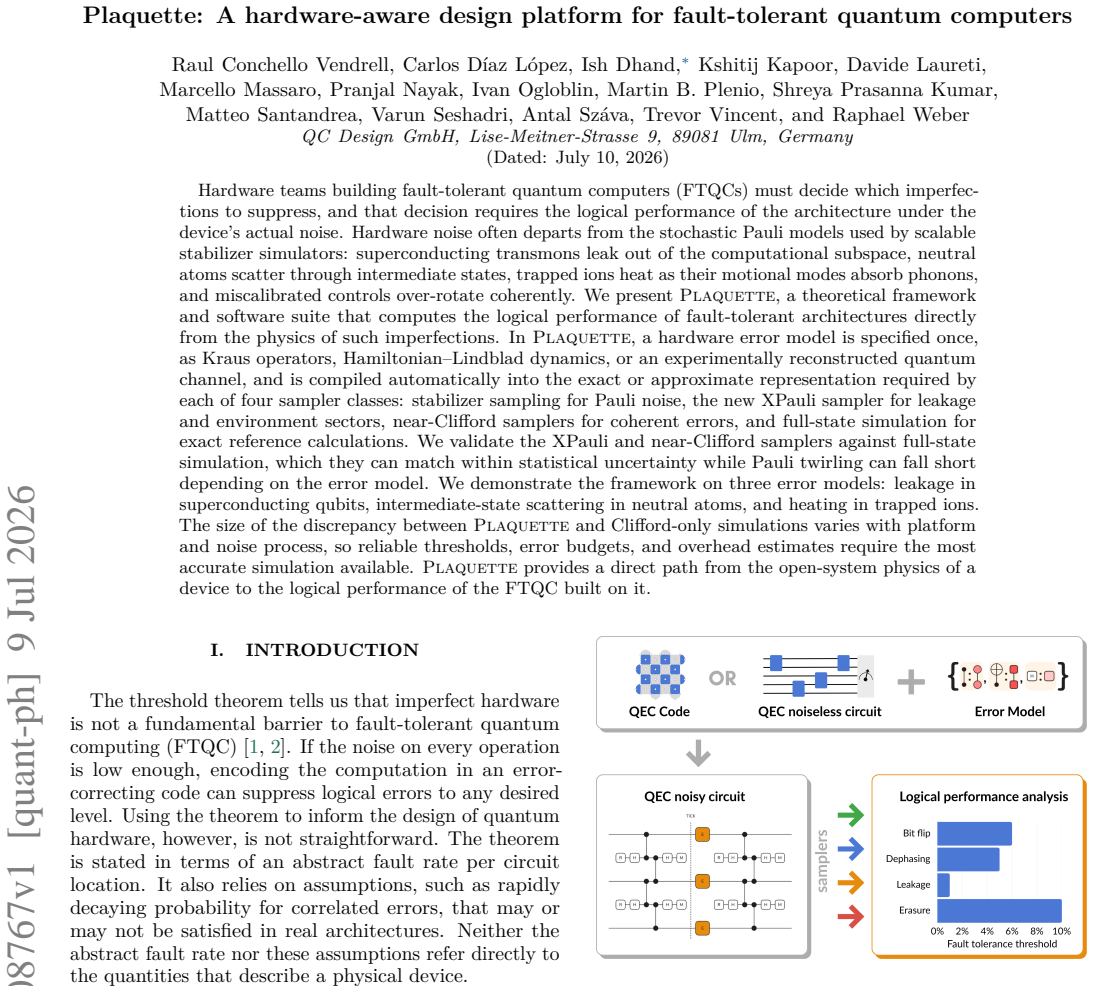
Summary. This paper presents Plaquette, a software framework for simulating fault-tolerant quantum error correction under realistic, non-Pauli hardware noise. The core technical contribution is the XPauli sampler, which extends stabilizer simulation by tracking leaked levels and environment sectors as classical labels while retaining coherence within the computational subspace. The framework also integrates near-Clifford samplers for coherent errors and full-state simulation for reference calculations. The paper validates XPauli and near-Clifford samplers against full-state simulation on small codes (distance-3 repetition code), then applies XPauli to three hardware-relevant scenarios: superconducting qubit leakage, neutral-atom intermediate-state scattering, and trapped-ion heating. The central quantitative finding is that Clifford-only Pauli-twirled simulations can underestimate logical error rates by over an order of magnitude and shift thresholds by approximately 20 percent relative to XPauli, which the authors argue is the more reliable approximation.
Significance. The paper addresses a genuine and important gap in FTQC design: the mismatch between the stochastic Pauli noise assumed by scalable stabilizer simulators and the richer noise structure of real hardware. The XPauli sampler is a well-motivated contribution that fills a practical niche between Clifford-only and full-state simulation. The channel-first design framework, which compiles a single physical error model into multiple sampler-specific representations, is a useful engineering contribution. The three hardware demonstrations are illustrative and span the major matter-qubit platforms. The key caveat, discussed below, is that the headline quantitative claims at large code distances rest on XPauli without independent full-state verification at those distances.
major comments (2)
- Section IIIC1, paragraph 2: The XPauli sampler's efficiency rests on the assumption that 'coherence between different leaked levels, sectors, or environment labels can be discarded.' This incoherence assumption is validated against full-state simulation only at distance 3 (Fig. 5b, Fig. 6a). At distance 9 (Fig. 6b), full-state is dropped and a 25–56× gap between XPauli and Stim is reported, but XPauli itself is not independently verified there. The threshold results at d=5–19 (Fig. 7), the 2.6× scattering-axis overestimate (Fig. 8), and the order-of-magnitude discrepancy at d=19 all depend on XPauli accuracy at distances where no full-state reference exists. The paper provides no bound on how the generalized Pauli twirl's approximation error scales with circuit depth or code distance. If leakage events accumulate coherently across rounds in a way the incoherence approximation misses, the
- Section IIID, paragraph on the trapped-ion model: The sector-dependent depolarization model (Eq. 22) uses a linear relation p_depol(n) = p_0 + kappa(2n+1) with p_0 = 1e-4 and kappa = 5e-3, described as 'a modelling relation based on Ref. [84].' This relation is the sole coupling between the vibrational sector and the computational qubit, and thus the entire trapped-ion demonstration rests on it. The paper should clarify whether this is a physically motivated mapping or a purely illustrative choice, and ideally provide a sensitivity analysis showing how the threshold estimate changes with different sector-to-rate assignments. Without this, it is unclear whether the trapped-ion results generalize beyond the specific functional form chosen.
minor comments (6)
- Fig. 5: The caption states '5,000 full-state shots and 200,000 shots for the other samplers,' but the main text (Section IVA, paragraph preceding Fig. 5) says '5,000 shots with the full-state sampler and 200,000 shots with the others.' Fig. 6a caption says '10^5 shots for Stim and XPauli and 10^4 shots for full-state,' which is inconsistent with the 5,000 figure. Please reconcile.
- Section IVB: The dimensionless parameters (omega=4.0, alpha=2.0, g=0.005, tau_CZ~444) are stated to be 'illustrative rather than tuned to a specific device.' It would help to note whether these are at least in a physically reasonable range for transmons, or whether they are purely abstract.
- Section IVD, Eq. (22): The statement 'p_0 = 10^{-4} and kappa = 5 x 10^{-3}, so that the depolarizing probability grows from about 0.5% in sector sigma=0 to 4.5% in sector sigma=4' appears to contain an arithmetic inconsistency: p_0 + kappa*(2*0+1) = 10^{-4} + 5e-3 = 5.1e-3 ~ 0.5%, which is consistent, but p_0 + kappa*(2*4+1) = 10^{-4} + 5e-3*9 = 4.51e-2 ~ 4.5%, which is also consistent. The values are fine; please just verify the intermediate sectors are as intended.
- Table II: The 'Near-Clifford sampling' entry lists four sub-methods but the distinction between 'general' and 'unitary' routes (channel-level vs. operator-level decomposition) could be clearer in the table. A brief note on when a user should choose one over the other would help.
- Section IIC: The threshold surface construction via barycentric scan directions is described, but the number of directions used (15 in Fig. 8) is mentioned only in the figure caption. Stating this in the main text would clarify the resolution of the surface.
- The paper uses 'Plaquette' both for the framework and the software suite. Occasional clarification that these refer to the same entity would help readers unfamiliar with the product.
Circularity Check
No significant circularity: Plaquette's central claims are validated against independent full-state benchmarks, not against their own outputs.
full rationale
The paper's central validation claim — that XPauli and near-Clifford samplers match full-state simulation — is tested against an independent reference method (exact state-vector propagation on CPU/GPU), not against XPauli's own output. The physical error models are derived from Hamiltonians and Lindblad operators (Eqs. 14–20) that are specified independently of the sampler representations. The threshold comparisons between XPauli and Clifford-only Stim (Figs. 7, 8) are comparisons of two different approximation methods applied to the same physical channel, not a self-referential loop. The generalized Pauli twirl that XPauli applies (Table III) is derived from the Kraus channel (Eq. 12) via a well-defined mathematical procedure, not fitted to the target output. The near-Clifford quasiprobability decompositions (Eqs. 6–7, Fig. 4) are obtained by solving a linear program or operator decomposition, not by fitting to logical error rates. No 'prediction' is equivalent to its input by construction. The only minor self-referential element is that the decoder DEM is constructed from a Pauli-twirled version of the same noisy circuit being sampled (Section IIID), but this is a standard, explicitly acknowledged design choice, not a circular derivation of the paper's claims. The paper's limitations (XPauli validated against full-state only at d=3, incoherence assumption unbounded at scale) are correctness concerns, not circularity: the claims do not reduce to their inputs by definition or by self-citation chain.
Axiom & Free-Parameter Ledger
free parameters (6)
- Transmon Hamiltonian parameters (omega, alpha, g) =
omega=4.0, alpha1=alpha2=2.0, g=0.005
- Dissipation rate ratios (Gamma_heat, Gamma_cool relative to Gamma_deph) =
Gamma_heat=0.02*gamma/tau_CZ, Gamma_cool=0.1*gamma/tau_CZ
- Neutral-atom CZ drive parameters (Omega, delta, V0, Delta, xi, tau) =
Omega=2.7382, delta=300, V0=200, Delta~0.38*Omega_eff, xi~3.90, tau~4.29/Omega_eff
- Trapped-ion sector-to-depolarization mapping (p0, kappa) =
p0=1e-4, kappa=5e-3
- Trapped-ion thermalization parameters (Gamma_h range, nth) =
Gamma_h in [0.0229, 0.0429], nth=1.0
- Near-Clifford decomposition robustness =
R_op~1.10 for Eq. 9, R_op_tot~5.98 for the circuit
axioms (4)
- domain assumption Markovian (memoryless) dissipation governs the hardware noise processes
- ad hoc to paper Coherence between leaked levels, sectors, and environment labels can be discarded for the XPauli sampler
- ad hoc to paper Pauli twirling of the noise model provides a sufficient decoder model (DEM) even when the sampler uses a richer representation
- domain assumption Finite-size scaling with the form P_fail ~ F((eta-eta*)*d^(1/nu)) holds near threshold
invented entities (2)
-
XPauli sampler
independent evidence
-
Channel-first design framework (Plaquette)
independent evidence
read the original abstract
Hardware teams building fault-tolerant quantum computers (FTQCs) must decide which imperfections to suppress, and that decision requires the logical performance of the architecture under the device's actual noise. Hardware noise often departs from the stochastic Pauli models used by scalable stabilizer simulators: superconducting transmons leak out of the computational subspace, neutral atoms scatter through intermediate states, trapped ions heat as their motional modes absorb phonons, and miscalibrated controls over-rotate coherently. We present Plaquette, a theoretical framework and software suite that computes the logical performance of fault-tolerant architectures directly from the physics of such imperfections. In Plaquette, a hardware error model is specified once, as Kraus operators, Hamiltonian-Lindblad dynamics, or an experimentally reconstructed quantum channel, and is compiled automatically into the exact or approximate representation required by each of four sampler classes: stabilizer sampling for Pauli noise, the new XPauli sampler for leakage and environment sectors, near-Clifford samplers for coherent errors, and full-state simulation for exact reference calculations. We validate the XPauli and near-Clifford samplers against full-state simulation, which they can match within statistical uncertainty while Pauli twirling can fall short depending on the error model. We demonstrate the framework on three error models: leakage in superconducting qubits, intermediate-state scattering in neutral atoms, and heating in trapped ions. The size of the discrepancy between Plaquette and Clifford-only simulations varies with platform and noise process, so reliable thresholds, error budgets, and overhead estimates require the most accurate simulation available. Plaquette provides a direct path from the open-system physics of a device to the logical performance of the FTQC built on it.
Figures


Reference graph
Works this paper leans on
-
[1]
The XPauli sampler The XPauli sampler extends stabilizer simulation to systems whose qubits can leave the computational sub- space or carry additional classical environment labels. It is designed for noise in which coherence inside the computational subspace must be retained, but coherence between different leaked levels, sectors, or environment labels ca...
-
[2]
The near-Clifford samplers Plaquette’s near-Clifford samplers address a differ- ent limitation of stabilizer simulation. Coherent errors and native non-Clifford gates cannot be captured by the 9 Rz(0.1π) General Near-Clifford Channel-level decomposition Decomposition α1 I·ρ·I†+α2 S·ρ·S†+α3 Z·ρ·Z† Coefficients α1 = 0.821α2 = 0.309α3 =−0.130 Robustness Rch ...
-
[3]
= +1 I·ρ·S† |c1c∗ 2| R2op phase(c1c∗ 2) S·ρ·I† |c2c∗ 1| R2op phase(c2c∗ 1) S·ρ·S† |c2c∗ 2| R2op phase(c2c∗
-
[4]
= +1 Pfail =R2op·mean(wjkOjk) FIG. 4. The two quasiprobability near-Clifford samplers, illustrated on the coherent rotationRz(0.1π). (Left) The general sampler decomposes thechannelas E = ∑ kαkΦ k, whereΦ k denotes a Clifford channel; each shot draws one channel with probability|αk|/Rch and carries the sign ofαk as its weight. (Right) The unitary sampler ...
-
[5]
Full-state sampling on CPU and GPU The full-state samplers are the reference methods. They do not reduce the channel to a Pauli, XPauli, or near- Clifford representation; instead, they propagate the state under the Kraus channels specified by the error model. Their memory and runtime costs are exponential in the number of levels included in the full-state...
-
[6]
D. Aharonov and M. Ben-Or, Fault-tolerant quantum computation with constant error rate, SIAM J. Comput. 38, 1207 (2008). 20
work page 2008
- [7]
-
[8]
Google Quantum AI, R. Acharya, I. Aleiner, R. Allen, T. I. Andersen, M. Ansmann, F. Arute, K. Arya, A. As- faw, J. Atalaya, R. Babbush, D. Bacon, J. C. Bardin, J. Basso, A. Bengtsson, S. Boixo, G. Bortoli, A. Bourassa, J. Bovaird, L. Brill, M. Broughton, B. B. Buckley, D. A. Buell, T. Burger, B. Burkett, N. Bushnell, Y. Chen, Z. Chen, B. Chiaro, J. Cogan,...
work page 2023
-
[9]
The Heisenberg Representation of Quantum Computers
D. Gottesman, The heisenberg representation of quantum computers, arXiv:quant-ph/9807006 10.48550/arXiv.quant-ph/9807006 (1998), arXiv: quant-ph/9807006
work page internal anchor Pith review Pith/arXiv arXiv doi:10.48550/arxiv.quant-ph/9807006 1998
-
[10]
S. Aaronson and D. Gottesman, Improved simulation of stabilizer circuits, Phys. Rev. A70, 052328 (2004), publisher: American Physical Society
work page 2004
-
[11]
Gidney, Stim: a fast stabilizer circuit simulator, Quan- tum5, 497 (2021)
C. Gidney, Stim: a fast stabilizer circuit simulator, Quan- tum5, 497 (2021)
work page 2021
- [12]
-
[13]
M. McEwen, D. Kafri, Z. Chen, J. Atalaya, K. J. Satzinger, C. Quintana, P. V. Klimov, D. Sank, C. Gidney, A. G. Fowler, F. Arute, K. Arya, B. Buckley, B. Bur- kett, N. Bushnell, B. Chiaro, R. Collins, S. Demura, A. Dunsworth, C. Erickson, B. Foxen, M. Giustina, T. Huang, S. Hong, E. Jeffrey, S. Kim, K. Kechedzhi, F. Kostritsa, P. Laptev, A. Megrant, X. Mi...
work page 2021
-
[14]
S. J. Evered, D. Bluvstein, M. Kalinowski, S. Ebadi, T. Manovitz, H. Zhou, S. H. Li, A. A. Geim, T. T. Wang, N. Maskara, H. Levine, G. Semeghini, M. Greiner, V. Vuletić, and M. D. Lukin, High-fidelity parallel entan- gling gates on a neutral-atom quantum computer, Nature 622, 268 (2023)
work page 2023
-
[15]
M. Saffman, T. G. Walker, and K. Mølmer, Quantum information with rydberg atoms, Rev. Mod. Phys.82, 2313 (2010)
work page 2010
-
[16]
M. Brownnutt, M. Kumph, P. Rabl, and R. Blatt, Ion- trap measurements of electric-field noise near surfaces, Rev. Mod. Phys.87, 1419 (2015)
work page 2015
-
[17]
J. D. Thompson, T. G. Tiecke, A. S. Zibrov, V. Vuletić, and M. D. Lukin, Coherence and raman sideband cooling of a single atom in an optical tweezer, Phys. Rev. Lett. 110, 133001 (2013)
work page 2013
-
[18]
C. H. Yang, A. Rossi, R. Ruskov, N. S. Lai, F. A. Mo- hiyaddin, S. Lee, C. Tahan, G. Klimeck, A. Morello, and A. S. Dzurak, Spin-valley lifetimes in a silicon quantum dot with tunable valley splitting, Nat. Commun.4, 2069 (2013)
work page 2069
-
[19]
D. Buterakos and S. Das Sarma, Spin-valley qubit dy- namics in exchange-coupled silicon quantum dots, PRX Quantum2, 040358 (2021)
work page 2021
- [20]
-
[21]
J. J. Wallman and J. Emerson, Noise tailoring for scalable quantum computation via randomized compiling, Phys. Rev. A94, 052325 (2016)
work page 2016
-
[22]
M. R. Geller and Z. Zhou, Efficient error models for fault-tolerant architectures and the pauli twirling approx- imation, Phys. Rev. A88, 012314 (2013)
work page 2013
-
[23]
C. T. Hann, K. Noh, H. Putterman, M. H. Matheny, J. K. Iverson, M. T. Fang, C. Chamberland, O. Painter, and F. G. Brandão, Hybrid cat-transmon architecture for scalable, hardware-efficient quantum error correction, PRX Quantum6, 030305 (2025)
work page 2025
-
[24]
C. Ryan-Anderson, J. G. Bohnet, K. Lee, D. Gresh, A. Hankin, J. P. Gaebler, D. Francois, A. Chernoguzov, D. Lucchetti, N. C. Brown, T. M. Gatterman, S. K. Halit, K. Gilmore, J. A. Gerber, B. Neyenhuis, D. Hayes, and R. P. Stutz, Realization of real-time fault-tolerant quan- tum error correction, Phys. Rev. X11, 041058 (2021)
work page 2021
-
[25]
J. D. Chadwick, G. G. Guerreschi, F. Luthi, M. T. Mądzik, F. A. Mohiyaddin, P. Prabhu, A. T. Schmitz, A. Litteken, S. Premaratne, N. C. Bishop, A. Y. Matsuura, and J. S. Clarke, Short two-qubit pulse sequences for exchange-only spin qubits in two-dimensional layouts, Phys. Rev. A111, 052616 (2025)
work page 2025
-
[26]
E. Tham, M. L. Goldman, S. Debnath, A. N. Pa- tel, J. Saraladevi, J. Nguyen, E. Nielsen, N. Pisenti, K. Wright, J. Gamble, and N. Delfosse, Breakeven demon- stration of quantum low-density parity-check codes (2026), arXiv:2606.06455 [quant-ph]
work page internal anchor Pith review Pith/arXiv arXiv 2026
-
[27]
F.-M. L. Régent, C. Berdou, Z. Leghtas, J. Guillaud, and M. Mirrahimi, High-performance repetition cat code using fast noisy operations, Quantum7, 1198 (2023)
work page 2023
-
[28]
F. Hopfmueller, M. Tremblay, P. St-Jean, B. Royer, and M.-A. Lemonde, Bosonic pauli+: Efficient simulation of concatenated gottesman-kitaev-preskill codes, Quantum 8, 1539 (2024). 21
work page 2024
-
[29]
A. G. Fowler, Coping with qubit leakage in topological codes, Phys. Rev. A88, 042308 (2013)
work page 2013
-
[30]
Leakage Suppression in the Toric Code
M. Suchara, A. W. Cross, and J. M. Gambetta, Leakage suppression in the toric code, arXiv preprint arXiv:1410.8562 10.48550/arXiv.1410.8562 (2014), arXiv:1410.8562 [quant-ph]
work page internal anchor Pith review Pith/arXiv arXiv doi:10.48550/arxiv.1410.8562 2014
-
[31]
QC Design Team, (2026), manuscript in preparation
work page 2026
-
[32]
M. A. Nielsen and I. L. Chuang, Quantum computation and quantum information (2010), iSBN: 9780511976667 Publisher: Cambridge University Press
work page 2010
-
[33]
A dynamical interpretation of the Pauli Twirling Approximation and Quantum Error Correction
A. Katabarwa, A dynamical interpretation of the pauli twirling approximation and quantum error correction (2017), arXiv:1701.03708 [quant-ph]
work page internal anchor Pith review Pith/arXiv arXiv 2017
-
[34]
A. R. Calderbank and P. W. Shor, Good quantum error- correcting codes exist, Phys. Rev. A54, 1098 (1996)
work page 1996
-
[35]
A. M. Steane, Error correcting codes in quantum theory, Phys. Rev. Lett.77, 793 (1996)
work page 1996
-
[36]
Subsystem surface codes with three-qubit check operators
S. Bravyi, G. Duclos-Cianci, D. Poulin, and M. Suchara, Subsystem surface codes with three-qubit check operators, arXiv preprint arXiv:1207.1443 10.48550/arXiv.1207.1443 (2012)
work page internal anchor Pith review Pith/arXiv arXiv doi:10.48550/arxiv.1207.1443 2012
-
[37]
O. Higgott and N. P. Breuckmann, Subsystem codes with high thresholds by gauge fixing and reduced qubit over- head, Phys. Rev. X11, 031039 (2021)
work page 2021
-
[38]
Topological Quantum Distillation
H. Bombin and M. A. Martin-Delgado, Topological quan- tum distillation, Phys. Rev. Lett.97, 180501 (2006), arXiv:quant-ph/0605138
work page internal anchor Pith review Pith/arXiv arXiv 2006
-
[39]
S.-H. Lee, A. Li, and S. D. Bartlett, Color code decoder with improved scaling for correcting circuit-level noise, Quantum9, 1609 (2025)
work page 2025
-
[40]
S. B. Bravyi and A. Y. Kitaev, Quantum codes on a lattice with boundary (1998), arXiv:quant-ph/9811052
work page internal anchor Pith review Pith/arXiv arXiv 1998
-
[41]
D. Horsman, A. G. Fowler, S. Devitt, and R. V. Meter, Surface code quantum computing by lattice surgery, New J. Phys.14, 123011 (2012), publisher: IOP Publishing
work page 2012
-
[42]
P. W. Shor, Scheme for reducing decoherence in quan- tum computer memory, Phys. Rev. A52, R2493 (1995), publisher: American Physical Society
work page 1995
-
[43]
R. Laflamme, C. Miquel, J. P. Paz, and W. H. Zurek, Perfect quantum error correcting code, Phys. Rev. Lett. 77, 198 (1996), publisher: American Physical Society
work page 1996
-
[44]
N. P. Breuckmann and J. N. Eberhardt, Quantum low- density parity-check codes, PRX Quantum2, 040101 (2021)
work page 2021
-
[45]
A. Y. Kitaev, Quantum computations: algorithms and error correction, Russ. Math. Surv.52, 1191 (1997), pub- lisher: IOP Publishing
work page 1997
-
[46]
J.-P. Tillich and G. Zemor, Quantum ldpc codes with positive rate and minimum distance proportional to the square root of the blocklength, IEEE Trans. Inf. Theory 60, 1193 (2013)
work page 2013
-
[47]
High-threshold and low-overhead fault-tolerant quantum memory
S. Bravyi, A. W. Cross, J. M. Gambetta, D. Maslov, P. Rall, and T. J. Yoder, High-threshold and low-overhead fault-tolerant quantum memory, Nature627, 778 (2024), arXiv:2308.07915 [quant-ph]
work page internal anchor Pith review Pith/arXiv arXiv 2024
-
[48]
P. Panteleev and G. Kalachev, Degenerate quantum ldpc codes with good finite length performance, Quantum5, 585 (2021)
work page 2021
-
[49]
P. Panteleev and G. Kalachev, Quantum ldpc codes with almost linear minimum distance, IEEE Trans. Inf. Theory 68, 213 (2021)
work page 2021
-
[50]
A Topologically Fault-Tolerant Quantum Computer with Four Dimensional Geometric Codes
D. Aasen, M. B. Hastings, V. Kliuchnikov, J. M. Bello- Rivas, A.Paetznick, R.Chao, B.W.Reichardt, M.Zanner, M. P. da Silva, Z. Wang, and K. M. Svore, A topologically fault-tolerant quantum computer with four dimensional geometric codes (2025), arXiv:2506.15130 [quant-ph]
work page internal anchor Pith review Pith/arXiv arXiv 2025
- [51]
-
[52]
R. S. Bennink, E. M. Ferragut, T. S. Humble, J. A. Laska, J. J. Nutaro, M. G. Pleszkoch, and R. C. Pooser, Unbiased simulation of near-clifford quantum circuits, Phys. Rev. A95, 062337 (2017)
work page 2017
-
[53]
S. Hakkaku, K. Mitarai, and K. Fujii, Sampling-based quasiprobability simulation for fault-tolerant quantum error correction on the surface codes under coherent noise, Phys. Rev. Res.3, 043130 (2021)
work page 2021
-
[54]
Simulation of quantum circuits by low-rank stabilizer decompositions
S. Bravyi, D. Browne, P. Calpin, E. Campbell, D. Gosset, and M. Howard, Simulation of quantum circuits by low- rank stabilizer decompositions, Quantum3, 181 (2019), arXiv:1808.00128 [quant-ph]
work page internal anchor Pith review Pith/arXiv arXiv 2019
-
[55]
T. LeBlond, P. Groszkowski, J. G. Lietz, C. M. Seck, and R. S. Bennink, Logical error rates for the surface code under a mixed coherent and stochastic circuit-level noise model inspired by trapped ions, Phys. Rev. Res.7, 043184 (2025)
work page 2025
-
[56]
R. Haenel, X. Luo, and C. Zhao, Tsim: Fast universal simulator for quantum error correction, arXiv preprint arXiv:2604.01059 10.48550/arXiv.2604.01059 (2026)
-
[57]
B. A. Chase and F. Labib, Clifft: Fast exact simula- tion of near-clifford quantum circuits, arXiv preprint arXiv:2604.27058 10.48550/arXiv.2604.27058 (2026)
work page internal anchor Pith review Pith/arXiv arXiv doi:10.48550/arxiv.2604.27058 2026
-
[58]
J. Marshall and D. Kafri, Incoherent approximation of leakage in quantum error correction, Phys. Rev. Appl.23, 054025 (2025)
work page 2025
-
[59]
H. Manabe, Y. Suzuki, and A. S. Darmawan, Efficient sim- ulation of leakage errors in quantum error correcting codes using tensor network methods (2025), arXiv:2308.08186 [quant-ph]
work page internal anchor Pith review Pith/arXiv arXiv 2025
- [60]
-
[61]
Efficient simulation of Clifford circuits with small Markovian errors
A. Miller, C. Ostrove, J. Hines, R. Blume-Kohout, K. Young, and T. Proctor, Efficient simulation of clifford circuits with small markovian errors, arXiv preprint arXiv:2504.15128 10.48550/arXiv.2504.15128 (2025), arXiv:2504.15128 [quant-ph]
work page internal anchor Pith review Pith/arXiv arXiv doi:10.48550/arxiv.2504.15128 2025
-
[62]
Developers, Cirq (2024), see full list of authors on Github
C. Developers, Cirq (2024), see full list of authors on Github
work page 2024
-
[63]
H. Bayraktar, A. Charara, D. Clark, S. Cohen, T. Costa, Y.-L. L. Fang, Y. Gao, J. Guan, J. Gunnels, A. Haidar, A. Hehn, M. Hohnerbach, M. Jones, T. Lubowe, D. Lyakh, S. Morino, P. Springer, S. Stanwyck, I. Terentyev, S. Varadhan, J. Wong, and T. Yamaguchi, cuquantum sdk: A high-performance library for accelerating quantum science, in2023 IEEE Internationa...
work page 2023
-
[64]
Estimating detector error models from syndrome data
R. Blume-Kohout and K. Young, Estimating detector er- ror models from syndrome data (2025), arXiv:2504.14643 [quant-ph]
work page internal anchor Pith review Pith/arXiv arXiv 2025
-
[65]
Logical error estimation from syndrome data of surface-code experiments
E. Takou, C. Benito, A. Vezvaee, D. A. Lidar, and K. R. Brown, Logical error estimation from syndrome data of surface-code experiments (2026), arXiv:2606.11496 [quant- ph]
work page internal anchor Pith review Pith/arXiv arXiv 2026
-
[66]
O. Higgott, Pymatching: A python package for decoding quantum codes with minimum-weight perfect matching, 22 ACM Trans. Quantum Comput.3, 1 (2022)
work page 2022
-
[67]
Fusion Blossom: Fast MWPM Decoders for QEC
Y. Wu and L. Zhong, Fusion blossom: Fast mwpm de- coders for qec, in2023 IEEE International Conference on Quantum Computing and Engineering (QCE)(2023) arXiv:2305.08307 [quant-ph]
work page internal anchor Pith review Pith/arXiv arXiv 2023
-
[68]
New circuits and an open source decoder for the color code
C. Gidney and C. Jones, New circuits and an open source decoder for the color code (2023), arXiv:2312.08813 [quant-ph]
work page internal anchor Pith review Pith/arXiv arXiv 2023
- [69]
-
[70]
T. Hillmann, L. Berent, A. O. Quintavalle, J. Eisert, R. Wille, and J. Roffe, Localized statistics decoding for quantum low-density parity-check codes, arXiv preprint arXiv:2406.18655 10.48550/arXiv.2406.18655 (2024)
-
[71]
Improved belief propagation is sufficient for real-time decoding of quantum memory
T. Müller, T. Alexander, M. E. Beverland, M. Bühler, B. R. Johnson, T. Maurer, and D. Vandeth, Improved belief propagation is sufficient for real-time decoding of quantum memory (2025), arXiv:2506.01779 [quant-ph]
work page internal anchor Pith review Pith/arXiv arXiv 2025
-
[72]
O.Higgott, T.C.Bohdanowicz, A.Kubica, S.T.Flammia, and E. T. Campbell, Improved decoding of circuit noise and fragile boundaries of tailored surface codes (2023)
work page 2023
-
[73]
L. A. Beni, O. Higgott, and N. Shutty, Tesseract: A search-based decoder for quantum error correction (2025), arXiv:2503.10988 [quant-ph]
work page internal anchor Pith review Pith/arXiv arXiv 2025
-
[74]
S. Gu, Y. Vaknin, A. Retzker, and A. Kubica, Optimizing quantum error-correction protocols with erasure qubits, PRX Quantum6, 040354 (2025), Figs. 3b and 4d
work page 2025
- [75]
-
[76]
G. Baranes, M. Cain, J. P. B. Ataides, D. Bluvstein, J. Sin- clair, V. Vuletić, H. Zhou, and M. D. Lukin, Leveraging qubit loss detection in fault-tolerant quantum algorithms, Phys. Rev. X16, 011002 (2026)
work page 2026
-
[77]
A. M. Stephens, Fault-tolerant thresholds for quantum error correction with the surface code, Phys. Rev. A89, 022321 (2014)
work page 2014
-
[78]
C. Wang, J. Harrington, and J. Preskill, Confinement- higgs transition in a disordered gauge theory and the accuracy threshold for quantum memory, Ann. Phys.303, 31 (2003)
work page 2003
-
[79]
D. Wang, A. Fowler, A. Stephens, and L. Hollenberg, Threshold error rates for the toric and planar codes, Quan- tum Inf. Comput.10, 456 (2010)
work page 2010
-
[80]
H. G. Katzgraber, H. Bombin, and M. A. Martin-Delgado, Error threshold for color codes and random three-body ising models, Phys. Rev. Lett.103, 090501 (2009)
work page 2009
discussion (0)
Sign in with ORCID, Apple, or X to comment. Anyone can read and Pith papers without signing in.