Quantum Physics · arXiv:quant-ph/0605138 v3 · submitted 16 May 2006 · 16 references
Topological Quantum Distillation
The paper says
“We construct a class of topological quantum codes to perform quantum entanglement distillation. These codes implement the whole Clifford group of unitary operations in a fully topological manner and without selective addressing of qubits.”
more of the abstract
This allows us to extend their application also to quantum teleportation, dense coding and computation with magic states.
from the abstract
Pith says
Machine review · deepseek-v4.1-flash · 13 Nov 2026 · what was read was not recorded · not checked by a person
Reviewed in 2026 with later literature in view.
It can be wrong. Challenge this review or reply to it.
Holds up, with conditions. The color code itself is the real contribution here; the distillation framing in the title oversells what the four pages actually deliver, and the phase-gate lattice family is asserted rather than built. This line is wrong
4 major objections · 8 minor
How often objections from reviews like this one are right: not yet measured
Not checked: figures, code, what the 16 references say.
The paper says, at Paragraph beginning 'Unfortunately, K̂ is more tricky'; Fig. 4(b)
The review did not quote this passage.
Pith says: Objection 1 of 4 · major
The full-Clifford claim rests on the existence of a family of triangular color codes, at arbitrary size and with arbitrarily large distance, in which every plaquette has v = 4m sites. The text derives K̂ B^X_p K̂† = (-1)^{v/2} B^X_p B^Z_p, correctly concluding that K̂ preserves the code space only under that condition, and then discharges the existence question with …
more of objection 1
… the single sentence 'this difficulty can be overcome by choosing a suitable lattice, as shown in Fig. 4' plus the caption of Fig. 4(b). No tiling is named, no recursive or explicit construction is given, and no argument is offered that the family exists at all sizes. This is load-bearing: without it the phase gate is unavailable and the Clifford claim reduces to {H, CNOT}. The authors should name the tiling (the 4.8.8 tiling, with square and octagonal plaquettes, is the natural candidate), give the construction of the family at arbitrary size, and state explicitly that the v = 4m condition is preserved under it.
The paper says, at Paragraph beginning 'As for the distance of triangular codes'; also the paragraph 'We now determine the distance of the'
The review did not quote this passage.
Pith says: Objection 2 of 4 · major
The distance of triangular codes is disposed of in one sentence: 'an operator in Z acting nontrivially on C must have a support connecting the red, green and blue borders.' This is plausible but is not proved, and it is the only statement in the paper that the distance can be made arbitrarily large, which is what makes the fault-tolerance claim meaningful.
more of objection 2
The general color-code distance argument earlier in the paper is likewise a sketch supported by Fig. 3 rather than a proof: the assertion that any operator in Z whose support contains no non-boundary closed path must lie in S is argued by picture. At minimum the authors should give a lower bound on the distance of the triangular family in terms of the linear size of the triangle, and should state the resulting [[n, 1, d]] parameters explicitly, since no n or d values appear anywhere in the manuscript.
The paper says, at Title, abstract, and final paragraph
The review did not quote this passage.
Pith says: Objection 3 of 4 · major
The title and abstract frame the paper as performing quantum entanglement distillation, but no distillation protocol is presented: there is no input ensemble, no measurement or post-selection scheme, no yield or fidelity analysis, and no comparison with the recurrence protocols of Refs.
more of objection 3
[4], [5], [6]. What the paper actually delivers is a code family plus a topological implementation of the Clifford group, with distillation named as an application. Since the Clifford group is the standard ingredient of distillation protocols, the connection is reasonable, but as written the headline claim is not supported by the body. The authors should either sketch a concrete distillation scheme on a triangular code (even at the level of which states are prepared, which Clifford operations are applied, and what is measured) or retitle and rewrite the abstract to lead with the code construction and the transversal Clifford group.
The paper says, at Eq. (13) and the sentence 'they become self-protected from local errors by the gap [12], [13]'
The review did not quote this passage.
Pith says: Objection 4 of 4 · major
The Hamiltonian of Eq. (13) is a sum of plaquette terms, and the paper claims it 'implements the desired self-correcting capabilities' and that the systems 'become self-protected from local errors by the gap.' The cited works [12] (Kitaev-Preskill) and [13] (Levin-Wen) establish topological order and the stability of the spectral gap against local perturbations at zero temperature; they do not …
more of objection 4
… establish finite-temperature self-correction, which is a strictly stronger property and is known to fail for 2D stabilizer models at any nonzero temperature. The manuscript is therefore applying the cited results outside their stated hypotheses. The claim should be weakened to gap protection and topological order at T = 0, or a separate argument for finite-temperature stability should be supplied. Relatedly, the phrase 'in a fault tolerant way' in the Clifford paragraph is asserted without any discussion of error propagation, state preparation, or measurement faults; transversality of the gates is necessary but not sufficient, and one sentence stating what is assumed would make the claim honest.
8 minor objections
The paper says, at Eq. (12)
Pith says: minor objection 1 of 8
The index b in the product ∏_b (1 + B^X_b) is never defined; presumably it runs over the boundary plaquettes, but this should be stated. The normalization factor 2^{(1-n)/2} should also be justified, since the number of independent stabilizer generators is not n - 1 in general.
The paper says, at Notation, paragraph defining stabilizer codes
Pith says: minor objection 2 of 8
The letter Z is used both for the Pauli matrix and for the centralizer of S in P_n. A different symbol for the centralizer (e.g. C(S)) would remove a persistent ambiguity in the distance discussion.
show 6 more
The paper says, at Paragraph 'So far we have described the Hilbert space' and Eq. (3)
Pith says: minor objection 3 of 8
The step from Eq. (2) to k = 4 - 2χ is compressed. The claim that four generators are superfluous follows from two independent relations per Pauli type, and the Euler-characteristic count is applied to a shrunk lattice without showing the arithmetic. A short explicit count would make the central result of the section verifiable at a glance.
The paper says, at Paragraph 'The most important case of such bordered codes are triangular codes'
Pith says: minor objection 4 of 8
The statement that removing a site and its three neighboring links and plaquettes removes exactly two stabilizer generators is asserted without derivation. Since this counting is what yields k = 1 for the triangular code, it deserves an explicit line.
The paper says, at Paragraph 'Unfortunately, K̂ is more tricky'
Pith says: minor objection 5 of 8
The remark that K̂ acts like K† when the number of sites is congruent to 3 mod 4 is called 'a minor detail' but is not explained. A sentence on why the global phase is irrelevant for the Clifford action would suffice.
The paper says, at Paragraph on destructive measurement in the Z basis
Pith says: minor objection 6 of 8
The argument that measuring every physical qubit in the Z basis performs a destructive Z̄ measurement 'because the two sets of outputs do not have common elements' should be spelled out: the relevant statement is a lower bound on the Hamming distance between the output strings of |0̄⟩ and |1̄⟩, and the reader is left to reconstruct it.
The paper says, at Reference list
Pith says: minor objection 7 of 8
Reference [11] (Kitaev, cond-mat/0506438) does not appear to be cited anywhere in the body of the manuscript.
The paper says, at Fig. 1 caption
Pith says: minor objection 8 of 8
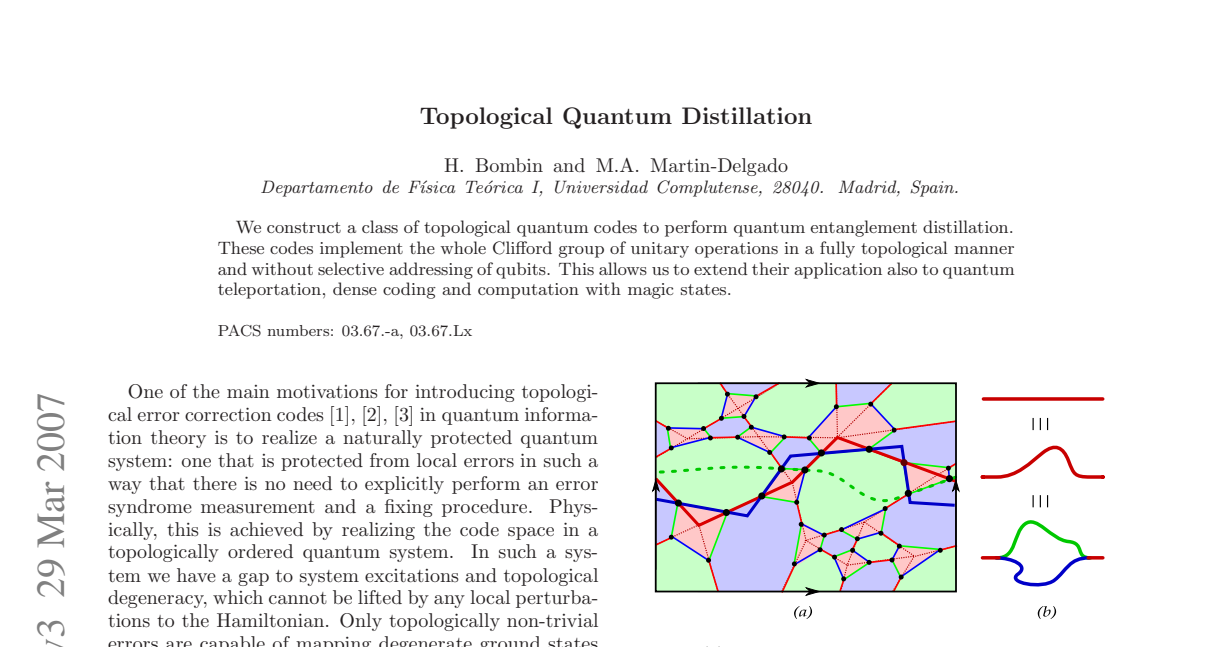
The caption states that the dotted green line results from the product of the red and blue strings, but the figure does not make the cancellation at the crossing points visible. Marking the crossing would help the reader connect the figure to Eq. (5).
What would settle it
Explicitly construct the 4.8.8 triangular color code family for the first three sizes (e.g. N = 7, 19, 37 qubits) and compute the code distance by exhaustive search over logical operators, or verify the string argument that a logical operator must connect all three colored borders. If the distance grows with N as expected (d ~ sqrt(N)), the concern is resolved and the Clifford claim stands. If the family does not exist at arbitrary size, or if the distance saturates, the phase gate is unavailable and the Clifford claim weakens to {H, CNOT}.
from the skeptic's reading
How the review went
4 readings by deepseek-v4.1-flash · 13 Nov 2026
- Reader holds up, with conditions
- Skeptic agrees
- Editor wrote the verdict above
- Referee major revision: 4 major objections, 8 minor
Not run on this paper: the simulated authors' defence.
Pith did not check this review's objections against the paper.
The review in full
The review in brief, machine-written
The thing to know: this is the paper that introduces color codes, and that construction is the durable contribution. The distillation framing in the title and abstract is mostly packaging. Read it for the code, not for a distillation protocol, because there isn't one in here — no yield, no fidelity, no error model. The body is honest about this; the abstract is not. [abstract:s0] promises distillation and the paper delivers the Clifford gate set that distillation would consume. That's a real gap between claim and content, but it's a titling problem more than a technical one, and the later magic-state literature makes the connection explicit anyway. I wouldn't hold it against the physics. What holds up on the page: the redundancy count from Eq. (2), the encoded-qubit count k = 4 - 2 chi in Eq. (3), the color-homology identity SR SG SB ~ 1 in Eq. (5), and the string commutation relations in Eq. (6). I checked these and they're fine. The triangular code with three colored borders is a genuinely nice idea, and getting the full Clifford group without addressing individual qubits or braiding anything is the point of the paper. Where it's soft, and the stress-test note is right about this: the phase gate only preserves the code space when every plaquette has v = 4m sites, and the existence of such a triangular family at arbitrary size, with distance growing, is discharged by pointing at Fig. 4(b) plus one sentence. The 4.8.8 tiling is the obvious candidate and I expect it works, but the paper doesn't name it or prove the distance scaling. The distance claim for triangular codes is also a single sentence. These are letter-format omissions rather than errors, and the algebra that is written down is correct, so the risk is low. Who should read it: anyone working on 2D topological codes or transversal gate sets. It's four pages and the construction is worth knowing cold. Send it out. The referee should ask for the lattice construction and the distance argument, and should ask the authors to either soften the abstract or add the distillation discussion. Neither request is fatal.
The strongest objection
The phase gate K is the only Clifford generator that requires a special lattice. The paper derives K̂ B^X_p K̂† = (-1)^{v/2} B^X_p B^Z_p for a plaquette with v sites, so K̂ preserves the code space only when every plaquette has v ≡ 0 mod 4. The paper then writes: 'this difficulty can be overcome by choosing a suitable lattice, as shown in Fig. 4' and 'triangular codes of any size can be constructed with the special property that any plaquette has v = 4m sites.' That is the load-bearing existence claim: a family of triangular color codes, at arbitrary size, with all plaquettes v ≡ 0 mod 4, and with distance growing without bound. The paper discharges it with a figure and a single sentence. If such a family does not exist beyond small examples, or if its distance does not grow, the phase gate is unavailable and the Clifford claim reduces to {H, CNOT}. The natural candidate is the 4.8.8 tiling (squares and octagons, both v ≡ 0 mod 4), which is standard in the later color-code literature, so the concern is likely to be resolved favorably. But the paper itself does not name the tiling, does not give the construction, and does not prove the distance scaling for that family. The distance claim for triangular codes is also a single sentence ('an operator in Z acting nontrivially on C must have a support connecting the red, green and blue borders'), which is plausible but not proved. The reader's identification of this premise is correct.
The reader correctly identifies the v = 4m lattice family as the load-bearing premise. The algebraic steps that can be checked on the page are correct: the redundancy count in Eq. (2), the encoded-qubit count k = 4 - 2χ in Eq. (3), the color-homology identity in Eq. (5), the commutation relations in Eq. (6), and the K-gate condition K̂ B^X_p K̂† = (-1)^{v/2} B^X_p B^Z_p all hold. The gap is that the existence of the family is asserted via Fig. 4(b) rather than constructed, and the distance claim is a single sentence. The 4.8.8 tiling likely resolves it, but the paper does not say so explicitly. The reader's verdict of CONDITIONAL is appropriate: the central claim is correct in outline, but the paper's stated support outruns what it shows. A secondary concern is the 'self-protection' claim in the introduction ('there is no need to explicitly perform an error syndrome measurement and a fixing procedure'), which is an overstatement for 2D codes at finite temperature; but this is a motivational claim, not the central technical claim, and does not change the verdict.
The referee's report
If the construction holds, this is a genuinely new and useful family of topological codes: unlike the toric code it is not organized by homology alone, and the color structure supplies a mechanism for implementing the full Clifford group by global, translation-invariant operations, with no selective addressing of qubits and no braiding of quasiparticles. That is a real conceptual advance over the braiding-based paradigm, and it is the kind of result that changes how one thinks about topological protection. The paper also has concrete virtues worth naming: the algebraic core is explicit and checkable (Eqs. 2, 3, 6, 7-8 are identities a reader can verify), there are no free parameters or fitted quantities, the Hamiltonian of Eq. (13) is exactly solvable and local, and the construction makes falsifiable structural predictions (the encoded-qubit count depends only on the surface, not the lattice). The later literature on color codes confirms the importance of the construction. The weaknesses are in what is asserted rather than derived, not in what is derived.
Pith's reading of the paper (a machine's summary, not the authors')
The paper sets out to show that a single topological code can carry out the whole Clifford group of quantum operations in a way that never singles out an individual qubit and never requires moving or braiding quasiparticles. The authors build a new class of stabilizer codes they call color codes, defined on two-dimensional lattices whose links meet three at a time and whose plaquettes can be colored red, green and blue, and they show that logical operators in these codes are string operators whose algebra is governed jointly by homology and by color. Cutting a spherical color code open at a single site produces a triangular code with one red, one green and one blue border that encodes exactly one qubit, and on suitably chosen triangular lattices the bitwise Hadamard, phase and pairwise controlled-not gates act as the corresponding logical gates. The payoff, if the construction holds, is that entanglement distillation, teleportation, superdense coding and Clifford-based computation with magic states could all be run on a self-protected topological substrate with no addressing hardware at all. The authors also write down the local Hamiltonian, a sum of plaquette terms, whose ground space is the code and whose excitations are gapped colored quasiparticles.
What carries the argument. The load-bearing device is the color code together with its string operators. Strings are products of a single Pauli matrix along a closed path in one of three shrunk lattices, one per color, and they commute with all plaquette generators. Two strings of the same color are equivalent exactly when their paths are homologous, and strings of different colors are tied together by the relation $S^R_σ S^G_σ S^B_σ ∼ 1$, which is what lets the authors trade homology for color. That relation also produces the 3-string operators $T^X$ and $T^Z$, built by joining one string of each color at a point; deforming $T$ shows that $T^X$ and $T^Z$ anticommute, which plain strings of a single color cannot do, and this supplies an operator basis for the single encoded qubit of a triangular code. The second piece of machinery is the exactly solvable Hamiltonian $H = -∑_p B^X_p - ∑_p B^Z_p$, whose ground space is the code and whose violated plaquette terms are the gapped colored excitations that give the self-protection the whole scheme is meant to exploit.
Core claim. The central claim is that certain triangular color codes admit a fully transversal implementation of the Clifford group. A color code is fixed by a two-dimensional lattice, embedded in a closed surface, in which three links meet at each site and plaquettes are 3-colored; each plaquette $p$ contributes two stabilizer generators, $B^X_p$ and $B^Z_p$, acting on the qubits on its border. Counting via the Euler characteristic gives $k = 4 - 2χ$ encoded qubits, so a sphere encodes none, and removing one site together with its three links and three plaquettes removes two generators, leaving a triangular code that encodes exactly one qubit. The authors then argue that the bitwise operators $Ĥ$ and $Λ̂(X)$ reproduce the local Hadamard and controlled-not at the logical level, citing $Ĥ^† X̂ Ĥ = Ẑ$ and $Ĥ^† Ẑ Ĥ = X̂$, and that the bitwise phase gate $K̂$ preserves the code space provided every plaquette has $v = 4m$ sites, since $K̂ B^X_p K̂^† = (-1)^{v/2} B^X_p B^Z_p$. With all three gates available transversally on a suitably chosen lattice, any Clifford operation can be performed fault tolerantly and without selective addressing, and the distance of such codes can be made arbitrarily large because a logical operator must connect all three colored borders.
The premise it rests on. The argument needs a family of triangular lattices, of arbitrary size and arbitrarily large distance, in which every plaquette has a number of sites divisible by four; the paper points to a figure for this rather than giving an explicit construction or a proof that the family exists at all sizes.
If the paper is right (Pith's inferences, not the authors')
Entanglement distillation protocols, which are built out of Clifford operations, could be run on a topological code without any selective addressing of qubits.
Quantum teleportation and superdense coding inherit the same fully topological implementation as corollaries of the Clifford construction.
Universal quantum computation becomes available once noisy magic states are distilled, since Clifford operations plus magic states are sufficient for universality.
The Hamiltonian $-∑_p B^X_p - ∑_p B^Z_p$ gives a self-protected system in which local errors create quasiparticles that decay, so no explicit syndrome measurement and correction cycle is needed.
Triangular codes with arbitrarily large distance would make the fault-tolerance claim scale with system size rather than being limited to small examples.
The color-labeling is presented as a visualization aid rather than a physical degree of freedom, which suggests the same code could be described purely homologically; whether the color relation $S^R_σ S^G_σ S^B_σ ∼ 1$ adds genuine computational power beyond the toric code, or only a convenient bookkeeping, is left open.
Because the phase gate works only when every plaquette has $v = 4m$ sites, the family of admissible lattices is a combinatorial constraint that could be studied independently of the physics; a census of such lattices at each size would settle the scaling question directly.
The claim that measuring every physical qubit in the $Z$ basis performs a destructive logical $Ẑ$ measurement, with classical outputs separated by at least $2t+1$, points toward a readout scheme that could be benchmarked against ordinary syndrome extraction on the same hardware.
The proposal deliberately avoids braiding, so it sits in contrast to anyonic-computation routes; a natural comparison is whether transversal Clifford gates plus magic-state distillation cost fewer physical qubits per logical gate than braiding-based alternatives.
Check this review
Pith stored no record of this review's passes and took no fingerprint of it. Reviews made by code from 13 Nov 2026 on carry both.
How often reviews like this one are right
Reviews like this one: written by deepseek-v4.1-flash, where what was read was not recorded.
How often objections from reviews like this one are right: not yet measured
Reviews by people
This review was written by a machine. No person has reviewed this paper on Pith yet. A scientist listed on Pith can review it for a fee, and their review is published here whatever it concludes.
The paper
Abstract
We construct a class of topological quantum codes to perform quantum entanglement distillation. These codes implement the whole Clifford group of unitary operations in a fully topological manner and without selective addressing of qubits. This allows us to extend their application also to quantum teleportation, dense coding and computation with magic states.
The paper's own sentences, arranged, kept beside the review and separate from it. Each label is drawn from a closed vocabulary; the number beside it is the probability the classifier gave that label. No sentence in this record was written by a model.
abstract compiled · 2026-09-23
The authors' main claim, as the classifier picked it out 0.41
“We construct a class of topological quantum codes to perform quantum entanglement distillation.”
How the main claim is stated: asserted 1.00
What the abstract itself states, as probabilities: claims first 0.05 · states limitation 0.06 · human participants 0.02 · controlled comparison 0.02 · randomized assignment 0.01 · states quantitative result 0.03 · compares with prior results 0.05 · mentions code or data availability 0.02
The abstract, sentence by sentence
This table labels the abstract only (arXiv listing abstract v3). The number is the probability the classifier gave the label.
| Sentence | Role | The authors' own work | States the main conclusion | Strength |
|---|---|---|---|---|
| We construct a class of topological quantum codes to perform quantum entanglement distillation. | contribution 1.00 | 0.94 | 0.43 | asserted 1.00 |
| These codes implement the whole Clifford group of unitary operations in a fully topological manner and without selective addressing of qubits. | contribution 0.49 | 0.85 | 0.27 | asserted 1.00 |
| This allows us to extend their application also to quantum teleportation, dense coding and computation with magic states. | interpretation 0.84 | 0.77 | 0.27 | asserted 0.93 |
What kind of paper the classifier reports this is: method or tool 0.96 · evidence from proof or derivation 0.95
What was examined, and what was not
Sources read
- arXiv listing abstract v3
Not examined
- full text
- figures and tables
- references and citing sentences
- relations to other papers
Levels run
- P abstract
Not run
- S sections
- T body sentences
- C citations
- R cross-paper relations
How the labels were made
Compiled by classifier-1.13.0 via TypeSafe API, question bank abstract-p1-20260923, 2026-09-23: 1 request, 2,854 input tokens.
Every quoted sentence on this record is the authors'. Every label is from Pith's closed vocabulary, with the probability shown beside it. This record as JSON
Figures (4)


Showing 3 of the paper's 4 figures. Figures are the authors', reproduced from the paper.
References (16)
- [4] Bennett et al. Phys. Rev. Lett. 76, 722-725 (1996) on Pith
- [5] Deutsch et al. Phys. Rev. Lett. 77, 2818-2821 (1996) on Pith
- [6] H. Bombin, M.A. Martin-Delgado Phys. Rev. A 72 , 032313 (2005) on Pith
- [12] A. Kitaev, J. Preskill, Phys. Rev. Lett. 96, 110404 (2006) on Pith
- [13] M. Levin,X.-G. Wen, Phys. Rev. Lett. 96, 110405 (2006) on Pith
- [1] A. Yu. Kitaev, Annals of Physics 303 no. 1, 2–30 (2003), quant-ph/9707021 on PithPith's reviewarXiv
- [2] Dennis et al . J. Math. Phys. 43, 4452-4505 (2002) on Pith
- [3] S. B. Bravyi, A. Yu. Kitaev, quant-ph/9811052 on PithPith's reviewarXiv
- [7] D. Gottesman, Phys. Rev. A 54, 1862 (1996) on Pith
- [8] A.R. Calderbank et al. Phys. Rev. Lett. 78,405 (1997) on Pith
- [9] X.-G. Wen. Quantum Field Theory of Many-body Sys- tems, Oxford University Press, (2004) on Pith
- [10] H. Bombin, M.A. Martin-Delgado, Phys. Rev. A 73, 062303 (2006) on Pith
- [11] A. Kitaev, cond-mat/0506438 on PithPith's reviewarXiv
- [14] S. Bravyi, A. Kitaev. Phys. Rev. A 71, 022316 (2005) on Pith
- [15] M. H. Freedman, A. Kitaev, M. J. Larsen, Z. Wang. Bull. Amer. Math. Soc. 40 31-38, (2003) on Pith
- [16] J. Preskill, Lecture notes on Topological Quantum Computation, http://www.theory.caltech.edu/preskill/ ph219/topological.ps on Pith
Cited by 25 Pith papers
Reviewed papers on Pith that cite this one. The full citation record
- Commuting-check gauging for fault-tolerant logical measurements quant-ph · Nov 2026
- Toric codes all the way down: decoupling translation-invariant topological CSS codes in higher dimensions quant-ph · Oct 2026
- A distillation-teleportation protocol for fault-tolerant QRAM quant-ph · May 2025
- Planar fault-tolerant circuits for non-Clifford gates on the 2D color code quant-ph · May 2025
- High-rate low-distance color codes quant-ph · Nov 2026
- Anyon Proliferation at Self-Triality: From a Lattice Model to Adjoint QCD$_3$ cond-mat.str-el · Nov 2026
- Meet-in-the-Middle Compilation of the $[\mathrm{CNOT}]$ Class with Fibonacci Anyons quant-ph · Oct 2026
- The Pangaea Architecture: Fault-Tolerant Heterogeneous Topological Codes via a Quantum Bus quant-ph · Aug 2026
- Average-Case Minimum-Weight Decoding of Two-Dimensional Color Codes cs.DS · Jun 2026
- Quantum computing by color-code lattice surgery quant-ph · Jul 2014
- A bridge to lower overhead quantum computation quant-ph · Sep 2012
- Fault-tolerant quantum computing with color codes quant-ph · Aug 2011
- A Family of Non-Abelian Kitaev Models on a Lattice: Topological Confinement and Condensation cond-mat.str-el · Dec 2007
- Towards Lattice Surgery Compilation for the Color Code Using Pipe Diagrams quant-ph · Jul 2026
- Machine-learning decoders for fusion-based quantum computing in real time quant-ph · Nov 2026
- Plaquette: A hardware-aware design platform for fault-tolerant quantum computers quant-ph · Jul 2026
- Genuine Multi-Entropy in the Toric Code hep-th · Jul 2026
- Quantum Error Correction Codes for Truncated SU(2) Lattice Gauge Theories quant-ph · Nov 2025
- Rigorous estimation of error thresholds of transversal Clifford logical circuits quant-ph · Oct 2025
- Learning to decode logical circuits quant-ph · Apr 2025
- General tensor network decoding of 2D Pauli codes quant-ph · Jan 2021
- A Hierarchy of Anyon Models Realised by Twists in Stacked Surface Codes quant-ph · Aug 2019
- Enhanced Compressive Threshold Quantum State Tomography for Qudit Systems quant-ph · Feb 2025
- Native Non-Clifford Gates in Quantum LDPC Codes: Conditions, Synthesis, and Scaling Limits quant-ph · Jan 2026
- Quantum entanglement quant-ph · Feb 2007
How later papers used it
276 later papers cite it
4 later papers by other authors are listed below: 1 used its method or tool and 3 compared their own results with it.
Uses its method or tool 1 of 6 papers with this label
-
Chose to work with the distance-3 topological 7-qubit color code.
Fault-tolerant protection of near-term trapped-ion topological qubits under realistic noise sources (2018) · 0.88 · paraphrased: the licence does not allow quoting
Compares with it 3 of 8 papers with this label
-
Compared the performance of the 49,1,9 concatenated Steane code to the 61,1,9 6.6.6 color code.
Concatenated Steane code with single-flag syndrome checks (2024) · 0.93 · paraphrased: the licence does not allow quoting
-
Compared its 7-qubit cyclic code to the Steane code, the smallest instance of a two-dimensional color code, using a biased Pauli error model.
Tailored codes for small quantum memories (2017) · 0.91 · paraphrased: the licence does not allow quoting
-
Compared the Floquet code to its associated subsystem code introduced by Bombin in this paper, and to other topological subsystem codes.
XYZ ruby code: Making a case for a three-colored graphical calculus for quantum error correction in spacetime (2024) · 0.82 · paraphrased: the licence does not allow quoting
How the literature uses it
37 arXiv papers cite this in 52 sentences
Papers citing it · 20 sentences without a confident label
Compares with it 3 papers
-
For example, in the case of the 7-qubit color-code state studied in Ref. [ref] , only 15 settings are needed for a faithful reconstruction of the $|0⟩$ and $|1⟩$ states, compared to the 57 required by tQST [ref] and the 127 used in Ref. [ref] .
Enhanced Compressive Threshold Quantum State Tomography for Qudit Systems · Discussion and conclusions · 0.93
-
We then compare the toric code with the color code [ref] on a honeycomb lattice.
Genuine Multi-Entropy in the Toric Code · GM for the Stabilizer Ground-State · 0.97
-
Note that this performance with biased noise is not shared by all topological codes; in stark contrast, the triangular 6.6.6 color code [ref] exhibits a decrease in threshold with bias; see Appendix [ref].
Tailoring surface codes for highly biased noise · Introduction · 0.97
Cites it as background 24 papers
-
The most well-known topological stabilizer codes are the toric or surface code [ref] , and the color code [ref] .
Low-overhead non-Clifford fault-tolerant circuits for all non-chiral abelian topological phases · Introduction · 0.97
-
The color code [ref] provides an alternative to the toric code that may make fault-tolerant computation on encoded qubits easier.
Efficient color code decoders in $d\geq 2$ dimensions from toric code decoders · Introduction · 0.84
-
Steane's $7,1,3$ quantum code [ref] is a color code [ref] on seven qubits; see f:steanecolor.
Fault-tolerant quantum error correction for Steane's seven-qubit color code with few or no extra qubits · Introduction · 1.00
Challenges and discussion
Disagree with the review, or know something it missed? Leave a comment, or challenge this review formally: a challenge becomes a permanent entry in this paper's record, and its decision is published here.
Come back by email
A short list of the week's newly reviewed papers. Nothing is sent until you confirm from your inbox, and every email has a link that stops it. No account.
No comments yet.
Sign in to comment