Quantum Physics · arXiv:2502.10031 v1 · submitted 14 Feb 2025 · 41 references
Enhanced Compressive Threshold Quantum State Tomography for Qudit Systems
The paper says
“We propose an efficient quantum state tomography method inspired by compressed sensing and threshold quantum state tomography that can drastically reduce the number of measurement settings to reconstruct the density matrix of an N-qudit system.”
more of the abstract
We validate our algorithm with simulations on IBMQ and demonstrate the efficient and accurate reconstruction of N ≤ 7 qubit systems, reproducing GHZ, W, and random states with O(1), O(N2), and O(N) settings.
from the abstract
Pith says
Machine review · deepseek-v4-flash · 7 Aug 2026 · what was read was not recorded · not checked by a person
It can be wrong. Challenge this review or reply to it.
Holds up, with conditions. Practical settings-reducing tomography heuristic with real utility, but the O(N) random-state scaling is an empirical guess from four points and the noiseless threshold uses oracle information. This line is wrong
4 major objections · 6 minor
How often objections from reviews like this one are right: not yet measured
Not checked: figures, code, what the 41 references say.
The paper says, at Sec. III.A and Table I
The review did not quote this passage.
Pith says: Objection 1 of 4 · major
The abstract's O(N) scaling for random states is not supported by the presented evidence. The IBMQ random-circuit data consist of only four values of |S'_t|, namely 13(5), 25(5), 35(7), and 40(14) for N = 4, 5, 6, 7, and the noiseless random-circuit results are reported only for N = 7; these data are also consistent with O(N log N) or O(N^2) with a small constant, and no scaling fit, asymptotic analysis, or larger-N test is given.
more of objection 1
Moreover, the number of candidate off-diagonal pairs grows like k^2, where k is the number of above-threshold diagonal elements (up to about 4.6e3 for the k=96 N=7 circuits), so the greedy pruning must compress an exponentially growing candidate set to O(N) settings; without a restricted-isometry, rank, or constructive argument, this compression is not established. This is the main load-bearing claim of the paper, so it should be either proven or substantially demoted in the abstract and conclusions.
The paper says, at Sec. III.A and Appendix C.1
The review did not quote this passage.
Pith says: Objection 2 of 4 · major
The noiseless threshold is set to the smallest non-zero diagonal element of the exact target density matrix, as stated at the beginning of Sec. III.A. This is target-dependent information that is not available in a real tomography experiment, and it directly controls how many matrix elements are selected and therefore the reported setting counts (for example, ell_N = 5, 7, 5, 10 for W states and ell_7 = 15(7) for random states).
more of objection 2
The same ideal-circuit information enters the IBMQ threshold calibration of Appendix C.1, where the zero/non-zero pattern of the diagonal is taken from the noiseless unitary simulation of the circuit. The data-driven Gini threshold of Appendix C.2 is not used in any of the scaling claims, so the practical performance of ECT-QST on unknown states remains untested.
The paper says, at Sec. II.C
The review did not quote this passage.
Pith says: Objection 3 of 4 · major
The pruning criterion is heuristic and no recovery guarantee is provided. Stopping when sum_{s in S'_t} C_{sm} >= beta_m for all m guarantees only that each selected matrix element has accumulated overlap at least as large as the best single setting; beta_m is a quantity derived from the chosen settings, not an information-theoretic or reconstruction error bound, so there is no proof that the subset produced by the greedy rule suffices for the low-rank maximum-likelihood reconstruction of Sec.
more of objection 3
II.E. The claim that the procedure yields a set close to or equal to the smallest one is likewise unsupported, since the rule makes a local choice (fewest zeros) with no optimality argument.
The paper says, at Sec. II.E, Eq. (10)
The review did not quote this passage.
Pith says: Objection 4 of 4 · major
The likelihood function is ambiguous as written because N_n^{(s)} denotes both the expected value <phi_n^{(s)}|rho|phi_n^{(s)}> and the measured counts, and the expression (N_n^{(s)} - N_n^{(s)}/(2 sqrt(N_n^{(s)})))^2 is not a standard chi-squared objective unless the two occurrences are distinct quantities. Since this objective is the reconstruction step on which all fidelity results depend, the authors should restate it with distinct symbols for measured counts and model probabilities and specify the minimization procedure used, including initialization, constraints, and convergence criterion.
6 minor objections
The paper says, at Abstract
Pith says: minor objection 1 of 6
The phrase 'simulations on IBMQ' is imprecise; the IBMQ results in Sec. III.B are presented as runs on the superconducting platform, while the IBMQ simulator is used for threshold calibration in Appendix C.1. Please rephrase.
The paper says, at Introduction
Pith says: minor objection 2 of 6
The word 'supercondcting' in the introduction should be 'superconducting'.
show 4 more
The paper says, at Sec. II.A, Eq. (3)
Pith says: minor objection 3 of 6
The expression for sigma(8) contains a double equals sign ('==' ); remove one of the equals signs.
The paper says, at Sec. II.D and Fig. 1 caption
Pith says: minor objection 4 of 6
The weight is defined as w_s = sum_m C_{sm} r_m, but the Fig. 1 caption refers to 'weights w_m(s)'; the notation should be made consistent.
The paper says, at Sec. II.E and Introduction
Pith says: minor objection 5 of 6
The statement that the approach works without any assumption on the state is too strong, since the reconstruction uses a low-rank model rho = M M^dagger with r initially fixed to N and later adjusted by the inverse-purity check; this should be acknowledged as an assumption or a validated heuristic.
The paper says, at Table I and Appendix D
Pith says: minor objection 6 of 6
Please specify the number of random circuits per N over which the averages and standard uncertainties are computed, and whether the circuits used in the noiseless and IBMQ studies are the same.
What would settle it
Run ECT-QST on 20 depth-3 random circuits each for N=8, 9, and 10, using the same noise-aware threshold protocol as Appendix C.1 and the same stopping rule as Table I. Record |S'_t| and the ℓ* setting count at F=95%. Fit the combined N=4..10 data to a power law a N^b; if b significantly exceeds 1 (e.g., b>1.3) or the counts grow roughly as 2^N, the O(N) claim is refuted. If b is close to 1 with sensible residuals, the scaling concern is resolved and the conditional verdict can be lifted.
from the skeptic's reading
How the review went
4 readings by deepseek-v4-flash · 7 Aug 2026
- Reader holds up, with conditions
- Skeptic partly agrees
- Editor wrote the verdict above
- Referee major revision: 4 major objections, 6 minor
Not run on this paper: the simulated authors' defence.
Pith did not check this review's objections against the paper.
The review in full
The review in brief, machine-written
Short version: this is a solid, implementable tomography method for settings-limited platforms, and the authors are honest about much of its heuristic nature. The abstract's O(N) scaling for random states, though, is a claim the data don't yet support.
What's genuinely new: they take tQST's threshold idea, map it onto SU(d) generator settings (one setting for real, one for imaginary parts), prune redundant settings with a greedy overlap rule, and sort settings by weight. That combination is new, and it targets exactly the cost that matters on multiplexing platforms: the number of settings. The qudit formulation is a real generalization, not a cosmetic change. The worked examples and the corrected W-state circuit in Appendix B show care. The Python implementation is available, and the algorithm is described well enough that a third party can reproduce it.
The results: for GHZ and W states the settings counts are plausible and match intuition. The reductions versus fQST (10-100x) and versus tQST (1-20x) on the tested states are believable. The IBMQ numbers are from a noisy simulator, not hardware; the text should say that more prominently, but it is not a dealbreaker.
Soft spots, in rough order of seriousness. First, the noiseless threshold in Sec. III.A is set to the smallest nonzero diagonal element of the exact target state. That is oracle information. The reported settings counts for noiseless states are therefore demonstrations of what the algorithm can do given the answer, not what it will do on an unknown state. The Gini-index and simulator-based thresholds in Appendix C partially address this, but the noiseless scaling claims rest on the oracle choice.
Second, the O(N) scaling for random states. Four data points (13, 25, 35, 40 settings for N=4..7) are consistent with O(N log N) or O(N2) with a small constant. Since the candidate-pair count grows like k2, where k is the number of nonzero diagonal entries, the greedy pruning would need an argument for why it compresses an exponentially large set to O(N). None is given. This is a heuristic extrapolation, and the abstract states it as a demonstrated result. It should be softened or backed with more sizes and a scaling argument.
Third, the pruning stopping rule—stop when accumulated overlap reaches the max single-setting beta_m—has no sufficiency proof. Plausible, and the simulations support it, but a referee should probe for failure modes.
Fourth, the fixed rank r=N ansatz is a strong assumption. They check purity afterwards and increase r, but there is no guarantee for mixed states.
None of this sinks the paper. The method works on the states tested, and the paper is honest about being heuristic in places. The issue is that the abstract overstates what is established. A good referee will ask for the scaling to be reined in, the oracle threshold to be clearly separated, and more discussion of the rank limitation.
Who benefits: experimentalists on multiplexing platforms who care about settings overhead and want a ready-to-run heuristic. A theorist looking for guaranteed recovery will not find it here.
Recommendation: send it to review. The algorithm is useful, reproducible, and the flaws are correctable. I would accept with major revision, mainly to soften the O(N) claim and separate the oracle-threshold experiments.
The strongest objection
The abstract's central claim that ECT-QST reconstructs random depth-3 circuit states with O(N) settings is the paper's main evidence of broad applicability, but the support is thin. Noiseless random states are reported only for N=7, and the IBMQ results in Table I give |S'_t| = 13(5), 25(5), 35(7), 40(14) for N=4,5,6,7. Four points cannot establish an asymptotic scaling; these values are also consistent with O(N log N) or O(N^2) with a small constant (settings grow ~3x while N grows ~1.75x). More importantly, the algorithm first selects matrix elements with r_ij >= t, and for the tested circuits the number k of non-zero diagonal entries roughly doubles with each added qubit (max 16, 32, 64, 96 for N=4..7), so the number of candidate off-diagonal pairs E ~ k^2 grows exponentially (up to ~4600 for k=96). The greedy pruning would have to compress an exponentially large candidate set to O(N) settings, yet no argument (restricted-isometry, rank condition, or explicit construction) is given for why such compression is possible or reliable. The color-code example in the conclusion is a single instance, not a scaling. Thus the O(N) random-state scaling is a heuristic extrapolation from small systems, not a demonstrated result, and it is the load-bearing part of the paper's claim to handle generic states beyond GHZ/W.
I read the paper in good faith: the method is clearly described, the Python implementation is promised, and the simulations for GHZ and W states are consistent with simple counting arguments (GHZ has one off-diagonal pair; W has N(N-1)/2 off-diagonal pairs, so O(N^2) settings is natural). The IBMQ results are honestly labeled as simulations, and the threshold issue in the noiseless case is not fatal because the diagonal is measured first and the target-state diagonal equals the measured diagonal in an ideal experiment. The reader's weakest_assumption focused on pruning sufficiency and the noiseless threshold; those are legitimate theoretical gaps, but they are not falsified by the data and could be repaired with additional analysis. The concern I find most load-bearing is the O(N) scaling for random states, which is a positive quantitative claim in the abstract and conclusion. It is supported by only four N values for the IBMQ case and one N value in the noiseless case, with no scaling fit and no theoretical justification. The exponential growth of the candidate pair count makes the linear claim surprising and in need of direct verification. My proposed test (larger N, proper scaling fit) would settle it. The reader also notes the empirical nature of the scaling, so we partially agree, but the reader's primary weakest_assumption is the pruning threshold. Since my concern does not change the overall conditional verdict, I recommend UNCHANGED: the paper should be published only after the random-state scaling is either demonstrated on more qubits or the claim is softened.
The referee's report
Setting-count reduction is practically relevant for multiplexed measurement platforms, and the GHZ and W results are clear: GHZ needs only about three settings and W needs O(N^2) settings, with high fidelities in the tested range. The paper is also transparent in providing a public implementation and compares ECT-QST with fQST and tQST on the same IBMQ circuits. However, the broad O(N) scaling claim for random/depth-3 circuit states is the load-bearing part of the paper, and it is currently an extrapolation from four data points and a single N=7 noiseless ensemble, with no proof that the greedy pruning can compress the exponentially growing candidate-pair set. If the O(N) scaling were established with a data-driven threshold and a recovery guarantee, the method would be a useful contribution; as it stands, the significance is conditional on that missing support.
Pith's reading of the paper (a machine's summary, not the authors')
The paper aims to show that quantum state tomography can be made dramatically cheaper in the number of measurement settings by combining threshold-based element selection with a greedy pruning step. The proposed method, ECT-QST, first measures only the diagonal of the density matrix, keeps the matrix elements above a threshold, and then finds a small set of tensor-product measurements that still cover all retained elements. The central claim is that this reduces the settings needed to reconstruct N-qubit states to O(1) for GHZ states, O($N^{2}$) for W states, and O(N) for the tested random circuit states, compared with the exponentially many settings required by full tomography. If correct, this would make the verification of larger quantum states practical on multiplexing platforms, where the cost of an experiment is dominated by the number of distinct measurement settings rather than by the number of individual projective outcomes.
What carries the argument. The load-bearing mechanism is the overlap matrix C_sm, defined as C_sm = sum_n |A^s_mn|^2, where A^s_mn = <phi^(s)_n | O_m | phi^(s)_n> is the overlap between the n-th basis vector of measurement setting s and the observable O_m for the real or imaginary part of a density-matrix element. The pruning step compares the summed overlap over retained settings with beta_m = max_s C_sm, keeping settings until the accumulated sum reaches beta_m for every selected element. This criterion is what allows the algorithm to compress the naive one-setting-per-matrix-element construction down to the small setting counts claimed for GHZ, W, and random states.
Core claim. ECT-QST is a settings-reduction protocol for quantum state tomography. It starts by measuring the diagonal of the density matrix, uses a threshold t to select entries (i,j) for which r_ij = $\sqrt$(rho_ii rho_jj) >= t, and constructs one measurement setting for the real part and one for the imaginary part of each selected entry, each setting being a tensor product of single-qudit SU(d) generators. The overlap tensor A^s_mn and the per-setting overlap C_sm = sum_n |A^s_mn|^2 quantify how much information setting s carries about matrix element m, and a greedy pruning step removes settings until the accumulated overlap sum over the retained set reaches, for every selected element m, the maximum overlap beta_m achieved by any single setting. The retained settings are weighted and sorted, and a low-rank maximum-likelihood reconstruction with rho = M M^dagger recovers the state. The authors report that qubit GHZ states need only three settings, W states need N(N-1) settings, and 7-qubit random circuit states need about 15 settings in the noiseless case, with a 10- to 100-fold reduction in settings versus full tomography and fidelity comparable to or better than threshold QST on IBMQ hardware.
The premise it rests on. The method assumes that the greedy pruning criterion — keeping settings until the accumulated overlap for every selected density-matrix element reaches the maximum overlap achievable by a single setting — leaves enough information for the low-rank maximum-likelihood reconstruction to succeed, an assumption stated without proof or error bound; in the noiseless simulations the threshold is also set using the exact diagonal of the target state, which a real experiment would not know.
If the paper is right (Pith's inferences, not the authors')
For GHZ-type states the number of settings becomes independent of N: qubit GHZ states need only three settings, and a d-qudit GHZ state needs O(d^2) settings.
For W states the setting count is O(N^2), but on noisy hardware ECT-QST shows greater resilience than tQST because each setting supplies a full projective basis, giving the maximum-likelihood fit more information per setting.
For the tested random circuit states, sorting settings by weight makes fidelity converge rapidly, so a stopping rule based on consecutive-fidelity saturation reaches near-linear setting counts without requiring basis changes between measurements.
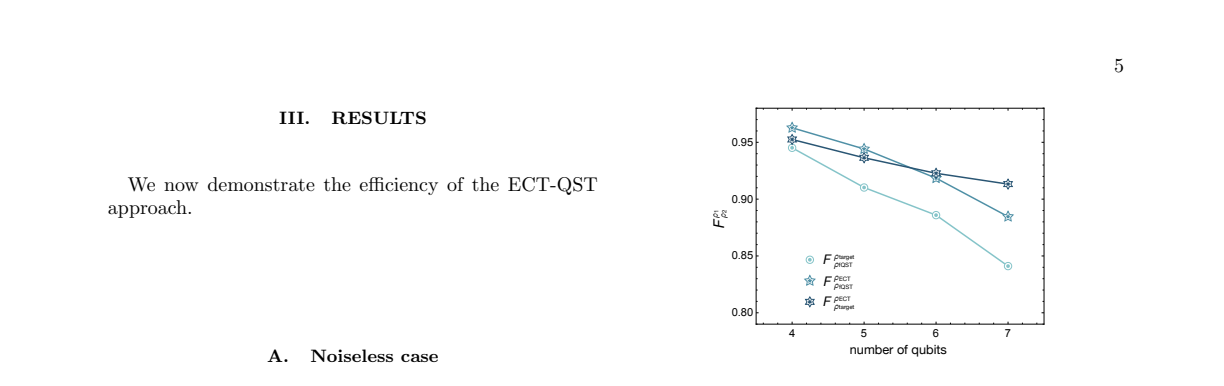
The method cuts the number of settings by a factor of 10 to 100 relative to full QST and by 1 to 20 relative to tQST on the IBMQ random states tested, while matching or slightly exceeding tQST fidelity.
The construction is defined for any qudit dimension through SU(d) generators, so the same threshold, prune, sort, and low-rank maximum-likelihood pipeline extends to qutrits and higher dimensions in principle, although the demonstrations are for qubits only.
The noiseless scaling numbers rely on an oracle threshold: setting t from the exact target-state diagonal is information a real experiment lacks, and the paper's own Gini-index alternative can roughly double the setting count, so the O(N) figures should be read as optimistic lower bounds until the threshold is chosen from measured data alone.
The greedy pruning criterion carries no formal recovery guarantee; a natural next step is to test whether the retained settings satisfy a compressed-sensing-style incoherence or restricted-isometry condition, and whether the overlap-sum stopping rule is necessary or merely sufficient for the examples shown.
The setting-count advantage is platform-specific: since ECT-QST reads out a complete projective basis of d^N outcomes per setting, it is most favorable on multiplexing architectures where cost scales with settings, while on platforms where each projective measurement is individually priced the total shot count can exceed tQST by O(d^N), as the paper's comparison tables show.
A testable extension would be to run ECT-QST on qutrit or higher-dimensional qudit states on a real device; the paper defines the SU(d) construction and gives a two-qutrit example, but only qubit systems are demonstrated, leaving the claimed O(d^2) GHZ scaling for d>2 experimentally unverified.
Check this review
Pith stored no record of this review's passes and took no fingerprint of it. Reviews made by code from 13 Nov 2026 on carry both.
How often reviews like this one are right
Reviews like this one: written by deepseek-v4-flash, where what was read was not recorded.
How often objections from reviews like this one are right: not yet measured
Reviews by people
This review was written by a machine. No person has reviewed this paper on Pith yet. A scientist listed on Pith can review it for a fee, and their review is published here whatever it concludes.
The paper
Abstract
We propose an efficient quantum state tomography method inspired by compressed sensing and threshold quantum state tomography that can drastically reduce the number of measurement settings to reconstruct the density matrix of an N-qudit system. We validate our algorithm with simulations on IBMQ and demonstrate the efficient and accurate reconstruction of N ≤ 7 qubit systems, reproducing GHZ, W, and random states with O(1), O(N2), and O(N) settings.
The paper's own sentences, arranged, kept beside the review and separate from it. Each label is drawn from a closed vocabulary; the number beside it is the probability the classifier gave that label. No sentence in this record was written by a model.
abstract compiled · 2026-09-23
The authors' main claim, as the classifier picked it out 0.68
“We validate our algorithm with simulations on IBMQ and demonstrate the efficient and accurate reconstruction of $N\leq7$ qubit systems, reproducing GHZ, $W$, and random states with $O(1)$, $O(N^2)$, and $O(N)$ settings.”
How the main claim is stated: asserted 1.00
What the abstract itself states, as probabilities: claims first 0.05 · states limitation 0.19 · human participants 0.02 · controlled comparison 0.07 · randomized assignment 0.01 · states quantitative result 0.93 · compares with prior results 0.19 · mentions code or data availability 0.03
The abstract, sentence by sentence
This table labels the abstract only (arXiv listing abstract v1). The number is the probability the classifier gave the label.
| Sentence | Role | The authors' own work | States the main conclusion | Strength |
|---|---|---|---|---|
| We propose an efficient quantum state tomography method inspired by compressed sensing and threshold quantum state tomography that can drastically reduce the number of measurement settings to reconstruct the density matrix of an $N$-qudit system. | contribution 0.95 | 0.74 | 0.44 | asserted 0.85 |
| We validate our algorithm with simulations on IBMQ and demonstrate the efficient and accurate reconstruction of $N\leq7$ qubit systems, reproducing GHZ, $W$, and random states with $O(1)$, $O(N^2)$, and $O(N)$ settings. | result 0.90 | 0.95 | 0.38 | asserted 1.00 |
What kind of paper the classifier reports this is: method or tool 1.00 · evidence from simulation or computation 1.00
What was examined, and what was not
Sources read
- arXiv listing abstract v1
Not examined
- full text
- figures and tables
- references and citing sentences
- relations to other papers
Levels run
- P abstract
Not run
- S sections
- T body sentences
- C citations
- R cross-paper relations
How the labels were made
Compiled by classifier-1.13.0 via TypeSafe API, question bank abstract-p1-20260923, 2026-09-23: 1 request, 2,410 input tokens.
Every quoted sentence on this record is the authors'. Every label is from Pith's closed vocabulary, with the probability shown beside it. This record as JSON
Figures (6)

Showing 2 of the paper's 6 figures. Figures are the authors', reproduced from the paper.
References (41)
- [1] On the one hand, as for N ≤ 7, the ∣0⟩⊗N com- ponent remains below threshold, ECT-QST recon- structs a density matrix closer to the target state 9 (where N⊗⟨0∣ ρex∣0⟩⊗N = 0) than the fQST one (where N⊗⟨0∣ ρFT∣0⟩⊗N ≠ 0, with a sizeable ground state population for large N ) on Pith
- [2] On the other hand, the fidelity with respect to the exact density matrix ρex degrades as N increases, due to the shift in population toward the ground state. Appendix C: Choice of threshold. The selection of an appropriate threshold value is de- pendent on the specific physica... on Pith
- [3] IBMQ platform For the reader’s convenience we reproduce here the algorithm identified in [31] for selecting an appropriate circuit-specific threshold on the IBMQ platform. Using the IBMQ simulator available in the qiskit package, one first simulates the unitary evolution of a ... on Pith
- [4] Gini index In the absence of a method to estimate the optimal value of the threshold t for a given measurement of the density matrix’s diagonal elements, analyzing the spar- sity of the latter can provide useful guidance. In [37], var- ious measures of sparsity are examined; a... on Pith
- [5] A. Klimov, C. Mu˜ noz, A. Fern´ andez, and C. Saavedra, Optimal quantum-state reconstruction for cold trapped ions, Physical Review A—Atomic, Molecular, and Opti- 11 fQST tQST ECT-QST N {ρii}≠ 0 F ρfQST ρtarget ∣S∣ M F ρtQST ρfQST F ρtQST ρtarget ∣S′ t∣ M F ρECT ρfQST F ρECT ρ... on Pith
- [6] V. D’Ambrosio, F. Cardano, E. Karimi, E. Nagali, E. Santamato, L. Marrucci, and F. Sciarrino, Test of mu- tually unbiased bases for six-dimensional photonic quan- tum systems, Scientific reports 3, 2726 (2013) on Pith
- [7] D. Giovannini, J. Romero, J. Leach, A. Dudley, A. Forbes, and M. J. Padgett, Characterization of high-dimensional entangled systems via mutually unbi- ased measurements, Physical review letters 110, 143601 (2013) on Pith
- [8] A. Klimov, G. Bj¨ ork, and L. S´ anchez-Soto, Opti- mal quantum tomography of permutationally invariant qubits, Physical Review A—Atomic, Molecular, and Op- tical Physics 87, 012109 (2013) on Pith
- [9] N. Rohling and G. Burkard, Tomography scheme for two spin-1 2 qubits in a double quantum dot, Physical Review B—Condensed Matter and Materials Physics 88, 085402 (2013) on Pith
- [10] H. Yuan, Z.-W. Zhou, and G.-C. Guo, Quantum state to- mography via mutually unbiased measurements in driven cavity qed systems, New Journal of Physics 18, 043013 (2016) on Pith
- [11] H. Yuan, X. Shi, and L.-F. Han, Qutrit state tomogra- phy via optimal unambiguous state discrimination and mutually unbiased measurements, Results in Physics 34, 105228 (2022) on Pith
- [12] Y. Wang and W. Cui, Classical shadow tomography with mutually unbiased bases, Physical Review A109, 062406 (2024) on Pith
- [13] I. Ivonovic, Geometrical description of quantal state de- termination, Journal of Physics A: Mathematical and General 14, 3241 (1981) on Pith
- [14] W. K. Wootters and B. D. Fields, Optimal state- determination by mutually unbiased measurements, An- nals of Physics 191, 363 (1989) on Pith
- [15] J. Lawrence, ˇC. Brukner, and A. Zeilinger, Mutually un- biased binary observable sets on n qubits, Physical Re- view A 65, 032320 (2002) on Pith
- [16] R. Adamson and A. M. Steinberg, Improving quantum state estimation with mutually unbiased bases, Physical review letters 105, 030406 (2010) on Pith
- [17] D. F. V. James, P. G. Kwiat, W. J. Munro, and A. G. White, Measurement of qubits, Phys. Rev. A 64, 052312 (2001) on Pith
- [18] J. M. Renes, R. Blume-Kohout, A. J. Scott, and C. M. Caves, Symmetric informationally complete quantum measurements, Journal of Mathematical Physics45, 2171 (2004) on Pith
- [19] H. Zhu, Quantum state estimation with informationally overcomplete measurements, Phys. Rev. A 90, 012115 (2014) on Pith
- [20] N. Bent, H. Qassim, A. A. Tahir, D. Sych, G. Leuchs, L. L. S´ anchez-Soto, E. Karimi, and R. W. Boyd, Ex- perimental realization of quantum tomography of pho- tonic qudits via symmetric informationally complete pos- itive operator-valued measures, Phys. Rev. X 5, 041006 (2015) on Pith
show 21 more
- [21] H.-H. Lu, K. V. Myilswamy, R. S. Bennink, S. Seshadri, M. S. Alshaykh, J. Liu, T. J. Kippenberg, D. E. Leaird, A. M. Weiner, and J. M. Lukens, Bayesian tomography of high-dimensional on-chip biphoton frequency combs with randomized measurements, Nature Communications 13, 4338 (2022) on Pith
- [22] R. T. Thew, K. Nemoto, A. G. White, and W. J. Munro, Qudit quantum-state tomography, Physical Review A 66, 012303 (2002) on Pith
- [23] H. H¨ affner, W. H¨ ansel, C. Roos, J. Benhelm, D. Chek- al Kar, M. Chwalla, T. K¨ orber, U. Rapol, M. Riebe, P. Schmidt, et al., Scalable multiparticle entanglement of trapped ions, Nature 438, 643 (2005) on Pith
- [24] M. Pont, G. Corrielli, A. Fyrillas, I. Agresti, G. Carvacho, N. Maring, P.-E. Emeriau, F. Ceccarelli, R. Albiero, P. H. Dias Ferreira, et al., High-fidelity four-photon ghz states on chip, npj Quantum Information 10, 50 (2024) on Pith
- [25] D. Gross, Y.-K. Liu, S. T. Flammia, S. Becker, and J. Eis- ert, Quantum state tomography via compressed sensing, Phys. Rev. Lett. 105, 150401 (2010) on Pith
- [26] D. Gross, Recovering low-rank matrices from few coef- ficients in any basis, IEEE Transactions on Information Theory 57, 1548 (2011) on Pith
- [27] S. T. Flammia, D. Gross, Y.-K. Liu, and J. Eisert, Quan- tum tomography via compressed sensing: error bounds, sample complexity and efficient estimators, New Journal of Physics 14, 095022 (2012) on Pith
- [28] W.-T. Liu, T. Zhang, J.-Y. Liu, P.-X. Chen, and J.-M. Yuan, Experimental quantum state tomography via com- pressed sampling, Physical review letters 108, 170403 (2012) on Pith
- [29] F. Tonolini, S. Chan, M. Agnew, A. Lindsay, and J. Leach, Reconstructing high-dimensional two-photon entangled states via compressive sensing, Scientific re- ports 4, 6542 (2014) on Pith
- [30] A. Steffens, C. Riofr ´ ıo, W. McCutcheon, I. Roth, B. A. Bell, A. McMillan, M. Tame, J. Rarity, and J. Eisert, Experimentally exploring compressed sensing quantum tomography, Quantum Science and Technology2, 025005 (2017) on Pith
- [31] D. Ahn, Y. Teo, H. Jeong, D. Koutn` y, J. ˇReh´ aˇ cek, Z. Hradil, G. Leuchs, and L. S´ anchez-Soto, Adaptive compressive tomography: A numerical study, Physical Review A 100, 012346 (2019) on Pith
- [32] D. Ahn, Y. S. Teo, H. Jeong, F. Bouchard, F. Hufnagel, E. Karimi, D. Koutn` y, J.ˇReh´ aˇ cek, Z. Hradil, G. Leuchs, et al., Adaptive compressive tomography with no a pri- ori information, Physical Review Letters 122, 100404 (2019) on Pith
- [33] R. Badveli, V. Jagadish, R. Srikanth, and F. Petruccione, Compressed-sensing tomography for qudits in hilbert spaces of non-power-of-two dimensions, Physical Review A 101, 062328 (2020) on Pith
- [34] D. Maragnano, D. Binosi, G. Garberoglio, C. Cusano, M. Dapor, and M. Liscidini, Threshold quantum state tomography, in 2023 23rd International Conference on Transparent Optical Networks (ICTON) (IEEE, 2023) pp. 1–4 on Pith
- [35] D. Binosi, G. Garberoglio, D. Maragnano, M. Dapor, and M. Liscidini, A tailor-made quantum state tomography approach, APL Quantum 1, 036112 (2024) on Pith
- [36] C. Gini, Sulla misura della concentrazione e della vari- abilit` a dei caratteri, Atti del Reale Istituto veneto di scienze, lettere ed arti 73, 1203 (1914) on Pith
- [37] https://github.com/gioGarbe/ECT-QST on Pith
- [38] D. Cruz, R. Fournier, F. Gremion, A. Jeannerot, K. Komagata, T. Tosic, J. Thiesbrummel, C. L. Chan, N. Macris, M.-A. Dupertuis, and C. Javerzac- Galy, Efficient quantum algorithms for ghz and w states, and implementation on the IBM quan- tum computer, Advanced Quantum Technolo... on Pithdoi:10.1002/qute.201900015
- [39] H. Bombin and M. A. Martin-Delgado, Topological quan- tum distillation, Phys. Rev. Lett. 97, 180501 (2006), arXiv:quant-ph/0605138 on PithPith's reviewarXiv
- [40] C. A. Riofrio, D. Gross, S. T. Flammia, T. Monz, D. Nigg, R. Blatt, and J. Eisert, Experimental quan- tum compressed sensing for a seven-qubit system, Nature communications 8, 15305 (2017) on Pith
- [41] N. Hurley and S. Rickard, Comparing measures of spar- sity, IEEE Transactions on Information Theory 55, 4723 (2009) on Pith
How the literature uses it
What this paper does with the arXiv papers it cites
What it cites
Compares with 1 paper
-
For example, in the case of the 7-qubit color-code state studied in Ref. [ref] , only 15 settings are needed for a faithful reconstruction of the $|0⟩$ and $|1⟩$ states, compared to the 57 required by tQST [ref] and the 127 used in Ref. [ref] .
Topological Quantum Distillation · Discussion and conclusions · 0.93
Challenges and discussion
Disagree with the review, or know something it missed? Leave a comment, or challenge this review formally: a challenge becomes a permanent entry in this paper's record, and its decision is published here.
Come back by email
A short list of the week's newly reviewed papers. Nothing is sent until you confirm from your inbox, and every email has a link that stops it. No account.
No comments yet.
Sign in to comment