REVIEW 3 major objections 8 minor 37 references
Four-party entanglement in toric code breaks free of topological entropy at replica n=4
Reviewed by Pith at T0; open to challenge. T0 means a machine referee read the full paper against a public rubric. the ladder, T0–T4 →
T0 review · glm-5.2
2026-07-08 18:02 UTC pith:P5FZDN7Z
load-bearing objection Solid computational results on genuine multi-entropy in the toric code; topological invariance claim for n=4 is the main soft spot. the 3 major comments →
Genuine Multi-Entropy in the Toric Code
The pith
A machine-rendered reading of the paper's core claim, the machinery that carries it, and where it could break.
Core claim
The paper identifies a replica-index threshold for stabilizer states: the q-partite genuine multi-entropy at replica index n<q collapses to a linear combination of entropies involving at most q−2 parties, while at n=q it becomes an independent topological invariant. For q=4 in the toric code, this means GM at n=2,3 is proportional to the tripartite information I₃ (and hence to the TEE), but at n=4 it carries information not reducible to I₃ while remaining a topological invariant — constant under partition deformations and lattice-size changes. The independence from I₃ is established by exhibiting two partitions with different GM/I₃ ratios.
What carries the argument
Genuine multi-entropy (GM) is a Rényy-n quantity built by subtracting all lower-partite multi-entropy contributions from the full q-partite multi-entropy, isolating entanglement irreducibly shared among all q parties. The replica index n controls the number of cyclic replicas in the contraction. For stabilizer states, GM can be evaluated exactly via a group-theoretic counting of non-local stabilizer elements. The toric code on a torus provides a four-dimensional ground-state manifold with a stabilizer basis, and the Kitaev–Preskill four-partition of the lattice edges into regions A, B, C, D is the geometric setup.
Load-bearing premise
The claim that the n=4 GM is a topological invariant rests on numerical evidence from very small lattices (L=2,3,4) and a heuristic argument that only finitely many stabilizer elements can contribute to genuine four-party entanglement. No analytic proof of invariance is provided, and it is not checked for partitions more complex than those considered.
What would settle it
If a larger lattice or a more intricate four-partition were found where the n=4 GM deviates from its small-lattice value, the topological-invariance claim would fail.
If this is right
- If the n=4 GM is a topological invariant distinct from I₃, it probes TQFT data beyond the total quantum dimension D — potentially TQFT partition functions on graph-encoded manifolds, as suggested by recent work connecting multipartite entanglement signals to TQFT.
- Computing the n=4 GM for the double semion theory (which shares D with the toric code but is a distinct TQFT) would test whether GM can distinguish topological phases that TEE cannot.
- The conjecture that n<q GM collapses to q−2-party data for all stabilizer states, if proven, would establish a structural constraint on multipartite entanglement in stabilizer codes with implications for quantum error correction.
- The failure of the collapse for non-stabilizer ground states means GM could serve as a diagnostic that distinguishes stabilizer states from generic states within the same topological phase.
Where Pith is reading between the lines
- The threshold at n=q suggests a connection between replica number and party number that may generalize: higher-party GM at sufficient replica depth could expose a hierarchy of topological invariants, with each level of genuine multipartite structure requiring n≥q replicas to unlock.
- If the n=4 GM computes a TQFT partition function on a specific graph-encoded manifold, then varying the partition geometry could in principle access different manifold topologies, turning GM into a systematic probe of TQFT data indexed by replica number and partition structure.
- The distinction between stabilizer and non-stabilizer behavior within the same ground-state manifold hints that GM could quantify how far a state is from the stabilizer locus, providing a notion of complexity or magic for topological ground states.
- The robustness of GM under Pauli-string excitations but sensitivity to coherent superpositions of excitations suggests that GM could classify excitation structures by their multipartite entanglement footprint, complementing anyon-based classifications.
Editorial analysis
A structured set of objections, weighed in public.
Referee Report
Summary. This paper studies the genuine multi-entropy (GM) for four-partite partitions of the toric code on a torus. The authors compute GM exactly for stabilizer ground states using the stabilizer-state framework of [16]. The central results are: (1) for replica index n=2 and n=3, the four-partite GM of stabilizer states reduces to the tripartite information I_3 (and hence to the topological entanglement entropy for the Kitaev-Preskill partition), confirming a conjecture from [20] for n=2; (2) at n=4, this reduction fails, as demonstrated by two explicit 3x3 lattice partitions with different GM/I_3 ratios (Eqs. 18-19); (3) the n=4 GM is argued to be a topological invariant (independent of lattice size L and robust under local deformations) based on numerical evidence for L=2,3,4 and a heuristic counting argument; (4) the n=2,3 reductions are special to stabilizer states and fail for generic non-stabilizer superpositions and coherent superpositions of local excitations. The color code (whose TQFT is two copies of the toric code) provides a consistency check, with both I_3 and n=4 GM doubling.
Significance. The paper addresses a well-motivated question: whether genuine multipartite entanglement measures capture TQFT data beyond the total quantum dimension D. The n=4 non-reduction result (Eqs. 18-19) is a clean, exact computational fact that establishes GM as a probe of genuinely four-partite structure not visible to I_3. The stabilizer-state computations are exact and verified on 10^5 random stabilizer states for the n=2,3 reductions. The color code consistency check is a nice falsifiable cross-check. The conjecture that n<q GM collapses to (q-2)-partite entropies for stabilizer states is interesting and clearly stated. The heuristic argument for topological invariance, while not a proof, is reasonable and the numerical evidence on small lattices is consistent.
major comments (3)
- The claim that the n=4 GM is a topological invariant (independent of L and robust under local deformations) is load-bearing for the paper's conclusion that GM probes universal TQFT data, but the evidence is limited. The numerical checks cover L=2,3,4 for the KP partition (all giving 3/16 log 2) and a few deformations on the 2x2 lattice (Fig. 4). The heuristic argument in Sec. II bounds the number of relevant stabilizer elements by O(1) using the quantity p from [27] (Eq. 14), but p counts a ratio of group orders, while GM is a specific linear combination of multi-entropies (Eq. 5) involving n^3 replica copies. The paper does not establish that the particular cancellations in the GM linear combination preserve the O(1) bound across all topologically equivalent partitions. The heuristic shows the answer should be O(1); it does not prove it is constant. This gap should be acknowledged more显
- Sec. II, paragraph on stabilizer group elements: the heuristic argument that only O(1) stabilizer elements associated with non-contractible cycles can contribute to genuine four-party entanglement is sound for the toric code, but the paper should clarify the logical status of this argument versus the numerical evidence. Specifically, the claim that 'any genuine multipartite measure of entanglement doesn't scale with L' (Sec. II) is stronger than what is proven: it is shown that p is O(1), but GM is not p. The relationship between p and GM for general n is not established. The paper should either weaken the claim to 'GM is expected not to scale with L based on the heuristic and confirmed numerically for small L' or provide a more direct argument connecting p to GM.
- The two partitions of the 3x3 lattice (Eqs. 18-19) demonstrate that GM_{n=4}/I_3 is not constant, which establishes non-reduction. However, the paper does not explore whether there exist other partitions of the 3x3 (or 4x4) lattice that yield yet different ratios. A more systematic scan of partitions on the 3x3 or 4x4 lattice would strengthen the claim that the n=4 GM is a genuine topological invariant (constant within a topological class) rather than partition-dependent. Currently, only one KP-type partition and one alternative partition are checked.
minor comments (8)
- Eq. (2): the notation GM_{n=2}^{(q=4)} is introduced before the general definition of GM in Eq. (5). Consider reordering or adding a forward reference.
- Sec. II, paragraph on stabilizer group elements: the phrase 'such a product element does not generate genuine multipartite entanglement, and is expected to cancel in the GM' could benefit from a more precise statement about which cancellations are exact (proven) versus heuristic.
- Fig. 4: the fourth panel shows GM=0 when B wraps a non-contractible cycle. It would help to briefly explain why GM vanishes in this case (e.g., the partition no longer has the KP disk topology).
- Sec. IV: the non-stabilizer analysis is restricted to the 2x2 lattice. A brief comment on whether the qualitative features (violation of GM=lambda_n I_3 away from stabilizer points) are expected to persist for larger L would help the reader.
- Sec. V, Eq. (50): the denominators vanish at nu=pi/4, theta=pi/2. The text mentions avoiding this singularity by taking nu slightly less than pi/4, but the origin of the singularity (apparent divergence of the normalization) could be stated more clearly. It would also help to note that Eq. (50) is derived for the (Z_1, Z_2) case only.
- The conjecture that for stabilizer states and q>=4, the q-partite GM at n<q collapses to a linear combination of multi-entropies involving at most q-2 parties is stated in the abstract and Sec. I but not discussed in detail beyond q=4. A brief comment on what evidence (if any) exists for q>4 would contextualize the conjecture.
- References [13] and [16] are cited as 2026 preprints. The authors should verify these are up to date and correctly attributed.
- Appendix C provides a useful explicit verification that the checkerboard partition is topologically equivalent to the KP disk partition. This could be referenced earlier in the main text (Sec. III.A) when the KP partition is first introduced.
Simulated Author's Rebuttal
We thank the referee for a careful and constructive report. The referee's three major comments all concern the same core issue: the gap between our heuristic argument for topological invariance of the n=4 GM (which proceeds via the quantity p from [27]) and the actual claim (which concerns GM, a specific linear combination of multi-entropies). We agree this gap is real and that the manuscript should be revised to clarify the logical status of the argument. We also agree that a more systematic scan of partitions would strengthen the paper and will add one. We address each comment below.
read point-by-point responses
-
Referee: The claim that the n=4 GM is a topological invariant is load-bearing but the evidence is limited. The heuristic shows the answer should be O(1); it does not prove it is constant. The relationship between p and GM for general n is not established. This gap should be acknowledged.
Authors: The referee is correct that the heuristic argument via p (Eq. 14) establishes an O(1) bound on the number of relevant stabilizer group elements, but does not by itself prove that the specific linear combination defining GM (Eq. 5) yields a constant independent of L and of partition details within a topological class. The quantity p counts a ratio of group orders, while GM is a particular linear combination of multi-entropies involving n^3 replica copies, and the relationship between p and GM for general n is not established in the current manuscript. We will revise the manuscript to explicitly acknowledge this gap. Specifically, we will: (1) restate the topological invariance claim as a conjecture supported by heuristic argument and numerical evidence, not as a proven result; (2) clarify that the O(1) bound on p is suggestive but not sufficient to establish constancy of GM; and (3) note that a direct argument connecting p to GM for general n is an open problem. The core computational results—the n=2,3 reductions (verified on 10^5 random stabilizer states) and the n=4 non-reduction (Eqs. 18-19)—are exact and independent of this conjecture. revision: yes
-
Referee: The claim that 'any genuine multipartite measure of entanglement doesn't scale with L' is stronger than what is proven: p is O(1), but GM is not p. The paper should either weaken the claim or provide a more direct argument connecting p to GM.
Authors: We agree with the referee that the statement 'any genuine multipartite measure of entanglement doesn't scale with L' is stronger than what the p-based argument establishes. The argument in [27] bounds p by O(1), and while it is natural to expect that GM (which is designed to isolate genuinely multipartite correlations) should also be O(1) for the same structural reasons—namely, that only O(1) stabilizer elements associated with non-contractible cycles can contribute to genuine four-party entanglement—this expectation is not a proof. We do not currently have a more direct argument connecting p to GM for general n. We will therefore weaken the claim in Sec. II to read that GM is expected not to scale with L based on the heuristic and confirmed numerically for small L, rather than asserting it as a general fact. We will also add a sentence clarifying that establishing a direct relationship between p and GM for general n remains an open problem. revision: yes
-
Referee: The paper does not explore whether other partitions of the 3x3 or 4x4 lattice yield yet different ratios. A more systematic scan of partitions would strengthen the claim that the n=4 GM is a genuine topological invariant (constant within a topological class) rather than partition-dependent. Currently only one KP-type partition and one alternative partition are checked.
Authors: This is a fair point. The two partitions in Eqs. 18-19 suffice to establish non-reduction (the ratio GM/I_3 is not constant), but they do not by themselves demonstrate that GM is constant within a topological class. We will add a more systematic scan of partitions on the 3x3 lattice. Specifically, we will enumerate all topologically distinct four-partitions (up to the symmetries of the lattice) that are in the same topological class as the Kitaev-Preskill partition—i.e., where no region wraps a non-contractible cycle—and verify that the n=4 GM takes the same value 3/16 log 2 for each. We will also check additional partitions in the topological class of the alternative partition (Fig. 6) to confirm that the value 7/16 log 2 is stable within that class. This will provide stronger evidence for topological invariance within each class, while preserving the non-reduction result across classes. We note that even with this additional scan, the topological invariance claim remains a conjecture supported by numerical evidence rather than a proof, as acknowledged in our response to the first comment. revision: yes
Circularity Check
No significant circularity: the central results are computed from first principles via explicit stabilizer-state evaluations, with one minor self-citation to a prior framework that is independently verifiable.
full rationale
The paper's two main claims are: (a) at n=4, GM does not reduce to I3, and (b) the n=4 GM is a topological invariant. Claim (a) is established by direct computation: two explicit 3×3 partitions yield different GM/I3 ratios (Eqs. 18-19: 3/16 vs 7/48 in units of log 2), which is a computational fact not forced by any input or definition. Claim (b) is supported by numerical evidence on L=2,3,4 lattices and a heuristic argument about O(1) stabilizer elements. The heuristic is incomplete (as the reader notes, it bounds a quantity p from [27] but does not prove the specific GM linear combination is partition-independent), but this is a correctness/completeness concern, not circularity. The framework of [16] (co-authored by one present author, Akella) provides the stabilizer-state evaluation method, but this is a computational tool whose outputs are independently checkable — it is not a self-citation that defines the result by construction. The n=2 reduction to I3 (Eq. 2) confirms a conjecture from [20] (different authors, Iizuka and Lin), providing external cross-validation. The color code check (Sec. III.B) serves as an independent consistency test. No step in the derivation chain reduces to its own inputs by definition, and no prediction is a renamed fit. The one self-citation to [16] is a methodological tool, not a load-bearing premise that would make the conclusion circular.
Axiom & Free-Parameter Ledger
free parameters (1)
- a (convention parameter of GM) =
1/3 (standard choice used throughout numerical results)
axioms (5)
- domain assumption The multi-entropy S^{(q)}_n for stabilizer states can be evaluated using the counting framework of [16], which relates the replica contraction to counting elements of the stabilizer group with specific support properties.
- standard math The n=2 GM reduction to bipartite entropies for stabilizer states follows from the Coxeter structure of the corresponding multi-invariant.
- standard math For the Kitaev-Preskill disk partition, the tripartite information I3 equals the negative of the topological entanglement entropy, I3 = -gamma = -log D.
- domain assumption The underlying TQFT of the 2D color code is equivalent to two copies of the toric code TQFT.
- domain assumption Only O(1) stabilizer elements can have non-trivial support on all four regions A,B,C,D while not being expressible as products of elements supported on at most three regions, and their number does not grow with system size L.
read the original abstract
We study genuine multi-entropy as a diagnostic of multipartite entanglement in the toric code, which provides a controlled setting for probing multipartite structures in topologically ordered states. Our main question is whether genuine multi-entropy captures information that is not reducible to conventional lower-party entropic data, such as topological entanglement entropy. We first analyze toric-code ground states that admit a stabilizer-state description, where the relevant quantities can be evaluated exactly. In this sector, genuine multi-entropy reflects the topological structure and symmetries of the toric code, while exhibiting highly constrained relations to lower-party multi-entropies. We conjecture that, for stabilizer states and ${q}\ge4$, the ${q}$-partite genuine multi-entropy at replica index $n<{q}$ collapses to a linear combination of multi-entropies involving at most ${q}-2$ parties. We establish this pattern explicitly for ${q}=4$ in the toric code stabilizer sector: for $n=2,3$, the genuine multi-entropy is proportional to the tripartite information $I_3$ and, for the Kitaev--Preskill partition, contains no independent genuine four-partite information beyond that captured by the topological entanglement entropy. At $n=4$, however, this reduction breaks down: the genuine multi-entropy is no longer proportional to $I_3$, but remains a topological invariant of the toric-code stabilizer ground states. For generic non-stabilizer superpositions within the ground-state manifold and for coherent superpositions of local excitations, the low-$n$ reduction also fails. These results show that genuine multi-entropy probes multipartite entanglement structure beyond the tripartite information, and hence beyond the topological entanglement entropy in the Kitaev--Preskill partition, whereas for stabilizer states at low replica index it reduces to lower-partite entropic data.
Figures




Reference graph
Works this paper leans on
-
[1]
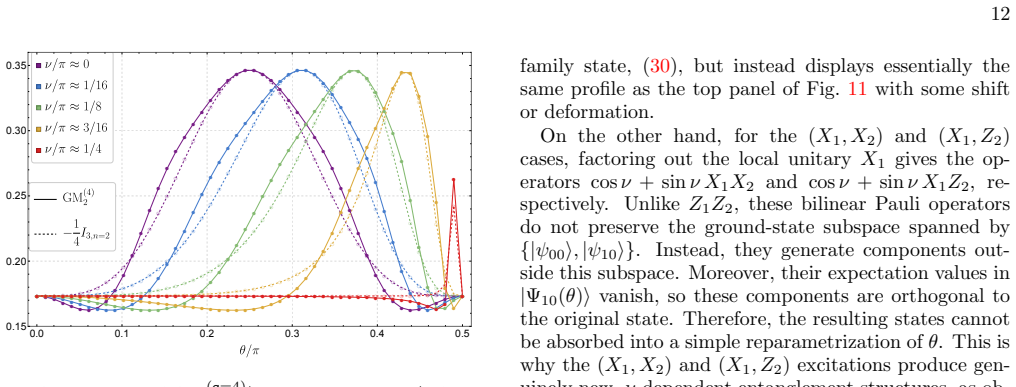
A one-parameter non-stabilizer family First, we consider the simplest real one-parameter fam- ily |Ψ10(θ)⟩= cosθ|ψ 00⟩+ sinθ|ψ 10⟩,0≤θ≤ π 2 .(30) We compute GM (q=4) witha= 1/3, together with the tripartite informationI 3,n, for several discrete choices of θand forn= 2,3. Our purpose is to examine whether the relation between GM (q=4) andI 3,n, which hold...
-
[2]
11 for the plots as a function ofθ
Another one-parameter non-stabilizer family One can also consider an analogous state, |Ψ11(θ)⟩= cosθ|ψ 00⟩+ sinθ|ψ 11⟩,0≤θ≤ π 2 .(34) See Fig. 11 for the plots as a function ofθ. Although the constituent basis states differ between|Ψ 10(θ)⟩and |Ψ11(θ)⟩, the resulting values of GM(q=4) n andI 3,n as func- tions ofθare identical to those shown in Fig. 10 fo...
-
[3]
12 for the plots as a function ofθwith different phasesϕ
Relative phase dependence for non-stabilizer family We introduce a relative phase in (30) as |Ψ10(θ, ϕ)⟩= cosθ|ψ 00⟩+e iϕ sinθ|ψ 10⟩.(35) See Fig. 12 for the plots as a function ofθwith different phasesϕ. This plot shows that introducing a nonzero phase 0< ϕ < π/2 changes the set of stabilizer points: althoughθ=π/4 is a stabilizer point forϕ= 0 and ϕ=π/2,...
-
[4]
Restricted four-component family with real coefficients Next, we consider a restricted four-component family with real coefficients c00 = cosθcosη, c 10 = sinθcosη, c01 = cosθsinη, c 11 = sinθsinη. (36) In other words, |Ψ(θ, η)⟩= cosθcosη|ψ 00⟩+ sinθcosη|ψ 10⟩ + cosθsinη|ψ 01⟩+ sinθsinη|ψ 11⟩.(37) This is a simple two-parameter subset of the general four-...
-
[5]
and compare it to the toric code. The toric code TQFT and the double semion TQFT have the same to- tal quantum dimensionD, but are inequivalent TQFTs. If then= 4 GM probes the deeper TQFT structure, then the obvious place to look is the double semion the- ory. The Levin-Wen model of the double semion theory, however, is not a simple Pauli stabilizer error...
-
[6]
Topological order: from long-range entangled quantum matter to an unification of light and electrons
X.-G. Wen, Topological order: from long-range entan- gled quantum matter to an unification of light and elec- trons, ISRN Cond. Matt. Phys.2013, 198710 (2013), arXiv:1210.1281 [cond-mat.str-el]
work page internal anchor Pith review Pith/arXiv arXiv 2013
-
[7]
Zoo of quantum-topological phases of matter
X.-G. Wen, Zoo of quantum-topological phases of matter, Rev. Mod. Phys.89, 041004 (2017), arXiv:1610.03911 [cond-mat.str-el]
work page internal anchor Pith review Pith/arXiv arXiv 2017
-
[8]
A. Kitaev and J. Preskill, Topological entanglement en- tropy, Phys. Rev. Lett.96, 110404 (2006), arXiv:hep- th/0510092
-
[9]
Detecting topological order in a ground state wave function
M. Levin and X.-G. Wen, Detecting Topological Order in a Ground State Wave Function, Phys. Rev. Lett.96, 110405 (2006), arXiv:cond-mat/0510613
work page internal anchor Pith review Pith/arXiv arXiv 2006
- [10]
-
[11]
Genuine multi-entropy and holography
N. Iizuka and M. Nishida, Genuine multientropy and holography, Phys. Rev. D112, 026011 (2025), arXiv:2502.07995 [hep-th]
work page internal anchor Pith review Pith/arXiv arXiv 2025
-
[12]
More on genuine multi-entropy and holography
N. Iizuka, S. Lin, and M. Nishida, More on genuine mul- tientropy and holography, Phys. Rev. D112, 066014 (2025), arXiv:2504.16589 [hep-th]
work page internal anchor Pith review Pith/arXiv arXiv 2025
-
[13]
A new multi-partite entanglement measure and its holographic dual
A. Gadde, V. Krishna, and T. Sharma, New multipartite entanglement measure and its holographic dual, Phys. Rev. D106, 126001 (2022), arXiv:2206.09723 [hep-th]
work page internal anchor Pith review Pith/arXiv arXiv 2022
-
[14]
Gadde, On genuine multipartite entanglement signals (2026), arXiv:2603.07680 [quant-ph]
A. Gadde, On genuine multipartite entanglement signals (2026), arXiv:2603.07680 [quant-ph]
-
[15]
M. A. Levin and X.-G. Wen, String net condensation: A Physical mechanism for topological phases, Phys. Rev. B 71, 045110 (2005), arXiv:cond-mat/0404617
work page internal anchor Pith review Pith/arXiv arXiv 2005
-
[16]
Quasi-particle Statistics and Braiding from Ground State Entanglement
Y. Zhang, T. Grover, A. Turner, M. Oshikawa, and A. Vishwanath, Quasi-particle Statistics and Braiding from Ground State Entanglement, Phys. Rev. B85, 235151 (2012), arXiv:1111.2342 [cond-mat.str-el]
work page internal anchor Pith review Pith/arXiv arXiv 2012
-
[17]
Extracting topological spins from bulk multipartite entanglement
Y. Sheffer, A. Stern, and E. Berg, Extracting Topological Spins from Bulk Multipartite Entanglement, Phys. Rev. Lett.135, 086601 (2025), arXiv:2502.12259 [quant-ph]
work page internal anchor Pith review Pith/arXiv arXiv 2025
-
[18]
M. Del Zotto, A. Gadde, and P. Putrov, From Multi- partite Entanglement to TQFT (2026), arXiv:2602.16770 [hep-th]
- [19]
-
[20]
Stabilizer Codes and Quantum Error Correction
D. Gottesman, Stabilizer codes and quantum error cor- rection (1997), arXiv:quant-ph/9705052
work page internal anchor Pith review Pith/arXiv arXiv 1997
- [21]
-
[22]
Multi-invariants and Bulk Replica Symmetry
A. Gadde, J. Harper, and V. Krishna, Multi- invariants and bulk replica symmetry, JHEP06, 116, arXiv:2411.00935 [hep-th]
work page internal anchor Pith review Pith/arXiv arXiv
- [23]
-
[24]
O. G¨ uhne and G. T´ oth, Entanglement detection, Phys. Rept.474, 1 (2009), arXiv:0811.2803 [quant-ph]
work page internal anchor Pith review Pith/arXiv arXiv 2009
-
[25]
N. Iizuka and S. Lin, Symmetry-resolved genuine multi- entropy: Random Haar and graph states, Phys. Rev. D 113, 026016 (2026), arXiv:2511.00905 [hep-th]
-
[26]
Topological Quantum Distillation
H. Bombin and M. A. Martin-Delgado, Topological quan- tum distillation, Phys. Rev. Lett.97, 180501 (2006), arXiv:quant-ph/0605138
work page internal anchor Pith review Pith/arXiv arXiv 2006
-
[27]
Topological Computation without Braiding
H. Bombin and M. A. Martin-Delgado, Topological com- putation without braiding, Phys. Rev. Lett.98, 160502 (2007), arXiv:quant-ph/0610024. 14
work page internal anchor Pith review Pith/arXiv arXiv 2007
-
[28]
Universal topological phase of 2D stabilizer codes
H. Bombin, G. Duclos-Cianci, and D. Poulin, Universal topological phase of 2D stabilizer codes, New J. Phys. 14, 073048 (2012), arXiv:1103.4606 [quant-ph]
work page internal anchor Pith review Pith/arXiv arXiv 2012
-
[29]
Fun with replicas: tripartitions in tensor networks and gravity
G. Penington, M. Walter, and F. Witteveen, Fun with replicas: tripartitions in tensor networks and gravity, JHEP05, 008, arXiv:2211.16045 [hep-th]
work page internal anchor Pith review Pith/arXiv arXiv
-
[30]
Towards classification of holographic multi-partite entanglement measures
A. Gadde, V. Krishna, and T. Sharma, Towards a classi- fication of holographic multi-partite entanglement mea- sures, JHEP08, 202, arXiv:2304.06082 [hep-th]
work page internal anchor Pith review Pith/arXiv arXiv
-
[31]
Entanglement in the stabilizer formalism
D. Fattal, T. S. Cubitt, Y. Yamamoto, S. Bravyi, and I. L. Chuang, Entanglement in the stabilizer formalism (2004), arXiv:quant-ph/0406168
work page internal anchor Pith review Pith/arXiv arXiv 2004
-
[32]
GHZ extraction yield for multipartite stabilizer states
S. Bravyi, D. Fattal, and D. Gottesman, GHZ extraction yield for multipartite stabilizer states, J. Math. Phys.47, 062106 (2006), arXiv:quant-ph/0504208
work page internal anchor Pith review Pith/arXiv arXiv 2006
-
[33]
Homological Error Correction: Classical and Quantum Codes
H. Bombin and M. A. Martin-Delgado, Homological error correction: Classical and quantum codes, J. Math. Phys. 48, 052105 (2007), arXiv:quant-ph/0605094
work page internal anchor Pith review Pith/arXiv arXiv 2007
-
[34]
Pauli stabilizer models of twisted quantum doubles
T. D. Ellison, Y.-A. Chen, A. Dua, W. Shirley, N. Tanti- vasadakarn, and D. J. Williamson, Pauli Stabilizer Mod- els of Twisted Quantum Doubles, PRX Quantum3, 010353 (2022), arXiv:2112.11394 [quant-ph]. Appendix A: Replica definition of multi-entropy In this appendix, we give the replica definition of the R´ enyi multi-entropy used in the main text. Consi...
work page internal anchor Pith review Pith/arXiv arXiv 2022
-
[35]
9, with the edge labellinge 1,
Setup We work on the 2×2 toric lattice of Fig. 9, with the edge labellinge 1, . . . , e8 introduced there. We start from the four-partite partition shown in Fig. 16, which is checkerboard edge partition: C={e 1, e5}, B={e 2, e6}, A={e 3, e7}, D={e 4, e8}. (C1) Each party is the pair of edges (one horizontal, one ver- tical) emanating from one vertex, soA⊔...
-
[36]
16 by reassigning edgee 7 fromAtoD, C={e 1, e5}, B={e 2, e6}, A={e 3}, D={e 4, e7, e8}
Step-by-step deformation The first step deforms Fig. 16 by reassigning edgee 7 fromAtoD, C={e 1, e5}, B={e 2, e6}, A={e 3}, D={e 4, e7, e8}. (C2) The corresponding partition is Fig. 17, which is the sec- ond panel of Fig. 4 up to aπrotation. C(e 1) B(e 2) A(e 3) D(e 4) C(e 5) B(e 6) D(e 7) D(e 8) FIG. 17: The partition (C2):C={e 1, e5}, B={e 2, e6},A={e 3...
-
[37]
16 to the Kitaev–Preskill disk partition in Fig
Invariance ofI 3 under local deformations We now follow the sequence of local deformations from the initial partition in Fig. 16 to the Kitaev–Preskill disk partition in Fig. 19. At each step, one edge is trans- ferred into the complementary regionD, without crossing a non-contractible cycle of the torus. For the initial partition (C1), direct computation...
discussion (0)
Sign in with ORCID, Apple, or X to comment. Anyone can read and Pith papers without signing in.