Quantum Physics · arXiv:2610.37552 v1 · submitted 27 Oct 2026 · 85 references
Meet-in-the-Middle Compilation of the [CNOT] Class with Fibonacci Anyons
The paper says
“Compilation of two-qubit Fibonacci anyon gates is complicated by leakage (ℓ) from the four-dimensional computational sector to the fifth state of the fusion space.”
more of the abstract
We construct a GPU pipeline to find low-leakage representatives of the [CNOT] class on different subsets of the braid group. We exhaustively explore the full positive five-generator alphabet up to L = 21 with minimal leakage ℓ ∼ 10−3 and error d[CNOT] ∼ 10−8 on it. To reach larger lengths, the search space is successively narrowed to three-generator, boundary-σ3, and palindromic braids, and by considering only the Garside left normal form. These optimizations allow us to reach L = 72. For L = 69, a braid with ℓ ∼ 10−10 and d[CNOT] ∼ 10−10 is found. In addition to directly enumerating optimal braids, we proved that ℓ ∈ ℤ[φ], and any nonzero leakage obeys an exponential lower bound in the braid length, and obtained the limit laws F3,∞(ℓ) = ℓ2 and F5,∞(ℓ) = ℓ4 for our sets. Using asymptotics for the distribution function F, we showed that for sufficiently long braids, the asymptotics of exhaustive search are better than the asymptotics of random sampling for finding low-leakage braids.
from the abstract
Pith says
Machine review · deepseek-v4-flash · 28 Oct 2026 · what was read was not recorded · not checked by a person
It can be wrong. Challenge this review or reply to it.
Holds up, with conditions. Certified record searches and a clean leakage-quantization lemma, but the claimed asymptotic advantage over random sampling is not actually proved. This line is wrong
2 major objections · 5 minor
How often objections from reviews like this one are right: not yet measured
Not checked: figures, code, what the 85 references say.
The paper says, at Lemma 3.2, Eqs. (3.4)-(3.12)
The review did not quote this passage.
Pith says: Objection 1 of 2 · major
The proof of the exponential lower bound is invalid as written because the map g defined in Eq. (3.4) is not a field embedding with the claimed restriction. The paper states that g(zeta_5)=zeta_5^2 and g(sqrt(phi))=i*sqrt(phi), and then claims that the restriction to Q(sqrt(5)) sends sqrt(5) to -sqrt(5).
more of objection 1
But phi=(1+sqrt(5))/2 gives sqrt(5)=2*phi-1, and g(phi)=g((sqrt(phi))^2)=(i*sqrt(phi))^2=-phi, so g(sqrt(5))=-2*phi-1=-sqrt(5)-2, not -sqrt(5). Equivalently, the Galois conjugate of phi is 1-phi, not -phi. Indeed i*sqrt(phi) is not a Galois conjugate of sqrt(phi) at all: (i*sqrt(phi))^2=-phi, whereas any embedding must send (sqrt(phi))^2=phi to a conjugate of phi. The map also fails to commute with complex conjugation on sqrt(phi). Since Eqs. (3.8)-(3.10) require g to be an honest embedding of Q(zeta_5,sqrt(phi)) into C, the bound ell(U) >= (1/2) C^{-2L} in Eq. (3.6) is not proved. The defect appears fixable, for example by setting g(sqrt(phi))=i/sqrt(phi) (equivalently i*(phi-1)*sqrt(phi)), which does restrict to Galois conjugation on Q(sqrt(5)); with that correction the norm and C^L estimates may go through, and the stated value of C in Eq. (3.5) would need to be recomputed. As it stands, however, the abstract's claim of a proved exponential lower bound is not supported.
This review says the paper's mathematics is wrong. Pith did not check that against the paper's source.
The paper says, at Section 4.3, Eqs. (4.8)-(4.11), and abstract
The review did not quote this passage.
A classifier read this sentence of the paper as acknowledging the concern (probability 0.87):
“However, the rate of convergence for the ensembles under consideration is not estimated there.”
Pith says: Objection 2 of 2 · major
The claimed asymptotic advantage of exhaustive search over random sampling is not established by the given derivation. Eq. (4.11) substitutes the fixed-threshold Haar limit F_infty(ell_L)=ell_L^{d-1} into the sampling-cost estimate at thresholds ell_L ~ sqrt(5)*10^{1-L/6}, which tend to zero with L.
more of objection 2
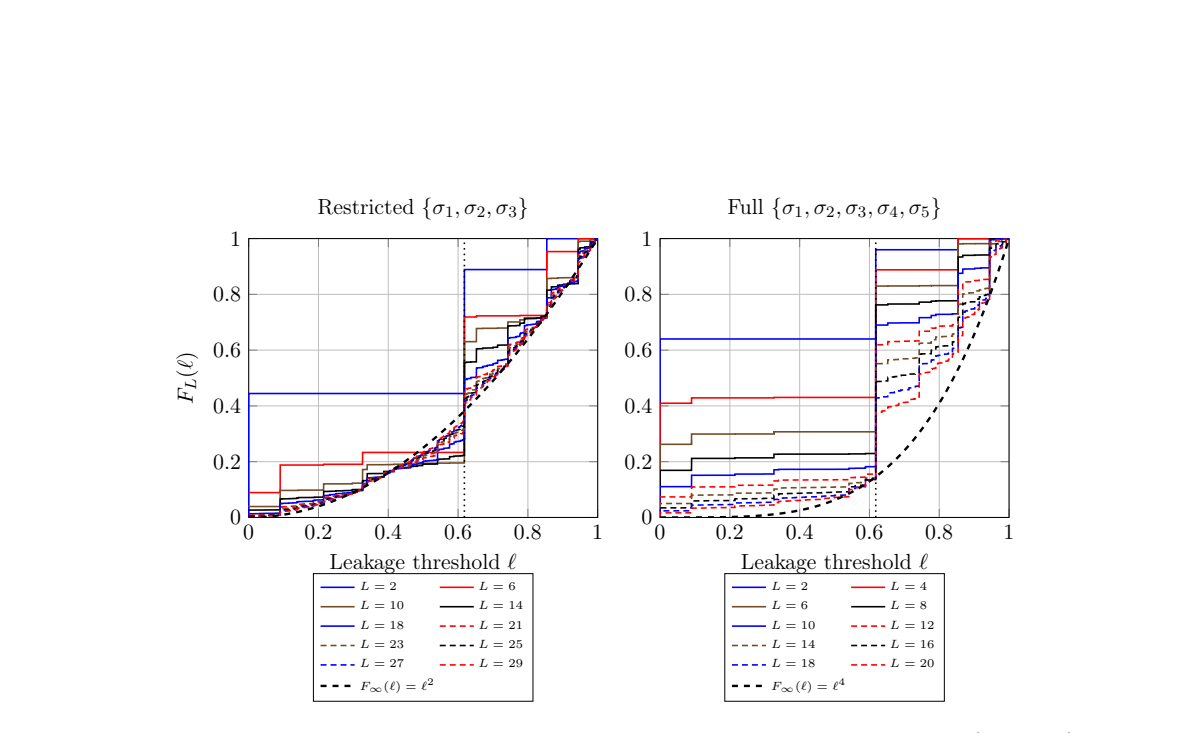
Theorem B.4 is a fixed-threshold statement (L -> infinity with ell_0 fixed), and the paper itself states that the rate of convergence is not estimated (Section 3.3, b166) and lists finite-length mixing estimates in the joint L -> infinity, ell -> 0 regime as future work (Section 6, b275). The data in Fig. 3 provide no monotone direction for the finite-L correction: for the five-generator set the finite-length curves approach the quartic limit from above (b158), while for the three-generator set they cross the quadratic limit from both sides (b155, b156). If F_L(ell_L) is larger than ell_L^{d-1} in the sampling regime, the required number of samples is smaller than the O(ell^{1-d}) bound suggests, and the crossover length at which exhaustive search dominates sampling shifts, potentially beyond the lengths studied. Additionally, the scaling fit (4.8) is explicitly empirical (R^2=0.9851). The conclusion may be true, but the abstract's wording that the authors 'showed' the asymptotic advantage goes beyond the derivation; the comparison should either be reworded as a heuristic based on the empirical fit, or a finite-L bound on |F_L(ell_L)-ell_L^{d-1}| in the joint regime should be supplied.
5 minor objections
The paper says, at Section 3.3 vs. Lemma B.3 and Theorem B.4
Pith says: minor objection 1 of 5
The cumulative distribution function in Definition 3.3 uses the strict inequality ell < ell_0, while Lemma B.3 and Theorem B.4 state the threshold with a non-strict inequality; the difference is harmless because the boundary has Haar measure zero, but the conventions should be harmonized for readability.
The paper says, at Eq. (4.10)
Pith says: minor objection 2 of 5
The displayed exponent in Eq. (4.10) is typeset in a confusing way: the chain 3^{...} = Theta(3^{-3 log10 ell_L ...}) should be rewritten cleanly as Theta(ell^{-3 log10(3)}) with the substitution L = -6 log10(ell) + C made explicit.
show 3 more
The paper says, at Section 4.3, paragraph after Eq. (4.11)
Pith says: minor objection 3 of 5
The phrase 'we obtain a clear advantage of the second method' is stronger than the argument supports, since Eq. (4.11) compares a lower bound on the sampling cost with an upper bound on the exhaustive cost, both under the empirical scaling (4.8) and the unproved joint limit; recommend adding a sentence stating explicitly that constants and the finite-L correction are uncontrolled.
The paper says, at Fig. 5 and Table 3
Pith says: minor objection 4 of 5
The floor line labelled 'Lemma 3.2' should be regenerated after the embedding in the lemma is corrected; at the displayed lengths the floor is many orders of magnitude below the records, so it does not constrain the data, but it is currently labelled as a proved bound whose proof as written is defective.
The paper says, at Section 4.2.2
Pith says: minor objection 5 of 5
The boundary-sigma_3 reduction says that appending {sigma_1,sigma_2} to either end does not increase distance or leakage; this relies on the local equivalence in Eq. (2.1), which is mentioned in the text but could be stated in one sentence at the point of use for clarity.
What would settle it
Use the exhaustive three-generator enumeration already within reach (L=23,25,27,29) to compute the empirical CDF F_L at the threshold ℓ_L=4√5·10^{1−L/6} and form R_L=F_L(ℓ_L)/ℓ_L^2. If R_L stays near 1 as L increases, the Haar substitution in Eq. 4.11 is supported in the accessible regime; if R_L grows toward (√3)^L ≈ ℓ_L^{−1.431}, random sampling would match or beat the exhaustive palindromic search at those lengths, and the asymptotic advantage claim should be softened or removed from the abstract. At L=29, 3^29≈6.9×10^13 and ℓ_L≈3.3×10^-4, so the check is numerically accessible by re-running the MITM-GEMM pipeline described in §3.4–3.5 or by using the already-reported CDF data.
from the skeptic's reading
How the review went
4 readings by deepseek-v4-flash · 28 Oct 2026
- Reader holds up, with conditions
- Skeptic partly agrees
- Editor wrote the verdict above
- Referee major revision: 2 major objections, 5 minor
Not run on this paper: the simulated authors' defence.
Pith did not check this review's objections against the paper.
The review in full
The review in brief, machine-written
Read this for the certified records and the leakage lemmas; skip the asymptotic comparison. The paper extends the full five-generator exhaustive search from L=14 (Burke et al.) to L=21, pushes restricted families to L=72, and reports a length-69 braid with leakage 8.78e-11 and distance 4.26e-10 to the CNOT class. The leakage quantization lemma (ell in Z[phi]) and the norm-based exponential lower bound on nonzero leakage are clean and appear correct. The Haar limit laws F3,inf = ell2 and F5,inf = ell4 are proved convincingly via Kawada-Ito plus Freedman-Larsen-Wang density, and the Garside quotient reduction from (sqrt(3))L to about 1.4446L is a genuine exact reduction. The MITM-GEMM pipeline is a real engineering contribution.
The authors are also unusually honest about scope. They state that the long-length optimum is guaranteed only within the chosen palindrome family, that the 5-to-3 generator reduction is empirical, and that finite-length mixing estimates in the joint L->infinity, ell->0 regime remain future work. So the family-scoped records stand.
The real soft spot is Section 4.3. The sampling-rejection argument substitutes the fixed-threshold limit F_infinity(ell) = ell^(d-1) into a comparison at thresholds ell_L -> 0. Theorem B.4 is only a fixed-threshold statement, no finite-L rate is given, and the finite-length CDFs show no consistent side of approach. So the lower bound n_sample = O(ell^(1-d)) is not established, and the claimed asymptotic superiority of exhaustive search over random sampling goes beyond what is proved. It may be true, but the abstract's "showed" is too strong. This flaw does not touch the records or the algebraic lemmas.
A second, smaller issue: no code or data artifacts are provided. Leakage is verified in exact arithmetic and distance in float128, which is good, but benchmark-grade claims would be much stronger with a released candidate list or artifact link.
Citation pattern looks normal. The paper is for people working on topological compilation, anyon gate synthesis, or random walks on compact groups. It deserves a serious referee; with the Section 4.3 claim either proved or softened, and artifacts released, it would be solid. My own verdict is conditional rather than accept.
The strongest objection
The family-scoped records and the fixed-ℓ limit laws are not the weak point; the authors carefully scope the record guarantees (b239) and give a plausible proof of Theorem B.4. The load-bearing gap is Section 4.3. Equation 4.11 converts the limit law F∞(ℓ)=ℓ^{d−1} into a lower bound on random-sampling cost at threshold ℓ_L, and Eq. 4.8 links ℓ_L to L. But Theorem B.4 is a fixed-threshold statement: L→∞ with ℓ0 fixed. The sampling comparison needs control of F_L(ℓ_L) in the joint regime L→∞, ℓ_L=√5·10^{1−L/6}→0. No such control is provided; the paper states the rate of convergence is not estimated (b166) and lists finite-length mixing estimates in the joint regime as future work (b275). The data in Fig. 3 give no monotone direction: for five generators the finite-length curves approach the quartic limit from above (b158), while for three generators they cross the limit from both sides (b155,b156). If F_L(ℓ_L) exceeds ℓ_L^{d−1} in the sampling regime, the bound n_sample=O(ℓ^{1−d}) is not a valid lower bound, and the crossover where exhaustive search dominates shifts, possibly beyond the lengths studied. The conclusion may still be true, but the abstract's wording that the authors 'showed' the asymptotic advantage goes beyond the derivation.
The reader's weakest assumption identifies the empirical scaling ℓ_fit(L)=√5·10^{1−L/6} and the overstrong asymptotic wording. I agree the asymptotic comparison is the main vulnerability, but I would sharpen it: even granting the empirical fit, Eq. 4.11 needs F_L(ℓ_L)≈F∞(ℓ_L) in the joint limit L→∞, ℓ_L→0, and Theorem B.4 only proves a fixed-ℓ limit. The paper's own sentences acknowledge the missing rate (b166) and list the joint-regime mixing estimate as future work (b275). The finite-length CDFs cross or approach the limit from either side, so a monotone replacement of F_L by F∞ is not justified. This does not undermine the defined-family records, the Z[φ] quantization, or the exponential lower bound, so the reader's CONDITIONAL verdict remains appropriate; the concern mainly says the abstract's 'showed' should be a 'consistent with' or 'suggests' claim unless a joint-limit estimate or direct CDF comparison is supplied.
The referee's report
If the proofs are corrected, this is a valuable contribution: it provides certified minima within explicitly defined braid families (with the honest caveat that these are not global optima over all braids), reproducible split/resumable enumeration, and two clean distributional limit laws that rest on published density results (Freedman-Larsen-Wang) and the Kawada-Ito theorem. The Z[phi]-quantization result is elegant and the numerical records, with exact verification of leakage and float128 verification of the distance, are concrete assets for the topological-compilation community. The two theoretical claims that go beyond the enumeration itself, the exponential lower bound and the sampling-versus-exhaustive asymptotic comparison, are the parts that need the most scrutiny; one has a defect in its proof as written and the other is stated more strongly than the derivation supports.
Pith's reading of the paper (a machine's summary, not the authors')
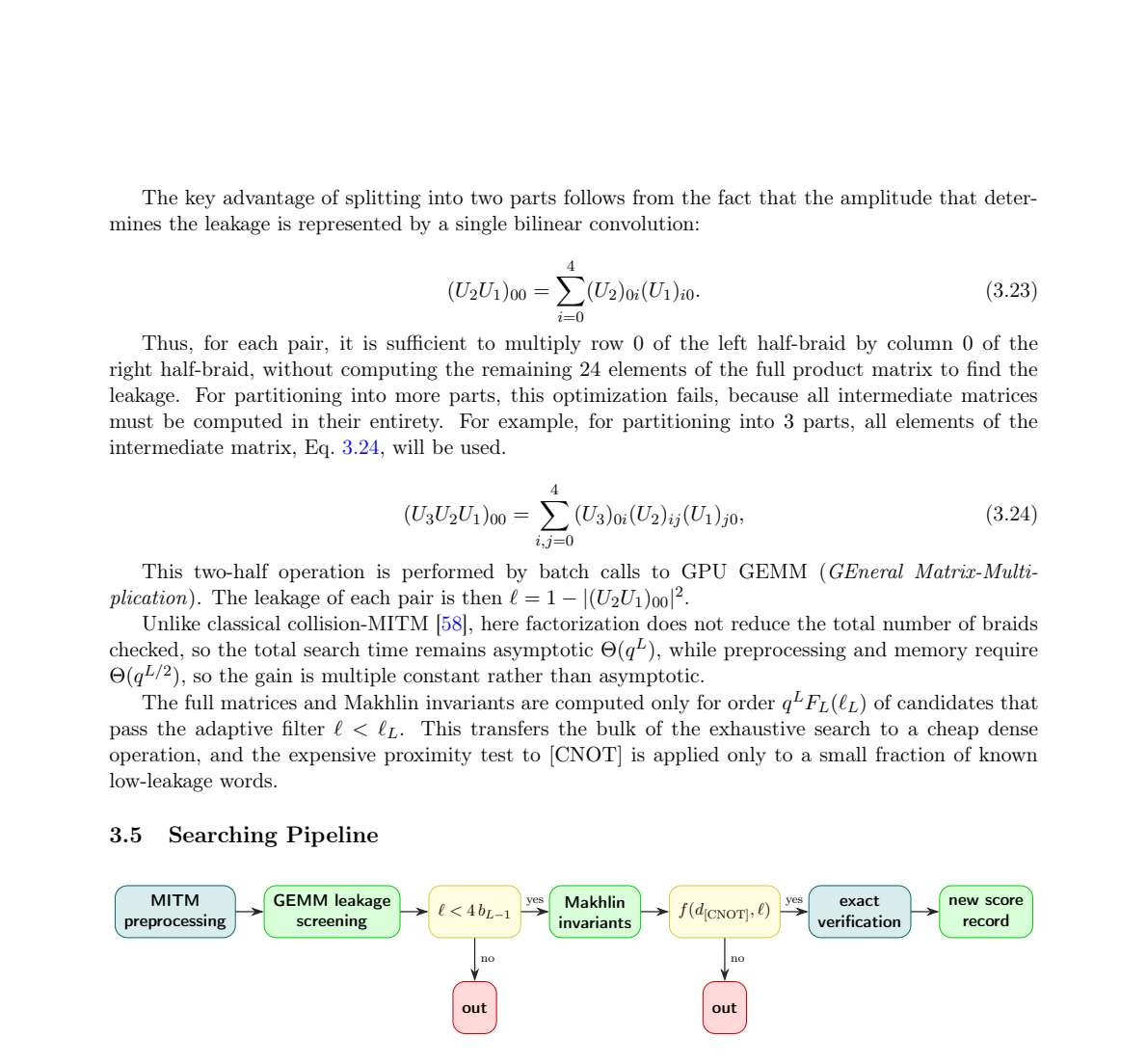
The paper tries to establish which braid words in the Fibonacci-anyon model best realize the two-qubit CNOT gate class, where braiding a six-anyon register inevitably leaks probability into a fifth, non-computational state. It builds a GPU pipeline that splits each braid in half and screens candidates using a single bilinear convolution, allowing a fully exhaustive, exactly verified search of the positive five-generator alphabet through length 21 and, after motivated reductions to three-generator, boundary-$\sigma_3$, and palindromic families, through length 72. The headline record is a length-69 positive braid with leakage $\ell = 8.78396 \times 10^{-11}$ and distance $d_{[\mathrm{CNOT}]} = 4.26 \times 10^{-10}$. Beyond the records, the paper proves that every finite positive braid has leakage in the golden-ratio integer ring $\mathbb{Z}[\varphi]$, that nonzero leakage cannot decay faster than exponentially in braid length, and that the leakage distribution of long random positive braids converges to $\ell^2$ (three generators) or $\ell^4$ (five generators). These results matter because CNOT together with arbitrary single-qubit gates is a universal gate set, and certified low-leakage braids are concrete, reproducible candidates for a topological quantum compiler.
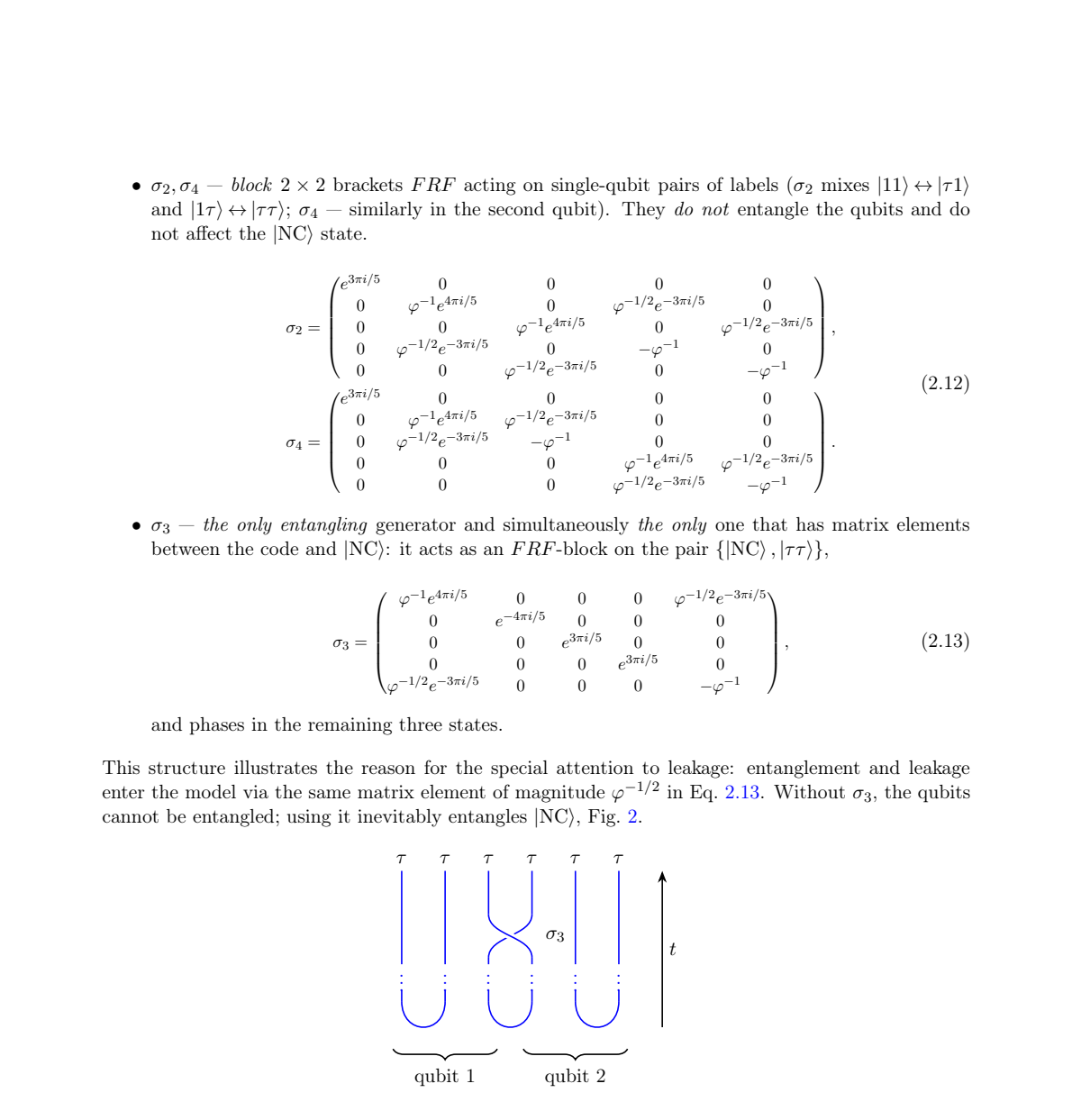
What carries the argument. The load-bearing device is meet-in-the-middle factorization of the leakage amplitude: for a split word $w=w_1w_2$, the screening quantity is the single bilinear convolution $(U_2U_1)_{00}=\sum_i (U_2)_{0i}(U_1)_{i0}$, computed for all pairs by batched GPU matrix multiplication, so the expensive full reconstruction happens only for the few words passing an adaptive threshold $\ell_L=4b_{L-1}$ set by the previous length's record. Four reductions shrink the search space from $5^L$ down to $\Theta(1.4446^L)$: restricting the alphabet to $\{\sigma_1,\sigma_2,\sigma_3\}$, fixing the entangling generator $\sigma_3$ at both boundaries, restricting to palindromes $A M A^{R}$, and finally enumerating canonical Garside left normal forms of the positive braid monoid $B_4^+$, whose growth rate $\rho=2.08679\ldots$ comes from the monoid's generating function. The proof of quantization runs through a parity grading $\gamma=(1,0,1,1,0)$ on matrix indices showing $U_{00}\in\mathbb{Z}[\zeta_5]$ and hence $\ell\in\mathbb{Z}[\varphi]$; the exponential lower bound follows from an algebraic-norm argument under a Galois embedding that bounds $|g(U_{00})|\le C^L$. The limit laws $F_{3,\infty}(\ell)=\ell^2$ and $F_{5,\infty}(\ell)=\ell^4$ are obtained by projecting to $PU(d)$, invoking density of the projective Jones representation and the Kawada–Ito theorem, and computing the Haar distribution $1-|\langle v,Uv\rangle|^2$, which has cumulative law $\ell^{d-1}$ on the $d=3$ and $d=5$ invariant subspaces.
Core claim. On the paper's own terms, the central result is a sequence of certified search records together with three structural theorems. Exhaustive enumeration certifies optima within each explicitly stated family: the full positive five-generator alphabet through $L=21$ (best leakage $\ell=0.00394572$, distance $d_{[\mathrm{CNOT}]}\simeq 7.8\times10^{-9}$), the restricted three-generator alphabet through $L=34$, boundary-$\sigma_3$ words through $L=36$, palindromic words through $L=42$, and Garside-quotient palindromic words through $L=72$, with the best word at $L=69$ having $\ell=8.78396\times10^{-11}$ and $d_{[\mathrm{CNOT}]}=4.26\times10^{-10}$. These are proven optima inside the searched families, not claims of global optimality over all braids; the paper also proves its leakage measure coincides with the trace-norm defect used by the benchmark study it extends, making the records directly comparable. The theorems are: leakage of any positive word lies in $\mathbb{Z}[\varphi]$, the integers of $\mathbb{Q}(\sqrt5)$; any nonzero leakage satisfies $\ell \ge \frac{1}{2}C^{-2L}$ with $C=2.8901\ldots$, an explicit exponential floor; and the leakage cumulative distribution over uniformly random words converges to $F_\infty(\ell)=\ell^{d-1}$, namely $\ell^2$ for the three-generator ensemble and $\ell^4$ for the five-generator ensemble. Combining the measured record scaling $\ell_{\mathrm{fit}}(L)=\sqrt5\cdot 10^{1-L/6}$ with these distributions, the paper concludes that for sufficiently long braids exhaustive structured search has better asymptotics than random sampling.
The premise it rests on. The argument that exhaustive search outperforms random sampling for long braids rests on the empirical record scaling $\ell_{\mathrm{fit}}(L)=\sqrt5\cdot10^{1-L/6}$ (Eq. 4.8, $R^2=0.9851$), which the authors fit to their own search records and call an experimental fact; if the true optimal leakage decays with a different exponent, the crossover length at which exhaustive search wins shifts, and the abstract's wording that they 'showed' the asymptotic advantage goes beyond what is proven.
If the paper is right (Pith's inferences, not the authors')
Records within the stated families are frozen and reproducible: each claimed optimum is exhaustive over its defined search space and exactly verified, so later work can extend the chain without re-running $5^L$ enumeration.
Leakage is structurally quantized: because $\ell\in\mathbb{Z}[\varphi]$ and nonzero leakage is bounded below by $\frac12 C^{-2L}$, finite positive braids cannot harbor arbitrarily small leakage, sharpening the open question of whether an exactly leakage-free entangling gate exists at all.
Random sampling is the wrong tool in the long-braid regime: hitting low-leakage operators needs $\Theta(\ell^{-2})$ samples, while the structured exhaustive pipeline needs $\Theta(\ell^{-1.431})$ steps, which is why the paper pushes exhaustive families to $L=72$ instead of sampling longer braids.
The limit laws $\ell^2$ and $\ell^4$ give exact, checkable predictions for long random positive braids and serve as a benchmark for any future heuristic compiler on this model.
The pipeline components — half-braid splitting, adaptive leakage thresholds, and canonical enumeration — carry directly to the paper's stated next target, exhaustive compilation of cabled two-qubit gates for $SU(N)_k$ anyon models.
If the empirical scaling $\ell_{\mathrm{fit}}(L)=\sqrt5\cdot10^{1-L/6}$ continues past $L=72$, leakage inside the searched families crosses $10^{-13}$ near $L\approx102$; but nothing in the paper rules out a steeper decay law for non-positive braids or for other generator alphabets, which would shift or invert the exhaustive-versus-sampling crossover at longer lengths.
The observed collapse from five to three effective generators is reported without a proof; if it reflects a genuine structural factorization of $[\mathrm{CNOT}]$-class representatives through a lower-rank subgroup of $B_6$, the same reduction could become a theorem and transfer to other anyon models and qubit counts.
A testable corollary of the Haar laws: the finite-length approach curves in Figure 3 encode the mixing rate the paper leaves unestimated, so measuring how fast the empirical tail exponent converges to 2 or 4 would quantify exactly when exhaustive search starts dominating sampling.
The proof that $\ell$ coincides with the benchmark's trace-norm defect means the records here are directly comparable to any future compiler that reports either metric on the same six-anyon encoding, including searches over the inverse-containing alphabet.
Check this review
Pith stored no record of this review's passes and took no fingerprint of it. Reviews made by code from 13 Nov 2026 on carry both.
How often reviews like this one are right
Reviews like this one: written by deepseek-v4-flash, where what was read was not recorded.
How often objections from reviews like this one are right: not yet measured
Reviews by people
This review was written by a machine. No person has reviewed this paper on Pith yet. A scientist listed on Pith can review it for a fee, and their review is published here whatever it concludes.
The paper
Abstract
Compilation of two-qubit Fibonacci anyon gates is complicated by leakage (ℓ) from the four-dimensional computational sector to the fifth state of the fusion space. We construct a GPU pipeline to find low-leakage representatives of the [CNOT] class on different subsets of the braid group. We exhaustively explore the full positive five-generator alphabet up to L = 21 with minimal leakage ℓ ∼ 10−3 and error d[CNOT] ∼ 10−8 on it. To reach larger lengths, the search space is successively narrowed to three-generator, boundary-σ3, and palindromic braids, and by considering only the Garside left normal form. These optimizations allow us to reach L = 72. For L = 69, a braid with ℓ ∼ 10−10 and d[CNOT] ∼ 10−10 is found. In addition to directly enumerating optimal braids, we proved that ℓ ∈ ℤ[φ], and any nonzero leakage obeys an exponential lower bound in the braid length, and obtained the limit laws F3,∞(ℓ) = ℓ2 and F5,∞(ℓ) = ℓ4 for our sets. Using asymptotics for the distribution function F, we showed that for sufficiently long braids, the asymptotics of exhaustive search are better than the asymptotics of random sampling for finding low-leakage braids.
The paper's own sentences, arranged, kept beside the review and separate from it. Each label is drawn from a closed vocabulary; the number beside it is the probability the classifier gave that label. No sentence in this record was written by a model.
abstract compiled · 2026-10-28
The authors' main claim, as the classifier picked it out 0.83
“Using asymptotics for the distribution function $F$, we showed that for sufficiently long braids, the asymptotics of exhaustive search are better than the asymptotics of random sampling for finding low-leakage braids.”
How the main claim is stated: asserted 1.00
What the abstract itself states, as probabilities: claims first 0.05 · states limitation 0.42 · human participants 0.01 · controlled comparison 0.35 · randomized assignment 0.01 · states quantitative result 0.98 · compares with prior results 0.83 · mentions code or data availability 0.04
The abstract, sentence by sentence
This table labels the abstract only (arXiv listing abstract v1). The number is the probability the classifier gave the label.
| Sentence | Role | The authors' own work | States the main conclusion | Strength |
|---|---|---|---|---|
| Compilation of two-qubit Fibonacci anyon gates is complicated by leakage ($\ell$) from the four-dimensional computational sector to the fifth state of the fusion space. | background 1.00 | 0.09 | 0.03 | asserted 1.00 |
| We construct a GPU pipeline to find low-leakage representatives of the $[\text{CNOT}]$ class on different subsets of the braid group. | method 0.73 | 0.96 | 0.07 | asserted 1.00 |
| We exhaustively explore the full positive five-generator alphabet up to $L=21$ with minimal leakage $\ell\sim10^{-3}$ and error $d_{[\text{CNOT}]}\sim 10^{-8}$ on it. | result 0.89 | 0.96 | 0.14 | asserted 1.00 |
| To reach larger lengths, the search space is successively narrowed to three-generator, boundary-$\sigma_3$, and palindromic braids, and by considering only the Garside left normal form. | method 0.99 | 0.92 | 0.04 | asserted 0.99 |
| These optimizations allow us to reach $L=72$. | result 0.86 | 0.94 | 0.09 | asserted 1.00 |
| For $L=69$, a braid with $\ell\sim10^{-10}$ and $d_{[\text{CNOT}]}\sim 10^{-10}$ is found. | result 1.00 | 0.96 | 0.15 | asserted 1.00 |
| In addition to directly enumerating optimal braids, we proved that $\ell\in\mathbb Z[\varphi]$, and any nonzero leakage obeys an exponential lower bound in the braid length, and obtained the limit laws $F_{3,\infty}(\ell)=\ell^2$ and $F_{5,\infty}(\ell)=\ell^4$ for our sets. | result 0.80 | 0.96 | 0.28 | asserted 1.00 |
| Using asymptotics for the distribution function $F$, we showed that for sufficiently long braids, the asymptotics of exhaustive search are better than the asymptotics of random sampling for finding low-leakage braids. | result 0.77 | 0.95 | 0.27 | asserted 1.00 |
What kind of paper the classifier reports this is: method or tool 0.82 · evidence from simulation or computation 0.99
What was examined, and what was not
Sources read
- arXiv listing abstract v1
Not examined
- full text
- figures and tables
- references and citing sentences
- relations to other papers
Levels run
- P abstract
Not run
- S sections
- T body sentences
- C citations
- R cross-paper relations
How the labels were made
Compiled by classifier-1.13.0 via TypeSafe API, question bank abstract-p1-20260923, 2026-10-28: 1 request, 6,595 input tokens.
Every quoted sentence on this record is the authors'. Every label is from Pith's closed vocabulary, with the probability shown beside it. This record as JSON
Figures (5)


Figures are the authors', reproduced from the paper.
References (85)
- [1] L. K. Grover,A fast quantum mechanical algorithm for database search, Proc. 28th ACM STOC, 212 (1996).https://arxiv.org/abs/quant-ph/9605043 on PithPith's reviewarXiv
- [2] P. W. Shor,Polynomial-time algorithms for prime factorization and discrete logarithms on a quan- tum computer, SIAM J. Comput.26, 1484 (1997).https://arxiv.org/abs/quant-ph/9508027 on PithPith's reviewarXiv
- [3] C. Gidney, M. Eker˚ a,How to factor 2048 bit RSA integers in 8 hours using 20 million noisy qubits, Quantum5, 433 (2021).https://arxiv.org/abs/1905.09749 on PithPith's reviewarXiv
- [4] D. R. Simon,On the power of quantum computation, SIAM J. Comput.26, 1474 (1997).https: //doi.org/10.1137/S0097539796298637 on Pithdoi:10.1137/s0097539796298637
- [5] E. Bernstein, U. Vazirani,Quantum complexity theory, SIAM J. Comput.26, 1411 (1997).https: //doi.org/10.1137/S0097539796300921 on Pithdoi:10.1137/s0097539796300921
- [6] E. Tang,A quantum-inspired classical algorithm for recommendation systems, Proc. 51st ACM STOC, 217 (2019).https://arxiv.org/abs/1807.04271 on PithPith's reviewarXiv
- [7] N.-H. Chia, A. Gily´ en, T. Li, H.-H. Lin, E. Tang, C. Wang,Sampling-based sublinear low-rank matrix arithmetic framework for dequantizing quantum machine learning, Proc. 52nd ACM STOC, 387 (2020).https://arxiv.org/abs/1910.06151 on PithPith's reviewarXiv
- [8] N. Isogai, M. Murao, H. Yamasaki,A quantum-inspired dequantization method for diag- onally weighted matrix functions: Application to learning with optimized random features, arXiv:2609.10729 (2026).https://arxiv.org/abs/2609.10729 on PithPith's reviewarXiv
- [9] C. H. Bennett,Logical reversibility of computation, IBM J. Res. Dev.17, 525 (1973).https: //doi.org/10.1147/rd.176.0525 22 on Pithdoi:10.1147/rd.176.0525
- [10] M. E. Beverland, P. Murali, M. Troyer, K. M. Svore, T. Hoefler, V. Kliuchnikov, G. H. Low, M. Soeken, A. Sundaram, A. Vaschillo,Assessing requirements to scale to practical quantum advantage, arXiv:2211.07629 (2022).https://arxiv.org/abs/2211.07629 on PithPith's reviewarXiv
- [11] R. P. Feynman,Simulating physics with computers, Int. J. Theor. Phys.21, 467 (1982).https: //doi.org/10.1007/BF02650179 on Pithdoi:10.1007/bf02650179
- [12] S. Lloyd,Universal quantum simulators, Science273, 1073 (1996).https://doi.org/10.1126/ science.273.5278.1073 on Pith
- [13] D. W. Berry, G. Ahokas, R. Cleve, B. C. Sanders,Efficient quantum algorithms for simulat- ing sparse Hamiltonians, Commun. Math. Phys.270, 359 (2007).https://arxiv.org/abs/ quant-ph/0508139 on PithPith's reviewarXiv
- [14] G. H. Low, I. L. Chuang,Hamiltonian simulation by qubitization, Quantum3, 163 (2019).https: //arxiv.org/abs/1610.06546 on PithPith's reviewarXiv
- [15] C. M. Dawson, M. A. Nielsen,The Solovay–Kitaev algorithm, Quantum Inf. Comput.6, 81 (2006). https://arxiv.org/abs/quant-ph/0505030 on PithPith's reviewarXiv
- [16] J.-L. Brylinski, R. Brylinski,Universal quantum gates, inMathematics of Quantum Computation, edited by R. Brylinski and G. Chen (Chapman & Hall/CRC, 2002), p. 101.https://arxiv.org/ abs/quant-ph/0108062 on PithPith's reviewarXiv
- [17] M. A. Nielsen, I. L. Chuang,Quantum Computation and Quantum Information, 10th An- niversary ed. (Cambridge University Press, Cambridge, 2010).https://doi.org/10.1017/ CBO9780511976667 on Pith
- [18] P. Krantz, M. Kjaergaard, F. Yan, T. P. Orlando, S. Gustavsson, W. D. Oliver,A quantum engineer’s guide to superconducting qubits, Appl. Phys. Rev.6, 021318 (2019).https://doi.org/ 10.1063/1.5089550;https://arxiv.org/abs/1904.06560 on Pithdoi:10.1063/1.5089550;https://arxiv.org/abs/1904.06560
- [19] R. W. Hamming,Error detecting and error correcting codes, Bell Syst. Tech. J.29, 147 (1950). https://doi.org/10.1002/j.1538-7305.1950.tb00463.x on Pithdoi:10.1002/j.1538-7305.1950.tb00463.x
- [20] J. von Neumann,Probabilistic logics and the synthesis of reliable organisms from unreliable com- ponents, inAutomata Studies, edited by C. E. Shannon and J. McCarthy (Princeton University Press, Princeton, 1956), pp. 43–98.https://doi.org/10.1515/9781400882618-003 on Pithdoi:10.1515/9781400882618-003
show 65 more
- [21] P. W. Shor,Scheme for reducing decoherence in quantum computer memory, Phys. Rev. A52, R2493 (1995).https://doi.org/10.1103/PhysRevA.52.R2493 on Pithdoi:10.1103/physreva.52.r2493
- [22] D. Aharonov, M. Ben-Or,Fault-tolerant quantum computation with constant error rate, SIAM J. Comput.38, 1207 (2008).https://arxiv.org/abs/quant-ph/9906129 on PithPith's reviewarXiv
- [23] W. K. Wootters, W. H. Zurek,A single quantum cannot be cloned, Nature299, 802 (1982). https://doi.org/10.1038/299802a0 on Pithdoi:10.1038/299802a0
- [24] E. Dennis, A. Kitaev, A. Landahl, J. Preskill,Topological quantum memory, J. Math. Phys.43, 4452 (2002).https://arxiv.org/abs/quant-ph/0110143 on PithPith's reviewarXiv
- [25] A.G.Fowler, M.Mariantoni, J.M.Martinis, A.N.Cleland,Surface codes: Towards practical large- scale quantum computation, Phys.Rev.A86, 032324(2012).https://arxiv.org/abs/1208.0928 23 on PithPith's reviewarXiv
- [26] D. Litinski,A game of surface codes: Large-scale quantum computing with lattice surgery, Quan- tum3, 128 (2019).https://arxiv.org/abs/1808.02892 on PithPith's reviewarXiv
- [27] N. P. Breuckmann, J. N. Eberhardt,Quantum low-density parity-check codes, PRX Quantum 2, 040101 (2021).https://doi.org/10.1103/PRXQuantum.2.040101;https://arxiv.org/abs/ 2103.06309 on PithPith's reviewarXiv
- [28] H. Bombin, M. A. Martin-Delgado,Topological quantum distillation, Phys. Rev. Lett.97, 180501 (2006).https://doi.org/10.1103/PhysRevLett.97.180501;https://arxiv.org/abs/ quant-ph/0605138 on PithPith's reviewarXiv
- [29] D. Gottesman, A. Kitaev, J. Preskill,Encoding a qubit in an oscillator, Phys. Rev. A64, 012310 (2001).https://doi.org/10.1103/PhysRevA.64.012310;https://arxiv.org/abs/quant-ph/ 0008040 on Pithdoi:10.1103/physreva.64.012310;https://arxiv.org/abs/quant-ph/
- [30] A. Yu. Kitaev,Fault-tolerant quantum computation by anyons, Ann. Phys.303, 2 (2003).https: //arxiv.org/abs/quant-ph/9707021 on PithPith's reviewarXiv
- [31] C. Nayak, S. H. Simon, A. Stern, M. Freedman, S. Das Sarma,Non-Abelian anyons and topological quantum computation, Rev. Mod. Phys.80, 1083 (2008).https://arxiv.org/abs/0707.1889 on PithPith's reviewarXiv
- [32] A. Belov, A. Morozov,Ising anyons in theSU(2)2 Chern–Simons theory, arXiv:2605.15268 (2026). https://arxiv.org/abs/2605.15268 on PithPith's reviewarXiv
- [33] S. Bravyi,Universal quantum computation with theν= 5/2fractional quantum Hall state, Phys. Rev. A73, 042313 (2006).https://arxiv.org/abs/quant-ph/0511178 on PithPith's reviewarXiv
- [34] N. Kolganov, A. Morozov,QuantumR-matrices as universal qubit gates, JETP Lett.111(9), 519– 524 (2020).https://doi.org/10.1134/S0021364020090027;https://arxiv.org/abs/2004. 07764 on Pithdoi:10.1134/s0021364020090027;https://arxiv.org/abs/2004
- [35] N. Kolganov, S. Mironov, A. Morozov,Largektopological quantum computer, Nucl. Phys. B987, 116072 (2023). doi:10.1016/j.nuclphysb.2023.116072;https://arxiv.org/abs/2105.03980 on Pithdoi:10.1016/j.nuclphysb.2023.116072;https://arxiv.org/abs/2105.03980
- [36] A. Belov, A. Morozov,Measuring Chern-Simons levelkby braidingSU(2) k anyons, Eur. Phys. J. C85, 91 (2025).https://arxiv.org/abs/2408.14188 on PithPith's reviewarXiv
- [37] M.Freedman, M.Larsen, Z.Wang,A modular functor which is universal for quantum computation, Commun. Math. Phys.227, 605 (2002).https://arxiv.org/abs/quant-ph/0001108 on PithPith's reviewarXiv
- [38] A. A. Morozov,On measuring the topological charge of anyons, Probl. Inf. Transm.60(1), 28–34 (2024).https://doi.org/10.1134/S0032946024010046;https://arxiv.org/abs/2403.07847 on Pithdoi:10.1134/s0032946024010046;https://arxiv.org/abs/2403.07847
- [39] S. Mironov, A. Morozov,Entangling gates from cabling of knots, Eur. Phys. J. C85, 799 (2025). https://arxiv.org/abs/2412.20931 on PithPith's reviewarXiv
- [40] S.Mironov, A.Morozov,Entangling gates for theSU(N)anyons, arXiv:2605.04016(2026).https: //arxiv.org/abs/2605.04016 on PithPith's reviewarXiv
- [41] S. X. Cui, K. T. Tian, J. F. Vasquez, Z. Wang, H. M. Wong,The search for leakage-free entangling Fibonacci braiding gates, J. Phys. A52, 455301 (2019).https://arxiv.org/abs/1904.01731 on PithPith's reviewarXiv
- [42] M. J. Bremner, C. M. Dawson, J. L. Dodd, A. Gilchrist, A. W. Harrow, D. Mortimer, M. A. Nielsen, T. J. Osborne,Practical scheme for quantum computation with any two-qubit en- tangling gate, Phys. Rev. Lett.89, 247902 (2002).https://arxiv.org/abs/quant-ph/0207072 24 on PithPith's reviewarXiv
- [43] R. Jozsa, N. Linden,On the role of entanglement in quantum-computational speed-up, Proc. R. Soc. A459, 2011 (2003).https://arxiv.org/abs/quant-ph/0201143 on PithPith's reviewarXiv
- [44] G. Vidal,Efficient classical simulation of slightly entangled quantum computations, Phys. Rev. Lett.91, 147902 (2003).https://arxiv.org/abs/quant-ph/0301063 on PithPith's reviewarXiv
- [45] Yu. Makhlin,Nonlocal properties of two-qubit gates and mixed states, and the optimization of quantum computations, Quantum Inf. Process.1, 243–252 (2002). doi:10.1023/A:1022144002391; https://arxiv.org/abs/quant-ph/0002045 on PithPith's reviewarXiv
- [46] A. Barenco, C. H. Bennett, R. Cleve, D. P. DiVincenzo, N. Margolus, P. Shor, T. Sleator, J. A. Smolin, H. Weinfurter,Elementary gates for quantum computation, Phys. Rev. A52, 3457 (1995).https://arxiv.org/abs/quant-ph/9503016 on PithPith's reviewarXiv
- [47] L. Hormozi, G. Zikos, N. E. Bonesteel, S. H. Simon,Topological quantum compiling, Phys. Rev. B75, 165310 (2007).https://doi.org/10.1103/PhysRevB.75.165310 on Pithdoi:10.1103/physrevb.75.165310
- [48] V. Kliuchnikov, A. Bocharov, K. M. Svore,Asymptotically optimal topological quantum compiling, Phys. Rev. Lett.112, 140504 (2014).https://arxiv.org/abs/1310.4150 on PithPith's reviewarXiv
- [49] H. Xu, X. Wan,Constructing functional braids for low-leakage topological quantum computing, Phys. Rev. A78, 042325 (2008).https://arxiv.org/abs/0802.4213 on PithPith's reviewarXiv
- [50] C. Carnahan, D. Zeuch, N. E. Bonesteel,Systematically generated two-qubit anyon braids, Phys. Rev. A93, 052328 (2016).https://arxiv.org/abs/1511.00719 on PithPith's reviewarXiv
- [51] J. Long, X. Huang, J. Zhong, L. Meng,Genetic algorithm enhanced Solovay–Kitaev algorithm for quantum compiling of Fibonacci anyons, Phys. Scr.100, 115111 (2025). doi:10.1088/1402- 4896/ae1d30;https://arxiv.org/abs/2501.01746 on PithPith's reviewarXiv
- [52] J. Long, J. Zhong, L. Meng,Topological quantum compilation of metaplectic anyons based on the genetic optimized algorithms, Phys. Rev. A112, 022421 (2025).https://arxiv.org/abs/2501. 01745 on Pith
- [53] J. Long, Y. Li, J. Zhong, L. Meng,The construction of a universal quantum gate set for the SU(2) k (k= 5,6,7) anyon models via genetic optimized algorithm, Phys. Lett. A565, 131142 (2026).https://arxiv.org/abs/2505.01774 on PithPith's reviewarXiv
- [54] J. Long, Z. Liu, Y. Li, L. Meng,Universal quantum gate compilation inSU(2)k anyon models via multiple-braiding, arXiv:2602.15324v4 (2026).https://arxiv.org/abs/2602.15324 on PithPith's reviewarXiv
- [55] J. Long, Z. Liu, Y. Li, J. Zhong, L. Meng,High-fidelity universal quantum gate compilation for non-semisimple Ising anyons via genetic algorithm-optimized Solovay–Kitaev decomposition, J. Phys. A59, 31LT01 (2026).https://doi.org/10.1088/1751-8121/ae91a0;https://arxiv. org/abs/... on PithPith's reviewarXiv
- [56] P. Ryt´ ıˇ r, P. C. Burke, C. Aravanis, J. Vala, J. Mareˇ cek,Topological Quantum Compi- lation Using Mixed-Integer Programming, IEEE Trans. Quantum Eng.7, 3104212 (2026). doi:10.1109/TQE.2026.3710775;https://arxiv.org/abs/2511.09513 on Pithdoi:10.1109/tqe.2026.3710775;https://arxiv.org/abs/2511.09513
- [57] P. C. Burke, C. Aravanis, J. Aspman, J. Mareˇ cek, J. Vala,Topological quantum compilation of two-qubit gates, Phys. Rev. A110, 052616 (2024).https://arxiv.org/abs/2408.07132 25 on PithPith's reviewarXiv
- [58] M. Amy, D. Maslov, M. Mosca, M. Roetteler,A meet-in-the-middle algorithm for fast synthesis of depth-optimal quantum circuits, IEEE TCAD32, 818 (2013).https://arxiv.org/abs/1206. 0758 on Pith
- [59] D. Ruiz, J. Guillaud, A. Leverrier, M. Mirrahimi, C. Vuillot,LDPC-cat codes for low-overhead quantum computing in 2D, Nat. Commun.16, 1040 (2025). doi:10.1038/s41467-025-56298-8 on Pithdoi:10.1038/s41467-025-56298-8
- [60] C. Gidney, M. Newman, P. Brooks, C. Jones,Yoked surface codes, Nat. Commun.16, 4498 (2025). https://doi.org/10.1038/s41467-025-59714-1;https://arxiv.org/abs/2312.04522 on Pithdoi:10.1038/s41467-025-59714-1;https://arxiv.org/abs/2312.04522
- [61] P. V. Klimov, A. Bengtsson, C. Quintana, et al.,Optimizing quantum gates towards the scale of logical qubits, Nat. Commun.15, 2442 (2024).https://doi.org/10.1038/s41467-024-46623-y; https://arxiv.org/abs/2308.02321 on PithPith's reviewarXiv
- [62] J. M. Leinaas, J. Myrheim,On the theory of identical particles, Nuovo Cimento B37, 1–23 (1977). doi:10.1007/BF02727953 on Pithdoi:10.1007/bf02727953
- [63] E. Rowell, R. Stong, Z. Wang,On Classification of Modular Tensor Categories, Commun. Math. Phys.292, 343–389 (2009). doi:10.1007/s00220-009-0908-z;https://arxiv.org/abs/0712.1377 on Pithdoi:10.1007/s00220-009-0908-z;https://arxiv.org/abs/0712.1377
- [64] N. Read, E. Rezayi,Beyond paired quantum Hall states: Parafermions and incompressible states in the first excited Landau level, Phys. Rev. B59, 8084–8092 (1999). doi:10.1103/PhysRevB.59.8084; https://arxiv.org/abs/cond-mat/9809384 on PithPith's reviewarXiv
- [65] R. S. K. Mong, M. P. Zaletel, F. Pollmann, Z. Papi´ c,Fibonacci anyons and charge den- sity order in the 12/5 and 13/5 quantum Hall plateaus, Phys. Rev. B95, 115136 (2017). doi:10.1103/PhysRevB.95.115136 on Pithdoi:10.1103/physrevb.95.115136
- [66] M. A. Levin, X.-G. Wen,String-net condensation: A physical mechanism for topological phases, Phys. Rev. B71, 045110 (2005). doi:10.1103/PhysRevB.71.045110;https://arxiv.org/abs/ cond-mat/0404617 on PithPith's reviewarXiv
- [67] E. Artin,Theory of Braids, Ann. of Math.48, no. 1, 101–126 (1947). doi:10.2307/1969218 on Pithdoi:10.2307/1969218
- [68] L. Hadjiivanov, L. S. Georgiev,Braiding Fibonacci anyons, J. High Energy Phys.2024, 84 (2024). https://arxiv.org/abs/2404.01778 on PithPith's reviewarXiv
- [69] V. F. R. Jones,Hecke algebra representations of braid groups and link polynomials, Ann. of Math. 126, no. 2, 335–388 (1987). doi:10.2307/1971403 on Pithdoi:10.2307/1971403
- [70] A. Anokhina, An. Morozov,Cabling procedure for the colored HOMFLY polynomials, Theor. Math. Phys.178, 1–58 (2014).https://arxiv.org/abs/1307.2216 on PithPith's reviewarXiv
- [71] M. Suchara, A. W. Cross, J. M. Gambetta,Leakage suppression in the toric code, Quantum Inf. Comput.15, 997–1016(2015).doi:10.26421/QIC15.11-12-8;https://arxiv.org/abs/1410.8562 on Pithdoi:10.26421/qic15.11-12-8;https://arxiv.org/abs/1410.8562
- [72] P. Aliferis, B. M. Terhal,Fault-tolerant quantum computation for local leakage faults, Quantum Inf. Comput.7, 139–156 (2007). doi:10.26421/QIC7.1-2-9;https://arxiv.org/abs/quant-ph/ 0511065 on Pithdoi:10.26421/qic7.1-2-9;https://arxiv.org/abs/quant-ph/
- [73] R. Ainsworth, J. K. Slingerland,Topological qubit design and leakage, New J. Phys.13, 065030 (2011).https://doi.org/10.1088/1367-2630/13/6/065030 26 on Pithdoi:10.1088/1367-2630/13/6/065030
- [74] S. Bigelow, C. Levaillant,An exact entangling gate using Fibonacci anyons, Bull. Aust. Math. Soc.99, 319–326 (2019).https://doi.org/10.1017/S0004972718001028 on Pithdoi:10.1017/s0004972718001028
- [75] M. H. Freedman, M. J. Larsen, and Z. Wang, The two-eigenvalue problem and density of Jones representation of braid groups,Communications in Mathematical Physics228(2002), no. 1, 177–199. doi:10.1007/s002200200636 on Pithdoi:10.1007/s002200200636
- [76] G. Kuperberg,Denseness and Zariski denseness of Jones braid representations, Geom. Topol.15, 11–39 (2011).https://arxiv.org/abs/0909.1881 on PithPith's reviewarXiv
- [77] Y. Kawada and K. Itˆ o, On the probability distribution on a compact group. I,Proceed- ings of the Physico-Mathematical Society of Japan, 3rd Series22(1940), no. 12, 977–998. doi:10.11429/ppmsj1919.22.12_977 on Pithdoi:10.11429/ppmsj1919.22.12_977
- [78] H. Mustafayev, A note on the Kawada–Itˆ o theorem,Statistics & Probability Letters181(2022), Article 109261. doi:10.1016/j.spl.2021.109261 on Pithdoi:10.1016/j.spl.2021.109261
- [79] G. V. Monakov, Non-stationary Itˆ o–Kawada and ergodic theorems for random isometries,Groups, Geometry, and Dynamics(2025), published online first. doi:10.4171/GGD/856 on Pithdoi:10.4171/ggd/856
- [80] R. N. Bhattacharya, Speed of convergence of then-fold convolution of a probability measure on a compact group,Zeitschrift f¨ ur Wahrscheinlichkeitstheorie und Verwandte Gebiete25(1972), no. 1, 1–10. doi:10.1007/BF00533331 on Pithdoi:10.1007/bf00533331
- [81] F. Deloup, D. Garber, S. Kaplan, M. Teicher,Palindromic braids, Asian J. Math.12, no. 1, 65–72 (2008). doi:10.4310/AJM.2008.v12.n1.a5;https://arxiv.org/abs/math/0410288 on Pithdoi:10.4310/ajm.2008.v12.n1.a5;https://arxiv.org/abs/math/0410288
- [82] L. A. Bokut,Gr¨ obner–Shirshov basis for the braid group in the Artin–Garside generators, J. Symbolic Comput.43, no. 6–7, 397–405 (2008). doi:10.1016/j.jsc.2007.02.003;https://arxiv. org/abs/0806.1125 on PithPith's reviewarXiv
- [83] V. Gebhardt, S. Tawn,Normal forms of random braids, J. Algebra408, 115–137 (2014). doi:10.1016/j.jalgebra.2013.10.008;https://arxiv.org/abs/1302.6676 on Pithdoi:10.1016/j.jalgebra.2013.10.008;https://arxiv.org/abs/1302.6676
- [84] V. Gebhardt, J. Gonz´ alez-Meneses,Generating random braids, J. Combin. Theory Ser. A120, no. 1, 111–128 (2013). doi:10.1016/j.jcta.2012.07.003;https://arxiv.org/abs/1112.5485 on Pithdoi:10.1016/j.jcta.2012.07.003;https://arxiv.org/abs/1112.5485
- [85] R. Flores, J. Gonz´ alez-Meneses,On the growth of Artin–Tits monoids and the partial theta function, J. Combin. Theory Ser. A190, 105623 (2022). doi:10.1016/j.jcta.2022.105623;https: //arxiv.org/abs/1808.03066. A The dimension of the Fibonacci anyon fusion space As can be seen... on PithPith's reviewarXiv
Challenges and discussion
Disagree with the review, or know something it missed? Leave a comment, or challenge this review formally: a challenge becomes a permanent entry in this paper's record, and its decision is published here.
Come back by email
A short list of the week's newly reviewed papers. Nothing is sent until you confirm from your inbox, and every email has a link that stops it. No account.
No comments yet.
Sign in to comment