REVIEW 4 major objections 3 minor 220 references
The paper claims that chiral intruder dynamics in a nonequilibrium bath can be reduced, in the dilute limit, to a Langevin equation with explicit surface-integral coefficients, and in the dense limit to torque-density-driven edge currents t
Reviewed by Pith at T0; open to challenge. T0 means a machine referee read the full paper against a public rubric. the ladder, T0–T4 →
T0 review · deepseek-v4-flash
2026-08-01 00:01 UTC pith:YQXJG4GQ
load-bearing objection Serious analytic paper with genuinely new explicit results in both dilute and dense regimes; the main caveat is the load-bearing and acknowledged uncorrelated-collision assumption, but it deserves peer review. the 4 major comments →
Kinetic and Hydrodynamic Theories of Chiral Intruder Dynamics in Nonequilibrium Baths
The pith
A machine-rendered reading of the paper's core claim, the machinery that carries it, and where it could break.
Core claim
The central claim is that a single intruder in a nonequilibrium bath has two complementary descriptions whose coefficients are computed, not fitted. In the dilute regime, starting from a Boltzmann-Lorentz master equation for uncorrelated binary collisions and a prescribed bath velocity distribution, a van Kampen expansion in the bath-to-intruder mass ratio produces a closed linear Langevin equation M·U̇ = F − Γ·U + √D·ζ (Eq. 60), with F, Γ, and D given explicitly by boundary integrals (Eqs. 61–63). Splitting the collision rule into a normal/dissipative sector (restitution α) and a chiral tangential-kick sector (Δ) separates the physics: shape chirality plus a nonequilibrium bath yields a rat
What carries the argument
The central object is the generalized force-damping-noise triple (F, Γ, D) expressed as boundary integrals over the intruder's surface, together with the split into normal (α) and chiral tangential-kick (Δ) sectors. The kinetic derivation relies on a van Kampen expansion (small bath-mass expansion) of the Kramers-Moyal moments, which identifies the ratchet force as a fluctuation-driven term ∝ T_b − T_I and justifies the Gaussian Fokker-Planck closure. The geometric moments that decide which coefficients survive are perimeter P, signed area A, Q_ab = ∮ ds n̂_a n̂_b, and H_φ = ∮ ds κ_n³. In the dense regime, the machinery is the chiral Navier-Stokes equation with a torque-density term τ0 actin
Load-bearing premise
The load-bearing premise is that, in the dilute regime, every intruder–bath collision is independent and the bath velocity distribution f(v) is unaffected by the intruder (Boltzmann-Lorentz assumption, Sec. II.A); the paper itself states that its companion molecular-dynamics simulations find a small but finite odd response caused by correlations, so if these correlations cannot be neglected the clean separation between shape-driven ratchet torque, collision-driven odd respons
What would settle it
Measure the off-diagonal translational damping of a chiral-shaped intruder (e.g., a chiral wheel) in a dilute, achiral, nonequilibrium bath with no tangential kick (Δ=0). The dilute theory predicts Γ_xy − Γ_yx = 0 identically and spontaneous rotation with torque ∝ (T_b − T_I)H_φ; a non-zero odd damping at the same low density would falsify the uncorrelated-collision premise, while a zero result would support the two-sector separation. Alternatively, reverse the sign of bath chirality in a dense chiral fluid and check that the lift force on a translating cylinder reverses proportionally to τ0.
If this is right
- A chiral-shaped intruder in a dilute, nonequilibrium but achiral bath should spontaneously rotate with torque ∝ (T_b − T_I)H_φ; for an achiral shape in a bath with chiral collisions, rotation is instead driven by the area and Δ.
- Odd translational damping in the dilute regime comes only from chiral intruder–bath collisions (Γ^Δ_ab ∝ P ε_ab), not from shape chirality; the paper predicts zero odd damping for a shape-chiral object in an achiral bath at this order, a direct consequence of uncorrelated collisions.
- Sector-wise fluctuation-dissipation-like relations hold at leading order (D^α = 2T_I Γ^α and D^Δ = 2(1+α)T_b Γ^{Δ,S}), but the higher-order equilibrium fluctuation relations fail once non-Gaussian noise is retained, so no single effective temperature describes the intruder beyond leading order.
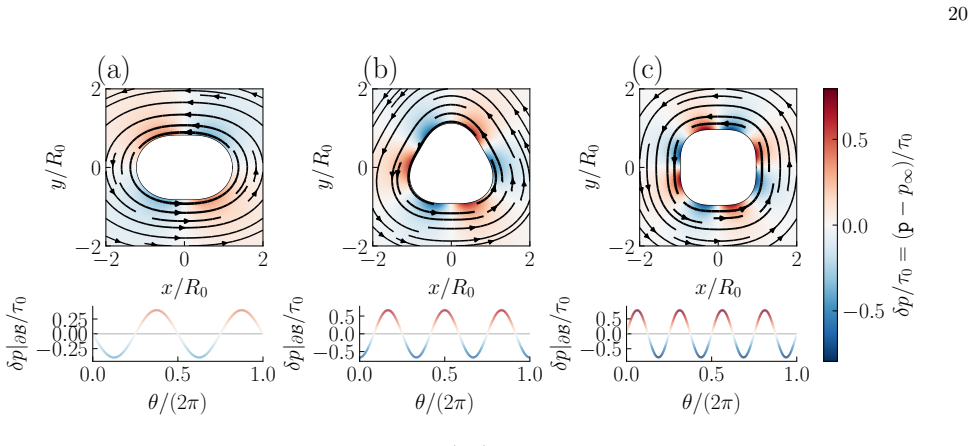
- In a dense chiral bath, a translating circular intruder experiences a lift force perpendicular to its velocity with Γ_xy ∝ τ0, independent of the Oseen logarithmic factor, so the antisymmetric response survives the Stokes paradox.
- A weakly non-circular intruder in a dense chiral bath experiences curvature-induced torque F_φ = π ε² τ0 R0² (m²−1)(m−2), leading to a steady angular velocity Ω = τ0(m−2)/(2ηm) that is independent of deformation amplitude at leading order.
Where Pith is reading between the lines
- If the dilute prediction of zero shape-induced odd damping is generic, then observing a finite Γ_xy at low densities in an achiral nonequilibrium bath gives a direct quantitative measure of intruder–bath correlations—a diagnostic that pure symmetry arguments cannot supply.
- The dense-regime formula suggests a design rule for chiral rotation or sorting: any smooth object with curvature variation placed in a bath with nonzero torque density τ0 should rotate even with perfect-slip surfaces, and the torque is maximized by tuning the symmetry index m of the shape.
- The two regimes imply a crossover in the origin of odd response—collision-driven at low density (∝ Δ) and edge-current/inertia-driven at high density (∝ τ0); measuring the sign and magnitude of Γ_xy as a function of bath density would test the proposed unified two-scale picture.
- The breakdown of the fluctuation-dissipation hierarchy at higher order implies that the third cumulant of intruder velocity fluctuations should show signatures of the discarded non-Gaussian noise C_ijk even when the second cumulant is well described by an effective temperature.
Editorial analysis
A structured set of objections, weighed in public.
Referee Report
Summary. The paper develops two complementary frameworks for a chiral intruder in a nonequilibrium bath. In the dilute regime, starting from a Boltzmann–Lorentz master equation and a van Kampen expansion in the bath-to-intruder mass ratio, it derives a linear Langevin equation whose damping, noise, and ratchet force/torque coefficients are given by explicit boundary integrals over the intruder shape. This is used to separate shape chirality (ratchet torque, no translational odd damping) from interaction chirality (odd damping, torque). In the dense regime, the bath is described by a chiral Navier–Stokes equation with a torque density that produces edge currents; the paper claims these currents generate an Oseen-type lift force and a curvature-induced torque. It also derives formal linear-response integral formulas for the damping matrix and shows that various fluctuation-dissipation-like relations hold only at leading order.
Significance. If the central claims hold, the paper would provide a useful, analytically explicit bridge between kinetic and hydrodynamic descriptions of chiral intruders, with concrete geometric formulas and a physical mechanism (torque-density edge currents) that is distinct from odd viscosity. The paper is unusually transparent about its approximations, including the uncontrolled truncation in the dilute theory and the discrepancy between its zero-odd-damping prediction and reported companion simulations. The explicit formulas for the damping matrix, the ratchet torque, and the Oseen lift force are potentially valuable for future experimental and numerical work. However, several load-bearing coefficients contain internal inconsistencies or rely on assumptions whose quantitative error is not assessed, so the current version is not yet a reliable reference for these predictions.
major comments (4)
- [Sec. II.C.2, Eqs. (52), (61)] The intruder temperature is defined as T_I = K3/(2K1)(1+α)^2 T_b, and the text immediately states that at equilibrium α=1 with a Gaussian bath (K3/(2K1)=1) one has T_I=T_b. With the displayed formula, however, T_I=4T_b. This inconsistent factor propagates into the ratchet force F_i^(α) ∝ (T_b−T_I) and into the fluctuation-dissipation relation D^(α)=2T_I Γ^(α). The correct prefactor appears to be (1+α)/2 (or (1+α)^2/4), not (1+α)^2. All temperature-dependent coefficients in Sec. III and Appendix E must be re-derived before the quantitative claims can be accepted.
- [Sec. II.C.1 and II.D] The derivation keeps the quadratic drift N_ijk while dropping E_ijk and C_ijk, which enter at the same order in the van Kampen expansion; the text calls this a standard approximation rather than a controlled truncation. The subsequent replacement of N_ijk U_j U_k by N_ijk S_lin_jk is a mean-field closure. Since the ratchet force in Eq. (57) is generated by this closure at a nominal order where a discarded term is equally important, the explicit coefficient of F_i is not a systematically derived result. The paper should provide a diagnostic—for example, the magnitude of the C_ijk contribution in a solvable limit, or a direct numerical estimate of the error in F_i—or clearly state that the ratchet coefficient is model-dependent at the same order as the neglected terms.
- [Sec. IV, Table I] One of the headline dilute results is the vanishing odd translational damping for a chiral intruder in an achiral nonequilibrium bath. The paper acknowledges in Sec. IV that companion MD simulations find a small but finite odd response generated by bath–intruder correlations. Because this vanishing coefficient is a central separation principle, the statement is only valid in the strict uncorrelated-collision limit. The authors should either provide a density-scaling estimate for the correction (e.g., whether it vanishes linearly with n_b) or explicitly reformulate the claim as a property of the Boltzmann–Lorentz model rather than a prediction for the dilute regime. Without such quantification, the clean two-mechanism picture remains a modeling outcome, not an established physical separation.
- [Sec. VII.D, Eq. (134)] With the sign conventions in Eqs. (82)–(83), a positive torque density τ0 produces a clockwise edge current uθ=−τ0R0^2/(2ηr). Using the displayed fields (122)–(127) in the boundary integral (128)–(131) gives Fφ = −π ε^2 τ0 R0^2 (m^2−1)(m−2), the opposite sign of Eq. (134). Consequently, Eq. (146) predicts a steady rotation counterclockwise to the edge current. If the authors use an opposite sign convention for Fφ, it should be stated; as written, the direction of the curvature-induced torque is inconsistent with the direction of the edge flow, and the sign of both the torque and the resulting angular velocity needs to be corrected or explicitly justified.
minor comments (3)
- [Sec. VII.A, Eqs. (109), (118)–(119)] The boundary perturbation contains a dimensional typo: for R(θ)=R0[1+εh(θ)], the normal is n = e_r − ε h'(θ) e_θ, not e_r − ε h'(θ)/R0 e_θ. The printed expansion appears to omit an R0 factor in the normal and boundary-condition terms. The final formulas for u_r and p suggest the authors used the correct expression downstream, but the displayed equations should be fixed.
- [Sec. II.B.3, Eq. (33)] The normalization of ψ(c) is not specified. Since the value of K3/(2K1) is used to set T_I and the text claims a value of 1 for a Gaussian bath, the definition of ψ in terms of the one-dimensional normal-velocity distribution should be written explicitly, including prefactors, to prevent a factor-of-two ambiguity.
- [General] The companion Letter [135] is cited for validation and for the MD observation of the small odd response, but the simulations are not available to the reader. The paper should include at least a brief statement of the simulation parameters and the measured odd-response magnitude, or state that the validation data are provided in the companion Letter and cannot be assessed independently.
Circularity Check
No significant circularity: the dilute Langevin coefficients are computed explicitly from a stated collision rule, the dense results are new calculations from a cited (self-authored) hydrodynamic framework, and the acknowledged correlation-induced limitation is stated transparently.
full rationale
The dilute derivation is self-contained: the authors state a collision rule (Eqs. 8–10) and a Boltzmann-Lorentz kernel (Eqs. 11–12), then compute Kramers–Moyal moments and organize them by a van Kampen small-mass expansion. The resulting Langevin coefficients (Eqs. 61–63) are explicit boundary integrals over shape-dependent vectors and bath velocity moments; no coefficient is fitted to the predicted odd response, ratchet torque, or damping. The vanishing of odd translational damping in the (α) sector follows algebraically from the symmetry of Q_ab (Sec. III / Appendix C), and the paper explicitly attributes any finite simulated odd response to correlations absent from the assumed kernel (Sec. IV). This is a clearly stated limitation of the model, not a circular definition of the result. In the dense regime, the chiral Navier–Stokes description is imported from Ref. 34, which shares an author with this paper, but that is a proper citation of a separate kinetic-theory derivation; the intruder-specific Oseen lift force (Eq. 107) and curvature-induced torque (Eq. 134) are new calculations from that framework, not reductions to their own outputs. The companion Letter [135] is cited for MD validation and for empirical limitations, not as a premise of the analytic derivation. I therefore find no step where a prediction is equivalent by construction to an input.
Axiom & Free-Parameter Ledger
free parameters (3)
- Δ (bath-intruder chiral tangential kick) =
not fitted; model parameter
- α (normal restitution coefficient) =
not fitted; model parameter
- τ0 (bulk torque density) =
not fitted; taken from prior kinetic theory
axioms (6)
- domain assumption Boltzmann-Lorentz master equation with instantaneous, binary, uncorrelated collisions
- ad hoc to paper Chiral collision rule of Eq. (9): J_t = 2(a + κ_t²/I)^{-1} Δ
- domain assumption Small-mass van Kampen expansion and weak chiral driving mΔ² ≪ T_b
- ad hoc to paper Gaussian closure: neglect E_ijk and C_ijk, average the quadratic drift using the linear covariance
- domain assumption Perfect-slip boundary condition and constant torque density τ0 at the intruder-fluid interface
- domain assumption Perturbative treatment: Oseen convection for lift, but no convection in the torque calculation of Sec. VII
read the original abstract
We study the chiral dynamics of an intruder immersed in a nonequilibrium bath in two complementary limits: the dilute kinetic regime and the dense hydrodynamic regime. In the dilute limit, starting from a Boltzmann-Lorentz description, we derive an effective Langevin equation whose coefficients are given explicitly by geometry-dependent boundary integrals. This formulation separates the effects of intruder-shape chirality from those of chiral intruder-bath interactions. We find that the chiral interactions generate an odd response and a torque, whereas the chirality of the intruder leads to a ratchet effect. We also show that fluctuation-dissipation-like relations exist and that certain symmetry-allowed couplings vanish in the dilute regime. In the dense regime, we argue that intruder dynamics are governed primarily by bath hydrodynamics and torque-density-driven edge currents not captured by the previous framework. These currents can generate both an antisymmetric drag and a curvature-induced torque, leading to an antisymmetric response when inertia is accounted for. Taken together, these results provide a step toward understanding the mechanisms governing the chiral dynamics of an intruder in a nonequilibrium bath across different scales.
Figures


Reference graph
Works this paper leans on
-
[1]
fluctuation
Generality In this Appendix, we clarify when the fluctuation- dissipation-like relations found in the main text hold. Since detailed balance is broken at the level of the Boltzmann-Lorentz equation, we cannot expect an equilibrium-like relation to persist at all orders in the expansionϵ. For simplicity, we focus on the case ∆ = 0. The analysis can be exte...
-
[2]
(45), ∂P ∂t =−∂ i [AiP] + 1 2 ∂i∂j [BijP]− 1 6 ∂i∂j∂k [Cijk P], (D1) where we recall that∂ i ≡∂ Πi
Expected hierarchy at equilibrium Consider the Kramers-Moyal equation truncated at third order, Eq. (45), ∂P ∂t =−∂ i [AiP] + 1 2 ∂i∂j [BijP]− 1 6 ∂i∂j∂k [Cijk P], (D1) where we recall that∂ i ≡∂ Πi . The truncation should be understood as the neglect of higher-order terms in a van Kampen expansion. We also discarded the reversible advective current, whic...
-
[3]
Theα-sector is simple: Γ(α) ab ∝ I dsˆna ˆnb =Q ab,(C12) which is symmetric and therefore doesnotgenerate odd transport, even for a chiral intruder
T ranslational damping:Γ ab. Theα-sector is simple: Γ(α) ab ∝ I dsˆna ˆnb =Q ab,(C12) which is symmetric and therefore doesnotgenerate odd transport, even for a chiral intruder. This differs from Ref. 133, where odd transport arises in an achiral nonequilibrium bath with a chiral intruder. As we ex- plain below, the vanishing found here follows from the a...
-
[4]
preserves the fluctuation in the force but changes the sign of the torque
T ranslational-rotation damping:Γ aφ. The mixed blocks follow directly from the definitions: Γ(α) φa ∝ I dsκn ˆna =W a,Γ (α) aφ ∝ I dsˆnaκn =W a, (C19) so theα-sector is symmetric in the translation-rotation couplings, Γ(α) aφ = Γ(α) φa .(C20) For the ∆-sector, however, Γ(∆) φa ∝ I dsκt ˆna =S a,(C21) Γ(∆) aφ ∝ I dsκnˆta =T a =ε abWb.(C22) 28 These two ve...
-
[5]
For the rotation damping in the normal sector, we find: Γ(α) φφ ∝ I dsκ2 n =H n >0,(C37) where positivity is immediate
Rotation damping:Γ φφ. For the rotation damping in the normal sector, we find: Γ(α) φφ ∝ I dsκ2 n =H n >0,(C37) where positivity is immediate. The chiral contribution is Γ(∆) φφ ∝ −∆ I dsκtκn =−H t∆.(C38) The scalarH t changes sign under reflection and there- fore vanishes for any achiral body. A nonzero Γ (∆) φφ thus requires a chiral shape. Once again, ...
-
[6]
In the dissipative sector, we find, D(α) ij = 2TI Γ(α) ij ,(C40) which is a fluctuation-dissipation relation for theα- sector
Diffusion tensor:D ij The diffusion tensor is constructed from similar geo- metric objects. In the dissipative sector, we find, D(α) ij = 2TI Γ(α) ij ,(C40) which is a fluctuation-dissipation relation for theα- sector. Note, however, that the temperatureT I is not the same as that of the bathT b for a nonequilibrium dy- namics. Moreover,T I corresponds to...
-
[7]
ratchet effect
Violation of detailed balance and the higher-order fluctuation relations in a nonequilibrium bath From the coefficients derived in the main text, we have at ∆ = 0: Ri = 1 +α 2 nbmTbϵ I dsµne(n) i ,(D9) Γij = 2(1 +α)K 1nb p mTb ϵ1/2 I dse(n) i e(n) j ,(D10) Nijk =− 1 +α 2 nbmϵ I dse(n) i e(n) j e(n) k ,(D11) Dij = (1 +α) 2K3nbTb p mTbϵ1/2 I dse(n) i e(n) j...
-
[8]
At lowest order, all fluctuation relations can still be recov- ered by introducing an effective temperature for each sec- tor [202]
Discussion To summarize, the fluctuation-dissipation theorem de- rived in the main text for each sector ceases to hold be- yond leading order in the van Kampen expansion. At lowest order, all fluctuation relations can still be recov- ered by introducing an effective temperature for each sec- tor [202]. At higher orders, however, this description breaks do...
-
[9]
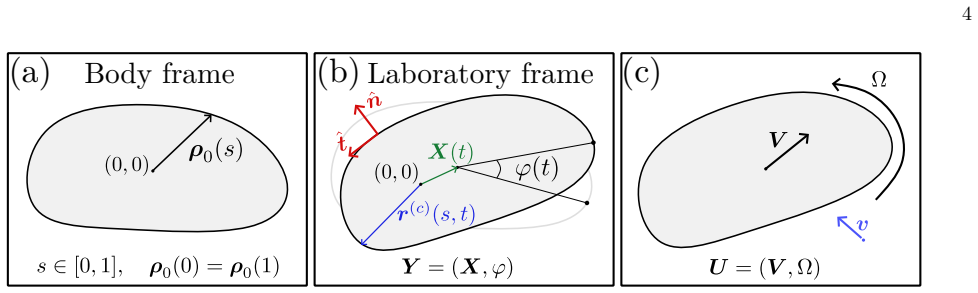
Body frame and laboratory frame We denote the body frame quantities with a tilde. For example, an intruder with a triangle shape will have on average⟨F y⟩ ≡ ⟨Flaboratory y ⟩= 0 because of isotropy, but if we always rotate the intruder to a fixed angle, then ˜Fy, the force in a given direction in the body frame, might not be 0 on average, for example becau...
-
[10]
If the bath particles are hard disks of diameterσ, their centers cannot approach the intruder closer than a distanceσ/2
Finite bath-particle size and Minkowski sum The Boltzmann-Lorentz description (11) was written for point-like bath particles. If the bath particles are hard disks of diameterσ, their centers cannot approach the intruder closer than a distanceσ/2. The relevant excluded region for the bath-particle centers is therefore not the intruder shapeB, but its Minko...
-
[11]
Regular polygon withnvertices A simple intruder is a polygon withnverticesv j placed at a distanceRfrom the origin: vj =R(cos(2πj/n),sin(2πj/n)), j= 0, . . . , n−1. (E9) 33 The casen= 3 yields an equilateral triangle,n= 4 a square, and in the limitn→ ∞a circle is recovered. Its side lengthℓ, perimeterP, and areaAare ℓ= 2Rsin π n ,P= 2nRsin π n , A= n 2 R2...
-
[12]
The vertices are v2j =R(cos 2πj/n,sin 2πj/n),v 2j+1 =r(cos(2πj/n+δ),sin(2πj/n+δ)), j= 0,
Chiral and achiral wheel We now consider a possibly chiral intruder, modeled as a wheel withnteeth,i.e., a 2n-vertex polygon, with alternating outer and inner radiiRandr. The vertices are v2j =R(cos 2πj/n,sin 2πj/n),v 2j+1 =r(cos(2πj/n+δ),sin(2πj/n+δ)), j= 0, . . . , n−1.(E26) The wheel is achiral when the inner vertices lie halfway between successive out...
-
[13]
Polar triangle Finally, we consider an isosceles triangle whose symmetry axis is the body frameyaxis (pointing from the base toward the apex, or the opposite). With the center of mass at the origin, a convenient choice of vertices is A= − a 2 ,− h 3 , B= a 2 ,− h 3 , C= 0, 2h 3 ,(E50) and the perimeter is P=a+ 2ℓ, ℓ≡ r h2 + a2 4 .(E51) In the body frame, ...
-
[14]
(106) perturbatively in the chiral Reynolds number
Passive Oseen solution We solve Eq. (106) perturbatively in the chiral Reynolds number. We first introduce R= r R0 , X= x R0 ,u (T) =U ∞Q,¯p (T) =ρ bU 2 ∞Π,Re ∞ = ρbU∞R0 η , δ= Re ∞/2,Re χ ≡ ρbc η .(F1) Eq. (106) becomes ∂X Q=−∇Π+ 1 2δ ∇2Q− Reχ R (∇×Q) z ˆer ,∇·Q= 0.(F2) We writeQ=Q (0) +Q (1) +O(Re 2 χ), whereQ (1) =O(Re χ). The passive fieldQ (0) obeys ...
-
[15]
(F2), we obtain ∇2 −2δ∂ X Ω + Reχ R2 ∂θΩ = 0,Ω = (∇×Q) z.(F11) The second term describes the advection of the translational vorticity by the circular edge current
Chiral correction Taking the curl of Eq. (F2), we obtain ∇2 −2δ∂ X Ω + Reχ R2 ∂θΩ = 0,Ω = (∇×Q) z.(F11) The second term describes the advection of the translational vorticity by the circular edge current. In the inner Oseen region, 1≲R≪δ −1, the total passive translational flowU ∞ +u (T,0) has streamfunction ψ(0)(R, θ) =U∞R0 Λ RlogRsinθ+O U∞R0 Λ2 , U∞R0δR...
-
[16]
cos(θ) + 1 δΛ R0 r − 1 Λ eδRcos(θ) K1(δR) + cos(θ)K0(δR) − Φχ(R) R sin(θ) # ,(F30) U∞ · ˆeθ +u (T) θ (r, θ) =U∞
V elocity and pressure fields Putting everything together, we obtain the translational fields in the inner Oseen region, 1≲R≪δ −1, perturba- tively in the chiral Reynolds number Re χ. It is convenient to introduce the first-order streamfunction correction Φχ(R) = q 2 R− 1 R +CRlogR+qR(logR) 2, q= Reχ 4Λ , C=− Reχ 4 +O Reχ Λ , R= r R0 ,(F28) whose radial d...
-
[17]
M. Fruchart and V. Vitelli, Nonreciprocal many-body physics, arXiv:2602.11111 (2026)
arXiv 2026
-
[18]
I. H. Riedel, K. Kruse, and J. Howard, A self-organized vortex array of hydrodynamically entrained sperm cells, Science309, 300 (2005)
2005
-
[19]
B. M. Friedrich and F. J¨ ulicher, Chemotaxis of sperm cells, Proceedings of the National Academy of Sciences 104, 13256 (2007)
2007
-
[20]
Grober, I
D. Grober, I. Palaia, M. C. U¸ car, E. Hannezo, A.ˇSari´ c, and J. Palacci, Unconventional colloidal aggregation in chiral bacterial baths, Nature Physics19, 1680 (2023)
2023
-
[21]
Nishiguchi, S
D. Nishiguchi, S. Shiratani, K. A. Takeuchi, and I. S. Aranson, Vortex reversal is a precursor of confined bac- terial turbulence, Proceedings of the National Academy of Sciences122, e2414446122 (2025)
2025
-
[22]
Villalobos-Concha, Z
C. Villalobos-Concha, Z. Liu, G. Ramos, M. Goral, A. Lindner, T. L´ opez-Le´ on, E. Cl´ ement, R. Soto, and M. L. Cordero, Active bacterial baths in droplets, Pro- ceedings of the National Academy of Sciences122, e2426096122 (2025)
2025
-
[23]
Di Leonardo, D
R. Di Leonardo, D. Dell’Arciprete, L. Angelani, and V. Iebba, Swimming with an image, Physical Review Letters106, 038101 (2011)
2011
-
[24]
K. A. Takeuchi and D. Nishiguchi, Various phases of active matter emerging from bacteria and their implica- tions, arXiv: 2604.13575 (2026)
Pith/arXiv arXiv 2026
-
[25]
Afroze, D
F. Afroze, D. Inoue, T. I. Farhana, T. Hiraiwa, R. Akiyama, A. M. R. Kabir, K. Sada, and A. Kakugo, Monopolar flocking of microtubules in collective motion, Biochemical and biophysical research communications 563, 73 (2021)
2021
-
[26]
S. Chen, D. E. G¨ okmen, M. Fruchart, M. Krumbein, P. Silberzan, V. Yashunsky, and V. Vitelli, Chiral- ity across scales in tissue dynamics, arXiv:2506.12276 (2025)
Pith/arXiv arXiv 2025
-
[27]
Yashunsky, D
V. Yashunsky, D. Pearce, C. Blanch-Mercader, F. As- cione, P. Silberzan, and L. Giomi, Chiral edge current in nematic cell monolayers, Physical Review X12, 041017 (2022)
2022
-
[28]
L. A. Hoffmann, K. Schakenraad, R. M. Merks, and L. Giomi, Chiral stresses in nematic cell monolayers, Soft matter16, 764 (2020). 42
2020
-
[29]
Inaki, J
M. Inaki, J. Liu, and K. Matsuno, Cell chirality: its origin and roles in left–right asymmetric development, Philosophical Transactions of the Royal Society B: Bio- logical Sciences371(2016)
2016
-
[30]
T. Juan, C. G´ eminard, J.-B. Coutelis, D. Cerezo, S. Pol` es, S. Noselli, and M. F¨ urthauer, Myosin1d is an evolutionarily conserved regulator of animal left–right asymmetry, Nature communications9, 1942 (2018)
1942
-
[31]
J. Fan, P. Ray, Y. W. Lu, G. Kaur, J. J. Schwarz, and L. Q. Wan, Cell chirality regulates intercellular junc- tions and endothelial permeability, Science Advances4, eaat2111 (2018)
2018
-
[32]
Novak, B
M. Novak, B. Polak, J. Simuni´ c, Z. Boban, B. Kuzmi´ c, A. W. Thomae, I. M. Toli´ c, and N. Pavin, The mitotic spindle is chiral due to torques within microtubule bun- dles, Nature communications9, 3571 (2018)
2018
-
[33]
C. W. Chan, D. Wu, K. Qiao, K. L. Fong, Z. Yang, Y. Han, and R. Zhang, Chiral active particles are sensi- tive reporters to environmental geometry, Nature com- munications15, 1406 (2024)
2024
-
[34]
Xu, T.-C
G.-h. Xu, T.-C. Li, and B.-q. Ai, Sorting of chiral ac- tive particles by a spiral shaped obstacle, Physica A: Statistical Mechanics and its Applications608, 128247 (2022)
2022
-
[35]
Q. Yang, H. Zhu, P. Liu, R. Liu, Q. Shi, K. Chen, N. Zheng, F. Ye, and M. Yang, Topologically protected transport of cargo in a chiral active fluid aided by odd- viscosity-enhanced depletion interactions, Physical Re- view Letters126, 198001 (2021)
2021
-
[36]
Valecha, H
B. Valecha, H. Vahid, P. L. Muzzeddu, J.-U. Sommer, and A. Sharma, Active transport of cargo-carrying and interconnected chiral particles, Soft Matter21, 3384 (2025)
2025
-
[37]
Fruchart, C
M. Fruchart, C. Scheibner, and V. Vitelli, Odd viscosity and odd elasticity, Annual Review of Condensed Matter Physics14, 471 (2023)
2023
-
[38]
Banerjee, A
D. Banerjee, A. Souslov, A. G. Abanov, and V. Vitelli, Odd viscosity in chiral active fluids, Nature communi- cations8, 1573 (2017)
2017
-
[39]
Markovich and T
T. Markovich and T. C. Lubensky, Odd viscosity in ac- tive matter: Microscopic origin and 3d effects, Physical Review Letters127, 048001 (2021)
2021
-
[40]
Markovich and T
T. Markovich and T. C. Lubensky, Chiral active fluids: Insights from the total momentum, Physical Review E 112, 035409 (2025)
2025
-
[41]
Avron, Odd viscosity, Journal of Statistical Physics 92, 543 (1998)
J. Avron, Odd viscosity, Journal of Statistical Physics 92, 543 (1998)
1998
-
[42]
Hargus, J
C. Hargus, J. M. Epstein, and K. K. Mandadapu, Odd diffusivity of chiral random motion, Physical Review Letters127, 178001 (2021)
2021
-
[43]
T. H. Tan, A. Mietke, J. Li, Y. Chen, H. Higinbotham, P. J. Foster, S. Gokhale, J. Dunkel, and N. Fakhri, Odd dynamics of living chiral crystals, Nature607, 287 (2022)
2022
-
[44]
Faedi, E
F. Faedi, E. Kalz, R. Metzler, and A. Sharma, A mo- bility based approach to transport in chiral fluids, New Journal of Physics28, 063501 (2026)
2026
-
[45]
E. Kalz, H. D. Vuijk, I. Abdoli, J.-U. Sommer, H. L¨ owen, and A. Sharma, Collisions enhance self- diffusion in odd-diffusive systems, Physical Review Let- ters129, 090601 (2022)
2022
-
[46]
E. Kalz, H. D. Vuijk, J.-U. Sommer, R. Metzler, and A. Sharma, Oscillatory force autocorrelations in equi- librium odd-diffusive systems, Physical Review Letters 132, 057102 (2024)
2024
-
[47]
E. Kalz, S. Ravichandir, J. Birkenmeier, R. Metzler, and A. Sharma, Reversal of tracer advection and hall drift in an interacting chiral fluid, Phys. Rev. E113, L042104 (2026)
2026
-
[48]
M. Fruchart, M. Han, C. Scheibner, and V. Vitelli, The odd ideal gas: Hall viscosity and thermal conductiv- ity from non-hermitian kinetic theory, arXiv:2202.02037 (2022)
Pith/arXiv arXiv 2022
-
[49]
Y. Jiao, Q. Yang, and M. Yang, Colloidal phoresis in odd fluids, arXiv:2603.28169 (2026)
arXiv 2026
-
[50]
Maire, A
R. Maire, A. Petrini, U. Marini Bettolo Marconi, and L. Caprini, Kinetic theory of chiral active disks: Odd transport and torque density, The Journal of Chemical Physics165, 034501 (2026)
2026
-
[51]
R. Lier and P. Matus, Chapman-enskog expansion for chirally colliding disks, arXiv:2602.21367 (2026)
arXiv 2026
-
[52]
E. Eren, M. Fruchart, and V. Vitelli, A collisional model of odd fluids: from boltzmann equation to chiral hydro- dynamics, arXiv:2508.12944 (2025)
Pith/arXiv arXiv 2025
-
[53]
Scheibner, A
C. Scheibner, A. Souslov, D. Banerjee, P. Sur´ owka, W. T. Irvine, and V. Vitelli, Odd elasticity, Nature Physics16, 475 (2020)
2020
-
[54]
C.-T. Lee, T. C. Lubensky, and T. Markovich, Odd elas- ticity in disordered chiral active materials, Phys. Rev. Lett. (2026)
2026
-
[55]
U. M. B. Marconi and L. Caprini, Spontaneous genera- tion of angular momentum in chiral active crystals, Soft Matter21, 2586 (2025)
2025
-
[56]
S. Kole, G. P. Alexander, A. Maitra, and S. Ra- maswamy, Chirality and odd mechanics in active colum- nar phases, PNAS nexus3, pgae398 (2024)
2024
-
[57]
Caprini and U
L. Caprini and U. M. B. Marconi, Active chiral particles under confinement: Surface currents and bulk accumu- lation phenomena, Soft Matter15, 2627 (2019)
2019
-
[58]
C. B. Caporusso, G. Gonnella, and D. Levis, Phase co- existence and edge currents in the chiral lennard-jones fluid, Physical Review Letters132, 168201 (2024)
2024
-
[59]
V. Soni, E. S. Bililign, S. Magkiriadou, S. Sacanna, D. Bartolo, M. J. Shelley, and W. T. Irvine, The odd free surface flows of a colloidal chiral fluid, Nature physics 15, 1188 (2019)
2019
- [60]
-
[61]
Shankar, A
S. Shankar, A. Souslov, M. J. Bowick, M. C. Marchetti, and V. Vitelli, Topological active matter, Nature Re- views Physics4, 380 (2022)
2022
-
[62]
Langford and A
L. Langford and A. K. Omar, Phase separation, cap- illarity, and odd-surface flows in chiral active matter, Physical Review Letters134, 068301 (2025)
2025
-
[63]
J. Metzger, C. Hargus, J. Tailleur, and F. van Wijland, Equation of state for the edge flow of chiral colloidal fluids, arXiv:2604.18708 (2026)
Pith/arXiv arXiv 2026
-
[64]
S. Burekovi´ c, S. Kole, A. Maitra, and C. Nardini, Bulk and microphase separation in chiral active systems, arXiv:2607.12045 (2026)
Pith/arXiv arXiv 2026
-
[65]
Mecke, Y
J. Mecke, Y. Gao, G. Gompper, and M. Ripoll, Chi- ral active systems near a substrate: Emergent damp- ing length controlled by fluid friction, Communications Physics7, 332 (2024)
2024
-
[66]
Beppu and Y
K. Beppu and Y. T. Maeda, Exploring order in active turbulence: Geometric rule and pairing order transition in confined bacterial vortices, Biophysics and physico- 43 biology19, e190020 (2022)
2022
-
[67]
L¨ owen, Chirality in microswimmer motion: From cir- cle swimmers to active turbulence, The European Phys- ical Journal Special Topics225, 2319 (2016)
H. L¨ owen, Chirality in microswimmer motion: From cir- cle swimmers to active turbulence, The European Phys- ical Journal Special Topics225, 2319 (2016)
2016
-
[68]
Caprini and U
L. Caprini and U. Marini Bettolo Marconi, Bubble phase induced by odd interactions in chiral systems, The Journal of Chemical Physics162, 161101 (2025)
2025
-
[69]
Shen and J
Z. Shen and J. S. Lintuvuori, Collective flows drive cav- itation in spinner monolayers, Physical Review Letters 130, 188202 (2023)
2023
-
[70]
Digregorio, I
P. Digregorio, I. Pagonabarraga, and F. Vega Reyes, Phase separation in a chiral active fluid of inertial self- spinning disks, Phys. Rev. Lett.136, 218301 (2026)
2026
-
[71]
Guo, J.-j
R.-x. Guo, J.-j. Li, and B.-q. Ai, Chirality-induced phase separation and collective dynamics in binary mixtures of chiral particles, Physical Review E111, 045423 (2025)
2025
-
[72]
Guo, M.-z
R.-x. Guo, M.-z. Dai, J.-j. Li, and B.-q. Ai, Tuning nonequilibrium phases with odd forces: From crystalline order to vortex structures in systems with competing in- teractions, Physical Review E113, 024110 (2026)
2026
-
[73]
A. Shee, S. Henkes, and C. Huepe, Emergent mesoscale correlations in active solids with noisy chiral dynamics, Soft Matter20, 7865 (2024)
2024
-
[74]
X. M. de Wit, M. Fruchart, T. Khain, F. Toschi, and V. Vitelli, Pattern formation by turbulent cascades, Na- ture627, 515 (2024)
2024
-
[75]
Maitra, M
A. Maitra, M. Lenz, and R. Voituriez, Chiral active hexatics: Giant number fluctuations, waves, and de- struction of order, Physical Review Letters125, 238005 (2020)
2020
-
[76]
Musacchio, A
M. Musacchio, A. P. Antonov, H. L¨ owen, and L. Caprini, Circling crystals in chiral active matter with self-alignment, Soft Matter (2026)
2026
-
[77]
Zhang, A
B. Zhang, A. Sokolov, and A. Snezhko, Reconfigurable emergent patterns in active chiral fluids, Nature com- munications11, 4401 (2020)
2020
-
[78]
F. Gu, B. Guiselin, N. Bain, I. Zuriguel, and D. Bartolo, Emergence of collective oscillations in massive human crowds, Nature638, 112 (2025)
2025
-
[79]
Ventejou, H
B. Ventejou, H. Chat´ e, R. Montagne, and X.-q. Shi, Susceptibility of orientationally ordered active matter to chirality disorder, Phys. Rev. Lett.127, 238001 (2021)
2021
-
[80]
Kuroda and K
Y. Kuroda and K. Miyazaki, Microscopic theory for hyperuniformity in two-dimensional chiral active fluid, Journal of Statistical Mechanics: Theory and Experi- ment2023, 103203 (2023)
2023
discussion (0)
Sign in with ORCID, Apple, or X to comment. Anyone can read and Pith papers without signing in.