Impact of the axion-like self-interactions in gravitational atoms for LISA
Pith reviewed 2026-05-19 22:58 UTC · model grok-4.3
The pith
Axion-like particles forming halos around black holes cause detectable dephasing in LISA waveforms from inspiraling binaries.
A machine-rendered reading of the paper's core claim, the machinery that carries it, and where it could break.
Core claim
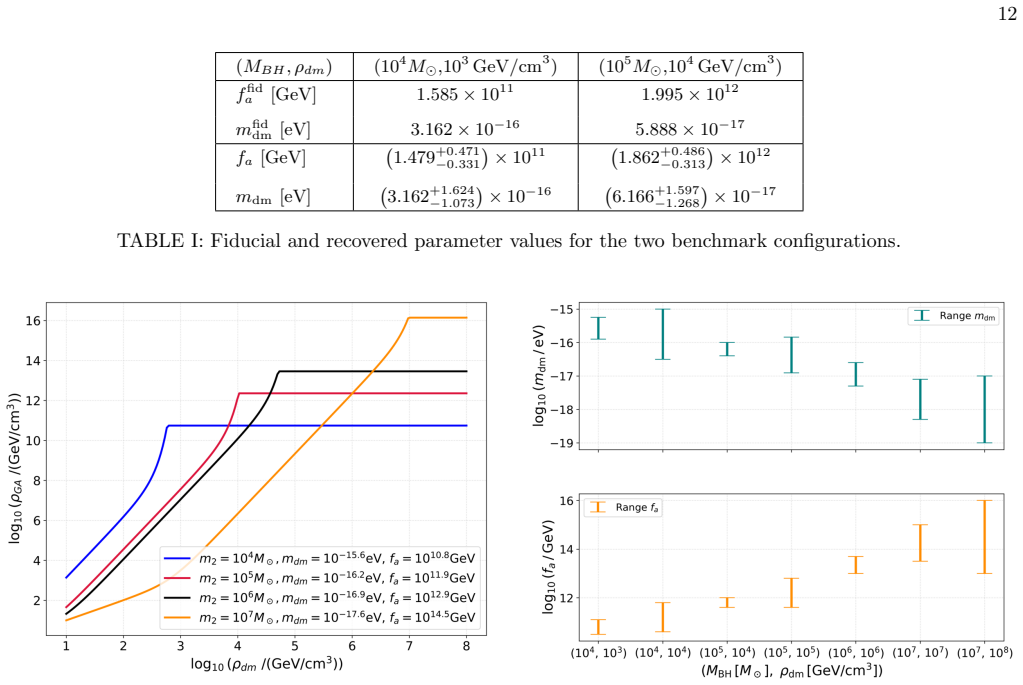
The paper shows that binaries embedded in these axion-like halos produce gravitational waveforms distinguishable by LISA for signal-to-noise ratios below about 100. The distinction comes from extra dephasing caused by dynamical friction in the halo overdensity. This lets LISA probe boson masses from 10^{-17} to 10^{-15} eV and decay constants from 10^{10} to 3.2 times 10^{12} GeV for total binary masses of 10^4 to 10^5 solar masses, under conservative densities taken from the centers of Navarro-Frenk-White profiles. For a binary with total mass near 10^4 solar masses, halo density of 10^3 GeV per cubic centimeter, and signal-to-noise ratio of 20, the values m_dm approximately 2.5 times 10^{-
What carries the argument
Dynamical friction on the secondary object from the overdense gravitational atom halo of self-interacting ultralight bosons surrounding the primary black hole.
If this is right
- LISA can distinguish waveforms from binaries in such halos for signal-to-noise ratios up to about 100.
- The accessible parameter space covers boson masses from 10^{-17} to 10^{-15} eV and decay constants from 10^{10} to 3.2 times 10^{12} GeV for binary masses between 10^4 and 10^5 solar masses.
- A specific configuration with total mass 10^4 solar masses, density 10^3 GeV per cubic centimeter, and signal-to-noise ratio 20 allows percent-level recovery of the particle parameters at m_dm approximately 2.5 times 10^{-16} eV and f_a approximately 6.3 times 10^{10} GeV.
- Higher background densities or different extreme-mass-ratio setups would extend the range of boson properties that can be probed.
Where Pith is reading between the lines
- This approach could provide independent bounds on ultralight dark matter candidates using only gravitational wave observations.
- Similar dephasing calculations might apply to other proposed halo formation channels or to future detectors with different sensitivity bands.
- If the assumed formation densities prove too high in reality, the detectable mass window would shrink toward higher boson masses or stronger self-interactions.
Load-bearing premise
The dynamical formation mechanism must produce halo background densities at least as high as the central values of Navarro-Frenk-White profiles, otherwise the friction dephasing drops below detectable levels for the signal strengths considered.
What would settle it
A LISA detection of an extreme-mass-ratio inspiral with total mass near 10^4 solar masses, signal-to-noise ratio near 20, and local density near 10^3 GeV per cubic centimeter that shows no excess dephasing matching the predicted maximum for m_dm of 2.5 times 10^{-16} eV and f_a of 6.3 times 10^{10} GeV would falsify the claim that such halos produce observable effects under the stated assumptions.
Figures




read the original abstract
Ultralight bosons with self-interactions, such as axion-like particles, can form astrophysical Bose-Einstein condensates around stars or compact objects, often referred to as gravitational atoms. In this work, we adopt a recently proposed dynamical formation mechanism for these halos and estimate their impact on extreme- and intermediate-mass-ratio inspirals when present around the primary black hole. We show that, for signal-to-noise ratios $\lesssim 100$, LISA can distinguish gravitational waveforms from binaries embedded in such halo overdensities. Our analysis indicates that LISA can probe boson masses $m_\mathrm{dm}\sim10^{-17}$-$10^{-15}\,\mathrm{eV}$ and decay constants $f_a\sim10^{10}$-$3.2 \times 10^{12}\,\mathrm{GeV}$ using binaries with total masses $M\sim10^4$-$10^5\,M_\odot$, assuming conservative DM densities consistent with the central values of Navarro-Frenk-White profiles. Allowing for higher background densities and different extreme-mass-ratio configurations further extends the accessible parameter space. Moreover, we find that for a binary configuration with $M\sim10^4\,M_\odot$, $\rho_\mathrm{dm} = 10^3\,\mathrm{GeV/cm^3}$, and signal-to-noise ratio $\mathrm{SNR}\sim20$, a particle mass of $m_\mathrm{dm}\sim2.5\times10^{-16}\,\mathrm{eV}$ and decay constant $f_a\sim6.3\times10^{10}\,\mathrm{GeV}$ maximize the dephasing due to dynamical friction, enabling the recovery of the particle parameters at the percent level. These results demonstrate that LISA can place constraints on axion-like particle masses and self-interactions without requiring additional couplings to Standard Model fields.
Editorial analysis
A structured set of objections, weighed in public.
Referee Report
Summary. The manuscript examines the effects of axion-like particles with self-interactions forming gravitational atom halos around the primary black hole in extreme- and intermediate-mass-ratio inspirals. Adopting a recently proposed dynamical formation mechanism, the authors estimate dynamical-friction-induced dephasing and conclude that LISA can distinguish the resulting waveforms from vacuum ones for SNR ≲ 100. They claim LISA can probe boson masses m_dm ∼ 10^{-17}–10^{-15} eV and decay constants f_a ∼ 10^{10}–3.2×10^{12} GeV for total binary masses M ∼ 10^4–10^5 M_⊙ assuming Navarro-Frenk-White central densities, and that for the benchmark M ∼ 10^4 M_⊙, ρ_dm = 10^3 GeV/cm³, SNR ∼ 20 the values m_dm ∼ 2.5×10^{-16} eV and f_a ∼ 6.3×10^{10} GeV maximize dephasing and permit percent-level parameter recovery.
Significance. If the adopted halo densities are realized and the dephasing estimates prove robust, the results would provide a concrete pathway for LISA to constrain ultralight axion-like particles via gravitational-wave dephasing without requiring Standard-Model couplings. The explicit use of a dynamical formation channel supplies a physically motivated setup rather than an ad-hoc overdensity. The significance is nevertheless limited by the lack of an independent density calculation under self-interactions and by the parameter-selection procedure used for the recovery claim.
major comments (3)
- [Results on dephasing maximization and parameter recovery] The headline claim of percent-level recovery for m_dm ∼ 2.5×10^{-16} eV and f_a ∼ 6.3×10^{10} GeV (abstract and associated results) is obtained by identifying the parameter pair that maximizes dephasing for fixed ρ_dm and SNR. This procedure is, by construction, a scan over the same quantities that define the signal, rendering the recovery dependent on the input assumptions rather than an independent test of the model.
- [Halo density and formation mechanism section] The analysis adopts ρ_dm = 10^3 GeV/cm³ as a conservative central value of an NFW profile produced by the dynamical formation mechanism, yet provides no explicit calculation of the equilibrium density profile of the self-interacting soliton or halo once the binary potential is present. Because the self-interaction term depends on f_a, this omission leaves open the possibility that the effective density (and therefore the integrated dephasing) is substantially lower than assumed, undermining the detectability statements for SNR ≲ 100.
- [Waveform and dephasing calculation section] The distinguishability claim for SNR ≲ 100 and the quoted parameter ranges rest on dephasing estimates without an explicit waveform model, propagated uncertainties, or comparison to full numerical-relativity waveforms. This makes it difficult to quantify how robust the separation from vacuum templates remains once higher-order effects and detector noise are included.
minor comments (2)
- Notation for m_dm and f_a should be made uniform between the abstract, main text, and any tables or figures that report the benchmark values.
- [Dynamical friction subsection] A brief statement clarifying whether the dynamical-friction force formula already incorporates the self-interaction potential or is taken from the non-interacting limit would improve readability.
Simulated Author's Rebuttal
We thank the referee for their careful reading and constructive comments on our manuscript. We address each major comment point by point below, providing clarifications and indicating revisions to strengthen the presentation of our results.
read point-by-point responses
-
Referee: [Results on dephasing maximization and parameter recovery] The headline claim of percent-level recovery for m_dm ∼ 2.5×10^{-16} eV and f_a ∼ 6.3×10^{10} GeV (abstract and associated results) is obtained by identifying the parameter pair that maximizes dephasing for fixed ρ_dm and SNR. This procedure is, by construction, a scan over the same quantities that define the signal, rendering the recovery dependent on the input assumptions rather than an independent test of the model.
Authors: We thank the referee for this observation. The parameter pair is selected specifically to identify the values that maximize the dephasing effect for the fixed density and SNR, thereby indicating the region of strongest potential signal within our assumptions. This is not presented as a blind or model-independent recovery but as an illustration of the maximum impact and associated precision. In the revised manuscript we have clarified the wording in the abstract and results to emphasize that this choice highlights the most detectable case rather than constituting a full independent test. revision: yes
-
Referee: [Halo density and formation mechanism section] The analysis adopts ρ_dm = 10^3 GeV/cm³ as a conservative central value of an NFW profile produced by the dynamical formation mechanism, yet provides no explicit calculation of the equilibrium density profile of the self-interacting soliton or halo once the binary potential is present. Because the self-interaction term depends on f_a, this omission leaves open the possibility that the effective density (and therefore the integrated dephasing) is substantially lower than assumed, undermining the detectability statements for SNR ≲ 100.
Authors: We agree that an explicit equilibrium calculation including the binary potential and f_a-dependent self-interactions would be desirable for full self-consistency. The adopted density follows from the dynamical formation mechanism and is chosen as a conservative NFW-consistent value. We have added a discussion paragraph noting this assumption and estimating that even with moderate density reductions the dephasing remains detectable at the quoted SNRs for the upper parameter ranges. A complete numerical equilibrium solution is beyond the present scope but is identified as a target for future work. revision: partial
-
Referee: [Waveform and dephasing calculation section] The distinguishability claim for SNR ≲ 100 and the quoted parameter ranges rest on dephasing estimates without an explicit waveform model, propagated uncertainties, or comparison to full numerical-relativity waveforms. This makes it difficult to quantify how robust the separation from vacuum templates remains once higher-order effects and detector noise are included.
Authors: The distinguishability is based on the accumulated phase shift from dynamical friction exceeding the threshold set by the LISA noise curve at the given SNRs. We have expanded the relevant section to include additional details on the integration procedure and a basic propagation of density uncertainties. While a full NR waveform comparison lies outside this semi-analytic study, the leading-order dephasing provides a conservative estimate; higher-order contributions are expected to increase rather than reduce the separation from vacuum templates. revision: partial
Circularity Check
Maximization over m_dm and f_a for peak dephasing reframed as enabling percent-level recovery
specific steps
-
fitted input called prediction
[Abstract]
"Moreover, we find that for a binary configuration with M∼10^4 M_⊙, ρ_dm = 10^3 GeV/cm^3, and signal-to-noise ratio SNR∼20, a particle mass of m_dm∼2.5×10^{-16} eV and decay constant f_a∼6.3×10^{10} GeV maximize the dephasing due to dynamical friction, enabling the recovery of the particle parameters at the percent level."
The quoted values of m_dm and f_a are obtained by maximizing dephasing for the given ρ_dm and SNR; the subsequent claim that these parameters enable percent-level recovery is therefore tied directly to the maximization procedure over the same parameters that define the signal strength, making the recovery statement a restatement of the optimization rather than an independent prediction.
full rationale
The paper selects specific m_dm and f_a values by maximizing dynamical-friction dephasing for fixed ρ_dm and SNR, then states that these values enable percent-level parameter recovery. This reduces the recovery claim to the outcome of the same search used to define the strongest signal, rather than an independent test of detectability across the space. The density assumption from the adopted formation mechanism is stated but not re-derived under self-interactions, yet the circularity flag is limited to the explicit maximization step quoted in the abstract.
Axiom & Free-Parameter Ledger
free parameters (2)
- dark matter density rho_dm =
10^3 GeV/cm^3 (example)
- signal-to-noise ratio SNR =
20
axioms (2)
- domain assumption Navarro-Frenk-White (NFW) profiles supply the background dark matter density around the primary black hole.
- domain assumption The recently proposed dynamical formation mechanism produces stable gravitational-atom halos with the assumed overdensities.
invented entities (1)
-
gravitational atom
no independent evidence
Lean theorems connected to this paper
-
IndisputableMonolith/Cost/FunctionalEquation.leanwashburn_uniqueness_aczel unclear?
unclearRelation between the paper passage and the cited Recognition theorem.
V(ϕ)=−m²_dm f_a² cos(ϕ/f_a) expanded to quadratic+quartic; Gross-Pitaevskii eq. (10); density ρ(r,t)=C0/π a0³ exp(Γt) exp(−2r/a0); dephasing δϕ from dynamical friction term in Eq. (33)
-
IndisputableMonolith/Foundation/RealityFromDistinction.leanreality_from_one_distinction unclear?
unclearRelation between the paper passage and the cited Recognition theorem.
Bohr radius a0=1/(M_BH m_dm²); critical density ρ_crit=16 f_a² m_dm⁴ M_BH²; formation timescale τ_crit
What do these tags mean?
- matches
- The paper's claim is directly supported by a theorem in the formal canon.
- supports
- The theorem supports part of the paper's argument, but the paper may add assumptions or extra steps.
- extends
- The paper goes beyond the formal theorem; the theorem is a base layer rather than the whole result.
- uses
- The paper appears to rely on the theorem as machinery.
- contradicts
- The paper's claim conflicts with a theorem or certificate in the canon.
- unclear
- Pith found a possible connection, but the passage is too broad, indirect, or ambiguous to say the theorem truly supports the claim.
Reference graph
Works this paper leans on
-
[1]
These were calculated by recovering different param- eter injections in logL. By marking in gray the region where we have computed the mismatchM(h BG|hGA), whereh v is the strain in vacuum andh GA is the strain for EMRIs embedded in a GA, the fractional uncertainties are smallest in the region of highest mismatch, consistent with the fact that the regions...
-
[2]
GeV under conservative assumptions for the ambi- ent DM density in the rangeρ dm ∼(10 3 −10 4)GeV /cm3 and central BH masses ofM BH ∼(10 4–105 M⊙). Using a Fisher Matrix framework, we have studied the frac- tional uncertaintiesσ θi /θi change for bothm dm. For SNR = 20 these range from less than∼10% in the high- mismatch region to∼50%–60%. In both configu...
-
[3]
G. Arcadi, D. Cabo-Almeida, M. Dutra, P. Ghosh, M. Lindner, Y. Mambrini, J. P. Neto, M. Pierre, S. Pro- fumo, and F. S. Queiroz, The European Physical Journal C85(2025), 10.1140/epjc/s10052-024-13672-y
-
[4]
E. G. M. Ferreira, The Astronomy and Astrophysics Re- view29(2021), 10.1007/s00159-021-00135-6
-
[5]
L. Hui, J. P. Ostriker, S. Tremaine, and E. Witten, Phys. Rev. D95, 043541 (2017)
work page 2017
-
[6]
R. D. Peccei and H. R. Quinn, Phys. Rev. Lett.38, 1440 (1977)
work page 1977
- [7]
- [8]
-
[9]
A. Arvanitaki, S. Dimopoulos, S. Dubovsky, N. Kaloper, and J. March-Russell, Physical Review D81(2010), 10.1103/physrevd.81.123530
-
[10]
P. Svrcek and E. Witten, Journal of High Energy Physics 2006, 051051 (2006)
work page 2006
-
[11]
E. Barausse, V. Cardoso, and P. Pani, Physical Review D89(2014), 10.1103/physrevd.89.104059
-
[12]
E. Barausse, V. Cardoso, and P. Pani, Journal of Physics: Conference Series610, 012044 (2015)
work page 2015
-
[13]
G. Caneva Santoro, S. Roy, R. Vicente, M. Haney, O. J. Piccinni, W. Del Pozzo, and M. Martinez, Phys. Rev. Lett.132, 251401 (2024), arXiv:2309.05061 [gr-qc]
-
[15]
K. Eda, Y. Itoh, S. Kuroyanagi, and J. Silk, Physical Review D91(2015), 10.1103/physrevd.91.044045
-
[16]
H. Zhao and J. Silk, Physical Review Letters95(2005), 10.1103/physrevlett.95.011301
-
[17]
Disks, spikes, and clouds: distinguishing en- vironmental effects on bbh gravitational waveforms,
P. S. Cole, G. Bertone, A. Coogan, D. Gaggero, T. Kary- das, B. J. Kavanagh, T. F. M. Spieksma, and G. M. Tomaselli, “Disks, spikes, and clouds: distinguishing en- vironmental effects on bbh gravitational waveforms,” (2022), arXiv:2211.01362 [gr-qc]
- [18]
-
[19]
W. H. Press and S. A. Teukolsky, Nature238, 211 (1972)
work page 1972
-
[21]
G. M. Tomaselli, T. F. Spieksma, and G. Bertone, Jour- nal of Cosmology and Astroparticle Physics2023, 070 (2023)
work page 2023
-
[22]
A generic formation mechanism of ultralight dark matter solar halos,
D. Budker, J. Eby, M. Gorghetto, M. Jiang, and G. Perez, “A generic formation mechanism of ultralight dark matter solar halos,” (2023), arXiv:2306.12477 [hep- ph]
- [23]
-
[25]
A. Boudon, P. Brax, P. Valageas, and L. K. Wong, Phys- ical Review D109(2024), 10.1103/physrevd.109.043504
-
[26]
Boson Stars Hosting Black Holes
A. Banik, J. H. Kim, and X.-Y. Yang, “Boson stars hosting black holes,” (2025), arXiv:2511.03788 [gr-qc]
work page internal anchor Pith review Pith/arXiv arXiv 2025
-
[27]
P.-H. Chavanis, Eur. Phys. J. Plus134, 352 (2019), arXiv:1909.04709 [gr-qc]
-
[28]
S. Roy, R. Vicente, J. C. Aurrekoetxea, K. Clough, and P. G. Ferreira, Physical Review Letters136(2026), 10.1103/fv9z-zkxx
-
[29]
D. J. Marsh, Physics Reports643, 179 (2016)
work page 2016
-
[31]
J. C. Degollado, C. A. Herdeiro, and E. Radu, Physics Letters B781, 651655 (2018)
work page 2018
- [32]
-
[33]
P. S. Cole, G. Bertone, A. Coogan, D. Gaggero, T. Kary- das, B. J. Kavanagh, T. F. M. Spieksma, and G. M. Tomaselli, Nature Astronomy7, 943950 (2023)
work page 2023
-
[34]
J. F. Navarro, C. S. Frenk, and S. D. M. White, The Astrophysical Journal490, 493508 (1997)
work page 1997
-
[35]
Einasto, Trudy Astrofizicheskogo Instituta Alma-Ata 5, 87 (1965)
J. Einasto, Trudy Astrofizicheskogo Instituta Alma-Ata 5, 87 (1965)
work page 1965
- [36]
-
[37]
E. P. Gross, Nuovo Cim.20, 454 (1961)
work page 1961
-
[38]
Pitaevskii, Physics Letters A221, 1418 (1996)
L. Pitaevskii, Physics Letters A221, 1418 (1996)
work page 1996
-
[39]
S. L. Liebling and C. Palenzuela, Living Reviews in Rel- ativity26(2023), 10.1007/s41114-023-00043-4
-
[40]
M. Bezares, C. Palenzuela, and C. Bona, Physical Re- view D95(2017), 10.1103/physrevd.95.124005
-
[41]
M. Bezares and C. Palenzuela, Classical and Quantum Gravity35, 234002 (2018)
work page 2018
-
[42]
S. R. Dolan, Physical Review D76(2007), 10.1103/phys- revd.76.084001
-
[43]
M. Maggiore,Gravitational Waves: Volume 1: Theory 19 and Experiments(Oxford University Press, Oxford, UK, 2008)
work page 2008
- [44]
- [45]
-
[46]
Chandrasekhar, Astrophysical Journal97(1943), 10.1086/144517
S. Chandrasekhar, Astrophysical Journal97(1943), 10.1086/144517
-
[47]
L. Hui, J. P. Ostriker, S. Tremaine, and E. Witten, Phys- ical Review D95(2017), 10.1103/physrevd.95.043541
-
[48]
V. Iri, M. Viel, M. G. Haehnelt, J. S. Bolton, and G. D. Becker, Physical Review Letters119(2017), 10.1103/physrevlett.119.031302
-
[49]
G. Raffelt and A. Caputo, inProceedings of 1st Gen- eral Meeting and 1st Training School of the COST Ac- tion COSMIC WSIPers PoS(COSMICWISPers), COS- MICWISPers (Sissa Medialab, 2024) p. 041
work page 2024
- [50]
- [51]
-
[52]
S. F. Portegies Zwart and S. L. W. McMillan, The As- trophysical Journal576, 899907 (2002)
work page 2002
- [53]
-
[54]
The dark matter profile of the milky way inferred from its circular velocity curve,
X. Ou, A.-C. Eilers, L. Necib, and A. Frebel, “The dark matter profile of the milky way inferred from its circular velocity curve,” (2023), arXiv:2303.12838 [astro-ph.GA]
-
[55]
Laser Interferometer Space Antenna
P. Amaro-Seoaneet al., “Laser interferometer space an- tenna,” (2017), arXiv:1702.00786 [astro-ph.IM]
work page internal anchor Pith review Pith/arXiv arXiv 2017
-
[56]
Waveform Modelling for the Laser Interferometer Space Antenna
L. C. W. W. Group, N. Afshordi, S. Akay, P. A. Seoane, A. Antonelli, J. C. Aurrekoetxea, L. Barack, E. Ba- rausse, R. Benkel, L. Bernard, S. Bernuzzi, E. Berti, M. Bonetti, B. Bonga, G. Bozzola, R. Brito, A. Buo- nanno, A. Crdenas-Avendao, M. Casals, D. F. Cher- noff, A. J. K. Chua, K. Clough, M. Colleoni, M. Dhesi, A. Druart, L. Durkan, G. Faye, D. Fergu...
work page internal anchor Pith review Pith/arXiv arXiv 2023
-
[57]
Impact of high-order tidal terms on binary neutron-star waveforms
X. Jim´ enez Forteza, T. Abdelsalhin, P. Pani, and L. Gualtieri, Phys. Rev. D98, 124014 (2018), arXiv:1807.08016 [gr-qc]
work page internal anchor Pith review Pith/arXiv arXiv 2018
-
[58]
Constructing Gravitational Waves from Generic Spin-Precessing Compact Binary Inspirals
K. Chatziioannou, A. Klein, N. Yunes, and N. Cornish, Phys. Rev. D95, 104004 (2017), arXiv:1703.03967 [gr- qc]
work page internal anchor Pith review Pith/arXiv arXiv 2017
-
[59]
Post-Newtonian Theory for Gravitational Waves
L. Blanchet, “Post-newtonian theory for gravitational waves,” (2024), arXiv:1310.1528 [gr-qc]
work page internal anchor Pith review Pith/arXiv arXiv 2024
- [60]
- [61]
discussion (0)
Sign in with ORCID, Apple, or X to comment. Anyone can read and Pith papers without signing in.