Boson Stars Hosting Black Holes
Pith reviewed 2026-05-18 00:41 UTC · model grok-4.3
The pith
A boson star can host a central black hole with density profiles that admit an analytic approximation for attractive interactions, and the resulting systems produce gravitational-wave dephasing during inspiral that LISA can use to constrain
A machine-rendered reading of the paper's core claim, the machinery that carries it, and where it could break.
Core claim
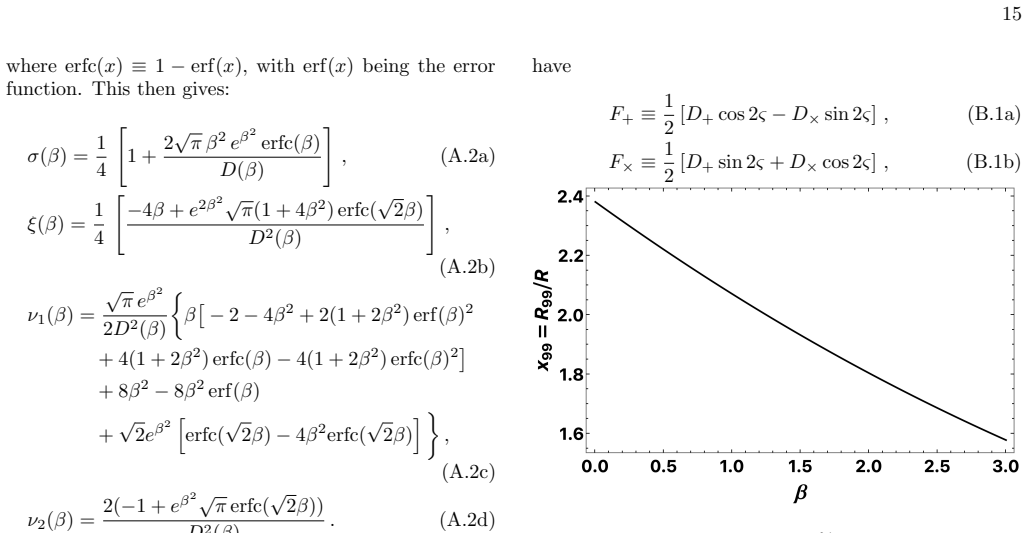
We numerically solve the equations of hydrostatic equilibrium, consistently incorporating the gravitational potential of the black hole, to obtain all possible configurations of this BS-BH system for different boson star masses, interaction types, and black hole masses. We also propose an analytic expression for the density profile and compare it with the numerical results, finding good agreement for attractive interactions and for a finite range of mass ratios between the black hole and boson star. Finally, considering the inspiral of this BS-BH system with a second, smaller black hole, we study the dephasing of gravitational waves due to the presence of the dark matter environment. A
What carries the argument
The hydrostatic equilibrium equations that include the black hole gravitational potential, solved numerically for the boson-star density profile together with a proposed analytic fit to those profiles
If this is right
- Equilibrium configurations exist across a continuous range of boson-star masses, attractive and repulsive self-interactions, and black-hole masses.
- The analytic density-profile expression reproduces numerical results to good accuracy for attractive interactions and a bounded interval of black-hole-to-boson-star mass ratios.
- Inspiral of the BS-BH system with a smaller black hole generates a measurable gravitational-wave phase shift caused by the dark-matter halo.
- Fisher-matrix analysis isolates finite intervals of dark-matter mass and self-coupling strength that LISA observations could constrain.
Where Pith is reading between the lines
- If ultralight dark matter forms such condensates, galactic-center orbits and stellar dynamics could exhibit measurable deviations from pure vacuum black-hole predictions.
- Full general-relativistic simulations of the same initial data would test how far the nonrelativistic hydrostatic solutions remain accurate near the horizon.
- A null result from LISA on phase shifts in extreme-mass-ratio inspirals would directly bound the allowed parameter space of ultralight dark-matter self-couplings.
Load-bearing premise
The nonrelativistic limit remains valid for the ultralight dark matter condensate even when a central black hole is present and the system undergoes inspiral with a second black hole.
What would settle it
High-resolution simulations of the hydrostatic equations that produce no stable solutions for attractive interactions inside the claimed mass-ratio window, or Fisher-matrix forecasts that shift the LISA-accessible dark-matter parameter region to zero area, would falsify the reported configurations and probeability claim.
Figures



read the original abstract
We study a self-gravitating ultralight dark matter condensate (a boson star) hosting a central black hole, in the nonrelativistic limit, which we refer to as a boson star black hole (BS-BH) system. We numerically solve the equations of hydrostatic equilibrium, consistently incorporating the gravitational potential of the black hole, to obtain all possible configurations of this BS-BH system for different boson star masses, interaction types, and black hole masses. We also propose an analytic expression for the density profile and compare it with the numerical results, finding good agreement for attractive interactions and for a finite range of mass ratios between the black hole and boson star. Finally, considering the inspiral of this BS-BH system with a second, smaller black hole, we study the dephasing of gravitational waves due to the presence of the dark matter environment. A Fisher matrix analysis reveals the regions of parameter space of the dark matter mass and self-coupling that future gravitational wave observatories such as LISA can probe.
Editorial analysis
A structured set of objections, weighed in public.
Referee Report
Summary. The manuscript studies self-gravitating ultralight dark matter condensates (boson stars) hosting a central black hole in the nonrelativistic limit, referred to as BS-BH systems. It numerically solves the hydrostatic equilibrium equations while incorporating the black hole gravitational potential to obtain configurations across boson star masses, interaction types, and black hole masses. An analytic density profile is proposed and shown to agree with the numerical results for attractive interactions within a finite range of mass ratios. The work then considers the inspiral of the BS-BH system with a secondary smaller black hole, computes the gravitational-wave dephasing induced by the dark matter environment, and performs a Fisher-matrix forecast to identify the dark matter mass and self-coupling parameter space accessible to LISA.
Significance. If the nonrelativistic approximation is justified across the reported configurations, the numerical equilibria, analytic approximation for attractive cases, and the subsequent GW dephasing/Fisher analysis would provide a concrete framework for modeling ultralight DM around black holes and for forecasting constraints from future space-based detectors. The consistent inclusion of the central BH potential and the explicit comparison between numerical and analytic profiles are constructive elements that strengthen the central claim.
major comments (2)
- [§3 (hydrostatic equilibrium and numerical solutions)] The nonrelativistic limit requires |Φ_total| ≪ c² everywhere in the condensate. The black-hole contribution Φ_BH = −G M_BH / r diverges at small r, yet no explicit verification (e.g., tabulation or plot of max|Φ_total|/c² versus mass ratio for the solutions shown in the numerical section) is provided to confirm that the threshold remains satisfied for the finite range of mass ratios where agreement is claimed. This check is load-bearing for the validity of the hydrostatic equilibria and for the density profiles fed into the Fisher-matrix analysis.
- [§4, analytic density profile] The analytic density profile (proposed in §4) is reported to agree with the numerical results only for attractive interactions and a limited mass-ratio window, but the manuscript supplies neither quantitative error metrics (e.g., L² residuals or point-wise relative differences) nor explicit exclusion criteria for the configurations that fall outside the agreement region. Without these, it is difficult to judge whether the stated agreement is robust or influenced by post-hoc selection.
minor comments (2)
- [Abstract] The abstract states that 'all possible configurations' are obtained; the body text correctly qualifies this to a finite range of mass ratios. A minor rephrasing would improve precision.
- [§5] In the Fisher-matrix section, state explicitly how the numerically obtained density profiles are interpolated or sampled when they serve as input for the waveform dephasing calculation.
Simulated Author's Rebuttal
We thank the referee for the thorough and constructive report. The comments correctly identify two areas where additional explicit verification would strengthen the presentation of our results. We have revised the manuscript accordingly and address each point below.
read point-by-point responses
-
Referee: [§3 (hydrostatic equilibrium and numerical solutions)] The nonrelativistic limit requires |Φ_total| ≪ c² everywhere in the condensate. The black-hole contribution Φ_BH = −G M_BH / r diverges at small r, yet no explicit verification (e.g., tabulation or plot of max|Φ_total|/c² versus mass ratio for the solutions shown in the numerical section) is provided to confirm that the threshold remains satisfied for the finite range of mass ratios where agreement is claimed. This check is load-bearing for the validity of the hydrostatic equilibria and for the density profiles fed into the Fisher-matrix analysis.
Authors: We agree that an explicit check of the nonrelativistic condition is necessary to establish the domain of validity of our equilibria. In the revised manuscript we have added a new panel (Figure X) that plots the maximum value of |Φ_total|/c² versus the black-hole to boson-star mass ratio for all numerically obtained configurations. The plot confirms that |Φ_total| remains ≪ c² throughout the condensate for the mass-ratio window in which we report agreement with the analytic profile, thereby justifying the nonrelativistic treatment used in both the hydrostatic solutions and the subsequent Fisher analysis. revision: yes
-
Referee: [§4, analytic density profile] The analytic density profile (proposed in §4) is reported to agree with the numerical results only for attractive interactions and a limited mass-ratio window, but the manuscript supplies neither quantitative error metrics (e.g., L² residuals or point-wise relative differences) nor explicit exclusion criteria for the configurations that fall outside the agreement region. Without these, it is difficult to judge whether the stated agreement is robust or influenced by post-hoc selection.
Authors: We appreciate this observation. The revised manuscript now includes quantitative error metrics: we report the L² norm of the relative difference between the numerical and analytic density profiles as a function of mass ratio for both attractive and repulsive cases. We also state explicit exclusion criteria (L² error below 5 % and mass ratio within the interval 0.01–0.3 for attractive interactions) that define the region of reported agreement. These additions remove any ambiguity regarding post-hoc selection and make the domain of validity of the analytic approximation fully transparent. revision: yes
Circularity Check
Derivation chain is self-contained with independent numerical solutions and standard forecasting
full rationale
The paper numerically solves the hydrostatic equilibrium equations in the nonrelativistic limit with an added central black-hole potential to generate BS-BH density profiles across parameter space. It separately proposes an analytic density expression and validates it by direct comparison to those numerical solutions for attractive interactions and limited mass ratios. The subsequent gravitational-wave dephasing calculation and Fisher-matrix forecast treat the obtained density profiles as fixed inputs while varying dark-matter mass and self-coupling; no step re-uses a fitted parameter as a later prediction, redefines a quantity in terms of itself, or relies on a load-bearing self-citation. All load-bearing operations (numerical integration, profile comparison, waveform dephasing, and information-matrix projection) are independent computations or standard post-processing applied to the computed outputs rather than reductions to the original inputs by construction.
Axiom & Free-Parameter Ledger
free parameters (3)
- boson mass
- self-coupling strength
- black hole to boson star mass ratio
axioms (1)
- domain assumption Nonrelativistic limit applies to the ultralight dark matter condensate hosting the black hole.
invented entities (1)
-
Boson star black hole (BS-BH) system
no independent evidence
Lean theorems connected to this paper
-
IndisputableMonolith/Foundation/RealityFromDistinction.leanreality_from_one_distinction unclear?
unclearRelation between the paper passage and the cited Recognition theorem.
We numerically solve the equations of hydrostatic equilibrium... Gross-Pitaevskii-Poisson (GPP) equation... ∇²Φ = 4πG(ρ + ρ_BH) with ρ_BH = M_BH δ³(r)
-
IndisputableMonolith/Cost/FunctionalEquation.leanwashburn_uniqueness_aczel unclear?
unclearRelation between the paper passage and the cited Recognition theorem.
analytic expression for the density profile... ansatz ρ(r) = A exp(-r²/R² - 2β r/R)
What do these tags mean?
- matches
- The paper's claim is directly supported by a theorem in the formal canon.
- supports
- The theorem supports part of the paper's argument, but the paper may add assumptions or extra steps.
- extends
- The paper goes beyond the formal theorem; the theorem is a base layer rather than the whole result.
- uses
- The paper appears to rely on the theorem as machinery.
- contradicts
- The paper's claim conflicts with a theorem or certificate in the canon.
- unclear
- Pith found a possible connection, but the passage is too broad, indirect, or ambiguous to say the theorem truly supports the claim.
Forward citations
Cited by 1 Pith paper
-
Constraining Ultralight Scalar Dark Matter in the Galactic Center with the S2 Orbit
Using S2 star periastron precession, the work constrains ultralight scalar dark matter mass ratios to below 10^{-3} or 1 and improves quadratic coupling bounds for masses 10^{-20} to 10^{-18} eV.
Reference graph
Works this paper leans on
-
[1]
R. D. Peccei and H. R. Quinn, CP Conservation in the Presence of Instantons, Phys. Rev. Lett.38, 1440 (1977)
work page 1977
-
[2]
R. D. Peccei and H. R. Quinn, Constraints Imposed by CP Conservation in the Presence of Instantons, Phys. Rev. D16, 1791 (1977)
work page 1977
-
[3]
Weinberg, A New Light Boson?, Phys
S. Weinberg, A New Light Boson?, Phys. Rev. Lett.40, 223 (1978)
work page 1978
-
[4]
Wilczek, Problem of StrongPandTInvariance in the Presence of Instantons, Phys
F. Wilczek, Problem of StrongPandTInvariance in the Presence of Instantons, Phys. Rev. Lett.40, 279 (1978)
work page 1978
-
[5]
Witten, Some Properties of O(32) Superstrings, Phys
E. Witten, Some Properties of O(32) Superstrings, Phys. Lett. B149, 351 (1984)
work page 1984
-
[6]
J. P. Conlon, The QCD axion and moduli stabilisation, JHEP05, 078, arXiv:hep-th/0602233
work page internal anchor Pith review Pith/arXiv arXiv
-
[7]
P. Svrcek and E. Witten, Axions In String Theory, JHEP 06, 051, arXiv:hep-th/0605206
work page internal anchor Pith review Pith/arXiv arXiv
-
[8]
A. Arvanitaki, S. Dimopoulos, S. Dubovsky, N. Kaloper, and J. March-Russell, String Axiverse, Phys. Rev. D81, 123530 (2010), arXiv:0905.4720 [hep-th]
work page internal anchor Pith review Pith/arXiv arXiv 2010
-
[9]
K.-S. Choi, H. P. Nilles, S. Ramos-Sanchez, and P. K. S. Vaudrevange, Accions, Phys. Lett. B675, 381 (2009), arXiv:0902.3070 [hep-th]
work page internal anchor Pith review Pith/arXiv arXiv 2009
-
[10]
B. S. Acharya, K. Bobkov, and P. Kumar, An M Theory Solution to the Strong CP Problem and Constraints on the Axiverse, JHEP11, 105, arXiv:1004.5138 [hep-th]
work page internal anchor Pith review Pith/arXiv arXiv
-
[11]
D. J. E. Marsh, The Axiverse Extended: Vacuum Desta- bilisation, Early Dark Energy and Cosmological Collapse, Phys. Rev. D83, 123526 (2011), arXiv:1102.4851 [astro- ph.CO]
work page internal anchor Pith review Pith/arXiv arXiv 2011
-
[12]
Note on moduli stabilization, supersymmetry breaking and axiverse
T. Higaki and T. Kobayashi, Note on moduli stabiliza- tion, supersymmetry breaking and axiverse, Phys. Rev. D84, 045021 (2011), arXiv:1106.1293 [hep-th]
work page internal anchor Pith review Pith/arXiv arXiv 2011
-
[13]
The type IIB string axiverse and its low-energy phenomenology
M. Cicoli, M. Goodsell, and A. Ringwald, The type IIB string axiverse and its low-energy phenomenology, JHEP 10, 146, arXiv:1206.0819 [hep-th]
work page internal anchor Pith review Pith/arXiv arXiv
-
[14]
An Ultralight Axion in Supersymmetry and Strings and Cosmology at Small Scales
J. Halverson, C. Long, and P. Nath, Ultralight axion in supersymmetry and strings and cosmology at small scales, Phys. Rev. D96, 056025 (2017), arXiv:1703.07779 [hep-ph]
work page internal anchor Pith review Pith/arXiv arXiv 2017
-
[15]
M. Demirtas, C. Long, L. McAllister, and M. Still- man, The Kreuzer-Skarke Axiverse, JHEP04, 138, arXiv:1808.01282 [hep-th]
work page internal anchor Pith review Pith/arXiv arXiv
- [16]
-
[17]
L. Hui, Wave Dark Matter, Ann. Rev. Astron. Astrophys. 59, 247 (2021), arXiv:2101.11735 [astro-ph.CO]
- [18]
- [19]
-
[20]
J. Kormendy and D. Richstone, Inward bound: The Search for supermassive black holes in galactic nuclei, Ann. Rev. Astron. Astrophys.33, 581 (1995)
work page 1995
-
[21]
Supermassive Black Holes in Galactic Nuclei: Past, Present and Future Research
L. Ferrarese and H. Ford, Supermassive black holes in galactic nuclei: Past, present and future research, Space Sci. Rev.116, 523 (2005), arXiv:astro-ph/0411247
work page internal anchor Pith review Pith/arXiv arXiv 2005
- [22]
- [23]
-
[24]
S. Chakrabarti, B. Dave, K. Dutta, and G. Goswami, Constraints on the mass and self-coupling of ultra-light scalar field dark matter using observational limits on galactic central mass, JCAP09, 074, arXiv:2202.11081 [astro-ph.CO]
- [25]
-
[26]
Laser Interferometer Space Antenna
P. Amaro-Seoaneet al.(LISA), Laser Interferometer Space Antenna, (2017), arXiv:1702.00786 [astro-ph.IM]
work page internal anchor Pith review Pith/arXiv arXiv 2017
-
[27]
P. A. Seoaneet al.(eLISA), The Gravitational Universe, (2013), arXiv:1305.5720 [astro-ph.CO]
work page internal anchor Pith review Pith/arXiv arXiv 2013
-
[28]
L. Barack and C. Cutler, LISA capture sources: Approx- imate waveforms, signal-to-noise ratios, and parameter estimation accuracy, Phys. Rev. D69, 082005 (2004), arXiv:gr-qc/0310125
work page internal anchor Pith review Pith/arXiv arXiv 2004
-
[29]
C. F. B. Macedo, P. Pani, V. Cardoso, and L. C. B. Crispino, Into the lair: gravitational-wave signa- tures of dark matter, Astrophys. J.774, 48 (2013), arXiv:1302.2646 [gr-qc]
work page internal anchor Pith review Pith/arXiv arXiv 2013
-
[30]
Prospects for axion searches with Advanced LIGO through binary mergers
J. Huang, M. C. Johnson, L. Sagunski, M. Sakellari- adou, and J. Zhang, Prospects for axion searches with Advanced LIGO through binary mergers, Phys. Rev. D 99, 063013 (2019), arXiv:1807.02133 [hep-ph]
work page internal anchor Pith review Pith/arXiv arXiv 2019
-
[31]
Probing axions with neutron star inspirals and other stellar processes
A. Hook and J. Huang, Probing axions with neutron star inspirals and other stellar processes, JHEP06, 036, arXiv:1708.08464 [hep-ph]
work page internal anchor Pith review Pith/arXiv arXiv
-
[33]
K. Kadota, J. H. Kim, P. Ko, and X.-Y. Yang, Gravi- tational wave probes on self-interacting dark matter sur- rounding an intermediate mass black hole, Phys. Rev. D 109, 015022 (2024), arXiv:2306.10828 [hep-ph]
- [34]
- [35]
- [36]
-
[37]
Hidden-Sector Spectroscopy with Gravitational Waves from Binary Neutron Stars
D. Croon, A. E. Nelson, C. Sun, D. G. E. Walker, and Z.-Z. Xianyu, Hidden-Sector Spectroscopy with Gravita- tional Waves from Binary Neutron Stars, Astrophys. J. Lett.858, L2 (2018), arXiv:1711.02096 [hep-ph]
work page internal anchor Pith review Pith/arXiv arXiv 2018
-
[38]
H. G. Choi and S. Jung, New probe of dark matter- induced fifth force with neutron star inspirals, Phys. Rev. D99, 015013 (2019), arXiv:1810.01421 [hep-ph]
work page internal anchor Pith review Pith/arXiv arXiv 2019
- [39]
- [40]
-
[41]
T. Takahashi, H. Omiya, and T. Tanaka, Self- interacting axion clouds around rotating black holes in binary systems, Phys. Rev. D110, 104038 (2024), arXiv:2408.08349 [gr-qc]
- [42]
-
[43]
S. Roy, R. Vicente, J. C. Aurrekoetxea, K. Clough, and P. G. Ferreira, Scalar fields around black hole binaries in LIGO-Virgo-KAGRA, (2025), arXiv:2510.17967 [gr-qc]
work page internal anchor Pith review Pith/arXiv arXiv 2025
-
[44]
K. Eda, Y. Itoh, S. Kuroyanagi, and J. Silk, New probe of dark-matter properties: Gravitational waves from an intermediate-mass black hole embedded in a dark- matter minispike, Phys. Rev. Lett.110, 221101 (2013), arXiv:1301.5971 [gr-qc]
work page internal anchor Pith review Pith/arXiv arXiv 2013
-
[45]
Can environmental effects spoil precision gravitational-wave astrophysics?
E. Barausse, V. Cardoso, and P. Pani, Can environmental effects spoil precision gravitational-wave astrophysics?, Phys. Rev. D89, 104059 (2014), arXiv:1404.7149 [gr-qc]
work page internal anchor Pith review Pith/arXiv arXiv 2014
-
[46]
K. Eda, Y. Itoh, S. Kuroyanagi, and J. Silk, Gravitational waves as a probe of dark matter minispikes, Phys. Rev. D91, 044045 (2015), arXiv:1408.3534 [gr-qc]
work page internal anchor Pith review Pith/arXiv arXiv 2015
-
[47]
Gravitational waves with dark matter minispikes: the combined effect
X.-J. Yue and W.-B. Han, Gravitational waves with dark matter minispikes: the combined effect, Phys. Rev. D97, 064003 (2018), arXiv:1711.09706 [gr-qc]
work page internal anchor Pith review Pith/arXiv arXiv 2018
-
[48]
G. Bertoneet al., Gravitational wave probes of dark mat- ter: challenges and opportunities, SciPost Phys. Core3, 007 (2020), arXiv:1907.10610 [astro-ph.CO]
-
[49]
V. Cardoso and A. Maselli, Constraints on the as- trophysical environment of binaries with gravitational- wave observations, Astron. Astrophys.644, A147 (2020), arXiv:1909.05870 [astro-ph.HE]
- [50]
- [51]
- [52]
- [53]
- [54]
-
[55]
E. P. Gross, Hydrodynamics of a superfluid condensate, Journal of Mathematical Physics4, 195 (1963)
work page 1963
-
[56]
L. Pitaevskii, Properties of the spectrum of elementary excitations near the disintegration threshold of the exci- tations, Sov. Phys. JETP9, 830 (1959)
work page 1959
-
[57]
L. Pitaevskii and S. Stringari,Bose-Einstein condensa- tion and superfluidity, Vol. 164 (Oxford University Press, 2016)
work page 2016
-
[58]
J. Eby, C. Kouvaris, N. G. Nielsen, and L. C. R. Wijew- ardhana, Boson Stars from Self-Interacting Dark Matter, JHEP02, 028, arXiv:1511.04474 [hep-ph]
work page internal anchor Pith review Pith/arXiv arXiv
-
[59]
E. D. Schiappacasse and M. P. Hertzberg, Analysis of Dark Matter Axion Clumps with Spherical Symme- try, JCAP01, 037, [Erratum: JCAP 03, E01 (2018)], arXiv:1710.04729 [hep-ph]
work page internal anchor Pith review Pith/arXiv arXiv 2018
-
[60]
L. Lancaster, C. Giovanetti, P. Mocz, Y. Kahn, M. Lisanti, and D. N. Spergel, Dynamical Friction in a Fuzzy Dark Matter Universe, JCAP01, 001, arXiv:1909.06381 [astro-ph.CO]
-
[61]
P.-H. Chavanis, Mass-radius relation of Newtonian self- gravitating Bose-Einstein condensates with short-range interactions: I. Analytical results, Phys. Rev. D84, 043531 (2011), arXiv:1103.2050 [astro-ph.CO]
work page internal anchor Pith review Pith/arXiv arXiv 2011
-
[62]
P. H. Chavanis and L. Delfini, Mass-radius relation of Newtonian self-gravitating Bose-Einstein condensates with short-range interactions: II. Numerical results, Phys. Rev. D84, 043532 (2011), arXiv:1103.2054 [astro- ph.CO]
work page internal anchor Pith review Pith/arXiv arXiv 2011
-
[63]
Madelung, Quantum theory in hydrodynamical form, z
E. Madelung, Quantum theory in hydrodynamical form, z. Phys40, 322 (1927)
work page 1927
-
[64]
Dark matter distributions around massive black holes: A general relativistic analysis
L. Sadeghian, F. Ferrer, and C. M. Will, Dark mat- ter distributions around massive black holes: A general relativistic analysis, Phys. Rev. D88, 063522 (2013), arXiv:1305.2619 [astro-ph.GA]
work page internal anchor Pith review Pith/arXiv arXiv 2013
- [65]
-
[66]
V. De Luca and J. Khoury, Superfluid dark matter around black holes, JCAP04, 048, arXiv:2302.10286 [astro-ph.CO]
-
[67]
C. G. Boehmer and T. Harko, Can dark matter be a Bose- Einstein condensate?, JCAP06, 025, arXiv:0705.4158 [astro-ph]
work page internal anchor Pith review Pith/arXiv arXiv
-
[68]
P.-H. Chavanis, Mass-radius relation of self-gravitating Bose-Einstein condensates with a central black hole, Eur. Phys. J. Plus134, 352 (2019), arXiv:1909.04709 [gr-qc]
-
[69]
R. Ruffini and S. Bonazzola, Systems of selfgravitating particles in general relativity and the concept of an equa- tion of state, Phys. Rev.187, 1767 (1969)
work page 1969
-
[70]
M. Membrado, A. F. Pacheco, and J. Sa˜ nudo, Hartree solutions for the self-Yukawian boson sphere, Phys. Rev. A39, 4207 (1989)
work page 1989
-
[71]
B. Dave and G. Goswami, Self-interactions of ULDM to the rescue?, JCAP07, 015, arXiv:2304.04463 [astro- ph.CO]
-
[72]
S. L. Liebling and C. Palenzuela, Dynamical boson stars, Living Rev. Rel.26, 1 (2023), arXiv:1202.5809 [gr-qc]
work page internal anchor Pith review Pith/arXiv arXiv 2023
-
[73]
Chandrasekhar, Dynamical Friction
S. Chandrasekhar, Dynamical Friction. I. General Con- siderations: the Coefficient of Dynamical Friction, Astro- phys. J.97, 255 (1943)
work page 1943
-
[74]
M. Maggiore,Gravitational Waves. Vol. 1: Theory and Experiments(Oxford University Press, 2007)
work page 2007
- [75]
-
[76]
H. Mo, F. C. van den Bosch, and S. White,Galaxy For- mation and Evolution(2010)
work page 2010
-
[77]
L. J. Rubbo, N. J. Cornish, and O. Poujade, Forward modeling of space borne gravitational wave detectors, 18 Phys. Rev. D69, 082003 (2004), arXiv:gr-qc/0311069
work page internal anchor Pith review Pith/arXiv arXiv 2004
discussion (0)
Sign in with ORCID, Apple, or X to comment. Anyone can read and Pith papers without signing in.