REVIEW 3 major objections 5 minor 5 cited by
Learning Long-Context Diffusion Policies via Past-Token Prediction
T0 review · 3 major / 5 minor · reviewed 2026-08-15 · deepseek-v4-flash
Pith's one-line read The paper claims that adding past-token prediction to long-context diffusion policies improves success by 3x and cuts training cost by more than 10x.
desk verdict A simple auxiliary objective that appears to deliver real gains for long-context diffusion policies, but the advertised training speedup is inconsistent with the paper's own numbers. read the letter →
The pith
A machine-rendered reading of the paper's core claim, the machinery that carries it, and where it could break.
The reading
What carries the argument
The central object is Past-Token Prediction (PTP), an auxiliary training objective that asks the policy, given a window of past observations, to output both the already-taken actions and the upcoming future actions. The diagnostic that motivates it is the action predictability ratio $\epsilon_{\pi^*}/\epsilon_\pi$, comparing how well the current action can be predicted from the previous action in expert demonstrations versus policy rollouts; a ratio below one marks underuse of past actions. Three mechanisms carry the argument: PTP as a regularizer on the policy head, a multistage recipe that freezes and caches a short-context visual encoder so long-context decoder training costs about the same as short-context training, and test-time candidate selection by past-action consistency. The ablation showing that decoder-only PTP matches full PTP while encoder-only PTP does not is what licenses the frozen-encoder recipe.
What would settle it
Train a PTP long-context policy on a task where the current frame is visually ambiguous (for example, several identical objects, with the identity of the target visible only in an early frame), then compare the frozen short-context encoder against the same encoder fine-tuned on long contexts. If the frozen-encoder policy fails while the fine-tuned one succeeds, the claim that short-context features suffice for long-context control is falsified; if both succeed, the assumption holds.
Extended reading notes
Core claim
The central discovery is the flipped copycat problem: regression-based policies over-predict the current action from the previous action, while diffusion-based policies do the opposite and underpredict it, even when conditioned on long observation histories. The paper argues that adding past-token prediction to the training objective bridges this gap, and that the benefit lives almost entirely in the action decoder, not the visual encoder. That localization justifies freezing a visual encoder pretrained on two-frame contexts, caching its embeddings, and training a long-context policy head on top; the paper reports that this recipe raises long-context diffusion policy success by 3x on average and accelerates training by over 10x. At inference, the same past-token objective becomes a self-verification signal: sample several action chunks and pick the one whose reconstructed past actions best match the actions actually executed.
Load-bearing premise
The load-bearing assumption is that a visual encoder trained on only two frames extracts features rich enough to support decisions that need sixteen frames of history; if long-horizon tasks require visual information that appears only across a longer time span, the frozen-encoder recipe and its speedups may not transfer.
Editorial extensions
If this is right
- Long observation histories become practical for imitation learning: a 16-frame context can be trained with roughly the memory and compute of a 2-frame context, so history-critical tasks no longer need to truncate the past.
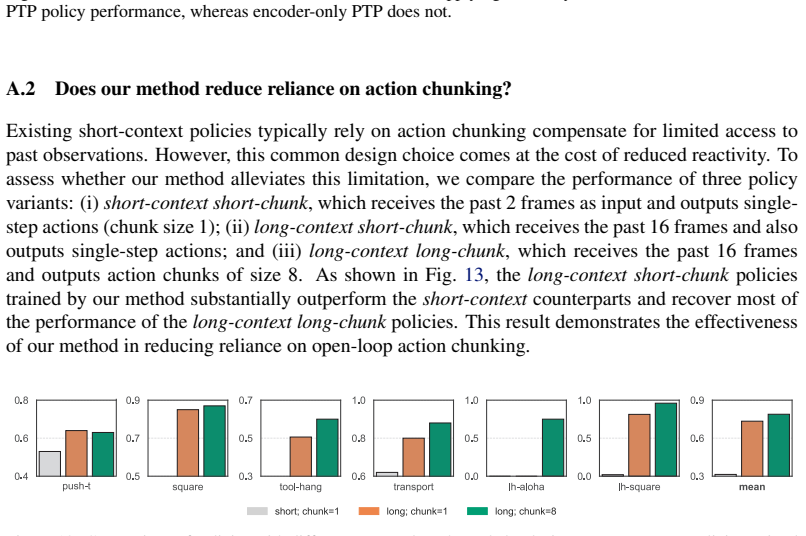
- Closed-loop execution improves: PTP-trained policies with chunk size one and long history reach 0.64 to 0.85 success on several simulated tasks, meaning reactivity does not have to be sacrificed for temporal memory.
- The failure-mode diagnosis points in opposite directions for the two policy families: regression policies should be regularized against copying past actions, while diffusion policies should be pushed toward stronger coupling between past and future actions.
- Test-time compute becomes a usable lever: sampling five action chunks and selecting by past-token consistency adds about five percentage points of success, so cheaper checkpoints can partly compensate for less training with more sampling.
Reading between the lines
- A natural extension, not tested in the paper, is to apply PTP-style supervision to other generative policy families, such as flow-matching or autoregressive action-token policies, whose heads are also trained with next-token-only objectives; if the mechanism is generic, the same auxiliary loss should tighten their temporal dependencies.
- The action predictability ratio could serve as a cheap diagnostic before full evaluation: a rollout ratio well below one would flag a diffusion policy as a candidate for PTP-style regularization, potentially saving compute in policy selection.
- The frozen-encoder assumption is the most likely boundary of the method; tasks where the disambiguating visual information appears only in an early frame and is absent from the current frame would test whether a two-frame-pretrained encoder already encodes what long-horizon decisions need.
Signed reviews
Editorial analysis
A structured set of objections, weighed in public.
Referee Report
Summary. The manuscript proposes Past-Token Prediction (PTP), an auxiliary objective for diffusion-based visuomotor policies that jointly predicts past and future action tokens, together with a multistage training recipe that pre-trains a visual encoder on short contexts, caches its embeddings, and then trains a long-context policy head conditioned on the cached embeddings. At inference, PTP is used as a self-verification criterion to select among sampled action chunks by comparing reconstructed past actions with the executed ones. The paper reports large gains over no-PTP and no-history baselines on six simulation tasks and four real-world tasks, and it claims in the Abstract and Figure 1 that the method improves long-context diffusion policy performance by 3x while accelerating training by more than 10x.
Significance. If the empirical results hold, PTP is a simple and broadly applicable modification to diffusion policies that addresses a real limitation: history-conditioned diffusion policies underperform on history-critical tasks. The evaluation is broad for a method paper, covering six simulation tasks and four real-world tasks across two platforms, with external success-rate metrics and several useful ablations (encoder-only vs decoder-only PTP, chunk-size dependence, and past-action conditioning). The authors also include an explicit Limitations section. The main risks are an internally inconsistent training-speedup claim, a diagnostic that may conflate sampling stochasticity with weak temporal dependency, and a load-bearing encoder-freezing assumption that is supported by a single-task ablation. These issues are correctable, but they affect the strength of the central claims as currently written.
major comments (3)
- [Abstract, Fig. 1, §5.1 Takeaway 4, Fig. 8] The claimed 'more than 10x' training speedup in the Abstract and Fig. 1 is inconsistent with the paper's own efficiency results. Takeaway 4 states that the caching-based recipe matches performance in just 20% of the training time and surpasses it within 40% of the compute budget, which corresponds to at most a 5x speedup, and the Fig. 8 caption says 'Caching speeds up training by over 5x.' If the uncached Tool Hang run never reaches the target success within the two-day budget, then the speedup ratio to a fixed-performance threshold is not well defined. Please correct the Abstract/Fig. 1 claim or report the measured compute-time curves that support a greater-than-10x speedup.
- [§3, Appendix B.3.4, Fig. 2] The action-predictability diagnostic does not cleanly isolate temporal action dependency from sampling stochasticity. Diffusion policies generate actions by sampling from a learned conditional distribution, so even a policy that strongly depends on past actions will produce rollout actions with irreducible sampling variance; this variance will inflate the MSE of an MLP predictor fitted to previous actions and push the predictability ratio below 1. The claim that modern diffusion policies 'underuse past action information' therefore needs a control, for example comparing prediction error given the full history against prediction error given past actions only, or evaluating rollouts under matched noise. In addition, §3 defines the probe as predicting the current action from the previous action alone, while Appendix B.3.4 defines it as predicting from a window of K=15 past actions; this discrepancy must be reconciled.
- [§A.1, Fig. 12, §4.2] The multistage recipe freezes a visual encoder pretrained on two-frame contexts and relies on cached embeddings for long-context policy training. The only direct evidence that this preserves performance is the Push-T ablation in Appendix A.1 (Fig. 12). Since the main experiments all use the frozen-encoder recipe, a failure of the frozen features on other tasks would affect both the performance and the efficiency claims. I ask for a per-task, or at least multi-task, comparison between end-to-end training and the cached-embedding recipe, or a quantitative report of how downstream success varies with encoder quality across the evaluated tasks.
minor comments (5)
- [Table 4] The Mean column in Table 4 is inconsistent with the per-task entries: for the 16-observation row, the per-task values 0.64, 0.85, 0.82, 0.51, and 0.81 average to 0.73, not the reported 0.77, and similar discrepancies appear in the other rows. Please recompute the means or explain the discrepancy.
- [§5.1, text before Fig. 9] The sentence reporting 'an average improvement of over 30%' and 'over 60%' should be clarified as percentage-point improvements; the relative improvement over no-PTP based on Table 3 averages is roughly 390%, not 60%.
- [Fig. 2 and Fig. 6] The action-predictability figures lack axis labels and error bars, which makes it difficult to assess the magnitude and variability of the reported ratios; please add these details.
- [Table 3] The task names 'ALOHA' and 'Long Square' should be made consistent with 'Long-Horizon ALOHA' and 'Long-Horizon Square' used elsewhere in the text.
- [Abstract] The '3x performance' claim should specify the baseline it is compared against (no-PTP history-conditioned policy vs no-history policy), since these give very different improvement ratios.
Circularity Check
No significant circularity: external benchmark evaluations carry the central claims; the self-citation to [19] is background only.
full rationale
I walked the claimed derivation chain. The central claim—that Past-Token Prediction (PTP) improves long-context diffusion-policy success and that embedding caching accelerates training—is supported by external success-rate evaluations on RoboMimic, Push-T, and four real-world tasks. Those evaluations are not constructed from the method's own outputs. The action-predictability diagnostic in Section 3 is used as motivation, not as a training objective: PTP is defined as predicting past action tokens (Eq. 1), while the diagnostic measures the MSE of a separately trained MLP that predicts the current action from the previous action. The paper's Fig. 6 therefore reports an empirical correlation, not a tautology. The multistage training recipe is justified by the Appendix A.1 ablation (Decoder PTP vs. Encoder PTP), not by a self-citation or imported uniqueness theorem. Reference [19] (Bidirectional Decoding) is cited as related work and includes overlapping authors, but it is not load-bearing: the paper's long-context, caching, and self-verification contributions do not reduce to that citation. The only notable issue is non-circular: the abstract's 'more than 10x' training-speedup claim is inconsistent with the paper's own Takeaway 4 and Fig. 8, which report approximately 5x. That is an internal-consistency or correctness concern, not a circularity, and does not affect the circularity score.
Assumptions & free parameters
free parameters (5)
- Observation context length k =
16 (default)
- Number of past tokens c =
16 (full-PTP)
- Task-specific subsampling rate =
1, 20, 24, 32 (per task)
- Action chunk size =
8
- Number of test-time samples B =
up to 10
assumptions (4)
- domain assumption Observations are only partially informative about the underlying state, so the full state must be inferred from history.
- ad hoc to paper The action predictability ratio, measured by an MLP trained on past actions, is a valid measure of temporal action dependency in a policy.
- domain assumption A visual encoder pretrained on short (2-frame) contexts preserves all information needed for long-context policy learning.
- domain assumption The Diffusion Policy architecture and training protocol from [8] are assumed without modification.
Cite this review
Pith. "Pith review of Learning Long-Context Diffusion Policies via Past-Token Prediction." pith.science (2026). https://pith.science/paper/YWJKGJLS
@misc{pith2026250509561,
  author       = {Pith},
  title        = {Pith review of: Learning Long-Context Diffusion Policies via Past-Token Prediction},
  year         = {2026},
  howpublished = {\url{https://pith.science/paper/YWJKGJLS}},
  note         = {Machine review of arXiv:2505.09561}
}
read the original abstract
Reasoning over long sequences of observations and actions is essential for many robotic tasks. Yet, learning effective long-context policies from demonstrations remains challenging. As context length increases, training becomes increasingly expensive due to rising memory demands, and policy performance often degrades as a result of spurious correlations. Recent methods typically sidestep these issues by truncating context length, discarding historical information that may be critical for subsequent decisions. In this paper, we propose an alternative approach that explicitly regularizes the retention of past information. We first revisit the copycat problem in imitation learning and identify an opposite challenge in recent diffusion policies: rather than over-relying on prior actions, they often fail to capture essential dependencies between past and future actions. To address this, we introduce Past-Token Prediction (PTP), an auxiliary task in which the policy learns to predict past action tokens alongside future ones. This regularization significantly improves temporal modeling in the policy head, with minimal reliance on visual representations. Building on this observation, we further introduce a multistage training strategy: pre-train the visual encoder with short contexts, and fine-tune the policy head using cached long-context embeddings. This strategy preserves the benefits of PTP while greatly reducing memory and computational overhead. Finally, we extend PTP into a self-verification mechanism at test time, enabling the policy to score and select candidates consistent with past actions during inference. Experiments across four real-world and six simulated tasks demonstrate that our proposed method improves the performance of long-context diffusion policies by 3x and accelerates policy training by more than 10x.
Figures


Figures from the paper (7 more)



Forward citations
Cited by 5 Pith papers
-
RoboTTT: Context Scaling for Robot Policies
A robot policy that updates its own weights during deployment can use 8,000 steps of history, steadily improving as context grows and enabling one-shot imitation from human videos.
-
Present but Not Remembered: Auditing How Frozen VLAs Encode, Deploy, and Steer Visual History
VLAs linearly encode past frames as near-redundant copies of the present and deploy them only as architecture-conditional fallback or standing use, so steerability tracks deployment regime not encoding.
-
Why Does Action Chunking Improve Behavioral Cloning Performance in Robotic Control?
Action chunking in robotic behavioral cloning works mainly because it acts as a delayed-prediction policy and an implicit ensemble, not because of temporal consistency or horizon reduction.
-
HiMe: Hierarchical Embodied Memory for Long-Horizon Vision-Language-Action Control
A three-layer embodied memory (Executor, Sentry, Planner) with cross-modal Add/Update/Delete operations raises long-horizon VLA task progress to ~90% and reduces planner API calls versus flat memory.
-
Training and Evaluating Diffusion Policies with Long Context Lengths
Naive long-context Diffusion Policies succeed with UNet+Cross-Attention and sufficient data; variable-history training cuts sample complexity in the low-data regime.
Reference graph
Works this paper leans on
-
[19]
Bidirectional Decoding: Improving Action Chunking via Closed-Loop Resampling
Yuejiang Liu, Jubayer Ibn Hamid, Annie Xie, Yoonho Lee, Maximilian Du, and Chelsea Finn. Bidirectional Decoding: Improving Action Chunking via Closed-Loop Resampling. arXiv preprint arXiv:2408.17355, December 2024
arXiv 2024
-
[1]
Argall, Sonia Chernova, Manuela Veloso, and Brett Browning
Brenna D. Argall, Sonia Chernova, Manuela Veloso, and Brett Browning. A survey of robot learning from demonstration. Robotics and Autonomous Systems, 57(5):469–483, May 2009
work page 2009
-
[2]
Hritik Bansal, Arian Hosseini, Rishabh Agarwal, Vinh Q. Tran, and Mehran Kazemi. Smaller, Weaker, Yet Better: Training LLM Reasoners via Compute-Optimal Sampling.arXiv preprint arXiv:2408.16737, August 2024
arXiv 2024
-
[3]
Homanga Bharadhwaj, Jay Vakil, Mohit Sharma, Abhinav Gupta, Shubham Tulsiani, and Vikash Kumar. RoboAgent: Generalization and Efficiency in Robot Manipulation via Seman- tic Augmentations and Action Chunking. In 2024 IEEE International Conference on Robotics and Automation (ICRA), pages 4788–4795, May 2024
work page 2024
-
[5]
π0: A vision-language-action flow model for general robot control, 2024
Kevin Black, Noah Brown, Danny Driess, Adnan Esmail, Michael Equi, Chelsea Finn, Nic- colo Fusai, Lachy Groom, Karol Hausman, Brian Ichter, Szymon Jakubczak, Tim Jones, Liyiming Ke, Sergey Levine, Adrian Li-Bell, Mohith Mothukuri, Suraj Nair, Karl Pertsch, Lucy Xiaoyang Shi, James Tanner, Quan Vuong, Anna Walling, Haohuan Wang, and Ury Zhilinsky. π0: A vi...
arXiv 2024
-
[6]
RT-2: Vision-Language-Action Models Transfer Web Knowledge to Robotic Con- trol
Anthony Brohan, Noah Brown, Justice Carbajal, Yevgen Chebotar, Xi Chen, Krzysztof Choro- manski, Tianli Ding, Danny Driess, Avinava Dubey, Chelsea Finn, Pete Florence, Chuyuan Fu, Montse Gonzalez Arenas, Keerthana Gopalakrishnan, Kehang Han, Karol Hausman, Alexan- der Herzog, Jasmine Hsu, Brian Ichter, Alex Irpan, Nikhil Joshi, Ryan Julian, Dmitry Kalash-...
arXiv 2023
-
[7]
RT-1: Robotics Transformer for Real-World Control at Scale
Anthony Brohan, Noah Brown, Justice Carbajal, Yevgen Chebotar, Joseph Dabis, Chelsea Finn, Keerthana Gopalakrishnan, Karol Hausman, Alexander Herzog, Jasmine Hsu, Julian Ibarz, Brian Ichter, Alex Irpan, Tomas Jackson, Sally Jesmonth, Nikhil Joshi, Ryan Julian, Dmitry Kalashnikov, Yuheng Kuang, Isabel Leal, Kuang-Huei Lee, Sergey Levine, Yao Lu, Utsav Mall...
work page 2023
-
[8]
Diffusion Policy: Visuomotor Policy Learning via Action Diffusion
Cheng Chi, Siyuan Feng, Yilun Du, Zhenjia Xu, Eric Cousineau, Benjamin Burchfiel, and Shuran Song. Diffusion Policy: Visuomotor Policy Learning via Action Diffusion. InRobotics: Science and Systems XIX. Robotics: Science and Systems Foundation, July 2023. ISBN 978- 0-9923747-9-2
work page 2023
Show all 50 references
-
[9]
Training Verifiers to Solve Math Word Problems.arXiv preprint arXiv:2110.14168, November 2021
Karl Cobbe, Vineet Kosaraju, Mohammad Bavarian, Mark Chen, Heewoo Jun, Lukasz Kaiser, Matthias Plappert, Jerry Tworek, Jacob Hilton, Reiichiro Nakano, Christopher Hesse, and John Schulman. Training Verifiers to Solve Math Word Problems.arXiv preprint arXiv:2110.14168, November 2021
-
[10]
Causal Confusion in Imitation Learning
Pim de Haan, Dinesh Jayaraman, and Sergey Levine. Causal Confusion in Imitation Learning. In Advances in Neural Information Processing Systems , volume 32. Curran Associates, Inc., 2019
2019
-
[11]
In-Context Imitation Learning via Next-Token Prediction
Letian Fu, Huang Huang, Gaurav Datta, Lawrence Yunliang Chen, William Chung-Ho Panitch, Fangchen Liu, Hui Li, and Ken Goldberg. In-Context Imitation Learning via Next-Token Prediction. arXiv preprint arXiv:2408.15980, September 2024
2024 arXiv
-
[12]
BAKU: An Efficient Transformer for Multi- Task Policy Learning
Siddhant Haldar, Zhuoran Peng, and Lerrel Pinto. BAKU: An Efficient Transformer for Multi- Task Policy Learning. In The Thirty-eighth Annual Conference on Neural Information Pro- cessing Systems, November 2024
2024
-
[13]
Sanketi, Archit Sharma, Cody Simpson, Quan Vuong, Homer Rich Walke, Blake Wulfe, Ted Xiao, Jonathan Heewon Yang, Arefeh Yavary, Tony Z
Alexander Khazatsky, Karl Pertsch, Suraj Nair, Ashwin Balakrishna, Sudeep Dasari, Sid- dharth Karamcheti, Soroush Nasiriany, Mohan Kumar Srirama, Lawrence Yunliang Chen, Kirsty Ellis, Peter David Fagan, Joey Hejna, Masha Itkina, Marion Lepert, Yecheng Jason Ma, Patrick Tree Mi...
2024 arXiv
-
[14]
Foster, Pannag R
Moo Jin Kim, Karl Pertsch, Siddharth Karamcheti, Ted Xiao, Ashwin Balakrishna, Suraj Nair, Rafael Rafailov, Ethan P. Foster, Pannag R. Sanketi, Quan Vuong, Thomas Kollar, Benjamin Burchfiel, Russ Tedrake, Dorsa Sadigh, Sergey Levine, Percy Liang, and Chelsea Finn. Open- VLA: A...
2024
-
[15]
Jin Kim, Nur Muhammad Mahi Shafiullah, and Lerrel Pinto
Seungjae Lee, Yibin Wang, Haritheja Etukuru, H. Jin Kim, Nur Muhammad Mahi Shafiullah, and Lerrel Pinto. Behavior Generation with Latent Actions. arXiv preprint arXiv:2403.03181, March 2024
2024 arXiv
-
[16]
Towards Generalist Robot Policies: What Matters in Building Vision-Language-Action Models.arXiv preprint arXiv:2412.14058, December 2024
Xinghang Li, Peiyan Li, Minghuan Liu, Dong Wang, Jirong Liu, Bingyi Kang, Xiao Ma, Tao Kong, Hanbo Zhang, and Huaping Liu. Towards Generalist Robot Policies: What Matters in Building Vision-Language-Action Models.arXiv preprint arXiv:2412.14058, December 2024
2024 arXiv
-
[17]
HAMSTER: Hierarchical Action Models for Open-World Robot Manipulation
Yi Li, Yuquan Deng, Jesse Zhang, Joel Jang, Marius Memmel, Caelan Reed Garrett, Fabio Ramos, Dieter Fox, Anqi Li, Abhishek Gupta, and Ankit Goyal. HAMSTER: Hierarchical Action Models for Open-World Robot Manipulation. In The Thirteenth International Confer- ence on Learning Re...
2024
-
[18]
Let’s Verify Step by Step
Hunter Lightman, Vineet Kosaraju, Yuri Burda, Harrison Edwards, Bowen Baker, Teddy Lee, Jan Leike, John Schulman, Ilya Sutskever, and Karl Cobbe. Let’s Verify Step by Step. In The Twelfth International Conference on Learning Representations, October 2023
2023
-
[20]
Inference-Time Scaling for Diffusion Models beyond Scaling Denoising Steps
Nanye Ma, Shangyuan Tong, Haolin Jia, Hexiang Hu, Yu-Chuan Su, Mingda Zhang, Xuan Yang, Yandong Li, Tommi Jaakkola, Xuhui Jia, and Saining Xie. Inference-Time Scaling for Diffusion Models beyond Scaling Denoising Steps. arXiv preprint arXiv:2501.09732, January 2025
2025 arXiv
-
[21]
What Matters in Learn- ing from Offline Human Demonstrations for Robot Manipulation
Ajay Mandlekar, Danfei Xu, Josiah Wong, Soroush Nasiriany, Chen Wang, Rohun Kulkarni, Li Fei-Fei, Silvio Savarese, Yuke Zhu, and Roberto Mart ´ın-Mart´ın. What Matters in Learn- ing from Offline Human Demonstrations for Robot Manipulation. In Proceedings of the 5th Conference ...
2022
-
[22]
Steering Your Generalists: Improving Robotic Foundation Models via Value Guidance
Mitsuhiko Nakamoto, Oier Mees, Aviral Kumar, and Sergey Levine. Steering Your Generalists: Improving Robotic Foundation Models via Value Guidance. In 8th Annual Conference on Robot Learning, September 2024. 11
2024
-
[23]
Rt-affordance: Affordances are versatile intermediate representations for robot manipulation, 2024
Soroush Nasiriany, Sean Kirmani, Tianli Ding, Laura Smith, Yuke Zhu, Danny Driess, Dorsa Sadigh, and Ted Xiao. Rt-affordance: Affordances are versatile intermediate representations for robot manipulation, 2024. URL https://arxiv.org/abs/2411.02704
2024 arXiv
-
[24]
RoboCasa: Large-Scale Simulation of Everyday Tasks for Generalist Robots
Soroush Nasiriany, Abhiram Maddukuri, Lance Zhang, Adeet Parikh, Aaron Lo, Abhishek Joshi, Ajay Mandlekar, and Yuke Zhu. RoboCasa: Large-Scale Simulation of Everyday Tasks for Generalist Robots. arXiv preprint arXiv:2406.02523, June 2024
2024 arXiv
-
[25]
Robot Learning with Sensorimotor Pre-training
Ilija Radosavovic, Baifeng Shi, Letian Fu, Ken Goldberg, Trevor Darrell, and Jitendra Malik. Robot Learning with Sensorimotor Pre-training. In Proceedings of The 7th Conference on Robot Learning, pages 683–693. PMLR, December 2023
2023
-
[26]
Polydoros, Sonia Chernova, and Aude Billard
Harish Ravichandar, Athanasios S. Polydoros, Sonia Chernova, and Aude Billard. Recent Advances in Robot Learning from Demonstration. Annual Review of Control, Robotics, and Autonomous Systems, 3(V olume 3, 2020):297–330, May 2020
2020
-
[27]
Mo- tion tracks: A unified representation for human-robot transfer in few-shot imitation learning,
Juntao Ren, Priya Sundaresan, Dorsa Sadigh, Sanjiban Choudhury, and Jeannette Bohg. Mo- tion tracks: A unified representation for human-robot transfer in few-shot imitation learning,
-
[28]
Efficient Reductions for Imitation Learning
Stephane Ross and Drew Bagnell. Efficient Reductions for Imitation Learning. In Proceedings of the Thirteenth International Conference on Artificial Intelligence and Statistics, pages 661–
-
[29]
Gordon, and J
Stephane Ross, Geoffrey J. Gordon, and J. Andrew Bagnell. A reduction of imitation learning and structured prediction to no-regret online learning, 2011. URL https://arxiv.org/ abs/1011.0686
2011 arXiv
-
[30]
Regularized be- havior cloning for blocking the leakage of past action information
Seokin Seo, HyeongJoo Hwang, Hongseok Yang, and Kee-Eung Kim. Regularized be- havior cloning for blocking the leakage of past action information. In A. Oh, T. Nau- mann, A. Globerson, K. Saenko, M. Hardt, and S. Levine, editors, Advances in Neural Information Processing System...
-
[31]
Regularized Behavior Cloning for Blocking the Leakage of Past Action Information.Advances in Neural Information Processing Systems, 36:2128–2153, December 2023
Seokin Seo, HyeongJoo Hwang, Hongseok Yang, and Kee-Eung Kim. Regularized Behavior Cloning for Blocking the Leakage of Past Action Information.Advances in Neural Information Processing Systems, 36:2128–2153, December 2023
2023
-
[32]
A Unifying Framework for Causal Imitation Learning with Hidden Confounders
Daqian Shao, Thomas Kleine Buening, and Marta Kwiatkowska. A Unifying Framework for Causal Imitation Learning with Hidden Confounders. arXiv preprint arXiv:2502.07656, February 2025
2025
-
[33]
Scaling llm test-time com- pute optimally can be more effective than scaling model parameters, 2024
Charlie Snell, Jaehoon Lee, Kelvin Xu, and Aviral Kumar. Scaling llm test-time com- pute optimally can be more effective than scaling model parameters, 2024. URL https: //arxiv.org/abs/2408.03314
2024 arXiv
-
[34]
Andrew Bagnell
Jonathan Spencer, Sanjiban Choudhury, Arun Venkatraman, Brian Ziebart, and J. Andrew Bagnell. Feedback in imitation learning: The three regimes of covariate shift, 2021. URL https://arxiv.org/abs/2102.02872
2021 arXiv
-
[35]
On the Self-Verification Limitations of Large Language Models on Reasoning and Planning Tasks
Kaya Stechly, Karthik Valmeekam, and Subbarao Kambhampati. On the Self-Verification Limitations of Large Language Models on Reasoning and Planning Tasks. arXiv preprint arXiv:2402.08115, August 2024
2024 arXiv
-
[36]
Rt-sketch: Goal-conditioned imitation learning from hand-drawn sketches, 2024
Priya Sundaresan, Quan Vuong, Jiayuan Gu, Peng Xu, Ted Xiao, Sean Kirmani, Tianhe Yu, Michael Stark, Ajinkya Jain, Karol Hausman, Dorsa Sadigh, Jeannette Bohg, and Stefan Schaal. Rt-sketch: Goal-conditioned imitation learning from hand-drawn sketches, 2024. URL https://arxiv.o...
2024 arXiv
-
[37]
Octo: An Open-Source Generalist Robot Policy
Octo Model Team, Dibya Ghosh, Homer Walke, Karl Pertsch, Kevin Black, Oier Mees, Sudeep Dasari, Joey Hejna, Tobias Kreiman, Charles Xu, Jianlan Luo, You Liang Tan, Lawrence Yun- liang Chen, Pannag Sanketi, Quan Vuong, Ted Xiao, Dorsa Sadigh, Chelsea Finn, and Sergey Levine. Oc...
2024 arXiv
-
[38]
Robot Learning with Super-Linear Scaling
Marcel Torne, Arhan Jain, Jiayi Yuan, Vidaaranya Macha, Lars Ankile, Anthony Simeonov, Pulkit Agrawal, and Abhishek Gupta. Robot Learning with Super-Linear Scaling. arXiv preprint arXiv:2412.01770, December 2024
2024
-
[39]
Action Tokenizer Matters in In- Context Imitation Learning
An Dinh Vuong, Minh Nhat Vu, Dong An, and Ian Reid. Action Tokenizer Matters in In- Context Imitation Learning. arXiv preprint arXiv:2503.01206, March 2025
2025
-
[40]
Equivariant Diffusion Policy
Dian Wang, Stephen Hart, David Surovik, Tarik Kelestemur, Haojie Huang, Haibo Zhao, Mark Yeatman, Jiuguang Wang, Robin Walters, and Robert Platt. Equivariant Diffusion Policy. In 8th Annual Conference on Robot Learning, September 2024
2024
-
[41]
Fighting Copycat Agents in Behavioral Cloning from Observation Histories
Chuan Wen, Jierui Lin, Trevor Darrell, Dinesh Jayaraman, and Yang Gao. Fighting Copycat Agents in Behavioral Cloning from Observation Histories. In Advances in Neural Information Processing Systems, volume 33, pages 2564–2575. Curran Associates, Inc., 2020
2020
-
[42]
Keyframe-focused visual imitation learning, 2021
Chuan Wen, Jierui Lin, Jianing Qian, Yang Gao, and Dinesh Jayaraman. Keyframe-focused visual imitation learning, 2021. URL https://arxiv.org/abs/2106.06452
2021 arXiv
-
[43]
Large Language Models are Better Reasoners with Self-Verification
Yixuan Weng, Minjun Zhu, Fei Xia, Bin Li, Shizhu He, Shengping Liu, Bin Sun, Kang Liu, and Jun Zhao. Large Language Models are Better Reasoners with Self-Verification. In The 2023 Conference on Empirical Methods in Natural Language Processing, December 2023
2023
-
[44]
OVM, Outcome-supervised Value Models for Planning in Mathematical Reasoning
Fei Yu, Anningzhe Gao, and Benyou Wang. OVM, Outcome-supervised Value Models for Planning in Mathematical Reasoning. In Kevin Duh, Helena Gomez, and Steven Bethard, editors, Findings of the Association for Computational Linguistics: NAACL 2024, pages 858– 875, Mexico City, Mex...
2024
-
[45]
Kebria, Abbas Khosravi, and Saeid Nahavandi
Maryam Zare, Parham M. Kebria, Abbas Khosravi, and Saeid Nahavandi. A Survey of Im- itation Learning: Algorithms, Recent Developments, and Challenges. IEEE Transactions on Cybernetics, 54(12):7173–7186, December 2024
2024
-
[46]
3D Diffusion Policy
Yanjie Ze, Gu Zhang, Kangning Zhang, Chenyuan Hu, Muhan Wang, and Huazhe Xu. 3D Diffusion Policy. arXiv preprint arXiv:2403.03954, March 2024
2024 arXiv
-
[47]
Zhao, Vikash Kumar, Sergey Levine, and Chelsea Finn
Tony Z. Zhao, Vikash Kumar, Sergey Levine, and Chelsea Finn. Learning Fine-Grained Bi- manual Manipulation with Low-Cost Hardware.arXiv preprint arXiv:2304.13705, April 2023
2023 arXiv
-
[48]
Tracevla: Visual trace prompting enhances spatial- temporal awareness for generalist robotic policies, 2024
Ruijie Zheng, Yongyuan Liang, Shuaiyi Huang, Jianfeng Gao, Hal Daum ´e III, Andrey Kolobov, Furong Huang, and Jianwei Yang. Tracevla: Visual trace prompting enhances spatial- temporal awareness for generalist robotic policies, 2024. URL https://arxiv.org/ abs/2412.10345. 13 A ...
2024 arXiv
-
[668]
JMLR Workshop and Conference Proceedings, March 2010
2010
-
[2023]
URL https://proceedings.neurips.cc/paper_files/paper/2023/ file/06b71ad997f7e3e4b2e2f2ea12e5a759-Paper-Conference.pdf
2023
-
[2025]
URL https://arxiv.org/abs/2501.06994
Reviewed August 15, 2026 · model on record in the stance chip above.
Discussion (0). Continue with ORCID to comment.