REVIEW 4 major objections 4 minor 30 references
Spending a small expert-query budget on trend–seasonal search around a foundation model's own samples yields better edited forecasts than pure selection or raw-horizon optimization.
Reviewed by Pith at T0; open to challenge. T0 means a machine referee read the full paper against a public rubric. the ladder, T0–T4 →
T0 review · deepseek-v4-flash
2026-08-01 12:04 UTC pith:YYHMLCBA
load-bearing objection DEFT is a well-executed empirical paper with a genuinely new combination of ideas, but the 'consistently' claim is too strong and the score-reuse mechanism—the paper's most distinctive choice—is never isolated. the 4 major comments →
Expert-Guided Forecast Editing for Time-Series Foundation Models
The pith
A machine-rendered reading of the paper's core claim, the machinery that carries it, and where it could break.
Core claim
The central discovery is that decomposing candidate forecasts into a moving-average trend and its seasonal residual turns a high-dimensional horizon-search problem into two low-dimensional component searches, and that max-pooling expert scores over recombinations gives each query two independent pieces of component-level feedback. DEFT first scans recombinations of trend and seasonal parts drawn from the foundation model's own predictive samples, selects elite components, then runs a cross-entropy-style refinement over each component separately. The result is a forecast editor that improves on the best single quantile trajectory under budgets as small as 2–8 queries, and continues to improve
What carries the argument
The central object is the additive decomposition y = MA_w(y) + (y - MA_w(y)) — trend T(y) plus seasonal residual S(y) — used as an editing basis instead of raw horizon coordinates. Around it, DEFT builds recombinations T_i + S_j, queries the expert on complete trajectories, and propagates each score to both components through max-pooling (u_i^T = max_j v_ij, u_j^S = max_i v_ij). Two component-wise Gaussian proposals, initialized from the model's own sample dispersion, are refined by cross-entropy updates over elite components. This machinery is what lets a single expert call inform two search directions.
Load-bearing premise
The load-bearing premise is that forecast errors are dominated by level, trend, and seasonal-amplitude deviations and that the expert's score for a complete trajectory is independently informative about its trend and seasonal components; if expert judgments are strongly non-additive across these components, the max-pooled component utilities misattribute credit and the search loses its edge.
What would settle it
Run DEFT and best-of-N against a synthetic expert whose score is the product of separate trend and seasonal utilities (strong interaction), under equal budgets; if DEFT no longer beats best-of-N, the score-reuse assumption fails. A second probe: evaluate on a corpus of abrupt regime-shift series without stable trend/seasonality, where the decomposition assumption breaks.
If this is right
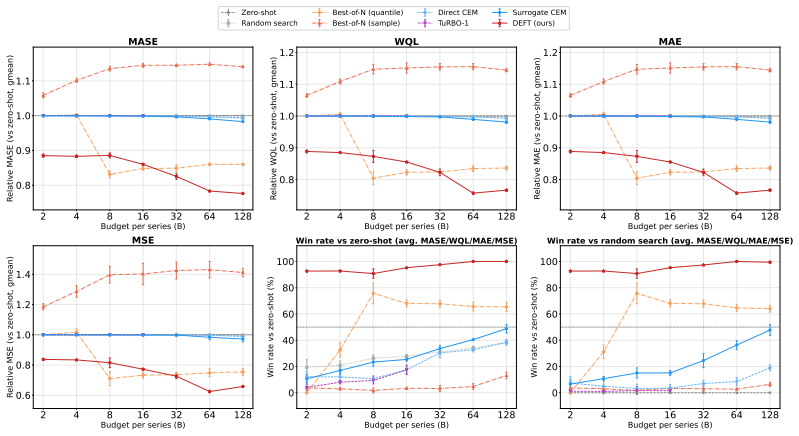
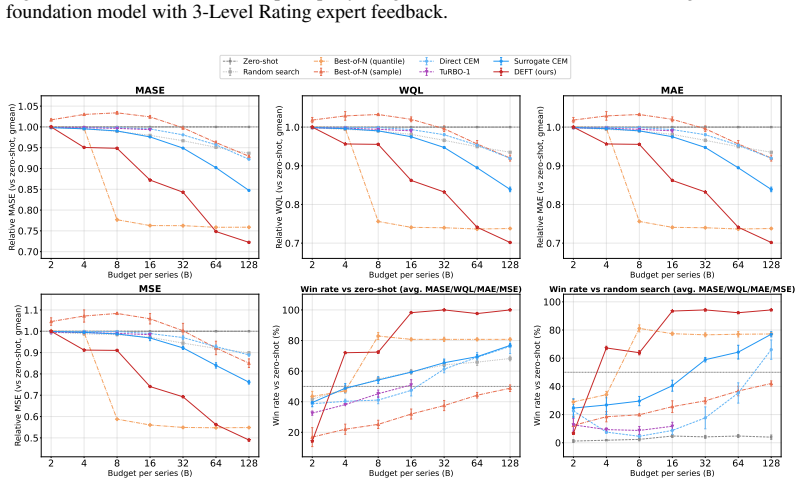
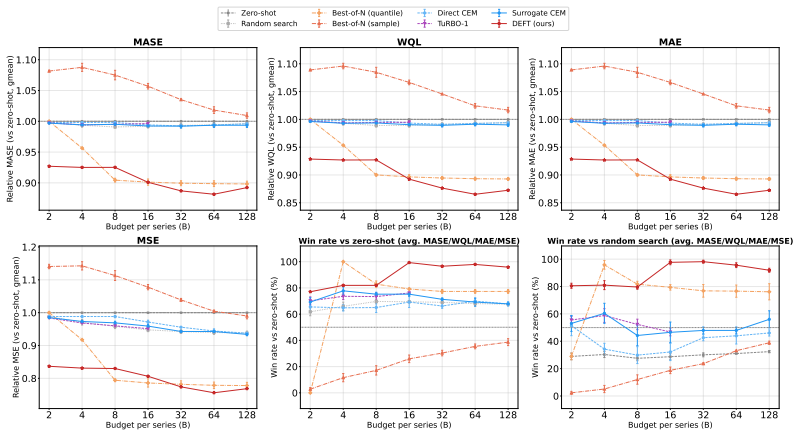
- DEFT improves forecast quality over best-of-N, random search, CEM, surrogate CEM, and TuRBO-1 under matched query budgets across 78 datasets and three foundation models, with win rates over zero-shot of 85–96% depending on backbone.
- The advantage holds under coarse feedback: 3- and 5-level ratings and pairwise preferences, not just continuous scores.
- The benefit grows with budget: DEFT keeps improving where best-of-N saturates, and at B=128 achieves the largest gap.
- Trajectory-level expert queries can be decomposed into component-level feedback without extra queries, effectively doubling per-query information.
- In the molecular-dynamics case study, DEFT reduces Morse-bond violations by up to 34% relative to zero-shot and is Pareto-better than best-of-N on violation-vs-MSE.
Where Pith is reading between the lines
- If the trend–seasonal additivity holds broadly, the same two-stage exploit-explore structure could apply to other structured output spaces, such as frequency components for spectral forecasting or piecewise-linear segments, whenever expert scores are trajectory-level.
- The near-identical performance of max-pooling and mean-pooling suggests the gains come from score reuse itself, not the pooling operator; a parallel derivation might show that any component-balanced recombination graph yields similar efficiency.
- A natural testable extension is to let DEFT decide per-series between editing and deferring to zero-shot when the seed-pool scan shows no component exceeds the median score, which could reduce overshoot on well-calibrated forecasts.
- Because DEFT keeps the foundation model frozen, it composes with test-time adaptation: one could first correct drift online, then edit with expert scores, attacking different error sources separately.
Editorial analysis
A structured set of objections, weighed in public.
Referee Report
Summary. The paper studies expert-guided forecast editing: a frozen time-series foundation model (TFM) produces forecast trajectories, an expensive expert scores a small number of complete candidate trajectories, and an editor returns a revised forecast under a fixed query budget. The proposed DEFT method first exploits the TFM prior by decomposing candidate trajectories into moving-average trend and residual components, scoring recombinations of these components, and max-pooling scores into component-level utilities; it then explores in a decomposed CEM loop. The paper claims that, under matched expert-query budgets, DEFT consistently improves forecast quality over best-of-N, random search, direct/surrogate CEM, and Bayesian optimization across 78 datasets, three TFM backbones, four feedback modes, and seven query budgets, plus a molecular-dynamics case study with a physically grounded score.
Significance. The problem is well motivated and the framing—spending a small expert budget by balancing TFM-prior exploitation with structured exploration—is timely and practically relevant. The evaluation is unusually broad: 78 datasets, three independent foundation-model backbones, four feedback interfaces, seven budgets, and a non-MSE physical-validity case study. The matched-budget protocol and the budget-curve analysis are appropriate and useful. The ablations also isolate several design choices. If the results hold, DEFT would be a simple, model-agnostic way to improve frozen TFM forecasts with very few expert calls. However, the strength of the claims currently exceeds the evidence in three specific ways: the Chronos-backbone results contradict the 'consistently improves over best-of-N' wording; no uncertainty quantification is reported despite noise-sensitive win rates and sub-1% metric differences; and the score-reuse mechanism—one of the paper's three stated principles—is never disabled in an ablation, so the claimed causal attribution for the gains is untested.
major comments (4)
- [§5.2, Table 3, §6 Conclusion] On the Chronos backbone with ChronosBench, DEFT is worse than Best-of-N(quantile) on all four error metrics: MASE 0.889 vs. 0.877, WQL 0.882 vs. 0.863, MAE 0.882 vs. 0.863, MSE 0.779 vs. 0.748. DEFT is better only on win rates. The abstract and the conclusion that DEFT 'consistently improves forecast quality over best-of-N' are therefore not supported by the reported numbers. Please qualify the claim—e.g., by metric, by setting, or by focusing on the win-rate criterion—and discuss why the win-rate advantage is the appropriate primary claim on this backbone.
- [§5.4, 'Score-reuse via max-pooling'] The mean-vs-max pooling comparison only changes the pooling operator; both variants reuse every queried score for both components. The text concludes that DEFT's gains 'stem primarily from reusing candidate evaluations across decomposed components,' but no ablation disables score reuse while keeping expert-query budgets matched. As written, the comparison cannot separate the information-multiplier effect of one query updating two proposals from the benefits of decomposed CEM search or the seed pool. Please add a no-reuse ablation—for example, alternating each query's score so it updates only the trend or only the seasonal proposal, with the budget held fixed—or remove the causal attribution.
- [§5.1/§5.2, Tables 2–4] No confidence intervals, standard errors, or significance tests are reported. All numbers are means over three seeds, and the win rates are computed over a fixed slice of series and settings. The paper claims the evaluation is 'large enough to detect sub-1% MASE differences,' but no evidence is provided. Given that several reported differences between DEFT and the best baseline are around 2–5%, the word 'consistently' needs support from per-series paired tests or bootstrap intervals. Please report uncertainty or at least a paired significance summary.
- [Limitations] The Limitations section explicitly flags the trend–seasonal decomposition assumption but does not flag the companion assumption, implicit in Eq. (9), that a high score for a recombined trajectory T_i + S_j can be attributed independently to T_i and S_j through max-pooling. If expert scores are strongly non-additive in trend and seasonal components, max-pooled utilities can misattribute quality and bias elite selection. This is a second, equally load-bearing modeling assumption for the score-reuse mechanism. Please either test robustness to non-additive scores (e.g., synthetic scores with explicit interactions) or state this as a limitation.
minor comments (4)
- [Algorithm 7, line 19] The update line contains a typo: 'arg max{..., T_i + S_j : (i,j) in I_r} underscore(·)' should be 'arg max{..., T_i + S_j : (i,j) in I_r}'.
- [Appendix A.3 / Table 7] The feedback-noise value(s) eta used in the main experiments are not reported. Since the paper emphasizes noisy/miscalibrated experts as future work but includes eta in the score definitions, please state the actual values used to generate the Rating and Pairwise signals.
- [Reproducibility] No code or data-slice release is mentioned. A reproducibility statement or an anonymized code/data link would substantially strengthen the paper, given the scale of the evaluation and the absence of confidence intervals.
- [Figure 3 / Table 8] The ablation figure legend includes 'Zero shot median' and 'Random search' as 'ablation variants,' but these are baselines rather than ablations of DEFT. Clarify the distinction in the caption or Table 8.
Circularity Check
No significant circularity: DEFT's improvements are empirical comparisons against external baselines; self-citations are background or benchmark sources, not load-bearing derivations.
full rationale
The paper's central claim is that DEFT improves forecast quality under matched expert-query budgets. This is established by controlled experiments on 78 datasets from the external ChronosBench/GIFT-Eval suites, with three time-series foundation models, four feedback modes, and seven query budgets, compared against best-of-N, random search, CEM, surrogate CEM, and TuRBO under identical query budgets. No parameters are fitted to the held-out future and then renamed as predictions: the moving-average decomposition y = T(y) + S(y) (Eq. 6) is an explicit algorithmic representation, the max-pooling utility (Eq. 9) is a definition of how trajectory scores are attributed to components, and the budget split (Algorithm 8) is a fixed heuristic. The paper does not derive its empirical win from Eq. 9 by construction; it reports measured MASE/WQL/MAE/MSE and win rates. The mean-vs-max ablation shows the pooling operator is not load-bearing, though the absence of a no-score-reuse ablation is a robustness gap (the reuse mechanism itself is never disabled), and Eqs. 6/9 assume level/trend/seasonal dominance and approximate score additivity—these are assumptions, not circular reductions. The self-citations (Le et al. 2025 for the MD benchmark/score; Nguyen et al. 2026 among decomposition-motivation citations) are background or benchmark sources, not invoked as authority for the central result. The MD case study further demonstrates non-circularity: DEFT is optimized on bond-violation rate and its MSE increases, showing the optimized objective and the reported accuracy metric are not identical by construction. Thus the derivation chain is self-contained: the headline improvement is an empirical observation with independent content, not an input recycled as an output.
Axiom & Free-Parameter Ledger
free parameters (7)
- elite fraction rho =
0.2
- per-round query budget b (DEFT) =
max(4, floor(B/8))
- seed-pool/refinement split tau =
0.5 (B0 approximately B/2)
- refinement rounds cap nr =
min(4, floor(s/b))
- component seed count K =
ceil(sqrt(B0))
- moving-average window w =
dominant autocorrelation period; fallback max(3, floor(H/4)), clamped to [2,H]
- expert feedback noise eta =
not specified (results appear to assume eta=0)
axioms (5)
- domain assumption Additive trend–seasonal decomposition with a centered moving average captures the dominant forecast-error modes (Eq. 6).
- domain assumption The expert score of a complete recombined trajectory can be reused as independent feedback for its trend and seasonal components via max-pooling (Eq. 9).
- domain assumption Diagonal Gaussian proposals over component vectors are an adequate search distribution for refining forecasts under a small query budget (Eqs. 11–14).
- domain assumption The foundation model's quantile/sample output provides a useful prior pool for editing.
- domain assumption An expert can score any complete candidate trajectory at a fixed cost, but cannot be queried on components.
Cite this review
Pith. "Pith review of Expert-Guided Forecast Editing for Time-Series Foundation Models." pith.science (2026). https://pith.science/paper/YYHMLCBA
@misc{pith2026260719659,
  author       = {Pith},
  title        = {Pith review of: Expert-Guided Forecast Editing for Time-Series Foundation Models},
  year         = {2026},
  howpublished = {\url{https://pith.science/paper/YYHMLCBA}},
  note         = {Machine review of arXiv:2607.19659}
}
read the original abstract
Time-series foundation models can forecast across heterogeneous domains without task-specific training, but their forecasts are fixed once produced and cannot directly incorporate task-specific expert feedback. We study expert-guided forecast editing: a frozen foundation model generates candidate future trajectories, and an expensive expert evaluator scores them to guide forecast revision. Under a tight query budget, two natural strategies sit at opposite ends: best-of-$N$ purely exploits the foundation model's predictive distribution, while optimization approaches mostly explore the forecast horizon as an unstructured high-dimensional vector. Each extreme is individually sub-optimal. We introduce \textbf{DEFT}, an expert-guided forecast editing framework that balances the two by first exploiting the foundation model's predictive samples in a decomposed trend--seasonal space, then exploring around them via component-wise refinement. DEFT queries the expert only on complete trajectories, then reuses scores for the trend and seasonal components that appeared in the queried recombinations. This lets each expert query provide structured component-level feedback while keeping the foundation model frozen. We compare DEFT against direct search approaches, including best-of-$N$, cross-entropy methods, and Bayesian optimization, under matched expert-query budgets. Across two forecasting benchmarks consisting of 78 datasets, three time-series foundation models, four feedback types, and seven query budgets, DEFT consistently improves the effectiveness of expert guidance. A molecular-dynamics case study further suggests that the same principle extends to more physically grounded feedback, supporting the hypothesis that sparse test-time guidance should be spent balancing prior exploitation with structured exploration.
Figures








Reference graph
Works this paper leans on
-
[1]
Proceedings of the 41st International Conference on Machine Learning , pages=
A decoder-only foundation model for time-series forecasting , author=. Proceedings of the 41st International Conference on Machine Learning , pages=
-
[2]
Proceedings of the IEEE , volume=
Taking the human out of the loop: A review of Bayesian optimization , author=. Proceedings of the IEEE , volume=. 2015 , publisher=
2015
-
[3]
Advances in neural information processing systems , volume=
Scalable global optimization via local Bayesian optimization , author=. Advances in neural information processing systems , volume=
-
[4]
arXiv preprint arXiv:2310.08278 , year=
Lag-llama: Towards foundation models for probabilistic time series forecasting , author=. arXiv preprint arXiv:2310.08278 , year=
-
[5]
Advances in neural information processing systems , volume=
Autoformer: Decomposition transformers with auto-correlation for long-term series forecasting , author=. Advances in neural information processing systems , volume=
-
[6]
Zhou, Tian and Ma, Ziqing and Wen, Qingsong and Wang, Xue and Sun, Liang and Jin, Rong , booktitle=
-
[7]
Proceedings of the AAAI conference on artificial intelligence , volume=
Are transformers effective for time series forecasting? , author=. Proceedings of the AAAI conference on artificial intelligence , volume=
-
[8]
and Bergmeir, Christoph , journal=
Bandara, Kasun and Hyndman, Rob J. and Bergmeir, Christoph , journal=
-
[9]
arXiv preprint arXiv:2502.12920 , year=
Lightweight Online Adaption for Time Series Foundation Model Forecasts , author=. arXiv preprint arXiv:2502.12920 , year=
-
[10]
Handbook of Statistics , volume=
The Cross-Entropy Method for Optimization , author=. Handbook of Statistics , volume=
-
[11]
Swarm and Evolutionary Computation , volume=
Surrogate-Assisted Evolutionary Computation: Recent Advances and Future Challenges , author=. Swarm and Evolutionary Computation , volume=
-
[13]
2004 , publisher=
The cross-entropy method: a unified approach to combinatorial optimization, Monte-Carlo simulation, and machine learning , author=. 2004 , publisher=
2004
-
[14]
arXiv preprint arXiv:2408.03314 , year=
Scaling llm test-time compute optimally can be more effective than scaling model parameters , author=. arXiv preprint arXiv:2408.03314 , year=
-
[15]
International Journal of forecasting , volume=
Judgmental forecasting: A review of progress over the last 25 years , author=. International Journal of forecasting , volume=. 2006 , publisher=
2006
-
[16]
International journal of forecasting , volume=
Effective forecasting and judgmental adjustments: an empirical evaluation and strategies for improvement in supply-chain planning , author=. International journal of forecasting , volume=. 2009 , publisher=
2009
-
[17]
IEEE Transactions on Intelligent Transportation Systems , year=
Online test-time adaptation of spatial--temporal traffic flow forecasting , author=. IEEE Transactions on Intelligent Transportation Systems , year=
-
[18]
Proceedings of the AAAI Conference on Artificial Intelligence , volume=
Battling the non-stationarity in time series forecasting via test-time adaptation , author=. Proceedings of the AAAI Conference on Artificial Intelligence , volume=
-
[19]
The Fourteenth International Conference on Learning Representations , year=
COSA: Context-aware Output-Space Adapter for Test-Time Adaptation in Time Series Forecasting , author=. The Fourteenth International Conference on Learning Representations , year=
-
[20]
arXiv preprint arXiv:2009.09043 , year=
Cross-entropy method variants for optimization , author=. arXiv preprint arXiv:2009.09043 , year=
Pith/arXiv arXiv 2009
-
[21]
and Carpov, Dmitri and Chapados, Nicolas and Bengio, Yoshua , booktitle=
Oreshkin, Boris N. and Carpov, Dmitri and Chapados, Nicolas and Bengio, Yoshua , booktitle=. 2020 , url=
2020
-
[22]
Forty-first International Conference on Machine Learning , year=
Unified training of universal time series forecasting transformers , author=. Forty-first International Conference on Machine Learning , year=
-
[23]
arXiv preprint arXiv:2510.15821 , year=
Chronos-2: From univariate to universal forecasting , author=. arXiv preprint arXiv:2510.15821 , year=
-
[24]
Transactions on Machine Learning Research , volume=
Chronos: Learning the Language of Time Series , author=. Transactions on Machine Learning Research , volume=. 2024 , publisher=
2024
-
[25]
NeurIPS Workshop on Time Series in the Age of Large Models , year=
GIFT-Eval: A Benchmark for General Time Series Forecasting Model Evaluation , author=. NeurIPS Workshop on Time Series in the Age of Large Models , year=
-
[26]
Maddix and Syama Rangapuram and David Salinas and Jasper Schulz and Lorenzo Stella and Ali Caner Türkmen and Yuyang Wang , title =
Alexander Alexandrov and Konstantinos Benidis and Michael Bohlke-Schneider and Valentin Flunkert and Jan Gasthaus and Tim Januschowski and Danielle C. Maddix and Syama Rangapuram and David Salinas and Jasper Schulz and Lorenzo Stella and Ali Caner Türkmen and Yuyang Wang , title =. Journal of Machine Learning Research , year =
-
[27]
2025 IEEE International Conference on Data Mining (ICDM) , pages=
Accelerating Long-Term Molecular Dynamics with Physics-Informed Time-Series Forecasting , author=. 2025 IEEE International Conference on Data Mining (ICDM) , pages=. 2025 , organization=
2025
-
[28]
International Conference on Machine Learning , year=
Reviving Error Correction in Modern Deep Time-Series Forecasting , author=. International Conference on Machine Learning , year=
-
[29]
arXiv preprint arXiv:2511.11698 , year=
Moirai 2.0: When less is more for time series forecasting , author=. arXiv preprint arXiv:2511.11698 , year=
-
[30]
Proceedings of the 42nd International Conference on Machine Learning (ICML) , year =
Sundial: A Family of Highly Capable Time Series Foundation Models , author =. Proceedings of the 42nd International Conference on Machine Learning (ICML) , year =. 2502.00816 , archivePrefix =
-
[31]
arXiv preprint arXiv:2602.12147 , year=
It's TIME: Towards the Next Generation of Time Series Forecasting Benchmarks , author=. arXiv preprint arXiv:2602.12147 , year=
discussion (0)
Sign in with ORCID, Apple, or X to comment. Anyone can read and Pith papers without signing in.