Nonrelativistic Spin-Orbit-Coupling Effects in Odd-Parity Coplanar Magnets
Pith reviewed 2026-06-26 06:55 UTC · model grok-4.3
The pith
Odd-parity coplanar magnets enable nonrelativistic SOC with tunable Rashba, Weyl and Dresselhaus textures equivalent to relativistic cases.
A machine-rendered reading of the paper's core claim, the machinery that carries it, and where it could break.
Core claim
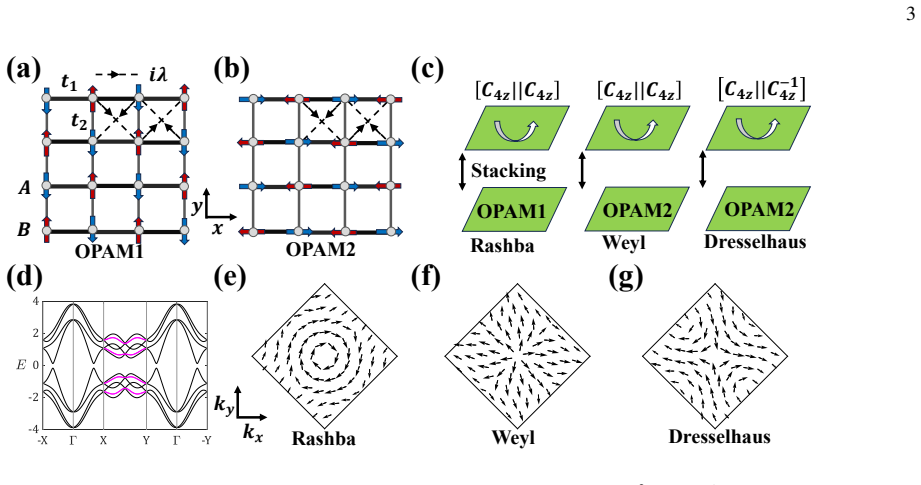
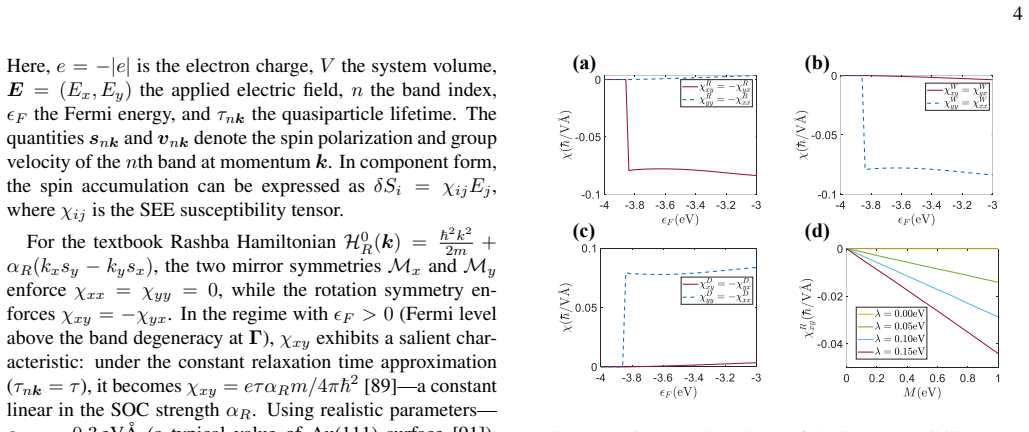
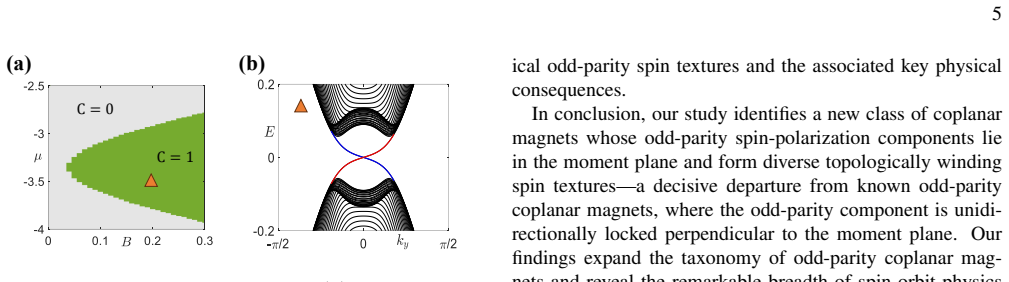
By constructing a bilayer coplanar magnet via symmetry-guided stacking of two monolayer odd-parity altermagnets, the authors demonstrate that Rashba, Weyl, and Dresselhaus spin textures can all be realized nonrelativistically, and that the spin texture can be switched between these forms simply by tuning the layer Néel vector. Through the spin Edelstein effect and the realization of fully gapped chiral topological superconducting phases, this nonrelativistic SOC achieves physical equivalence to its relativistic counterpart.
What carries the argument
Symmetry-guided bilayer stacking of two monolayer odd-parity altermagnets that generates and switches nonrelativistic spin textures.
Load-bearing premise
The bilayer construction via symmetry-guided stacking of two monolayer odd-parity altermagnets produces the claimed spin textures and physical equivalence without hidden relativistic contributions or model-specific fitting.
What would settle it
Direct measurement of the predicted spin-texture switching when the layer Néel vector is reversed in a fabricated bilayer sample, with no relativistic SOC present.
Figures
read the original abstract
Spin-orbit coupling (SOC) is a relativistic effect that underpins a broad spectrum of phenomena in condensed matter physics, from topological phases of matter to spintronic functionality. Its relativistic origin, however, restricts strong SOC to heavy-element materials and locks spin-momentum texture into a fixed, material-specific pattern. Here we show that odd-parity coplanar magnets offer a nonrelativistic pathway to highly tunable SOC effects. We construct a bilayer coplanar magnet via symmetry-guided stacking of two monolayer odd-parity altermagnets and demonstrate that Rashba, Weyl, and Dresselhaus spin textures can all be realized, and that the spin texture can be switched between these forms simply by tuning the layer Neel vector. Through the spin Edelstein effect and the realization of fully gapped chiral topological superconducting phases, we demonstrate that this nonrelativistic SOC achieves physical equivalence to its relativistic counterpart. Our findings identify a new class of odd-parity coplanar magnets as a versatile platform for engineering SOC effects.
Editorial analysis
A structured set of objections, weighed in public.
Referee Report
Summary. The manuscript claims that odd-parity coplanar magnets, realized via symmetry-guided bilayer stacking of two monolayer odd-parity altermagnets, provide a nonrelativistic route to highly tunable SOC effects. By adjusting the layer Néel vector, Rashba, Weyl, and Dresselhaus spin textures are obtained; physical equivalence to relativistic SOC is demonstrated via the spin Edelstein effect and the emergence of fully gapped chiral topological superconducting phases.
Significance. If the central construction and equivalence hold, the work identifies a new materials platform for engineering SOC phenomena without heavy elements, offering magnetic tunability that is unavailable in conventional relativistic SOC. The parameter-free character of the bilayer model and the explicit mapping to observable signatures (Edelstein effect, topological SC) would constitute a substantive advance in altermagnet-based spintronics.
minor comments (3)
- [Introduction] The abstract introduces 'odd-parity coplanar magnets' as a new class; the introduction should explicitly define the parity and coplanarity conditions relative to existing altermagnet literature and state the symmetry operations that enforce the bilayer stacking.
- Figure captions and text should clarify whether the reported spin textures are obtained from a minimal tight-binding model or from first-principles calculations, and whether any relativistic SOC term is retained as a control parameter.
- [Model] The claim that the nonrelativistic SOC is 'parameter-free' should be supported by an explicit statement of the Hamiltonian and the absence of adjustable parameters in the bilayer construction.
Simulated Author's Rebuttal
We thank the referee for the positive assessment of our work, the accurate summary of our central claims, and the recommendation for minor revision. No specific major comments were provided in the report.
Circularity Check
No significant circularity; derivation self-contained via explicit bilayer construction and observable demonstrations
full rationale
The paper constructs a bilayer via symmetry-guided stacking of two monolayer odd-parity altermagnets, then computes spin textures (Rashba/Weyl/Dresselhaus) and demonstrates equivalence through independent observables (spin Edelstein effect, fully gapped chiral topological SC). No quoted equations reduce a claimed prediction to a fitted input by construction, no load-bearing self-citation chain justifies the central premise, and the model is presented as parameter-free with explicit symmetry inputs. The equivalence is shown via computed physical responses rather than definitional renaming or ansatz smuggling. This is the normal case of an independent derivation.
Axiom & Free-Parameter Ledger
invented entities (1)
-
odd-parity coplanar magnets
no independent evidence
Reference graph
Works this paper leans on
-
[1]
Roland, Spin-orbit coupling effects in two-dimensional electron and hole systems, Springer Tracts in Modern Ph- ysiscs: Springer, Berlin, Heidelberg191(2003)
W. Roland, Spin-orbit coupling effects in two-dimensional electron and hole systems, Springer Tracts in Modern Ph- ysiscs: Springer, Berlin, Heidelberg191(2003)
2003
-
[2]
Galitski and I
V . Galitski and I. B. Spielman, Spin–orbit coupling in quantum gases, Nature494, 49 (2013)
2013
-
[3]
Manchon, H
A. Manchon, H. C. Koo, J. Nitta, S. M. Frolov, and R. A. Duine, New perspectives for Rashba spin–orbit coupling, Na- ture Materials14, 871 (2015)
2015
-
[4]
Nagaosa, J
N. Nagaosa, J. Sinova, S. Onoda, A. H. MacDonald, and N. P. Ong, Anomalous Hall effect, Rev. Mod. Phys.82, 1539 (2010)
2010
-
[5]
Sinova, S
J. Sinova, S. O. Valenzuela, J. Wunderlich, C. H. Back, and T. Jungwirth, Spin Hall effects, Rev. Mod. Phys.87, 1213 (2015)
2015
-
[6]
Chang, C.-X
C.-Z. Chang, C.-X. Liu, and A. H. MacDonald, Colloquium: Quantum anomalous Hall effect, Rev. Mod. Phys.95, 011002 (2023)
2023
-
[7]
Bauer and M
E. Bauer and M. Sigrist,Non-centrosymmetric superconduc- tors: introduction and overview, V ol. 847 (Springer Science & Business Media, 2012)
2012
-
[8]
Smidman, M
M. Smidman, M. B. Salamon, H. Q. Yuan, and D. F. Agterberg, Superconductivity and spin–orbit coupling in non- centrosymmetric materials: a review, Reports on Progress in Physics80, 036501 (2017)
2017
-
[9]
M. Z. Hasan and C. L. Kane,Colloquium: Topological insu- lators, Rev. Mod. Phys.82, 3045 (2010)
2010
-
[10]
Qi and S.-C
X.-L. Qi and S.-C. Zhang, Topological insulators and super- conductors, Rev. Mod. Phys.83, 1057 (2011)
2011
-
[11]
N. P. Armitage, E. J. Mele, and A. Vishwanath, Weyl and dirac semimetals in three-dimensional solids, Rev. Mod. Phys.90, 015001 (2018)
2018
-
[12]
G. Sala, M. T. Mercaldo, K. Domi, S. Gariglio, M. Cuoco, C. Ortix, and A. D. Caviglia, The quantum metric of electrons with spin-momentum locking, Science389, 822 (2025)
2025
-
[13]
Xiao, M.-C
D. Xiao, M.-C. Chang, and Q. Niu, Berry phase effects on electronic properties, Rev. Mod. Phys.82, 1959 (2010). 6
1959
-
[14]
Bercioux and P
D. Bercioux and P. Lucignano, Quantum transport in Rashba spin–orbit materials: a review, Reports on Progress in Physics 78, 106001 (2015)
2015
-
[15]
Zhang, Y
K. Zhang, Y . Feng, Y . Chen, J. Gong, L. Xu, Z. Wu, C. Liu, C. Chen, K. Shimada, and L. Qiao, Spin-momentum locking in locally noncentrosymmetric quantum materials, Reports on Progress in Physics88, 106503 (2025)
2025
-
[16]
Zhang, Q
X. Zhang, Q. Liu, J.-W. Luo, A. J. Freeman, and A. Zunger, Hidden spin polarization in inversion-symmetric bulk crystals, Nature Physics10, 387 (2014)
2014
-
[17]
S. D. Ganichev, V . V . Bel’kov, L. E. Golub, E. L. Ivchenko, P. Schneider, S. Giglberger, J. Eroms, J. De Boeck, G. Borghs, W. Wegscheider, D. Weiss, and W. Prettl, Experimental sep- aration of rashba and dresselhaus spin splittings in semicon- ductor quantum wells, Phys. Rev. Lett.92, 256601 (2004)
2004
-
[18]
B. A. Bernevig, J. Orenstein, and S.-C. Zhang, Exact SU(2) Symmetry and Persistent Spin Helix in a Spin-Orbit Coupled System, Phys. Rev. Lett.97, 236601 (2006)
2006
-
[19]
J. D. Koralek, C. P. Weber, J. Orenstein, B. A. Bernevig, S.- C. Zhang, S. Mack, and D. D. Awschalom, Emergence of the persistent spin helix in semiconductor quantum wells, Nature 458, 610 (2009)
2009
-
[20]
Manchon and S
A. Manchon and S. Zhang, Theory of spin torque due to spin- orbit coupling, Phys. Rev. B79, 094422 (2009)
2009
-
[21]
A. D. Caviglia, M. Gabay, S. Gariglio, N. Reyren, C. Cancel- lieri, and J.-M. Triscone, Tunable rashba spin-orbit interaction at oxide interfaces, Phys. Rev. Lett.104, 126803 (2010)
2010
-
[22]
Y .-J. Lin, K. Jim´enez-Garc´ıa, and I. B. Spielman, Spin–orbit- coupled Bose–Einstein condensates, Nature471, 83 (2011)
2011
-
[23]
Wang, Z.-Q
P. Wang, Z.-Q. Yu, Z. Fu, J. Miao, L. Huang, S. Chai, H. Zhai, and J. Zhang, Spin-Orbit Coupled Degenerate Fermi Gases, Phys. Rev. Lett.109, 095301 (2012)
2012
-
[24]
Niesner, M
D. Niesner, M. Wilhelm, I. Levchuk, A. Osvet, S. Shrestha, M. Batentschuk, C. Brabec, and T. Fauster, Giant rashba split- ting inch 3nh3pbbr3 organic-inorganic perovskite, Phys. Rev. Lett.117, 126401 (2016)
2016
-
[25]
Rowland, S
J. Rowland, S. Banerjee, and M. Randeria, Skyrmions in chi- ral magnets with Rashba and Dresselhaus spin-orbit coupling, Phys. Rev. B93, 020404(R) (2016)
2016
-
[26]
Bihlmayer, P
G. Bihlmayer, P. No ¨el, D. V . Vyalikh, E. V . Chulkov, and A. Manchon, Rashba-like physics in condensed matter, Nature Reviews Physics4, 642 (2022)
2022
-
[27]
Gatti, D
G. Gatti, D. Gos ´albez-Mart´ınez, S. S. Tsirkin, M. Fanciulli, M. Puppin, S. Polishchuk, S. Moser, L. Testa, E. Martino, S. Roth, P. Bugnon, L. Moreschini, A. Bostwick, C. Jozwiak, E. Rotenberg, G. Di Santo, L. Petaccia, I. V obornik, J. Fujii, J. Wong, D. Jariwala, H. A. Atwater, H. M. Rønnow, M. Cher- gui, O. V . Yazyev, M. Grioni, and A. Crepaldi, Rad...
2020
-
[28]
W.-H. Kang, M. Barth, A. Costa, A. Garcia-Ruiz, A. Mre ´nca- Kolasi´nska, M.-H. Liu, and D. Kochan, Magnetotransport and Spin-Relaxation Signatures of the Radial Rashba and Dres- selhaus Spin-Orbit Coupling in Proximitized Graphene, Phys. Rev. Lett.133, 216201 (2024)
2024
-
[29]
Costa and J
A. Costa and J. Fabian, Transport signatures of radial Rashba spin-orbit coupling at ferromagnet/superconductor interfaces, Phys. Rev. B111, 054512 (2025)
2025
-
[30]
D. J. P. de Sousa, S. Lee, and T. Low, Moir ´e Kramers-Weyl Fermions with Ideal Radial Spin Texture from Structural Chi- rality, Phys. Rev. Lett.134, 166401 (2025)
2025
-
[31]
Wu and S.-C
C. Wu and S.-C. Zhang, Dynamic Generation of Spin-Orbit Coupling, Phys. Rev. Lett.93, 036403 (2004)
2004
-
[32]
C. Wu, K. Sun, E. Fradkin, and S.-C. Zhang, Fermi liquid in- stabilities in the spin channel, Phys. Rev. B75, 115103 (2007)
2007
-
[33]
Fujita, M
T. Fujita, M. B. A. Jalil, S. G. Tan, and S. Murakami, Gauge fields in spintronics, Journal of Applied Physics110, 121301 (2011)
2011
-
[34]
Martin and A
I. Martin and A. F. Morpurgo, Majorana fermions in supercon- ducting helical magnets, Phys. Rev. B85, 144505 (2012)
2012
-
[35]
Uchida, Y
M. Uchida, Y . Onose, Y . Matsui, and Y . Tokura, Real-Space Observation of Helical Spin Order, Science311, 359 (2006)
2006
-
[36]
Togawa, T
Y . Togawa, T. Koyama, K. Takayanagi, S. Mori, Y . Kousaka, J. Akimitsu, S. Nishihara, K. Inoue, A. S. Ovchinnikov, and J. Kishine, Chiral Magnetic Soliton Lattice on a Chiral Heli- magnet, Phys. Rev. Lett.108, 107202 (2012)
2012
-
[37]
Togawa, Y
Y . Togawa, Y . Kousaka, K. Inoue, and J.-i. Kishine, Symme- try, Structure, and Dynamics of Monoaxial Chiral Magnets, Journal of the Physical Society of Japan85, 112001 (2016)
2016
-
[38]
Q. Song, S. Stavri ´c, P. Barone, A. Droghetti, D. S. Antonenko, J. W. F. Venderbos, C. A. Occhialini, B. Ilyas, E. Ergec ¸en, N. Gedik, S.-W. Cheong, R. M. Fernandes, S. Picozzi, and R. Comin, Electrical switching of a p-wave magnet , Nature 642, 64 (2025)
2025
-
[39]
Yamada, M
R. Yamada, M. T. Birch, P. R. Baral, S. Okumura, R. Nakano, S. Gao, M. Ezawa, T. Nomoto, J. Masell, Y . Ishihara, K. K. Kolincio, I. Belopolski, H. Sagayama, H. Nakao, K. Ohishi, T. Ohhara, R. Kiyanagi, T. Nakajima, Y . Tokura, T.-h. Arima, Y . Motome, M. M. Hirschmann, and M. Hirschberger, A metallic p-wave magnet with commensurate spin helix, Na- ture64...
2025
-
[40]
A. Birk Hellenes, T. Jungwirth, R. Jaeschke-Ubiergo, A. Chakraborty, J. Sinova, and L. ˇSmejkal, P-wave magnets, arXiv e-prints , arXiv:2309.01607 (2023), arXiv:2309.01607 [cond-mat.mes-hall]
Pith/arXiv arXiv 2023
-
[41]
Brekke, P
B. Brekke, P. Sukhachov, H. G. Giil, A. Brataas, and J. Linder, Minimal Models and Transport Properties of Unconventional p-Wave Magnets, Phys. Rev. Lett.133, 236703 (2024)
2024
-
[42]
Maeda, B
K. Maeda, B. Lu, K. Yada, and Y . Tanaka, Theory of Tunneling Spectroscopy in Unconventional p-Wave Magnet- Superconductor Hybrid Structures, Journal of the Physical So- ciety of Japan93, 114703 (2024)
2024
-
[43]
Ezawa, Higher-order bulk photovoltaic effects, quantum geometry, and application top-wave magnets, Phys
M. Ezawa, Higher-order bulk photovoltaic effects, quantum geometry, and application top-wave magnets, Phys. Rev. B 112, 155308 (2025)
2025
-
[44]
Ezawa, Out-of-plane edelstein effects: Electric field in- duced magnetization inp-wave magnets, Phys
M. Ezawa, Out-of-plane edelstein effects: Electric field in- duced magnetization inp-wave magnets, Phys. Rev. B111, L161301 (2025)
2025
-
[45]
Sukhachov, H
P. Sukhachov, H. G. Giil, B. Brekke, and J. Linder, Coexis- tence ofp-wave magnetism and superconductivity, Phys. Rev. B111, L220403 (2025)
2025
-
[46]
Y . Yu, M. B. Lyngby, T. Shishidou, M. Roig, A. Kreisel, M. Weinert, B. M. Andersen, and D. F. Agterberg, Odd-parity magnetism driven by antiferromagnetic exchange, Phys. Rev. Lett.135, 046701 (2025)
2025
-
[47]
Z.-T. Sun, X. Feng, Y .-M. Xie, B. T. Zhou, J.-X. Hu, and K. T. Law, Pseudo-ising superconductivity induced byp-wave mag- netism, Phys. Rev. B112, 214504 (2025)
2025
-
[48]
Zeng, Tunneling spin Hall effect induced by unconven- tional p-wave magnetism, Phys
W. Zeng, Tunneling spin Hall effect induced by unconven- tional p-wave magnetism, Phys. Rev. B112, 144516 (2025), arXiv:2507.09112 [cond-mat.mes-hall]
arXiv 2025
-
[49]
Kokkeler, I
T. Kokkeler, I. Tokatly, and F. S. Bergeret, Quantum transport theory for unconventional magnets: Interplay of altermag- netism and p-wave magnetism with superconductivity, SciPost Phys.18, 178 (2025)
2025
-
[50]
Chakraborty, A
A. Chakraborty, A. Birk Hellenes, R. Jaeschke-Ubiergo, T. Jungwirth, L. ˇSmejkal, and J. Sinova, Highly efficient non- relativistic Edelstein effect in nodal p-wave magnets, Nature 7 Communications16, 7270 (2025)
2025
-
[51]
C. Lee, N. A. Hackner, and P. M. R. Brydon, Incommensura- tion in odd-parity magnets, Phys. Rev. B113, 064420 (2026)
2026
-
[52]
P.-H. Fu, S. Mondal, J.-F. Liu, Y . Tanaka, and J. Cayao, Flo- quet engineering spin triplet states in unconventional magnets, Phys. Rev. Lett.136, 066703 (2026)
2026
-
[53]
F. Zhang, H. Li, X. Cheng, Y . Fan, Y . Yin, Y . Gao, Z. Liu, S. Cui, Z. Yin, Y . Zhao, J. Lin, Z. Liu, M. Ye, Y . Huang, S. Qiao, W. Xie, P. Miao, H. Wu, J. Liu, G. Cao, and C. Chen, Odd spin symmetry and anisotropy switching in p- wave magnet CeNiAsO, arXiv e-prints , arXiv:2605.28701 (2026), arXiv:2605.28701 [cond-mat.str-el]
Pith/arXiv arXiv 2026
-
[54]
Dsouza, A
R. Dsouza, A. Kreisel, B. M. Andersen, D. F. Agterberg, and M. H. Christensen, Odd-parity magnetism in fe-based super- conductors with coplanar magnetic order, Phys. Rev. B113, 144509 (2026)
2026
-
[55]
J. Priessnitz, A. Birk Hellenes, R. Comin, and L. ˇSmejkal, Fer- roelectricp-wave magnets, arXiv e-prints , arXiv:2603.19107 (2026), arXiv:2603.19107 [cond-mat.mtrl-sci]
arXiv 2026
-
[56]
J. E. C. Carmelo, I. R. Pimentel, and P. D. Sacramento, Com- petition and coexistence of superconducting symmetries in p-wave magnets, arXiv e-prints , arXiv:2605.17649 (2026), arXiv:2605.17649 [cond-mat.supr-con]
Pith/arXiv arXiv 2026
- [57]
-
[58]
Z.-Y . Yuan, J.-F. Liu, P.-H. Fu, and J. Wang, Time reversal re- served spin valve and spin transistor based on unconventional p-wave magnets, arXiv e-prints , arXiv:2603.18685 (2026), arXiv:2603.18685 [cond-mat.mes-hall]
Pith/arXiv arXiv 2026
-
[59]
J. Mitscherling, J. Priessnitz, C. K. Geschner, and L. ˇSmejkal, Microscopic origin ofp-wave magnetism, arXiv e-prints , arXiv:2603.09736 (2026), arXiv:2603.09736 [cond-mat.mes- hall]
arXiv 2026
-
[60]
Y . Li and P. Sukhachov,P-wave Orbital Magnetism, arXiv e-prints , arXiv:2604.18695 (2026), arXiv:2604.18695 [cond- mat.mes-hall]
Pith/arXiv arXiv 2026
- [61]
-
[62]
A. Fakhredine, G. Cuono, J. Skolimowski, S. Picozzi, and C. Autieri, Interplay between Relativistic Spin-Momentum Locking and Breaking of Inversion Symmetry: conditions for p-wave magnetism, arXiv e-prints , arXiv:2602.21871 (2026), arXiv:2602.21871 [cond-mat.mtrl-sci]
Pith/arXiv arXiv 2026
-
[63]
I. d. M. Froldi and H. Freire, Highly efficient superconduct- ing diode effect in unconventionalp-wave magnets, arXiv e- prints , arXiv:2601.09783 (2026), arXiv:2601.09783 [cond- mat.supr-con]
arXiv 2026
-
[64]
V . Leeb and J. Knolle, Collinearp-wave magnetism and hid- den orbital ferrimagnetism, arXiv e-prints , arXiv:2601.07418 (2026), arXiv:2601.07418 [cond-mat.str-el]
arXiv 2026
-
[65]
M. M. Hirschmann, A. Furusaki, and M. Hirschberger, Symmetry-Enforced Nodalf-Wave Magnets, arXiv e-prints , arXiv:2603.17406 (2026), arXiv:2603.17406 [cond-mat.mes- hall]
arXiv 2026
- [66]
-
[67]
M. Salehi, Transverse Spin Supercurrent at p-wave mag- netic Josephson Junctions, arXiv e-prints , arXiv:2507.11397 (2025), arXiv:2507.11397 [cond-mat.supr-con]
arXiv 2025
- [68]
- [69]
-
[70]
Nagae, L
Y . Nagae, L. Katayama, and S. Ikegaya, Flat-band zero-energy states and anomalous proximity effects inp-wave magnet– superconductor hybrid systems, Phys. Rev. B111, 174519 (2025)
2025
-
[71]
A. Pal, P. Dutta, and A. Saha, Emergent superconducting phases in unconventionalp-wave magnets: Topological super- conductivity, Bogoliubov Fermi surfaces and superconduct- ing diode effect, arXiv e-prints , arXiv:2603.03221 (2026), arXiv:2603.03221 [cond-mat.supr-con]
arXiv 2026
-
[72]
K.-M. Kim, G. Sim, and M. Jip Park, Topological Ising su- perconductivity in two-dimensional p-wave magnet, arXiv e- prints , arXiv:2605.01686 (2026), arXiv:2605.01686 [cond- mat.str-el]
Pith/arXiv arXiv 2026
- [73]
-
[74]
D. Zhu, D. Liu, Z.-Y . Zhuang, Z. Wu, and Z. Yan, Light- Induced Even-Parity Unidirectional Spin Splitting in Coplanar Antiferromagnets, arXiv e-prints , arXiv:2601.03358 (2026), arXiv:2601.03358 [cond-mat.mtrl-sci]
arXiv 2026
-
[75]
Huang, Z
S. Huang, Z. Qin, F. Zhan, D.-H. Xu, D.-S. Ma, and R. Wang, Light-Induced Odd-Parity Magnetism in Conventional Anti- ferromagnetism, Phys. Rev. Lett.136, 126703 (2026)
2026
-
[76]
Li, D.-F
B. Li, D.-F. Shao, and A. A. Kovalev, Floquet Spin Splitting and Spin Generation in Antiferromagnets, Phys. Rev. Lett. 136, 166701 (2026)
2026
-
[77]
T. Zhu, D. Zhou, H. Wang, S.-H. Wei, and J. Ruan, Floquet odd-parity collinear magnets, Phys. Rev. Lett.136, 126704 (2026)
2026
-
[78]
Liu, Z.-Y
D. Liu, Z.-Y . Zhuang, D. Zhu, Z. Wu, and Z. Yan, Light- induced odd-parity altermagnets on dimerized lattices, Phys. Rev. B113, L060409 (2026)
2026
-
[79]
Z.-Y . Zhuang, J.-X. Hu, S.-B. Zhang, L.-H. Hu, and Z. Yan, Mixed-Parity Altermagnetism in Collinear Spin- Orbital Magnets, arXiv e-prints , arXiv:2605.05205 (2026), arXiv:2605.05205 [cond-mat.mes-hall]
Pith/arXiv arXiv 2026
-
[80]
Y .-P. Lin, Odd-parity altermagnetism through sublattice cur- rents: From Haldane-Hubbard model to general bipartite lat- tices, arXiv e-prints , arXiv:2503.09602 (2025)
arXiv 2025
discussion (0)
Sign in with ORCID, Apple, or X to comment. Anyone can read and Pith papers without signing in.