REVIEW 4 major objections 4 minor 70 references
This paper argues that a quantum conformal anomaly can drive extreme-mass-ratio inspiral orbits into chaos and that the resulting gravitational waves carry a distinct, detectable signature—opening a direct observational route to the anomaly
Reviewed by Pith at T0; open to challenge. T0 means a machine referee read the full paper against a public rubric. the ladder, T0–T4 →
T0 review · deepseek-v4-flash
2026-08-01 14:37 UTC pith:Z4FCNJUL
load-bearing objection The paper's central claim doesn't survive its own setup: the conformal anomaly cannot create chaos in this spherically symmetric metric, and the chaos they study comes from a hand-added harmonic trap rather than from the anomaly. the 4 major comments →
Chaotic Imprints in Gravitational Waves from Conformal-Anomaly-Corrected Extreme-Mass-Ratio Inspirals
The pith
A machine-rendered reading of the paper's core claim, the machinery that carries it, and where it could break.
Core claim
The central claim is that conformal-anomaly corrections to the black hole metric do not merely modify thermodynamics but also reshape orbital dynamics: as the anomaly coefficient (or the orbital energy) is increased, the secondary body's motion passes from regular, integrable tori through broken tori to fully chaotic orbits, and this dynamical transition is imprinted on the gravitational-wave signal. Waveforms from chaotic orbits show strong, nonstationary amplitude fluctuations; their frequency spectra show dense fine spikes and quasi-continuous bands instead of clean discrete harmonics; their energy spectra grow rather than decay above a characteristic frequency. The paper further claims t
What carries the argument
Three components carry the argument. First, the conformal-anomaly-corrected, static spherically symmetric metric f(r)=1−r²/(4α)(1−√(1−8α(2M/r³−Q²/r⁴))), where α is the renormalized central charge (conformal anomaly coefficient). Second, an external harmonic-oscillator potential, U=½K_r(r−r_c)²+½K_φ(r_h)²(φ−φ_c)², which is introduced to confine the particle; this trap is the integrability-breaking mechanism—without it, free geodesic motion in the metric is integrable and no chaos appears. Third, the numerical kludge method, which maps the geodesic trajectory into a flat-space orbit and feeds it into the quadrupole radiation formula to generate waveforms, from which characteristic strain and s
Load-bearing premise
The load-bearing premise is that the harmonic-oscillator trap used in Eqs. (9)–(13) is a physically realistic description of how the secondary is confined near the black hole; without that trap the background geodesic motion is integrable, and the claimed anomaly-driven chaos—and the gravitational-wave signature built on it—would not arise.
What would settle it
A direct calculation of the same system (same α, E, M, Q) with the harmonic-trap terms K_r and K_φ in Eqs. (10)–(13) set to zero: if the Poincaré sections remain regular tori for all α, then the conformal anomaly alone does not drive chaos and the central claim collapses. Observational falsification would come from a large, clean EMRI sample in LISA data showing exclusively discrete harmonic spectra with no quasi-continuous broadband component.
If this is right
- If the claim is correct, standard quasi-periodic EMRI templates would miss conformal-anomaly-chaotic signals; search pipelines must allow for broadband, irregular amplitude-modulated waveforms.
- The rising energy spectrum and the persistence of characteristic strain at high frequencies give chaotic EMRIs an observational fingerprint that can be used to separate them from regular inspirals.
- A detected chaotic EMRI of this type would directly constrain the conformal anomaly coefficient α, turning a quantum-correction parameter into a measurable astrophysical quantity.
- The claimed detectability by LISA, Taiji, and TianQin at a luminosity distance of 2 Gpc means that near-future space-based observatories, not distant space experiments, could test the hypothesis.
- The dense spectral spikes and quasi-continuous bands provide a route to identifying the onset of chaos in the data, even when the time-domain waveform is too complex for template matching.
Where Pith is reading between the lines
- The paper does not justify the harmonic trap astrophysically; if no physical confinement mechanism (e.g., an accretion torus or dark-matter density profile) acts this way, the claimed chaos—and hence the gravitational-wave signature—may be an artifact of the toy potential rather than a property of the anomaly.
- The authors explicitly note that radiation backreaction and higher multipole contributions were neglected; including them could shorten the observable chaotic phase or regularize the orbit, so the sensitivity-curve comparison should be read as an optimistic upper bound on detectability.
- Because any integrability-breaking perturbation can produce irregular amplitude and broadband spectra, a future detection of such a signal would not by itself identify a conformal anomaly; that identification would require the specific dependence on α and on the metric parameters predicted here.
- A testable extension would be to run the same waveform-generation pipeline on mock LISA/Taiji/TianQin data with injected chaotic signals to check how often the fine spectral spikes are distinguishable from noise transients or instrumental artifacts.
Editorial analysis
A structured set of objections, weighed in public.
Referee Report
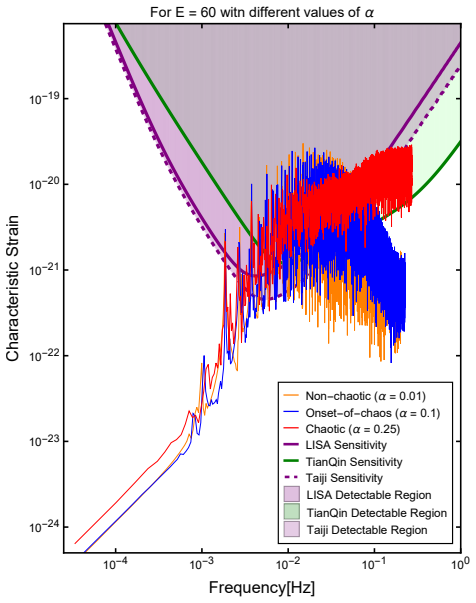
Summary. The paper studies gravitational-wave (GW) emission from an extreme-mass-ratio inspiral (EMRI) in which the central black hole is modified by a quantum conformal anomaly. The authors integrate the equations of motion of a massive test particle in Painlevé coordinates, adding an external harmonic oscillator potential to confine the particle. Based on Poincaré sections from their prior work, they classify trajectories as non-chaotic, onset-of-chaos, and chaotic for different values of the anomaly coefficient α at fixed energy E=60, and similarly for varying E at fixed α in the appendix. They then use the numerical kludge method and the weak-field quadrupole formula to compute GW waveforms, frequency spectra, energy spectra, and characteristic strain, comparing the latter with LISA, Taiji, and TianQin sensitivity curves. The central claim is that conformal-anomaly-induced chaos leaves detectable imprints in EMRI GWs, providing an observational pathway to probe quantum anomaly effects.
Significance. If the central claim were correct, it would be a notable step toward connecting quantum corrections to black-hole spacetimes with observable GW signatures from EMRIs. The paper includes a concrete numerical workflow: explicit equations of motion, waveform generation, spectral analysis, and a detectability comparison against space-based detector sensitivity curves. However, the claim is not supported by the model as presented. The chaotic dynamics are generated by an external harmonic oscillator potential that has no counterpart in real EMRIs, and the conformal anomaly only modifies the spherically symmetric metric without breaking integrability. As a result, the computed waveforms and detectability estimates pertain to a toy model, not to 'conformal-anomaly-affected chaotic EMRI configurations.' The significance of the paper is therefore contingent on a physical mechanism that is absent from the manuscript.
major comments (4)
- [§2, Eqs. (9)–(13)] The central dynamical model is not an EMRI. In the spherically symmetric metric Eq. (2), an unperturbed test particle has conserved p_t and p_φ and, for θ=π/2, effectively one-dimensional radial motion; the geodesic system is Liouville integrable for any α. The terms (1/2)K_r(r−r_c)^2 and (1/2)K_φ r_h^2(φ−φ_c)^2 in Eq. (9), together with the forces in Eqs. (11) and (13), are the only non-integrable ingredients. The text itself says this external potential is introduced 'to confine the particles' (after Eq. (8)). Real EMRIs have no such external oscillator trap; the secondary is bound by the black hole's gravity. Hence the Poincaré sections of Fig. 1 and the irregular waveforms/spectra of Figs. 2, 4, 5, and 6 are imprints of the artificial potential, not of the conformal anomaly. The abstract and Sec. 3.2's attribution of the chaos to 'intrinsic quantum anomaly corrections' is therefore u
- [§3, Eq. (20)] The quadrupole formula Eq. (20) is applied to orbits with r ~ 2.4–4.0M (Fig. 1) and E=60. This is not a weak-field, slow-motion regime: r ~ 3M is in the strong-field region near the horizon, and E=60 implies highly relativistic motion. No justification is given for using the flat-space retarded quadrupole formula with velocities and accelerations computed in Painlevé coordinates. This affects all quantitative waveform, spectral, and characteristic-strain results, including the detectability comparison in Fig. 6.
- [§3.1, Eq. (31)] The adiabatic approximation is not established. The statement that radiation-reaction angular-momentum loss is negligible 'compared to the angular momentum variation induced by the harmonic oscillator potential along the φ direction' (Sec. 3.1) admits that the external potential, not gravitational radiation, drives the orbital evolution. Comparing dE/dt in Eq. (31) to the total energy E is not the relevant criterion; one must show that the inspiral timescale is much longer than the integration time for the physical EMRI. Since the external trap is absent in real EMRIs, this check does not transfer to the claimed astrophysical setting.
- [§3.3, Fig. 6] Even if the strain computation were valid, the detectability claim in Sec. 3.3 compares characteristic strain to noise-free sensitivity curves. The statement that 'portions of these strain curves rise above the sensitivity thresholds' is not a detection criterion; a proper SNR estimate with observation time, noise realization, and confusion noise is required. More fundamentally, since the chaotic signal is generated by the artificial harmonic potential, the conclusion that LISA/Taiji/TianQin can 'capture gravitational-wave signals originating from conformal-anomaly-affected chaotic EMRI configurations' does not follow.
minor comments (4)
- [Throughout] The manuscript contains numerous typographical errors, e.g., 'steller-mass', 'suffiencient', 'der serving', 'orbitsorbits', 'withn', and inconsistent cross-references such as 'Fig.3(a)' in the Appendix A caption. A careful proofread is needed.
- [§2, Eq. (9)] The potential terms in Eq. (9) are introduced without discussion of their physical dimensions or origin. In natural units, K_r(r−r_c)^2 and K_φ r_h^2(φ−φ_c)^2 should be energies; it would help to state the mass scale of the test particle and the units of K_r and K_φ.
- [§3.2, Sec. 3.2] The classification of orbits as non-chaotic, onset-of-chaos, and chaotic is imported from the authors' prior preprint [37] without reproducing the Lyapunov exponents or other quantitative chaos indicators. Since this classification is the basis for all subsequent comparisons, it should be summarized or verified in the present work.
- [Figure captions] Several figure captions are incomplete or ambiguous. For example, Fig. 4 says 'orbitsorbits' and Fig. 5(a) uses 'αc' while the text uses 'α'. Please standardize the notation.
Circularity Check
Chaos is attributed to the conformal anomaly, but the Poincaré-section chaos actually comes from the ad hoc harmonic-oscillator potential adopted from the authors' own prior work; the claimed anomaly-induced GW imprints are therefore built into the model by construction.
specific steps
-
ansatz smuggled in via citation
[Sec. 2, Eqs. (9)–(13); Sec. 3.2 (novelty claim)]
"to observe the transition of particle motion from integrable dynamics to chaos near the black hole over an extended evolution time, we introduce a simple external harmonic oscillator potential to confine the particles. ... The novelty of our work is that the chaotic dynamics is not induced by addition matter field but by the intrinsic quantum anomaly corrections which exist ubquitously."
The anomaly coefficient α appears only in f(r) (Eq. (3)), so the spherically symmetric geodesic system (Eq. (2)) remains Liouville integrable; the external harmonic terms in Eq. (9) are what break integrability and generate the Poincaré-section chaos. These terms are an ad hoc ansatz inherited from the authors' own prior work [37], not derived from the anomaly. The paper then attributes the resulting chaos to 'intrinsic quantum anomaly corrections' and uses it to produce the 'detectable' waveforms. Thus the central prediction—anomaly-induced chaotic GW imprints—is not a consequence of the anomaly but of the externally imposed oscillator trap; the conclusion is built into the model by construction.
full rationale
The numerical-kludge waveform computation is self-contained: trajectories are integrated from the equations of motion, the quadrupole formula is applied, and characteristic strains are compared with published sensitivity curves. No parameter is fitted to the conclusion, so there is no fitted-input circularity. The circular component is upstream: the chaotic/non-chaotic classification that drives all waveform differences is produced by the hand-added harmonic-oscillator potential of Eq. (9), adopted from the authors' own prior work [37], and then relabeled as 'conformal-anomaly-induced chaos' (Sec. 3.2). Since the conformal anomaly only rescales f(r) and cannot by itself break the integrability of the spherically symmetric geodesic system, the claimed imprints and their detectability are imprints of the trap, not of the anomaly. The central astrophysical claim therefore inherits an ansatz from a self-citation rather than being derived from the anomaly. However, the GW analysis itself has independent computational content, so the circularity is partial rather than total.
Axiom & Free-Parameter Ledger
free parameters (6)
- conformal anomaly coefficient α =
0.01, 0.1, 0.25
- U(1) charge Q =
1/√2
- harmonic potential parameters K_r, K_phi, r_c, phi_c =
K_r=80, K_phi=20, r_c=3.2, phi_c=0
- orbital energy E =
50, 60, 70, 80 (main text E=60)
- geometric/observation parameters =
ι=π/4, ζ=π/4, D_L=2 Gpc, m/M=10^-5, M=10^6 M_sun
- initial conditions for the orbit =
unspecified
axioms (5)
- domain assumption The conformal-anomaly-corrected metric in Eq. (3) from Ref. [27] correctly describes the semiclassical backreaction of the trace anomaly.
- ad hoc to paper The external harmonic oscillator potential is a valid way to model an EMRI secondary's confinement.
- domain assumption The adiabatic approximation holds: radiation reaction is negligible over the signal duration.
- ad hoc to paper The weak-field quadrupole formula in Eq. (20) applies to these near-horizon orbits (r~3M).
- domain assumption The chaos classification from the Poincaré sections in Ref. [37] is reliable.
invented entities (1)
-
external harmonic oscillator potential in Eq. (9)
no independent evidence
read the original abstract
In this work, we investigate the effect of chaotic orbits on the extreme mass ratio inspiral (EMRI) gravitational wave signals where the central black hole is corrected by quantum conformal anomaly. We utilize the numerical kludge method to compute gravitational waveforms produced by the compact object along different orbital trajectories, and also derive the corresponding frequency distribution and energy spectra of gravitational waves. Our calculations reveal that variations in orbital energy or anomaly coefficient drive the orbital evolution from regular integrable motion to chaotic motion, and such dynamical transition leaves clear imprints on gravitational-wave signal. Specifically, gravitational waves originating from chaotic orbits feature pronounced irregular and time-varying amplitude fluctuations, accompanied by abundant fine spectral spikes and extended continuous spectral distributions in both frequency and energy domains, which differ drastically from the gravitational radiation generated by the regular non-chaotic orbits. Moreover, we evaluate the detectability by comparing the calculated characteristic strain of gravitational waves emitted by the compact object on different orbits with the sensitivity curves of future space-based GW detectors, including LISA, Taiji and TianQin. The results demonstrate that these detectors are capable of capturing gravitational-wave signals from chaotic systems modified by conformal anomalies, which provide a potential pathway for detecting conformal anomaly correction in astronomical observation.
Figures


Reference graph
Works this paper leans on
-
[1]
P. C. Peters, Gravitational Radiation and the Motion of Two Point Masses, Phys. Rev. 136 (1964) B1224–B1232. doi:10.1103/PhysRev.136.B1224
-
[2]
Einstein, N
A. Einstein, N. Rosen, On Gravitational waves, J. Franklin Inst. 223 (1937) 43–54.doi:10.1016/ S0016-0032(37)90583-0
1937
-
[3]
B. P. Abbott, et al., Observation of Gravitational Waves from a Binary Black Hole Merger, Phys. Rev. Lett. 116 (6) (2016) 061102.arXiv:1602.03837,doi:10.1103/ PhysRevLett.116.061102
Pith/arXiv arXiv 2016
-
[4]
B. P. Abbott, et al., A Gravitational-wave Measurement of the Hubble Constant Following the Second Observ- ing Run of Advanced LIGO and Virgo, Astrophys. J. 909 (2) (2021) 218.arXiv:1908.06060,doi:10.3847/ 1538-4357/abdcb7
Pith/arXiv arXiv 2021
-
[5]
B. P. Abbott, et al., GW150914: The Advanced LIGO De- tectors in the Era of First Discoveries, Phys. Rev. Lett. 116 (13) (2016) 131103.arXiv:1602.03838,doi: 10.1103/PhysRevLett.116.131103
Pith/arXiv arXiv 2016
-
[6]
Akiyama, et al., First M87 Event Horizon Telescope Results
K. Akiyama, et al., First M87 Event Horizon Telescope Results. II. Array and Instrumentation, Astrophys. J. Lett. 875 (1) (2019) L2.arXiv:1906.11239,doi:10.3847/ 2041-8213/ab0c96
Pith/arXiv arXiv 2019
-
[7]
Akiyama, et al., First Sagittarius A* Event Horizon Telescope Results
K. Akiyama, et al., First Sagittarius A* Event Horizon Telescope Results. I. The Shadow of the Supermassive Black Hole in the Center of the Milky Way, Astrophys. J. Lett. 930 (2) (2022) L12.arXiv:2311.08680,doi: 10.3847/2041-8213/ac6674
Pith/arXiv arXiv 2022
-
[8]
Akiyama, et al., First Sagittarius A* Event Horizon Telescope Results
K. Akiyama, et al., First Sagittarius A* Event Horizon Telescope Results. II. EHT and Multiwavelength Obser- vations, Data Processing, and Calibration, Astrophys. J. Lett. 930 (2) (2022) L13.arXiv:2311.08679,doi: 10.3847/2041-8213/ac6675
Pith/arXiv arXiv 2022
-
[9]
F. Ozel, D. Psaltis, S. Ransom, P. Demorest, M. Alford, The Massive Pulsar PSR J1614-2230: Linking Quantum Chromodynamics, Gamma-ray Bursts, and Gravitational Wave Astronomy, Astrophys. J. Lett. 724 (2010) L199– L202.arXiv:1010.5790,doi:10.1088/2041-8205/ 724/2/L199
Pith/arXiv arXiv 2010
-
[10]
K. Hashimoto, N. Tanahashi, Universality in Chaos of Particle Motion near Black Hole Horizon, Phys. Rev. D 95 (2) (2017) 024007.arXiv:1610.06070,doi:10. 1103/PhysRevD.95.024007
Pith/arXiv arXiv 2017
-
[11]
A. Bera, S. Dalui, S. Ghosh, E. C. Vagenas, Quantum cor- rections enhance chaos: Study of particle motion near a generalized Schwarzschild black hole, Phys. Lett. B 829 (2022) 137033.arXiv:2109.00330,doi:10.1016/j. physletb.2022.137033
Pith/arXiv arXiv 2022
-
[12]
S. Dalui, B. R. Majhi, P. Mishra, Presence of hori- zon makes particle motion chaotic, Phys. Lett. B 788 (2019) 486–493.arXiv:1803.06527,doi:10.1016/ j.physletb.2018.11.050
Pith/arXiv arXiv 2019
-
[13]
J. Maldacena, S. H. Shenker, D. Stanford, A bound on chaos, JHEP 08 (2016) 106.arXiv:1503.01409,doi: 10.1007/JHEP08(2016)106
Pith/arXiv arXiv 2016
-
[14]
C. Yu, D. Chen, B. Mu, Y . He, Violating the chaos bound in five-dimensional, charged, rotating Einstein-Maxwell- Chern-Simons black holes, Nucl. Phys. B 987 (2023) 116093.doi:10.1016/j.nuclphysb.2023.116093. 11 0.00 0.05 0.10 0.15 0.20 0.25 -6 -4 -2 0 2 4 t/103M h+/10-21 h+ forα=0.01 Non-chaotic(E=50) Onset-of-chaos(E=70) Chaotic(E=80) (a) 0.00 0.05 0.10...
arXiv 2023
-
[15]
P. Dutta, K. L. Panigrahi, B. Singh, Chaos bound and its violation in black p-brane, JHEP 02 (2025) 043.arXiv: 2408.14056,doi:10.1007/JHEP02(2025)043
Pith/arXiv arXiv 2025
-
[16]
C. Gao, D. Chen, C. Yu, P. Wang, Chaos bound and its violation in charged Kiselev black hole, Phys. Lett. B 833 (2022) 137343.arXiv:2204.07983,doi:10.1016/j. physletb.2022.137343
Pith/arXiv arXiv 2022
-
[17]
B. Gwak, N. Kan, B.-H. Lee, H. Lee, Violation of bound on chaos for charged probe in Kerr-Newman-AdS black hole, JHEP 09 (2022) 026.arXiv:2203.07298,doi: 10.1007/JHEP09(2022)026
Pith/arXiv arXiv 2022
-
[18]
Y .-Q. Lei, X.-H. Ge, C. Ran, Chaos of particle mo- tion near a black hole with quasitopological electromag- netism, Phys. Rev. D 104 (4) (2021) 046020.arXiv: 2008.01384,doi:10.1103/PhysRevD.104.046020
Pith/arXiv arXiv 2021
-
[19]
H. Xie, S.-J. Yang, Probing phase transitions of regular black holes in anti-de Sitter space with Lyapunov expo- nent, Eur. Phys. J. C 85 (12) (2025) 1374.arXiv:2510. 23387,doi:10.1140/epjc/s10052-025-15111-y
-
[20]
Zhang, Z.-Q
S.-H. Zhang, Z.-Q. Zhao, Z.-Y . Li, J.-F. Zhang, X. Zhang, Gaussian curvature and Lyapunov exponent as probes of black hole phase transitions (9 2025).arXiv:2509. 05103
2025
-
[21]
B. Shukla, P. P. Das, D. Dudal, S. Mahapatra, Inter- play between the Lyapunov exponents and phase transi- tions of charged AdS black holes, Phys. Rev. D 110 (2) (2024) 024068.arXiv:2404.02095,doi:10.1103/ PhysRevD.110.024068
Pith/arXiv arXiv 2024
-
[22]
X. Guo, Y . Lu, B. Mu, P. Wang, Probing phase struc- ture of black holes with Lyapunov exponents, JHEP 08 (2022) 153.arXiv:2205.02122,doi:10.1007/ JHEP08(2022)153
Pith/arXiv arXiv 2022
-
[23]
S. Das, S. Dalui, R. Samanta, Near-horizon chaos beyond Einstein gravity, Phys. Rev. D 110 (12) (2024) 124037.arXiv:2405.09945,doi:10.1103/ PhysRevD.110.124037
Pith/arXiv arXiv 2024
-
[24]
D. A. Roberts, D. Stanford, L. Susskind, Localized shocks, JHEP 03 (2015) 051.arXiv:1409.8180,doi: 10.1007/JHEP03(2015)051
Pith/arXiv arXiv 2015
-
[25]
S. H. Shenker, D. Stanford, Black holes and the butterfly effect, JHEP 03 (2014) 067.arXiv:1306.0622,doi: 10.1007/JHEP03(2014)067. 12 (a) -0.75 -0.7 -0.65 -0.6 -0.55 -0.5 -0.45 -0.4 -0.35 19 20 21 22 23 log10[fM] log10[dE/dω] E = 50 (b)E=50 -0.75 -0.7 -0.65 -0.6 -0.55 -0.5 -0.45 -0.4 -0.35 19 20 21 22 23 log10[fM] log10[dE/dω] E = 70 (c)E=70 -0.75 -0.7 -0...
Pith/arXiv arXiv 2014
-
[26]
S. Deser, A. Schwimmer, Geometric classification of con- formal anomalies in arbitrary dimensions, Phys. Lett. B 309 (1993) 279–284.arXiv:hep-th/9302047,doi: 10.1016/0370-2693(93)90934-A
Pith/arXiv arXiv 1993
-
[27]
R.-G. Cai, L.-M. Cao, N. Ohta, Black Holes in Gravity with Conformal Anomaly and Logarithmic Term in Black Hole Entropy, JHEP 04 (2010) 082.arXiv:0911.4379, doi:10.1007/JHEP04(2010)082
Pith/arXiv arXiv 2010
-
[28]
Cai, Thermodynamics of Conformal Anomaly Cor- rected Black Holes in AdS Space, Phys
R.-G. Cai, Thermodynamics of Conformal Anomaly Cor- rected Black Holes in AdS Space, Phys. Lett. B 733 (2014) 183–189.arXiv:1405.1246,doi:10.1016/j. physletb.2014.04.044
Pith/arXiv arXiv 2014
-
[29]
P. G. S. Fernandes, Rotating black holes in semiclassical gravity, Phys. Rev. D 108 (6) (2023) L061502.arXiv: 2305.10382,doi:10.1103/PhysRevD.108.L061502
Pith/arXiv arXiv 2023
-
[30]
M. Gurses, B. Tekin, Kerr-Vaidya type radiating black holes in semiclassical gravity with conformal anomaly, Phys. Rev. D 109 (2) (2024) 024001.arXiv:2310. 00312,doi:10.1103/PhysRevD.109.024001
-
[31]
S. N. Solodukhin, Entropy of Schwarzschild black hole and string - black hole correspondence, Phys. Rev. D 57 (1998) 2410–2414.arXiv:hep-th/9701106,doi:10. 1103/PhysRevD.57.2410
Pith/arXiv arXiv 1998
-
[32]
R. K. Kaul, P. Majumdar, Logarithmic correction to the Bekenstein-Hawking entropy, Phys. Rev. Lett. 84 (2000) 5255–5257.arXiv:gr-qc/0002040,doi:10.1103/ PhysRevLett.84.5255
Pith/arXiv arXiv 2000
-
[33]
S. Das, P. Majumdar, R. K. Bhaduri, General logarithmic corrections to black hole entropy, Class. Quant. Grav. 19 (2002) 2355–2368.arXiv:hep-th/0111001,doi:10. 1088/0264-9381/19/9/302
Pith/arXiv arXiv 2002
-
[34]
B. P. Dolan, A. Kostouki, D. Kubiznak, R. B. Mann, Iso- lated critical point from Lovelock gravity, Class. Quant. Grav. 31 (24) (2014) 242001.arXiv:1407.4783,doi: 10.1088/0264-9381/31/24/242001
Pith/arXiv arXiv 2014
-
[35]
Y .-P. Hu, Y .-S. An, G.-Y . Sun, W.-L. You, D.-N. Shi, H. Zhang, X. Chen, R.-G. Cai, Quantum anomaly trig- gers the violation of scaling laws in gravitational system (10 2024).arXiv:2410.23783
Pith/arXiv arXiv 2024
-
[36]
Z. Zhang, Y . Hou, M. Guo, Observational signatures of rotating black holes in the semiclassical gravity with trace anomaly*, Chin. Phys. C 48 (8) (2024) 085106.arXiv: 2305.14924,doi:10.1088/1674-1137/ad432b
Pith/arXiv arXiv 2024
- [37]
-
[38]
S. Das, S. Dalui, B.-H. Lee, Y .-F. Cai, Extreme-Mass- Ratio Inspirals Embedded in Dark Matter Halo II: Chaotic Imprints in Gravitational Waves (12 2025).arXiv:2512. 04848
2025
-
[39]
S.-J. Huang, Y .-M. Hu, V . Korol, P.-C. Li, Z.-C. Liang, Y . Lu, H.-T. Wang, S. Yu, J. Mei, Science with the TianQin Observatory: Preliminary results on Galactic double white dwarf binaries, Phys. Rev. D 102 (6) (2020) 063021.arXiv:2005.07889,doi:10.1103/ PhysRevD.102.063021
Pith/arXiv arXiv 2020
-
[40]
V . Korol, E. M. Rossi, P. J. Groot, G. Nelemans, S. Too- nen, A. G. A. Brown, Prospects for detection of detached double white dwarf binaries with Gaia, LSST and LISA, Mon. Not. Roy. Astron. Soc. 470 (2) (2017) 1894–1910. arXiv:1703.02555,doi:10.1093/mnras/stx1285
Pith/arXiv arXiv 2017
-
[41]
A. Klein, et al., Science with the space-based interfer- ometer eLISA: Supermassive black hole binaries, Phys. Rev. D 93 (2) (2016) 024003.arXiv:1511.05581,doi: 10.1103/PhysRevD.93.024003
Pith/arXiv arXiv 2016
-
[42]
H.-T. Wang, et al., Science with the TianQin observatory: Preliminary results on massive black hole binaries, Phys. Rev. D 100 (4) (2019) 043003.arXiv:1902.04423, doi:10.1103/PhysRevD.100.043003
Pith/arXiv arXiv 2019
-
[43]
Sesana, Prospects for Multiband Gravitational-Wave Astronomy after GW150914, Phys
A. Sesana, Prospects for Multiband Gravitational-Wave Astronomy after GW150914, Phys. Rev. Lett. 116 (23) (2016) 231102.arXiv:1602.06951,doi:10.1103/ PhysRevLett.116.231102
Pith/arXiv arXiv 2016
-
[44]
S. Liu, Y .-M. Hu, J.-d. Zhang, J. Mei, Science with the TianQin observatory: Preliminary results on stellar- mass binary black holes, Phys. Rev. D 101 (10) (2020) 103027.arXiv:2004.14242,doi:10.1103/ PhysRevD.101.103027
Pith/arXiv arXiv 2020
-
[45]
S. Babak, J. Gair, A. Sesana, E. Barausse, C. F. Sop- uerta, C. P. L. Berry, E. Berti, P. Amaro-Seoane, A. Pe- titeau, A. Klein, Science with the space-based interferom- eter LISA. V: Extreme mass-ratio inspirals, Phys. Rev. D 95 (10) (2017) 103012.arXiv:1703.09722,doi: 10.1103/PhysRevD.95.103012
Pith/arXiv arXiv 2017
-
[46]
H.-M. Fan, Y .-M. Hu, E. Barausse, A. Sesana, J.-d. Zhang, X. Zhang, T.-G. Zi, J. Mei, Science with the TianQin ob- servatory: Preliminary result on extreme-mass-ratio in- spirals, Phys. Rev. D 102 (6) (2020) 063016.arXiv: 2005.08212,doi:10.1103/PhysRevD.102.063016
Pith/arXiv arXiv 2020
-
[47]
J. Mei, et al., The TianQin project: current progress on science and technology, PTEP 2021 (5) (2021) 05A107. arXiv:2008.10332,doi:10.1093/ptep/ptaa114
arXiv 2021
-
[48]
Amaro-Seoane, et al., Laser Interferometer Space An- tenna (2 2017).arXiv:1702.00786
P. Amaro-Seoane, et al., Laser Interferometer Space An- tenna (2 2017).arXiv:1702.00786
Pith/arXiv arXiv 2017
-
[49]
W.-R. Hu, Y .-L. Wu, The Taiji Program in Space for grav- itational wave physics and the nature of gravity, Natl. Sci. Rev. 4 (5) (2017) 685–686.doi:10.1093/nsr/nwx116
-
[50]
N. Yunes, P. Pani, V . Cardoso, Gravitational Waves from Quasicircular Extreme Mass-Ratio Inspirals as Probes of Scalar-Tensor Theories, Phys. Rev. D 85 (2012) 102003.arXiv:1112.3351,doi:10.1103/PhysRevD. 85.102003
Pith/arXiv arXiv 2012
-
[51]
P. Canizares, J. R. Gair, C. F. Sopuerta, Testing Chern- Simons Modified Gravity with Gravitational-Wave De- tections of Extreme-Mass-Ratio Binaries, Phys. Rev. D 86 (2012) 044010.arXiv:1205.1253,doi:10.1103/ PhysRevD.86.044010
Pith/arXiv arXiv 2012
-
[52]
C. J. Moore, A. J. K. Chua, J. R. Gair, Gravitational waves from extreme mass ratio inspirals around bumpy black holes, Class. Quant. Grav. 34 (19) (2017) 195009.arXiv: 1707.00712,doi:10.1088/1361-6382/aa85fa
Pith/arXiv arXiv 2017
-
[53]
K. Martel, E. Poisson, Regular coordinate systems for Schwarzschild and other spherical space-times, Am. J. Phys. 69 (2001) 476–480.arXiv:gr-qc/0001069,doi: 10.1119/1.1336836
Pith/arXiv arXiv 2001
-
[54]
T. W. Baumgarte, S. L. Shapiro, Numerical Relativ- ity: Solving Einstein’s Equations on the Computer, Cambridge University Press, 2010.doi:10.1017/ CBO9781139193344
2010
-
[55]
R. Grossman, J. Levin, G. Perez-Giz, Faster computa- tion of adiabatic extreme mass-ratio inspirals using res- onances, Phys. Rev. D 88 (2) (2013) 023002.arXiv: 1108.1819,doi:10.1103/PhysRevD.88.023002
Pith/arXiv arXiv 2013
-
[56]
T. Zi, P.-C. Li, Gravitational waves from extreme-mass- ratio inspirals in the semiclassical gravity spacetime, Phys. Rev. D 109 (6) (2024) 064089.arXiv:2311. 07279,doi:10.1103/PhysRevD.109.064089
-
[57]
P. A. Sundararajan, G. Khanna, S. A. Hughes, To- wards adiabatic waveforms for inspiral into Kerr black holes. I. A New model of the source for the time do- main perturbation equation, Phys. Rev. D 76 (2007) 104005.arXiv:gr-qc/0703028,doi:10.1103/ PhysRevD.76.104005
Pith/arXiv arXiv 2007
-
[58]
S. Babak, H. Fang, J. R. Gair, K. Glampedakis, S. A. Hughes, ’Kludge’ gravitational waveforms for a test-body orbiting a Kerr black hole, Phys. Rev. D 75 (2007) 024005, [Erratum: Phys.Rev.D 77, 04990 (2008)].arXiv:gr-qc/0607007,doi:10.1103/ PhysRevD.75.024005
Pith/arXiv arXiv 2007
-
[59]
K. S. Thorne, Multipole Expansions of Gravitational Ra- diation, Rev. Mod. Phys. 52 (1980) 299–339.doi:10. 1103/RevModPhys.52.299. 15
1980
-
[60]
W. H. Press, Gravitational Radiation from Sources Which Extend Into their Own Wave Zone, Phys. Rev. D 15 (1977) 965–968.doi:10.1103/PhysRevD.15.965
-
[61]
Poisson, C
E. Poisson, C. M. Will, Gravity: Newtonian, Post- Newtonian, Relativistic, Cambridge University Press, 2014
2014
-
[62]
S. Yang, Y .-P. Zhang, T. Zhu, L. Zhao, Y .-X. Liu, Gravita- tional waveforms from periodic orbits around a quantum- corrected black hole, JCAP 01 (2025) 091.arXiv:2407. 00283,doi:10.1088/1475-7516/2025/01/091
-
[63]
W. Macke, L. d. landau and e. m. lifshitz, the clas- sical theory of fields. revised second edition. trans- lated from the russian. ix+404 s. m. 19 abb. ox- ford/london/paris/frankfurt 1962. pergamon press. preis geb. 80s. net, ZAMM - Journal of Applied Mathe- matics and Mechanics/Zeitschrift für Angewandte Mathematik und Mechanik 43 (6) (1963) 287–287. a...
-
[64]
Lichtenberg, M
A. Lichtenberg, M. Lieberman, Regular and Chaotic Dy- namics, 1992
1992
-
[65]
S. Suzuki, K.-i. Maeda, Signature of chaos in gravi- tational waves from a spinning particle, Phys. Rev. D 61 (2000) 024005.arXiv:gr-qc/9910064,doi:10. 1103/PhysRevD.61.024005
Pith/arXiv arXiv 2000
-
[66]
K. Kiuchi, K.-i. Maeda, Gravitational waves from chaotic dynamical system, Phys. Rev. D 70 (2004) 064036.arXiv:gr-qc/0404124,doi:10.1103/ PhysRevD.70.064036
Pith/arXiv arXiv 2004
-
[67]
S. Drasco, S. A. Hughes, Rotating black hole orbit func- tionals in the frequency domain, Phys. Rev. D 69 (2004) 044015.arXiv:astro-ph/0308479,doi:10.1103/ PhysRevD.69.044015
Pith/arXiv arXiv 2004
-
[68]
T. Robson, N. J. Cornish, C. Liu, The construction and use of LISA sensitivity curves, Class. Quant. Grav. 36 (10) (2019) 105011.arXiv:1803.01944,doi:10.1088/ 1361-6382/ab1101
Pith/arXiv arXiv 2019
-
[69]
Li, et al., Gravitational wave astronomy with Tian- Qin, Rept
E.-K. Li, et al., Gravitational wave astronomy with Tian- Qin, Rept. Prog. Phys. 88 (5) (2025) 056901.arXiv: 2409.19665,doi:10.1088/1361-6633/adc9be
Pith/arXiv arXiv 2025
-
[70]
C. Liu, W.-H. Ruan, Z.-K. Guo, Confusion noise from Galactic binaries for Taiji, Phys. Rev. D 107 (6) (2023) 064021.arXiv:2301.02821,doi:10.1103/ PhysRevD.107.064021. 16
Pith/arXiv arXiv 2023
discussion (0)
Sign in with ORCID, Apple, or X to comment. Anyone can read and Pith papers without signing in.