REVIEW 2 major objections 7 minor 46 references
ROSGuard: A Bandwidth Regulation Mechanism for ROS2-based Applications
T0 review · 2 major / 7 minor · reviewed 2026-08-07 · deepseek-v4-flash
Pith's one-line read ROSGuard brings memory-bandwidth regulation to ordinary ROS2 systems.
desk verdict A genuinely new ROS2-level bandwidth regulation mechanism with a useful feasibility study, but the headline parity claim with specialized approaches rests on a zero-traffic assumption that is asserted, not measured. read the letter →
The pith
A machine-rendered reading of the paper's core claim, the machinery that carries it, and where it could break.
The reading
What carries the argument
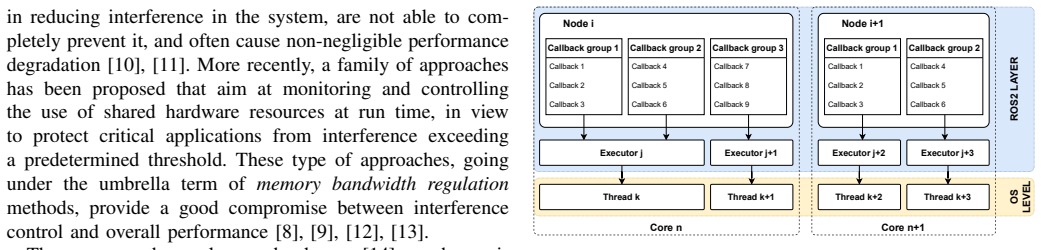
The load-bearing mechanism is a priority-driven callback hierarchy inside each regulated ROS2 node. By mapping distinct callbacks to dedicated executors and OS threads with different SCHED_FIFO priorities on the same core, ROSGuard creates a high-priority state-control callback that can always preempt the node's nominal callback and switch it between normal, sampling, and throttling states. In the throttle state, a second-highest-priority callback runs an idle loop that blocks the nominal and sampling callbacks, stopping the core's memory traffic; a separate controller node on a dedicated core compares accumulated bandwidth against a setpoint and issues replenish commands at the end of each regulation window.
What would settle it
Run the same ROSGuard setup with an additional unrelated high-priority thread on the regulated core, or with a ROS2 executor that does not honor the documented callback-to-thread mapping, and measure the critical node's slowdown: if the critical node's slowdown approaches the unregulated contention case, or if activation delay grows beyond the regulation period, the preemption assumption fails.
Extended reading notes
Core claim
The central claim is that fine-grained, microsecond-level regulation is not the right fit for ROS2-based systems, and that a middleware-level regulator working at millisecond periods can be nearly as effective in protecting critical nodes. ROSGuard achieves this with a controller node that monitors last-level-cache events, either by having non-critical nodes sample and publish their own performance counters or by polling them externally, and with a throttle callback that preempts the non-critical node's nominal work so the core stops issuing memory requests. The paper reports activation delays below 200 µs for self-sampling and below 100 µs for external sampling, and slowdown results on SD-VBS workloads that are comparable to published MemGuard results when configured with similar regulation periods.
Load-bearing premise
The mechanism assumes that mapping each callback to its own executor and OS thread with SCHED_FIFO priorities reliably preempts the nominal callback, so a throttle command actually stops the core's memory requests.
Editorial extensions
If this is right
- ROS2 applications on a generic Linux distribution can receive memory interference protection without hypervisor, hardware QoS, or real-time kernel modifications.
- Millisecond-level sampling and regulation periods, which are a poor fit for hard real-time systems, are sufficient for the timing requirements of many production ROS2 workloads.
- Because the regulator is expressed as ROS2 nodes, executors, and topics, it can be added to existing ROS2 architectures and reconfigured per node without platform-specific code.
- External sampling removes the sampling overhead from the regulated node and reacts faster, making it the better default for bandwidth-hungry non-critical workloads.
Reading between the lines
- If the preemption assumption holds across ROS2 executor implementations, the same callback-priority pattern could regulate other shared resources by swapping the sampled hardware event.
- The millisecond granularity leaves a window of contention before throttle engages, so the approach is better suited to protecting applications with slack than to enforcing hard deadlines; tighter setpoints or admission control would be needed for the latter.
- The comparison with MemGuard is across different platforms with different total bandwidth, so 'comparable' should be read as qualitative; a same-platform head-to-head would be needed to quantify the gap.
Editorial analysis
A structured set of objections, weighed in public.
Referee Report
Summary. The paper presents ROSGuard, a memory-bandwidth regulation mechanism implemented entirely at the ROS2 middleware level on a generic Linux stack. A dedicated controller node monitors PMC-based bandwidth estimates from non-critical (regulated) cores through either self-sampling (the nRT node publishes PMC values) or external sampling (the controller polls the PMU), and on threshold exceedance triggers a high-priority throttle callback that preempts the nominal callback on the offending core. This is realized by mapping ROS2 callback groups and executors to dedicated pthreads with SCHED_FIFO priorities and core affinities. The evaluation, on an NVIDIA Jetson AGX Orin with Isolbench and SD-VBS benchmarks, measures sampling overhead, activation delay, sensitivity to bandwidth threshold and regulation period, and compares slowdown ratios with published MemGuard results. The central claim is that ROSGuard achieves effectiveness comparable to specialized mechanisms such as MemGuard at millisecond-level granularity while being far more portable.
Significance. ROSGuard addresses a relevant gap: interference mitigation for productized ROS2 applications on mainstream Linux, where specialized hardware or OS support is typically unavailable. The design is clean, modular, and configurable, and the experimental campaign is unusually broad, varying sampling mode (self vs. external), sampling period, regulation period, bandwidth threshold, and benchmark pairs, while reporting both RT protection and nRT slowdown. The authors are appropriately cautious in several places, explicitly acknowledging that the MemGuard comparison is 'not totally fair' and that overheads are configuration dependent. If the central parity claim were convincingly supported, the contribution would be a useful, portable alternative for a wide class of systems. However, the current evidence does not yet fully support the headline claim for the specific reasons detailed below.
major comments (2)
- [Section III-B.3] The claim that a core running the THR callback generates 'no request ... on any shared hardware resource' is the load-bearing premise of the whole mechanism, but it is never verified by measurement. The THR callback is an idle loop: it still performs instruction fetches, may touch stack and data, and dirty cache lines left by the preempted NCT callback can be evicted and written back during the throttle interval. Hardware prefetchers and in-flight memory requests may also not be canceled by SCHED_FIFO preemption. The paper reports activation delay (Section IV-C) and slowdowns (Sections IV-D through IV-F), but no experiment measures L3 miss traffic, DRAM read/write requests, or memory-controller occupancy on the throttled core. Without that measurement (e.g., using memory-controller PMCs or a co-running traffic probe), the central parity claim with MemGuard/MemCore, which halt cores at a lower level, is unsupported.
- [Section IV-F, Figure 16] The only quantitative evidence for the abstract's 'comparable effectiveness' claim is Figure 16, which compares ROSGuard slowdowns with a MemGuard implementation reported in [8] on a different platform under different total available bandwidth. The authors themselves state that the comparison is 'not totally fair' and acknowledge that the apparent improvements for disparity and mser are 'probably justified by the overhead being compensated by a higher available bandwidth on the AGX Orin.' As presented, the figure does not support parity, because a higher-bandwidth platform can mask degradation that would appear on the reference platform. The central claim should either be substantiated with a same-platform or bandwidth-normalized comparison, or softened to a more modest claim of providing qualitatively similar protection with substantially higher portability.
minor comments (7)
- [Section IV-A, Table I] The benchmark characterization table is not labeled 'TABLE I' and is referenced as 'Table IV-A' in the text; it should be numbered and cited consistently.
- [Section IV-F] In the paragraph discussing Isolbench results, 'bandwidth_read, and bandwidth_read' repeats the first benchmark; the second occurrence should be 'bandwidth_write.'
- [Abstract] 'widespreadedly adopted' should be 'widely adopted.'
- [Section II-A] The author name 'Krounaer et al.' should be 'Kronauer et al.'
- [Section IV-D] The word 'benchamrks' is a typo for 'benchmarks.'
- [Section IV-B] The sentence 'a slowdown-ratio of 1.059% indicates an absolute increase of 59µs per ms' mixes a ratio and a percentage; Figure 7 plots a ratio near 1.059, so '1.059%' should be rephrased, for example as 'a 5.9% slowdown' or 'a slowdown ratio of 1.059.'
- [Section IV-D] The paper should report the absolute bandwidth reference values corresponding to the 15%, 20%, and 30% thresholds, since the thresholds are derived from per-benchmark maxima and the values are needed to reproduce and transfer the results across platforms.
Circularity Check
No significant circularity: ROSGuard's 'comparable effectiveness' claim rests on measured slowdown ratios against isolation baselines; the empirically calibrated bandwidth thresholds are openly varied sensitivity knobs, the MemGuard comparison is self-admittedly imperfect, and the paper's self-citations are contextual rather than load-bearing.
full rationale
ROSGuard is a system evaluation paper, not a derivation paper: its central claims of 'comparable effectiveness to specialized, finer-grained state-of-the-art solutions' and effective protection of critical nodes are supported by measured slowdown ratios (Figures 10-16) relative to isolation baselines, not by equations derived from its own inputs. The bandwidth metric (Eq. 1, Section IV-A) is a standard PMU-to-bandwidth conversion (bytes per second from l3_accesses and cycles) that is independent of the claimed outcome. The only fitted element is the bandwidth-threshold setpoint, which Section IV-D reports was 'empirically derived from observing the total measurable bandwidth with the most memory demanding benchmarks'; however, thresholds are employed as an openly varied configuration knob across a wide range (5%-30%, and then 20/30/40% to match MemGuard's published configuration), and the paper honestly documents the saturation regime (bandwidth_read at 30%) where protection degrades, so the setpoint does not force the headline result. The comparison to MemGuard (Figure 16) is made on a different platform with different available bandwidth, an unfairness the authors explicitly concede ('the comparison with MemGuard is not totally fair as results heavily depend on the total available bandwidth in the target'); this weakens the comparison's validity but is not circularity, since the reported ROSGuard values are measured rather than derived. The load-bearing premise in Section III-B.3 that a throttled core emits 'no request... on any shared hardware resource' is asserted rather than measured, and residual idle-loop traffic, cache write-backs, and in-flight memory requests could violate it; this is a correctness and validation gap, not a self-referential reduction. The paper's self-citations ([1], [34], [36]) to a safety-critical multicore survey and to the authors' earlier hardware-QoS mechanisms are contextual related-work support, are externally published and falsifiable, and do not carry the central argument. No equation in the paper reduces to its inputs by construction, and no fitted parameter is renamed as a prediction.
Assumptions & free parameters
free parameters (3)
- Bandwidth threshold setpoint =
15%, 20%, 30%, 40% of empirically measured total bandwidth
- PMC sampling period =
100 to 1000 microseconds across experiments
- Regulation period =
1 to 5 milliseconds across experiments
assumptions (3)
- domain assumption ROS2 executor-to-OS-thread mapping with pthread priorities ensures deterministic preemption of callbacks.
- domain assumption perf and PMU events provide an accurate proxy for memory bandwidth, using L2 misses / L3 accesses with 64-byte cache lines.
- domain assumption Core isolation and irq mapping remove all other memory-generating activity on regulated cores.
Cite this review
Pith. "Pith review of ROSGuard: A Bandwidth Regulation Mechanism for ROS2-based Applications." pith.science (2026). https://pith.science/paper/Z7XHOEB3
@misc{pith2026250604640,
  author       = {Pith},
  title        = {Pith review of: ROSGuard: A Bandwidth Regulation Mechanism for ROS2-based Applications},
  year         = {2026},
  howpublished = {\url{https://pith.science/paper/Z7XHOEB3}},
  note         = {Machine review of arXiv:2506.04640}
}
read the original abstract
Multicore timing interference, arising when multiple requests contend for the same shared hardware resources, is a primary concern for timing verification and validation of time-critical applications. Bandwidth control and regulation approaches have been proposed in the literature as an effective method to monitor and limit the impact of timing interference at run time. These approaches seek for fine-grained control of the bandwidth consumption (at the microsecond level) to meet stringent timing requirements on embedded critical systems. Such granularity and configurations, while effective, can become an entry barrier for the application of bandwidth control to a wide class of productized, modular ROS2 applications. This is so because those applications have less stringent timing requirements but would still benefit from bandwidth regulation, though under less restrictive, and therefore more portable, granularity and configurations. In this work, we provide ROSGuard, a highly-portable, modular implementation of a timing interference monitoring and control mechanism that builds on the abstractions available on top of a generic and portable Linux-based software stack with the Robotic Operating System 2 (ROS2) layer, a widespreadedly adopted middleware for a wide class of industrial applications, far beyond the robotic domain. We deploy ROSGuard on an NVIDIA AGX Orin platform as a representative target for functionally rich distributed AI-based applications and a set of synthetic and real-world benchmarks. We apply an effective bandwidth regulation scheme on ROS2-based applications and achieve comparable effectiveness to specialized, finer-grained state-of-the-art solutions.
Figures


Figures from the paper (9 more)


Reference graph
Works this paper leans on
-
[8]
Coherence-Aided Memory Bandwidth Regulation ,
I. Izhbirdeev, D. Hoornaert, W. Chen, A. Zuepke, Y . Hammad, M. Caccamo, and R. Mancuso, “ Coherence-Aided Memory Bandwidth Regulation ,” in2024 IEEE Real-Time Systems Symposium (RTSS). Los Alamitos, CA, USA: IEEE Computer Society, Dec. 2024, pp. 322–335. [Online]. Available: https://doi.ieeecomputersociety.org/10. 1109/RTSS62706.2024.00035
arXiv 2024
-
[1]
Multi-core devices for safety- critical systems: A survey,
J. Pérez-Cerrolaza, R. Obermaisser, J. Abella, F. J. Cazorla, K. Grüttner, I. Agirre, H. Ahmadian, and I. Allende, “Multi-core devices for safety- critical systems: A survey,”ACM Comput. Surv., vol. 53, no. 4, pp. 79:1–79:38, 2020
work page 2020
-
[2]
Impact, challenges and prospect of software-defined vehicles,
Z. Liu, W. Zhang, and F. Zhao, “Impact, challenges and prospect of software-defined vehicles,”Automotive Innovation, vol. 5, no. 2, pp. 180–194, 2022
work page 2022
-
[3]
Embedded systems: Many cores - many problems,
R. Wilhelm and J. Reineke, “Embedded systems: Many cores - many problems,” in7th IEEE International Symposium on Industrial Embedded Systems, SIES 2012, Karlsruhe, Germany, June 20-22, 2012. IEEE, 2012, pp. 176–180. [Online]. Available: https://doi.org/10.1109/SIES.2012.6356583
-
[4]
Analysis of memory-contention in heterogeneous COTS mpsocs,
M. Hassan and R. Pellizzoni, “Analysis of memory-contention in heterogeneous COTS mpsocs,” in32nd Euromicro Conference on Real-Time Systems, ECRTS 2020, July 7-10, 2020, Virtual Conference, ser. LIPIcs, M. Völp, Ed., vol. 165. Schloss Dagstuhl - Leibniz- Zentrum für Informatik, 2020, pp. 23:1–23:24. [Online]. Available: https://doi.org/10.4230/LIPIcs.ECRT...
-
[5]
Denial-of-service attacks on shared cache in multicore: Analysis and prevention,
M. Bechtel and H. Yun, “Denial-of-service attacks on shared cache in multicore: Analysis and prevention,” in2019 IEEE Real-Time and Embedded Technology and Applications Symposium (RTAS), 2019, pp. 357–367
work page 2019
-
[6]
H. Yun, G. Yao, R. Pellizzoni, M. Caccamo, and L. Sha, “Memguard: Memory bandwidth reservation system for efficient performance iso- lation in multi-core platforms,” in2013 IEEE 19th Real-Time and Embedded Technology and Applications Symposium (RTAS), 2013, pp. 55–64
work page 2013
-
[7]
Memory bandwidth management for efficient performance isola- tion in multi-core platforms,
——, “Memory bandwidth management for efficient performance isola- tion in multi-core platforms,”IEEE Transactions on Computers, vol. 65, no. 2, pp. 562–576, 2016
work page 2016
Show all 46 references
-
[9]
Mem- pol: Policing core memory bandwidth from outside of the cores,
A. Zuepke, A. Bastoni, W. Chen, M. Caccamo, and R. Mancuso, “Mem- pol: Policing core memory bandwidth from outside of the cores,” in 2023 IEEE 29th Real-Time and Embedded Technology and Applications Symposium (RTAS), 2023, pp. 235–248
2023
-
[10]
H-MBR: Hypervisor-Level Memory Bandwidth Reservation for Mixed Criticality Systems,
A. Oliveira, D. Costa, G. Moreira, J. Martins, and S. Pinto, “H-MBR: Hypervisor-Level Memory Bandwidth Reservation for Mixed Criticality Systems,” inSixth Workshop on Next Generation Real-Time Embedded Systems (NG-RES 2025), ser. Open Access Series in Informatics (OASIcs), P. ...
2025 doi
-
[11]
SP- IMPact: A Framework for Static Partitioning Interference Mitigation and Performance Analysis,
D. Costa, G. Moreira, A. Oliveira, J. Martins, and S. Pinto, “SP- IMPact: A Framework for Static Partitioning Interference Mitigation and Performance Analysis,” inSixth Workshop on Next Generation Real-Time Embedded Systems (NG-RES 2025), ser. Open Access Series in Informatics...
2025
-
[12]
Bandwatch: A system-wide memory bandwidth regulation system for heterogeneous multicore,
E. Seals, M. G. Bechtel, and H. Yun, “Bandwatch: A system-wide memory bandwidth regulation system for heterogeneous multicore,” in29th IEEE International Conference on Embedded and Real-Time Computing Systems and Applications, RTCSA 2023, Niigata, Japan, August 30 - Sept. 1, 2...
2023
-
[13]
Memory Latency Distribution-Driven Regulation for Temporal Isolation in MPSoCs,
A. Saeed, D. Hoornaert, D. Dasari, D. Ziegenbein, D. Mueller- Gritschneder, U. Schlichtmann, A. Gerstlauer, and R. Mancuso, “Memory Latency Distribution-Driven Regulation for Temporal Isolation in MPSoCs,” in35th Euromicro Conference on Real-Time Systems (ECRTS 2023), ser. Lei...
2023
-
[14]
Analyzing arm’s MPAM from the perspective of time predictability,
M. Zini, D. Casini, and A. Biondi, “Analyzing arm’s MPAM from the perspective of time predictability,”IEEE Trans. Computers, vol. 72, no. 1, pp. 168–182, 2023. [Online]. Available: https: //doi.org/10.1109/TC.2022.3202720
2023
-
[15]
White paper: Solving Multicore Interfer- ence for Safety Critical Applications,
GreenHills Software, “White paper: Solving Multicore Interfer- ence for Safety Critical Applications,” https://www.ghs.com/download/ whitepapers/GHS_multicore_interference.pdf, 2021
2021
-
[16]
Supporting temporal and spatial isolation in a hypervisor for arm multicore platforms,
P. Modica, A. Biondi, G. Buttazzo, and A. Patel, “Supporting temporal and spatial isolation in a hypervisor for arm multicore platforms,” in IEEE International Conference on Industrial Technology (ICIT), 02 2018, pp. 1651–1657
2018
-
[17]
Robotic Operating System (ROS) version 2
“Robotic Operating System (ROS) version 2.” https://www.ros.org/, 2025
2025
-
[18]
Invited Paper: On the Granularity of Bandwidth Regulation in FPGA-Based Heterogeneous Systems on Chip,
G. Brilli, G. Valente, A. Capotondi, T. Di Mascio, and A. Marongiu, “Invited Paper: On the Granularity of Bandwidth Regulation in FPGA-Based Heterogeneous Systems on Chip,” in22nd International Workshop on Worst-Case Execution Time Analysis (WCET 2024), ser. Open Access Series...
2024 doi
-
[19]
Robot operating system 2: Design, architecture, and uses in the wild,
S. Macenski, T. Foote, B. Gerkey, C. Lalancette, and W. Woodall, “Robot operating system 2: Design, architecture, and uses in the wild,” Science Robotics, vol. 7, no. 66, p. eabm6074, 2022. [Online]. Available: https://www.science.org/doi/abs/10.1126/scirobotics.abm6074
2022 doi
-
[20]
Shrinking pomcp: A framework for real-time uav search and rescue,
Y . Zhang, B. Luo, A. Mukhopadhyay, D. Stojcsics, D. Elenius, A. Roy, S. Jha, M. Maroti, X. Koutsoukos, G. Karsai, and A. Dubey, “Shrinking pomcp: A framework for real-time uav search and rescue,” 11 2024
2024
-
[21]
Real-time performance moni- toring of a cnc milling machine using ros 2 and aws iot towards industry 4.0,
D. Patel, C. Maiti, and S. Muthuswamy, “Real-time performance moni- toring of a cnc milling machine using ros 2 and aws iot towards industry 4.0,” inIEEE EUROCON 2023 - 20th International Conference on Smart Technologies, 2023, pp. 776–781. 12
2023
-
[22]
Ros 2 in a nutshell: A survey,
A. S. Al-Batati, A. Koubaa, and M. Abdelkader, “Ros 2 in a nutshell: A survey,”Preprints, October 2024. [Online]. Available: https://doi.org/10.20944/preprints202410.1204.v2
2024
-
[23]
Response time analysis for dynamic priority scheduling in ros2,
A. A. Arafat, S. Vaidhun, K. M. Wilson, J. Sun, and Z. Guo, “Response time analysis for dynamic priority scheduling in ros2,” inProceedings of the 59th ACM/IEEE Design Automation Conference, ser. DAC ’22. New York, NY , USA: Association for Computing Machinery, 2022, p. 301–30...
2022
-
[24]
Latency analysis of ros2 multi-node systems,
T. Kronauer, J. Pohlmann, M. Matthé, T. Smejkal, and G. Fettweis, “Latency analysis of ros2 multi-node systems,” in2021 IEEE Interna- tional Conference on Multisensor Fusion and Integration for Intelligent Systems (MFI), 2021, pp. 1–7
2021
-
[25]
Performance evaluation of real-time ros2 robotic control in a time-synchronized distributed network,
L. Puck, P. Keller, T. Schnell, C. Plasberg, A. Tanev, G. Heppner, A. Roennau, and R. Dillmann, “Performance evaluation of real-time ros2 robotic control in a time-synchronized distributed network,” in 2021 IEEE 17th International Conference on Automation Science and Engineeri...
2021
-
[26]
Picas: New design of priority-driven chain-aware scheduling for ros2,
H. Choi, Y . Xiang, and H. Kim, “Picas: New design of priority-driven chain-aware scheduling for ros2,” in2021 IEEE 27th Real-Time and Embedded Technology and Applications Symposium (RTAS), 2021, pp. 251–263
2021
-
[27]
Compros: A composable ros2 based architecture for real-time embed- ded robotic development,
S. Dehnavi, M. Koedam, A. Nelson, D. Goswami, and K. Goossens, “Compros: A composable ros2 based architecture for real-time embed- ded robotic development,” in2021 IEEE/RSJ International Conference on Intelligent Robots and Systems (IROS), 2021, pp. 6449–6455
2021
-
[28]
Response-time analysis of ros 2 processing chains under reservation- based scheduling,
D. Casini, T. Blass, I. Lütkebohle, and B. B. Brandenburg, “Response-time analysis of ros 2 processing chains under reservation- based scheduling,”Dagstuhl Artifacts Ser., vol. 5, pp. 05:1–05:2,
-
[29]
Real-time control architecture based on xenomai using ros packages for a service robot,
R. Delgado, B.-J. You, and B. W. Choi, “Real-time control architecture based on xenomai using ros packages for a service robot,”Journal of Systems and Software, vol. 151, pp. 8–19, 2019. [Online]. Available: https://www.sciencedirect.com/science/article/pii/S0164121219300160
2019
-
[30]
Real-time linux communications: an evaluation of the linux communication stack for real-time robotic applications,
C. S. V . Gutiérrez, L. U. S. Juan, I. Z. Ugarte, and V . M. Vilches, “Real-time linux communications: an evaluation of the linux communication stack for real-time robotic applications,” 2018. [Online]. Available: https://arxiv.org/abs/1808.10821
2018 arXiv
-
[31]
CROS-RT: Cross- Layer Priority Scheduling for Predictable Inter-Process Communication in ROS 2,
S. Kim, H. S. Chwa, J. Song, K. Lee, and S. Oh, “CROS-RT: Cross- Layer Priority Scheduling for Predictable Inter-Process Communication in ROS 2,” in31st IEEE Real-Time and Embedded Technology and Applications Symposium (RTAS 2025), 2025
2025
-
[32]
Road Vehicles – Functional Safety, 2009
International Organization for Standardization,ISO/DIS 26262. Road Vehicles – Functional Safety, 2009
2009
-
[33]
Bru: Bandwidth regulation unit for real-time multicore processors,
F. Farshchi, Q. Huang, and H. Yun, “Bru: Bandwidth regulation unit for real-time multicore processors,” 04 2020, pp. 364–375
2020
-
[34]
Maximum- contention control unit (mccu): Resource access count and contention time enforcement,
J. Cardona, C. Hernandez, J. Abella, and F. J. Cazorla, “Maximum- contention control unit (mccu): Resource access count and contention time enforcement,” in2019 Design, Automation & Test in Europe Conference & Exhibition (DATE), 2019, pp. 710–715
2019
-
[35]
Profiling and controlling i/o-related memory contention in cots heterogeneous platforms,
M. Zini, G. Cicero, D. Casini, and A. Biondi, “Profiling and controlling i/o-related memory contention in cots heterogeneous platforms,”Soft- ware: Practice and Experience, vol. 52, 11 2021
2021
-
[36]
Leveraging Hardware QoS to Control Contention in the Xilinx Zynq UltraScale+ MPSoC,
A. Serrano-Cases, J. M. Reina, J. Abella, E. Mezzetti, and F. J. Cazorla, “Leveraging Hardware QoS to Control Contention in the Xilinx Zynq UltraScale+ MPSoC,” in33rd Euromicro Conference on Real-Time Systems (ECRTS 2021), ser. Leibniz International Proceedings in Informatics ...
2021
-
[37]
Bao: A Lightweight Static Partitioning Hypervisor for Modern Multi-Core Embedded Systems,
J. Martins, A. Tavares, M. Solieri, M. Bertogna, and S. Pinto, “Bao: A Lightweight Static Partitioning Hypervisor for Modern Multi-Core Embedded Systems,” inWorkshop on Next Generation Real-Time Embedded Systems (NG-RES 2020), ser. Open Access Series in Informatics (OASIcs), M...
2020 doi
-
[38]
Supporting temporal and spatial isolation in a hypervisor for arm multicore platforms,
P. Modica, A. Biondi, G. Buttazzo, and A. Patel, “Supporting temporal and spatial isolation in a hypervisor for arm multicore platforms,” in 2018 IEEE International Conference on Industrial Technology (ICIT), 2018, pp. 1651–1657
2018
-
[39]
Memguard, memory bandwidth management in mixed criticality virtualized systems - memguard kvm scheduling,
N. Dagieu, A. Spyridakis, and D. Raho, “Memguard, memory bandwidth management in mixed criticality virtualized systems - memguard kvm scheduling,” inThe Tenth International Conference on Mobile Ubiquitous Computing, Systems, Services and Technologies (UBICOMM 2016), 2016, pp. ...
2016
-
[40]
Memory utilization-based dynamic bandwidth regu- lation for temporal isolation in multi-cores,
A. Saeed, D. Dasari, D. Ziegenbein, V . Rajasekaran, F. Rehm, M. Pressler, A. Hamann, D. Mueller-Gritschneder, A. Gerstlauer, and U. Schlichtmann, “Memory utilization-based dynamic bandwidth regu- lation for temporal isolation in multi-cores,” in2022 IEEE 28th Real- Time and E...
2022
-
[41]
E-warp: A system- wide framework for memory bandwidth profiling and management,
P. Sohal, R. Tabish, U. Drepper, and R. Mancuso, “E-warp: A system- wide framework for memory bandwidth profiling and management,” in 2020 IEEE Real-Time Systems Symposium (RTSS), 2020, pp. 345–357
2020
-
[42]
NVIDIA Orin Series System-on-Chip Technical Ref- erence Manual, Version: 1.2, 2023,
NVIDIA, “NVIDIA Orin Series System-on-Chip Technical Ref- erence Manual, Version: 1.2, 2023,” https://developer.nvidia.com/ orin-series-soc-technical-reference-manual, accessed: April 2025
2023
-
[43]
Isolbench,
H. Yun, “Isolbench,” https://github.com/CSLKU/IsolBench, accessed: April 2025
2025
-
[44]
Taming non-blocking caches to improve isolation in multicore real-time systems,
P. K. Valsan, H. Yun, and F. Farshchi, “Taming non-blocking caches to improve isolation in multicore real-time systems,” in2016 IEEE Real- Time and Embedded Technology and Applications Symposium (RTAS), 2016, pp. 1–12
2016
-
[45]
Sd-vbs: The san diego vision benchmark suite,
S. K. Venkata, I. Ahn, D. Jeon, A. Gupta, C. Louie, S. Garcia, S. Belongie, and M. B. Taylor, “Sd-vbs: The san diego vision benchmark suite,” in2009 IEEE International Symposium on Workload Character- ization (IISWC), 2009, pp. 55–64. 13
2009
-
[2019]
Available: https://api.semanticscholar.org/CorpusID: 195825437
[Online]. Available: https://api.semanticscholar.org/CorpusID: 195825437
Reviewed August 7, 2026 · model on record in the stance chip above.
Discussion (0). Sign in to comment.