Governance by Design: Architecting Agentic AI for Organizational Learning and Scalable Autonomy
Pith reviewed 2026-05-21 09:17 UTC · model grok-4.3
The pith
Governance for agentic AI systems is achieved through specific architectural and operational arrangements that control actions, tools, data access, memory, and updates.
A machine-rendered reading of the paper's core claim, the machinery that carries it, and where it could break.
Core claim
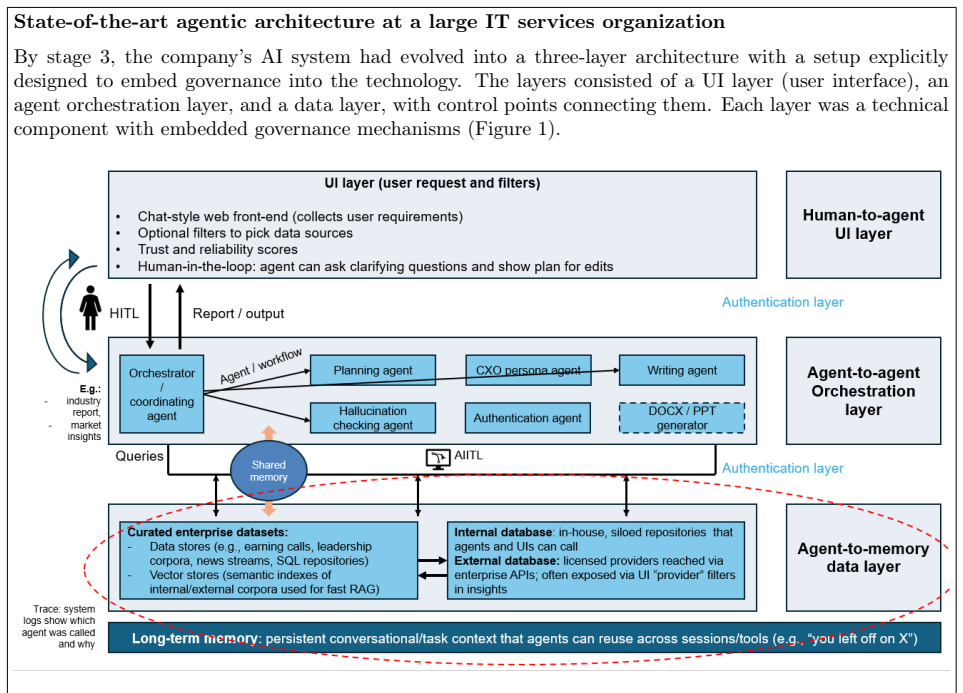
Governance is implemented through concrete architectural and working arrangements that determine what the system is allowed to do, which tools and data it can use, how memory is handled, and how performance improvements are introduced over time. Drawing from an in-depth qualitative case of one company's staged rollout of an agentic system integrated with enterprise tools, the paper distills seven lessons for building effective governance into agentic AI during operationalization and scaling.
What carries the argument
Architectural and working arrangements that embed governance constraints directly into what actions the agent can take, which tools and data it accesses, how memory is managed, and how updates are introduced.
If this is right
- Organizations gain scalable autonomy by fixing clear limits on agent actions and tool access at the architecture level before deployment.
- Memory systems must be structured to support organizational learning while keeping data use accountable and private.
- Performance gains are introduced through controlled, auditable update processes that preserve the original governance boundaries.
- Governance arrangements are most effective when integrated during initial design and staged rollout rather than added later.
- Staged deployment creates opportunities to refine these arrangements based on observed system behavior in real workflows.
Where Pith is reading between the lines
- Similar architectural patterns could be tested in regulated sectors such as healthcare or finance where agent actions involve high-stakes decisions.
- The lessons point to a need for early involvement of compliance and operations teams in agentic AI projects to shape the governance arrangements from the start.
- Multi-agent systems may require additional coordination rules on top of these single-agent arrangements to maintain overall accountability.
- Regulators could shift focus from outcome audits alone to requiring evidence of such embedded architectural controls in deployed systems.
Load-bearing premise
That the governance arrangements observed in this single company's rollout can be generalized to other organizations, industries, or agentic AI deployments.
What would settle it
A documented case of an organization achieving scalable autonomy and accountability in an agentic AI system through post-deployment governance rules rather than through design-time architectural choices would undermine the central claim.
Figures
read the original abstract
Agentic AI systems - systems that can pursue goals through multi-step planning and tool-mediated action with limited direct supervision - are moving from experimental prototypes to enterprise deployments. This transition introduces tensions in implementation, scaling, and governance: organizations seek scalable autonomy for knowledge and coordination work, yet must preserve accountability, safety, cost control, and responsibility as systems initiate actions, access enterprise data, and evolve through iterative updates. Building on an in-depth qualitative case of a large IT services company's 2025 development and staged rollout of an agentic system integrated with enterprise tools; we show that governance is implemented through concrete architectural and working arrangements that determine what the system is allowed to do, which tools and data it can use, how memory is handled, and how performance improvements are introduced over time. We then distill seven lessons that explain how to build effective governance into agentic AI during operationalization and scaling.
Editorial analysis
A structured set of objections, weighed in public.
Referee Report
Summary. The paper reports findings from an in-depth qualitative case study of a large IT services company's 2025 development and staged rollout of an agentic AI system integrated with enterprise tools. It claims that governance is implemented through concrete architectural and working arrangements that specify what the system is allowed to do, which tools and data it can access, how memory is handled, and how performance improvements are introduced over time. From this single case, the authors distill seven lessons intended to guide the building of effective governance into agentic AI systems during operationalization and scaling.
Significance. If the lessons prove robust beyond the single case, the work offers practical, design-oriented guidance for enterprises deploying agentic AI while addressing accountability, safety, and cost control. It contributes to the cs.CY literature by shifting focus from high-level principles to specific architectural choices such as memory handling and update mechanisms, potentially informing both practitioners and researchers working on scalable autonomy in organizational settings.
major comments (2)
- The abstract and case description provide no details on data collection methods, coding procedures, participant selection, or checks for selection bias and researcher interpretation. This leaves the central claim—that governance is realized through the described arrangements and that the seven lessons follow—only weakly supported by the reported evidence.
- The seven lessons are presented as guidance for other organizations and implementations, yet they rest on observations from one 2025 IT-services rollout without comparative cases, cross-validation, or explicit discussion of boundary conditions under which the lessons would not hold. This directly affects the transferability of the governance-by-design claim.
minor comments (1)
- Clarify early in the introduction how 'agentic AI' is distinguished from related concepts such as autonomous agents or LLM-based workflows to improve accessibility for readers outside the immediate subfield.
Simulated Author's Rebuttal
We thank the referee for their detailed and constructive comments. We address each of the major comments below, indicating the revisions we plan to make to strengthen the manuscript.
read point-by-point responses
-
Referee: The abstract and case description provide no details on data collection methods, coding procedures, participant selection, or checks for selection bias and researcher interpretation. This leaves the central claim—that governance is realized through the described arrangements and that the seven lessons follow—only weakly supported by the reported evidence.
Authors: We agree that the abstract and case description lack sufficient detail on our qualitative methods. Although the full manuscript includes a Methods section describing the overall case study approach, we will revise the case description to incorporate a concise summary of data collection methods (including interviews and document analysis), coding procedures (thematic analysis), participant selection criteria, and checks for selection bias and researcher interpretation (such as triangulation and member validation). This revision will directly strengthen the evidentiary basis for our claims about the governance arrangements and the seven lessons. revision: yes
-
Referee: The seven lessons are presented as guidance for other organizations and implementations, yet they rest on observations from one 2025 IT-services rollout without comparative cases, cross-validation, or explicit discussion of boundary conditions under which the lessons would not hold. This directly affects the transferability of the governance-by-design claim.
Authors: We acknowledge that our findings derive from a single case study, which inherently limits immediate transferability and is a standard constraint in qualitative research on emerging technologies. The lessons are offered as contextually grounded insights rather than universal rules. To address this, we will add an explicit discussion of boundary conditions (e.g., applicability primarily to large enterprises with integrated tool ecosystems) and a limitations subsection noting the absence of comparative cases and the value of future multi-case validation. This will clarify the scope without overstating generalizability. revision: partial
Circularity Check
No circularity; claims rest on single-case qualitative observation without definitional or self-referential reductions
full rationale
The manuscript derives its central claims and seven lessons directly from an in-depth qualitative case study of one large IT services company's 2025 agentic AI rollout. Governance is described as realized through concrete architectural arrangements (allowed actions, tool/data access, memory handling, update mechanisms) observed in that deployment. No equations, fitted parameters, or mathematical derivations exist. No load-bearing self-citations or uniqueness theorems are invoked that reduce the argument to prior unverified inputs by the same authors. The derivation is therefore self-contained as empirical reporting; questions of generalizability to other organizations constitute a separate external-validity concern rather than circularity.
Axiom & Free-Parameter Ledger
axioms (1)
- domain assumption A single in-depth qualitative case study of one IT services company's agentic AI rollout can yield generalizable lessons for other organizations.
Reference graph
Works this paper leans on
-
[1]
Data Rules: Reinventing the Market Economy
Cristina Alaimo and Jannis Kallinikos. Data Rules: Reinventing the Market Economy. MIT Press, 2024. doi:10.7551/mitpress/11751.001.0001
-
[2]
Mike Ananny and Kate Crawford. Seeing without knowing: Limitations of the transparency ideal and its application to algorithmic accountability. New Media & Society, 20 0 (3): 0 973--989, 2018
work page 2018
-
[3]
Managing artificial intelligence
Nicholas Berente, Bin Gu, Jan Recker, and Radhika Santhanam. Managing artificial intelligence. MIS Quarterly, 45 0 (3): 0 1433--1450, 2021
work page 2021
-
[4]
Geoffrey C. Bowker and Susan Leigh Star. Sorting Things Out: Classification and Its Consequences. MIT Press, 1999
work page 1999
-
[5]
Responsible Artificial Intelligence: How to Develop and Use AI in a Responsible Way
Virginia Dignum. Responsible Artificial Intelligence: How to Develop and Use AI in a Responsible Way. Springer, 2019
work page 2019
-
[6]
AI4People ---An ethical framework for a good AI society
Luciano Floridi, Josh Cowls, Monica Beltrametti, et al. AI4People ---An ethical framework for a good AI society. Minds and Machines, 28 0 (4): 0 689--707, 2018
work page 2018
-
[7]
Regulation ( EU ) 2024/1689 laying down harmonised rules on artificial intelligence ( AI Act ), 2024
European Parliament and Council . Regulation ( EU ) 2024/1689 laying down harmonised rules on artificial intelligence ( AI Act ), 2024
work page 2024
-
[8]
Retrieval-augmented generation for knowledge-intensive NLP tasks
Patrick Lewis, Ethan Perez, Aleksandra Piktus, et al. Retrieval-augmented generation for knowledge-intensive NLP tasks. Advances in Neural Information Processing Systems, 33, 2020
work page 2020
-
[9]
` D atafication': Making sense of (big) data in a complex world
Mark Lycett. ` D atafication': Making sense of (big) data in a complex world. European Journal of Information Systems, 22 0 (4): 0 381--386, 2013
work page 2013
-
[10]
Patrick Mikalef and Manjul Gupta. Artificial intelligence capability: Conceptualization, measurement calibration, and empirical study on its impact on organizational creativity and firm performance. Information & Management, 58 0 (3): 0 103434, 2021
work page 2021
-
[11]
AI Risk Management Framework ( AI RMF 1.0)
NIST . AI Risk Management Framework ( AI RMF 1.0). Technical report, National Institute of Standards and Technology, 2023
work page 2023
-
[12]
Wanda J. Orlikowski. Sociomaterial practices: Exploring technology at work. Organization Studies, 28 0 (9): 0 1435--1448, 2007
work page 2007
-
[13]
Society-in-the-loop: Programming the algorithmic social contract
Iyad Rahwan. Society-in-the-loop: Programming the algorithmic social contract. Ethics and Information Technology, 20 0 (1): 0 5--14, 2018
work page 2018
-
[14]
Artificial intelligence and management: The automation--augmentation paradox
Sebastian Raisch and Sebastian Krakowski. Artificial intelligence and management: The automation--augmentation paradox. Academy of Management Review, 46 0 (1): 0 192--210, 2021
work page 2021
-
[15]
Inioluwa Deborah Raji, Andrew Smart, Rebecca N. White, et al. Closing the AI accountability gap: Defining an end-to-end framework for internal algorithmic auditing. In Proceedings of the 2020 Conference on Fairness, Accountability, and Transparency (FAccT), 2020
work page 2020
-
[16]
Toolformer: Language Models Can Teach Themselves to Use Tools
Timo Schick, Jane Dwivedi-Yu, Roberto Dess \`i , et al. Toolformer: Language models can teach themselves to use tools. arXiv preprint arXiv:2302.04761, 2023
work page internal anchor Pith review Pith/arXiv arXiv 2023
-
[17]
Andrew D. Selbst, Danah Boyd, Sorelle A. Friedler, Suresh Venkatasubramanian, and Janet Vertesi. Fairness and abstraction in sociotechnical systems. In Proceedings of FAT*, 2019
work page 2019
-
[18]
Information systems research on artificial intelligence: A call for sociotechnical perspectives
Polyxeni Vassilakopoulou, Eli Hustad, and Dag H kon Olsen. Information systems research on artificial intelligence: A call for sociotechnical perspectives. Journal of the Association for Information Systems, 23 0 (2): 0 506--531, 2022
work page 2022
-
[19]
Lei Wang, Chen Ma, Xueyang Feng, Zeyu Zhang, Hao Yang, Jingsen Zhang, Wayne Xin Zhao, Zhewei Wei, Ji-Rong Wen, et al. A survey on large language model based autonomous agents. Frontiers of Computer Science, 18: 0 186345, 2024. doi:10.1007/s11704-024-40231-1
discussion (0)
Sign in with ORCID, Apple, or X to comment. Anyone can read and Pith papers without signing in.