REVIEW 2 major objections 7 minor 71 references
The paper derives a closed-form formula that scores any graph node by how much training on it would improve a balanced meta-set, and shows that filtering labeled, unlabeled, and synthetic nodes by this score outperforms existing class-imbal
Reviewed by Pith at T0; open to challenge. T0 means a machine referee read the full paper against a public rubric. the ladder, T0–T4 →
T0 review · deepseek-v4-flash
2026-08-02 03:35 UTC pith:ZD72N2BA
load-bearing objection A useful, mostly honest graph-specific importance filter for imbalanced node classification, but the 'theoretical derivation' only covers linear encoders while every experiment uses nonlinear GNNs. the 2 major comments →
NodeImport: Imbalanced Node Classification with Node Importance Assessment
The pith
A machine-rendered reading of the paper's core claim, the machinery that carries it, and where it could break.
Core claim
The paper's central claim is that a training node is important exactly when including it improves model performance on an unbiased, balanced meta-set, and that this importance can be computed directly. Starting from the bi-level definition, the derivation applies Bayes' rule, a first-order Taylor expansion, and a one-step gradient assumption to reduce the problem to gradient alignment between the node and the meta-set. With a single linear-layer encoder assumption, this becomes the explicit formula in Eq. 9, which decomposes into a static context-similarity term (Ã_v X)(Ã_meta X)^T and a dynamic prediction-behavior term (H_meta − Y_meta)(h_v − y_v)^T. The authors argue this formula naturally
What carries the argument
The central object is the importance metric η_v in Eq. 9, a scalar that measures gradient alignment between a candidate training node and the balanced meta-set. The derivation chain is: meta-set importance (Eq. 2) → Bayes and Taylor expansion to gradient alignment (Eq. 6) → closed-form gradient under a single linear-layer encoder (Eq. 8) → the final formula. The metric drives the selection rule η_v > 0, which is applied to labeled, pseudo-labeled, and synthetic nodes. A second mechanism is the meta-set constructor, which selects per-class medoids in the context-embedding space (ÃX) to keep the meta-set small yet representative.
Load-bearing premise
The load-bearing assumption is that the gradient of the loss for the actual multi-layer GNN is well enough approximated by the single-layer formula (ÃX)^T(H−Y) that the derived importance score retains its meaning; if that approximation breaks, the selection rule is no longer the derived-gradient alignment but an unqualified heuristic.
What would settle it
On a small graph, train a two-layer GCN once per candidate node (or on a random subset), evaluate the balanced meta-set after each single-node update, and rank nodes by true importance; then compute Eq. 9 scores and measure the rank correlation. If the Spearman correlation is close to zero for GCN or GAT, the closed-form does not track the actual meta-set improvement the paper defines.
If this is right
- The metric lets a GNN filter its own training data each epoch at roughly the cost of one forward pass, replacing bi-level, per-node training evaluation.
- The same importance score applies to labeled, pseudo-labeled, and synthetic nodes, so any node generation or pseudo-labeling method can be plugged in without changing the selection logic.
- The meta-set construction, which picks per-class medoids in the context-embedding space, keeps the reference set small while representing each class's feature-structure distribution.
- Experiments report consistent gains in balanced accuracy and Macro F1 across GCN, GAT, and GraphSAGE on five datasets, with the largest gains at imbalance ratio 50.
Where Pith is reading between the lines
- The derivation's reliance on a single linear encoder leaves open whether the formula faithfully approximates true meta-set importance for the multi-layer GNNs actually run; if the alignment signal is distorted by nonlinearity, the η_v > 0 rule becomes a heuristic that happens to work well empirically.
- A direct test would be to compare Eq. 9 rankings against exhaustive leave-one-out training on a small graph for GCN/GAT; high rank correlation would vindicate the transfer, low correlation would indicate the empirical gains come from the filtering heuristic rather than the derived quantity.
- The context-similarity term depends only on graph structure and features, so it can be precomputed once; the prediction term uses the model's current output, suggesting the method could scale to very large graphs where only the dynamic part needs recomputation.
- The meta-set idea could transfer to other skewed-data settings, such as graph anomaly detection or active learning, where a small, balanced reference set is available.
Editorial analysis
A structured set of objections, weighed in public.
Referee Report
Summary. This paper proposes NodeImport, a method for class-imbalanced node classification. The central idea is to define the importance of a training node by the improvement it induces on a balanced meta-set (Eq. 2), then derive a closed-form, sign-only approximation η_v ≈ κ(Ã_vX)(Ã_metaX)^T(H_meta−Y_meta)(h_v−y_v)^T (Eq. 9) under a single-layer linear encoder (Assumption 4.2). The framework filters labeled, pseudo-labeled, and MixUp-generated synthetic nodes by η_v>0 and trains with a weighted sum of losses. Experiments on Cora, CiteSeer, PubMed, Amazon-Photo, and Amazon-Computers with GCN, GAT, and GraphSAGE backbones report consistent gains over eleven baselines, with ablations and hyperparameter sensitivity in appendices.
Significance. If the theoretical derivation transferred to the evaluated architectures, the paper would make a useful contribution: a cheap, differentiable-free importance score with a natural threshold, decoupling node generation from selection, plus a principled meta-set construction. The paper ships code, reports extensive ablations, and the appendix derivation of the softmax cross-entropy gradient is careful; the simplification from Eq. 32 to Eq. 33 is valid for row-stochastic label matrices, which covers the soft MixUp labels used in Component 3. However, the central theoretical claim is currently only established for a single linear layer, while all experiments use multilayer nonlinear GNNs; the gap is unmeasured. The empirical results are encouraging and may stand on their own, but the paper's headline contribution—a theoretically derived importance formula—is not yet supported for the models actually deployed.
major comments (2)
- [§4.1, Assumption 4.2; §5.1, Appendix E.2] Eq. 8 and therefore Eq. 9 are derived for a single linear encoder H=SoftMax(ÃXθ). All evaluated backbones are two-layer nonlinear networks (GCN with ReLU, GAT with attention, GraphSAGE with mean aggregator), for which the final-layer gradient is (Z)^T(H−Y) with Z a nonlinear function of X, not (ÃX)^T(H−Y). Consequently η_v>0 in Eqs. 10/12/16 is not the derived gradient-alignment score for the architectures actually run; it is an unanalyzed surrogate. The paper never measures how well Eq. 9 approximates the true importance in Eq. 2 for GCN/GAT/GraphSAGE. Please add a small-scale empirical validation (e.g., compare rankings from Eq. 9 with leave-one-out estimates of Eq. 2, or report the correlation/filter overlap), or explicitly reframe Eq. 9 as a heuristic whose validity is demonstrated separately. As written, the abstract's 'theoretically derive' claim overstates the coverage.
- [§4.1, Eq. 9 and §4.3, Eq. 18] The context similarity (Ã_vX)(Ã_metaX)^T and the meta-set construction both rely on a fixed polynomial aggregation matrix Ã. For GAT, the attention weights are data-dependent and learned, so the effective aggregation is neither fixed nor equal to Ã; for GCN/GraphSAGE, the propagation is interleaved with nonlinearities. The paper does not discuss whether the choice of à (APPNP/SSGC-style) is compatible with the backbone's own aggregation, nor does it ablate this choice. At minimum, report sensitivity of the selected nodes and final performance to the aggregation matrix used in Eq. 9.
minor comments (7)
- [§4.2, Eq. 13] p_t(u) as written is not a normalized probability distribution over nodes: summing over all nodes gives a value less than 1. Call it a sampling weight or supply the normalizing constant.
- [Algorithm 1, line 13] Stray 'xw' after 'λ∼Beta(2,2)' in the pseudocode; remove.
- [Appendix E heading] Typo: 'Deatials' should be 'Details'.
- [Eq. 9] The equality between the trace expression and the final scalar is not immediately obvious; add a sentence explaining that the dimensions are (c×1)(1×d)(d×m)(m×c), so the trace of the c×c product equals the scalar by the cyclic property.
- [§4.1 vs Appendix B] The text says the context similarity is computed once at the beginning of the program, but Appendix B recomputes the context embedding for the augmented graph with synthetic nodes. Clarify which quantity is computed when.
- [Appendix F.1] The large-scale experiment uses only C1 and C2; the conclusion should explicitly state that the full framework, including synthetic-node filtering, was not evaluated at that scale.
- [Table 2 caption] 'Models with performances within the standard error are statistically comparable' is informal; standard-error overlap is not a significance test. Either add a formal test or phrase this as 'differences within one standard error'.
Circularity Check
No significant circularity: Eq. 9 is a disclosed approximation of the defined meta-set importance, not a fitted or self-citational reduction.
full rationale
The derivation chain (Eq. 2 -> Eq. 3 -> Eq. 4 -> Eq. 5 -> Eq. 6 -> Eq. 9) is a sequence of exact Bayesian identities and stated first-order/architectural approximations, not an equivalence to the inputs. Eq. 2 defines importance via meta-set likelihood improvement; Eq. 4 is the Bayes-rule symmetry; Eq. 6 is the one-step gradient alignment following Assumption 4.1; Eq. 8 uses Assumption 4.2 to obtain the closed form. The threshold eta_v > 0 is the sign of the defined quantity, so no constant is fitted and no 'prediction' is a renamed fit. Hyperparameters beta, gamma, tau, K, and alpha are validation-searched and are not presented as predictions. The paper explicitly credits RHO-Loss [34] for the derivation, so the overlap is disclosed rather than hidden; citations to the authors' own prior work ([6], [30], [67]) are background/survey and are not load-bearing. The mismatch between Assumption 4.2's single linear layer and the nonlinear GCN/GAT/SAGE backbones used in Section 5 is an approximation-validity concern, not circularity: Eq. 9 is still derived under stated assumptions and empirically tested, rather than obtained by fitting to the test outcomes. The meta-set is an input reference by definition; using the same context embedding for medoid selection and context similarity is a modeling choice, not a reduction of the output to the input.
Axiom & Free-Parameter Ledger
free parameters (4)
- beta — scaling factor for unlabeled-node loss =
searched {0.1, 0.5, 1, 2, 4}
- gamma — scaling factor for synthetic-node loss =
searched {0.1, 0.5, 1, 2, 4}
- tau — meta-samples per class =
≈40% of smallest class size
- K, alpha — aggregation depth and teleport probability for A_tilde =
K∈{2,4,8,16}, alpha∈{0.05,0.10,0.15,0.20}
axioms (6)
- domain assumption Bayes decomposition with conditional independence p(y_v|v,u;theta_t)=p(y_v|v;theta_t) (Eq. 3)
- standard math One gradient step on the meta-set approximates the updated model theta_hat_t (Assumption 4.1)
- ad hoc to paper Encoder form H=SoftMax(A_tilde X theta) (Assumption 4.2)
- domain assumption A meta-set carved from the training pool provides an unbiased balanced evaluation signal
- standard math Gradient of softmax cross-entropy: ∇_theta L=(A_tilde X)^T(H−Y) (Eq. 8)
- standard math Point-estimate Bayesian update: conditioning on (v_meta,y_meta) ≡ parameter update theta→theta_hat
read the original abstract
In real-world applications, node classification on graphs often faces the challenge of class imbalance, where majority classes dominate training, resulting in biased model performance. Traditional GNNs often struggle in such scenarios, as they tend to overfit to majority classes while underrepresenting minority classes. Existing solutions, which either prioritize nodes based on class size or synthesize new nodes for minority classes, often fall short of effectively addressing this imbalance issue. This paper introduces an approach to class-imbalanced node classification by utilizing a balanced meta-set for importance measurement, where a training node is considered significant if it enhances model performance under an unbiased setting. Our method identifies important nodes that can counteract class imbalance and utilizes them for model training, allowing for fine-grained and dynamic node selection throughout the training process. We theoretically derive a formula to directly assess node importance, reducing computational overhead and providing an intuitive threshold for node selection. Guided by this metric, we develop a novel framework that filters valuable labeled, unlabeled, and synthetic nodes that enhance model performance in an unbiased context. A key advantage of this framework is its separation of the synthetic node generation process from the filtering process, ensuring compatibility with various node generation methods. Furthermore, we introduce a strategy to construct a high-quality meta-set that closely approximates the overall feature distribution, ensuring robust representation of each class. We evaluate our framework, NodeImport, across multiple datasets using popular GNN architectures, demonstrating its superiority over existing baselines. Our results highlight the flexibility and effectiveness of the framework in mitigating class imbalance, leading to improved outcomes.
Figures



Reference graph
Works this paper leans on
-
[1]
David Berthelot, Nicholas Carlini, Ian Goodfellow, Nicolas Papernot, Avital Oliver, and Colin A Raffel. 2019. Mixmatch: A holistic approach to semi-supervised learning.Advances in neural information processing systems32 (2019)
2019
-
[2]
Hongyun Cai, Vincent W Zheng, and Kevin Chen-Chuan Chang. 2018. A com- prehensive survey of graph embedding: Problems, techniques, and applications. IEEE Transactions on Knowledge and Data Engineering30, 9 (2018), 1616–1637
2018
-
[3]
Kaidi Cao, Colin Wei, Adrien Gaidon, Nikos Arechiga, and Tengyu Ma. 2019. Learning imbalanced datasets with label-distribution-aware margin loss.Ad- vances in neural information processing systems32 (2019)
2019
-
[4]
Nitesh V Chawla, Kevin W Bowyer, Lawrence O Hall, and W Philip Kegelmeyer
-
[5]
Deli Chen, Yankai Lin, Guangxiang Zhao, Xuancheng Ren, Peng Li, Jie Zhou, and Xu Sun. 2021. Topology-imbalance learning for semi-supervised node classifica- tion.Advances in Neural Information Processing Systems34 (2021), 29885–29897
2021
-
[6]
Nan Chen, Zemin Liu, Bryan Hooi, Bingsheng He, Rizal Fathony, Jun Hu, and Jia Chen. 2024. Consistency Training with Learnable Data Augmentation for Graph Anomaly Detection with Limited Supervision. InThe Twelfth International Confer- ence on Learning Representations. https://openreview.net/forum?id=elMKXvhhQ9
2024
-
[7]
Eli Chien, Jianhao Peng, Pan Li, and Olgica Milenkovic. 2020. Adaptive universal generalized pagerank graph neural network.arXiv preprint arXiv:2006.07988 (2020)
Pith/arXiv arXiv 2020
-
[8]
Limeng Cui, Xianfeng Tang, Sumeet Katariya, Nikhil Rao, Pallav Agrawal, Karthik Subbian, and Dongwon Lee. 2022. ALLIE: Active learning on large-scale imbal- anced graphs. InProceedings of the ACM Web Conference 2022. 690–698
2022
-
[9]
Yin Cui, Menglin Jia, Tsung-Yi Lin, Yang Song, and Serge Belongie. 2019. Class- balanced loss based on effective number of samples. InProceedings of the IEEE/CVF conference on computer vision and pattern recognition. 9268–9277
2019
-
[10]
Amir Erfan Eshratifar, David Eigen, and Massoud Pedram. 2018. Gradient agreement as an optimization objective for meta-learning.arXiv preprint arXiv:1810.08178(2018)
Pith/arXiv arXiv 2018
-
[11]
Wenzheng Feng, Jie Zhang, Yuxiao Dong, Yu Han, Huanbo Luan, Qian Xu, Qiang Yang, Evgeny Kharlamov, and Jie Tang. 2020. Graph random neural networks for semi-supervised learning on graphs.Advances in neural information processing systems33 (2020), 22092–22103
2020
-
[12]
Matthias Fey and Jan Eric Lenssen. 2019. Fast graph representation learning with PyTorch Geometric.arXiv preprint arXiv:1903.02428(2019)
Pith/arXiv arXiv 2019
-
[13]
Chelsea Finn, Pieter Abbeel, and Sergey Levine. 2017. Model-agnostic meta- learning for fast adaptation of deep networks. InInternational conference on machine learning. PMLR, 1126–1135
2017
-
[14]
Johannes Gasteiger, Aleksandar Bojchevski, and Stephan Günnemann. 2018. Predict then propagate: Graph neural networks meet personalized pagerank. arXiv preprint arXiv:1810.05997(2018)
Pith/arXiv arXiv 2018
-
[15]
Xinyu Guo, Kai Wu, Xiaoyu Zhang, and Jing Liu. 2024. Automated Loss func- tion Search for Class-imbalanced Node Classification. InForty-first International Conference on Machine Learning, ICML 2024, Vienna, Austria, July 21-27, 2024. OpenReview.net. https://openreview.net/forum?id=O1hmwi51pp
2024
-
[16]
Will Hamilton, Zhitao Ying, and Jure Leskovec. 2017. Inductive representation learning on large graphs.Advances in neural information processing systems30 (2017)
2017
-
[17]
Haibo He and Edwardo A Garcia. 2009. Learning from imbalanced data.IEEE Transactions on knowledge and data engineering21, 9 (2009), 1263–1284
2009
-
[18]
Youngkyu Hong, Seungju Han, Kwanghee Choi, Seokjun Seo, Beomsu Kim, and Buru Chang. 2021. Disentangling label distribution for long-tailed visual recognition. InProceedings of the IEEE/CVF conference on computer vision and pattern recognition. 6626–6636
2021
-
[19]
Weihua Hu, Matthias Fey, Marinka Zitnik, Yuxiao Dong, Hongyu Ren, Bowen Liu, Michele Catasta, and Jure Leskovec. 2020. Open graph benchmark: datasets for machine learning on graphs. InProceedings of the 34th International Conference on Neural Information Processing Systems(Vancouver, BC, Canada)(NIPS ’20). Curran Associates Inc., Red Hook, NY, USA, Articl...
2020
-
[20]
Nathalie Japkowicz and Shaju Stephen. 2002. The class imbalance problem: A systematic study.Intelligent data analysis6, 5 (2002), 429–449
2002
-
[21]
Krishnateja Killamsetty, Durga Sivasubramanian, Ganesh Ramakrishnan, and Rishabh Iyer. 2021. Glister: Generalization based data subset selection for efficient and robust learning. InProceedings of the AAAI Conference on Artificial Intelligence, Vol. 35. 8110–8118
2021
-
[22]
Kingma and Jimmy Ba
Diederik P. Kingma and Jimmy Ba. 2015. Adam: A Method for Stochastic Opti- mization. In3rd International Conference on Learning Representations, ICLR 2015, San Diego, CA, USA, May 7-9, 2015, Conference Track Proceedings. KDD ’25, August 3–7, 2025, Toronto, ON, Canada Nan Chen et al
2015
-
[23]
Kipf and Max Welling
Thomas N. Kipf and Max Welling. 2017. Semi-Supervised Classification with Graph Convolutional Networks. InInternational Conference on Learning Repre- sentations
2017
-
[24]
Andreas Kirsch, Tom Rainforth, and Yarin Gal. 2021. Test distribution-aware active learning: A principled approach against distribution shift and outliers. arXiv preprint arXiv:2106.11719(2021)
Pith/arXiv arXiv 2021
-
[25]
Bartosz Krawczyk. 2016. Learning from imbalanced data: open challenges and future directions.Progress in artificial intelligence5, 4 (2016), 221–232
2016
-
[26]
Wen-Zhi Li, Chang-Dong Wang, Hui Xiong, and Jian-Huang Lai. 2023. GraphSHA: Synthesizing Harder Samples for Class-Imbalanced Node Classification.SIGKDD (2023)
2023
-
[27]
Tsung-Yi Lin, Priya Goyal, Ross Girshick, Kaiming He, and Piotr Dollár. 2017. Focal loss for dense object detection. InProceedings of the IEEE international conference on computer vision. 2980–2988
2017
-
[28]
Jie Liu, Mengting He, Guangtao Wang, Nguyen Quoc Viet Hung, Xuequn Shang, and Hongzhi Yin. 2023. Imbalanced node classification beyond homophilic assumption.arXiv preprint arXiv:2304.14635(2023)
Pith/arXiv arXiv 2023
-
[29]
Yang Liu, Xiang Ao, Zidi Qin, Jianfeng Chi, Jinghua Feng, Hao Yang, and Qing He. 2021. Pick and choose: a GNN-based imbalanced learning approach for fraud detection. InProceedings of the web conference 2021. 3168–3177
2021
-
[30]
Zemin Liu, Yuan Li, Nan Chen, Qian Wang, Bryan Hooi, and Bingsheng He. 2023. A survey of imbalanced learning on graphs: Problems, techniques, and future directions.arXiv preprint arXiv:2308.13821(2023)
Pith/arXiv arXiv 2023
-
[31]
Zhining Liu, Ruizhong Qiu, Zhichen Zeng, Hyunsik Yoo, David Zhou, Zhe Xu, Yada Zhu, Kommy Weldemariam, Jingrui He, and Hanghang Tong. 2024. Class- Imbalanced Graph Learning without Class Rebalancing. InForty-first International Conference on Machine Learning, ICML 2024, Vienna, Austria, July 21-27, 2024. OpenReview.net. https://openreview.net/forum?id=pPnkpvBeZN
2024
-
[32]
Yihong Ma, Yijun Tian, Nuno Moniz, and Nitesh V Chawla. 2023. Class- imbalanced learning on graphs: A survey.arXiv preprint arXiv:2304.04300(2023)
Pith/arXiv arXiv 2023
-
[33]
Aditya Krishna Menon, Sadeep Jayasumana, Ankit Singh Rawat, Himanshu Jain, Andreas Veit, and Sanjiv Kumar. 2021. Long-tail learning via logit adjustment. In International Conference on Learning Representations. https://openreview.net/ forum?id=37nvvqkCo5
2021
-
[34]
Sören Mindermann, Jan M Brauner, Muhammed T Razzak, Mrinank Sharma, Andreas Kirsch, Winnie Xu, Benedikt Höltgen, Aidan N Gomez, Adrien Morisot, Sebastian Farquhar, et al . 2022. Prioritized training on points that are learn- able, worth learning, and not yet learnt. InInternational Conference on Machine Learning. PMLR, 15630–15649
2022
-
[35]
Hae-Sang Park and Chi-Hyuck Jun. 2009. A simple and fast algorithm for K- medoids clustering.Expert systems with applications36, 2 (2009), 3336–3341
2009
-
[36]
Joonhyung Park, Jaeyun Song, and Eunho Yang. 2022. GraphENS: Neighbor- Aware Ego Network Synthesis for Class-Imbalanced Node Classification. In International Conference on Learning Representations. https://openreview.net/ forum?id=MXEl7i-iru
2022
-
[37]
Hongbin Pei, Bingzhe Wei, Kevin Chen-Chuan Chang, Yu Lei, and Bo Yang
-
[38]
Liang Qu, Huaisheng Zhu, Ruiqi Zheng, Yuhui Shi, and Hongzhi Yin. 2021. Im- gagn: Imbalanced network embedding via generative adversarial graph networks. InProceedings of the 27th ACM SIGKDD Conference on Knowledge Discovery & Data Mining. 1390–1398
2021
-
[39]
Jiawei Ren, Cunjun Yu, Xiao Ma, Haiyu Zhao, Shuai Yi, et al . 2020. Balanced meta-softmax for long-tailed visual recognition.Advances in neural information processing systems33 (2020), 4175–4186
2020
-
[40]
Mengye Ren, Wenyuan Zeng, Bin Yang, and Raquel Urtasun. 2018. Learning to reweight examples for robust deep learning. InInternational conference on machine learning. PMLR, 4334–4343
2018
-
[41]
Ozan Sener and Silvio Savarese. 2017. Active learning for convolutional neural networks: A core-set approach.arXiv preprint arXiv:1708.00489(2017)
Pith/arXiv arXiv 2017
-
[42]
Oleksandr Shchur, Maximilian Mumme, Aleksandar Bojchevski, and Stephan Günnemann. 2018. Pitfalls of graph neural network evaluation.arXiv preprint arXiv:1811.05868(2018)
Pith/arXiv arXiv 2018
-
[44]
Min Shi, Yufei Tang, Xingquan Zhu, David Wilson, and Jianxun Liu. 2020. Multi- class imbalanced graph convolutional network learning. InProceedings of the Twenty-Ninth International Joint Conference on Artificial Intelligence (IJCAI-20)
2020
-
[45]
Jun Shu, Qi Xie, Lixuan Yi, Qian Zhao, Sanping Zhou, Zongben Xu, and Deyu Meng. 2019. Meta-weight-net: Learning an explicit mapping for sample weighting. Advances in neural information processing systems32 (2019)
2019
-
[46]
Kihyuk Sohn, David Berthelot, Nicholas Carlini, Zizhao Zhang, Han Zhang, Colin A Raffel, Ekin Dogus Cubuk, Alexey Kurakin, and Chun-Liang Li. 2020. Fixmatch: Simplifying semi-supervised learning with consistency and confidence. Advances in neural information processing systems33 (2020), 596–608
2020
-
[47]
Jaeyun Song, Joonhyung Park, and Eunho Yang. 2022. TAM: topology-aware margin loss for class-imbalanced node classification. InInternational Conference on Machine Learning. PMLR, 20369–20383
2022
-
[48]
Jingru Tan, Changbao Wang, Buyu Li, Quanquan Li, Wanli Ouyang, Changqing Yin, and Junjie Yan. 2020. Equalization loss for long-tailed object recognition. In Proceedings of the IEEE/CVF conference on computer vision and pattern recognition. 11662–11671
2020
-
[49]
Petar Velicković, Guillem Cucurull, Arantxa Casanova, Adriana Romero, Pietro Liò, and Yoshua Bengio. 2018. Graph Attention Networks. InInternational Con- ference on Learning Representations
2018
-
[50]
Vikas Verma, Alex Lamb, Christopher Beckham, Amir Najafi, Ioannis Mitliagkas, David Lopez-Paz, and Yoshua Bengio. 2019. Manifold mixup: Better represen- tations by interpolating hidden states. InInternational conference on machine learning. 6438–6447
2019
-
[51]
Jianfeng Wang, Thomas Lukasiewicz, Xiaolin Hu, Jianfei Cai, and Zhenghua Xu
-
[52]
Felix Wu, Amauri Souza, Tianyi Zhang, Christopher Fifty, Tao Yu, and Kilian Weinberger. 2019. Simplifying graph convolutional networks. InInternational conference on machine learning. PMLR, 6861–6871
2019
-
[53]
Lirong Wu, Haitao Lin, Zhangyang Gao, Cheng Tan, Stan Li, et al . 2021. Graphmixup: Improving class-imbalanced node classification on graphs by self- supervised context prediction.arXiv preprint arXiv:2106.11133(2021)
Pith/arXiv arXiv 2021
-
[54]
Zonghan Wu, Shirui Pan, Fengwen Chen, Guodong Long, Chengqi Zhang, and S Yu Philip. 2020. A comprehensive survey on graph neural networks.IEEE transactions on neural networks and learning systems32, 1 (2020), 4–24
2020
-
[55]
Keyulu Xu, Weihua Hu, Jure Leskovec, and Stefanie Jegelka. 2019. How Powerful are Graph Neural Networks?. InInternational Conference on Learning Representa- tions
2019
-
[56]
Ziyu Xu, Chen Dan, Justin Khim, and Pradeep Ravikumar. 2020. Class-weighted classification: Trade-offs and robust approaches. InInternational conference on machine learning. PMLR, 10544–10554
2020
-
[57]
Divin Yan, Gengchen Wei, Chen Yang, Shengzhong Zhang, and Zengfeng Huang
-
[58]
Yu Yang, Hao Kang, and Baharan Mirzasoleiman. 2023. Towards sustainable learning: Coresets for data-efficient deep learning. InInternational Conference on Machine Learning. PMLR, 39314–39330
2023
-
[59]
Zhilin Yang, William Cohen, and Ruslan Salakhudinov. 2016. Revisiting semi- supervised learning with graph embeddings. InInternational conference on ma- chine learning. PMLR, 40–48
2016
-
[60]
Sukwon Yun, Kibum Kim, Kanghoon Yoon, and Chanyoung Park. 2022. Lte4g: long-tail experts for graph neural networks. InProceedings of the 31st ACM International Conference on Information & Knowledge Management. 2434–2443
2022
-
[61]
Dauphin, and David Lopez-Paz
Hongyi Zhang, Moustapha Cissé, Yann N. Dauphin, and David Lopez-Paz. 2018. mixup: Beyond Empirical Risk Minimization. In6th International Conference on Learning Representations, ICLR 2018, Vancouver, BC, Canada, April 30 - May 3, 2018, Conference Track Proceedings
2018
-
[62]
Yifan Zhang, Bingyi Kang, Bryan Hooi, Shuicheng Yan, and Jiashi Feng. 2023. Deep long-tailed learning: A survey.IEEE Transactions on Pattern Analysis and Machine Intelligence45, 9 (2023), 10795–10816
2023
-
[63]
Yongshun Zhang, Xiu-Shen Wei, Boyan Zhou, and Jianxin Wu. 2021. Bag of tricks for long-tailed visual recognition with deep convolutional neural networks. InProceedings of the AAAI conference on artificial intelligence, Vol. 35. 3447–3455
2021
-
[64]
Tianxiang Zhao, Xiang Zhang, and Suhang Wang. 2021. Graphsmote: Imbalanced node classification on graphs with graph neural networks. InProceedings of the 14th ACM international conference on web search and data mining. 833–841
2021
-
[65]
Mengting Zhou and Zhiguo Gong. 2023. GraphSR: A Data Augmentation Algo- rithm for Imbalanced Node Classification. InProceedings of the AAAI Conference on Artificial Intelligence, Vol. 37. 4954–4962
2023
-
[66]
Hao Zhu and Piotr Koniusz. 2020. Simple spectral graph convolution. InInterna- tional conference on learning representations
2020
-
[67]
Wei Zhuo, Zemin Liu, Bryan Hooi, Bingsheng He, Guang Tan, Rizal Fathony, and Jia Chen. 2024. Partitioning Message Passing for Graph Fraud Detection. InThe Twelfth International Conference on Learning Representations. https: //openreview.net/forum?id=tEgrUrUuwA A Proofs for Theoretical Analysis In this section, we present theoretical proofs for the equatio...
arXiv 2024
-
[256]
5 20 50 Imbalance Ratio 60 65 70 75 80 85Acc
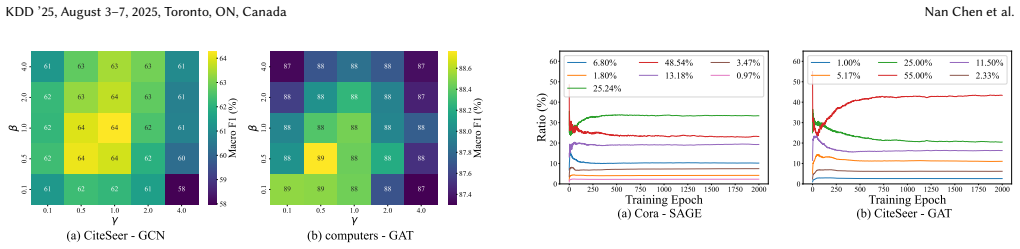
The multi-head attention mechanism is applied, with the KDD ’25, August 3–7, 2025, Toronto, ON, Canada Nan Chen et al. 5 20 50 Imbalance Ratio 60 65 70 75 80 85Acc. (%) Vanillar PC Softmax Balanced Softmax GraphENS GraphSHA TAM(ReNode) TAM(G-ENS) NodeImport 5 20 50 Imbalance Ratio 60 65 70 75 80 85 Vanillar PC Softmax Balanced Softmax GraphENS GraphSHA TA...
2025
-
[2002]
SMOTE: synthetic minority over-sampling technique.Journal of artificial intelligence research16 (2002), 321–357
2002
-
[2020]
Geom-gcn: Geometric graph convolutional networks.arXiv preprint arXiv:2002.05287(2020)
Pith/arXiv arXiv 2002
-
[2021]
In Proceedings of the IEEE/CVF Conference on Computer Vision and Pattern Recognition
Rsg: A simple but effective module for learning imbalanced datasets. In Proceedings of the IEEE/CVF Conference on Computer Vision and Pattern Recognition. 3784–3793
-
[2023]
InThirty-seventh Conference on Neural Information Processing Systems
Rethinking Semi-Supervised Imbalanced Node Classification from Bias- Variance Decomposition. InThirty-seventh Conference on Neural Information Processing Systems. https://openreview.net/forum?id=0gvtoxhvMY
discussion (0)
Sign in with ORCID, Apple, or X to comment. Anyone can read and Pith papers without signing in.