REVIEW 4 minor 1 cited by
Two-stage training with a gradient-guided edge loss and weighted model ensemble secured first place in the all-weather image restoration challenge.
Reviewed by Pith at T0; open to challenge. T0 means a machine referee read the full paper against a public rubric. the ladder, T0–T4 →
T0 review · grok-4.3
2026-06-30 21:59 UTC pith:ZF52M5T2
load-bearing objection This is a competition report that won UG2+ by tweaking X-Restormer with two-stage training, a Sobel-based edge loss, and a fixed ensemble; the ranking is real but the method adds little new.
X-Restormer++: 1st Place Solution for the UG2+ CVPR 2026 All-Weather Restoration Challenge
The pith
A machine-rendered reading of the paper's core claim, the machinery that carries it, and where it could break.
Core claim
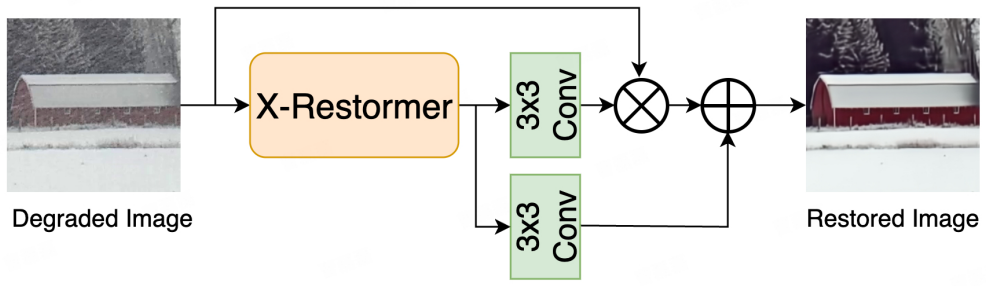
The central claim is that a two-stage training process on a large multi-degradation dataset followed by weather-specific fine-tuning, combined with a Gradient-Guided Edge-Aware loss and a 0.4/0.6 weighted ensemble of the resulting models, produces the highest-performing system for all-weather image restoration on the challenge test set.
What carries the argument
The Gradient-Guided Edge-Aware (GGEA) Loss, which applies Sobel operators to the ground-truth image to build a spatially adaptive weight map that assigns higher supervision to edge and high-frequency regions.
Load-bearing premise
The specific ensemble weights, two-stage data splits, and loss-component balance will yield superior results on the hidden challenge test distribution.
What would settle it
Re-running the full pipeline without the GGEA loss or with altered ensemble weights and measuring whether the method loses its top ranking on the official challenge test set.
If this is right
- The two-stage strategy enables efficient domain adaptation when only limited weather-specific data is available.
- The edge-aware loss improves structural detail preservation when added to standard L1 and multi-scale SSIM objectives.
- The weighted ensemble balances broad generalization from large-scale pretraining with targeted adaptation from fine-tuning.
- The overall pipeline handles composite degradations such as simultaneous rain and haze more effectively than single-stage training.
Where Pith is reading between the lines
- Similar staged pretraining and fine-tuning could be tested on other restoration tasks where domain-specific data is scarce relative to general data.
- The GGEA loss could be applied to different backbone architectures to check whether the edge-weighting benefit holds beyond the Restormer family.
- Validation-based adjustment of the 0.4/0.6 ensemble ratio might improve performance if the hidden test distribution differs from the training splits.
Editorial analysis
A structured set of objections, weighed in public.
Referee Report
Summary. The manuscript presents the authors' 1st-place entry in the UG2+ CVPR 2026 All-Weather Restoration Challenge (Track 1). The solution augments the X-Restormer baseline (with Multi-DConv Head Transposed Attention, Overlapping Cross-Attention, and Restormer-Plus input scaling) by a novel Gradient-Guided Edge-Aware (GGEA) loss that uses Sobel-derived spatial weights, a two-stage training regimen (large-scale pretraining on a ~800 GB FoundIR subset covering five degradation types, followed by fine-tuning on WeatherStream), and a 0.4/0.6 weighted ensemble of the fine-tuned and pretrained models at inference.
Significance. The external 1st-place ranking on the hidden test set provides concrete validation that the described pipeline is effective for all-weather restoration. The GGEA loss and two-stage pretraining/fine-tuning strategy constitute reusable engineering contributions that could be adopted in other restoration pipelines; the manuscript also supplies a concrete, reproducible recipe (dataset splits, ensemble coefficients) that achieved top performance under challenge conditions.
minor comments (4)
- [Abstract] Abstract: the precise scalar weights multiplying the GGEA, L1, and Multi-Scale SSIM terms in the unified objective are omitted; supplying these coefficients (or stating they were tuned on a held-out validation split) would improve reproducibility without altering the central claim.
- [Abstract] Abstract: the exact number of images or patches drawn from the 800 GB FoundIR subset, the number of training epochs or iterations per stage, and the optimizer/learning-rate schedule are not stated; these details are standard for competition-solution papers and would allow readers to replicate the reported ranking.
- [Abstract] Abstract: the challenge evaluation metric(s) (PSNR, SSIM, or a composite score) on which the 1st-place ranking was determined are not named; adding this information clarifies the quantitative basis of the result.
- The manuscript would benefit from a short table or paragraph summarizing the contribution of each added component (GGEA loss, two-stage schedule, ensemble) even if only on the public validation set; such a table is conventional in solution papers and does not require new experiments.
Simulated Author's Rebuttal
We thank the referee for their positive summary of our manuscript, recognition of its significance, and recommendation for minor revision. We appreciate the acknowledgment that the 1st-place result, GGEA loss, and two-stage training provide concrete, reusable contributions with a reproducible recipe.
Circularity Check
No significant circularity
full rationale
The paper is a competition solution report whose central claim is an externally verified 1st-place ranking on a hidden test set. The described pipeline (X-Restormer baseline, GGEA loss, two-stage training, 0.4/0.6 ensemble) contains no mathematical derivation, no fitted parameter renamed as a prediction, and no load-bearing self-citation chain. All components are standard engineering choices whose performance is measured against an organizer-provided benchmark rather than against quantities defined from the method's own inputs.
Axiom & Free-Parameter Ledger
free parameters (2)
- ensemble weights =
0.4 and 0.6
- loss-component weights
axioms (2)
- domain assumption X-Restormer dual-attention blocks capture both channel-wise global dependencies and spatially-local structure
- domain assumption Large-scale pretraining followed by fine-tuning on a smaller domain-specific set yields better generalization than single-stage training
invented entities (1)
-
Gradient-Guided Edge-Aware (GGEA) Loss
no independent evidence
Cite this review
Pith. "Pith review of X-Restormer++: 1st Place Solution for the UG2+ CVPR 2026 All-Weather Restoration Challenge." pith.science (2026). https://pith.science/paper/ZF52M5T2
@misc{pith2026260513258,
  author       = {Pith},
  title        = {Pith review of: X-Restormer++: 1st Place Solution for the UG2+ CVPR 2026 All-Weather Restoration Challenge},
  year         = {2026},
  howpublished = {\url{https://pith.science/paper/ZF52M5T2}},
  note         = {Machine review of arXiv:2605.13258}
}
read the original abstract
In this work, we present our winning solution for the 8th UG2+ Challenge (CVPR 2026) Track 1: Image Restoration under All-weather Conditions. Our method is built upon the X-Restormer baseline, which captures both channel-wise global dependencies and spatially-local structural information through its dual-attention design (Multi-DConv Head Transposed Attention and Overlapping Cross-Attention), augmented with the spatially-adaptive input scaling mechanism from Restormer-Plus. We adopt a two-stage training strategy with dual-model ensemble inference. In the first stage, Model B is trained from scratch on a large-scale diverse dataset randomly sampled from the FoundIR training set (approximately 800 GB out of 4.84 TB), covering five degradation types: blur, haze, rain, snow, and composite conditions such as co-occurring rain and haze. In the second stage, Model A is fine-tuned on the WeatherStream dataset (rain and snow splits) using Model B's final checkpoint as pretrained initialization, enabling efficient domain adaptation with a substantially smaller dataset. To better preserve structural details during training, we propose a novel Gradient-Guided Edge-Aware (GGEA) Loss, which applies Sobel operators to the ground-truth image to construct a spatially adaptive weight map that assigns higher supervision to edge and high-frequency regions. This is incorporated alongside L1 and Multi-Scale SSIM losses in a unified training objective. At inference time, predictions from the two models are fused via a weighted average, out = 0.4 x outA + 0.6 x outB, where the higher weight assigned to Model B reflects its stronger generalization ability from large-scale pretraining. With these strategies, our proposed method successfully ranks 1st in the challenge.
Figures


Forward citations
Cited by 1 Pith paper
-
The Second LoViF 2026 Challenge on Real-World All-in-One Image Restoration: Methods and Results
The second LoViF all-in-one image restoration challenge produced a close top-three leaderboard but is weakened by train/test leakage and an unexplained leaderboard entry.
Reference graph
Works this paper leans on
-
[1]
A comparative study of image restoration networks for gen eral backbone network design
Xiangyu Chen, Zheyuan Li, Yuandong Pu, Yihao Liu, Jiantao Zhou, Yu Qiao, and Chao Dong. A comparative study of image restoration networks for general backbone network de- sign.arXiv preprint arXiv:2310.11881, 2023. 1, 2
-
[2]
Activating more pixels in image super-resolution transformer
Xiangyu Chen, Xintao Wang, Jiantao Zhou, Yu Qiao, and Chao Dong. Activating more pixels in image super-resolution transformer. InProceedings of the IEEE/CVF conference on computer vision and pattern recognition, pages 22367–22377,
-
[3]
Foundir: Unleashing million-scale training data to ad- vance foundation models for image restoration
Hao Li, Xiang Chen, Jiangxin Dong, Jinhui Tang, and Jinshan Pan. Foundir: Unleashing million-scale training data to ad- vance foundation models for image restoration. InProceed- ings of the IEEE/CVF international conference on computer vision, pages 12626–12636, 2025. 2, 3, 4
work page 2025
-
[4]
Diff- bir: Toward blind image restoration with generative diffusion prior
Xinqi Lin, Jingwen He, Ziyan Chen, Zhaoyang Lyu, Bo Dai, Fanghua Yu, Yu Qiao, Wanli Ouyang, and Chao Dong. Diff- bir: Toward blind image restoration with generative diffusion prior. InEuropean conference on computer vision, pages 430–
-
[5]
Springer, 2024. 2, 5
work page 2024
-
[6]
Restormer: Efficient transformer for high-resolution image restoration
Syed Waqas Zamir, Aditya Arora, Salman Khan, Mu- nawar Hayat, Fahad Shahbaz Khan, and Ming-Hsuan Yang. Restormer: Efficient transformer for high-resolution image restoration. InProceedings of the IEEE/CVF conference on computer vision and pattern recognition, pages 5728–5739,
-
[7]
Weatherstream: Light transport automation of single image deweathering
Howard Zhang, Yunhao Ba, Ethan Yang, Varan Mehra, Blake Gella, Akira Suzuki, Arnold Pfahnl, Chethan Chinder Chan- drappa, Alex Wong, and Achuta Kadambi. Weatherstream: Light transport automation of single image deweathering. In Proceedings of the IEEE/CVF conference on computer vision and pattern recognition, pages 13499–13509, 2023. 2, 3, 4, 7
work page 2023
-
[8]
Chaochao Zheng, Luping Wang, and Bin Liu. Restormer- plus for real world image deraining: One state-of-the-art solu- tion to the gt-rain challenge (cvpr 2023 ug2+ track 3).arXiv preprint arXiv:2305.05454, 2023. 1, 2, 4
discussion (0)
Sign in with ORCID, Apple, or X to comment. Anyone can read and Pith papers without signing in.