REVIEW 3 major objections 6 minor 300 references
Adaptive re-sampling makes risk-averse Bayesian optimization practical for noisy RL hyperparameter tuning.
Reviewed by Pith at T0; open to challenge. T0 means a machine referee read the full paper against a public rubric. the ladder, T0–T4 →
T0 review · grok-4.5
2026-07-31 00:11 UTC pith:ZFJQPLUB
load-bearing objection Solid AutoRL methods paper: adaptive fixed-budget RAHBO plus a useful 50-seed dataset; theory covers bounded k, not the full stopping rule. the 3 major comments →
Efficient Heteroscedastic Bayesian Optimization for Risk-Aware AutoRL
The pith
A machine-rendered reading of the paper's core claim, the machinery that carries it, and where it could break.
Core claim
ERAHBO turns fixed-replication risk-averse heteroscedastic Bayesian optimization into an adaptive procedure that allocates training runs only where uncertainty still threatens the mean-variance ranking, preserving RAHBO-style sublinear sample-count cumulative regret under bounded replications while empirically outperforming both fixed-k RAHBO and risk-neutral GP-UCB on multi-seed AutoRL tasks.
What carries the argument
Confidence-based adaptive resampling: after selecting a point by maximizing the upper confidence bound on the mean-variance objective, keep drawing independent training runs until that same upper bound drops to or below the incumbent lower confidence bound (or a preset maximum is hit).
Load-bearing premise
The formal regret guarantee treats the number of repeats in each round as chosen under an aggregate observation model and only bounds any schedule inside fixed min/max limits; a full analysis of the practical stop-when-optimistic-score-is-beaten rule is left open.
What would settle it
On the released multi-seed offline datasets (or fresh online AutoRL runs), check whether ERAHBO’s mean-variance simple and cumulative regret ranks and the evaluation counts needed to hit fixed regret thresholds remain better than fixed-k RAHBO and GP-UCB; if adaptive stopping systematically wastes budget or yields worse final configurations, the efficiency claim fails.
If this is right
- Risk-aware AutoRL can drop the manual choice of a fixed replication budget per hyperparameter configuration.
- Mean-variance hyperparameter search becomes more usable under the tight evaluation budgets typical of RL.
- The released 50-seed mapping from hyperparameters to returns supplies a reusable benchmark for other risk-aware HPO methods.
- Bounded adaptive replication does not by itself destroy the no-regret rate of the underlying risk-averse BO analysis.
Where Pith is reading between the lines
- The same stop-when-optimistic-score-loses rule could be ported to other expensive stochastic black-boxes where variance is input-dependent, not only RL.
- Because the mean-variance trade-off is scale-sensitive, practical deployments will still need careful outcome normalization or an adaptive risk weight.
- Environments with almost no good configurations (as seen on parts of XLand) remain hard for incumbent-based stopping and may need a different exploration schedule.
Editorial analysis
A structured set of objections, weighed in public.
Referee Report
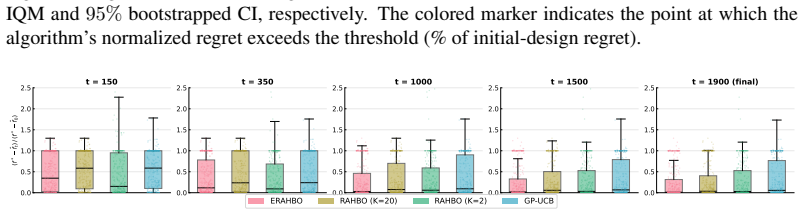
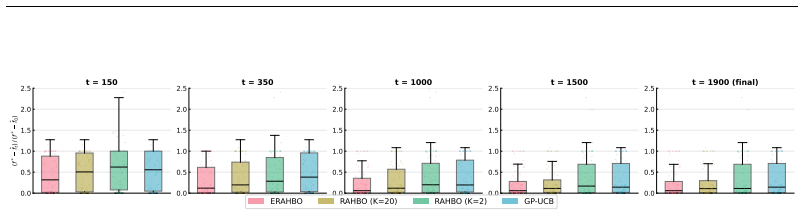
Summary. The paper proposes ERAHBO, an extension of risk-averse heteroscedastic Bayesian optimization (RAHBO) for AutoRL hyperparameter optimization under a mean–variance objective. Instead of a fixed replication budget per configuration, ERAHBO adaptively stops resampling once the MV upper confidence bound at the current point falls below the incumbent MV lower confidence bound (Eqs. 9–12), with replications restricted to [k_min, k_max]. The authors lift RAHBO-style sample-count cumulative regret bounds to bounded variable replication counts (Theorem 1), supply a finite-sample suboptimality certificate (Lemma 2), release a 50-seed offline HP–return dataset over 19 algorithm–environment tasks, and report that ERAHBO generally matches or beats fixed-k RAHBO and GP-UCB on rank and sample-efficiency metrics (Tables 1–2, Figs. 2–4).
Significance. Risk-aware HPO for RL is a practically important and under-served problem: training stochasticity makes mean-only AutoRL brittle, and fixed multi-seed budgets are expensive. The adaptive reallocation idea is simple, well-motivated, and empirically useful; the 50-seed multi-task dataset is a concrete community contribution beyond typical 5–10 seed tables. The paper also ships code/data links, multi-domain evaluation with IQM/CIs and Wilcoxon tests, and an explicit (if conservative) regret analysis for bounded variable k_t. If the efficiency claims hold under broader online settings, ERAHBO is a practical drop-in improvement over fixed-k RAHBO for risk-aware AutoRL rather than a purely incremental modeling tweak.
major comments (3)
- [§4.2.2, Theorem 1, Appendix A remark] §4.2.2 and Theorem 1 over-associate the deployed algorithm with the proved guarantee. Theorem 1 and the Appendix A remark establish sublinear sample-count regret for schedules with k_t ∈ [k_min, k_max] under an aggregate observation model in which k_t is fixed before round-t samples; the remark explicitly places a full optional-stopping analysis of the inner loop (stop when UCB_MV_t(x_t; k) ≤ B_t after intermediate GP updates; Eqs. 11–12) out of scope. The main-text claim that “ERAHBO preserves the sublinear regret guarantees of RAHBO” therefore covers bounded variable replication, not the data-dependent stopping rule that defines ERAHBO. Please either (i) restate Theorem 1 / §4.2.2 as a bound for any bounded schedule (with the adaptive rule presented as a practical selector of such schedules), or (ii) add a precise optional-stopping / anytime-union argument that matches the implemented
- [§4.2.1, Eqs. (9)–(12); §5; Lemma 2; Appendix C.5] The high-probability stopping language in §4.2.1 is not aligned with the experimental confidence parameters. The prose interprets UCB_MV(x_t; k) ≤ B_t as certifying that x_t cannot beat the incumbent “with high probability,” but experiments set β_t = 2.5 for acquisition and β_stop = 1 for the stopping test (§5), so the stopping event is not the same concentration event used in Theorem 1 / Lemma 1. Lemma 2 also assumes posterior width bounds and a fixed B_t, which is fine as a local certificate, but does not restore the joint high-probability claim under β_stop ≠ β_t. Please either run stopping under the same β sequence as the confidence bounds, or rewrite §4.2.1 to describe the rule as a practical optimistic heuristic and report sensitivity (the Appendix C.5 β_stop schedules already suggest this matters, especially on XLand).
- [Abstract; §5; Conclusion; Appendix C.1] All HPO comparisons are offline lookups on fixed 512×50 tables (nan-filtered), not online AutoRL with fresh training runs. The conclusion acknowledges this, but the abstract and §5 frame results as improved sample efficiency for risk-averse AutoRL HPO. Offline evaluation is appropriate for reproducible benchmarking and is a strength of the dataset contribution, yet it removes nonstationarity, failure modes, and wall-clock coupling that matter in true AutoRL. At minimum, qualify the empirical claims as offline multi-seed ranking results; ideally add a small online sanity check on 1–2 cheap tasks (e.g., Classic Control) to show that adaptive stopping still helps when each y is a fresh train.
minor comments (6)
- [Figure 1] Figure 1 caption writes “ERHABO” instead of “ERAHBO”.
- [§5] §5 states a heteroscedastic GP for f and a homoscedastic GP for ρ²(x). Given the paper’s emphasis on heteroscedastic variance, briefly justify why the variance surrogate is homoscedastic and whether that choice affects RAHBO vs ERAHBO comparisons.
- [§5] α = 1 is chosen after Song et al. (2024) outcome processing because MV is scale-sensitive. Please state the preprocessing transform explicitly in the main text or appendix so the objective is reproducible without external lookup.
- [Table 1; §5.1] Table 1 reports mean ranks with a Wilcoxon test mentioned in prose but without the exact paired design (per-task ranks? final budget only?) or multiple-comparison handling. A one-line clarification would help.
- [§3] Related work cites Dai et al. (2023) for adaptive evaluation in batch settings; a short contrast (sequential confidence stopping vs batch replicable design) would sharpen novelty.
- [§5.1–5.2; Appendix C.3–C.4] Several environment-level plots (Fig. 8, Table 5) show tasks where little is gained over the initial design or thresholds are never hit. Consider flagging these “hard/flat” tasks when aggregating “generally outperforms” claims.
Circularity Check
No circular derivation: regret extension and adaptive rule are not forced by definition or self-citation; empirics evaluate the stated MV objective against external baselines.
full rationale
The paper’s load-bearing chain is (i) adopt RAHBO’s mean/variance GPs and MV objective from Makarova et al. (2021), (ii) replace fixed k with a confidence stopping rule, (iii) prove a RAHBO-style sample-count regret bound for any bounded schedule k_t ∈ [k_min, k_max] under an aggregate observation model with k_t fixed before round-t samples (Thm. 1 / App. A), and (iv) show offline multi-seed efficiency vs GP-UCB and fixed-k RAHBO. None of these steps reduces the claimed result to its inputs by construction: MV is the declared objective and is scored as such; the regret proof is an explicit adaptation with stated assumptions, not a fit renamed as prediction; the practical inner-loop optional-stopping analysis is openly deferred rather than smuggled in as a theorem corollary. Author-overlapping ARLBench is only a data source; GP hypers and α are standard experimental knobs, not uniqueness or first-principles predictions. The optional-stopping gap is a correctness/coverage limitation, not circularity.
Axiom & Free-Parameter Ledger
free parameters (5)
- risk aversion α =
1 (on processed outcomes)
- UCB confidence multiplier β_t =
2.5
- stopping confidence β_stop =
1 (main); scheduled variants in App. C.5
- replication bounds [k_min, k_max] =
k_min=2, k_max=20
- GP kernel hyperparameters =
MLE on 5 Sobol inits (per experiment setup)
axioms (5)
- domain assumption Unknown mean f lies in an RKHS with bounded norm and normalized kernel κ(x,x')≤1.
- domain assumption Training noise ξ(x) is strictly ρ(x)-sub-Gaussian with ρ(x) in [ρ̲, ρ̄], and ρ² itself lies in a bounded-norm RKHS.
- domain assumption Mean-variance MV(x)=f(x)-α ρ²(x) is the right risk-aware HPO objective for reliable RL hyperparameters.
- standard math Bounded variable replication k_t∈[k_min,k_max] under the aggregate observation model preserves RAHBO-style sublinear sample-count regret rates.
- ad hoc to paper Offline multi-seed lookup tables (50 seeds, Sobol configs, nan filtered) are sufficient to rank risk-aware HPO methods for AutoRL.
invented entities (2)
-
ERAHBO adaptive stopping rule (stop resampling when UCB_MV(x_t;k) ≤ incumbent LCB B_t)
independent evidence
-
50-seed AutoRL HP outcome dataset across 19 algorithm–environment tasks
independent evidence
Cite this review
Pith. "Pith review of Efficient Heteroscedastic Bayesian Optimization for Risk-Aware AutoRL." pith.science (2026). https://pith.science/paper/ZFJQPLUB
@misc{pith2026260726680,
  author       = {Pith},
  title        = {Pith review of: Efficient Heteroscedastic Bayesian Optimization for Risk-Aware AutoRL},
  year         = {2026},
  howpublished = {\url{https://pith.science/paper/ZFJQPLUB}},
  note         = {Machine review of arXiv:2607.26680}
}
read the original abstract
Reinforcement learning (RL) has shown remarkable success across a wide range of complex tasks. However, RL outcomes can be highly stochastic, and both expected performance and variability often depend on hyperparameter (HP) configurations. We propose efficient and risk-averse heteroscedastic Bayesian Optimization (ERAHBO), a Bayesian optimization method that models both the mean and variance of learning outcomes as functions of the HP configurations. ERAHBO aims to identify HP configurations that achieve high average return while reducing variability across training runs, and it improves the sample efficiency of the HP optimization via adaptive re-sampling rather than a fixed budget per HP. Empirical evaluations across diverse RL algorithms and environments demonstrate that ERAHBO generally outperforms both risk-neutral and risk-averse baselines, delivering improved sample efficiency for risk-averse returns.
Figures




Reference graph
Works this paper leans on
-
[1]
Sutton and A
R. Sutton and A. Barto , year =. Reinforcement Learning:
-
[2]
Advances in Neural Information Processing Systems 12 , pages =
Policy Gradient Methods for Reinforcement Learning With Function Approximation , author =. Advances in Neural Information Processing Systems 12 , pages =
-
[3]
Simple Statistical Gradient-following Algorithms for Connectionist Reinforcement Learning , author =
-
[4]
2016 IEEE international conference on robotics and automation (ICRA) , pages =
Safe Controller Optimization for Quadrotors With Gaussian Processes , author =. 2016 IEEE international conference on robotics and automation (ICRA) , pages =
2016
-
[5]
Snoek and H
J. Snoek and H. Larochelle and R. Adams , booktitle =. Practical
-
[6]
Reproducibility of Benchmarked Deep Reinforcement Learning Tasks for Continuous Control , author =. arXiv:1708.04133 , year =
-
[7]
IFAC-PapersOnLine , volume =
Constrained Bayesian Optimization With Particle Swarms for Safe Adaptive Controller Tuning , author =. IFAC-PapersOnLine , volume =
-
[8]
Hyper-parameter Optimization: A Review of Algorithms and Applications , author =. arXiv:2003.05689 , year =
Pith/arXiv arXiv 2003
-
[9]
Proceedings of Machine Learning and Systems , volume =
Randomness in Neural Network Training: Characterizing the Impact of Tooling , author =. Proceedings of Machine Learning and Systems , volume =
-
[10]
Makarova and I
A. Makarova and I. Usmanova and I. Bogunovic and A. Krause , booktitle =. Risk-averse Heteroscedastic
-
[11]
Proceedings of the 26th International Conference on Advances in Neural Information Processing Systems (
Risk-aversion in Multi-armed Bandits , author =. Proceedings of the 26th International Conference on Advances in Neural Information Processing Systems (
-
[12]
Advances in neural information processing systems , volume =
Parallel Predictive Entropy Search for Batch Global Optimization of Expensive Objective Functions , author =. Advances in neural information processing systems , volume =
-
[13]
Journal of Global optimization , volume =
Efficient Global Optimization of Expensive Black-box Functions , author =. Journal of Global optimization , volume =
-
[14]
Journal of Basic Engineering , volume =
A New Method of Locating the Maximum Point of an Arbitrary Multipeak Curve in the Presence of Noise , author =. Journal of Basic Engineering , volume =
-
[15]
Constrained Bayesian Optimization With Noisy Experiments , author =
-
[16]
Advances in neural information processing systems , volume =
The Parallel Knowledge Gradient Method for Batch Bayesian Optimization , author =. Advances in neural information processing systems , volume =
-
[17]
Technometrics , volume =
Replication or Exploration? Sequential Design for Stochastic Simulation Experiments , author =. Technometrics , volume =
-
[18]
Journal of Computational and Graphical Statistics , volume =
Practical Heteroscedastic Gaussian Process Modeling for Large Simulation Experiments , author =. Journal of Computational and Graphical Statistics , volume =
-
[19]
An Empirical Study of Assumptions in Bayesian Optimisation , author =. arXiv:2012.03826 , volume =
Pith/arXiv arXiv 2012
-
[20]
Batch Bayesian Optimization for Replicable Experimental Design , author =
-
[21]
Proceedings of the 35th International Conference on Advances in Neural Information Processing Systems (
Deep Reinforcement Learning at the Edge of the Statistical Precipice , author =. Proceedings of the 35th International Conference on Advances in Neural Information Processing Systems (
-
[22]
The Vizier Gaussian Process Bandit Algorithm , author =. arXiv:2408.11527 , year =
-
[23]
Proceedings of the 25th ACM SIGKDD international conference on knowledge discovery & data mining , pages =
Optuna: A Next-generation Hyperparameter Optimization Framework , author =. Proceedings of the 25th ACM SIGKDD international conference on knowledge discovery & data mining , pages =
-
[24]
Journal of machine learning research , volume =
Stable-baselines3: Reliable Reinforcement Learning Implementations , author =. Journal of machine learning research , volume =
-
[25]
Becktepe and J
J. Becktepe and J. Dierkes and C. Benjamins and A. Mohan and D. Salinas and R. Rajan and F. Hutter and H. Hoos and M. Lindauer and T. Eimer , journal =
-
[26]
Conference On Learning Theory , pages =
Information Directed Sampling and Bandits With Heteroscedastic Noise , author =. Conference On Learning Theory , pages =
-
[27]
jmlr , volume =
Empirical Design in Reinforcement Learning , author =. jmlr , volume =
-
[28]
On the Consistency of Hyper-parameter Selection in Value-based Deep Reinforcement Learning , author =
-
[29]
18th European Workshop on Reinforcement Learning (EWRL) , year =
Performance Prediction In Reinforcement Learning: The Bad And The Ugly , author =. 18th European Workshop on Reinforcement Learning (EWRL) , year =
-
[30]
Nikulin and V
A. Nikulin and V. Kurenkov and I. Zisman and V. Sinii and A. Agarkov and S. Kolesnikov , booktitle =
-
[31]
Shala and S
G. Shala and S. Arango and A. Biedenkapp and F. Hutter and J. Grabocka , booktitle =. Hpo-rl-bench: A Zero-cost Benchmark for
-
[32]
A Super-human Vision-based Reinforcement Learning Agent for Autonomous Racing in Gran Turismo , author =
-
[33]
Learning Quadrupedal Locomotion Over Challenging Terrain , author =. Sci. Robotics , volume =
-
[34]
Champion-level Drone Racing Using Deep Reinforcement Learning , author =. Nat. , volume =
-
[35]
Freeman and E
C. Freeman and E. Frey and A. Raichuk and S. Girgin and I. Mordatch and O. Bachem , crossref =. Brax -
-
[36]
Hvarfner and E
C. Hvarfner and E. Hellsten and L. Nardi , booktitle =. Vanilla
-
[37]
Proceedings of the Nineteenth National Conference on Artificial Intelligence (
Proceedings of the Nineteenth National Conference on Artificial Intelligence (. Proceedings of the Nineteenth National Conference on Artificial Intelligence (
-
[38]
Proceedings of the Twenty-second
Proceedings of the Twenty-second. Proceedings of the Twenty-second
-
[39]
Proceedings of the Twenty-fourth
Proceedings of the Twenty-fourth. Proceedings of the Twenty-fourth
-
[40]
Proceedings of the Twenty-eighth
Proceedings of the Twenty-eighth. Proceedings of the Twenty-eighth
-
[41]
Proceedings of the Twenty-ninth
Proceedings of the Twenty-ninth. Proceedings of the Twenty-ninth
-
[42]
Proceedings of the Thirtieth
Proceedings of the Thirtieth. Proceedings of the Thirtieth
-
[43]
Proceedings of the Thirty-First Conference on Artificial Intelligence (
Proceedings of the Thirty-First Conference on Artificial Intelligence (. Proceedings of the Thirty-First Conference on Artificial Intelligence (
-
[44]
Proceedings of the Thirty-Second Conference on Artificial Intelligence (
Proceedings of the Thirty-Second Conference on Artificial Intelligence (. Proceedings of the Thirty-Second Conference on Artificial Intelligence (
-
[45]
Proceedings of the Thirty-Third Conference on Artificial Intelligence (
Proceedings of the Thirty-Third Conference on Artificial Intelligence (. Proceedings of the Thirty-Third Conference on Artificial Intelligence (
-
[46]
Proceedings of the Thirty-Fourth Conference on Artificial Intelligence (
Proceedings of the Thirty-Fourth Conference on Artificial Intelligence (. Proceedings of the Thirty-Fourth Conference on Artificial Intelligence (
-
[47]
Proceedings of the Thirty-Fifth Conference on Artificial Intelligence (
Proceedings of the Thirty-Fifth Conference on Artificial Intelligence (. Proceedings of the Thirty-Fifth Conference on Artificial Intelligence (
-
[48]
Proceedings of the Thirty-Sixth Conference on Artificial Intelligence (
Proceedings of the Thirty-Sixth Conference on Artificial Intelligence (. Proceedings of the Thirty-Sixth Conference on Artificial Intelligence (
-
[49]
Proceedings of the Thirty-Seventh Conference on Artificial Intelligence (
Proceedings of the Thirty-Seventh Conference on Artificial Intelligence (. Proceedings of the Thirty-Seventh Conference on Artificial Intelligence (
-
[50]
Proceedings of the Thirty-Eighth
Proceedings of the Thirty-Eighth. Proceedings of the Thirty-Eighth
-
[51]
Proceedings of the Fortieth
Proceedings of the Fortieth. Proceedings of the Fortieth
-
[52]
Proceedings of the 10th National Conference on Artificial Intelligence , year = 1992, booktitle =
1992
-
[53]
Proceedings of the 12th National Conference on Artificial Intelligence , year = 1994, booktitle =
1994
-
[54]
Proceedings of the 15th National Conference on Artificial Intelligence , year = 1997, booktitle =
1997
-
[55]
Evaluation Methods for Machine Learning -- Papers from the AAAI Workshop , year = 2006, booktitle =
2006
-
[56]
Proceedings of the Workshops at Twenty-ninth
Proceedings of the Workshops at Twenty-ninth. Proceedings of the Workshops at Twenty-ninth
-
[57]
Proceedings of the Workshops at Thirty-Fifth Conference on Artificial Intelligence (
Proceedings of the Workshops at Thirty-Fifth Conference on Artificial Intelligence (. Proceedings of the Workshops at Thirty-Fifth Conference on Artificial Intelligence (
-
[58]
AI 2019: Advances in artificial intelligence: Proceedings of the 32nd Australasian Joint Conference on Artificial Intelligence 2019 , year = 2019, booktitle =
2019
-
[59]
Proceedings of the 55th Annual Meeting of the Association for Computational Linguistics (Volume 2: Short Papers) , year = 2017, booktitle =
2017
-
[60]
2017 , editor =
Proceedings of the First ACL Workshop on Ethics in Natural Language Processing , booktitle =. 2017 , editor =
2017
-
[61]
Proceedings of the Workshop on Machine Reading for Question Answering@ACL 2018 , title =
2018
-
[62]
Proceedings of the 2019 Conference of the North
Proceedings of the 2019 Conference of the North. Proceedings of the 2019 Conference of the North
2019
-
[63]
Proceedings of the 2020 Conference of the North
Proceedings of the 2020 Conference of the North. Proceedings of the 2020 Conference of the North
2020
-
[64]
Proceedings of the 2021 Conference of the North
Proceedings of the 2021 Conference of the North. Proceedings of the 2021 Conference of the North
2021
-
[65]
Proceedings of the 61st Annual Meeting of the Association for Computational Linguistics , year = 2023, booktitle =
2023
-
[66]
Proceedings of the 62nd Annual Meeting of the Association for Computational Linguistics , year = 2024, booktitle =
2024
-
[67]
Findings of the Association for Computational Linguistics:
Findings of the Association for Computational Linguistics:. Findings of the Association for Computational Linguistics:
-
[68]
Proceedings of the 12th Asian Conference on Machine Learning (
Proceedings of the 12th Asian Conference on Machine Learning (. Proceedings of the 12th Asian Conference on Machine Learning (
-
[69]
Proceedings of the 13th Asian Conference on Machine Learning (
Proceedings of the 13th Asian Conference on Machine Learning (. Proceedings of the 13th Asian Conference on Machine Learning (
-
[70]
Proceedings of the Nineteenth Irish Conference on Artificial Intelligence and Cognitive Science (
Proceedings of the Nineteenth Irish Conference on Artificial Intelligence and Cognitive Science (. Proceedings of the Nineteenth Irish Conference on Artificial Intelligence and Cognitive Science (
-
[71]
Proceedings of the Workshop on Interactive Adaptive Learning (
Proceedings of the Workshop on Interactive Adaptive Learning (. Proceedings of the Workshop on Interactive Adaptive Learning (
-
[72]
Proceedings of the Sixth International Conference on Artificial Intelligence (
Proceedings of the Sixth International Conference on Artificial Intelligence (. Proceedings of the Sixth International Conference on Artificial Intelligence (
-
[73]
Proceedings of the Fourth International Conference on Artificial Intelligence (
Proceedings of the Fourth International Conference on Artificial Intelligence (. Proceedings of the Fourth International Conference on Artificial Intelligence (
-
[74]
Proceedings of the Fourteenth International Conference on Artificial Intelligence and Statistics (
Proceedings of the Fourteenth International Conference on Artificial Intelligence and Statistics (. Proceedings of the Fourteenth International Conference on Artificial Intelligence and Statistics (
-
[75]
Proceedings of the Seventeenth International Conference on Artificial Intelligence and Statistics (
Proceedings of the Seventeenth International Conference on Artificial Intelligence and Statistics (. Proceedings of the Seventeenth International Conference on Artificial Intelligence and Statistics (
-
[76]
Proceedings of the 21st International Conference on Artificial Intelligence and Statistics (
Proceedings of the 21st International Conference on Artificial Intelligence and Statistics (. Proceedings of the 21st International Conference on Artificial Intelligence and Statistics (
-
[77]
Proceedings of the 22nd International Conference on Artificial Intelligence and Statistics (
Proceedings of the 22nd International Conference on Artificial Intelligence and Statistics (. Proceedings of the 22nd International Conference on Artificial Intelligence and Statistics (
-
[78]
Proceedings of the 23rd International Conference on Artificial Intelligence and Statistics (
Proceedings of the 23rd International Conference on Artificial Intelligence and Statistics (. Proceedings of the 23rd International Conference on Artificial Intelligence and Statistics (
-
[79]
Proceedings of the 24th International Conference on Artificial Intelligence and Statistics (
Proceedings of the 24th International Conference on Artificial Intelligence and Statistics (. Proceedings of the 24th International Conference on Artificial Intelligence and Statistics (
-
[80]
Proceedings of the 27th International Conference on Artificial Intelligence and Statistics (
Proceedings of the 27th International Conference on Artificial Intelligence and Statistics (. Proceedings of the 27th International Conference on Artificial Intelligence and Statistics (
discussion (0)
Sign in with ORCID, Apple, or X to comment. Anyone can read and Pith papers without signing in.